Business Administration
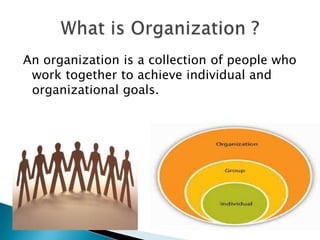
An organization is a collection of people who
work together to achieve individual and
organizational goals.
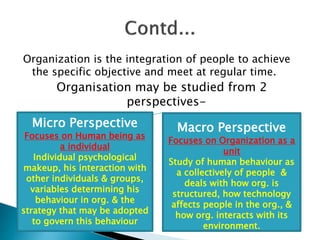
Organization is the integration of people to achieve
the specific objective and meet at regular time.
Organisation may be studied from 2
perspectives-
Micro Perspective
Focuses on Human being as
a individual
Individual psychological
makeup, his interaction with
other individuals & groups,
variables determining his
behaviour in org. & the
strategy that may be adopted
to govern this behaviour
Macro Perspective
Focuses on Organization as a
unit
Study of human behaviour as
a collectively of people &
deals with how org. is
structured, how technology
affects people in the org., &
how org. interacts with its
environment.
 According to Mooney and Reiley
“Organization is the form of every human
association for the attainment of a common
purpose.”
 In other words, Organization is simply people
working together for a common goal.
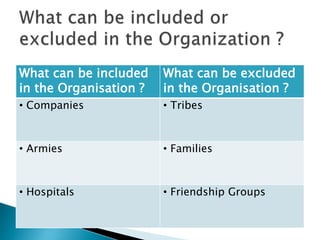
What can be included
in the Organisation ?
What can be excluded
in the Organisation ?
• Companies • Tribes
• Armies • Families
• Hospitals • Friendship Groups
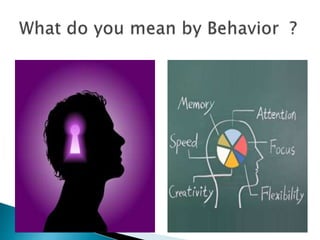
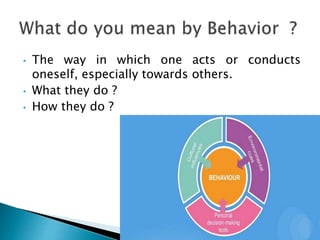
• The way in which one acts or conducts
oneself, especially towards others.
• What they do ?
• How they do ?
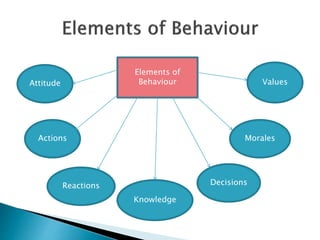
Attitude
Reactions
Values
Morales
Knowledge
Decisions
Actions
Elements of
Behaviour
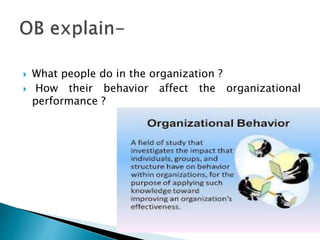
 What people do in the organization ?
 How their behavior affect the organizational
performance ?
It studies human behavior at –
 Individual Level
 Group Level
 Organizational level
 Definition: According to Aldag & Brief “ OB is a
Branch of social sciences that seeks to build
theories that can be applied to predicting,
understanding and controlling behavior in work
organization.”
O + B = OB
Organization + Behavior = Organizational Behavior
Integration of What they do? Study of human
Various individuals, How they do? Behavior in the
groups & structure organization
1. “the study of human behavior, attitudes and performance within an
organizational setting;
2. drawing on theory, methods and principles from such disciplines--
-
3. as psychology, sociology, and cultural anthropology to learn about
individual perception, values, learning capabilities, and actions
4. while working with groups and within the total organization;
5. analyzing the external environment’s effect on the organization
6. and its human resources, missions, objectives and strategies.”
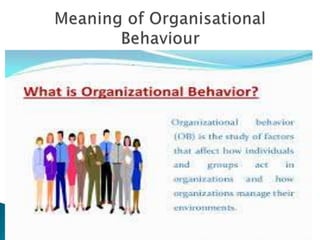
 Organizational behavior is defines as “The understanding,
prediction and management of human behavior in organizations.”
Fred Luthans
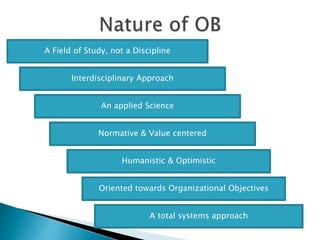
A Field of Study, not a Discipline
Interdisciplinary Approach
An applied Science
Normative & Value centered
Humanistic & Optimistic
Oriented towards Organizational Objectives
A total systems approach
 A discipline is an accepted science with a
theoretical foundation that serves as the
basis for research & analysis.
 It is a eclectic field of study that integrates
behavioral sciences like psychology,
sociology, anthropology etc.
 An interdisciplinary approach integrates the
relevant knowledge drawn from different
disciplines for some specific purpose.
 It draws from psychology, sociology,
anthropology, economics, law and etc.
 Organizational behavior is both science as
well as arts.
 It focused on solve various organizational
problems related to human behavior.
 A normative science unlike the positive
science which only suggests cause–effect
relationship, prescribes how the various
findings of the researches can be applied to
get organizational results which are
acceptable to the society.
 Focus the attention on people from
humanistic point of view.
 Based on the belief that needs and motivation
of people are of high concern.
 There is optimism about the innate potential
of man to be independent, creative,
productive & capable of contributing
positively to the objectives of the
organizations.
 OB emphasis on achievement of Individual
objectives and organizational objectives both.
 It tries to integrate both types of objectives
so that these are achieved simultaneously.
 It is a total system approach wherein the
living system of an organization is viewed as
an enlargement of man.
 It is an integrative approach which takes into
account all the variables affecting
organizational functioning.
 Man’s nature is quite complex, and OB by
applying systems approach tries to find
solution of the complexity.
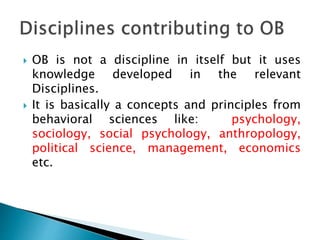
 OB is not a discipline in itself but it uses
knowledge developed in the relevant
Disciplines.
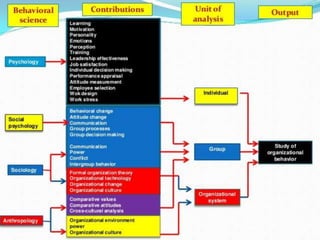
 It is basically a concepts and principles from
behavioral sciences like: psychology,
sociology, social psychology, anthropology,
political science, management, economics
etc.
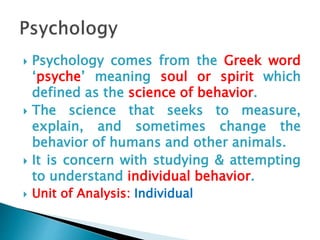
 Psychology comes from the Greek word
‘psyche’ meaning soul or spirit which
defined as the science of behavior.
 The science that seeks to measure,
explain, and sometimes change the
behavior of humans and other animals.
 It is concern with studying & attempting
to understand individual behavior.
 Unit of Analysis: Individual
 The psychological concepts relevant to organizational behavior
include:-
 Perception
 Personality
 Motivation
 Learning
 Values
 Attitudes
 Job satisfaction
 Leadership
 Psychology studies behavior in various conditions- normal,
abnormal, social, industrial, legal; childhood, adolescence,
old age etc.
 It also studies processes of human behavior, such as learning,
thinking, memory, sensation, perception, emotion, feeling
and personality.
 Knowledge about man’s social behavior.
 It study the way in which people act towards one
another.
 It studies social groups, social behavior, social class,
status, social mobility and prestige.
 While psychologists focus their attention on the
individual, sociologist study the social system in
which individuals fill their roles.
 Unit of Analysis: Group, Organization
system
o Group dynamics
◦ Team Work
◦ Communication
◦ Power & Policies
◦ Conflict
◦ Intergroup behavior
◦ Organization theory
◦ Organization change
 Sociologist made their great contribution to
Organization Behavior through the study of
group behavior in organization.
 An area within psychology that blends
concepts from psychology and sociology
and that focuses on the influence of
people on one another.
◦ Unit of Analysis:
Group
◦ Contributions to OB:
 Behavioral change
 Attitude change
 Communication
 Group processes
 Group decision making
 It combines the Greek words ‘Anthropo’ meaning man and
the noun ending ‘logy’ meaning science. So it is defined as
the science of man.
 The study of societies to learn about human beings and their
activities.
 It studies civilization, forms of cultures and their impact on
individuals and groups, biological features of man and
evolutionary pattern, speech and relationship among
languages.
 It works on cultures & environment has helped to
understand differences in fundamental values, attitudes,
and behavior between people in different countries and
within different organizations.
 Unit of Analysis:
◦ Organizational System
◦ Group
◦ Organizational culture
◦ Organizational environment
• Comparative values
• Comparative attitudes
• Cross-cultural analysis
• Comparative values
 Anthropologist work on cultures and environment has
helped us understand differences in fundamental
values, attitudes, behavior between people in different
countries and within different organisations.
 Political Science studies the behavior of
individuals & groups within a political
environment.
 Some topics are- Structuring of conflict,
allocation of power etc.
 It is application of knowledge.
 Technology influences the human behavior
directly and significantly by influencing job
designs, relationship between employees,
machinery, organizational, structure, working
styles of employees etc.
 Perception
 Communication
 Work environment
 Team work
 Team Dynamics
 Decision- making
 Knowledge management
 Management is getting things done by the
people.
 In other words, people are directed and
motivated to get the things done.
 Thus management contributes to OB in
building decision- making models,
communication patterns, leadership styles
etc.
 Decision-making
 Leadership
 Motivation
 Manage the behavior towards the strategic
requirements
 Communication
 Organizational structure
 Economics is the science which studies human
behavior as a relationship between ends and
scarce means which have alternatives uses.
 The contribution of Economics to OB include:-
Motivation
 Learning
 Decision- making
 In this way OB is multi-disciplinary in nature and
being studied by managers, engineers,
sociologists, politicians and psychologist for
research in various fields.
 OB offers several ideas to management as to how
human factor should be properly emphasized to
achieve organizational objectives.
 OB helps to human being in changing money
motivated behavior to multimotivated behavior.
 It helps the manager to understand the behavioral
pattern of the people and shape this pattern to
achieve organizational objectives.
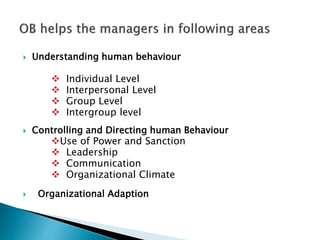
 Understanding human behaviour
 Individual Level
 Interpersonal Level
 Group Level
 Intergroup level
 Controlling and Directing human Behaviour
Use of Power and Sanction
 Leadership
 Communication
 Organizational Climate
 Organizational Adaption
Introduction of organizational behavior

Introduction of organizational behavior

  • 1.
  • 3.
    An organization isa collection of people who work together to achieve individual and organizational goals.
  • 4.
    Organization is theintegration of people to achieve the specific objective and meet at regular time. Organisation may be studied from 2 perspectives- Micro Perspective Focuses on Human being as a individual Individual psychological makeup, his interaction with other individuals & groups, variables determining his behaviour in org. & the strategy that may be adopted to govern this behaviour Macro Perspective Focuses on Organization as a unit Study of human behaviour as a collectively of people & deals with how org. is structured, how technology affects people in the org., & how org. interacts with its environment.
  • 5.
     According toMooney and Reiley “Organization is the form of every human association for the attainment of a common purpose.”  In other words, Organization is simply people working together for a common goal.
  • 6.
    What can beincluded in the Organisation ? What can be excluded in the Organisation ? • Companies • Tribes • Armies • Families • Hospitals • Friendship Groups
  • 8.
    • The wayin which one acts or conducts oneself, especially towards others. • What they do ? • How they do ?
  • 9.
  • 12.
     What peopledo in the organization ?  How their behavior affect the organizational performance ?
  • 13.
    It studies humanbehavior at –  Individual Level  Group Level  Organizational level
  • 14.
     Definition: Accordingto Aldag & Brief “ OB is a Branch of social sciences that seeks to build theories that can be applied to predicting, understanding and controlling behavior in work organization.” O + B = OB Organization + Behavior = Organizational Behavior Integration of What they do? Study of human Various individuals, How they do? Behavior in the groups & structure organization
  • 15.
    1. “the studyof human behavior, attitudes and performance within an organizational setting; 2. drawing on theory, methods and principles from such disciplines-- - 3. as psychology, sociology, and cultural anthropology to learn about individual perception, values, learning capabilities, and actions 4. while working with groups and within the total organization; 5. analyzing the external environment’s effect on the organization 6. and its human resources, missions, objectives and strategies.”  Organizational behavior is defines as “The understanding, prediction and management of human behavior in organizations.” Fred Luthans
  • 16.
    A Field ofStudy, not a Discipline Interdisciplinary Approach An applied Science Normative & Value centered Humanistic & Optimistic Oriented towards Organizational Objectives A total systems approach
  • 17.
     A disciplineis an accepted science with a theoretical foundation that serves as the basis for research & analysis.  It is a eclectic field of study that integrates behavioral sciences like psychology, sociology, anthropology etc.
  • 18.
     An interdisciplinaryapproach integrates the relevant knowledge drawn from different disciplines for some specific purpose.  It draws from psychology, sociology, anthropology, economics, law and etc.
  • 19.
     Organizational behavioris both science as well as arts.  It focused on solve various organizational problems related to human behavior.
  • 20.
     A normativescience unlike the positive science which only suggests cause–effect relationship, prescribes how the various findings of the researches can be applied to get organizational results which are acceptable to the society.
  • 21.
     Focus theattention on people from humanistic point of view.  Based on the belief that needs and motivation of people are of high concern.  There is optimism about the innate potential of man to be independent, creative, productive & capable of contributing positively to the objectives of the organizations.
  • 22.
     OB emphasison achievement of Individual objectives and organizational objectives both.  It tries to integrate both types of objectives so that these are achieved simultaneously.
  • 23.
     It isa total system approach wherein the living system of an organization is viewed as an enlargement of man.  It is an integrative approach which takes into account all the variables affecting organizational functioning.  Man’s nature is quite complex, and OB by applying systems approach tries to find solution of the complexity.
  • 24.
     OB isnot a discipline in itself but it uses knowledge developed in the relevant Disciplines.  It is basically a concepts and principles from behavioral sciences like: psychology, sociology, social psychology, anthropology, political science, management, economics etc.
  • 26.
     Psychology comesfrom the Greek word ‘psyche’ meaning soul or spirit which defined as the science of behavior.  The science that seeks to measure, explain, and sometimes change the behavior of humans and other animals.  It is concern with studying & attempting to understand individual behavior.  Unit of Analysis: Individual
  • 27.
     The psychologicalconcepts relevant to organizational behavior include:-  Perception  Personality  Motivation  Learning  Values  Attitudes  Job satisfaction  Leadership  Psychology studies behavior in various conditions- normal, abnormal, social, industrial, legal; childhood, adolescence, old age etc.  It also studies processes of human behavior, such as learning, thinking, memory, sensation, perception, emotion, feeling and personality.
  • 28.
     Knowledge aboutman’s social behavior.  It study the way in which people act towards one another.  It studies social groups, social behavior, social class, status, social mobility and prestige.  While psychologists focus their attention on the individual, sociologist study the social system in which individuals fill their roles.  Unit of Analysis: Group, Organization system
  • 29.
    o Group dynamics ◦Team Work ◦ Communication ◦ Power & Policies ◦ Conflict ◦ Intergroup behavior ◦ Organization theory ◦ Organization change  Sociologist made their great contribution to Organization Behavior through the study of group behavior in organization.
  • 30.
     An areawithin psychology that blends concepts from psychology and sociology and that focuses on the influence of people on one another. ◦ Unit of Analysis: Group ◦ Contributions to OB:  Behavioral change  Attitude change  Communication  Group processes  Group decision making
  • 31.
     It combinesthe Greek words ‘Anthropo’ meaning man and the noun ending ‘logy’ meaning science. So it is defined as the science of man.  The study of societies to learn about human beings and their activities.  It studies civilization, forms of cultures and their impact on individuals and groups, biological features of man and evolutionary pattern, speech and relationship among languages.  It works on cultures & environment has helped to understand differences in fundamental values, attitudes, and behavior between people in different countries and within different organizations.  Unit of Analysis: ◦ Organizational System ◦ Group
  • 32.
    ◦ Organizational culture ◦Organizational environment • Comparative values • Comparative attitudes • Cross-cultural analysis • Comparative values  Anthropologist work on cultures and environment has helped us understand differences in fundamental values, attitudes, behavior between people in different countries and within different organisations.
  • 33.
     Political Sciencestudies the behavior of individuals & groups within a political environment.  Some topics are- Structuring of conflict, allocation of power etc.
  • 34.
     It isapplication of knowledge.  Technology influences the human behavior directly and significantly by influencing job designs, relationship between employees, machinery, organizational, structure, working styles of employees etc.
  • 35.
     Perception  Communication Work environment  Team work  Team Dynamics  Decision- making  Knowledge management
  • 36.
     Management isgetting things done by the people.  In other words, people are directed and motivated to get the things done.  Thus management contributes to OB in building decision- making models, communication patterns, leadership styles etc.
  • 37.
     Decision-making  Leadership Motivation  Manage the behavior towards the strategic requirements  Communication  Organizational structure
  • 38.
     Economics isthe science which studies human behavior as a relationship between ends and scarce means which have alternatives uses.  The contribution of Economics to OB include:- Motivation  Learning  Decision- making  In this way OB is multi-disciplinary in nature and being studied by managers, engineers, sociologists, politicians and psychologist for research in various fields.
  • 39.
     OB offersseveral ideas to management as to how human factor should be properly emphasized to achieve organizational objectives.  OB helps to human being in changing money motivated behavior to multimotivated behavior.  It helps the manager to understand the behavioral pattern of the people and shape this pattern to achieve organizational objectives.
  • 40.
     Understanding humanbehaviour  Individual Level  Interpersonal Level  Group Level  Intergroup level  Controlling and Directing human Behaviour Use of Power and Sanction  Leadership  Communication  Organizational Climate  Organizational Adaption