NATURE, SCOPE,
CHALLENGES &
OPPORTUNITIES, GOAL,
MODEL OF OB.
By: Manoj Kumar
Assistant Professor
K-IMS Unnao
Introduction of OB:
 It is related to individuals, group of people working together in
teams.
 The study of organizational behaviour relates to the expected
behaviour of an individual in the organization.
 No two individuals are likely to behave in the same manner in a
particular work situation.
 It must be understand the very credentials of an individual, his
background, social framework, educational update, impact of
social groups and other situational factors on behaviour.
Definition (OB):
“Organizational behaviour is a field of study that investigates the impact
that individuals, groups and organizational structure have on behaviour
within the organization, for the purpose of applying such knowledge
towards improving an organizational effectiveness”.
L.M. Prasad defines “the study and application of knowledge about
human behaviour related to other elements of an
organization such as structure, technology and social
systems”.
Stephen P Robins defines “Organizational behaviour as a systematic
study of the actions and attitudes that people
exhibit within organizations.”
NATURE AND SCOPE (FEATURES) OF ORGANIZATIONAL
BEHAVIOUR
1. A Separate Field of Study and not a Discipline Only: By
definition, a discipline is an accepted science that is based on a
theoretical foundation. But, O.B. has a multi-interdisciplinary
orientation and is, thus, not based on a specific theoretical
background. Therefore, it is better reasonable to call O.B. a
separate field of study rather than a discipline only.
2. An Interdisciplinary Approach: Organizational behaviour is
essentially an interdisciplinary approach to study human
behaviour at work. It tries to integrate the relevant knowledge
drawn from related disciplines like psychology, sociology and
anthropology to make them applicable for studying and analysing
organizational behaviour.
3. An Applied Science: The very nature of O.B. is applied. What O.B.
basically does is the application of various researches to solve the
organizational problems related to human behaviour. The basic line of
difference between pure science and O.B. is that while the former
concentrates of fundamental researches, the latter concentrates on
applied researches. O.B. involves both applied research and its
application in organizational analysis. Hence, O.B. can be called both
science as well as art.
4. A Normative Science: Organizational Behaviour is a normative
science also. While the positive science discusses only cause effect
relationship, O.B. prescribes how the findings of applied researches
can be applied to socially accepted organizational goals. Thus, O.B.
deals with what is accepted by individuals and society engaged in an
organization. O.B. is normative as well that is well underscored by the
proliferation of management theories.
5. A Humanistic and Optimistic Approach: Organizational
Behaviour applies humanistic approach towards people working in
the organization. It, deals with the thinking and feeling of human
beings. O.B. is based on the belief that people have an innate desire to
be independent, creative and productive. It also realizes that people
working in the organization can and will actualize these potentials if
they are given proper conditions and environment. Environment
affects performance of workers in an organization.
6. A Total System Approach: The system approach is one that
integrates all the variables, affecting organizational functioning. The
systems approach has been developed by the behavioural scientists to
analyse human behaviour in view of his/her socio-psychological
framework. Man's socio-psychological framework makes man a
complex one and the systems approach tries to study his/her
complexity and find solution to it.
Scope of O.B:
The three internal organizational elements viz., people, technology and
structure and the fourth element, i.e., external social systems may be
taken as the scope of O.B.
1. People
The people constitute the internal social system of the organization.
They consist of individuals and groups. Groups may be large or small,
formal or informal, official or unofficial. They are dynamic. They form,
change and disband. Human organization changes everyday. Today, it is
not the same as it was yesterday. It may change further in the coming
days. People are living, thinking and feeling being who created the
organization and try to achieve the objectives and goals. Thus,
organizations exist to serve the people and not the people exist to serve
the organization.
2. Structure: Structure defines the sole relationship of people in an
organization. Different people in an organization are given different roles
and they have certain relationship with others. It leads to division of labour
so that people can perform their duties or work to accomplish the
organizational goal. Thus, everybody cannot be an accountant or a clerk.
Work is complex and different duties are to be performed by different
people. Some may be accountant, others may be managers, clerks, peons or
workers. All are so related to each other to accomplish the goal in a co-
ordinated manner. Thus, structure relates to power and duties. One has the
authority and others have a duty to obey him.
3. Technology: Technology imparts the physical and economic conditions
within which people work. With their bare hands people can do nothing so
they are given assistance of buildings, machines, tools, processes and
resources. The nature of technology depends very much on the nature of the
organization and influences the work or working conditions. Thus,
technology brings effectiveness and at the same restricts people in various
ways.
4. Social System: Social system provides external environment which
the organization operates. A single organization cannot exist also. It is
a part of the whole. One organization cannot give everything and
therefore, there are many other organizations. All these organizations
influence each other. It influences the attitudes of people, their
working conditions and above all provides competition for resources
and power.
Challenges & Opportunities of O.B:
Challenges and opportunities of organizational behavior are massive and
rapidly changing for improving productivity and meeting business goals.
• Improving Peoples’ Skills.
• Improving Quality and Productivity.
• Total Quality Management (TQM).
• Managing Workforce Diversity.
• Responding to Globalization.
• Empowering People.
• Stimulating Innovation and Change.
• Emergence of E- Organisation & E-Commerce.
• Improving Ethical Behavior.
• Improving Customer Service.
• Helping Employees Balance Work-Life Conflicts.
Goals of Organizational Behavior
Organizational behaviour is an applied science that deals with
individual behaviour as well as group behaviour in an organization.
The four goals of organizational behaviour are to describe,
understand, predict and control.
1. To describe: The first objective is to describe how people behave
under various conditions. For example, as a manager, I have
information about a particular junior officer that he comes office
in late and leaves the office early.
2. To understand: The second goal of organizational behaviour is to
understand why people behave as they do. Managers have to
understand the reasons behind a particular action. For example, as
a manager, I must find out the reason why the junior officer is
coming late and going earlier.
3. To predict: Predicting future behaviour of employee is another
goal of organizational behaviour. Usually, managers would have the
capacity to predict why the employees are committed to the
organization or not. For instance, I have to realize why he wants to
leave my organization, how I can hold the officer in my organization,
what should be done by me in this situation or what my role is etc.
4. To control: The final goal of organizational behaviour is to control
and develop a friendly atmosphere for the organization. Since
managers are responsible for the overall performance of an
organization, they must develop workers’ teamwork, skill and
commitment. Managers should take necessary action for themselves.
In the above case, I can increase the financial benefits of the officer if
it is not satisfactory for him or I can help him to solve his personal
problem, or I can negotiate him to solve any organizational problem.
Impact of Global and Cultural Diversity
 Multi national corporations developed operations world wide and
companies developed joint ventures with foreign partners.
 Workers increasingly chased job opportunities across national
borders.
 As organizations have become more global , their work force has
become culturally diverse.
 Globalization has created a large shift in organizational behavior
as increasing diversity has brought together people of different
backgrounds with different values, cultures and beliefs all
working together for common objective.
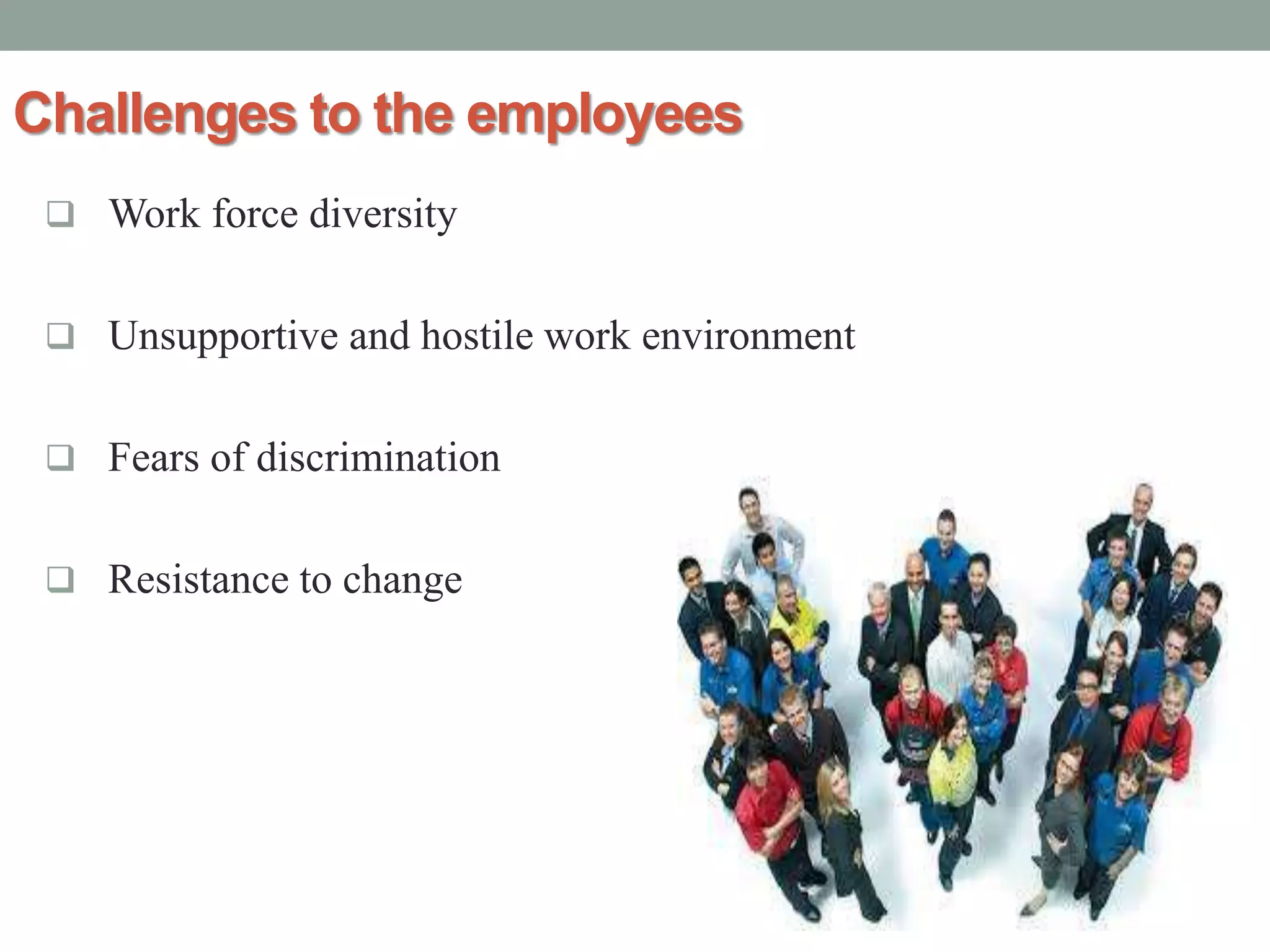
Challenges to the employees
 Work force diversity
 Unsupportive and hostile work environment
 Fears of discrimination
 Resistance to change

OB Introduction, Scope, Challenges and Opportunities, goal and OB Model

  • 1.
    NATURE, SCOPE, CHALLENGES & OPPORTUNITIES,GOAL, MODEL OF OB. By: Manoj Kumar Assistant Professor K-IMS Unnao
  • 2.
    Introduction of OB: It is related to individuals, group of people working together in teams.  The study of organizational behaviour relates to the expected behaviour of an individual in the organization.  No two individuals are likely to behave in the same manner in a particular work situation.  It must be understand the very credentials of an individual, his background, social framework, educational update, impact of social groups and other situational factors on behaviour.
  • 3.
    Definition (OB): “Organizational behaviouris a field of study that investigates the impact that individuals, groups and organizational structure have on behaviour within the organization, for the purpose of applying such knowledge towards improving an organizational effectiveness”. L.M. Prasad defines “the study and application of knowledge about human behaviour related to other elements of an organization such as structure, technology and social systems”. Stephen P Robins defines “Organizational behaviour as a systematic study of the actions and attitudes that people exhibit within organizations.”
  • 4.
    NATURE AND SCOPE(FEATURES) OF ORGANIZATIONAL BEHAVIOUR 1. A Separate Field of Study and not a Discipline Only: By definition, a discipline is an accepted science that is based on a theoretical foundation. But, O.B. has a multi-interdisciplinary orientation and is, thus, not based on a specific theoretical background. Therefore, it is better reasonable to call O.B. a separate field of study rather than a discipline only. 2. An Interdisciplinary Approach: Organizational behaviour is essentially an interdisciplinary approach to study human behaviour at work. It tries to integrate the relevant knowledge drawn from related disciplines like psychology, sociology and anthropology to make them applicable for studying and analysing organizational behaviour.
  • 5.
    3. An AppliedScience: The very nature of O.B. is applied. What O.B. basically does is the application of various researches to solve the organizational problems related to human behaviour. The basic line of difference between pure science and O.B. is that while the former concentrates of fundamental researches, the latter concentrates on applied researches. O.B. involves both applied research and its application in organizational analysis. Hence, O.B. can be called both science as well as art. 4. A Normative Science: Organizational Behaviour is a normative science also. While the positive science discusses only cause effect relationship, O.B. prescribes how the findings of applied researches can be applied to socially accepted organizational goals. Thus, O.B. deals with what is accepted by individuals and society engaged in an organization. O.B. is normative as well that is well underscored by the proliferation of management theories.
  • 6.
    5. A Humanisticand Optimistic Approach: Organizational Behaviour applies humanistic approach towards people working in the organization. It, deals with the thinking and feeling of human beings. O.B. is based on the belief that people have an innate desire to be independent, creative and productive. It also realizes that people working in the organization can and will actualize these potentials if they are given proper conditions and environment. Environment affects performance of workers in an organization. 6. A Total System Approach: The system approach is one that integrates all the variables, affecting organizational functioning. The systems approach has been developed by the behavioural scientists to analyse human behaviour in view of his/her socio-psychological framework. Man's socio-psychological framework makes man a complex one and the systems approach tries to study his/her complexity and find solution to it.
  • 7.
    Scope of O.B: Thethree internal organizational elements viz., people, technology and structure and the fourth element, i.e., external social systems may be taken as the scope of O.B. 1. People The people constitute the internal social system of the organization. They consist of individuals and groups. Groups may be large or small, formal or informal, official or unofficial. They are dynamic. They form, change and disband. Human organization changes everyday. Today, it is not the same as it was yesterday. It may change further in the coming days. People are living, thinking and feeling being who created the organization and try to achieve the objectives and goals. Thus, organizations exist to serve the people and not the people exist to serve the organization.
  • 8.
    2. Structure: Structuredefines the sole relationship of people in an organization. Different people in an organization are given different roles and they have certain relationship with others. It leads to division of labour so that people can perform their duties or work to accomplish the organizational goal. Thus, everybody cannot be an accountant or a clerk. Work is complex and different duties are to be performed by different people. Some may be accountant, others may be managers, clerks, peons or workers. All are so related to each other to accomplish the goal in a co- ordinated manner. Thus, structure relates to power and duties. One has the authority and others have a duty to obey him. 3. Technology: Technology imparts the physical and economic conditions within which people work. With their bare hands people can do nothing so they are given assistance of buildings, machines, tools, processes and resources. The nature of technology depends very much on the nature of the organization and influences the work or working conditions. Thus, technology brings effectiveness and at the same restricts people in various ways.
  • 9.
    4. Social System:Social system provides external environment which the organization operates. A single organization cannot exist also. It is a part of the whole. One organization cannot give everything and therefore, there are many other organizations. All these organizations influence each other. It influences the attitudes of people, their working conditions and above all provides competition for resources and power.
  • 10.
    Challenges & Opportunitiesof O.B: Challenges and opportunities of organizational behavior are massive and rapidly changing for improving productivity and meeting business goals. • Improving Peoples’ Skills. • Improving Quality and Productivity. • Total Quality Management (TQM). • Managing Workforce Diversity. • Responding to Globalization. • Empowering People. • Stimulating Innovation and Change. • Emergence of E- Organisation & E-Commerce. • Improving Ethical Behavior. • Improving Customer Service. • Helping Employees Balance Work-Life Conflicts.
  • 11.
    Goals of OrganizationalBehavior Organizational behaviour is an applied science that deals with individual behaviour as well as group behaviour in an organization. The four goals of organizational behaviour are to describe, understand, predict and control. 1. To describe: The first objective is to describe how people behave under various conditions. For example, as a manager, I have information about a particular junior officer that he comes office in late and leaves the office early. 2. To understand: The second goal of organizational behaviour is to understand why people behave as they do. Managers have to understand the reasons behind a particular action. For example, as a manager, I must find out the reason why the junior officer is coming late and going earlier.
  • 12.
    3. To predict:Predicting future behaviour of employee is another goal of organizational behaviour. Usually, managers would have the capacity to predict why the employees are committed to the organization or not. For instance, I have to realize why he wants to leave my organization, how I can hold the officer in my organization, what should be done by me in this situation or what my role is etc. 4. To control: The final goal of organizational behaviour is to control and develop a friendly atmosphere for the organization. Since managers are responsible for the overall performance of an organization, they must develop workers’ teamwork, skill and commitment. Managers should take necessary action for themselves. In the above case, I can increase the financial benefits of the officer if it is not satisfactory for him or I can help him to solve his personal problem, or I can negotiate him to solve any organizational problem.
  • 13.
    Impact of Globaland Cultural Diversity  Multi national corporations developed operations world wide and companies developed joint ventures with foreign partners.  Workers increasingly chased job opportunities across national borders.  As organizations have become more global , their work force has become culturally diverse.  Globalization has created a large shift in organizational behavior as increasing diversity has brought together people of different backgrounds with different values, cultures and beliefs all working together for common objective.
  • 14.
    Challenges to theemployees  Work force diversity  Unsupportive and hostile work environment  Fears of discrimination  Resistance to change