Organizational Behavior
O + B = OB
People Are an Organization’s Most Important Assets
What is an Organization? Organizations are simply groups with two or more people that share a certain set of goals and meet at regular times. 4
Behavior This behavior occurs in organizations.
What is an Organization? An organization is a collection of people who work together to achieve individual and organizational goals. 5
What is Organizational Behavior? Organizational behavior (OB) is the study of factors that affect how individuals and groups act in organizations and how organizations manage their environments. 6
What is Organizational Behavior? Definition:  The study of human behavior, attitudes, and performance in organizations. Value of OB:  Helps people attain the competencies needed to become  effective  employees, team leaders/members, or managers Competency  = an interrelated set of abilities, behaviors, attitudes, and knowledge needed by an individual to be effective in most professional and managerial positions
What is Organizational Behavior? Organizational Behavior is the study of human behavior in the workplace, the interaction between people and the organization  with the intent to understand and predict human behavior .
What is OB? The study of human behavior in the workplace The i nvestigation of the impact that individuals, groups and structure have on behaviour within organizations, for the purpose of applying such knowledge toward improving an organization’s effectiveness OB theories have widespread applications – among other things, knowing these theories can help you to: Promote the well-being of employees Evaluate solutions proposed by consultants and managers Predict what will happen in your organization Influence the direction of your organization
Organizational Behaviour . . .  a field of study that investigates the impact that individuals, groups and structure have on behaviour within organizations, for the purpose of applying such knowledge toward improving an organization’s effectiveness.
Why Do We Study OB? To learn about yourself and how to deal with others You are part of an organization now, and will continue to be a part of various organizations Organizations are increasingly expecting individuals to be able to work in teams, at least some of the time Some of you may want to be managers or entrepreneurs
WHY OB
4 Insert Figure 1.1 here
Characteristics  Goal-Oriented Levels of analysis  Human tool Satisfaction of employees need A total systems approach
Challenges and Opportunities for OB Responding to Globalization Increased foreign assignments Working with people from different cultures Coping with anti-capitalism backlash Overseeing movement of jobs to countries with  low-cost labor Managing people during the war on terror Managing Workforce Diversity Embracing diversity Changing U.S. demographics Implications for managers Recognizing and responding to differences
Major Workforce Diversity Categories Domestic Partners Race Non-Christian National Origin Age Disability E X H I B I T  1–4 Gender
Challenges and Opportunities for OB (cont’d) Improving Quality and Productivity Quality management (QM) Process reengineering Responding to the Labor Shortage Changing work force demographics Fewer skilled laborers Early retirements and older workers Improving Customer Service Increased expectation of service quality Customer-responsive cultures
Today’s Challenges in the Canadian Workplace Challenges at the Individual Level Job Satisfaction Empowerment Behaving Ethically Challenges at the Group Level Working With Others Workforce Diversity
Today’s Challenges in the Canadian Workplace Challenges at the Organizational Level Productivity Developing Effective Employees Absenteeism Turnover  Organizational Citizenship Competition From the Global Environment Managing and Working in a Global Village
Productivity Productivity A performance measure including effectiveness and efficiency Effectiveness Achievement of goals Efficiency The ratio of effective work output to the input required to produce the work
Effective Employees Absenteeism Failure to report to work Turnover Voluntary and involuntary permanent withdrawal from the organization Organizational citizenship behaviour Discretionary behaviour that is not part of an employee’s formal job requirements, but is helpful to the organization
Exhibit 1-2  Toward an OB Discipline Social psychology Psychology Behavioural  science Contribution Unit of analysis Output Anthropology Sociology Political science Study of Organizational Behaviour Organization system Learning Motivation Perception Training Leadership effectiveness Job satisfaction Individual decision making Performance appraisal Attitude measurement Employee selection Work design Work stress Group dynamics Work teams Communication Power Conflict Intergroup behaviour Formal organization theory Organizational technology Organizational change Organizational culture Conflict Intraorganizational politics Power Organizational culture Organizational environment Behavioural change Attitude change Communication Group processes Group decision making Group Comparative values Comparative attitudes Cross-cultural analysis Individual
The Rigour of OB OB looks at consistencies What is common about behaviour, and helps predictability? OB is more than common sense Systematic study, based on scientific evidence OB has few absolutes OB takes a contingency approach Considers behaviour in context
Beyond Common Sense Systematic Study Looking at relationships, attempting to attribute causes and effects and drawing conclusions based on scientific evidence Behaviour is generally predictable There are differences between individuals There are fundamental consistencies There are rules (written & unwritten) in almost every setting
Exhibit 1-1 Challenges Facing the Workplace Workplace Organizational Level • Productivity • Developing Effective Employees • Global Competition • Managing in the Global Village Group Level • Working With Others • Workforce Diversity Individual Level • Job Satisfaction • Empowerment • Behaving Ethically
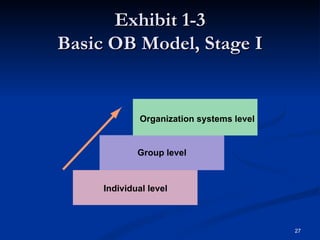
Exhibit 1-3 Basic OB Model, Stage I Organization systems level Group level Individual level
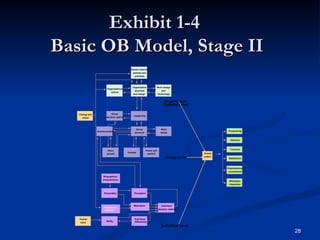
Exhibit 1-4  Basic OB Model, Stage II Ability Human input Values and attitudes Motivation Individual decision making Personality Perception Biographical characteristics Leadership Work design and technology Organizational culture Change and stress Group decision making Other groups Conflict Power and politics Work teams Individual Level Group Level Organization Systems Level Communication Group structure Human resource policies and practices Organization structure and design Individual  Differences Satisfaction Organizational commitment Turnover Absence Productivity Workplace interaction Human output
Exhibit 1-5  Competing Values Framework Flexibility Control Internal Focus External Focus
Competing Values Framework Internal-External Dimension Inwardly toward employee needs and concerns and/or production processes and internal systems or Outwardly, toward such factors as the marketplace, government regulations, and the changing social, environmental, and technological conditions of the future Flexibility-Control Dimension Flexible and dynamic, allowing more teamwork and participation; seeking new opportunities for products and services or Controlling or stable, maintaining the status quo and exhibiting less change
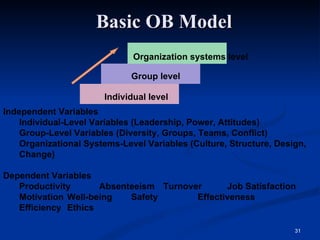
Basic OB Model Independent Variables Individual-Level Variables (Leadership, Power, Attitudes) Group-Level Variables (Diversity, Groups, Teams, Conflict) Organizational Systems-Level Variables (Culture, Structure, Design, Change) Dependent Variables Productivity Absenteeism Turnover Job Satisfaction Motivation Well-being Safety  Effectiveness Efficiency Ethics Organization systems level Group level Individual level
Summary & Implications OB is a field of study that investigates the impact of individuals, groups, and structure on behaviour within an organization. OB focuses on improving productivity, by understanding employees and why they behave in the ways they do. Behavior of organizations, groups, & individuals can be predicted, but you have to understand the circumstances. To study OB, one needs to move from an intuition and common sense approach to a systematic study. OB uses systematic study to improve predictions of behaviour.
Why Study  Organizational Behavior? Success isn’t a destination – it’s a process.  And the margin between successes is often small.  Learn the principles of defining and achieving success in your own life and  begin the journey today . This journey begins with understanding the behaviors between the leader, the followers, and the organization. This is also a leadership course of study.  To be successful leader, one needs to understand the behaviors of people, organizations, and the situation.
Levels of Analysis Organization level Group level Individual level
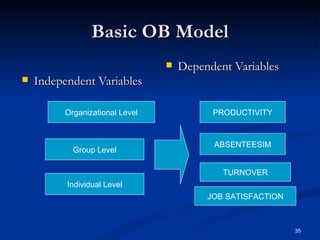
Basic OB Model Independent Variables Dependent Variables PRODUCTIVITY ABSENTEESIM TURNOVER JOB SATISFACTION Organizational Level Group Level Individual Level
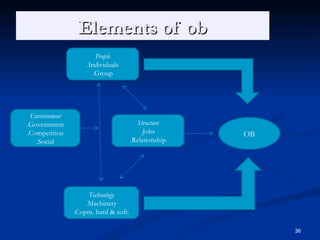
Elements of ob People .Individuals .Group Environment .Government .Competition .Social Technology .Machinery .Copm. hard & soft. Structure .Jobs .Relationship OB
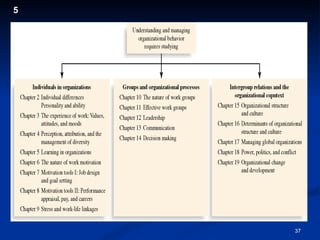
5 Insert Figure 1.2 here
Contribution to various disciplines of ob
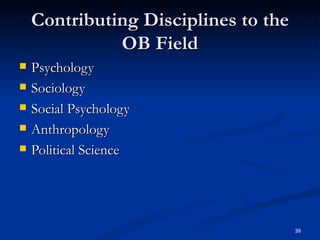
Contributing Disciplines to the OB Field Psychology Sociology Social Psychology Anthropology Political Science
Study of OB Individual Group Organizations Perception Personality Motivation Training P A Job Satisfact. Psychology Group ,Team Communi. Conflict Org.change, structure Attit.& beh. Change Group process & decision making Indi.Org.culture & Env. Org. Power Politics Sociology Social Psychology Anthropology Political science
ORIGINS OF ORGANIZATIONAL BEHAVIOR  Psychology . Psychological theories have helped us explain and predict  individual behavior . Many of the theories dealing with  personality, attitude, learning, motivation, and stress  have been applied in Organizational Behavior to understand work-related phenomena such as  job satisfaction, commitment, absenteeism, turnover, and worker well-being .
Sociology Sociologists , studying the structure and function of  small groups  within a society have contributed greatly to a more complete understanding of behavior within organizations. Taking their cue from Sociologists, scholars in the field of Organizational Behavior have studied the effects of the structure and function of work organization on the behavior of groups, as well as the individuals within those groups. Many of the concepts and theories about groups and the processes of  communication, decision making, conflict, and politics  used in Organizational Behavior, are rooted in the field of  Social Psychology .
Contributing Disciplines to the OB Field (cont’d) E X H I B I T  1–3 (cont’d) Sociology The study of people in relation to their fellow human beings
Contributing Disciplines to the OB Field (cont’d) E X H I B I T  1–3 (cont’d) Social Psychology An area within psychology that blends concepts from psychology and sociology and that focuses on the influence of people on one another
Political Science The field of  Political Science  has helped us understand how differences in preferences and interests lead to  conflict and power  struggles between groups within organizations.
Anthropology Organizational Behavior draws on the field of  Anthropology  for lessons about how  cultures  ( corporate culture) and belief systems develop.
Contributing Disciplines to the OB Field (cont’d) E X H I B I T  1–3 (cont’d) Anthropology The study of societies to learn about human beings and their activities
Managerial Roles Manager :  Any person who supervises one or more subordinates. Role :  A set of behaviors or tasks a person is expected to perform because of the position he or she holds in a group or organization. Managerial roles  identified by Mintzberg (see Table 1.1): Figurehead Leader Liaison Monitor Disseminator Spokesperson Entrepreneur Disturbance handler Resource allocator Negotiator 8
Managerial Skills Conceptual Skills :  The ability to analyze and diagnose a situation and distinguish between cause and effect. Human Skills :  The ability to understand, work with, lead, and control the behavior of other people and groups. Technical Skills :  Job-specific knowledge and techniques. 9
Challenges for Organizational Behavior and Management Using new information technology to enhance creativity and organizational learning. Managing human resources to increase competitive advantage. Developing organizational ethics and well-being. Managing a diverse work force. Managing the global environment. 10
personality
Nature of Personality Personality traits Reflects individuals differences Personality can change
determinants Individual personality Biological Others Cultural Situational Family & Social
biological Heredity Brain Physical features
Cultural factors Situational factors
Family & Social Factors Home & Family environment Social group
Others Interest Motives
Big Five Traits of Personality
Agreeableness Extroversion Emotional stability Conscientiousness Openness
agreeableness Agreeableness High  Low Agreeableness - Cooperative, warm, caring,  good-natured, trusting
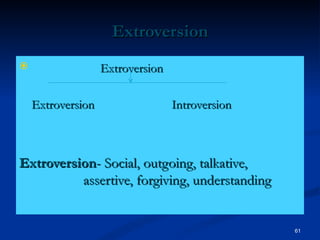
Extroversion Extroversion Extroversion  Introversion Extroversion - Social, outgoing, talkative,  assertive, forgiving, understanding
Emotional stability Emotional High  Low Emotional stability-  happy, unworried,  secure, calm
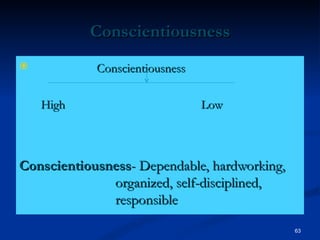
Conscientiousness Conscientiousness High  Low Conscientiousness - Dependable, hardworking,  organized, self-disciplined,  responsible
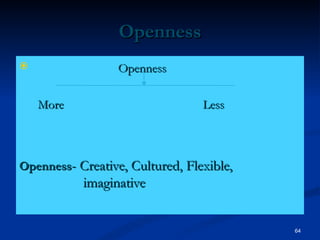
Openness Openness More  Less Openness - Creative, Cultured, Flexible,  imaginative
perception
Human being are constantly attacked by numerous sensory including noise, sight, smell, taste etc.  The critical question is the study of perception is “why the same universe is viewed differently by different persons?” The answer is the perception. Different people perceive the universe differently .
Perception is the process through which the information from outside environment is selected, received, organize and interpreted to make it meaningful to us. Acc. To the Joseph Reitz: perception includes all those processes by which an individual receive information about his environment – seeing, hearing, feeling, tasting and smelling.
process Perceptual Inputs Perceptual  Mechanisms Perceptual Outputs Individual Receiving  Selecting  Organizing  Interpreting Actions
Figure and Group-Figure is perceived to dominate and more attention is paid to it, while ground is given less attention and is kept in the background. Simplification- Whenever people is overloaded with the information, they try to simplify it to make it more meaningful and understandable. Perceiver subtract less salient information and concentrate on more important one.  Grouping- In grouping, the information which have been grouped together, are likely to be perceived as having same characteristics.
action The last phase of perceptual process is that acting in relation to what has been perceived. This action may be covert or overt. Covert- Change in attitude, opinions, feeling, values and impression formation resulting from the perceptual input. Overt- The overt action may be in the form of behavior easily visible.
Factors that influence the perception Perception Factors in situation Social setting, Organizational setting Factors in perceiver Needs and Motives, Experience, Current psychological state Factors in target Status, Size, Contrast,
Internal factors Needs and Motives-  People’s perception is determined by their inner needs. A feeling of tension and discomfort when one thinks he is missing something or requires something. Similarly people with different needs selects different items to respond. Experience - It have a constant bearing on perception. Successful experience boost the perception ability whereas failure erodes self- confidence.
Current psychological state-  The emotional and psychological states of an individual are likely to influence how things are perceived. If a person is depressed, he is likely to perceive the same situation differently than if he is elated.
External factors Status - Perception is also influenced by the status of the perceiver. High status people can exert influence on perception of employees than low status people. For example if we introduce the CEO or the peon of the organization then w remember only the name of the CEO.
Contrast - Stimuli contrast with the surrounding environment. A contrasting effects can be caused by color or any other factor that is unusual.  Size - The bigger size of the perceived stimulus, the higher is the probability that it is perceived. Size attracts the attention of an individual.

Organizational behavior

  • 1.
  • 2.
    O + B= OB
  • 3.
    People Are anOrganization’s Most Important Assets
  • 4.
    What is anOrganization? Organizations are simply groups with two or more people that share a certain set of goals and meet at regular times. 4
  • 5.
    Behavior This behavioroccurs in organizations.
  • 6.
    What is anOrganization? An organization is a collection of people who work together to achieve individual and organizational goals. 5
  • 7.
    What is OrganizationalBehavior? Organizational behavior (OB) is the study of factors that affect how individuals and groups act in organizations and how organizations manage their environments. 6
  • 8.
    What is OrganizationalBehavior? Definition: The study of human behavior, attitudes, and performance in organizations. Value of OB: Helps people attain the competencies needed to become effective employees, team leaders/members, or managers Competency = an interrelated set of abilities, behaviors, attitudes, and knowledge needed by an individual to be effective in most professional and managerial positions
  • 9.
    What is OrganizationalBehavior? Organizational Behavior is the study of human behavior in the workplace, the interaction between people and the organization with the intent to understand and predict human behavior .
  • 10.
    What is OB?The study of human behavior in the workplace The i nvestigation of the impact that individuals, groups and structure have on behaviour within organizations, for the purpose of applying such knowledge toward improving an organization’s effectiveness OB theories have widespread applications – among other things, knowing these theories can help you to: Promote the well-being of employees Evaluate solutions proposed by consultants and managers Predict what will happen in your organization Influence the direction of your organization
  • 11.
    Organizational Behaviour .. . a field of study that investigates the impact that individuals, groups and structure have on behaviour within organizations, for the purpose of applying such knowledge toward improving an organization’s effectiveness.
  • 12.
    Why Do WeStudy OB? To learn about yourself and how to deal with others You are part of an organization now, and will continue to be a part of various organizations Organizations are increasingly expecting individuals to be able to work in teams, at least some of the time Some of you may want to be managers or entrepreneurs
  • 13.
  • 14.
  • 15.
    Characteristics Goal-OrientedLevels of analysis Human tool Satisfaction of employees need A total systems approach
  • 16.
    Challenges and Opportunitiesfor OB Responding to Globalization Increased foreign assignments Working with people from different cultures Coping with anti-capitalism backlash Overseeing movement of jobs to countries with low-cost labor Managing people during the war on terror Managing Workforce Diversity Embracing diversity Changing U.S. demographics Implications for managers Recognizing and responding to differences
  • 17.
    Major Workforce DiversityCategories Domestic Partners Race Non-Christian National Origin Age Disability E X H I B I T 1–4 Gender
  • 18.
    Challenges and Opportunitiesfor OB (cont’d) Improving Quality and Productivity Quality management (QM) Process reengineering Responding to the Labor Shortage Changing work force demographics Fewer skilled laborers Early retirements and older workers Improving Customer Service Increased expectation of service quality Customer-responsive cultures
  • 19.
    Today’s Challenges inthe Canadian Workplace Challenges at the Individual Level Job Satisfaction Empowerment Behaving Ethically Challenges at the Group Level Working With Others Workforce Diversity
  • 20.
    Today’s Challenges inthe Canadian Workplace Challenges at the Organizational Level Productivity Developing Effective Employees Absenteeism Turnover Organizational Citizenship Competition From the Global Environment Managing and Working in a Global Village
  • 21.
    Productivity Productivity Aperformance measure including effectiveness and efficiency Effectiveness Achievement of goals Efficiency The ratio of effective work output to the input required to produce the work
  • 22.
    Effective Employees AbsenteeismFailure to report to work Turnover Voluntary and involuntary permanent withdrawal from the organization Organizational citizenship behaviour Discretionary behaviour that is not part of an employee’s formal job requirements, but is helpful to the organization
  • 23.
    Exhibit 1-2 Toward an OB Discipline Social psychology Psychology Behavioural science Contribution Unit of analysis Output Anthropology Sociology Political science Study of Organizational Behaviour Organization system Learning Motivation Perception Training Leadership effectiveness Job satisfaction Individual decision making Performance appraisal Attitude measurement Employee selection Work design Work stress Group dynamics Work teams Communication Power Conflict Intergroup behaviour Formal organization theory Organizational technology Organizational change Organizational culture Conflict Intraorganizational politics Power Organizational culture Organizational environment Behavioural change Attitude change Communication Group processes Group decision making Group Comparative values Comparative attitudes Cross-cultural analysis Individual
  • 24.
    The Rigour ofOB OB looks at consistencies What is common about behaviour, and helps predictability? OB is more than common sense Systematic study, based on scientific evidence OB has few absolutes OB takes a contingency approach Considers behaviour in context
  • 25.
    Beyond Common SenseSystematic Study Looking at relationships, attempting to attribute causes and effects and drawing conclusions based on scientific evidence Behaviour is generally predictable There are differences between individuals There are fundamental consistencies There are rules (written & unwritten) in almost every setting
  • 26.
    Exhibit 1-1 ChallengesFacing the Workplace Workplace Organizational Level • Productivity • Developing Effective Employees • Global Competition • Managing in the Global Village Group Level • Working With Others • Workforce Diversity Individual Level • Job Satisfaction • Empowerment • Behaving Ethically
  • 27.
    Exhibit 1-3 BasicOB Model, Stage I Organization systems level Group level Individual level
  • 28.
    Exhibit 1-4 Basic OB Model, Stage II Ability Human input Values and attitudes Motivation Individual decision making Personality Perception Biographical characteristics Leadership Work design and technology Organizational culture Change and stress Group decision making Other groups Conflict Power and politics Work teams Individual Level Group Level Organization Systems Level Communication Group structure Human resource policies and practices Organization structure and design Individual Differences Satisfaction Organizational commitment Turnover Absence Productivity Workplace interaction Human output
  • 29.
    Exhibit 1-5 Competing Values Framework Flexibility Control Internal Focus External Focus
  • 30.
    Competing Values FrameworkInternal-External Dimension Inwardly toward employee needs and concerns and/or production processes and internal systems or Outwardly, toward such factors as the marketplace, government regulations, and the changing social, environmental, and technological conditions of the future Flexibility-Control Dimension Flexible and dynamic, allowing more teamwork and participation; seeking new opportunities for products and services or Controlling or stable, maintaining the status quo and exhibiting less change
  • 31.
    Basic OB ModelIndependent Variables Individual-Level Variables (Leadership, Power, Attitudes) Group-Level Variables (Diversity, Groups, Teams, Conflict) Organizational Systems-Level Variables (Culture, Structure, Design, Change) Dependent Variables Productivity Absenteeism Turnover Job Satisfaction Motivation Well-being Safety Effectiveness Efficiency Ethics Organization systems level Group level Individual level
  • 32.
    Summary & ImplicationsOB is a field of study that investigates the impact of individuals, groups, and structure on behaviour within an organization. OB focuses on improving productivity, by understanding employees and why they behave in the ways they do. Behavior of organizations, groups, & individuals can be predicted, but you have to understand the circumstances. To study OB, one needs to move from an intuition and common sense approach to a systematic study. OB uses systematic study to improve predictions of behaviour.
  • 33.
    Why Study Organizational Behavior? Success isn’t a destination – it’s a process. And the margin between successes is often small. Learn the principles of defining and achieving success in your own life and begin the journey today . This journey begins with understanding the behaviors between the leader, the followers, and the organization. This is also a leadership course of study. To be successful leader, one needs to understand the behaviors of people, organizations, and the situation.
  • 34.
    Levels of AnalysisOrganization level Group level Individual level
  • 35.
    Basic OB ModelIndependent Variables Dependent Variables PRODUCTIVITY ABSENTEESIM TURNOVER JOB SATISFACTION Organizational Level Group Level Individual Level
  • 36.
    Elements of obPeople .Individuals .Group Environment .Government .Competition .Social Technology .Machinery .Copm. hard & soft. Structure .Jobs .Relationship OB
  • 37.
  • 38.
    Contribution to variousdisciplines of ob
  • 39.
    Contributing Disciplines tothe OB Field Psychology Sociology Social Psychology Anthropology Political Science
  • 40.
    Study of OBIndividual Group Organizations Perception Personality Motivation Training P A Job Satisfact. Psychology Group ,Team Communi. Conflict Org.change, structure Attit.& beh. Change Group process & decision making Indi.Org.culture & Env. Org. Power Politics Sociology Social Psychology Anthropology Political science
  • 41.
    ORIGINS OF ORGANIZATIONALBEHAVIOR Psychology . Psychological theories have helped us explain and predict individual behavior . Many of the theories dealing with personality, attitude, learning, motivation, and stress have been applied in Organizational Behavior to understand work-related phenomena such as job satisfaction, commitment, absenteeism, turnover, and worker well-being .
  • 42.
    Sociology Sociologists ,studying the structure and function of small groups within a society have contributed greatly to a more complete understanding of behavior within organizations. Taking their cue from Sociologists, scholars in the field of Organizational Behavior have studied the effects of the structure and function of work organization on the behavior of groups, as well as the individuals within those groups. Many of the concepts and theories about groups and the processes of communication, decision making, conflict, and politics used in Organizational Behavior, are rooted in the field of Social Psychology .
  • 43.
    Contributing Disciplines tothe OB Field (cont’d) E X H I B I T 1–3 (cont’d) Sociology The study of people in relation to their fellow human beings
  • 44.
    Contributing Disciplines tothe OB Field (cont’d) E X H I B I T 1–3 (cont’d) Social Psychology An area within psychology that blends concepts from psychology and sociology and that focuses on the influence of people on one another
  • 45.
    Political Science Thefield of Political Science has helped us understand how differences in preferences and interests lead to conflict and power struggles between groups within organizations.
  • 46.
    Anthropology Organizational Behaviordraws on the field of Anthropology for lessons about how cultures ( corporate culture) and belief systems develop.
  • 47.
    Contributing Disciplines tothe OB Field (cont’d) E X H I B I T 1–3 (cont’d) Anthropology The study of societies to learn about human beings and their activities
  • 48.
    Managerial Roles Manager: Any person who supervises one or more subordinates. Role : A set of behaviors or tasks a person is expected to perform because of the position he or she holds in a group or organization. Managerial roles identified by Mintzberg (see Table 1.1): Figurehead Leader Liaison Monitor Disseminator Spokesperson Entrepreneur Disturbance handler Resource allocator Negotiator 8
  • 49.
    Managerial Skills ConceptualSkills : The ability to analyze and diagnose a situation and distinguish between cause and effect. Human Skills : The ability to understand, work with, lead, and control the behavior of other people and groups. Technical Skills : Job-specific knowledge and techniques. 9
  • 50.
    Challenges for OrganizationalBehavior and Management Using new information technology to enhance creativity and organizational learning. Managing human resources to increase competitive advantage. Developing organizational ethics and well-being. Managing a diverse work force. Managing the global environment. 10
  • 51.
  • 52.
    Nature of PersonalityPersonality traits Reflects individuals differences Personality can change
  • 53.
    determinants Individual personalityBiological Others Cultural Situational Family & Social
  • 54.
    biological Heredity BrainPhysical features
  • 55.
  • 56.
    Family & SocialFactors Home & Family environment Social group
  • 57.
  • 58.
    Big Five Traitsof Personality
  • 59.
    Agreeableness Extroversion Emotionalstability Conscientiousness Openness
  • 60.
    agreeableness Agreeableness High Low Agreeableness - Cooperative, warm, caring, good-natured, trusting
  • 61.
    Extroversion Extroversion Extroversion Introversion Extroversion - Social, outgoing, talkative, assertive, forgiving, understanding
  • 62.
    Emotional stability EmotionalHigh Low Emotional stability- happy, unworried, secure, calm
  • 63.
    Conscientiousness Conscientiousness High Low Conscientiousness - Dependable, hardworking, organized, self-disciplined, responsible
  • 64.
    Openness Openness More Less Openness - Creative, Cultured, Flexible, imaginative
  • 65.
  • 66.
    Human being areconstantly attacked by numerous sensory including noise, sight, smell, taste etc. The critical question is the study of perception is “why the same universe is viewed differently by different persons?” The answer is the perception. Different people perceive the universe differently .
  • 67.
    Perception is theprocess through which the information from outside environment is selected, received, organize and interpreted to make it meaningful to us. Acc. To the Joseph Reitz: perception includes all those processes by which an individual receive information about his environment – seeing, hearing, feeling, tasting and smelling.
  • 68.
    process Perceptual InputsPerceptual Mechanisms Perceptual Outputs Individual Receiving Selecting Organizing Interpreting Actions
  • 69.
    Figure and Group-Figureis perceived to dominate and more attention is paid to it, while ground is given less attention and is kept in the background. Simplification- Whenever people is overloaded with the information, they try to simplify it to make it more meaningful and understandable. Perceiver subtract less salient information and concentrate on more important one. Grouping- In grouping, the information which have been grouped together, are likely to be perceived as having same characteristics.
  • 70.
    action The lastphase of perceptual process is that acting in relation to what has been perceived. This action may be covert or overt. Covert- Change in attitude, opinions, feeling, values and impression formation resulting from the perceptual input. Overt- The overt action may be in the form of behavior easily visible.
  • 71.
    Factors that influencethe perception Perception Factors in situation Social setting, Organizational setting Factors in perceiver Needs and Motives, Experience, Current psychological state Factors in target Status, Size, Contrast,
  • 72.
    Internal factors Needsand Motives- People’s perception is determined by their inner needs. A feeling of tension and discomfort when one thinks he is missing something or requires something. Similarly people with different needs selects different items to respond. Experience - It have a constant bearing on perception. Successful experience boost the perception ability whereas failure erodes self- confidence.
  • 73.
    Current psychological state- The emotional and psychological states of an individual are likely to influence how things are perceived. If a person is depressed, he is likely to perceive the same situation differently than if he is elated.
  • 74.
    External factors Status- Perception is also influenced by the status of the perceiver. High status people can exert influence on perception of employees than low status people. For example if we introduce the CEO or the peon of the organization then w remember only the name of the CEO.
  • 75.
    Contrast - Stimulicontrast with the surrounding environment. A contrasting effects can be caused by color or any other factor that is unusual. Size - The bigger size of the perceived stimulus, the higher is the probability that it is perceived. Size attracts the attention of an individual.

Editor's Notes

  • #7 2
  • #8 3
  • #12 This material is found in more detail on page 4.
  • #13 This is one of the slides I use on the first day of class to help motivate the course.
  • #15 4
  • #20 This material is found in more detail on pages 8-11. 1. In a recent Financial Post survey, 75 percent of the public said it was extremely important for managers to make employees happy and satisfied. 2. Employees are increasingly demanding job satisfaction out of their jobs. In a recent Financial Post survey, 75 percent of the public deemed it extremely important for managers to make employees happy and satisfied. 3. Managers are empowering employees. They are putting employees in charge of what they do. And, in the process, managers are learning how to give up control, and employees are learning how to take responsibility for their work and make appropriate decisions. 4. In addition to the more obvious groups—women, First Nations peoples, Asian Canadians, African Canadians, Indo-Canadians—the workplace also includes people with disabilities, gays and lesbians, and the elderly.
  • #21 This material is found in more detail on pages 11-15. 1. Absences in 2001 resulted in the loss of 3.4% of weekly work time. Absenteeism’s annual cost has been estimated at over $18 billion for Canadian firms and $60 billion for U.S. organizations. 2. In recent years, Canadian businesses have faced tough competition from the United States, Europe, Japan, and even China. To survive, they have had to cut fat, increase productivity, and improve quality. 3. As multinational corporations develop operations worldwide, as companies develop joint ventures with foreign partners, and as workers increasingly pursue job opportunities across national borders, managers and employees must become capable of working with people from different cultures.
  • #22 This material is found in more detail on pages 11.
  • #23 This material is found in more detail on pages 12-13.
  • #24 The material for this illustration is found on pages 15-17.
  • #25 This material is found in more detail on pages 17-19. This would be a good place to get students’ views on questions such as: (1) Are happy workers always productive workers? (2) Are individuals always more productive when their boss is a real “people person?” (3) Does everyone want a challenging job?
  • #26 This material is found in more detail on page 18.
  • #27 The material for this illustration is found on page 6.
  • #28 The material for this illustration is found on page 20.
  • #29 The material for this illustration is found on page 21.
  • #30 The material for this illustration is found on page 26. In teaching this, you may want to start by having students do the Learning about Yourself and Working with Others exercises. Debriefing the exercise will provide information about what skills students think are important, and what skills they believe they already have. You can then point to the skill gaps, and the problems that organizations and managers would face as a result.
  • #31 This material is found in more detail on pages 26-27.
  • #32 The material for this illustration is found on page 20.
  • #33 This material is found in more detail on pages 22 and 23.
  • #38 5
  • #40 This material is found in more detail on pages 15-16 Psychology is the science that seeks to measure, explain, and sometimes change the behaviour of humans and other animals. Sociology: Whereas psychologists focus on the individual, sociologists study the social system in which individuals fill their roles; that is, sociology studies people in relation to other human beings. Social psychology is an area within psychology, but it blends concepts from psychology and sociology. It focuses on the influence of people on one another. One of the major areas receiving considerable investigation from social psychologists has been change--how to implement it and how to reduce barriers to its acceptance. processes. Anthropology is the study of societies to learn about human beings and their activities. Anthropologists’ work on cultures and environments, for instance, has helped us understand differences in fundamental values, attitudes, and behaviour between people in different countries and within different organizations. Political science studies the behaviour of individuals and groups within a political environment. Specific topics of concern include structuring of conflict, allocation of power, and the manipulation of power for individual self-interest.
  • #49 8
  • #50 9
  • #51 10