SYLLABUS OF OB
S. No. Particulars
1. Introduction to OB
2. Personality
3. Perception, Attitude and Value
4. Motivation Concepts
5. Group Behaviour and Group Dynamics
6. Organisational Design
7. Leadership
8. Organisational Change and Culture Environnent
REFERENCE TEXT
1.Organisational Behavior- K. Aswathappa
2.Organisational Behavior- Stephen Robbins
3.Organisational Behavior-Fred Luthans
4.Understanding Organizational Behavior – Udai Pareek
5.Organizational Behavior – L. M. Prasad (Sultan Chand)
EVALUATION PATTERN FOR
ORGANISATIONAL BEHAVIOUR
Scheme of Assessments for Subjects of 100 Marks
 Semester end Examination -60 Marks.
 Internal Assessments -40 Marks.
The allocation of 40 marks shall be on the following basis: -
a) Periodical class tests -(20 Marks)
b) Presentations -(10 Marks)
c) Attendance and Active participation in class - (05 Marks)
d) Overall Conduct - (05 Marks)
Note: Student has to separately secure minimum 50% marks
(i.e 20 out of 40) in the internal assessments and secure
minimum 50% marks (i.e 30 out of 60) in the Semester
End Examination in every subject to be declared as Pass.
ORGANIZATIONAL BEHAVIOR
After studying this chapter,
you should be able to:
1. Define organizational behavior (OB).
2. Describe what managers do.
3. Explain the value of the systematic study of OB.
4. List the major challenges and opportunities for
managers to use OB concepts.
5. Identify the contributions made by major behavioral
science disciplines to OB.
6. Describe why managers require a knowledge of OB.
7. Explain the need for a contingency approach to the
study of OB.
L
E
A
R
N
I
N
G
O
B
J
E
C
T
I
V
E
S
What are ORGANISATIONS?
 Organisations are
sets of people who
work together to
achieve shared
goals.
Why do Organisations Exist?
What is Organisational Effectiveness?
Organizations are effective when they produce
quality goods and services at reasonable cost
without compromising on profit –making.
Organizational behavior
OB is the study of Human behaviour;
The study is about the behaviour in
organisations;
And knowledge about human behaviour ,would
be useful in improving an organisations
effectiveness.
Enter Organizational Behavior
Organizational behavior (OB)
A field of study that investigates the impact that
individuals, groups, and structure have on
behavior within organizations, for the purpose of
applying such knowledge toward improving an
organization’s effectiveness.
History
Industrial Revolution
Robert Owen , Andrew Ure and J. N. Tata provided certain
welfare facilities.
Scientific Management
Fredrick Taylor believed in rationalising production.
Hawthrone studies
Hawthrone studies matched with the workers preferences
of factors influencing productivity: these were size of the
group, supervisory behavior, earning, novelty of situation,
workers interest in the experiment and attention received.
Human Relations Movement
Great Depression, Labour movement and Hawthrone studies
led to the movement.
Organisation Behaviour – 1950’s
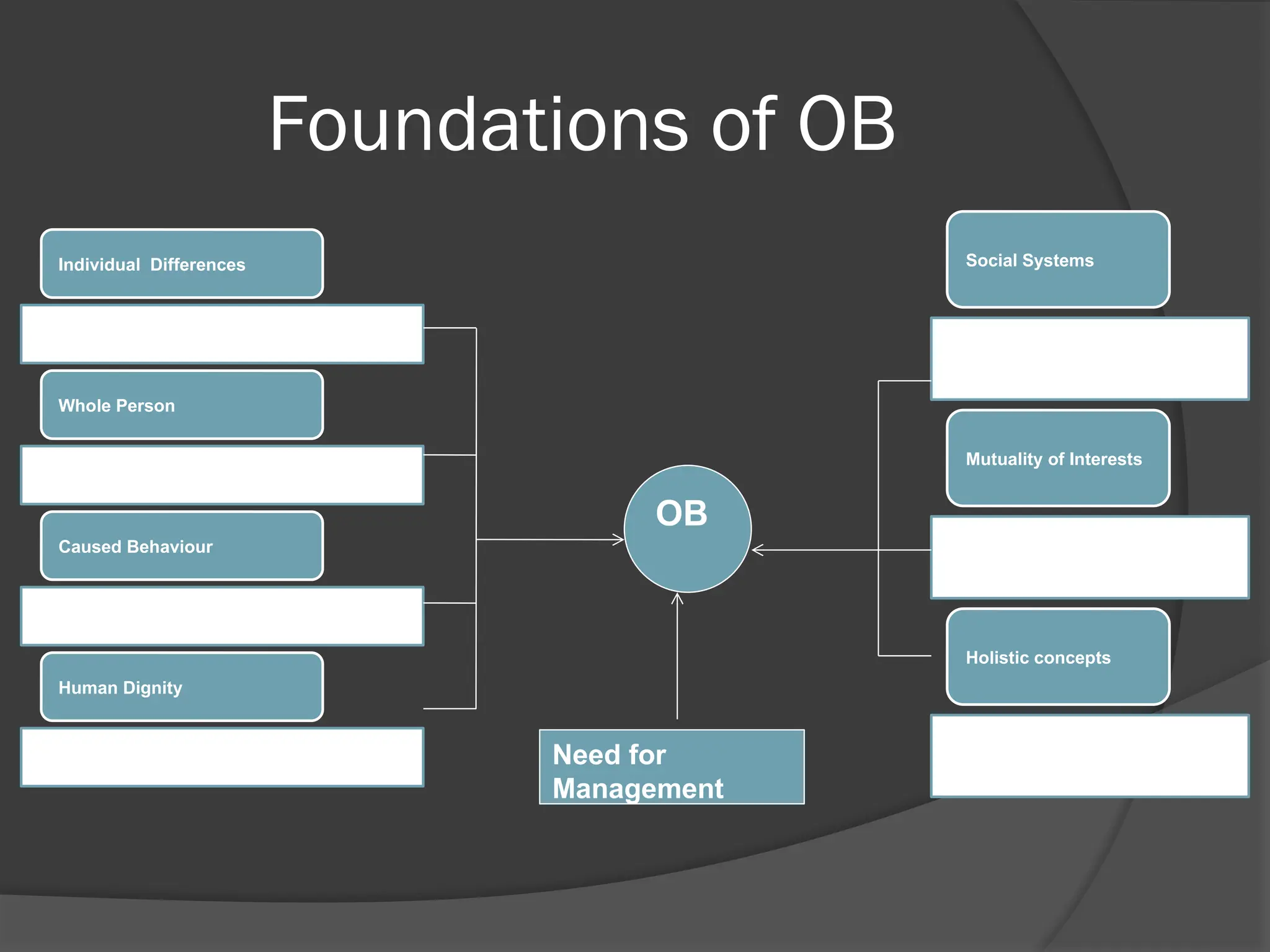
Foundations of OB
Individual Differences
Whole Person
Caused Behaviour
Human Dignity
Social Systems
Mutuality of Interests
Holistic concepts
OB
Need for
Management
Foundations of OB
 Individual differences-People have much in
common but each person in the world is
individually different ex. Personality, intelligence
and physique etc.
 Whole person-when an individual is appointed,
his skill alone is not hires, his background, likes
and dislikes, pride and prejudices are also hired.
A person’s family life cannot be separated from
his work.
 Caused behavior-The behavior of the employee
is caused and not random.
Foundations of OB
 Human dignity-It states that people want to be
treated with respect and dignity and should be
treated as such.
 Organizations are social system-Two social
system prevails formal and informal system. All
parts of the systems are interdependent and are
subject to influence by any other part.
 Mutuality of interest-Organization needs people
and people needs organization. It provides a
super ordinate goal that unites the variety of
needs that people brings to the organizations.
Foundations of OB
 Holistic concept-When the above six
fundamental concept of OB are placed together,
a holistic concept emerges. This concept
interprets people organization relationships in
terms of the whole person, whole group, whole
organization and the whole system.
 Need for management-Management is the
attainment of organizational goals in an efficient
and effective manner through planning,
organizing, leading and controlling
organizational resources. Success or failure of
an organization depends on these people.
Importance
1. OB provides a road map to our lives in organizations
2. The field of OB uses scientific research to help us understand and
predict organizational life.
3. OB helps us influence organizational events
4. It helps an individual to understand himself/herself and others
better.
5. It helps manager understand the basis of motivation and what he
or she should do to motivate subordinates
6. It helps in maintaining cordial industrial relations.
So, OB is a discipline which enables a manager to motivate his
subordinates towards higher productivity and better results.
Toward an OB Discipline
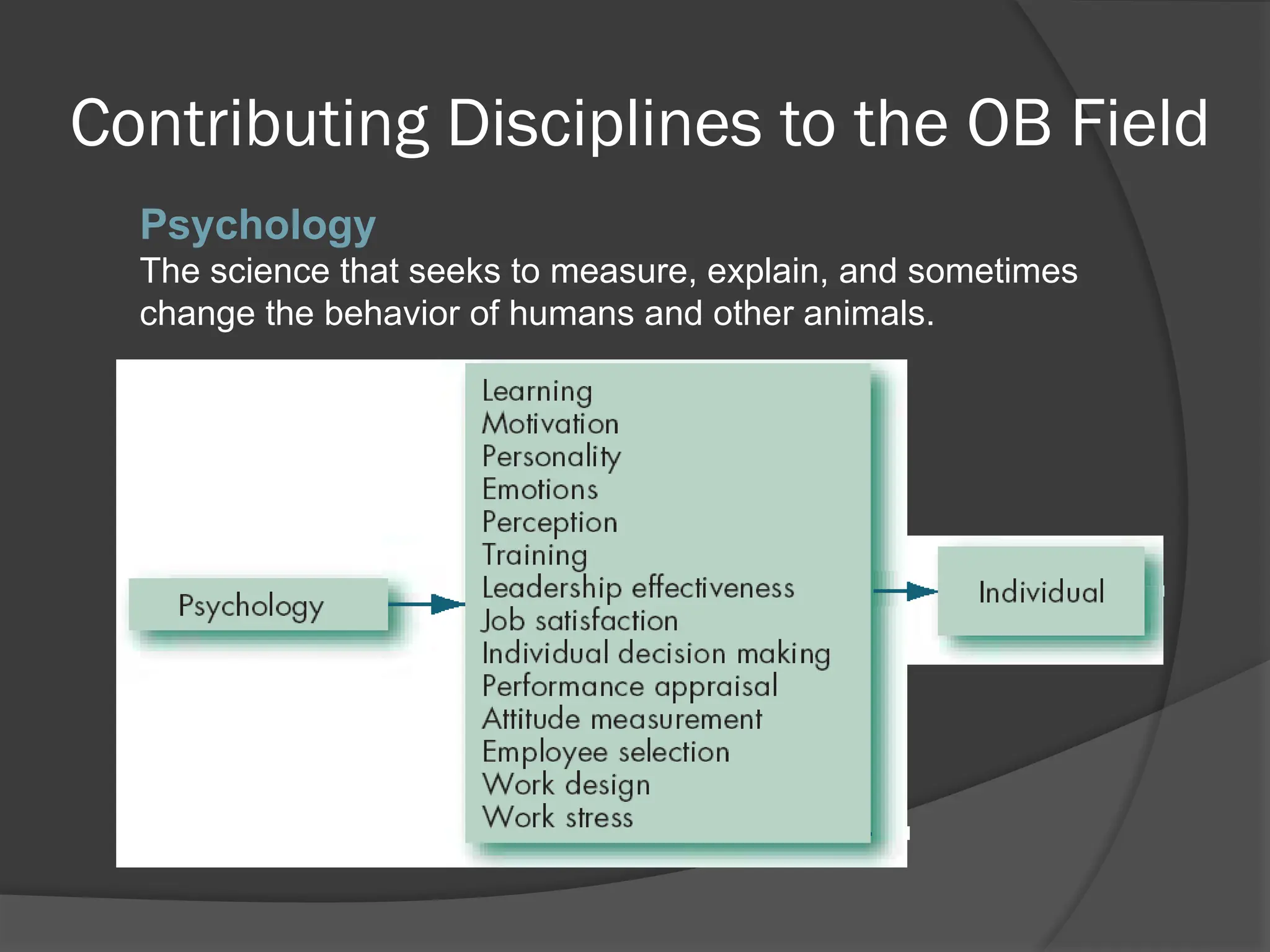
Contributing Disciplines to the OB Field
Psychology
The science that seeks to measure, explain, and sometimes
change the behavior of humans and other animals.
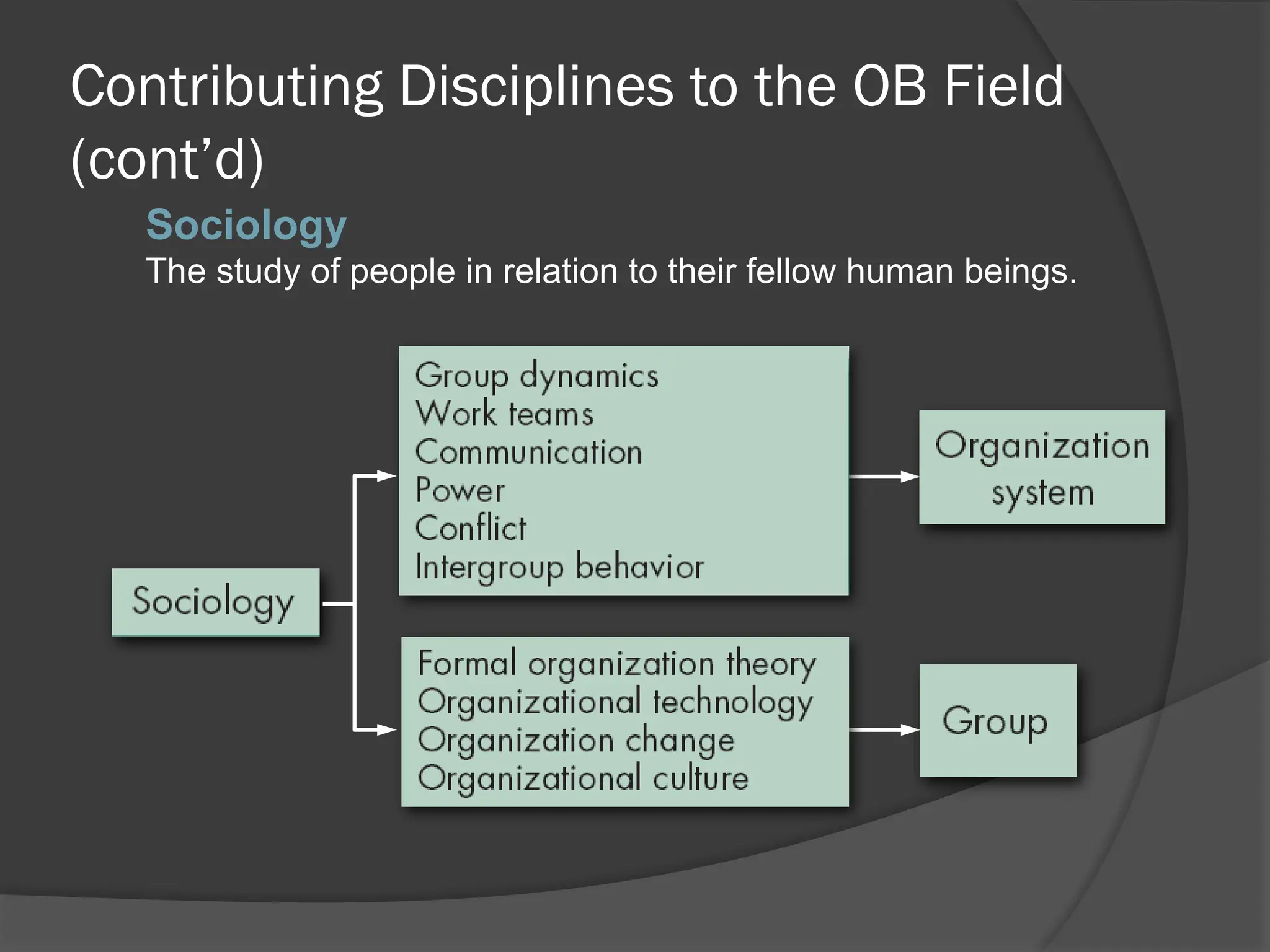
Contributing Disciplines to the OB Field
(cont’d)
Sociology
The study of people in relation to their fellow human beings.
Contributing Disciplines to the OB Field
(cont’d)
Social Psychology
An area within psychology that blends concepts from
psychology and sociology and that focuses on the influence of
people on one another.
Contributing Disciplines to the OB Field
(cont’d)
Anthropology
The study of societies to learn about human beings and
their activities.
Contributing Disciplines to the OB Field
(cont’d)
Political Science
The study of the behavior of individuals and
groups within a political environment.
Models of OB
Personality
Intelligence
Perception
Learning
Attitudes and
Attribution
Motivation
Management &
Managers
Group Dynamics
Team Dynamics
Leadership
Power & Politics
Communication
Conflict
Decision Making
Organisational Culture
Human Resource
Policies & Practices
Work Stress
Organisational
Change &
Development
Individual
Behaviour
Group Behaviour
Organisation
Organisational
Effectiveness
Scope of OB
It is the study of human behaviour within organisations.
It encompasses the study of individual behaviour,
interpersonal behaviour and of the organisations
themselves.
Intra personal Behaviour: Personality, attitude, perception,
learning, opinion, motivation, job satisfaction and stress
management.
Inter Personal Behaviour: Group dynamics, team
dynamics, intergroup conflict, leadership, communication
etc.
What Managers Do
Managerial Activities
• Make decisions
• Allocate resources
• Direct activities of others
to attain goals
Managers (or administrators)
Individuals who achieve goals through other
people.
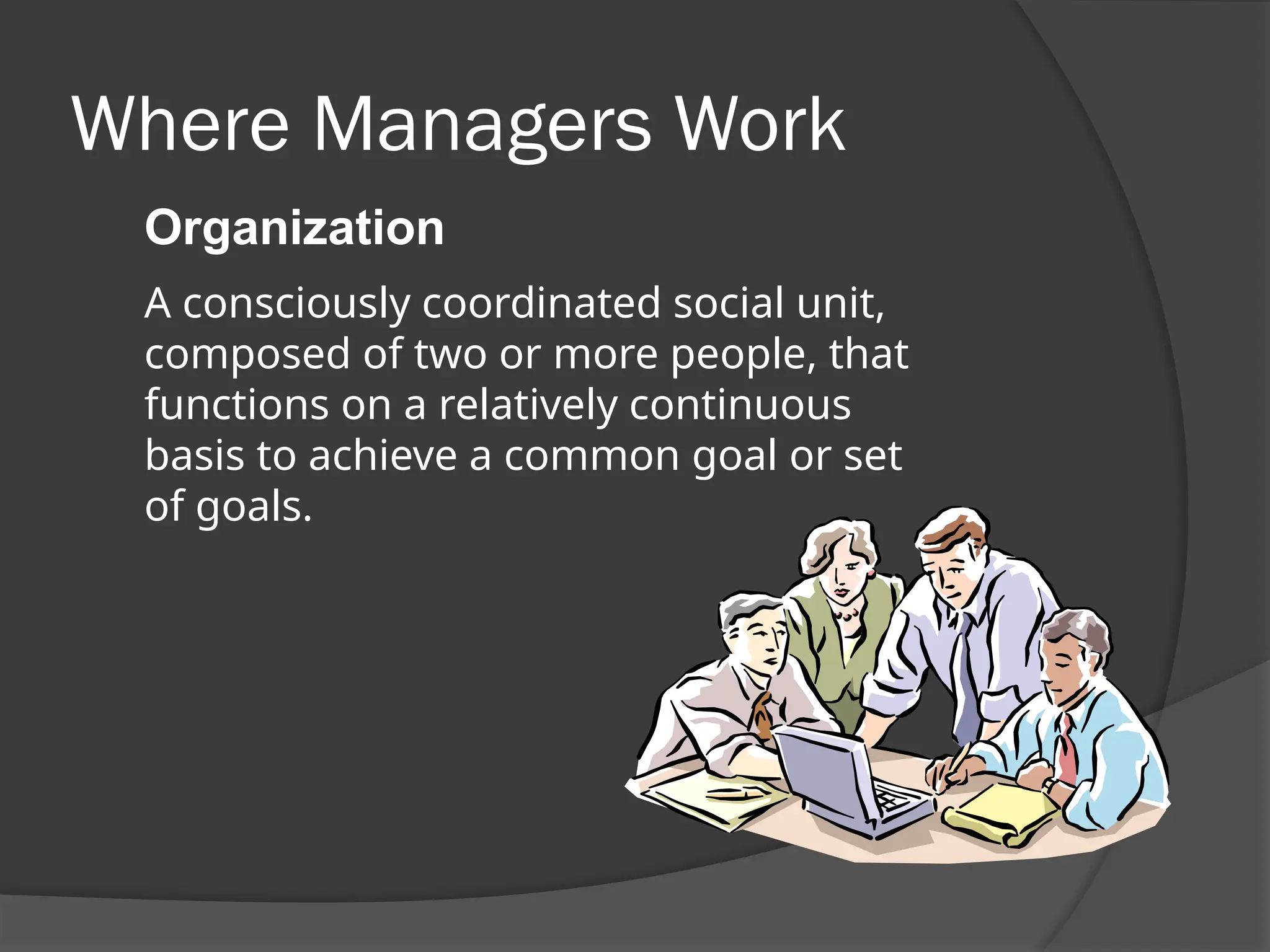
Where Managers Work
Organization
A consciously coordinated social unit,
composed of two or more people, that
functions on a relatively continuous
basis to achieve a common goal or set
of goals.
Management Functions
Management
Functions
Planning Organizing
Leading
Controlling
Management Functions (cont’d)
Planning
A process that includes defining
goals, establishing strategy, and
developing plans to coordinate
activities.
Management Functions (cont’d)
Organizing
Determining what tasks are to be done,
who is to do them, how the tasks are to
be grouped, who reports to whom, and
where decisions are to be made.
Management Functions (cont’d)
Leading
A function that includes motivating
employees, directing others, selecting
the most effective communication
channels, and resolving conflicts.
Management Functions (cont’d)
Controlling
Monitoring activities to ensure they are being
accomplished as planned and correcting any
significant deviations.
Types of Manager
First Line Managers
Middle Level Managers
Top Managers
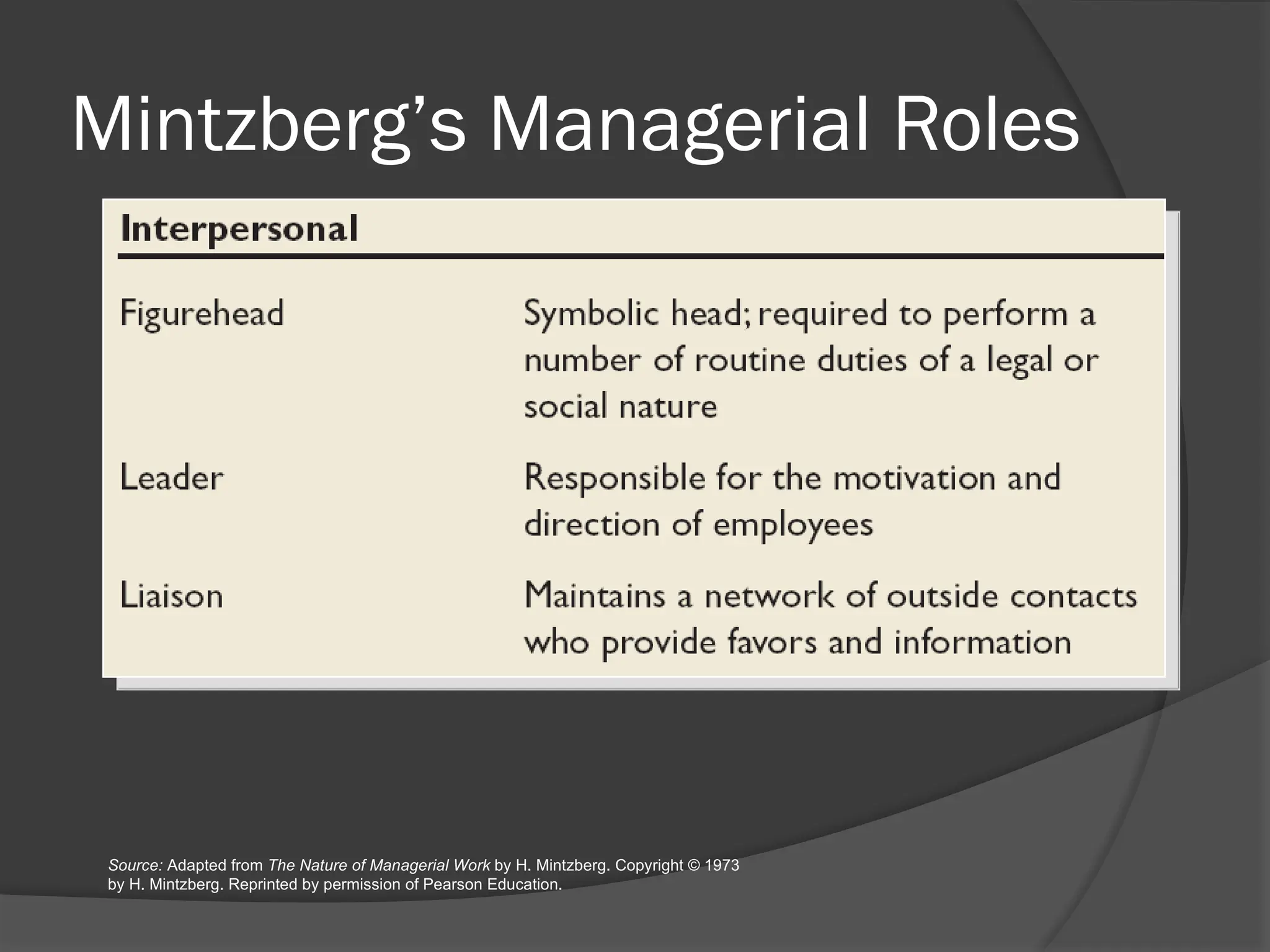
Mintzberg’s Managerial Roles
Source: Adapted from The Nature of Managerial Work by H. Mintzberg. Copyright © 1973
by H. Mintzberg. Reprinted by permission of Pearson Education.
Mintzberg’s Managerial Roles (cont’d)
Source: Adapted from The Nature of Managerial Work by H. Mintzberg. Copyright © 1973
by H. Mintzberg. Reprinted by permission of Pearson Education.
Mintzberg’s Managerial Roles (cont’d)
Source: Adapted from The Nature of Managerial Work by H. Mintzberg. Copyright © 1973
by H. Mintzberg. Reprinted by permission of Pearson Education.
Management Skills
Technical skills
The ability to apply specialized
knowledge or expertise.
Human skills
The ability to work with,
understand, and motivate other
people, both individually and in
groups.
Conceptual and design Skills
The mental ability to analyze and
diagnose complex situations and to
coordinate the integration of ideas
across departments.
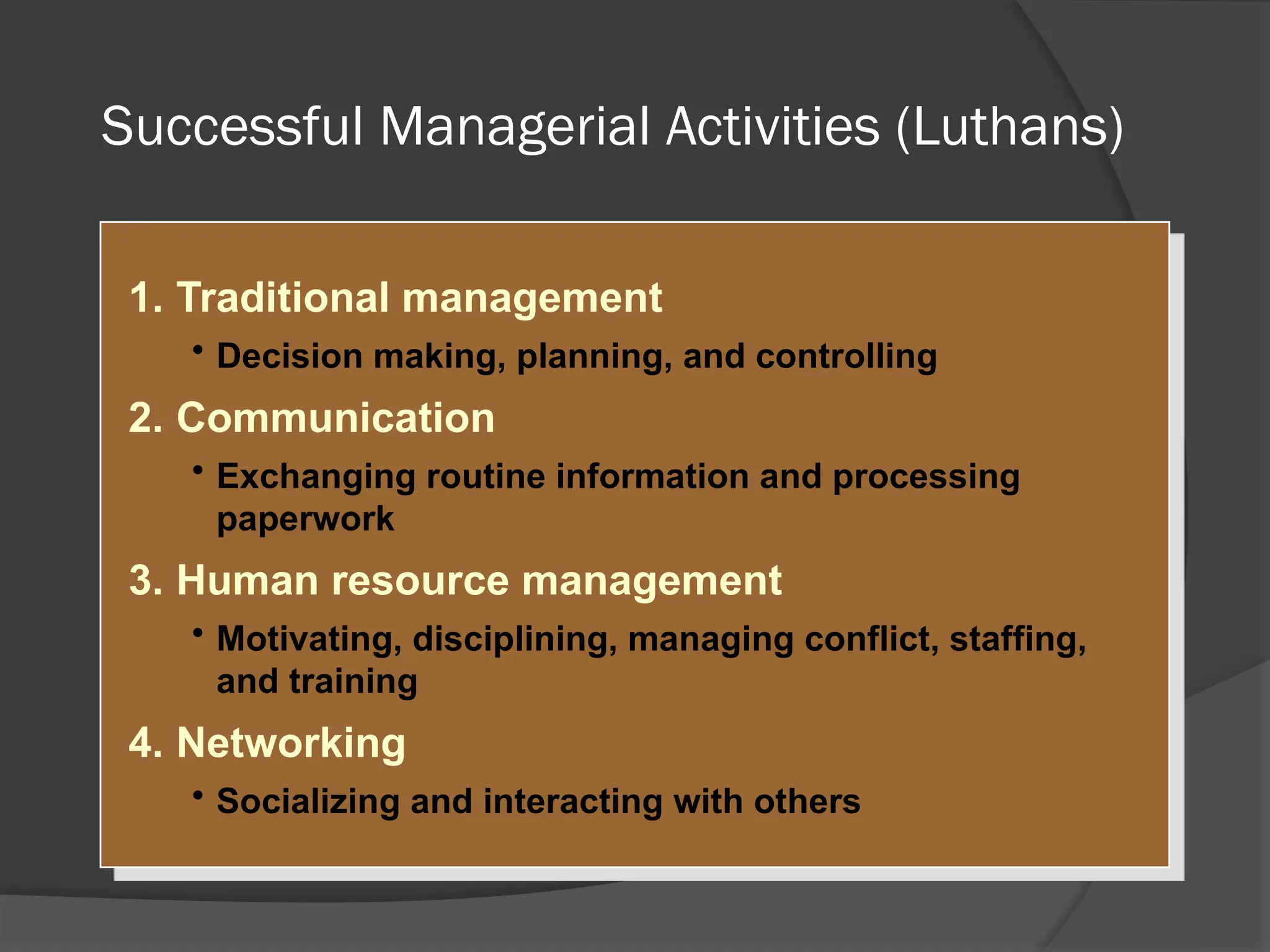
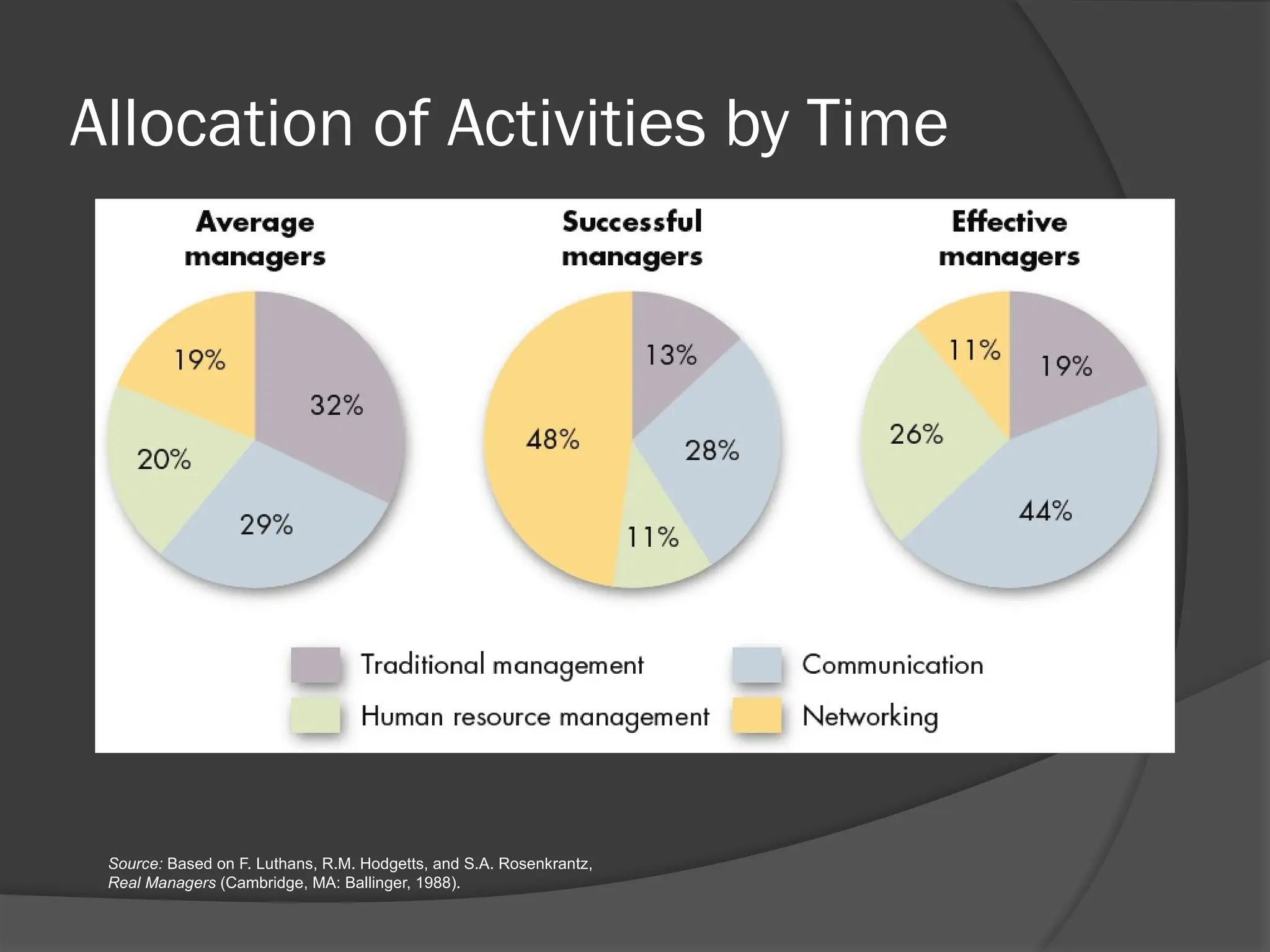
Successful Managerial Activities (Luthans)
1. Traditional management
• Decision making, planning, and controlling
2. Communication
• Exchanging routine information and processing
paperwork
3. Human resource management
• Motivating, disciplining, managing conflict, staffing,
and training
4. Networking
• Socializing and interacting with others
Allocation of Activities by Time
Source: Based on F. Luthans, R.M. Hodgetts, and S.A. Rosenkrantz,
Real Managers (Cambridge, MA: Ballinger, 1988).
Challenges and Opportunities for OB
 Responding to Economic Pressure- Managing employees well when
times are tough is just as hard as when times are good. In good times,
understanding how to reward, satisfy and retain employees is at a
premium. In bad times, issues like stress, decision making and coping
come to the fore.
 Responding to Globalization
 Increased foreign assignments- If your are manager, you’ll have to manage a
workforce very different in needs, aspirations and attitudes from those you are
used to back home.
 Working with people from different cultures-To work effectively with people from
different cultures, you need to understand how their culture, geography and
religion have shaped them and how to adapt your management style to their
differences. Ex. McDonald’s, Disney and Coca-cola
 Overseeing movement of jobs to countries with low-cost labor- In a global
economy, jobs tend to flow where lower costs give businesses a comparative
advantage, though labor groups, politicians and local community leaders see the
exporting of jobs as undermining the job market at home. Mangers face the
difficult task of balancing the interests of their organization with their
responsibilities tot the communities in which they operate.
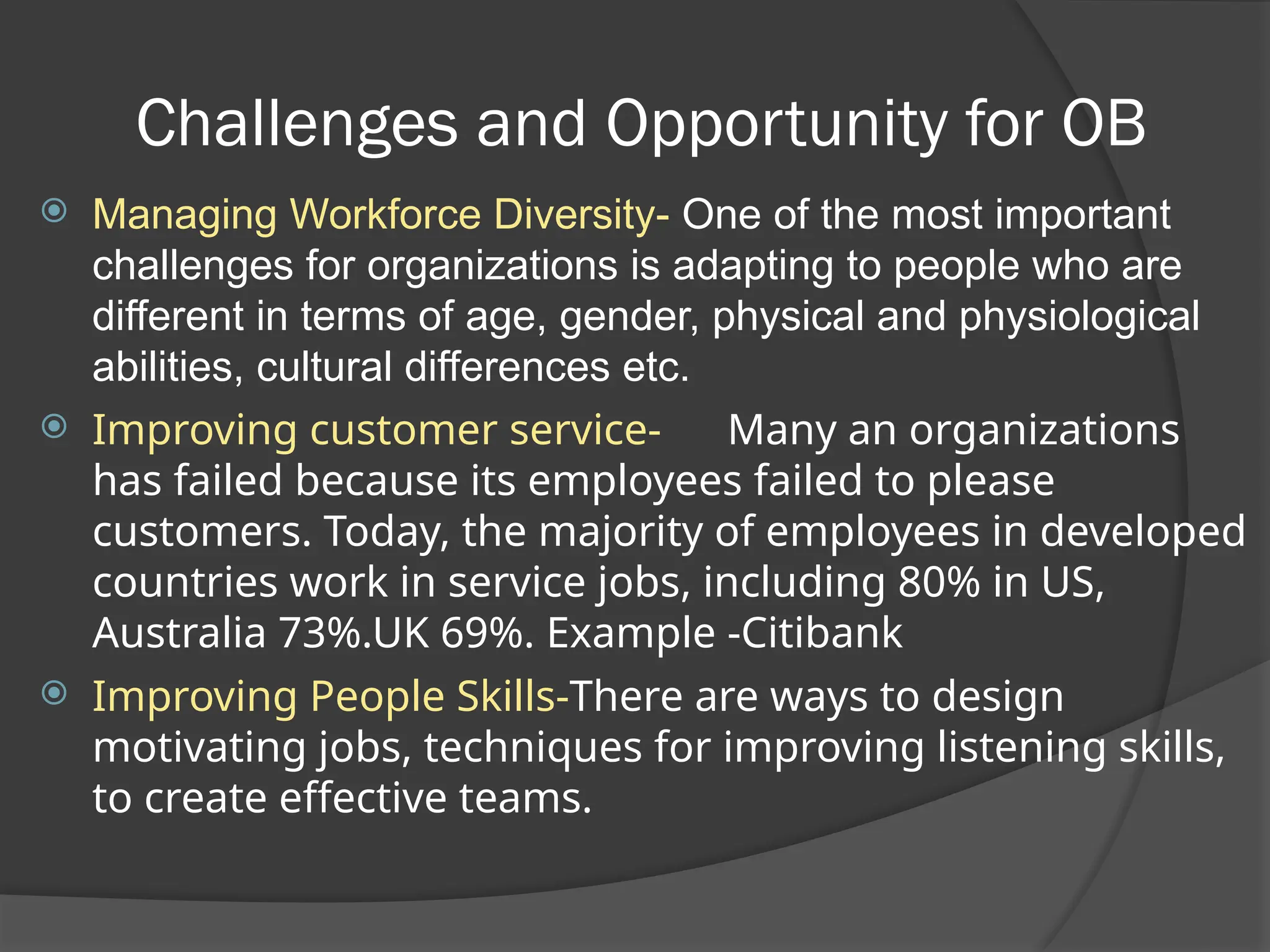
Challenges and Opportunity for OB
 Managing Workforce Diversity- One of the most important
challenges for organizations is adapting to people who are
different in terms of age, gender, physical and physiological
abilities, cultural differences etc.
 Improving customer service- Many an organizations
has failed because its employees failed to please
customers. Today, the majority of employees in developed
countries work in service jobs, including 80% in US,
Australia 73%.UK 69%. Example -Citibank
 Improving People Skills-There are ways to design
motivating jobs, techniques for improving listening skills,
to create effective teams.
Challenges and Opportunities for OB
 Stimulating innovation and change-Today’s successful
organizations must foster innovation and master the
art of change, or they’ll become candidates for
extinction. Ex. Wockhardt hospital, Air India etc.
 Helping Employees Balance Work/Life Conflicts-
Recent studies suggest employees want jobs that give
them flexibility in their work schedules so they can
better manage work-life conflicts. Today, many
organizations are trying to help their people achieve
work life Balance in a bid to attract and retain the most
capable and motivated employees.
Challenges and Opportunities for OB
 Coping with Temporariness-Today’s managers and
employees must learn to cope with temporariness,
flexibility, spontaneity and unpredictability. The study of OB
can help to better understand a work world of continual
change, overcome resistance to change, and create an
organizational culture that thrives on change.
 Working in Networked organizations- Networked
organizations allow people to communicate and work
together even though they may be thousand of miles apart.
The manager’s job is different in a networked
organizations, motivating and leading people and making
collaborative decision online requires different techniques
than when individuals are physically present in a single
location.
Challenges and Opportunities for OB
 Creating a positive work environment-Companies have been
planning avenues for their employees to donate some of their
time and talent to work on issues they are interested in. For
Ex. Satyam computer Service had developed a software for
emergency services, called 108 emergency services, with
the help of employees who are willing to volunteer their
programming skills for the 108 application.
 Improving ethical behavior-Today’s manager must create an
ethically healthy climate for his employees, where they can
do their work productively with minimal ambiguity about what
right and wrong behaviors are. Companies that promote a
strong ethical mission, encourage employees to behave with
integrity , and provide strong ethical leadership[ can influence
employee decisions to behave ethically.
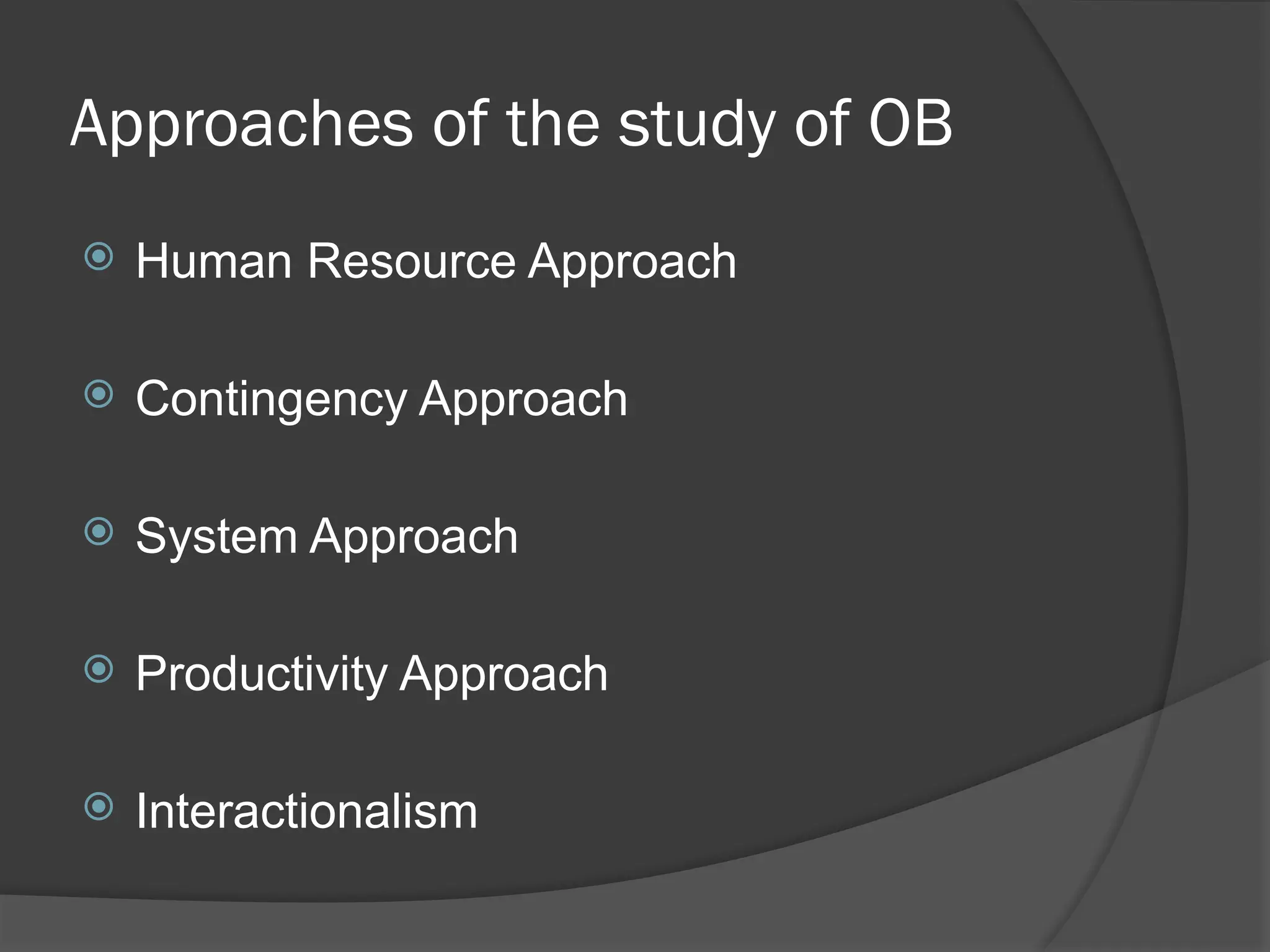
Approaches of the study of OB
 Human Resource Approach
 Contingency Approach
 System Approach
 Productivity Approach
 Interactionalism
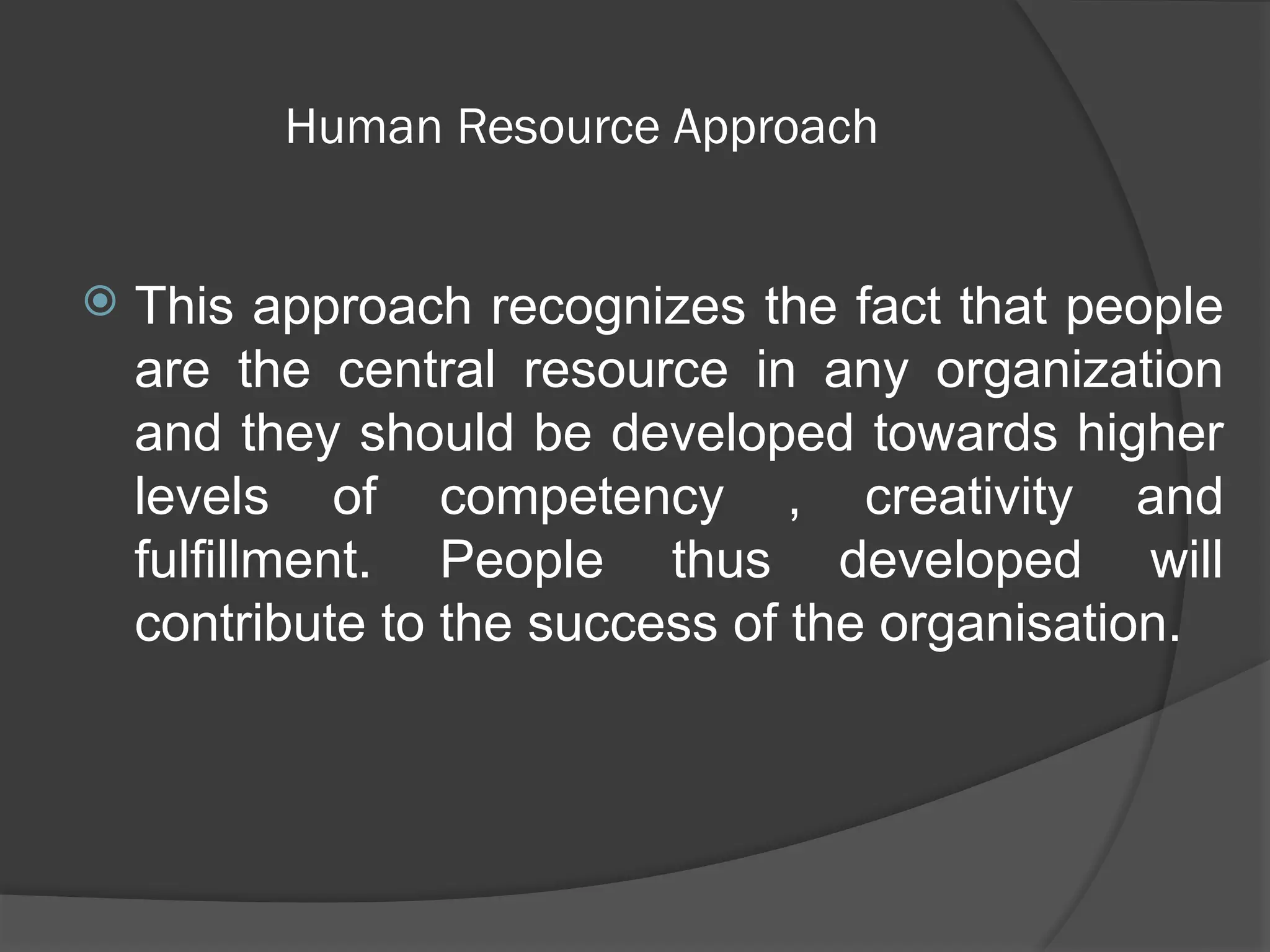
Human Resource Approach
 This approach recognizes the fact that people
are the central resource in any organization
and they should be developed towards higher
levels of competency , creativity and
fulfillment. People thus developed will
contribute to the success of the organisation.
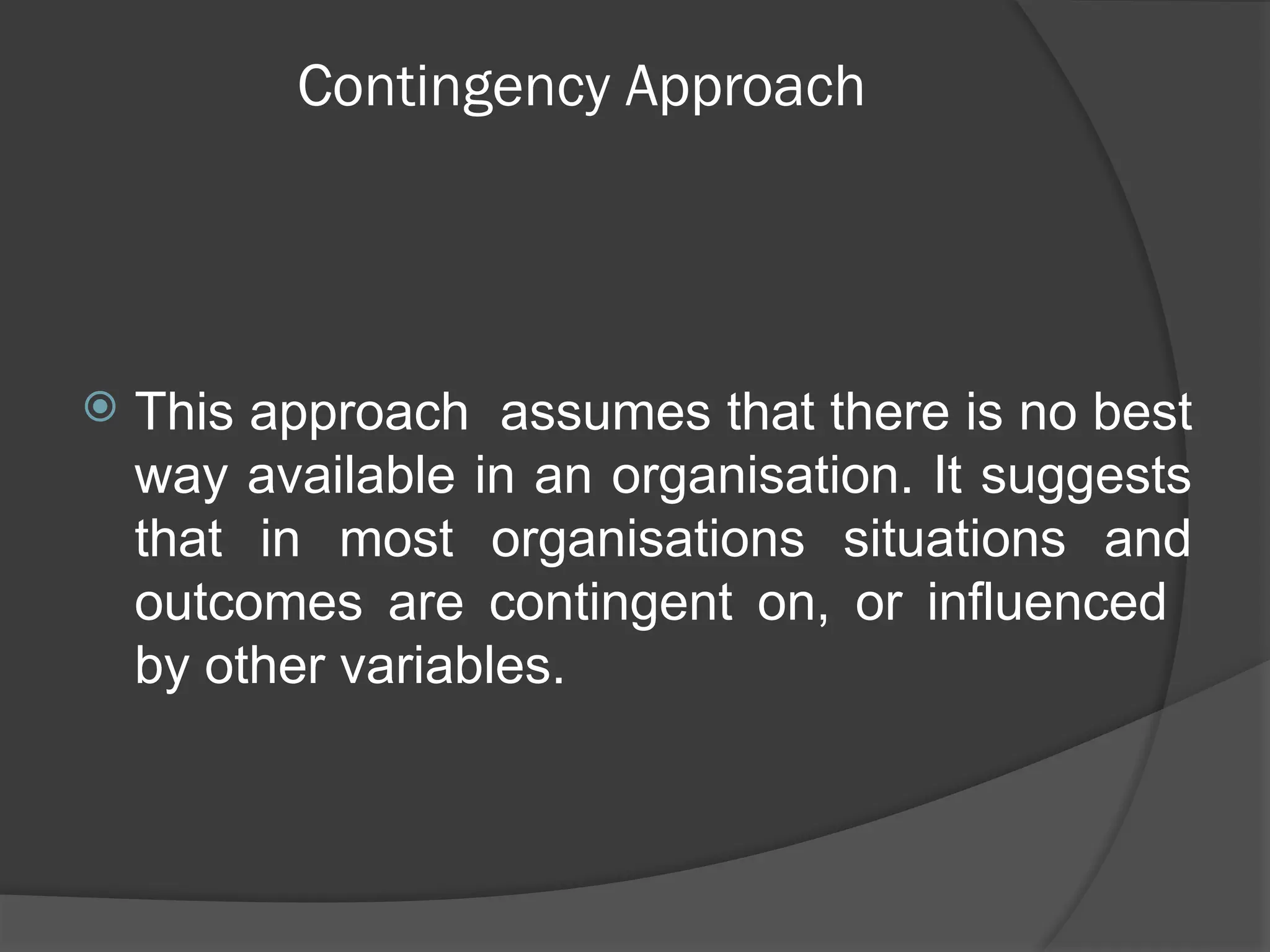
Contingency Approach
 This approach assumes that there is no best
way available in an organisation. It suggests
that in most organisations situations and
outcomes are contingent on, or influenced
by other variables.
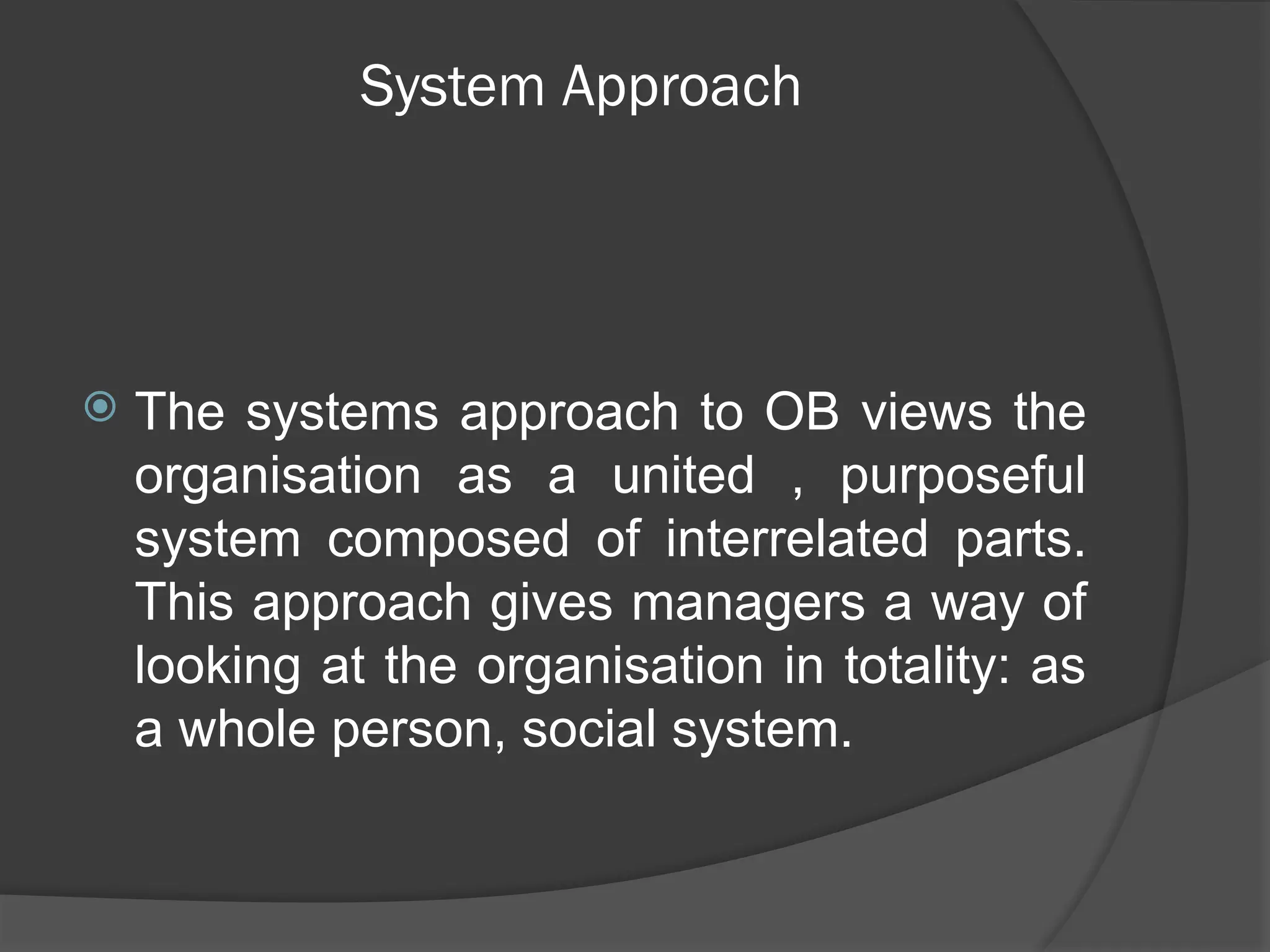
System Approach
 The systems approach to OB views the
organisation as a united , purposeful
system composed of interrelated parts.
This approach gives managers a way of
looking at the organisation in totality: as
a whole person, social system.
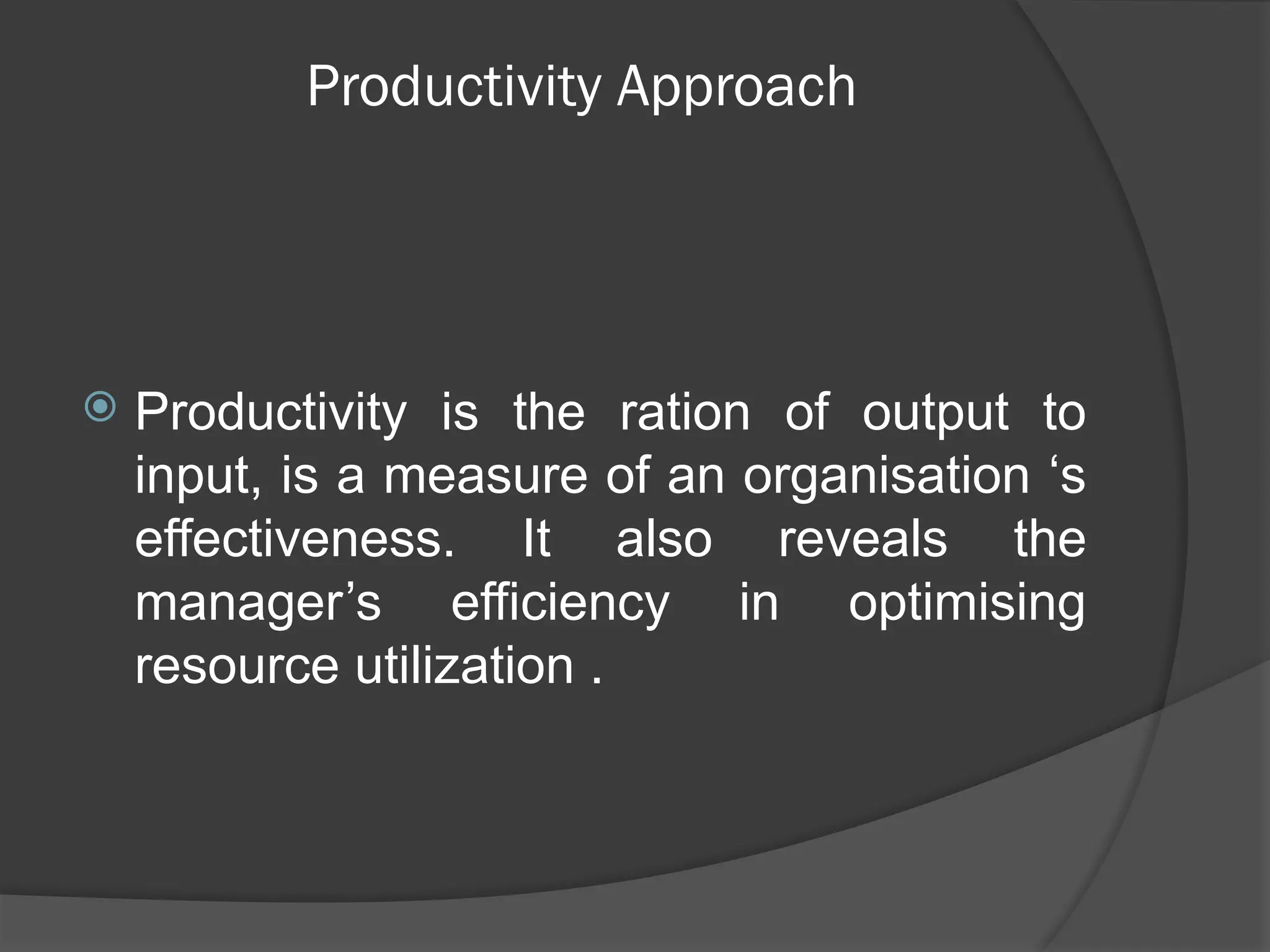
Productivity Approach
 Productivity is the ration of output to
input, is a measure of an organisation ‘s
effectiveness. It also reveals the
manager’s efficiency in optimising
resource utilization .
Interactionalism
 This is a relatively new approach to
understanding behavior in organisational
settings. It assumes that individual behaviour
results from a continuous and multidirectional
interaction between characteristics of the people
and of the situation . This attempts to explain
how people select, interpret and change various
situations.

organizational behaviour ashwathappa.ppt

  • 1.
    SYLLABUS OF OB S.No. Particulars 1. Introduction to OB 2. Personality 3. Perception, Attitude and Value 4. Motivation Concepts 5. Group Behaviour and Group Dynamics 6. Organisational Design 7. Leadership 8. Organisational Change and Culture Environnent
  • 2.
    REFERENCE TEXT 1.Organisational Behavior-K. Aswathappa 2.Organisational Behavior- Stephen Robbins 3.Organisational Behavior-Fred Luthans 4.Understanding Organizational Behavior – Udai Pareek 5.Organizational Behavior – L. M. Prasad (Sultan Chand)
  • 3.
  • 4.
    Scheme of Assessmentsfor Subjects of 100 Marks  Semester end Examination -60 Marks.  Internal Assessments -40 Marks. The allocation of 40 marks shall be on the following basis: - a) Periodical class tests -(20 Marks) b) Presentations -(10 Marks) c) Attendance and Active participation in class - (05 Marks) d) Overall Conduct - (05 Marks) Note: Student has to separately secure minimum 50% marks (i.e 20 out of 40) in the internal assessments and secure minimum 50% marks (i.e 30 out of 60) in the Semester End Examination in every subject to be declared as Pass.
  • 5.
  • 6.
    After studying thischapter, you should be able to: 1. Define organizational behavior (OB). 2. Describe what managers do. 3. Explain the value of the systematic study of OB. 4. List the major challenges and opportunities for managers to use OB concepts. 5. Identify the contributions made by major behavioral science disciplines to OB. 6. Describe why managers require a knowledge of OB. 7. Explain the need for a contingency approach to the study of OB. L E A R N I N G O B J E C T I V E S
  • 7.
    What are ORGANISATIONS? Organisations are sets of people who work together to achieve shared goals.
  • 8.
    Why do OrganisationsExist? What is Organisational Effectiveness? Organizations are effective when they produce quality goods and services at reasonable cost without compromising on profit –making.
  • 9.
    Organizational behavior OB isthe study of Human behaviour; The study is about the behaviour in organisations; And knowledge about human behaviour ,would be useful in improving an organisations effectiveness.
  • 10.
    Enter Organizational Behavior Organizationalbehavior (OB) A field of study that investigates the impact that individuals, groups, and structure have on behavior within organizations, for the purpose of applying such knowledge toward improving an organization’s effectiveness.
  • 11.
    History Industrial Revolution Robert Owen, Andrew Ure and J. N. Tata provided certain welfare facilities. Scientific Management Fredrick Taylor believed in rationalising production. Hawthrone studies Hawthrone studies matched with the workers preferences of factors influencing productivity: these were size of the group, supervisory behavior, earning, novelty of situation, workers interest in the experiment and attention received. Human Relations Movement Great Depression, Labour movement and Hawthrone studies led to the movement. Organisation Behaviour – 1950’s
  • 12.
    Foundations of OB IndividualDifferences Whole Person Caused Behaviour Human Dignity Social Systems Mutuality of Interests Holistic concepts OB Need for Management
  • 13.
    Foundations of OB Individual differences-People have much in common but each person in the world is individually different ex. Personality, intelligence and physique etc.  Whole person-when an individual is appointed, his skill alone is not hires, his background, likes and dislikes, pride and prejudices are also hired. A person’s family life cannot be separated from his work.  Caused behavior-The behavior of the employee is caused and not random.
  • 14.
    Foundations of OB Human dignity-It states that people want to be treated with respect and dignity and should be treated as such.  Organizations are social system-Two social system prevails formal and informal system. All parts of the systems are interdependent and are subject to influence by any other part.  Mutuality of interest-Organization needs people and people needs organization. It provides a super ordinate goal that unites the variety of needs that people brings to the organizations.
  • 15.
    Foundations of OB Holistic concept-When the above six fundamental concept of OB are placed together, a holistic concept emerges. This concept interprets people organization relationships in terms of the whole person, whole group, whole organization and the whole system.  Need for management-Management is the attainment of organizational goals in an efficient and effective manner through planning, organizing, leading and controlling organizational resources. Success or failure of an organization depends on these people.
  • 16.
    Importance 1. OB providesa road map to our lives in organizations 2. The field of OB uses scientific research to help us understand and predict organizational life. 3. OB helps us influence organizational events 4. It helps an individual to understand himself/herself and others better. 5. It helps manager understand the basis of motivation and what he or she should do to motivate subordinates 6. It helps in maintaining cordial industrial relations. So, OB is a discipline which enables a manager to motivate his subordinates towards higher productivity and better results.
  • 17.
    Toward an OBDiscipline
  • 18.
    Contributing Disciplines tothe OB Field Psychology The science that seeks to measure, explain, and sometimes change the behavior of humans and other animals.
  • 19.
    Contributing Disciplines tothe OB Field (cont’d) Sociology The study of people in relation to their fellow human beings.
  • 20.
    Contributing Disciplines tothe OB Field (cont’d) Social Psychology An area within psychology that blends concepts from psychology and sociology and that focuses on the influence of people on one another.
  • 21.
    Contributing Disciplines tothe OB Field (cont’d) Anthropology The study of societies to learn about human beings and their activities.
  • 22.
    Contributing Disciplines tothe OB Field (cont’d) Political Science The study of the behavior of individuals and groups within a political environment.
  • 23.
    Models of OB Personality Intelligence Perception Learning Attitudesand Attribution Motivation Management & Managers Group Dynamics Team Dynamics Leadership Power & Politics Communication Conflict Decision Making Organisational Culture Human Resource Policies & Practices Work Stress Organisational Change & Development Individual Behaviour Group Behaviour Organisation Organisational Effectiveness
  • 24.
    Scope of OB Itis the study of human behaviour within organisations. It encompasses the study of individual behaviour, interpersonal behaviour and of the organisations themselves. Intra personal Behaviour: Personality, attitude, perception, learning, opinion, motivation, job satisfaction and stress management. Inter Personal Behaviour: Group dynamics, team dynamics, intergroup conflict, leadership, communication etc.
  • 25.
    What Managers Do ManagerialActivities • Make decisions • Allocate resources • Direct activities of others to attain goals Managers (or administrators) Individuals who achieve goals through other people.
  • 26.
    Where Managers Work Organization Aconsciously coordinated social unit, composed of two or more people, that functions on a relatively continuous basis to achieve a common goal or set of goals.
  • 27.
  • 28.
    Management Functions (cont’d) Planning Aprocess that includes defining goals, establishing strategy, and developing plans to coordinate activities.
  • 29.
    Management Functions (cont’d) Organizing Determiningwhat tasks are to be done, who is to do them, how the tasks are to be grouped, who reports to whom, and where decisions are to be made.
  • 30.
    Management Functions (cont’d) Leading Afunction that includes motivating employees, directing others, selecting the most effective communication channels, and resolving conflicts.
  • 31.
    Management Functions (cont’d) Controlling Monitoringactivities to ensure they are being accomplished as planned and correcting any significant deviations.
  • 32.
    Types of Manager FirstLine Managers Middle Level Managers Top Managers
  • 33.
    Mintzberg’s Managerial Roles Source:Adapted from The Nature of Managerial Work by H. Mintzberg. Copyright © 1973 by H. Mintzberg. Reprinted by permission of Pearson Education.
  • 34.
    Mintzberg’s Managerial Roles(cont’d) Source: Adapted from The Nature of Managerial Work by H. Mintzberg. Copyright © 1973 by H. Mintzberg. Reprinted by permission of Pearson Education.
  • 35.
    Mintzberg’s Managerial Roles(cont’d) Source: Adapted from The Nature of Managerial Work by H. Mintzberg. Copyright © 1973 by H. Mintzberg. Reprinted by permission of Pearson Education.
  • 36.
    Management Skills Technical skills Theability to apply specialized knowledge or expertise. Human skills The ability to work with, understand, and motivate other people, both individually and in groups. Conceptual and design Skills The mental ability to analyze and diagnose complex situations and to coordinate the integration of ideas across departments.
  • 37.
    Successful Managerial Activities(Luthans) 1. Traditional management • Decision making, planning, and controlling 2. Communication • Exchanging routine information and processing paperwork 3. Human resource management • Motivating, disciplining, managing conflict, staffing, and training 4. Networking • Socializing and interacting with others
  • 38.
    Allocation of Activitiesby Time Source: Based on F. Luthans, R.M. Hodgetts, and S.A. Rosenkrantz, Real Managers (Cambridge, MA: Ballinger, 1988).
  • 39.
    Challenges and Opportunitiesfor OB  Responding to Economic Pressure- Managing employees well when times are tough is just as hard as when times are good. In good times, understanding how to reward, satisfy and retain employees is at a premium. In bad times, issues like stress, decision making and coping come to the fore.  Responding to Globalization  Increased foreign assignments- If your are manager, you’ll have to manage a workforce very different in needs, aspirations and attitudes from those you are used to back home.  Working with people from different cultures-To work effectively with people from different cultures, you need to understand how their culture, geography and religion have shaped them and how to adapt your management style to their differences. Ex. McDonald’s, Disney and Coca-cola  Overseeing movement of jobs to countries with low-cost labor- In a global economy, jobs tend to flow where lower costs give businesses a comparative advantage, though labor groups, politicians and local community leaders see the exporting of jobs as undermining the job market at home. Mangers face the difficult task of balancing the interests of their organization with their responsibilities tot the communities in which they operate.
  • 40.
    Challenges and Opportunityfor OB  Managing Workforce Diversity- One of the most important challenges for organizations is adapting to people who are different in terms of age, gender, physical and physiological abilities, cultural differences etc.  Improving customer service- Many an organizations has failed because its employees failed to please customers. Today, the majority of employees in developed countries work in service jobs, including 80% in US, Australia 73%.UK 69%. Example -Citibank  Improving People Skills-There are ways to design motivating jobs, techniques for improving listening skills, to create effective teams.
  • 41.
    Challenges and Opportunitiesfor OB  Stimulating innovation and change-Today’s successful organizations must foster innovation and master the art of change, or they’ll become candidates for extinction. Ex. Wockhardt hospital, Air India etc.  Helping Employees Balance Work/Life Conflicts- Recent studies suggest employees want jobs that give them flexibility in their work schedules so they can better manage work-life conflicts. Today, many organizations are trying to help their people achieve work life Balance in a bid to attract and retain the most capable and motivated employees.
  • 42.
    Challenges and Opportunitiesfor OB  Coping with Temporariness-Today’s managers and employees must learn to cope with temporariness, flexibility, spontaneity and unpredictability. The study of OB can help to better understand a work world of continual change, overcome resistance to change, and create an organizational culture that thrives on change.  Working in Networked organizations- Networked organizations allow people to communicate and work together even though they may be thousand of miles apart. The manager’s job is different in a networked organizations, motivating and leading people and making collaborative decision online requires different techniques than when individuals are physically present in a single location.
  • 43.
    Challenges and Opportunitiesfor OB  Creating a positive work environment-Companies have been planning avenues for their employees to donate some of their time and talent to work on issues they are interested in. For Ex. Satyam computer Service had developed a software for emergency services, called 108 emergency services, with the help of employees who are willing to volunteer their programming skills for the 108 application.  Improving ethical behavior-Today’s manager must create an ethically healthy climate for his employees, where they can do their work productively with minimal ambiguity about what right and wrong behaviors are. Companies that promote a strong ethical mission, encourage employees to behave with integrity , and provide strong ethical leadership[ can influence employee decisions to behave ethically.
  • 44.
    Approaches of thestudy of OB  Human Resource Approach  Contingency Approach  System Approach  Productivity Approach  Interactionalism
  • 45.
    Human Resource Approach This approach recognizes the fact that people are the central resource in any organization and they should be developed towards higher levels of competency , creativity and fulfillment. People thus developed will contribute to the success of the organisation.
  • 46.
    Contingency Approach  Thisapproach assumes that there is no best way available in an organisation. It suggests that in most organisations situations and outcomes are contingent on, or influenced by other variables.
  • 47.
    System Approach  Thesystems approach to OB views the organisation as a united , purposeful system composed of interrelated parts. This approach gives managers a way of looking at the organisation in totality: as a whole person, social system.
  • 48.
    Productivity Approach  Productivityis the ration of output to input, is a measure of an organisation ‘s effectiveness. It also reveals the manager’s efficiency in optimising resource utilization .
  • 49.
    Interactionalism  This isa relatively new approach to understanding behavior in organisational settings. It assumes that individual behaviour results from a continuous and multidirectional interaction between characteristics of the people and of the situation . This attempts to explain how people select, interpret and change various situations.