 To understand how management theories
develop
 To understand the impact of the environment
to management thinking
 To gain insights into new management
approach
 Early ideas about management strategy
 Sun Tzu (770-476 B.C.), The Art of War
 Early ideas about leadership
 Nicolò Machiavelli (1469-1527), The Prince
 Early ideas about the design and
organization of work
 Adam Smith, The Wealth of Nations
 division of labor
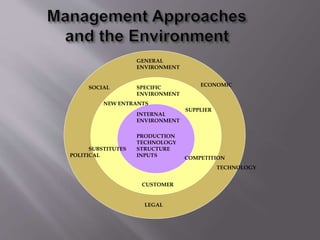
Organizational environments are
composed of forces or institutions
surrounding an organization that
affect performance, operations,
and resources.
It includes all of the elements that
exist outside of the
organization's boundaries and
have the potential to affect a
portion or all of the organization.
GENERAL
ENVIRONMENT
SPECIFIC
ENVIRONMENT
INTERNAL
ENVIRONMENT
SOCIAL
ECONOMIC
POLITICAL
LEGAL
TECHNOLOGY
NEW ENTRANTS
SUPPLIER
SUBSTITUTES
CUSTOMER
COMPETITION
PRODUCTION
TECHNOLOGY
STRUCTURE
INPUTS
Environment in 1890
•Industrial revolution
The classical approach (1890) to
management is a management approach that
emphasizes organizational efficiency to
increase organizational success.
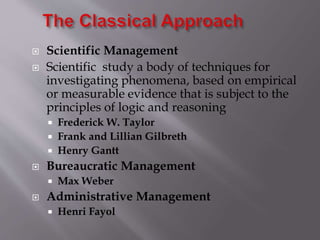
 Scientific Management
 Scientific study a body of techniques for
investigating phenomena, based on empirical
or measurable evidence that is subject to the
principles of logic and reasoning
 Frederick W. Taylor
 Frank and Lillian Gilbreth
 Henry Gantt
 Bureaucratic Management
 Max Weber
 Administrative Management
 Henri Fayol
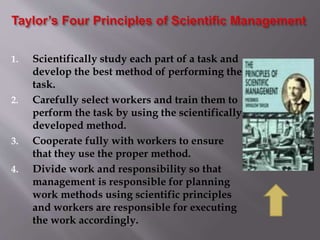
 Frederick Winslow Taylor was an American
mechanical engineer who sought to improve
industrial efficiency. He was one of the first
management consultants.
 Book name
 Taylor summed up his efficiency techniques in
his 1911 book The Principles of Scientific
Management.
1. Scientifically study each part of a task and
develop the best method of performing the
task.
2. Carefully select workers and train them to
perform the task by using the scientifically
developed method.
3. Cooperate fully with workers to ensure
that they use the proper method.
4. Divide work and responsibility so that
management is responsible for planning
work methods using scientific principles
and workers are responsible for executing
the work accordingly.
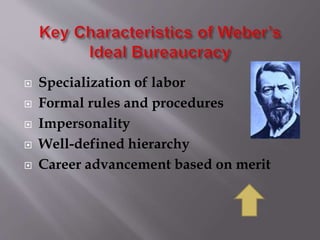
 Specialization of labor
 Formal rules and procedures
 Impersonality
 Well-defined hierarchy
 Career advancement based on merit
• Henri Fayol was a French mining
engineer, mining executive, author
and director of mines who
developed a general theory of business
administration that is often called
Fayolism.
. Fayol's "14 Principles"
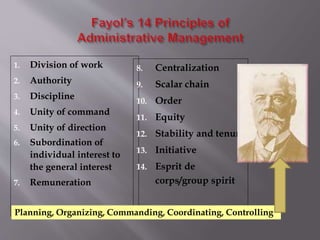
1. Division of work
2. Authority
3. Discipline
4. Unity of command
5. Unity of direction
6. Subordination of
individual interest to
the general interest
7. Remuneration
8. Centralization
9. Scalar chain
10. Order
11. Equity
12. Stability and tenure
13. Initiative
14. Esprit de
corps/group spirit
Planning, Organizing, Commanding, Coordinating, Controlling
The behavioral approach (1910) to
management is a management approach that
emphasizes increasing organizational
success by focusing on human variables
within the organization.
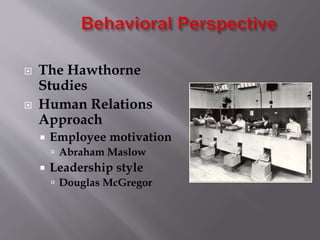
 The Hawthorne
Studies
 Human Relations
Approach
 Employee motivation
 Abraham Maslow
 Leadership style
 Douglas McGregor
The Hawthorne studies, which were
conducted by Elton Mayo and Fritz
Roethlisberger in the 1920s with the
workers at the Hawthorne plant of the
Western Electric Company, were part of
an emphasis on socio-psychological
aspects of human behavior in
organizations.
The discovery that paying special
attention to employees motivates
them to put greater effort into their
jobs.
(from the Hawthorne management studies,
performed from 1924 – 1932 at Western Electric
Company’s plant near Chicago)
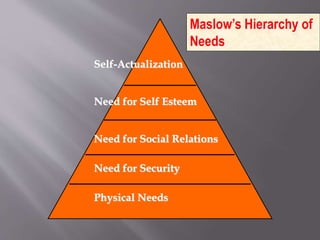
Physical Needs
Need for Security
Need for Social Relations
Need for Self Esteem
Self-Actualization
Maslow’s Hierarchy of
Needs
 Leaders and managers who hold Theory X
assumptions believe that employees are inherently
lazy and lack ambition.
 A negative perspective on human behavior.
 Leaders and managers who hold Theory Y
assumptions believe that most employees do not
dislike work and want to make useful contributions
to the organization.
 A positive perspective on human behavior.
Approaches
 Management Science
 Operation management
 Management Information system (MIS)
 An approach aimed at increasing
decision effectiveness through the
use of sophisticated mathematical
models and statistical methods
 The function or field of expertise, that is
primarily responsible for managing the
production and delivery of an organization's
products and services.
 It inclucdes
Inventory management
Work Scheduling
Production planning
 The field of management that focuses on
designing and implementing computer-based
information system for use by management.
System theory
Contingency Theory
Emerging view
The system approach ( 50’s-60’s) to
management is a management approach
based on general system theory--the theory
that to understand fully the operation of an
entity, the entity must be viewed as a system.
This requires understanding the
interdependence of its parts.
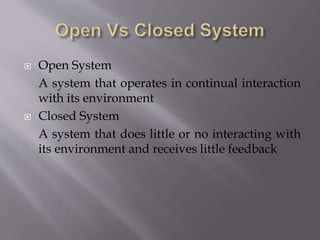
 Open System
A system that operates in continual interaction
with its environment
 Closed System
A system that does little or no interacting with
its environment and receives little feedback
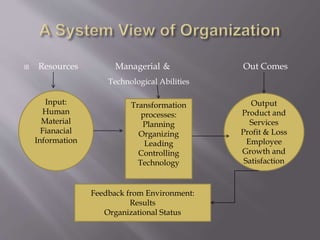
 Resources Managerial & Out Comes
Technological Abilities
Input:
Human
Material
Fianacial
Information
Transformation
processes:
Planning
Organizing
Leading
Controlling
Technology
Output
Product and
Services
Profit & Loss
Employee
Growth and
Satisfaction
Feedback from Environment:
Results
Organizational Status
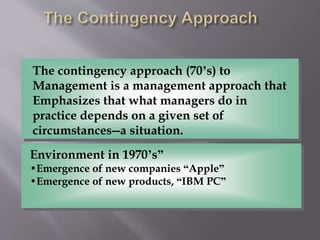
The contingency approach (70’s) to
Management is a management approach that
Emphasizes that what managers do in
practice depends on a given set of
circumstances--a situation.
Environment in 1970’s”
•Emergence of new companies “Apple”
•Emergence of new products, “IBM PC”
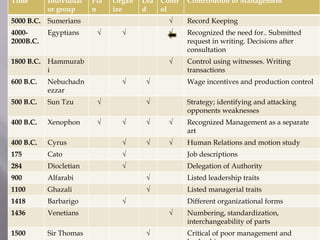
Time Individual
or group
Pla
n
Organ
ize
Lea
d
Contr
ol
Contribution to Management
5000 B.C. Sumerians √ Record Keeping
4000-
2000B.C.
Egyptians √ √ √ Recognized the need for.. Submitted
request in writing. Decisions after
consultation
1800 B.C. Hammurab
i
√ Control using witnesses. Writing
transactions
600 B.C. Nebuchadn
ezzar
√ √ Wage incentives and production control
500 B.C. Sun Tzu √ √ Strategy; identifying and attacking
opponents weaknesses
400 B.C. Xenophon √ √ √ √ Recognized Management as a separate
art
400 B.C. Cyrus √ √ √ Human Relations and motion study
175 Cato √ Job descriptions
284 Diocletian √ Delegation of Authority
900 Alfarabi √ Listed leadership traits
1100 Ghazali √ Listed managerial traits
1418 Barbarigo √ Different organizational forms
1436 Venetians √ Numbering, standardization,
interchangeability of parts
1500 Sir Thomas √ Critical of poor management and

Evolution of Organizational Behavior

  • 2.
     To understandhow management theories develop  To understand the impact of the environment to management thinking  To gain insights into new management approach
  • 3.
     Early ideasabout management strategy  Sun Tzu (770-476 B.C.), The Art of War  Early ideas about leadership  Nicolò Machiavelli (1469-1527), The Prince  Early ideas about the design and organization of work  Adam Smith, The Wealth of Nations  division of labor
  • 4.
    Organizational environments are composedof forces or institutions surrounding an organization that affect performance, operations, and resources. It includes all of the elements that exist outside of the organization's boundaries and have the potential to affect a portion or all of the organization.
  • 5.
  • 6.
    Environment in 1890 •Industrialrevolution The classical approach (1890) to management is a management approach that emphasizes organizational efficiency to increase organizational success.
  • 7.
     Scientific Management Scientific study a body of techniques for investigating phenomena, based on empirical or measurable evidence that is subject to the principles of logic and reasoning  Frederick W. Taylor  Frank and Lillian Gilbreth  Henry Gantt  Bureaucratic Management  Max Weber  Administrative Management  Henri Fayol
  • 8.
     Frederick WinslowTaylor was an American mechanical engineer who sought to improve industrial efficiency. He was one of the first management consultants.  Book name  Taylor summed up his efficiency techniques in his 1911 book The Principles of Scientific Management.
  • 9.
    1. Scientifically studyeach part of a task and develop the best method of performing the task. 2. Carefully select workers and train them to perform the task by using the scientifically developed method. 3. Cooperate fully with workers to ensure that they use the proper method. 4. Divide work and responsibility so that management is responsible for planning work methods using scientific principles and workers are responsible for executing the work accordingly.
  • 10.
     Specialization oflabor  Formal rules and procedures  Impersonality  Well-defined hierarchy  Career advancement based on merit
  • 11.
    • Henri Fayolwas a French mining engineer, mining executive, author and director of mines who developed a general theory of business administration that is often called Fayolism. . Fayol's "14 Principles"
  • 12.
    1. Division ofwork 2. Authority 3. Discipline 4. Unity of command 5. Unity of direction 6. Subordination of individual interest to the general interest 7. Remuneration 8. Centralization 9. Scalar chain 10. Order 11. Equity 12. Stability and tenure 13. Initiative 14. Esprit de corps/group spirit Planning, Organizing, Commanding, Coordinating, Controlling
  • 13.
    The behavioral approach(1910) to management is a management approach that emphasizes increasing organizational success by focusing on human variables within the organization.
  • 14.
     The Hawthorne Studies Human Relations Approach  Employee motivation  Abraham Maslow  Leadership style  Douglas McGregor
  • 15.
    The Hawthorne studies,which were conducted by Elton Mayo and Fritz Roethlisberger in the 1920s with the workers at the Hawthorne plant of the Western Electric Company, were part of an emphasis on socio-psychological aspects of human behavior in organizations.
  • 16.
    The discovery thatpaying special attention to employees motivates them to put greater effort into their jobs. (from the Hawthorne management studies, performed from 1924 – 1932 at Western Electric Company’s plant near Chicago)
  • 17.
    Physical Needs Need forSecurity Need for Social Relations Need for Self Esteem Self-Actualization Maslow’s Hierarchy of Needs
  • 18.
     Leaders andmanagers who hold Theory X assumptions believe that employees are inherently lazy and lack ambition.  A negative perspective on human behavior.  Leaders and managers who hold Theory Y assumptions believe that most employees do not dislike work and want to make useful contributions to the organization.  A positive perspective on human behavior.
  • 19.
    Approaches  Management Science Operation management  Management Information system (MIS)
  • 20.
     An approachaimed at increasing decision effectiveness through the use of sophisticated mathematical models and statistical methods
  • 21.
     The functionor field of expertise, that is primarily responsible for managing the production and delivery of an organization's products and services.  It inclucdes Inventory management Work Scheduling Production planning
  • 22.
     The fieldof management that focuses on designing and implementing computer-based information system for use by management.
  • 23.
  • 24.
    The system approach( 50’s-60’s) to management is a management approach based on general system theory--the theory that to understand fully the operation of an entity, the entity must be viewed as a system. This requires understanding the interdependence of its parts.
  • 25.
     Open System Asystem that operates in continual interaction with its environment  Closed System A system that does little or no interacting with its environment and receives little feedback
  • 26.
     Resources Managerial& Out Comes Technological Abilities Input: Human Material Fianacial Information Transformation processes: Planning Organizing Leading Controlling Technology Output Product and Services Profit & Loss Employee Growth and Satisfaction Feedback from Environment: Results Organizational Status
  • 27.
    The contingency approach(70’s) to Management is a management approach that Emphasizes that what managers do in practice depends on a given set of circumstances--a situation. Environment in 1970’s” •Emergence of new companies “Apple” •Emergence of new products, “IBM PC”
  • 28.
    Time Individual or group Pla n Organ ize Lea d Contr ol Contributionto Management 5000 B.C. Sumerians √ Record Keeping 4000- 2000B.C. Egyptians √ √ √ Recognized the need for.. Submitted request in writing. Decisions after consultation 1800 B.C. Hammurab i √ Control using witnesses. Writing transactions 600 B.C. Nebuchadn ezzar √ √ Wage incentives and production control 500 B.C. Sun Tzu √ √ Strategy; identifying and attacking opponents weaknesses 400 B.C. Xenophon √ √ √ √ Recognized Management as a separate art 400 B.C. Cyrus √ √ √ Human Relations and motion study 175 Cato √ Job descriptions 284 Diocletian √ Delegation of Authority 900 Alfarabi √ Listed leadership traits 1100 Ghazali √ Listed managerial traits 1418 Barbarigo √ Different organizational forms 1436 Venetians √ Numbering, standardization, interchangeability of parts 1500 Sir Thomas √ Critical of poor management and