 Concept of group dynamics
 What is group???
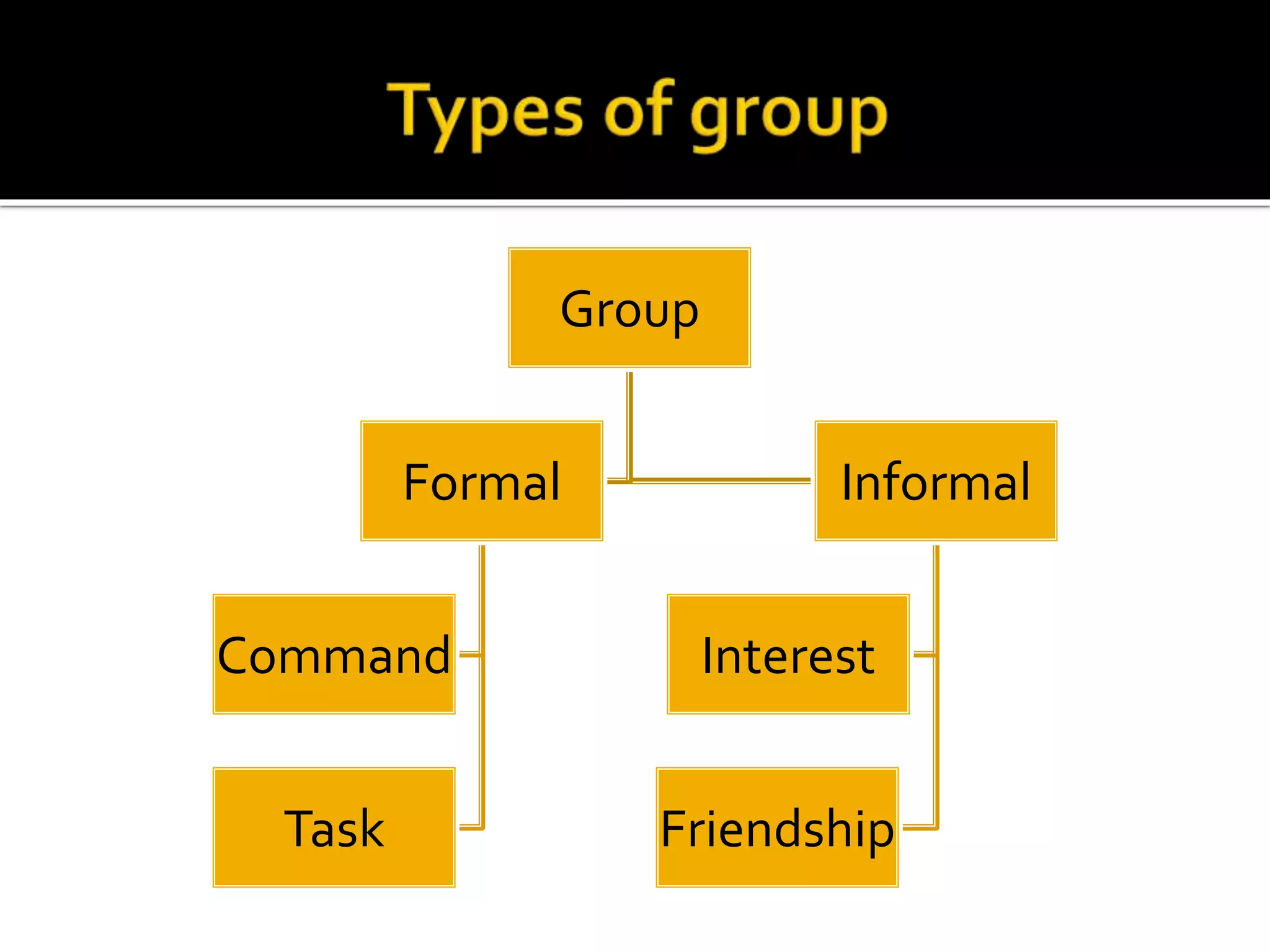
 Types of group
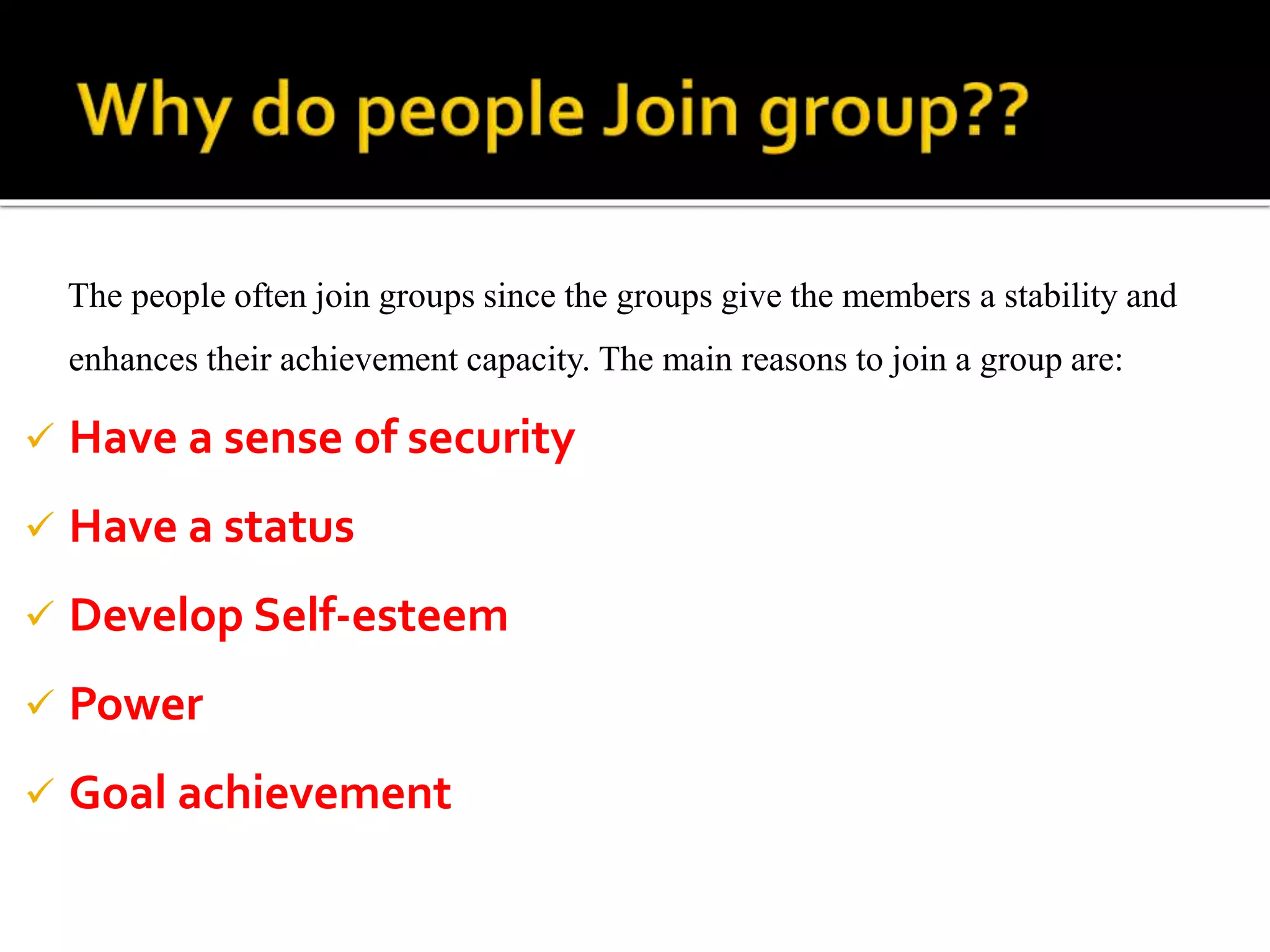
 why people join groups??
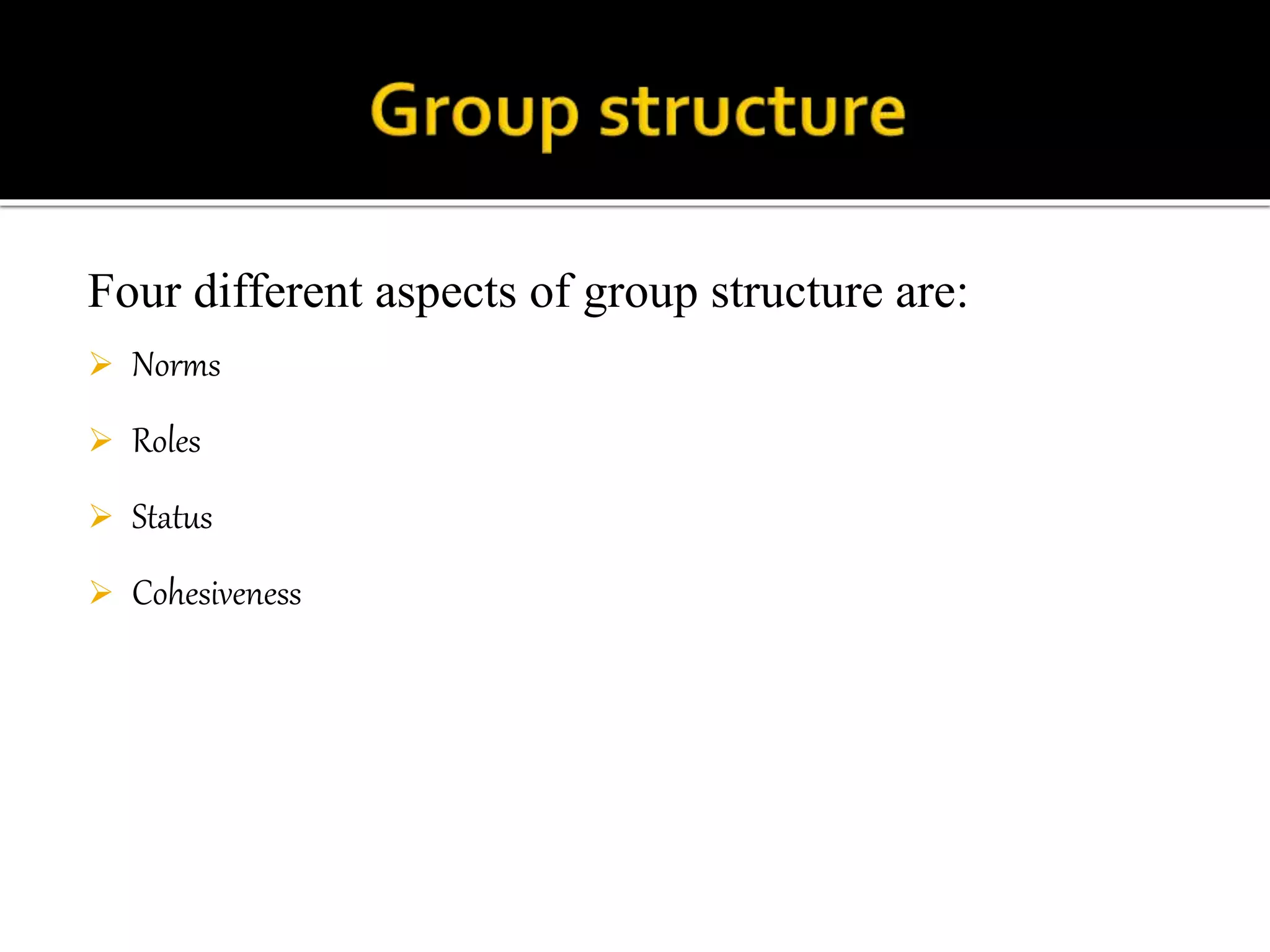
 Group Structure
 Theory of group formation
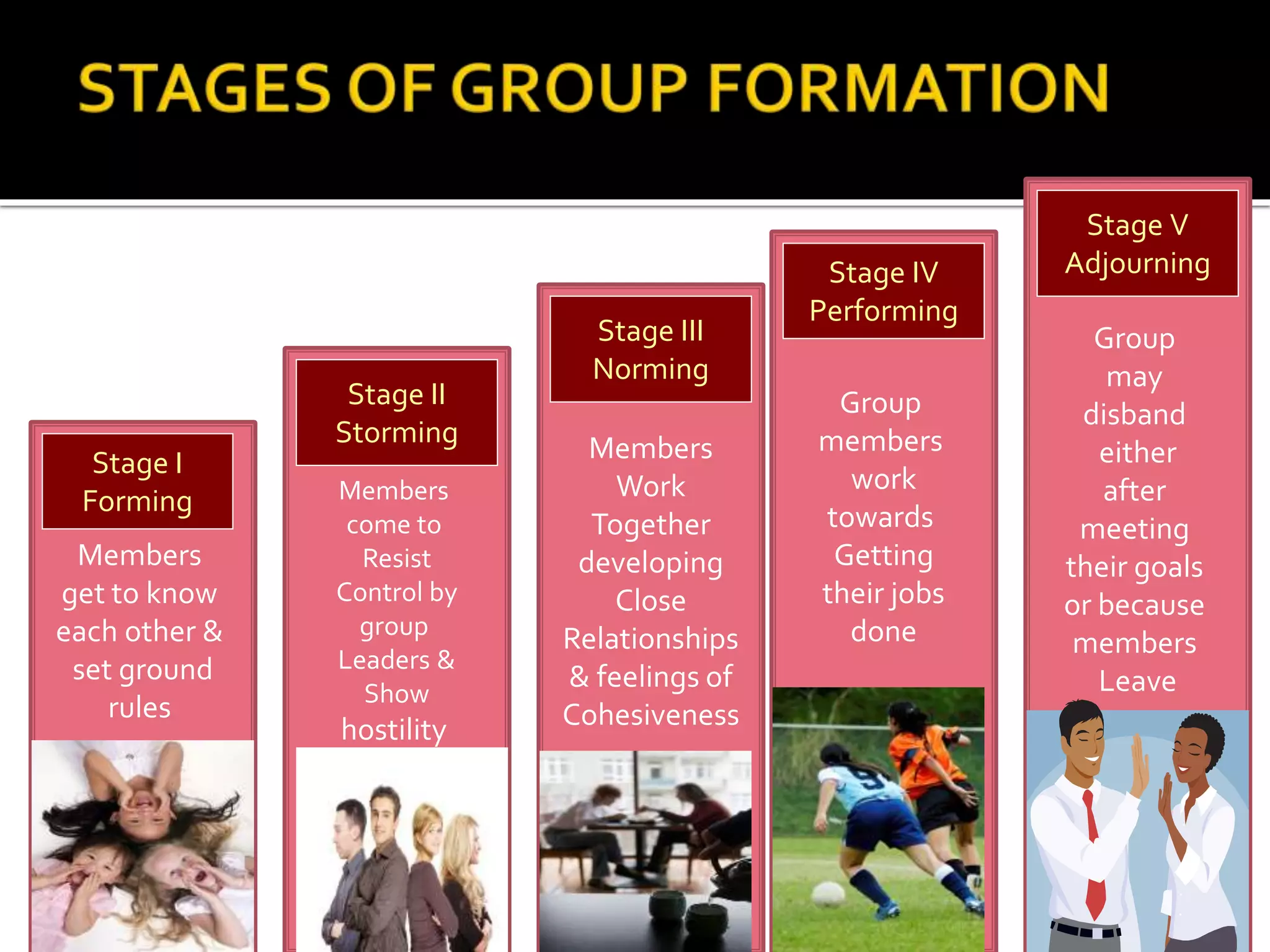
 Stages of group formation
 Principles of group dynamics
 Features of group dynamics
 Conclusion
It was founded by Kurt Lewin to study group decision, group productivity,
group interaction, group cohesiveness and group communication. The
underlying assumption was that the laws of the group behavior can be
established independently of the goals or specific activities of group
irrespective of the structure of the group.
Group dynamics contains two terms: group and dynamics.
Group is basically a collectivity of two or more persons. Dynamics comes
from Greek word meaning FORCE.
Thus, “Group dynamics is concerned with the interactions of
forces among group members in a social situation.”
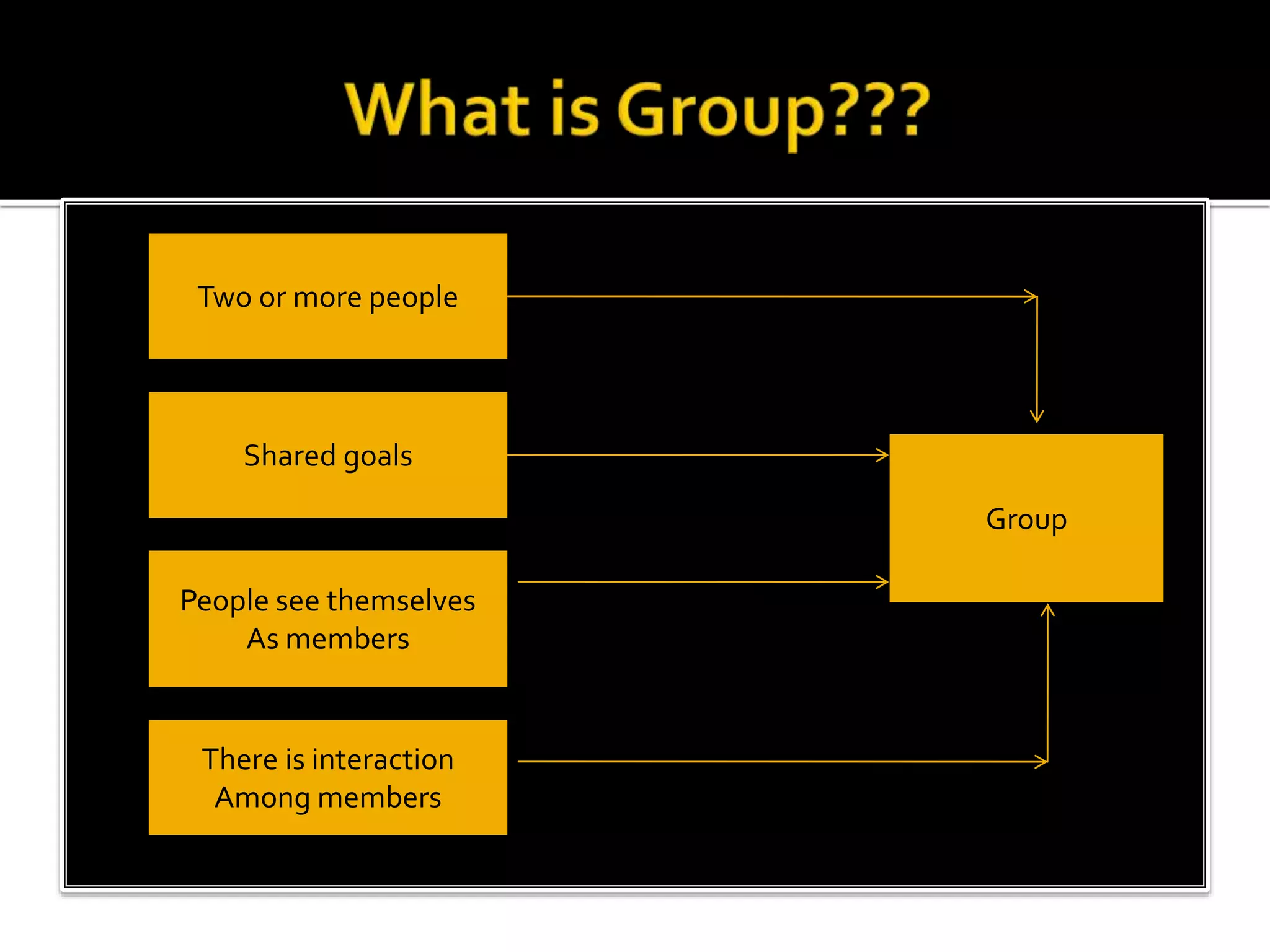
Two or more people
Shared goals
People see themselves
As members
There is interaction
Among members
Group
Group
Formal
Task
Command
Informal
Friendship
Interest
The people often join groups since the groups give the members a stability and
enhances their achievement capacity. The main reasons to join a group are:
 Have a sense of security
 Have a status
 Develop Self-esteem
 Power
 Goal achievement
Four different aspects of group structure are:
 Norms
 Roles
 Status
 Cohesiveness
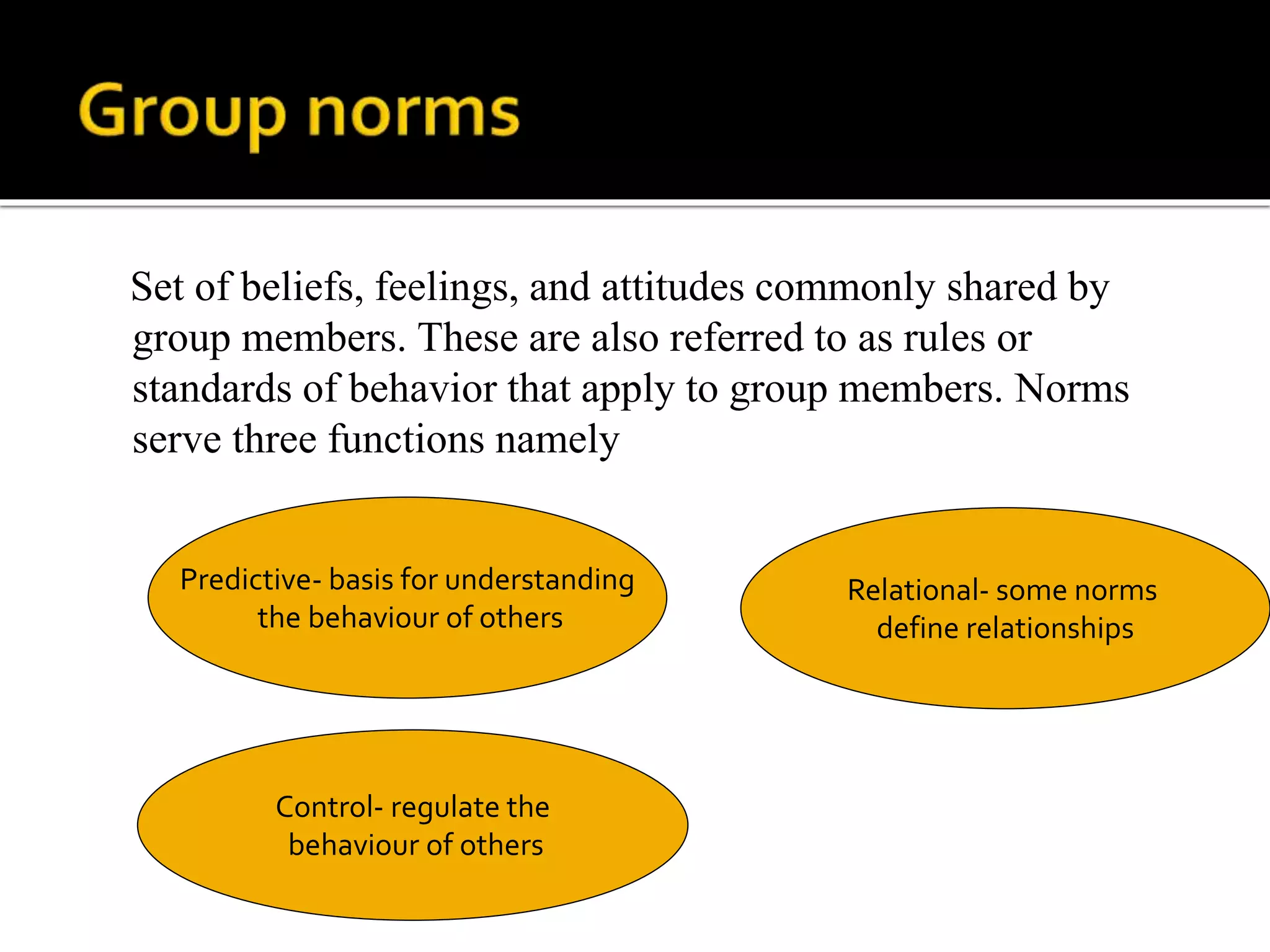
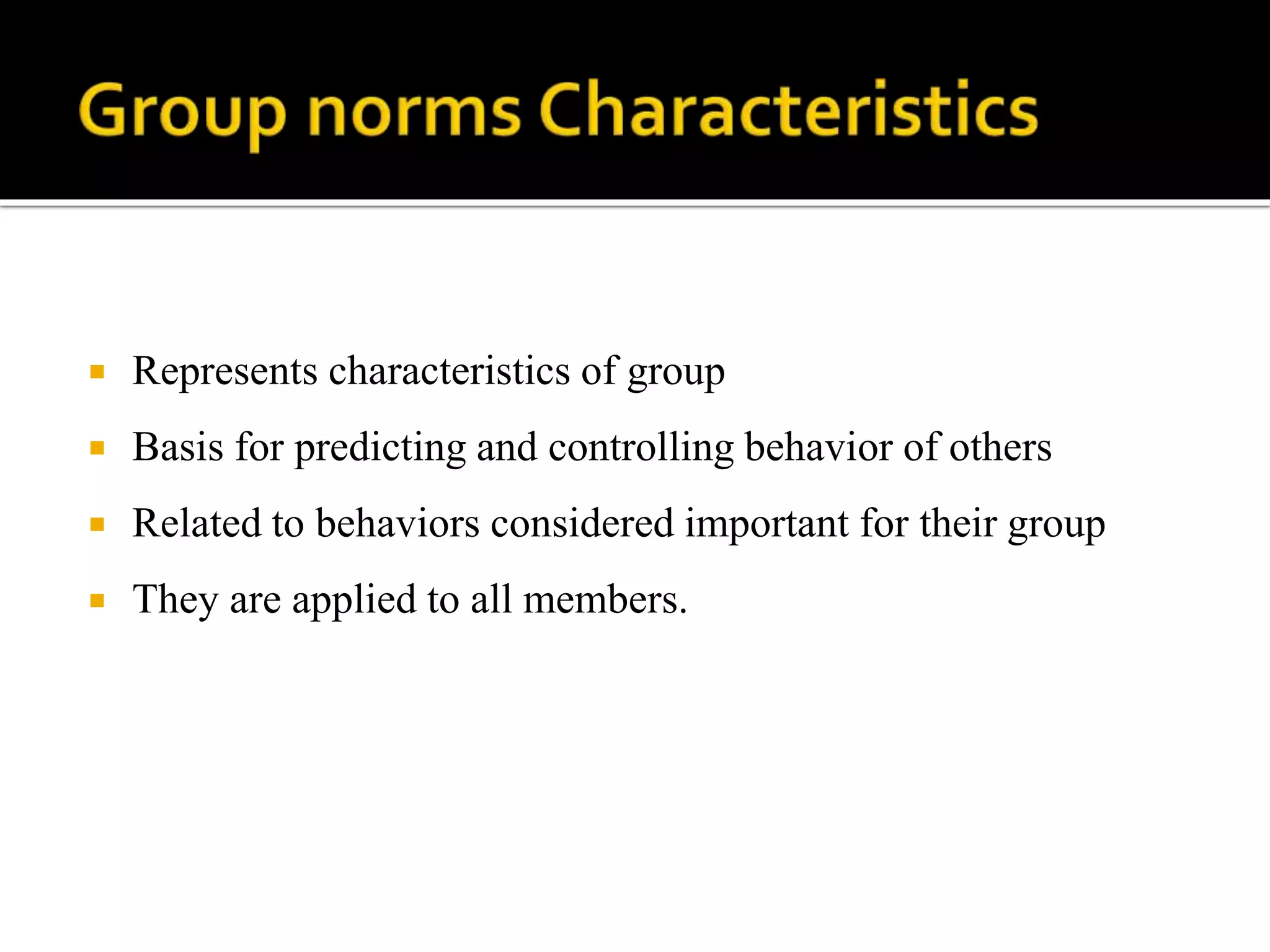
Set of beliefs, feelings, and attitudes commonly shared by
group members. These are also referred to as rules or
standards of behavior that apply to group members. Norms
serve three functions namely
Predictive- basis for understanding
the behaviour of others
Relational- some norms
define relationships
Control- regulate the
behaviour of others
 Represents characteristics of group
 Basis for predicting and controlling behavior of others
 Related to behaviors considered important for their group
 They are applied to all members.
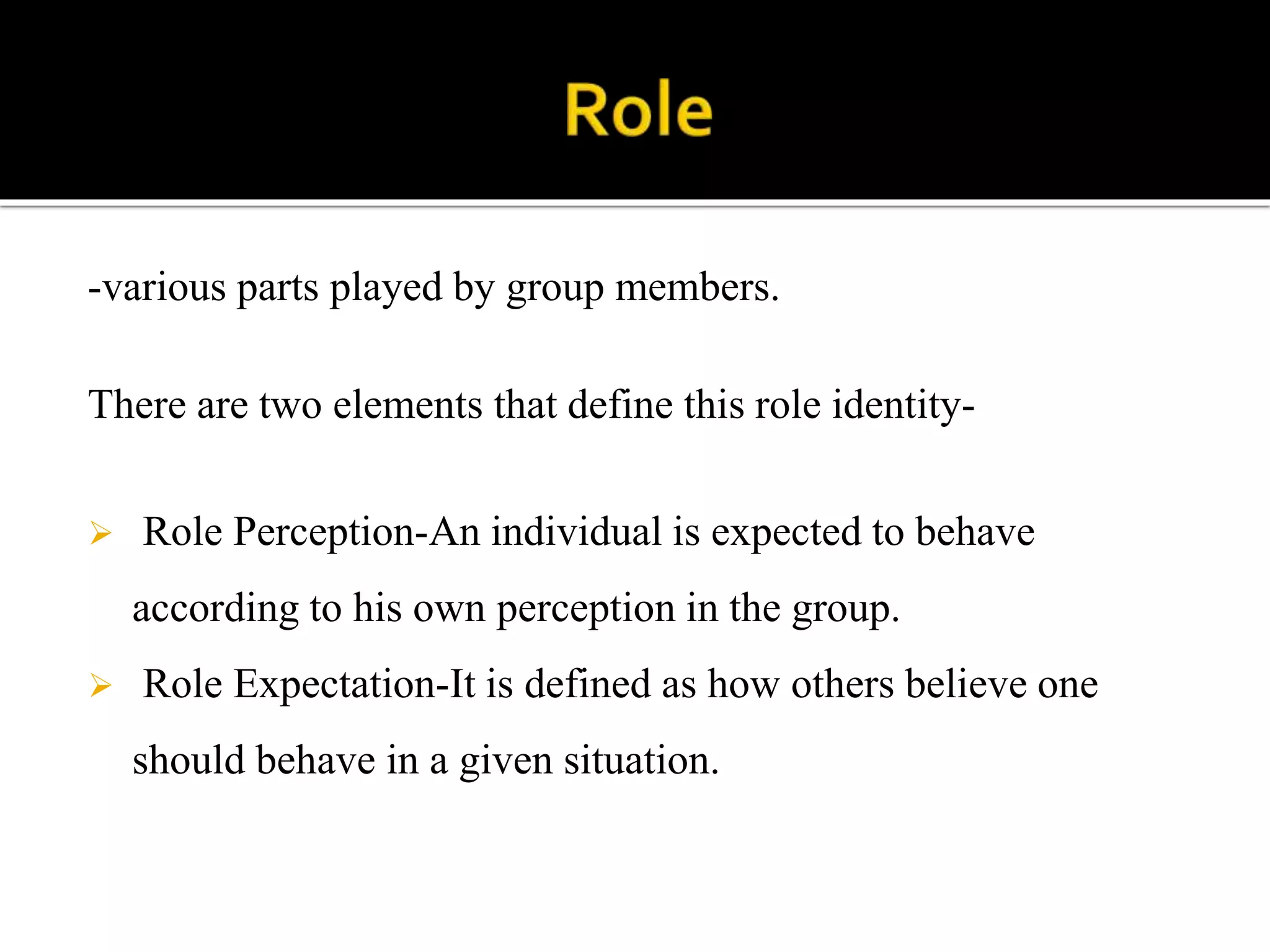
-various parts played by group members.
There are two elements that define this role identity-
 Role Perception-An individual is expected to behave
according to his own perception in the group.
 Role Expectation-It is defined as how others believe one
should behave in a given situation.
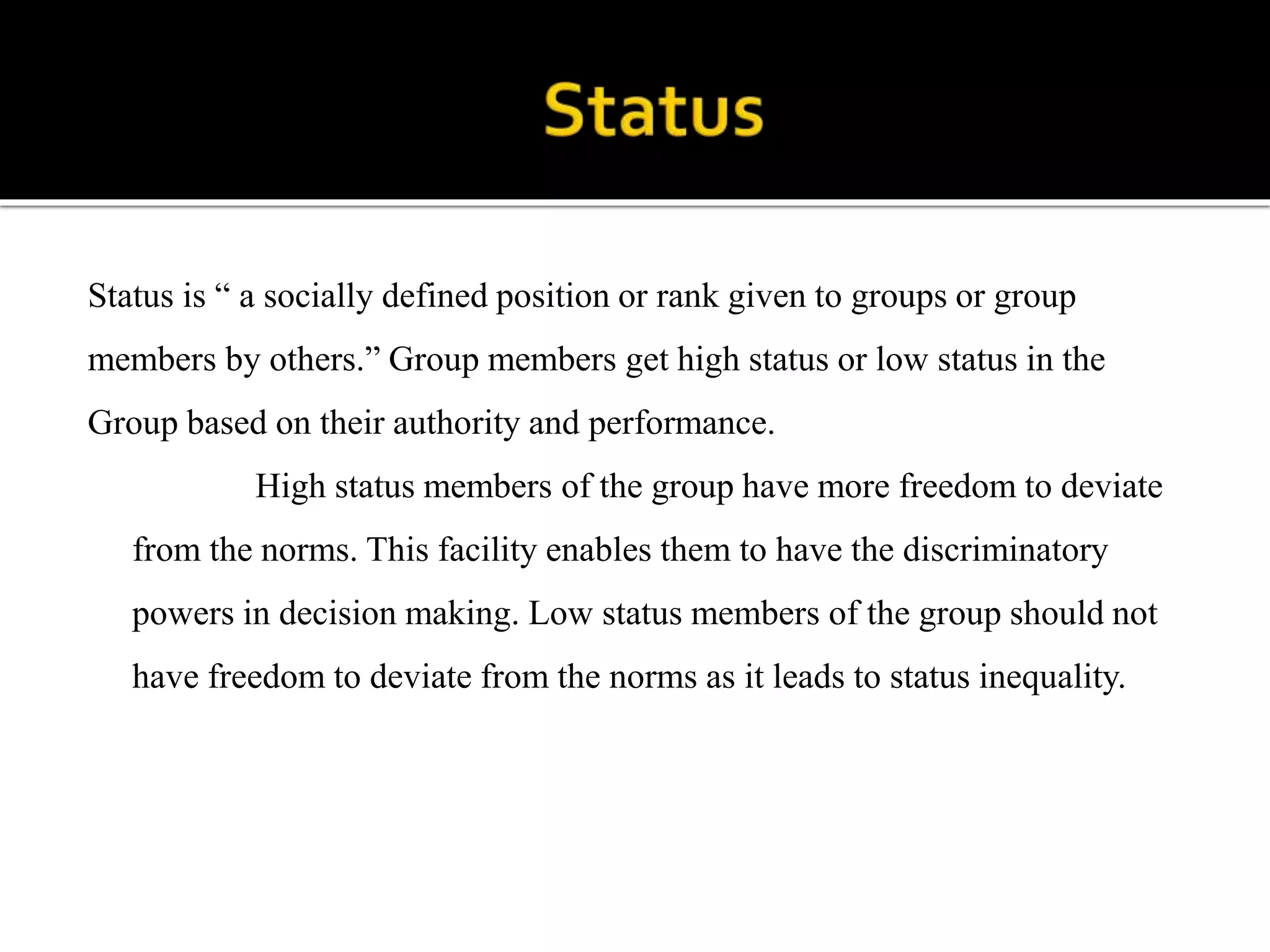
Status is “ a socially defined position or rank given to groups or group
members by others.” Group members get high status or low status in the
Group based on their authority and performance.
High status members of the group have more freedom to deviate
from the norms. This facility enables them to have the discriminatory
powers in decision making. Low status members of the group should not
have freedom to deviate from the norms as it leads to status inequality.
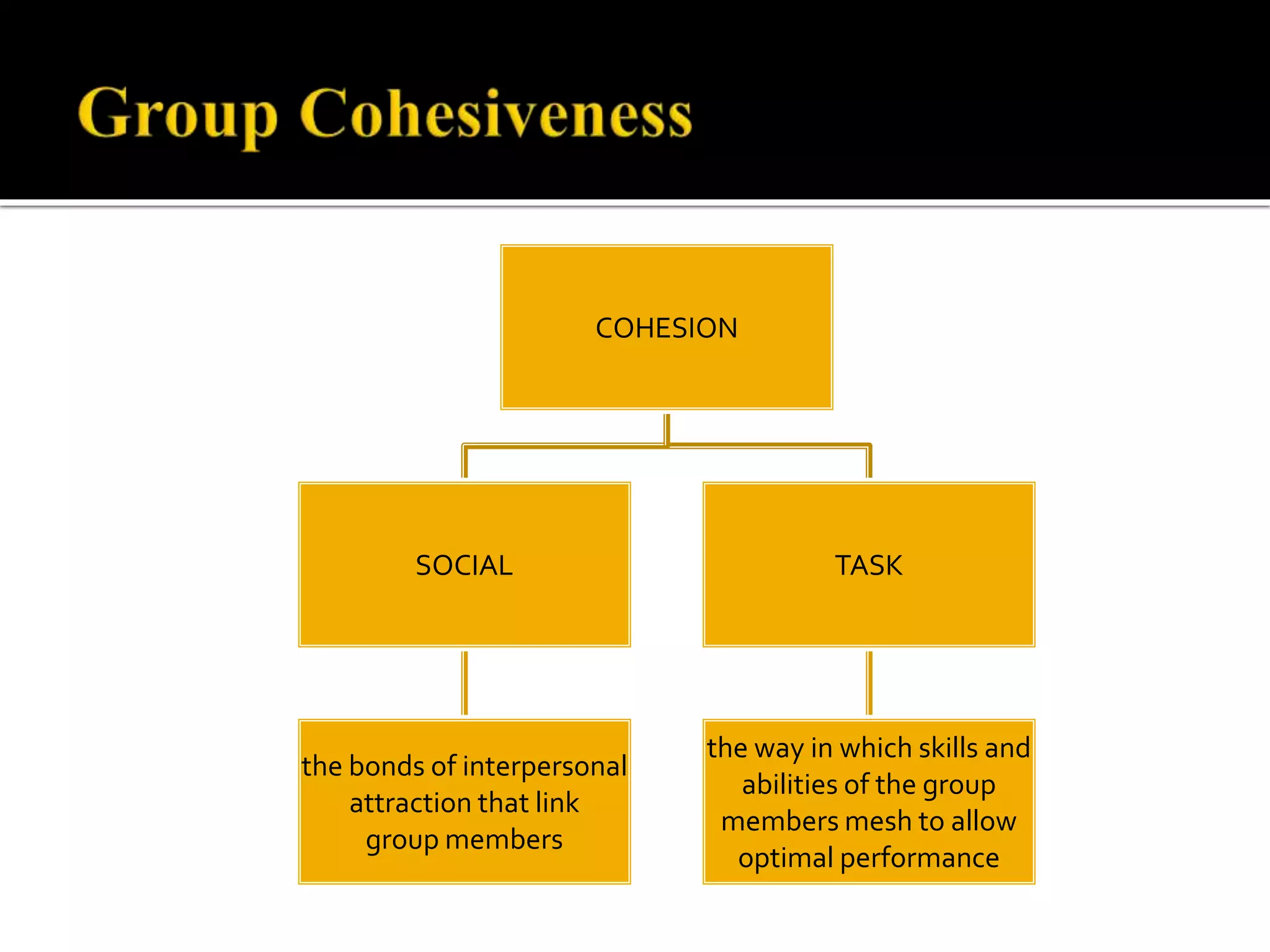
COHESION
SOCIAL
the bonds of interpersonal
attraction that link
group members
TASK
the way in which skills and
abilities of the group
members mesh to allow
optimal performance
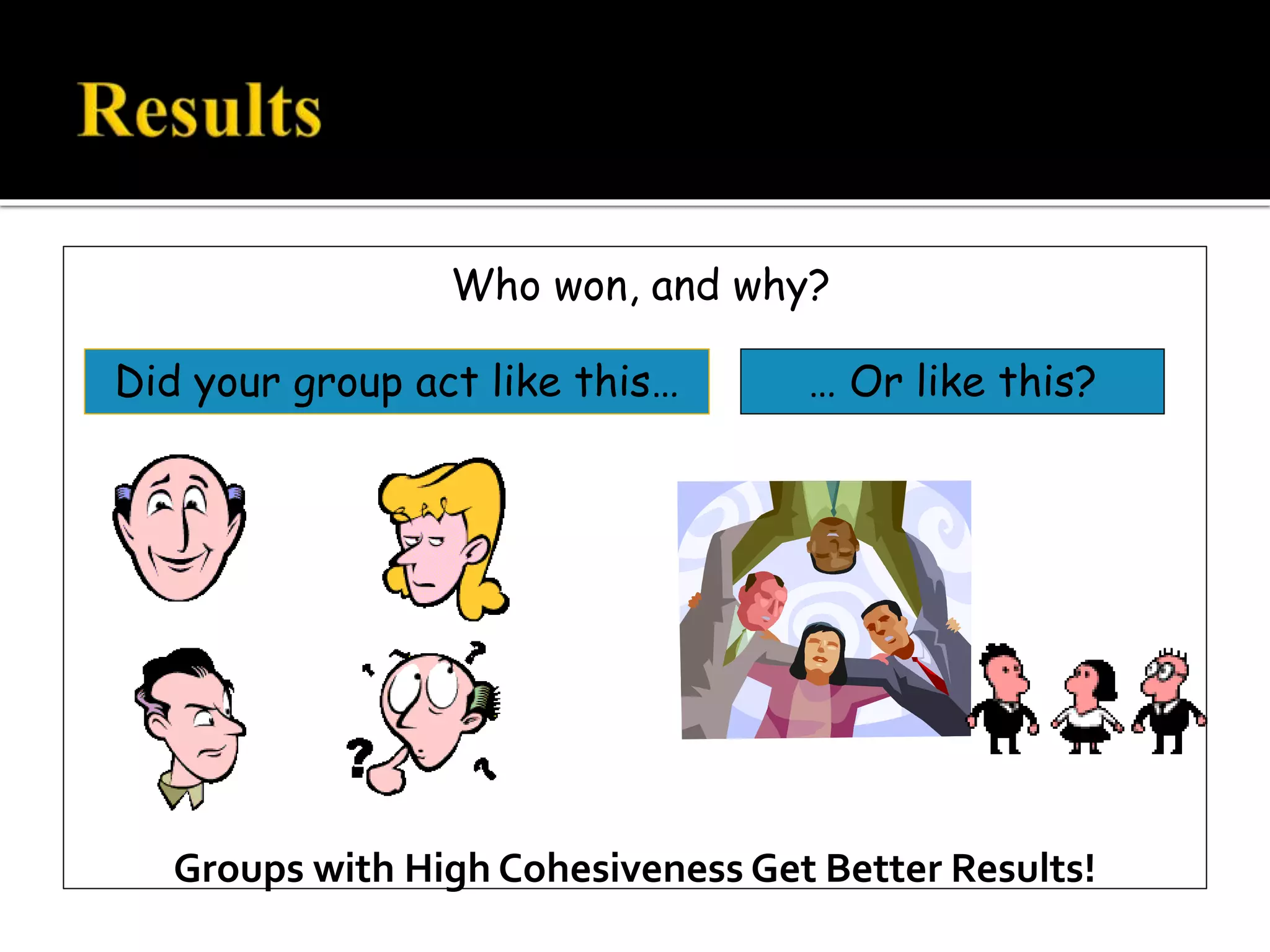
Who won, and why?
Did your group act like this… … Or like this?
Groups with High Cohesiveness Get Better Results!
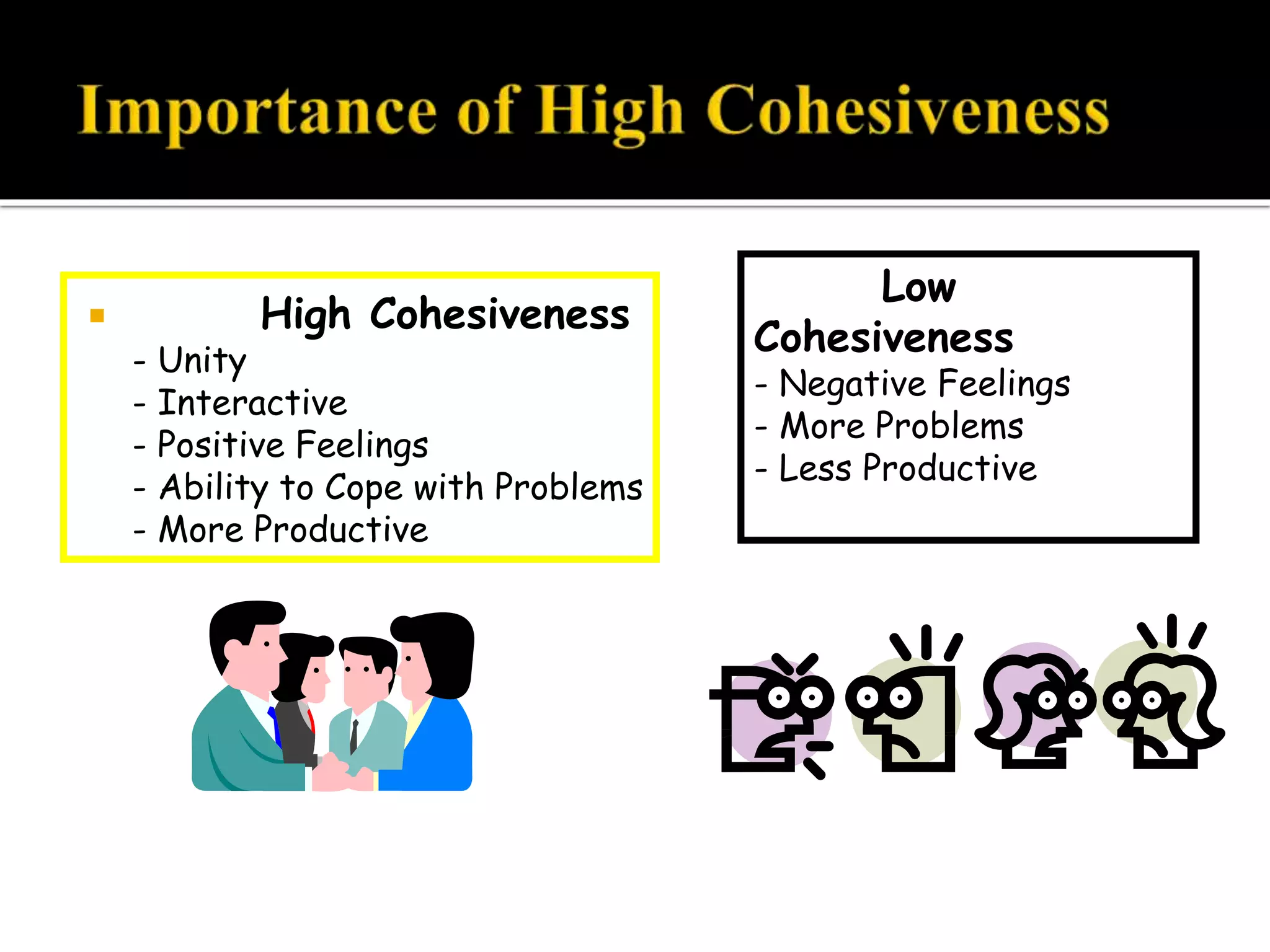
Low
Cohesiveness
- Negative Feelings
- More Problems
- Less Productive
 High Cohesiveness
- Unity
- Interactive
- Positive Feelings
- Ability to Cope with Problems
- More Productive
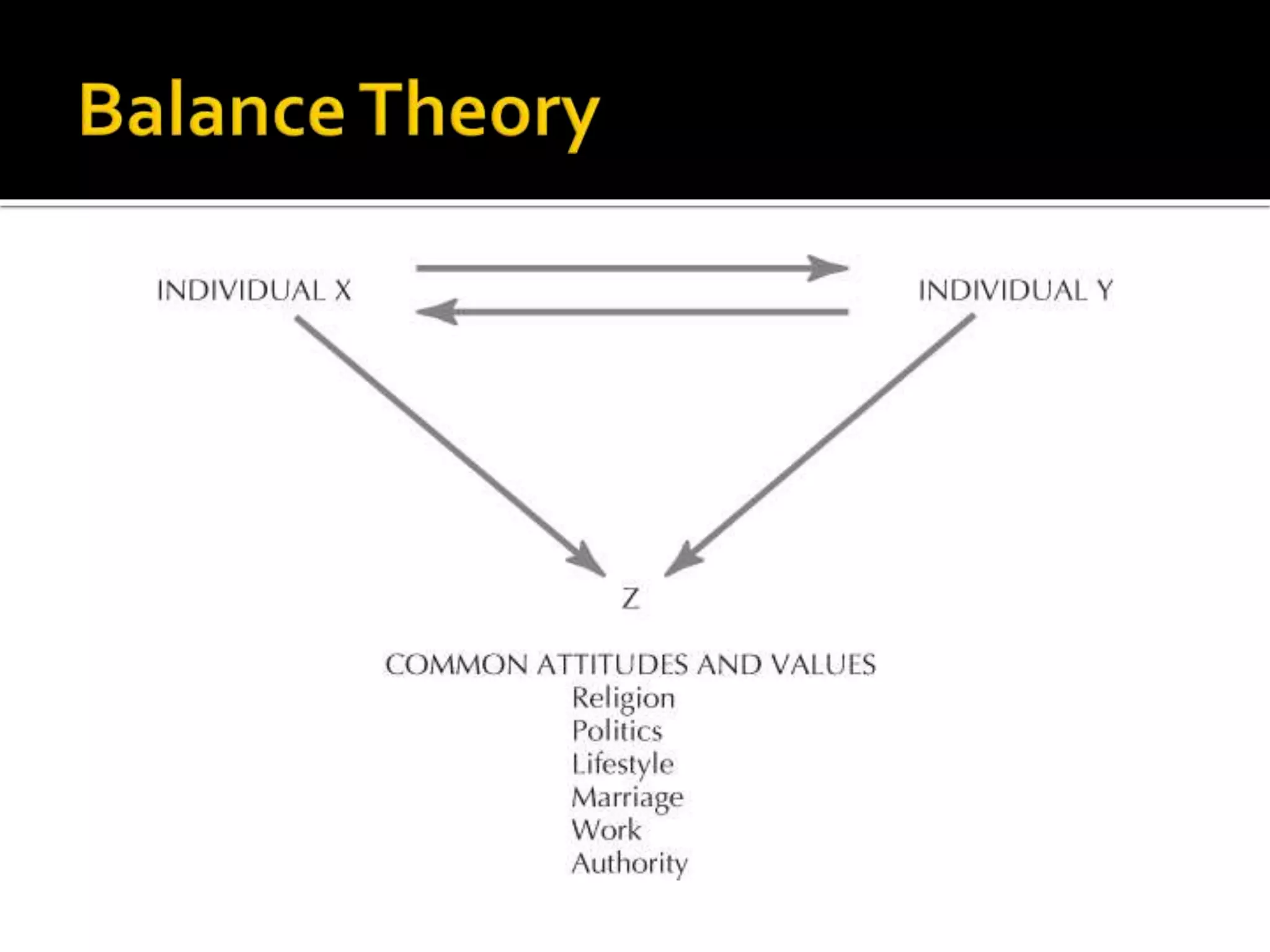
 Balance Theory:
Propounded by “ Theodore New-Comb” which states that- “
Persons are attracted with one another on the basis of similar
attitudes towards commonly relevant objectives and goals.”
 Propounded by “Thaibaunt and Kelly”.This
theory is based on reward-cost outcomes of
interaction between employees.
 The intraction between people is reward.
Members
get to know
each other &
set ground
rules
Members
come to
Resist
Control by
group
Leaders &
Show
hostility
Members
Work
Together
developing
Close
Relationships
& feelings of
Cohesiveness
Group
members
work
towards
Getting
their jobs
done
Group
may
disband
either
after
meeting
their goals
or because
members
Leave
Stage I
Forming
Stage II
Storming
Stage III
Norming
Stage IV
Performing
Stage V
Adjourning
 1 . The members of the group must have a strong sense of
belonging to the group .The barrier between the leaders and to
be led must be broken down.
 2. The more attraction a group is to its members, the greater
influence it would exercise on its members.
 3. The grater the prestige of the group member in the eyes of
the member in the eyes of the members , the grater influence
he would exercise on the theme.
 4.The successful efforts to change individuals sub parts of the
group would result in making them confirm to the norms of
the group.
 5. The pressures for change when strong can be established in
the group by creating a shared perception by the members for
the need for the change.
 Concerned with group
 Changes
 Rigidity or flexibility
 Continuous process
The groups operate on a common task and common attitudes. The
group dynamics is concerned with the interaction between the group
members in a social situation. This is concerned with the gaining in the
knowledge of the group, how they develop and their effect on the
individual members and the organization in which they function.
The group dynamics is essential to study since it helps to find
how the relationships are made within a group and how the forces act
within the group members in a social setting. This helps to recognize the
formation of group and how a group should be organized, lead and
promoted.
 In 1980 , Richard semler joined SEMCO , founded by his father 27 years
earlier, having 100 employees and manufacturing hydraulic pumps for
ships, producing about $4million in revenue and tottered on the edge of
bankruptcy.
 For the next 2 years, top managers constantly sought bank loans and
fought off rumors that the company was about to sink.
 They also travelled 4 continents that enabled the company to reduce its
cyclical marine business to 60% of total sales.
 Today SEMCO has many factories producing range of products like
marine pumps, digital scanners, commercial dishwashers, truck filters and
mixing equipment for substances ranging from bubble gum to rocket fuel.
 Customers include Alcoa,saab,general motors and SEMCO is regarded as
one of the best company in Brazil to work for by press.
 The company’s survival and ultimate success is due largely to a major change in its
management approach.
 SEMCO emphasized on 3 fundamental values- democracy , information , profit
sharing. These values helped in gaining confidence on work groups as a primary
mechanism for managing the company.
 After some experimentations SEMCO found that they need 150 employees per
factory and all are divided into 10 member group given a major responsibilities for
outcomes associated with their areas.
 Costs rose up because of duplication of effort and lost economies of scale. within a
year sales got doubled ,inventory dropped from126 to 46 days,8 new products
appeared that had been tied up in R&D for 2 years and the product rejection rate at
inspection dropped from 33 to 1% and increased productivity enabled the company
to reduce the workforce by 32& through attrition and early retirement.
 At SEMCO once the members of a group agree on a monthly production schedule,
they meet it . At end of the month every body has done their work allotted except
for motors that had not yet arrived, despite repeated phone calls to the supplier.
 finally 2 employees went to the supplier’s plant and got delivery on the last day of
the month and every one sat for the whole night till mng 4.45 and completed the
assignment ( meat slicers)
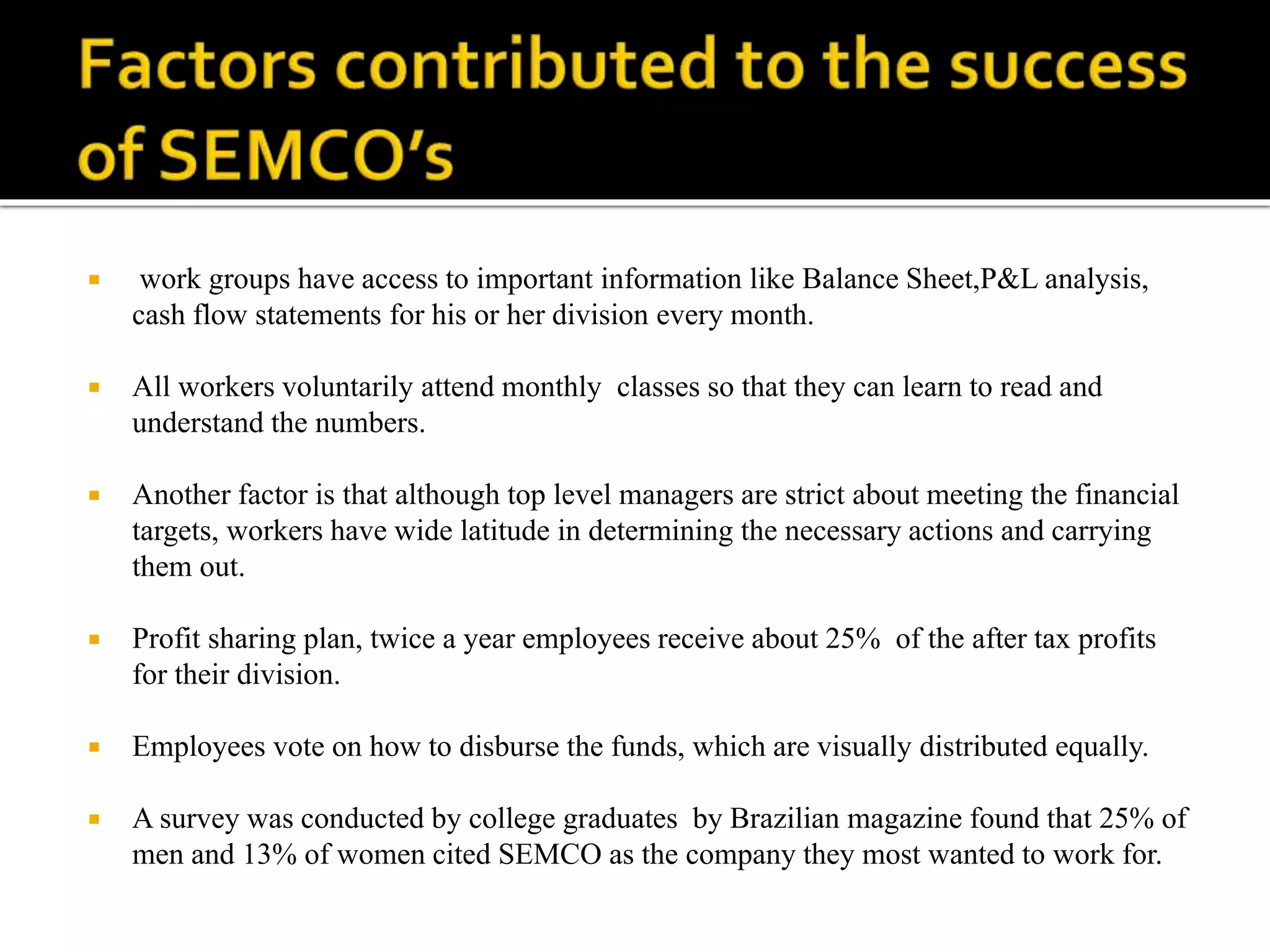
 work groups have access to important information like Balance Sheet,P&L analysis,
cash flow statements for his or her division every month.
 All workers voluntarily attend monthly classes so that they can learn to read and
understand the numbers.
 Another factor is that although top level managers are strict about meeting the financial
targets, workers have wide latitude in determining the necessary actions and carrying
them out.
 Profit sharing plan, twice a year employees receive about 25% of the after tax profits
for their division.
 Employees vote on how to disburse the funds, which are visually distributed equally.
 A survey was conducted by college graduates by Brazilian magazine found that 25% of
men and 13% of women cited SEMCO as the company they most wanted to work for.
Group dynamics

Group dynamics

  • 2.
     Concept ofgroup dynamics  What is group???  Types of group  why people join groups??  Group Structure  Theory of group formation  Stages of group formation  Principles of group dynamics  Features of group dynamics  Conclusion
  • 3.
    It was foundedby Kurt Lewin to study group decision, group productivity, group interaction, group cohesiveness and group communication. The underlying assumption was that the laws of the group behavior can be established independently of the goals or specific activities of group irrespective of the structure of the group. Group dynamics contains two terms: group and dynamics. Group is basically a collectivity of two or more persons. Dynamics comes from Greek word meaning FORCE. Thus, “Group dynamics is concerned with the interactions of forces among group members in a social situation.”
  • 4.
    Two or morepeople Shared goals People see themselves As members There is interaction Among members Group
  • 5.
  • 6.
    The people oftenjoin groups since the groups give the members a stability and enhances their achievement capacity. The main reasons to join a group are:  Have a sense of security  Have a status  Develop Self-esteem  Power  Goal achievement
  • 7.
    Four different aspectsof group structure are:  Norms  Roles  Status  Cohesiveness
  • 8.
    Set of beliefs,feelings, and attitudes commonly shared by group members. These are also referred to as rules or standards of behavior that apply to group members. Norms serve three functions namely Predictive- basis for understanding the behaviour of others Relational- some norms define relationships Control- regulate the behaviour of others
  • 9.
     Represents characteristicsof group  Basis for predicting and controlling behavior of others  Related to behaviors considered important for their group  They are applied to all members.
  • 10.
    -various parts playedby group members. There are two elements that define this role identity-  Role Perception-An individual is expected to behave according to his own perception in the group.  Role Expectation-It is defined as how others believe one should behave in a given situation.
  • 11.
    Status is “a socially defined position or rank given to groups or group members by others.” Group members get high status or low status in the Group based on their authority and performance. High status members of the group have more freedom to deviate from the norms. This facility enables them to have the discriminatory powers in decision making. Low status members of the group should not have freedom to deviate from the norms as it leads to status inequality.
  • 12.
    COHESION SOCIAL the bonds ofinterpersonal attraction that link group members TASK the way in which skills and abilities of the group members mesh to allow optimal performance
  • 13.
    Who won, andwhy? Did your group act like this… … Or like this? Groups with High Cohesiveness Get Better Results!
  • 14.
    Low Cohesiveness - Negative Feelings -More Problems - Less Productive  High Cohesiveness - Unity - Interactive - Positive Feelings - Ability to Cope with Problems - More Productive
  • 15.
     Balance Theory: Propoundedby “ Theodore New-Comb” which states that- “ Persons are attracted with one another on the basis of similar attitudes towards commonly relevant objectives and goals.”
  • 17.
     Propounded by“Thaibaunt and Kelly”.This theory is based on reward-cost outcomes of interaction between employees.  The intraction between people is reward.
  • 18.
    Members get to know eachother & set ground rules Members come to Resist Control by group Leaders & Show hostility Members Work Together developing Close Relationships & feelings of Cohesiveness Group members work towards Getting their jobs done Group may disband either after meeting their goals or because members Leave Stage I Forming Stage II Storming Stage III Norming Stage IV Performing Stage V Adjourning
  • 19.
     1 .The members of the group must have a strong sense of belonging to the group .The barrier between the leaders and to be led must be broken down.  2. The more attraction a group is to its members, the greater influence it would exercise on its members.  3. The grater the prestige of the group member in the eyes of the member in the eyes of the members , the grater influence he would exercise on the theme.
  • 20.
     4.The successfulefforts to change individuals sub parts of the group would result in making them confirm to the norms of the group.  5. The pressures for change when strong can be established in the group by creating a shared perception by the members for the need for the change.
  • 21.
     Concerned withgroup  Changes  Rigidity or flexibility  Continuous process
  • 22.
    The groups operateon a common task and common attitudes. The group dynamics is concerned with the interaction between the group members in a social situation. This is concerned with the gaining in the knowledge of the group, how they develop and their effect on the individual members and the organization in which they function. The group dynamics is essential to study since it helps to find how the relationships are made within a group and how the forces act within the group members in a social setting. This helps to recognize the formation of group and how a group should be organized, lead and promoted.
  • 23.
     In 1980, Richard semler joined SEMCO , founded by his father 27 years earlier, having 100 employees and manufacturing hydraulic pumps for ships, producing about $4million in revenue and tottered on the edge of bankruptcy.  For the next 2 years, top managers constantly sought bank loans and fought off rumors that the company was about to sink.  They also travelled 4 continents that enabled the company to reduce its cyclical marine business to 60% of total sales.  Today SEMCO has many factories producing range of products like marine pumps, digital scanners, commercial dishwashers, truck filters and mixing equipment for substances ranging from bubble gum to rocket fuel.  Customers include Alcoa,saab,general motors and SEMCO is regarded as one of the best company in Brazil to work for by press.
  • 24.
     The company’ssurvival and ultimate success is due largely to a major change in its management approach.  SEMCO emphasized on 3 fundamental values- democracy , information , profit sharing. These values helped in gaining confidence on work groups as a primary mechanism for managing the company.  After some experimentations SEMCO found that they need 150 employees per factory and all are divided into 10 member group given a major responsibilities for outcomes associated with their areas.  Costs rose up because of duplication of effort and lost economies of scale. within a year sales got doubled ,inventory dropped from126 to 46 days,8 new products appeared that had been tied up in R&D for 2 years and the product rejection rate at inspection dropped from 33 to 1% and increased productivity enabled the company to reduce the workforce by 32& through attrition and early retirement.  At SEMCO once the members of a group agree on a monthly production schedule, they meet it . At end of the month every body has done their work allotted except for motors that had not yet arrived, despite repeated phone calls to the supplier.  finally 2 employees went to the supplier’s plant and got delivery on the last day of the month and every one sat for the whole night till mng 4.45 and completed the assignment ( meat slicers)
  • 25.
     work groupshave access to important information like Balance Sheet,P&L analysis, cash flow statements for his or her division every month.  All workers voluntarily attend monthly classes so that they can learn to read and understand the numbers.  Another factor is that although top level managers are strict about meeting the financial targets, workers have wide latitude in determining the necessary actions and carrying them out.  Profit sharing plan, twice a year employees receive about 25% of the after tax profits for their division.  Employees vote on how to disburse the funds, which are visually distributed equally.  A survey was conducted by college graduates by Brazilian magazine found that 25% of men and 13% of women cited SEMCO as the company they most wanted to work for.