
Introduction to
Organizational Behaviour
Module-1
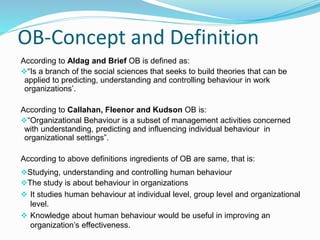
OB-Concept and Definition
According to Aldag and Brief OB is defined as:
“Is a branch of the social sciences that seeks to build theories that can be
applied to predicting, understanding and controlling behaviour in work
organizations’.
According to Callahan, Fleenor and Kudson OB is:
“Organizational Behaviour is a subset of management activities concerned
with understanding, predicting and influencing individual behaviour in
organizational settings”.
According to above definitions ingredients of OB are same, that is:
Studying, understanding and controlling human behaviour
The study is about behaviour in organizations
 It studies human behaviour at individual level, group level and organizational
level.
 Knowledge about human behaviour would be useful in improving an
organization’s effectiveness.
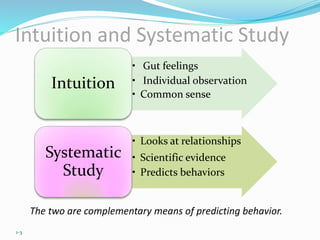
Intuition and Systematic Study
• Gut feelings
• Individual observation
• Common sense
Intuition
• Looks at relationships
• Scientific evidence
• Predicts behaviors
Systematic
Study
The two are complementary means of predicting behavior.
1-3
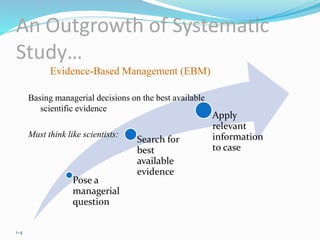
An Outgrowth of Systematic
Study…
Pose a
managerial
question
Search for
best
available
evidence
Apply
relevant
information
to case
Evidence-Based Management (EBM)
Basing managerial decisions on the best available
scientific evidence
Must think like scientists:
1-4
Managers Should Use All Three
Approaches
The trick is to know when to go with your gut.
– Jack Welsh
 Intuition is often based on inaccurate information
 Faddism is prevalent in management
 Systematic study can be time consuming
Use evidence as much as possible to inform your
intuition and experience. That is the promise of OB.
1-5
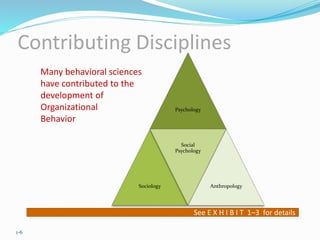
Contributing Disciplines
Psychology
Sociology
Social
Psychology
Anthropology
See E X H I B I T 1–3 for details
Many behavioral sciences
have contributed to the
development of
Organizational
Behavior
1-6
Psychology
The science that seeks to measure, explain, and sometimes
change the behavior of humans and other animals.
Unit of Analysis:
 Individual
Contributions to OB:
 Learning, motivation, personality, emotions, perception
 Training, leadership effectiveness, job satisfaction
 Individual decision making, performance appraisal, attitude
measurement
 Employee selection, work design, and work stress
1-7
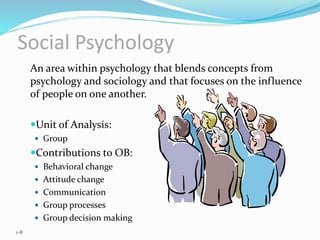
Social Psychology
An area within psychology that blends concepts from
psychology and sociology and that focuses on the influence
of people on one another.
Unit of Analysis:
 Group
Contributions to OB:
 Behavioral change
 Attitude change
 Communication
 Group processes
 Group decision making
1-8
Sociology
Unit of Analysis:
-- Organizational System
 Contributions to OB:
 Group dynamics
 Work teams
 Communication
 Power
 Conflict
 Intergroup behavior
-- Group
 Formal organization theory
 Organizational technology
 Organizational change
 Organizational culture
The study of people in relation to their fellow human
beings.
1-9
Anthropology
Unit of Analysis:
-- Organizational System
 Contributions to OB:
 Organizational culture
 Organizational environment
-- Group
 Comparative values
 Comparative attitudes
 Cross-cultural analysis
The study of societies to learn about human beings and
their activities.
1-10
Nature of OB
A field of Study and not a Discipline- OB can be treated as a distinct field of study and
not a discipline or even emerging discipline.
 OB, because of its broad base, recent emergence and interdisciplinary orientation,
is not accepted as science.
2. Interdisciplinary Approach- OB is basically an interdisciplinary approach.
 An interdisciplinary approach integrates the relevant knowledge drawn from different
disciplines like psychology, sociology and anthropology.
3. An Applied Science- The basic objective of OB is to make application of various
researches to solve the organizational problems particularly related to human
behaviour aspect.
4. Humanistic and Optimistic-
OB focuses the attention on people from humanistic point of view.
 It is based on the belief that needs and motivation of people are of high concern.
5. Oriented towards Organizational Objective-
OB, being an applied science and emphasising human aspect of the organization, is
oriented towards organizational objectives.
6. A total Systems Approach-
The systems approach is an integrative approach which takes into account all the
variables affecting organizational functioning.
Importance of OB
 Road map to our lives in organisations
 Helps us understand and predict organisational
life
 Influences events in organisations
 Helps understand self and others better
 Helps a manager get things done better
 Helps maintain cordial relations
 Highly useful in the field of marketing
 Helps in career planning and development
 Helps sustain the temp of economic growth
Limitations of OB
 Knowledge about OB does not help an individual
manage personal life better
 Dualities of OB are baffling
 Has become a fad with managers
 Is selfish and exploitative
 Managers expect quick-fix solutions-not possible
 Principles and practices may not work in the
events of declining fortunes
 Cannot eliminate totally conflict and frustration
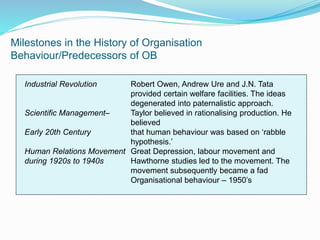
Milestones in the History of Organisation
Behaviour/Predecessors of OB
Industrial Revolution Robert Owen, Andrew Ure and J.N. Tata
provided certain welfare facilities. The ideas
degenerated into paternalistic approach.
Scientific Management– Taylor believed in rationalising production. He
believed
Early 20th Century that human behaviour was based on ‘rabble
hypothesis.’
Human Relations Movement Great Depression, labour movement and
during 1920s to 1940s Hawthorne studies led to the movement. The
movement subsequently became a fad
Organisational behaviour – 1950’s
The Industrial Revolution’s Influence
On Management Practices
 Machine power began to substitute for human power
 Lead to mass production of economical goods
 Improved and less costly transportation systems
became available
 Created larger markets for goods.
 Larger organizations developed to serve larger
markets
 Created the need for formalized management practices.
Scientific Management
Frederick W. Taylor Scientific Management
 The Principles of Scientific
Management (1911)
 Advocated the use of the scientific
method to define the “one best
way” for a job to be done
 Believed that increased efficiency
could be achieved by selecting
the right people for the job and
training them to do it precisely in
the one best way.
 To motivate workers, he favored
incentive wage plans.
 Separated managerial work from
operative work.
 The systematic study of the
relationships between
people and tasks for the
purpose of redesigning the
work process for higher
efficiency.
 Taylor sought to reduce the
time a worker spent on each
task by optimizing the way
the task was done.
Definition of Hawthorne Studies
 “Mayo wanted to find out what effect fatigue and
monotony had on job productivity and how to
control them through such variables as rest
breaks, work hours, temperatures and humidity.”
Origins of Human Relations Theory
 “The Hawthorne Studies
 Hawthorne Works of Western Electric
Company
 1924 - Chicago
 Research focus: Relation of quality and
quantity of illumination to efficiency in
industry
 Four Important Studies
“The Hawthorne Studies”
 Illumination Study (November 1924)
 Designed to test the effect of lighting intensity on worker productivity
 Heuristic value: influence of human relations on work behavior
 Relay Assembly Test Room Study (1927-1932)
 Assembly of telephone relays (35 parts - 4 machine screws)
 Production and satisfaction increased regardless of IV manipulation
 Workers’ increased production and satisfaction related to supervisory
practices
 Human interrelationships are important contributing factors to worker
productivity
 Bottom Line: Supervisory practices increase employee morale AND
productivity
 Interviewing Program (1928-1930)
 Investigate connection between supervisory practices and employee morale
 Employees expressed their ideas and feelings (e.g., likes and dislikes)
 Process more important than actual results
 Bank Wiring Room Observation Study (November 1931 - May 1932)
 Social groups can influence production and individual work behavior
 RQ: How is social control manifested on the shop floor?
 Informal organization constrains employee behavior within formal
organizational structure
CHALLENGES AND OPPORTUNITIES FOR OB
1. Responding to economic pressures
 Deep and prolonged recession in 2008 that spread
worldwide
 In difficult economic times, effective management is
an asset. During these times, the difference between
good and bad management can be the difference
between profit and loss.
 In good times, understanding how to reward, satisfy,
and retain employees is at a premium. In bad times,
issues like stress, decision making, and coping come
to the fore.
CHALLENGES AND OPPORTUNITIES FOR OB
2. Responding to globalization
 Increased foreign assignments
 Organizations are no longer constrained by national borders.
 Once you’re in another country, you’ll have to manage a workforce
very differently in needs, aspirations, and attitudes from those you are
used to back home.
 Working with people from different cultures
 Even in your own country, you’ll find yourself working with bosses,
peers, and other employees born and raised in different cultures.
 Management practices need to be modified to reflect the values of the
different countries in which an organization operates.
 Overseeing movement of jobs to countries with low-cost labor
 Managers are under pressure to keep costs down to maintain
competitiveness.
 Moving jobs to low-labor cost places requires managers to deal with
difficulties in balancing the interests of their organization with
responsibilities to the communities in which they operate.
CHALLENGES AND OPPORTUNITIES FOR OB
3. Managing workforce diversity
 Workforce diversity is one of the most important and broad-
based challenges currently facing organizations.
 While globalization focuses on differences between people from
different countries, workforce diversity addresses differences among
people within given countries.
 Workforce diversity acknowledges a workforce of women and men;
many racial and ethnic groups; individuals with a variety of physical
or psychological abilities; and people who differ in age and sexual
orientation.
 Managing this diversity is a global concern.
 Three demographic forces will shape India’s labor force in this decade:
more women in the workforce, urbanization, and an increase in the
population of Indians in their thirties and forties.
CHALLENGES AND OPPORTUNITIES FOR OB
4. Improving customer service
 Today the majority of employees in developed
countries work in service jobs.
 The service industry in India contributed 54.6 per cent of the
country’s GDP and employed 34 per cent of the labor force in
2009.
 Examples of people in the service industry include technical
support reps, fast food counter workers, waiters, nurses,
financial planners, and flight attendants.
 Employee attitudes and behavior are associated with
customer satisfaction.
CHALLENGES AND OPPORTUNITIES FOR OB
5. Improving people skills
 People skills are essential to managerial effectiveness.
 OB provides the concepts and theories that allow
managers to predict employee behavior in given
situations.
6. Stimulating innovation and change
 Successful organizations must foster innovation and
master the art of change.
 Employees can be the impetus for innovation and
change or a major stumbling block.
 Managers must stimulate employees’ creativity and
tolerance for change.
CHALLENGES AND OPPORTUNITIES FOR OB
7. Coping with “temporariness”
 Organizations must be flexible and fast in order to survive. In
such a scenario:
 Jobs must be continually redesigned.
 Tasks are being done by flexible work teams rather than
individuals.
 Companies rely more on temporary workers.
 Workers need to update knowledge and skills.
 Work groups and organizations are in a continuing state of
flux.
 Managers and employees must learn to cope with temporariness.
 Learning to live with flexibility, spontaneity, and unpredictability
has become part of one’s job.
 OB provides help in understanding a work world of continual
change, overcoming resistance to change, and creating an
organizational culture that thrives on change.
CHALLENGES AND OPPORTUNITIES FOR OB
8. Working in networked organizations
 Networked organizations are becoming more pronounced.
 Manager’s job is fundamentally different in networked organizations.
Challenges of motivating and leading “online” require different
techniques.
9. Helping employees balance work-life conflicts
 The creation of the global workforce means work no longer sleeps.
Workers are on-call 24-hours a day or working nontraditional shifts.
 Communication technology has provided a vehicle for working at any
time or any place.
 Employees are working longer hours per week— India ranks among the
hardest working nations globally with an average workweek of 50 hours.
 The lifestyles of families have changed—creating conflict: more dual-
career couples and single parents find it hard to fulfill commitments to
home, children, spouse, parents, and friends.
 Balancing work and life demands now surpasses job security as an
employee priority.
CHALLENGES AND OPPORTUNITIES FOR OB
10. Creating a positive work environment
 Organizations like the erstwhile Satyam Computer Services realized that
creating a positive work environment could be a competitive advantage.
 Positive organizational scholarship or behavior studies what is ‘good’
about organizations.
 This field of study focuses on employees’ strengths versus their
limitations as employees share situations in which they performed at
their personal best.
11. Improving ethical behavior
 Ethical dilemmas are situations in which an individual is required to
define right and wrong conduct.
 Good ethical behavior is not so easily defined.
 Organizations are distributing codes of ethics to guide employees
through ethical dilemmas.
 Managers need to create an ethically healthy climate.
Group Activity
 Business Game – Discuss the challenges for managers
in designing a new organization.
intoduction of organization behaviour

intoduction of organization behaviour

  • 1.
  • 2.
    OB-Concept and Definition Accordingto Aldag and Brief OB is defined as: “Is a branch of the social sciences that seeks to build theories that can be applied to predicting, understanding and controlling behaviour in work organizations’. According to Callahan, Fleenor and Kudson OB is: “Organizational Behaviour is a subset of management activities concerned with understanding, predicting and influencing individual behaviour in organizational settings”. According to above definitions ingredients of OB are same, that is: Studying, understanding and controlling human behaviour The study is about behaviour in organizations  It studies human behaviour at individual level, group level and organizational level.  Knowledge about human behaviour would be useful in improving an organization’s effectiveness.
  • 3.
    Intuition and SystematicStudy • Gut feelings • Individual observation • Common sense Intuition • Looks at relationships • Scientific evidence • Predicts behaviors Systematic Study The two are complementary means of predicting behavior. 1-3
  • 4.
    An Outgrowth ofSystematic Study… Pose a managerial question Search for best available evidence Apply relevant information to case Evidence-Based Management (EBM) Basing managerial decisions on the best available scientific evidence Must think like scientists: 1-4
  • 5.
    Managers Should UseAll Three Approaches The trick is to know when to go with your gut. – Jack Welsh  Intuition is often based on inaccurate information  Faddism is prevalent in management  Systematic study can be time consuming Use evidence as much as possible to inform your intuition and experience. That is the promise of OB. 1-5
  • 6.
    Contributing Disciplines Psychology Sociology Social Psychology Anthropology See EX H I B I T 1–3 for details Many behavioral sciences have contributed to the development of Organizational Behavior 1-6
  • 7.
    Psychology The science thatseeks to measure, explain, and sometimes change the behavior of humans and other animals. Unit of Analysis:  Individual Contributions to OB:  Learning, motivation, personality, emotions, perception  Training, leadership effectiveness, job satisfaction  Individual decision making, performance appraisal, attitude measurement  Employee selection, work design, and work stress 1-7
  • 8.
    Social Psychology An areawithin psychology that blends concepts from psychology and sociology and that focuses on the influence of people on one another. Unit of Analysis:  Group Contributions to OB:  Behavioral change  Attitude change  Communication  Group processes  Group decision making 1-8
  • 9.
    Sociology Unit of Analysis: --Organizational System  Contributions to OB:  Group dynamics  Work teams  Communication  Power  Conflict  Intergroup behavior -- Group  Formal organization theory  Organizational technology  Organizational change  Organizational culture The study of people in relation to their fellow human beings. 1-9
  • 10.
    Anthropology Unit of Analysis: --Organizational System  Contributions to OB:  Organizational culture  Organizational environment -- Group  Comparative values  Comparative attitudes  Cross-cultural analysis The study of societies to learn about human beings and their activities. 1-10
  • 11.
    Nature of OB Afield of Study and not a Discipline- OB can be treated as a distinct field of study and not a discipline or even emerging discipline.  OB, because of its broad base, recent emergence and interdisciplinary orientation, is not accepted as science. 2. Interdisciplinary Approach- OB is basically an interdisciplinary approach.  An interdisciplinary approach integrates the relevant knowledge drawn from different disciplines like psychology, sociology and anthropology. 3. An Applied Science- The basic objective of OB is to make application of various researches to solve the organizational problems particularly related to human behaviour aspect. 4. Humanistic and Optimistic- OB focuses the attention on people from humanistic point of view.  It is based on the belief that needs and motivation of people are of high concern. 5. Oriented towards Organizational Objective- OB, being an applied science and emphasising human aspect of the organization, is oriented towards organizational objectives. 6. A total Systems Approach- The systems approach is an integrative approach which takes into account all the variables affecting organizational functioning.
  • 12.
    Importance of OB Road map to our lives in organisations  Helps us understand and predict organisational life  Influences events in organisations  Helps understand self and others better  Helps a manager get things done better  Helps maintain cordial relations  Highly useful in the field of marketing  Helps in career planning and development  Helps sustain the temp of economic growth
  • 13.
    Limitations of OB Knowledge about OB does not help an individual manage personal life better  Dualities of OB are baffling  Has become a fad with managers  Is selfish and exploitative  Managers expect quick-fix solutions-not possible  Principles and practices may not work in the events of declining fortunes  Cannot eliminate totally conflict and frustration
  • 14.
    Milestones in theHistory of Organisation Behaviour/Predecessors of OB Industrial Revolution Robert Owen, Andrew Ure and J.N. Tata provided certain welfare facilities. The ideas degenerated into paternalistic approach. Scientific Management– Taylor believed in rationalising production. He believed Early 20th Century that human behaviour was based on ‘rabble hypothesis.’ Human Relations Movement Great Depression, labour movement and during 1920s to 1940s Hawthorne studies led to the movement. The movement subsequently became a fad Organisational behaviour – 1950’s
  • 15.
    The Industrial Revolution’sInfluence On Management Practices  Machine power began to substitute for human power  Lead to mass production of economical goods  Improved and less costly transportation systems became available  Created larger markets for goods.  Larger organizations developed to serve larger markets  Created the need for formalized management practices.
  • 16.
    Scientific Management Frederick W.Taylor Scientific Management  The Principles of Scientific Management (1911)  Advocated the use of the scientific method to define the “one best way” for a job to be done  Believed that increased efficiency could be achieved by selecting the right people for the job and training them to do it precisely in the one best way.  To motivate workers, he favored incentive wage plans.  Separated managerial work from operative work.  The systematic study of the relationships between people and tasks for the purpose of redesigning the work process for higher efficiency.  Taylor sought to reduce the time a worker spent on each task by optimizing the way the task was done.
  • 17.
    Definition of HawthorneStudies  “Mayo wanted to find out what effect fatigue and monotony had on job productivity and how to control them through such variables as rest breaks, work hours, temperatures and humidity.”
  • 18.
    Origins of HumanRelations Theory  “The Hawthorne Studies  Hawthorne Works of Western Electric Company  1924 - Chicago  Research focus: Relation of quality and quantity of illumination to efficiency in industry  Four Important Studies
  • 19.
    “The Hawthorne Studies” Illumination Study (November 1924)  Designed to test the effect of lighting intensity on worker productivity  Heuristic value: influence of human relations on work behavior  Relay Assembly Test Room Study (1927-1932)  Assembly of telephone relays (35 parts - 4 machine screws)  Production and satisfaction increased regardless of IV manipulation  Workers’ increased production and satisfaction related to supervisory practices  Human interrelationships are important contributing factors to worker productivity  Bottom Line: Supervisory practices increase employee morale AND productivity  Interviewing Program (1928-1930)  Investigate connection between supervisory practices and employee morale  Employees expressed their ideas and feelings (e.g., likes and dislikes)  Process more important than actual results  Bank Wiring Room Observation Study (November 1931 - May 1932)  Social groups can influence production and individual work behavior  RQ: How is social control manifested on the shop floor?  Informal organization constrains employee behavior within formal organizational structure
  • 20.
    CHALLENGES AND OPPORTUNITIESFOR OB 1. Responding to economic pressures  Deep and prolonged recession in 2008 that spread worldwide  In difficult economic times, effective management is an asset. During these times, the difference between good and bad management can be the difference between profit and loss.  In good times, understanding how to reward, satisfy, and retain employees is at a premium. In bad times, issues like stress, decision making, and coping come to the fore.
  • 21.
    CHALLENGES AND OPPORTUNITIESFOR OB 2. Responding to globalization  Increased foreign assignments  Organizations are no longer constrained by national borders.  Once you’re in another country, you’ll have to manage a workforce very differently in needs, aspirations, and attitudes from those you are used to back home.  Working with people from different cultures  Even in your own country, you’ll find yourself working with bosses, peers, and other employees born and raised in different cultures.  Management practices need to be modified to reflect the values of the different countries in which an organization operates.  Overseeing movement of jobs to countries with low-cost labor  Managers are under pressure to keep costs down to maintain competitiveness.  Moving jobs to low-labor cost places requires managers to deal with difficulties in balancing the interests of their organization with responsibilities to the communities in which they operate.
  • 22.
    CHALLENGES AND OPPORTUNITIESFOR OB 3. Managing workforce diversity  Workforce diversity is one of the most important and broad- based challenges currently facing organizations.  While globalization focuses on differences between people from different countries, workforce diversity addresses differences among people within given countries.  Workforce diversity acknowledges a workforce of women and men; many racial and ethnic groups; individuals with a variety of physical or psychological abilities; and people who differ in age and sexual orientation.  Managing this diversity is a global concern.  Three demographic forces will shape India’s labor force in this decade: more women in the workforce, urbanization, and an increase in the population of Indians in their thirties and forties.
  • 23.
    CHALLENGES AND OPPORTUNITIESFOR OB 4. Improving customer service  Today the majority of employees in developed countries work in service jobs.  The service industry in India contributed 54.6 per cent of the country’s GDP and employed 34 per cent of the labor force in 2009.  Examples of people in the service industry include technical support reps, fast food counter workers, waiters, nurses, financial planners, and flight attendants.  Employee attitudes and behavior are associated with customer satisfaction.
  • 24.
    CHALLENGES AND OPPORTUNITIESFOR OB 5. Improving people skills  People skills are essential to managerial effectiveness.  OB provides the concepts and theories that allow managers to predict employee behavior in given situations. 6. Stimulating innovation and change  Successful organizations must foster innovation and master the art of change.  Employees can be the impetus for innovation and change or a major stumbling block.  Managers must stimulate employees’ creativity and tolerance for change.
  • 25.
    CHALLENGES AND OPPORTUNITIESFOR OB 7. Coping with “temporariness”  Organizations must be flexible and fast in order to survive. In such a scenario:  Jobs must be continually redesigned.  Tasks are being done by flexible work teams rather than individuals.  Companies rely more on temporary workers.  Workers need to update knowledge and skills.  Work groups and organizations are in a continuing state of flux.  Managers and employees must learn to cope with temporariness.  Learning to live with flexibility, spontaneity, and unpredictability has become part of one’s job.  OB provides help in understanding a work world of continual change, overcoming resistance to change, and creating an organizational culture that thrives on change.
  • 26.
    CHALLENGES AND OPPORTUNITIESFOR OB 8. Working in networked organizations  Networked organizations are becoming more pronounced.  Manager’s job is fundamentally different in networked organizations. Challenges of motivating and leading “online” require different techniques. 9. Helping employees balance work-life conflicts  The creation of the global workforce means work no longer sleeps. Workers are on-call 24-hours a day or working nontraditional shifts.  Communication technology has provided a vehicle for working at any time or any place.  Employees are working longer hours per week— India ranks among the hardest working nations globally with an average workweek of 50 hours.  The lifestyles of families have changed—creating conflict: more dual- career couples and single parents find it hard to fulfill commitments to home, children, spouse, parents, and friends.  Balancing work and life demands now surpasses job security as an employee priority.
  • 27.
    CHALLENGES AND OPPORTUNITIESFOR OB 10. Creating a positive work environment  Organizations like the erstwhile Satyam Computer Services realized that creating a positive work environment could be a competitive advantage.  Positive organizational scholarship or behavior studies what is ‘good’ about organizations.  This field of study focuses on employees’ strengths versus their limitations as employees share situations in which they performed at their personal best. 11. Improving ethical behavior  Ethical dilemmas are situations in which an individual is required to define right and wrong conduct.  Good ethical behavior is not so easily defined.  Organizations are distributing codes of ethics to guide employees through ethical dilemmas.  Managers need to create an ethically healthy climate.
  • 28.
    Group Activity  BusinessGame – Discuss the challenges for managers in designing a new organization.