-Prarthana Joshi
MBA II
809
What is Organizational
development?
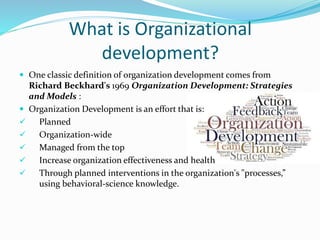
 One classic definition of organization development comes from
Richard Beckhard's 1969 Organization Development: Strategies
and Models :
 Organization Development is an effort that is:
 Planned
 Organization-wide
 Managed from the top
 Increase organization effectiveness and health
 Through planned interventions in the organization's "processes,”
using behavioral-science knowledge.
 Similarly OD is also defined as a systematic process for applying
behavioral science principles and practices in organizations to increase
individual and organizational effectiveness (French, 2008).
 So OD is improvement of the organization by developing its human
resource through planned change efforts/interventions at all levels
using human behavior approach.
 The tools and techniques of OD can improve an organization's
problem-solving ability, increase its ability to adapt to rapid societal
change, and provide managers an updated set of concepts and methods
for managing their organizations.
 It also includes formal organizational restructuring which is frequently
initiated, facilitated and reinforced by the normative and behavioral
changes.
 The three sub objectives of OD are “changing attitudes or values,
modifying behavior, and inducing change in structure and policy.”
THE EVOLUTION OF ORGANIZATION
DEVELOPMENT
 In the late 1940s and early 1950s laboratory training methods were
developed and applied by groups of behavioural scientists at Bethel,
Maine.
 Douglas McGregor (Theory X and Theory Y), working with Richard
Backhard, began applying laboratory training methods to industry at
General Mills in 1956 and at Union Carbide in 1957.
 At Union Carbide, McGragor and Johan Paul Jones (an internal
consultant) formed the first internal OD consulting group.
Techniques of Organisation
Development
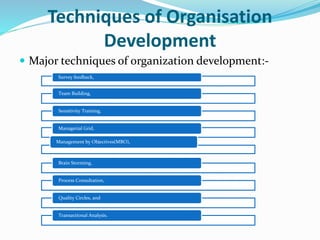
 Major techniques of organization development:-
Survey feedback,
Team Building,
Sensitivity Training,
Managerial Grid,
Management by Objectives(MBO),
Brain Storming,
Process Consultation,
Quality Circles, and
Transactional Analysis.
 1. Survey Feedback: Information is collected through survey
method. This is the most popular and widely used method of
data collection. The managers use this information collected
through survey for making decisions. The wide range of data is
collected regarding working conditions, quality of work, working
hours, wages and salaries, attitude of employees relating to
above.
 2. Team Building: Team Building is another method of
organisation development. This method is specifically designed
to make improvement in the ability of employees and motivating
them to work together. It is the organisation development
technique which emphasizes on team building or forming work
groups in order to improve organisational effectiveness.
 3. Sensitivity Training: It is quite popular OD intervention. It is also
known as laboratory training. Under this technique the employees in
groups are asked to interact. The aim of sensitivity training is to help
people understand each other and gain insight so that they feel free
and become fearless.
 4. Managerial Grid: This technique is developed by industrial
psychologists duo Robert Blake and Jane Mouton. The concept of
managerial grid identifies two major dimensions of management
behaviour. They are people oriented and production oriented
behaviours. Attempts are made to pay increased attention to both the
variables.
 5. Management by Objectives (MBO):
 MBO is a technique of management development which was put
forward for the first time by Peter Drucker in 1954. It is a method of
achieving organisational objectives and a technique of evaluation and
review of performance. Under this method objectives of the
organisation are fixed and responsibility to achieve them lie on the
managers and results are expected from them.
 Achievement of organisational objectives is considered as the joint and
individual responsibility of all managers. It also provides a perfect
appraisal system. Performance of the managers is measured against the
specific objectives. It is result oriented technique.
 George Odiorne observed that MBO is, “a system wherein superior and
subordinate managers of an organisation jointly identify its common
aims, define each individual’s major areas of responsibility in terms of
the results expected of him and use these measures as guides for
operating the unit, assessing the contribution benefits of its members.”
 6. Brain Storming: It is a technique where a group of five to eight
managers come together and find a solution to a problem. As the name
suggests it involves storming of the brain to develop creativity in
thinking. It gives rise to new ideas. The principle involves in it is that
any idea, thought or plan put forward in a meeting must be critically
evaluated. The participants are asked to come forward with novel ideas
generated in their mind. It works on a premise that everyone has a
creative mind and capability to generate new ideas.
 7. Process Consultation: The technique of process consultation is an
improvement over the method of sensitivity training or T Group in the
sense that both are based on the similar premise of improving
organisational effectiveness through dealing with interpersonal
problems but process consultation is more tasks oriented than
sensitivity training.
 In process consultation the consultant or expert provides the trainee
feedback and tell him what is going around him as pointed out by E H
Schein that the consultant, “gives the client ‘insight’ into what is going
on around him, within him, and between him and other people.”
 8. Quality Circles: Under this system a group of 5 to 12 come together
at their own free will during working hours once in a week and discuss
out the problems and suggests solution to the management for
implementation. The supervisors remain present during the meeting.
Quality Circles have their origin in Japan in nineteen sixties which
improved the quality, reduced cost and heightened the morale of the
workers. The success was due to workers’ participation. Total quality
management or TQM is the recent development. This concept was
adopted by the USA in 1980.
 9. Transactional Analysis: Transactional analysis helps people to
understand each other better. It is a useful tool for organisational
development but it has diverse applications in training, counselling,
interpersonal communication and making analysis of group dynamics.
Nowadays, it is widely used as OD technique. It helps in developing
more adult ego states among people of the organisation. It is also used
in process consultation and team building.
TATA CONSULTANCY SERVICES
- Case Study
About Tata Consultancy Services
Ltd (TCS)
 Tata Consultancy Services is an IT services, consulting, and
business solutions organization that delivers real results to
global business, ensuring a level of certainty no other firm
can match. TCS offers a consulting-led, integrated portfolio
of IT and IT-enabled infrastructure, engineering, and
assurance services. This is delivered through its unique
Global Network Delivery Model™, recognized as the
benchmark of excellence in software development. A part
of the Tata Group, India’s largest industrial conglomerate,
TCS has a global footprint and is listed on the National
Stock Exchange and Bombay Stock Exchange in India.
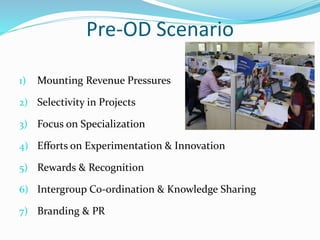
Pre-OD Scenario
1) Mounting Revenue Pressures
2) Selectivity in Projects
3) Focus on Specialization
4) Efforts on Experimentation & Innovation
5) Rewards & Recognition
6) Intergroup Co-ordination & Knowledge Sharing
7) Branding & PR
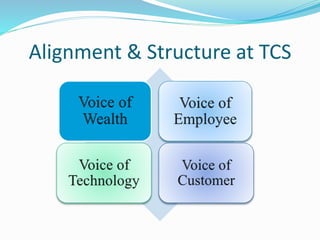
Alignment & Structure at TCS
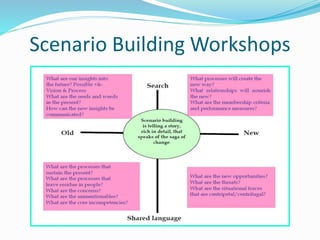
Scenario Building Workshops
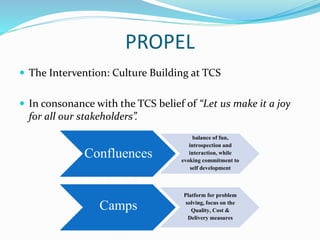
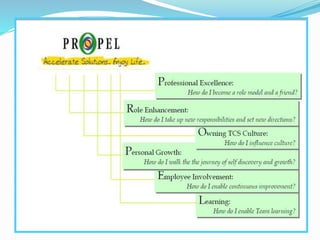
PROPEL
 The Intervention: Culture Building at TCS
 In consonance with the TCS belief of “Let us make it a joy
for all our stakeholders”.
Confluences
balance of fun,
introspection and
interaction, while
evoking commitment to
self development
Camps
Platform for problem
solving, focus on the
Quality, Cost &
Delivery measures
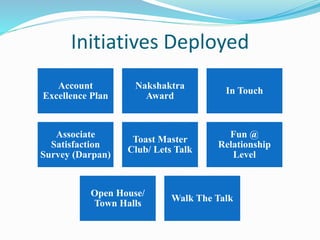
Initiatives Deployed
Account
Excellence Plan
Nakshaktra
Award
In Touch
Associate
Satisfaction
Survey (Darpan)
Toast Master
Club/ Lets Talk
Fun @
Relationship
Level
Open House/
Town Halls
Walk The Talk
Account Excellence Program
 Meeting all customer requirements
 Minimizing processes variances
 Reduction in Cost Of Quality
 Elimination of waste
 Enhanced Customer Support
 Efficient Product Service
 Flexibility to meet Customer demands & Market changes
 Rework Reduction
 Continuous Process Improvements
 On-time delivery of major programs
Darpan
 Reflect & Improve
 There was a distinct increase in the Associate
Satisfaction Index (ASI) in Darpan 06, which,
interestingly, corresponded to an increase in Customer
Satisfaction Index (CSI) as well.
Paradigm Shift: Post OD Scenario
 The earlier tendency of self-sacrificing hard work was replaced
by a shift of focus to teamwork and valuing of the employee.
 In a nutshell, the OD interventions at TCS have helped build a
culture of fostering systems thinking & creating forums for
dialogue, while encouraging leadership at all levels.
 For the organization at large, OD helped to reiterate the merits
of valuing enquiry, expressing differences, and constantly
generating new knowledge.
THANK YOU!!

Organisational development and its techniques

  • 1.
  • 3.
    What is Organizational development? One classic definition of organization development comes from Richard Beckhard's 1969 Organization Development: Strategies and Models :  Organization Development is an effort that is:  Planned  Organization-wide  Managed from the top  Increase organization effectiveness and health  Through planned interventions in the organization's "processes,” using behavioral-science knowledge.
  • 4.
     Similarly ODis also defined as a systematic process for applying behavioral science principles and practices in organizations to increase individual and organizational effectiveness (French, 2008).  So OD is improvement of the organization by developing its human resource through planned change efforts/interventions at all levels using human behavior approach.  The tools and techniques of OD can improve an organization's problem-solving ability, increase its ability to adapt to rapid societal change, and provide managers an updated set of concepts and methods for managing their organizations.  It also includes formal organizational restructuring which is frequently initiated, facilitated and reinforced by the normative and behavioral changes.  The three sub objectives of OD are “changing attitudes or values, modifying behavior, and inducing change in structure and policy.”
  • 5.
    THE EVOLUTION OFORGANIZATION DEVELOPMENT  In the late 1940s and early 1950s laboratory training methods were developed and applied by groups of behavioural scientists at Bethel, Maine.  Douglas McGregor (Theory X and Theory Y), working with Richard Backhard, began applying laboratory training methods to industry at General Mills in 1956 and at Union Carbide in 1957.  At Union Carbide, McGragor and Johan Paul Jones (an internal consultant) formed the first internal OD consulting group.
  • 6.
    Techniques of Organisation Development Major techniques of organization development:- Survey feedback, Team Building, Sensitivity Training, Managerial Grid, Management by Objectives(MBO), Brain Storming, Process Consultation, Quality Circles, and Transactional Analysis.
  • 7.
     1. SurveyFeedback: Information is collected through survey method. This is the most popular and widely used method of data collection. The managers use this information collected through survey for making decisions. The wide range of data is collected regarding working conditions, quality of work, working hours, wages and salaries, attitude of employees relating to above.  2. Team Building: Team Building is another method of organisation development. This method is specifically designed to make improvement in the ability of employees and motivating them to work together. It is the organisation development technique which emphasizes on team building or forming work groups in order to improve organisational effectiveness.
  • 8.
     3. SensitivityTraining: It is quite popular OD intervention. It is also known as laboratory training. Under this technique the employees in groups are asked to interact. The aim of sensitivity training is to help people understand each other and gain insight so that they feel free and become fearless.  4. Managerial Grid: This technique is developed by industrial psychologists duo Robert Blake and Jane Mouton. The concept of managerial grid identifies two major dimensions of management behaviour. They are people oriented and production oriented behaviours. Attempts are made to pay increased attention to both the variables.
  • 9.
     5. Managementby Objectives (MBO):  MBO is a technique of management development which was put forward for the first time by Peter Drucker in 1954. It is a method of achieving organisational objectives and a technique of evaluation and review of performance. Under this method objectives of the organisation are fixed and responsibility to achieve them lie on the managers and results are expected from them.  Achievement of organisational objectives is considered as the joint and individual responsibility of all managers. It also provides a perfect appraisal system. Performance of the managers is measured against the specific objectives. It is result oriented technique.  George Odiorne observed that MBO is, “a system wherein superior and subordinate managers of an organisation jointly identify its common aims, define each individual’s major areas of responsibility in terms of the results expected of him and use these measures as guides for operating the unit, assessing the contribution benefits of its members.”
  • 10.
     6. BrainStorming: It is a technique where a group of five to eight managers come together and find a solution to a problem. As the name suggests it involves storming of the brain to develop creativity in thinking. It gives rise to new ideas. The principle involves in it is that any idea, thought or plan put forward in a meeting must be critically evaluated. The participants are asked to come forward with novel ideas generated in their mind. It works on a premise that everyone has a creative mind and capability to generate new ideas.  7. Process Consultation: The technique of process consultation is an improvement over the method of sensitivity training or T Group in the sense that both are based on the similar premise of improving organisational effectiveness through dealing with interpersonal problems but process consultation is more tasks oriented than sensitivity training.  In process consultation the consultant or expert provides the trainee feedback and tell him what is going around him as pointed out by E H Schein that the consultant, “gives the client ‘insight’ into what is going on around him, within him, and between him and other people.”
  • 11.
     8. QualityCircles: Under this system a group of 5 to 12 come together at their own free will during working hours once in a week and discuss out the problems and suggests solution to the management for implementation. The supervisors remain present during the meeting. Quality Circles have their origin in Japan in nineteen sixties which improved the quality, reduced cost and heightened the morale of the workers. The success was due to workers’ participation. Total quality management or TQM is the recent development. This concept was adopted by the USA in 1980.  9. Transactional Analysis: Transactional analysis helps people to understand each other better. It is a useful tool for organisational development but it has diverse applications in training, counselling, interpersonal communication and making analysis of group dynamics. Nowadays, it is widely used as OD technique. It helps in developing more adult ego states among people of the organisation. It is also used in process consultation and team building.
  • 12.
  • 13.
    About Tata ConsultancyServices Ltd (TCS)  Tata Consultancy Services is an IT services, consulting, and business solutions organization that delivers real results to global business, ensuring a level of certainty no other firm can match. TCS offers a consulting-led, integrated portfolio of IT and IT-enabled infrastructure, engineering, and assurance services. This is delivered through its unique Global Network Delivery Model™, recognized as the benchmark of excellence in software development. A part of the Tata Group, India’s largest industrial conglomerate, TCS has a global footprint and is listed on the National Stock Exchange and Bombay Stock Exchange in India.
  • 14.
    Pre-OD Scenario 1) MountingRevenue Pressures 2) Selectivity in Projects 3) Focus on Specialization 4) Efforts on Experimentation & Innovation 5) Rewards & Recognition 6) Intergroup Co-ordination & Knowledge Sharing 7) Branding & PR
  • 15.
  • 16.
  • 17.
    PROPEL  The Intervention:Culture Building at TCS  In consonance with the TCS belief of “Let us make it a joy for all our stakeholders”. Confluences balance of fun, introspection and interaction, while evoking commitment to self development Camps Platform for problem solving, focus on the Quality, Cost & Delivery measures
  • 19.
    Initiatives Deployed Account Excellence Plan Nakshaktra Award InTouch Associate Satisfaction Survey (Darpan) Toast Master Club/ Lets Talk Fun @ Relationship Level Open House/ Town Halls Walk The Talk
  • 20.
    Account Excellence Program Meeting all customer requirements  Minimizing processes variances  Reduction in Cost Of Quality  Elimination of waste  Enhanced Customer Support  Efficient Product Service  Flexibility to meet Customer demands & Market changes  Rework Reduction  Continuous Process Improvements  On-time delivery of major programs
  • 21.
    Darpan  Reflect &Improve  There was a distinct increase in the Associate Satisfaction Index (ASI) in Darpan 06, which, interestingly, corresponded to an increase in Customer Satisfaction Index (CSI) as well.
  • 22.
    Paradigm Shift: PostOD Scenario  The earlier tendency of self-sacrificing hard work was replaced by a shift of focus to teamwork and valuing of the employee.  In a nutshell, the OD interventions at TCS have helped build a culture of fostering systems thinking & creating forums for dialogue, while encouraging leadership at all levels.  For the organization at large, OD helped to reiterate the merits of valuing enquiry, expressing differences, and constantly generating new knowledge.
  • 23.