The small scale Industry sector holds the key to
economic prosperity of the Indian economy
characterized by abundant labour supply,
unemployment and under employment. This
sector account for about 54% of the country
total export. The emerging challenges to the
small scale industries Sector are also due to
the Impact of globalization and agreement
under the WTO and GATT to which India is a
signatory along with 134 member countries.
Small scale industries play a key role in the
industrialisation of a developing country
this is because
1. Provide large scale employment
2. higher labour capital ratio
3. Shorter gestation period
4. Small market to be economic
5. Mobilisation of resources of capital and
skill
6. Need lower investment
Criteria of Small Business
 Size of the Business
 Qualitative Characteristics
(Ownership, Manager, Technology etc.)
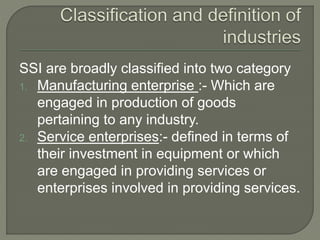
SSI are broadly classified into two category
1. Manufacturing enterprise :- Which are
engaged in production of goods
pertaining to any industry.
2. Service enterprises:- defined in terms of
their investment in equipment or which
are engaged in providing services or
enterprises involved in providing services.
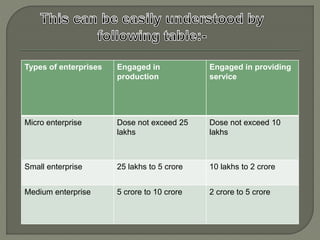
Types of enterprises Engaged in
production
Engaged in providing
service
Micro enterprise Dose not exceed 25
lakhs
Dose not exceed 10
lakhs
Small enterprise 25 lakhs to 5 crore 10 lakhs to 2 crore
Medium enterprise 5 crore to 10 crore 2 crore to 5 crore
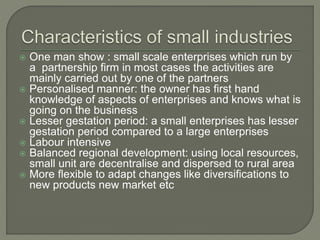
 One man show : small scale enterprises which run by
a partnership firm in most cases the activities are
mainly carried out by one of the partners
 Personalised manner: the owner has first hand
knowledge of aspects of enterprises and knows what is
going on the business
 Lesser gestation period: a small enterprises has lesser
gestation period compared to a large enterprises
 Labour intensive
 Balanced regional development: using local resources,
small unit are decentralise and dispersed to rural area
 More flexible to adapt changes like diversifications to
new products new market etc
 Create greater employment opportunities
 Low gestation period
 Easily setup in rural area
 Need small market
 Encourage growth of entrepreneurship
 Decentralized pattern of ownership
 Diversification of economic activities
 Innovate and Introduce new product
 Improve standard of living of local people
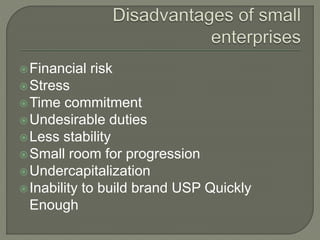
Financial risk
Stress
Time commitment
Undesirable duties
Less stability
Small room for progression
Undercapitalization
Inability to build brand USP Quickly
Enough
1.Employment argument:
a. Important argument put forth in aver of the
SSI’s in that they have a potential to create
immediate large scale employment
opportunities.
b. small scale units are more labour intensive
than larger units
c. Employment ratio is the lowest in the small
scale sector the employment generation
capacity of small sector between 8 to 15
times that of the large sector for the same
amount of capital investment for different
types of industries
2.Eqality argument:
Another argument put forward in favour of the
small scale industry is that they ensure a
more equitable distribution of national
income.
1. The ownership pattern of SSi’s is more
widespread compared to the ownership of
large scale units.
2. They are more labor intensive and are
dispersal to rural and backward area provide
more employment opportunities to the
unemployed.
3. Decentralization argument:
1. Large Industries are concentrated every
where in urban area but small enterprise
can be located resources and to meet
local demand
2. Decentralisation of industrial enterprise
will help harnessing local resources such
as raw material Idle capital, local talents
and ultimately improves the socio-
economic conditions and standard
4. Latent resources argument:
1. This argument suggests that small
enterprise are capable of picking up latent
and unutilized resources like hoarded
wealth and Idle entrepreneurial ability.
2. latent resources argument lies in the
existence of entrepreneurial skill

Small and medium enterprise

  • 2.
    The small scaleIndustry sector holds the key to economic prosperity of the Indian economy characterized by abundant labour supply, unemployment and under employment. This sector account for about 54% of the country total export. The emerging challenges to the small scale industries Sector are also due to the Impact of globalization and agreement under the WTO and GATT to which India is a signatory along with 134 member countries.
  • 3.
    Small scale industriesplay a key role in the industrialisation of a developing country this is because 1. Provide large scale employment 2. higher labour capital ratio 3. Shorter gestation period 4. Small market to be economic 5. Mobilisation of resources of capital and skill 6. Need lower investment
  • 4.
    Criteria of SmallBusiness  Size of the Business  Qualitative Characteristics (Ownership, Manager, Technology etc.)
  • 5.
    SSI are broadlyclassified into two category 1. Manufacturing enterprise :- Which are engaged in production of goods pertaining to any industry. 2. Service enterprises:- defined in terms of their investment in equipment or which are engaged in providing services or enterprises involved in providing services.
  • 6.
    Types of enterprisesEngaged in production Engaged in providing service Micro enterprise Dose not exceed 25 lakhs Dose not exceed 10 lakhs Small enterprise 25 lakhs to 5 crore 10 lakhs to 2 crore Medium enterprise 5 crore to 10 crore 2 crore to 5 crore
  • 7.
     One manshow : small scale enterprises which run by a partnership firm in most cases the activities are mainly carried out by one of the partners  Personalised manner: the owner has first hand knowledge of aspects of enterprises and knows what is going on the business  Lesser gestation period: a small enterprises has lesser gestation period compared to a large enterprises  Labour intensive  Balanced regional development: using local resources, small unit are decentralise and dispersed to rural area  More flexible to adapt changes like diversifications to new products new market etc
  • 8.
     Create greateremployment opportunities  Low gestation period  Easily setup in rural area  Need small market  Encourage growth of entrepreneurship  Decentralized pattern of ownership  Diversification of economic activities  Innovate and Introduce new product  Improve standard of living of local people
  • 9.
    Financial risk Stress Time commitment Undesirableduties Less stability Small room for progression Undercapitalization Inability to build brand USP Quickly Enough
  • 10.
    1.Employment argument: a. Importantargument put forth in aver of the SSI’s in that they have a potential to create immediate large scale employment opportunities. b. small scale units are more labour intensive than larger units c. Employment ratio is the lowest in the small scale sector the employment generation capacity of small sector between 8 to 15 times that of the large sector for the same amount of capital investment for different types of industries
  • 11.
    2.Eqality argument: Another argumentput forward in favour of the small scale industry is that they ensure a more equitable distribution of national income. 1. The ownership pattern of SSi’s is more widespread compared to the ownership of large scale units. 2. They are more labor intensive and are dispersal to rural and backward area provide more employment opportunities to the unemployed.
  • 12.
    3. Decentralization argument: 1.Large Industries are concentrated every where in urban area but small enterprise can be located resources and to meet local demand 2. Decentralisation of industrial enterprise will help harnessing local resources such as raw material Idle capital, local talents and ultimately improves the socio- economic conditions and standard
  • 13.
    4. Latent resourcesargument: 1. This argument suggests that small enterprise are capable of picking up latent and unutilized resources like hoarded wealth and Idle entrepreneurial ability. 2. latent resources argument lies in the existence of entrepreneurial skill