MARKETING RESEARCH
BADM DEPT
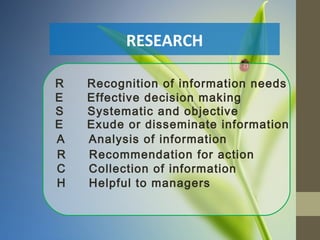
E Effective decision making
S Systematic and objective
E Exude or disseminate information
A Analysis of information
R Recommendation for action
C Collection of information
H Helpful to managers
R Recognition of information needs
RESEARCH
Marketing Research: Definition
• “Marketing research is the systematic design, collection, analysis
and reporting of data and findings relevant to a specific marketing
situation facing the company.”
• Marketing research is the process of designing, gathering,
analyzing, and reporting information that may be used to solve a
specific marketing problem.
Definition of Marketing Research
Marketing research is the systematic and objective
 identification
 collection
 analysis
 dissemination
 and use of information
For the purpose of improving decision making related
to the
 identification and
 solution of problems and opportunities in marketing.
Need For Marketing Research
• Why do businesses need accurate and up-to-date
information?
– To undertake marketing effectively
– Changes in technology
– Changes in consumer tastes
– Market demand
– Changes in the product ranges of competitors
– Changes in economic conditions
– Distribution channels
Purpose Of Marketing Research
• Gain a more detailed understanding of
consumers’ needs:
– e.g., views on products’ prices, packaging, recent
advertising campaigns
• Reduce the risk of product/business failure:
– there is no guarantee that any new idea will be
a commercial success
– Can help to achieve commercial success
• Forecast future trends:
– it can also be used to anticipate future customer needs
Scope Of Marketing Research
• Product Research
• Advertising Research
• Distribution Research
• Pricing Research
• Consumer Research
• Market Research
• Sales research
• Marketing environment research
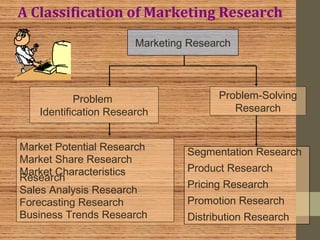
A Classification of Marketing Research
Problem-Identification Research
• Research undertaken to help identify problems which are
not necessarily apparent on the surface and yet exist or
are likely to arise in the future. Examples: market
potential, market share, image, market characteristics,
sales analysis, forecasting, and trends research.
Problem-Solving Research
• Research undertaken to help solve specific marketing
problems. Examples: segmentation, product, pricing,
promotion, and distribution research.
A Classification of Marketing Research
Marketing Research
Problem
Identification Research
Problem-Solving
Research
Market Potential Research
Market Share Research
Market Characteristics
Research
Sales Analysis Research
Forecasting Research
Business Trends Research
Segmentation Research
Product Research
Pricing Research
Promotion Research
Distribution Research
Process and Techniques Of Marketing
Research
• Marketing research process or procedure means a
sequence of steps to be taken to conduct and complete
the research study.
• Each step in marketing research process is independent
but inter-related with next step.
• Thus, the success of each next step is dependent on the
success of preceding step.
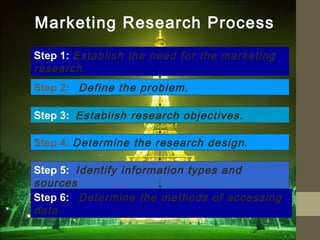
Marketing Research Process
Step 1: Establish the need for the marketing
research.
Step 2: Define the problem.
Step 3: Establish research objectives.
Step 4: Determine the research design.
Step 5: Identify information types and
sources
Step 6: Determine the methods of accessing
data.
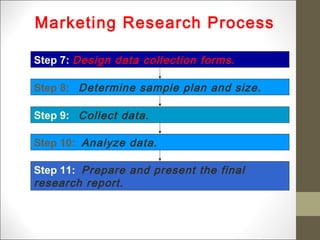
Marketing Research Process
ingResearch Process
Step 7: Design data collection forms.
Step 8: Determine sample plan and size.
Step 9: Collect data.
Step 10: Analyze data.
Step 11: Prepare and present the final
research report.
Steps in the Marketing Research
Process
 Few comments about the process:
1. It is rare in practice a research project follows all
the exact steps.
 Research is an interactive process where a researcher by
discovering something may move forward or backwards in
the process.
1. May not involve every step shown
 The research problem may be resolved, for example by a
review of secondary data, thereby eliminating the need to
determine a sample plan or size.
1. What’s important is although every research
project is different, there are enough
commonalities to follow the eleven steps of
marketing research.
Step 1: Establish the Need for
Marketing Research
 A good monitoring system will alert the marketing
manager to a problem that can be attacked by
marketing research.
 Marketing research may not be needed
 Information is already available
 There is insufficient time for marketing research
 Resources are not available
 Costs outweigh the value of the research
Step 2: Define the Problem
 Defining the problem is the single most important
step in the marketing research process.
 This stage involves developing an understanding of
the problem which requires further study and
investigation.
 Problem definition involves:
1. Specifying the symptoms
2. Itemizing the possible causes of the symptoms
3. Listing the reasonable alternative courses of action that the
marketing manager can undertake to solve the problem.
Further business problems may
include:
• Who are your target customers?
• What method could be implemented to reach these
customers?
• Who are your customers and what advantages and
disadvantages do they have over your business?
• What size is the consumer market you are trying to engage?
Step 3: Establish the Research
Objectives
 Objectives are the ‘why’ aspect of the
proposed study.
Why do we want to study the problem ?
 Research objectives identify what specific
pieces of information are necessary to solve
the problem at hand.
 Objectives set the path of research work.
 Research objectives step is the specification of
the specific types of information useful to the
managers as they catch for a solution to the
marketing problem at hand.
Step 4: Determine Research
Design
 There are three types of research design:
1. Exploratory Research Design - is defined as collecting information in
an unstructured and informal manner. Examples: Reading
periodicals, visiting competitors premises, examine company sales
and profits vs. industry sales and profit.
2. Descriptive Research Design - refers to a set of methods and
procedure that describe marketing variables. Portray these variables
by answering who, what, why and how questions. example:
consumer attitude survey to your companies services.
3. Casual Research Design – designs allow us to isolate causes and their
effects.
 Casual research is conducted by controlling various factors to
determine which factor is causing the problem.
 By changing one factor, say price, we can monitor its effect on a
key consequence, such as sales. In other words, casual design
allows us to determine causality, or which variable is causing
another variable to change.
Step 5: Identify Information Types
and Sources.
Basically two types of data information
available to a marketing researcher:
A. Secondary data – secondary data are those
which are already gathered, having been
collected originally for some other purposes.
These data remain available in published and
unpublished forms.
B. Primary data - Primary data are original data
gathered specifically for the project at the
hand. .
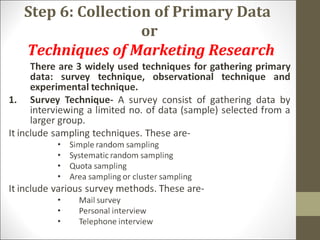
Step 6: Collection of Primary Data
or
Techniques of Marketing Research
Techniques of Marketing
Research
2. Observational Technique- In this technique the
data are gathered by observing some actions of
the respondents. The researcher without showing
his identity, observes the respondents.
3. Experimental Technique- Under the experimental
method primary data is collected, in which the
researcher is able to observe the results of
changes taking place in one variable in a given
situation, while hold the other variable constant.
Step 7: Design Data Collection
Forms
 Questionnaires and observation forms must be designed
with great care.
 Questionnaires – which record the information
communicated by respondents or the respondent’s
behavior as observed by the researcher
 Structured Questionnaires - list questions that have pre-
specified answer choices.
 Unstructured questionnaires – have open ended
questions and/or questions that are asked based on a
response.
 Disguised-true object of the study is not identified.
 Undisguised- respondent is made fully aware of the
purpose/or sponsor of the survey.
Step 8: Determine Sample Plan
and Size
 A sample plan identifies who is to be sampled and
how to select them for study.
 A sample element refers to a unit of the entity being
studied.
 A sample Frame is a list from which the sample
elements are drawn for the sample.
 A sample plan specify how to draw the sample
elements from the sample plan.
 Methods are available to help the researcher
determine the sample size required for the research
study.
Step 9: Collect Data
 Data collection is usually done by trained
interviewers who are employed by field data
collection companies to collect primary data.
 Being ware of errors that may occur is important.
 Non-sampling Errors are attributable to factors other
than sampling errors.
 Wrong sample elements to interview
 Securing participants who refuse to participate
 Not a home
 Interviewing subjects who give the wrong information.
 Hiring interviewers who cheat and fill out fictitious survey
questionnaires.
Collection methods and
techniques
• Qualitative research is where you seek an understanding of
why things are a certain way. For example, a researcher may
stop a shopper and ask them why they bought a particular
product or brand.
• Quantitative research refers to measuring market
phenomena in a numerical sense, such as when a bank asks
consumers to rate their service on a scale of one to ten.
Step 10: Analyse Data
 Data analysis involves entering data into computer
files, inspecting it for errors and running tabulations
and various statistical tests.
 Data cleaning – process by which the raw data are
checked to verify that the data has been correctly
inputted from the data collection form to the
computer software program. Use SPSS
 Coding – is the process of assigning all response
categories a numerical value males=1, females=2.
 Tabulation – which refers to the actual counting of
the number of observations that fall into each
possible response category.
Step 11: Prepare and Present the
Final Research Report
 Preparing the marketing research report
involves describing the process used, building
meaningful tables, and using presentation
graphics for clarity.
 Preparing the SPSS software allows you to
prepare graphics to enhance your written or
oral presentation.
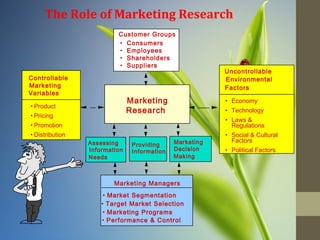
The Role of Marketing Research
Controllable
Marketing
• Product
• Pricing
• Promotion
• Distribution
Variables
Marketing
Research
Marketing
Decision
Making
Providing
Information
Assessing
Information
Needs
Marketing Managers
• Market Segmentation
• Performance & Control
• Target Market Selection
• Marketing Programs
Uncontrollable
Environmental
Factors
• Economy
• Technology
• Laws &
Regulations
• Social & Cultural
Factors
• Political Factors
• Consumers
• Employees
• Shareholders
• Suppliers
Customer Groups
• Know what you’re talking about
– What’s your product?
– Who are you selling to in existing
markets?
• Look for answers to specific questions
– But don’t always expect specific answers
• Not everything can be found on the
Internet
Keys to Successful Marketing
Research
Marketing research

Marketing research

  • 1.
  • 2.
    E Effective decisionmaking S Systematic and objective E Exude or disseminate information A Analysis of information R Recommendation for action C Collection of information H Helpful to managers R Recognition of information needs RESEARCH
  • 3.
    Marketing Research: Definition •“Marketing research is the systematic design, collection, analysis and reporting of data and findings relevant to a specific marketing situation facing the company.” • Marketing research is the process of designing, gathering, analyzing, and reporting information that may be used to solve a specific marketing problem.
  • 4.
    Definition of MarketingResearch Marketing research is the systematic and objective  identification  collection  analysis  dissemination  and use of information For the purpose of improving decision making related to the  identification and  solution of problems and opportunities in marketing.
  • 5.
    Need For MarketingResearch • Why do businesses need accurate and up-to-date information? – To undertake marketing effectively – Changes in technology – Changes in consumer tastes – Market demand – Changes in the product ranges of competitors – Changes in economic conditions – Distribution channels
  • 6.
    Purpose Of MarketingResearch • Gain a more detailed understanding of consumers’ needs: – e.g., views on products’ prices, packaging, recent advertising campaigns • Reduce the risk of product/business failure: – there is no guarantee that any new idea will be a commercial success – Can help to achieve commercial success • Forecast future trends: – it can also be used to anticipate future customer needs
  • 7.
    Scope Of MarketingResearch • Product Research • Advertising Research • Distribution Research • Pricing Research • Consumer Research • Market Research • Sales research • Marketing environment research
  • 8.
    A Classification ofMarketing Research Problem-Identification Research • Research undertaken to help identify problems which are not necessarily apparent on the surface and yet exist or are likely to arise in the future. Examples: market potential, market share, image, market characteristics, sales analysis, forecasting, and trends research. Problem-Solving Research • Research undertaken to help solve specific marketing problems. Examples: segmentation, product, pricing, promotion, and distribution research.
  • 9.
    A Classification ofMarketing Research Marketing Research Problem Identification Research Problem-Solving Research Market Potential Research Market Share Research Market Characteristics Research Sales Analysis Research Forecasting Research Business Trends Research Segmentation Research Product Research Pricing Research Promotion Research Distribution Research
  • 10.
    Process and TechniquesOf Marketing Research • Marketing research process or procedure means a sequence of steps to be taken to conduct and complete the research study. • Each step in marketing research process is independent but inter-related with next step. • Thus, the success of each next step is dependent on the success of preceding step.
  • 11.
    Marketing Research Process Step1: Establish the need for the marketing research. Step 2: Define the problem. Step 3: Establish research objectives. Step 4: Determine the research design. Step 5: Identify information types and sources Step 6: Determine the methods of accessing data.
  • 12.
    Marketing Research Process ingResearchProcess Step 7: Design data collection forms. Step 8: Determine sample plan and size. Step 9: Collect data. Step 10: Analyze data. Step 11: Prepare and present the final research report.
  • 13.
    Steps in theMarketing Research Process  Few comments about the process: 1. It is rare in practice a research project follows all the exact steps.  Research is an interactive process where a researcher by discovering something may move forward or backwards in the process. 1. May not involve every step shown  The research problem may be resolved, for example by a review of secondary data, thereby eliminating the need to determine a sample plan or size. 1. What’s important is although every research project is different, there are enough commonalities to follow the eleven steps of marketing research.
  • 14.
    Step 1: Establishthe Need for Marketing Research  A good monitoring system will alert the marketing manager to a problem that can be attacked by marketing research.  Marketing research may not be needed  Information is already available  There is insufficient time for marketing research  Resources are not available  Costs outweigh the value of the research
  • 15.
    Step 2: Definethe Problem  Defining the problem is the single most important step in the marketing research process.  This stage involves developing an understanding of the problem which requires further study and investigation.  Problem definition involves: 1. Specifying the symptoms 2. Itemizing the possible causes of the symptoms 3. Listing the reasonable alternative courses of action that the marketing manager can undertake to solve the problem.
  • 16.
    Further business problemsmay include: • Who are your target customers? • What method could be implemented to reach these customers? • Who are your customers and what advantages and disadvantages do they have over your business? • What size is the consumer market you are trying to engage?
  • 17.
    Step 3: Establishthe Research Objectives  Objectives are the ‘why’ aspect of the proposed study. Why do we want to study the problem ?  Research objectives identify what specific pieces of information are necessary to solve the problem at hand.  Objectives set the path of research work.  Research objectives step is the specification of the specific types of information useful to the managers as they catch for a solution to the marketing problem at hand.
  • 18.
    Step 4: DetermineResearch Design  There are three types of research design: 1. Exploratory Research Design - is defined as collecting information in an unstructured and informal manner. Examples: Reading periodicals, visiting competitors premises, examine company sales and profits vs. industry sales and profit. 2. Descriptive Research Design - refers to a set of methods and procedure that describe marketing variables. Portray these variables by answering who, what, why and how questions. example: consumer attitude survey to your companies services. 3. Casual Research Design – designs allow us to isolate causes and their effects.  Casual research is conducted by controlling various factors to determine which factor is causing the problem.  By changing one factor, say price, we can monitor its effect on a key consequence, such as sales. In other words, casual design allows us to determine causality, or which variable is causing another variable to change.
  • 19.
    Step 5: IdentifyInformation Types and Sources. Basically two types of data information available to a marketing researcher: A. Secondary data – secondary data are those which are already gathered, having been collected originally for some other purposes. These data remain available in published and unpublished forms. B. Primary data - Primary data are original data gathered specifically for the project at the hand. .
  • 20.
    Step 6: Collectionof Primary Data or Techniques of Marketing Research
  • 21.
    Techniques of Marketing Research 2.Observational Technique- In this technique the data are gathered by observing some actions of the respondents. The researcher without showing his identity, observes the respondents. 3. Experimental Technique- Under the experimental method primary data is collected, in which the researcher is able to observe the results of changes taking place in one variable in a given situation, while hold the other variable constant.
  • 22.
    Step 7: DesignData Collection Forms  Questionnaires and observation forms must be designed with great care.  Questionnaires – which record the information communicated by respondents or the respondent’s behavior as observed by the researcher  Structured Questionnaires - list questions that have pre- specified answer choices.  Unstructured questionnaires – have open ended questions and/or questions that are asked based on a response.  Disguised-true object of the study is not identified.  Undisguised- respondent is made fully aware of the purpose/or sponsor of the survey.
  • 23.
    Step 8: DetermineSample Plan and Size  A sample plan identifies who is to be sampled and how to select them for study.  A sample element refers to a unit of the entity being studied.  A sample Frame is a list from which the sample elements are drawn for the sample.  A sample plan specify how to draw the sample elements from the sample plan.  Methods are available to help the researcher determine the sample size required for the research study.
  • 24.
    Step 9: CollectData  Data collection is usually done by trained interviewers who are employed by field data collection companies to collect primary data.  Being ware of errors that may occur is important.  Non-sampling Errors are attributable to factors other than sampling errors.  Wrong sample elements to interview  Securing participants who refuse to participate  Not a home  Interviewing subjects who give the wrong information.  Hiring interviewers who cheat and fill out fictitious survey questionnaires.
  • 25.
    Collection methods and techniques •Qualitative research is where you seek an understanding of why things are a certain way. For example, a researcher may stop a shopper and ask them why they bought a particular product or brand. • Quantitative research refers to measuring market phenomena in a numerical sense, such as when a bank asks consumers to rate their service on a scale of one to ten.
  • 26.
    Step 10: AnalyseData  Data analysis involves entering data into computer files, inspecting it for errors and running tabulations and various statistical tests.  Data cleaning – process by which the raw data are checked to verify that the data has been correctly inputted from the data collection form to the computer software program. Use SPSS  Coding – is the process of assigning all response categories a numerical value males=1, females=2.  Tabulation – which refers to the actual counting of the number of observations that fall into each possible response category.
  • 27.
    Step 11: Prepareand Present the Final Research Report  Preparing the marketing research report involves describing the process used, building meaningful tables, and using presentation graphics for clarity.  Preparing the SPSS software allows you to prepare graphics to enhance your written or oral presentation.
  • 28.
    The Role ofMarketing Research Controllable Marketing • Product • Pricing • Promotion • Distribution Variables Marketing Research Marketing Decision Making Providing Information Assessing Information Needs Marketing Managers • Market Segmentation • Performance & Control • Target Market Selection • Marketing Programs Uncontrollable Environmental Factors • Economy • Technology • Laws & Regulations • Social & Cultural Factors • Political Factors • Consumers • Employees • Shareholders • Suppliers Customer Groups
  • 29.
    • Know whatyou’re talking about – What’s your product? – Who are you selling to in existing markets? • Look for answers to specific questions – But don’t always expect specific answers • Not everything can be found on the Internet Keys to Successful Marketing Research