Organizational
Behavior
Organizational Behavior-Meaning
Organizational Behavior (OB) can be defined as the
understanding, prediction and management of human
behavior both individually or in a group that occur within
an organization.
Importance of OB
it builds better relationship by achieving people’s, organizational, and social objectives.
It helps in training and development, change management, leadership, team building
etc.
It brings coordination which is the essence of management.
It improves goodwill of the organization.
Importance of OB
It makes optimum utilization of resources.
It facilitates motivation.
It leads to higher efficiency.
It improves relations in the organization.
Contributing disciplines to the OB
Psychology
Sociology
Social Psychology
Anthropology
Psychology
Psychology is the science that seeks to measure, explain, and sometimes change
the behavior of humans and other animals. It may be; the mental and behavior
characteristic of an individual or group;
RELATONSHIP WITH OB- If one want to improve the behaviour of an
individual or group we have to look into the psychological needs of an individual
and group. So the knowledge of psychology can really help in improving and
modifying the behaviour of individual and group. If the psychological needs are
fulfilled ,it gives satisfaction to people and also give peace of mind, which can
improve the ability of an organization
Sociology
Sociology is the study of the social system in which individual fills their role. It
studies people in relation to their fellow human beings.
RELATONSHIP WITH OB- Sociologists have made their greatest
contribution to organizational behavior through their study of group behavior
in organizations, particularly in formal and complex organizations. Some of the
areas within organizational behavior that have received valuable input from
sociologists are group dynamics, design of work teams, organizational culture,
formal organization theory and structure, organizational technology,
communications, power conflict, and inter group behavior.
Social Psychology
Social psychology is an area within psychology, but it blends concepts from
psychology and sociology. It concentrates on the influence of people on one
another.
RELATONSHIP WITH OB- One of the major areas receiving considerable
investigation from social psychologist is Change, how to implement it and how
to reduce barriers to its acceptance. In addition, social psychologists are making
significant contributions in the areas of measuring, understanding, and
changing attitudes; communication patterns; the ways in which group activities
can satisfy individual needs; and group decision making processes.
Anthropology
Anthropology is the study of societies to learn about human beings and their
activities. Anthropologists’ work on cultures and environments, for instance, has
helped us understand differences in fundamental values, attitudes, and behavior
between people in different countries.
RELATONSHIP WITH OB- Much of our current understanding of
organizational culture, organizational environments, and differences between
national cultures is the result of anthropology.
Political Science
Political science studies the behaviour of individuals and groups within a
political environment.
RELATONSHIP WITH OB- Specific topics such as conflict, intra-
organizational politics and power.
Contingency Approach to OB
The contingency approach/situational approach is based on the premise that
methods or behaviors which work effectively in one situation fail in another.
Results differ because situations differ, the manager’s task, therefore, is to
identify which method will, in a particular situation, under particular
circumstances, and at a particular time, best contribute to the attainment of
organization’s goals
Strength of Contingency Approach
Helps in analysis of each situation
Not rely completely on universal assumptions and practices.
System-oriented approach
Research oriented
Inter-disciplinary Approach.
Opportunities of OB
Improving Peoples’ Skills.
Improving Quality and Productivity.
Total Quality Management (TQM).
Managing Workforce Diversity.
Responding to Globalization.
Empowering People.
Opportunities of OB
Coping with Temporariness.
Stimulating Innovation and Change.
Emergence of E-Organization & E-Commerce.
Improving Ethical Behavior.
Improving Customer Service.
Helping Employees Balance Work-Life Conflicts.
Challenges of OB
OB is only one of the many systems operating within a large social system.
People who lack system understanding may develop a 'behavioral bias',
which gives them a narrow view point, i.e., a tunnel vision that emphasizes
on satisfying employee experiences while overlooking the broader system of
an organization in relation to all its public.
The law of diminishing returns also operates in the case of organizational
behaviour. It states, that at some point increase of a desirable practice
produce declining returns and sometimes, negative returns.
Challenges of OB
A significant concern about OB is that its knowledge and techniques could be used to
manipulate people without regard for human welfare. People who lack ethical values could
use people in unethical ways.
OB helps an individual to understand human behaviour only at workplace or it may be a
failure at domestic front.
OB has not contributed to improved interpersonal relations in an organization. Jealousies,
back stabbing, harassments go side by side with rewards, lectures, discussions etc.
OB is selfish and exploitive. With emphasis on motivation, efficiency, productivity there
exists a kind of competition among workers and they are not able to live in harmony.
System Approach
The systems approach is of the view that an organization is a powerful system with
several subsystems which are highly and closely interconnected.
Any action taken to solve the problems in one subsystem will have its effect on the
other subsystems as well; since all the parts of the organization are closely connected.
Systems approach has become an integral part of modern organizational theory.
Organizations are termed as complex systems comprising of interrelated and
interlocking systems.
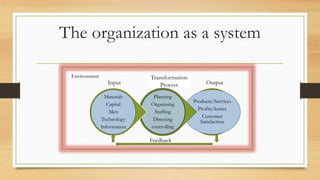
According to this approach, an organization receives several inputs from its
environment such as material, human and financial. These inputs are then processed
so as to produce the final output in terms of products or services.
The organization as a system
Products/Services
Profits/losses
Customer
Satisfaction
Planning
Organizing
Staffing
Directing
controlling
Materials
Capital
Men
Technology
Information
Input Output
Transformation
Process
Feedback
Environment
Functions of a manager
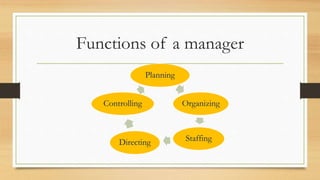
Planning
Organizing
StaffingDirecting
Controlling
Planning
Planning is about creating a detailed plan towards achieving a specific
organizational objective.
It involves identifying the tasks which are required to achieve the desired
goals, outlining how the tasks should be performed, and identifying when
and by whom they must be performed.
The focus of planning is about achieving the objectives and it does require
knowledge of the organization’s objectives and vision.
Organizing
Organizing is about using the plan to bring together the physical, financial and
other available resources and use them to achieve the organizational goal.
Organizing as a process involves:
Identification of activities.
Classification of grouping of activities.
Assignment of duties.
Delegation of authority and creation of responsibility.
Coordinating authority and responsibility relationships.
Staffing
Staffing can be defined as one of the most important functions of
management. It involves the process of filling the vacant position of the
right personnel at the right job, at right time.
Staffing is the basic function of management which involves that the
manager is continuously engaged in performing the staffing function. They
are actively associated with the recruitment, selection, training, and appraisal
of his subordinates.
Directing
“Directing consists of process or technique by which instruction can be
issued and operations can be carried out as originally planned.”-Human
Directing means giving instructions, guiding, counselling, motivating and
leading the staff in an organization in doing work to achieve Organizational
goals.
Directing is a continuous process initiated at top level and flows to the
bottom through organizational hierarchy.
Controlling
Controlling is that process of regulating organizational activities so that actual
performance conforms to expected organizational goals and standards.
Controlling takes place in a four-step process:
Establish performance standards based on organizational objectives
Measure and report on actual performance
Compare results with performance and standards
Take corrective or preventive measures as needed
The organization and people
People are of paramount importance in the organization. People comprise the
human element of the organization. People provide the hands that do the work
of the organization. And people lead and manage the organization. The
integrity of any organization, its effectiveness in achieving its purpose and even
its continued existence, all depend entirely on the people that comprise it.
Without human resource other factors such as money, machines, materials,
methods and markets cannot be acquired and utilized. It is through people that
these factors be developed and be utilized as human factor is responsible for the
success and failure in any organization because people is the significant input
and output in an organization.
Thank you

Organizational behavior

  • 1.
  • 2.
    Organizational Behavior-Meaning Organizational Behavior(OB) can be defined as the understanding, prediction and management of human behavior both individually or in a group that occur within an organization.
  • 3.
    Importance of OB itbuilds better relationship by achieving people’s, organizational, and social objectives. It helps in training and development, change management, leadership, team building etc. It brings coordination which is the essence of management. It improves goodwill of the organization.
  • 4.
    Importance of OB Itmakes optimum utilization of resources. It facilitates motivation. It leads to higher efficiency. It improves relations in the organization.
  • 5.
    Contributing disciplines tothe OB Psychology Sociology Social Psychology Anthropology
  • 6.
    Psychology Psychology is thescience that seeks to measure, explain, and sometimes change the behavior of humans and other animals. It may be; the mental and behavior characteristic of an individual or group; RELATONSHIP WITH OB- If one want to improve the behaviour of an individual or group we have to look into the psychological needs of an individual and group. So the knowledge of psychology can really help in improving and modifying the behaviour of individual and group. If the psychological needs are fulfilled ,it gives satisfaction to people and also give peace of mind, which can improve the ability of an organization
  • 7.
    Sociology Sociology is thestudy of the social system in which individual fills their role. It studies people in relation to their fellow human beings. RELATONSHIP WITH OB- Sociologists have made their greatest contribution to organizational behavior through their study of group behavior in organizations, particularly in formal and complex organizations. Some of the areas within organizational behavior that have received valuable input from sociologists are group dynamics, design of work teams, organizational culture, formal organization theory and structure, organizational technology, communications, power conflict, and inter group behavior.
  • 8.
    Social Psychology Social psychologyis an area within psychology, but it blends concepts from psychology and sociology. It concentrates on the influence of people on one another. RELATONSHIP WITH OB- One of the major areas receiving considerable investigation from social psychologist is Change, how to implement it and how to reduce barriers to its acceptance. In addition, social psychologists are making significant contributions in the areas of measuring, understanding, and changing attitudes; communication patterns; the ways in which group activities can satisfy individual needs; and group decision making processes.
  • 9.
    Anthropology Anthropology is thestudy of societies to learn about human beings and their activities. Anthropologists’ work on cultures and environments, for instance, has helped us understand differences in fundamental values, attitudes, and behavior between people in different countries. RELATONSHIP WITH OB- Much of our current understanding of organizational culture, organizational environments, and differences between national cultures is the result of anthropology.
  • 10.
    Political Science Political sciencestudies the behaviour of individuals and groups within a political environment. RELATONSHIP WITH OB- Specific topics such as conflict, intra- organizational politics and power.
  • 11.
    Contingency Approach toOB The contingency approach/situational approach is based on the premise that methods or behaviors which work effectively in one situation fail in another. Results differ because situations differ, the manager’s task, therefore, is to identify which method will, in a particular situation, under particular circumstances, and at a particular time, best contribute to the attainment of organization’s goals
  • 12.
    Strength of ContingencyApproach Helps in analysis of each situation Not rely completely on universal assumptions and practices. System-oriented approach Research oriented Inter-disciplinary Approach.
  • 13.
    Opportunities of OB ImprovingPeoples’ Skills. Improving Quality and Productivity. Total Quality Management (TQM). Managing Workforce Diversity. Responding to Globalization. Empowering People.
  • 14.
    Opportunities of OB Copingwith Temporariness. Stimulating Innovation and Change. Emergence of E-Organization & E-Commerce. Improving Ethical Behavior. Improving Customer Service. Helping Employees Balance Work-Life Conflicts.
  • 15.
    Challenges of OB OBis only one of the many systems operating within a large social system. People who lack system understanding may develop a 'behavioral bias', which gives them a narrow view point, i.e., a tunnel vision that emphasizes on satisfying employee experiences while overlooking the broader system of an organization in relation to all its public. The law of diminishing returns also operates in the case of organizational behaviour. It states, that at some point increase of a desirable practice produce declining returns and sometimes, negative returns.
  • 16.
    Challenges of OB Asignificant concern about OB is that its knowledge and techniques could be used to manipulate people without regard for human welfare. People who lack ethical values could use people in unethical ways. OB helps an individual to understand human behaviour only at workplace or it may be a failure at domestic front. OB has not contributed to improved interpersonal relations in an organization. Jealousies, back stabbing, harassments go side by side with rewards, lectures, discussions etc. OB is selfish and exploitive. With emphasis on motivation, efficiency, productivity there exists a kind of competition among workers and they are not able to live in harmony.
  • 17.
    System Approach The systemsapproach is of the view that an organization is a powerful system with several subsystems which are highly and closely interconnected. Any action taken to solve the problems in one subsystem will have its effect on the other subsystems as well; since all the parts of the organization are closely connected. Systems approach has become an integral part of modern organizational theory. Organizations are termed as complex systems comprising of interrelated and interlocking systems. According to this approach, an organization receives several inputs from its environment such as material, human and financial. These inputs are then processed so as to produce the final output in terms of products or services.
  • 18.
    The organization asa system Products/Services Profits/losses Customer Satisfaction Planning Organizing Staffing Directing controlling Materials Capital Men Technology Information Input Output Transformation Process Feedback Environment
  • 19.
    Functions of amanager Planning Organizing StaffingDirecting Controlling
  • 20.
    Planning Planning is aboutcreating a detailed plan towards achieving a specific organizational objective. It involves identifying the tasks which are required to achieve the desired goals, outlining how the tasks should be performed, and identifying when and by whom they must be performed. The focus of planning is about achieving the objectives and it does require knowledge of the organization’s objectives and vision.
  • 21.
    Organizing Organizing is aboutusing the plan to bring together the physical, financial and other available resources and use them to achieve the organizational goal. Organizing as a process involves: Identification of activities. Classification of grouping of activities. Assignment of duties. Delegation of authority and creation of responsibility. Coordinating authority and responsibility relationships.
  • 22.
    Staffing Staffing can bedefined as one of the most important functions of management. It involves the process of filling the vacant position of the right personnel at the right job, at right time. Staffing is the basic function of management which involves that the manager is continuously engaged in performing the staffing function. They are actively associated with the recruitment, selection, training, and appraisal of his subordinates.
  • 23.
    Directing “Directing consists ofprocess or technique by which instruction can be issued and operations can be carried out as originally planned.”-Human Directing means giving instructions, guiding, counselling, motivating and leading the staff in an organization in doing work to achieve Organizational goals. Directing is a continuous process initiated at top level and flows to the bottom through organizational hierarchy.
  • 24.
    Controlling Controlling is thatprocess of regulating organizational activities so that actual performance conforms to expected organizational goals and standards. Controlling takes place in a four-step process: Establish performance standards based on organizational objectives Measure and report on actual performance Compare results with performance and standards Take corrective or preventive measures as needed
  • 25.
    The organization andpeople People are of paramount importance in the organization. People comprise the human element of the organization. People provide the hands that do the work of the organization. And people lead and manage the organization. The integrity of any organization, its effectiveness in achieving its purpose and even its continued existence, all depend entirely on the people that comprise it. Without human resource other factors such as money, machines, materials, methods and markets cannot be acquired and utilized. It is through people that these factors be developed and be utilized as human factor is responsible for the success and failure in any organization because people is the significant input and output in an organization.
  • 26.