



Interpersonal  & Group Behaviour A Presentation by Rajiv Bajaj
What is Behaviour ? A word with many different definitions… probably no such thing as an absolute definition. 1. Manner of behaving or acting. 2. Psychology, Animal Behavior. a. observable activity in a human or  animal. b. the aggregate of responses to internal  and external stimuli. 3. Often, behaviours. a behaviour pattern. (www.dictionary.com)
At the core of this definition lie the ideas of  stimulus  and  response . Stimuli  - Sets of circumstances or individual events. Cause people to act or react  (respond)  to them.
Part I Interpersonal Behaviour
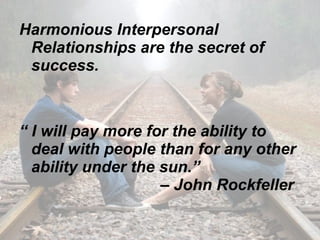
Harmonious Interpersonal Relationships are the secret of success. “  I will pay more for the ability to deal with people than for any other ability under the sun.”    – John Rockfeller
Different people, however, have different responses to particular stimuli. In any given situation, different people may react in different ways. Behaviour = The sum of all of a person's varying response styles to varying stimuli.
A Closer Look At Behaviour Communication Stimulus & Response – Transactional Analysis Life Positions Johari Window
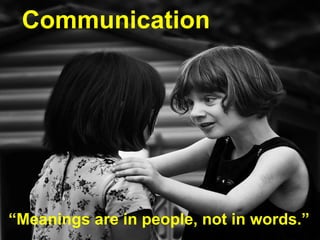
Communication “ Meanings are in people, not in words.”
Communication - The  bridge of meaning  that forms the basis of  understanding  between the members of an organisation. Communication connects all Human Beings.  Effective Communication is one where a message is understood in the  same sense  in which it has been communicated.
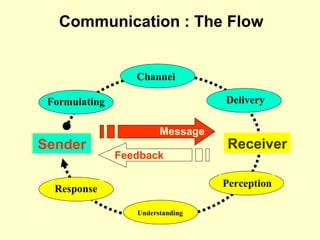
Communication : The Flow Sender Receiver Message Feedback Channel Perception Delivery Formulating Response Understanding
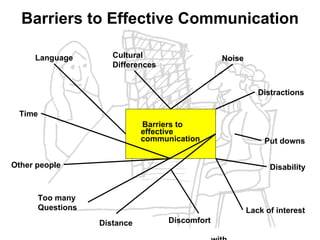
Barriers to Effective Communication Barriers to  effective  communication Noise Distractions Put downs Lack of interest Disability Discomfort  with the topic Distance Too many Questions Other people Time Language Cultural Differences
Perceptions & Attitudes… Their Impact on Communication
Perceptions Perception is a process of making sense of events – the process by which we perceive meaning of any event. Perception and reality are not necessarily one and the same – different people will have different perceptions.
Perceptions influence human behaviour in a variety of ways. They  qualify or evaluate  individuals or events as either – Complete or Incomplete Beautiful or Ugly Sincere or Manipulative Fair or Unfair Precise or Exaggerated  Good or Bad Reasonable or Unreasonable
Good communicators recognise the fact that others may not necessarily perceive their intentions as they themselves do  A classic example: Two salesmen of a shoe company visit a remote village and make the following observations: Salesman A – “There is absolutely no scope. No one wears shoes here !” Salesman B – “No one wears shoes here. There is tremendous scope !” Although the event or information base is the same, the inferences are quite different !
Attitudes Attitude exercises a strong influence on human relationships in any sphere. It essentially  relates to a predisposition  and concerns an individual’s likes or dislikes. Attitudes can be both positive and negative. Positive attitude contributes to the effectiveness of any process. Negative attitude hinders the process
Negative attitude = Barrier. A person with the wrong attitude is often unwilling to listen or to understand reason. Brings negative feelings that undermine the achievement of personal and group objectives. Attitudes, however, are not necessarily permanent in nature – it is possible, with conscious effort, to change the attitude of a person.
Behavioural psychologists stress on the need to develop RMA –  Right Mental Attitude  . People work together better by developing the RMA. Effective communication, like other aspects of human behaviour,  relies heavily on positive thinking  and the RMA.
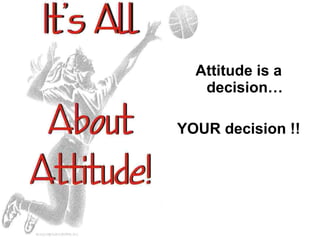
Attitude is a decision… YOUR decision !!
Transactional  Analysis
One of the most promising breakthroughs in psychiatry. A valuable approach to understanding of Human Behaviour & Action. Developed by Dr Eric Berne, author of the book ‘Games People Play’ & subsequently discussed by Dr Thomas A Harris in his book  ‘ I’m OK – You’re OK ’
Starting-point of the theory –  When two people encounter each other, one of them will speak to the other.  This is called the Transaction Stimulus.  The reaction from the other person is called the Transaction Response.
The person sending the Stimulus is called the Agent.  The person who responds is called the Respondent T.A. became the method of examining the transaction wherein: 'I do something to you, and you do something back'.
In any personal interaction, a study of TA is useful in understanding & appropriately responding to varied behaviour. TA divides an individual’s personality into three Ego States. Ego State has been defined as a constant pattern of thinking, feeling or behaving. These states are produced by recalling past events involving real people, real times, real places & real feelings.
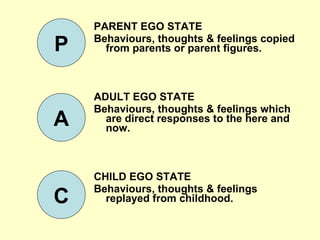
PARENT EGO STATE Behaviours, thoughts & feelings copied from parents or parent figures. ADULT EGO STATE Behaviours, thoughts & feelings which are direct responses to the here and now. CHILD EGO STATE Behaviours, thoughts & feelings replayed from childhood. P A C
The Parent State  - Our ingrained voice of authority, absorbed conditioning, learning and attitudes from when we were young. We were conditioned by our real parents, teachers, and ALL older people, next door neighbours, aunts and uncles. Parent is made up of huge number of hidden and overt recorded playbacks.
Typically embodied by phrases and attitudes starting with 'how to', 'under no circumstances', 'always' and 'never forget', 'don't lie, cheat, steal', etc, etc.  Formed by external events and influences upon us as we grow through early childhood. We can change it, but this is easier said than done.
The Child State  - Our internal reaction and feelings to external events form the ‘Child’. This is the seeing, hearing, feeling, and emotional body of data within each of us. When anger or despair dominates reason, the Child is in control. Like our Parent we can change it, but it is no easier.
The Adult State  - Our ability to think and determine action for ourselves, based on received data. The adult in us begins to form at around ten months old.  Is the means by which we keep our Parent and Child under control.  If we are to change our Parent or Child we must do so through our adult.
In other words: Parent is our 'Taught' concept of life.  Adult is our 'Thought' concept of life.  Child is our 'Felt' concept of life.
When we communicate we are doing so from one of our own Ego States, our P, A or C. Our feelings at the time determine which one we use, and at any time something can trigger a shift from one state to another.  When we respond, we are also doing this from one of the three states. It is in the analysis of these stimuli and responses that the essence of TA lies.
Core of Berne's theory  -  Effective transactions must be complementary. They must go back from the receiving ego state to the sending ego state.  For example, if the stimulus is Parent to Child, the response must be Child to Parent, or the transaction is 'crossed', and there will be a problem between sender and receiver.
If a crossed transaction occurs, there is an ineffective communication.  Worse still, either or both parties will be upset.  For the relationship to continue smoothly the agent or the respondent must rescue the situation with a complementary transaction.
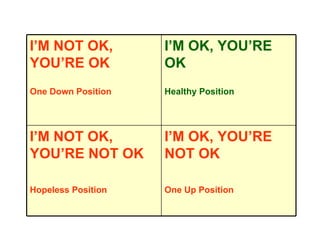
In serious break-downs, there is no chance of immediately resuming a discussion about the original subject matter. Attention is focused on the relationship.  Discussion can only continue constructively when and if the relationship is mended. TA also refers to FOUR LIFE POSITIONS concerning one’s own self as well as others.
Life Positions Life positions - Basic beliefs about self and others, which are used to justify decisions and behaviour. These are perceptions of the world and the people that we ‘transact’ with, as well as of ourselves. Life positions are existential positions, one of which we are more likely to go to under stress.
I’M OK, YOU’RE NOT OK One Up Position I’M NOT OK, YOU’RE NOT OK Hopeless Position I’M OK, YOU’RE OK Healthy Position I’M NOT OK, YOU’RE OK One Down Position
I’m OK – You’re OK Eminently desirable position. Indicates an acceptance of one’s own self-worth as well as that of others. Positive approach in dealing with real life situations. Person concerned shows sense of maturity & comfort in dealing with others.
People with this attitude enjoy positions of leadership. They succeed in developing & sustaining meaningful interpersonal relationships. Attitude Displayed -  "It's no-one's fault, blame isn't the issue - what matters is how we go forward and sort things out."  (I'm okay and you are okay - 'happy')
I’m Not OK – You’re OK Relates to acceptance of others but not of self. Person suffers from an inferiority complex – feels there is something lacking in him. Shows a shortcoming in dealing with real life situations. Will be submissive or passive. Often display subservient attitude.
Often look up to others for advice & seek constant guidance. Display lack of confidence in their own abilities. Attitude Displayed – I’m to blame (You are okay and I'm not okay – ‘helpless’).
I’m OK – You’re Not OK Relates to acceptance of self but not of others. Feels there is something lacking in others. Suffers from superiority complex. Is aggressive & even intimidating. Tries to dominate and tends to give unsolicited advice to others. Displays Attitude - You are to blame (I'm okay and you are not okay - 'angry').
I’m Not OK – You’re Not OK Refers to rejection of both self & others. Nothing is right. Something is lacking in them and in others as well. Opposite of “ I’m OK – You’re OK ” kind of person. Visibly negative & pessimistic approach. Undermine themselves as well as others.
Look down upon others, and do not give others credit for positive developments. Does not see the positive side of anything. Not capable of becoming an effective leader. Displays Attitude - We are both to blame (I’m not okay and you are not okay – ‘hopeless’).
Against backdrop of these Life Positions, TA attempts to analyse a transaction. Transaction forms a basic unit of communication – stimulus by one person and response by another. Transactions take place each time people meet or a communication takes place.
The Three Transactions Three Categories: Complementary  – Smooth conversations with expected responses emanating. Crossed  – Unexpected response, breakdown in communication. Hidden  – Words spoken do not express real meanings. Real responses conveyed through facial expressions or other actions.
Understanding life positions from which a person operates is essential for making communication effective. Knowledge of human behaviours and of transaction types helps to enhance the interpersonal skills of an individual.
The Johari Window
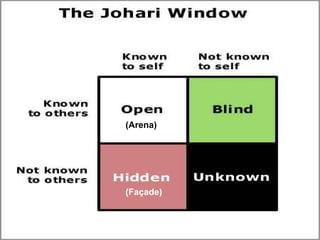
A cognitive psychological tool created by Joseph Luft and Harry Ingham in 1955. Used for helping people better understand their interpersonal communication and relationships.
(Arena) (Façade)
Desirable Behaviour: Be A Winner
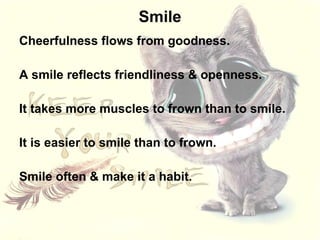
Smile Cheerfulness flows from goodness.  A smile reflects friendliness & openness. It takes more muscles to frown than to smile.  It is easier to smile than to frown.  Smile often & make it a habit.
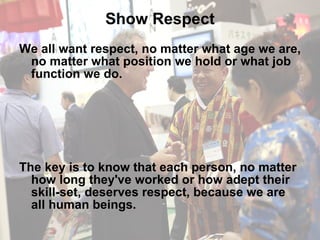
Show Respect We all want respect, no matter what age we are, no matter what position we hold or what job function we do. The key is to know that each person, no matter how long they've worked or how adept their skill-set, deserves respect, because we are all human beings.
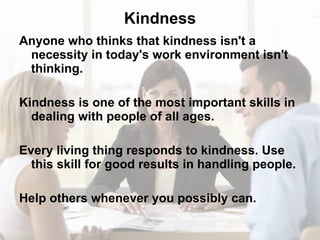
Kindness Anyone who thinks that kindness isn't a necessity in today's work environment isn't thinking. Kindness is one of the most important skills in dealing with people of all ages. Every living thing responds to kindness. Use this skill for good results in handling people. Help others whenever you possibly can.
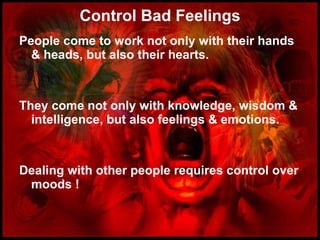
Control Bad Feelings People come to work not only with their hands & heads, but also their hearts. They come not only with knowledge, wisdom & intelligence, but also feelings & emotions. Dealing with other people requires control over moods !
Any work situation is a mix of positive & negative, good & bad strokes. Good Interpersonal skills require underplaying negative strokes & not letting them spoil one’s temper. Learn to rise above bad feelings coming from any quarter and do not let these show up or hinder dealings with people.
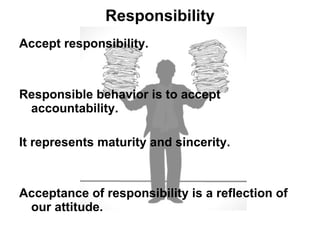
Responsibility Accept responsibility.  Responsible behavior is to accept accountability. It represents maturity and sincerity.  Acceptance of responsibility is a reflection of our attitude.
Mind Your Language ! Language counts. Choose what you say rather than say what you choose. Your point won’t come across any better if you use rude, derogatory, or obscene language, no matter whom you’re addressing. Talk like a professional and you’ll be seen and treated as one.
Admit Mistakes When we make a mistake, we should accept it immediately & willingly.  Some people live & learn while others live & never learn.  Learn from mistakes.  The greatest mistake a person can make is to repeat it.
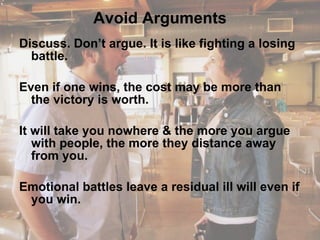
Avoid Arguments Discuss. Don’t argue. It is like fighting a losing battle.  Even if one wins, the cost may be more than the victory is worth.  It will take you nowhere & the more you argue with people, the more they distance away from you.  Emotional battles leave a residual ill will even if you win.
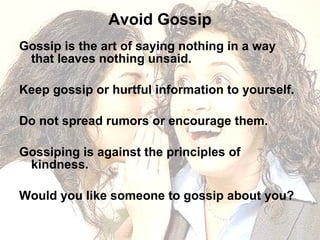
Avoid Gossip Gossip is the art of saying nothing in a way that leaves nothing unsaid. Keep gossip or hurtful information to yourself.  Do not spread rumors or encourage them. Gossiping is against the principles of kindness. Would you like someone to gossip about you?
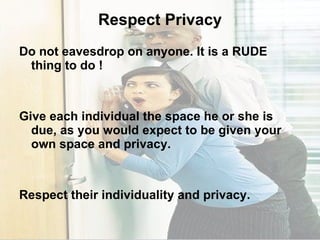
Respect Privacy Do not eavesdrop on anyone. It is a RUDE thing to do ! Give each individual the space he or she is due, as you would expect to be given your own space and privacy. Respect their individuality and privacy.
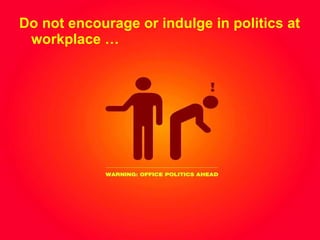
Do not encourage or indulge in politics at workplace …
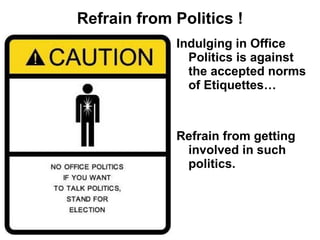
Refrain from Politics ! Indulging in Office Politics is against the accepted norms of Etiquettes…  Refrain from getting involved in such politics.
Practice
Leave gender out of the equation Coworkers are peers, regardless of gender.  Be sensitive towards female colleagues. Of course, dirty jokes, off-color remarks, and discussion of certain private matters are an absolute no-no. Period.
Integrity Maintain your integrity at all times. When you make a promise or give your word, you need to follow through on it. If you are unable to keep the promise or fulfill the commitment, you must be prepared to make amends and set things right.
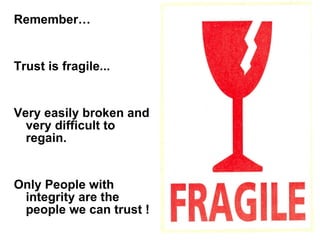
Remember… Trust is fragile... Very easily broken and very difficult to regain. Only People with integrity are the people we can trust !
Part II Group & Team Behaviour
"It's possible to achieve almost anything as long as you are not worried about who gets the credit."  –  Harry S. Truman
Why do people join a group? GROUP SYNERGY Refers to the idea that two heads (or more) are better than one; OR "The whole is greater than the sum of its parts," which also refers to group synergy. Groups are often capable of producing higher quality work and better decisions than can an individual working alone.
SUPPORT & COMMITMENT Group may be  more willing  to take on a large project than would an individual. With increased ability to perform work, group can provide  encouragement and support  to its members while working on a big project.
SOCIAL GROUPS While all groups will have both social and task dimensions, some groups are predominantly social in their orientation. Examples of these groups would be families and social clubs. These provide for our  safety & solidarity needs  and they help us develop self-esteem.
WORK GROUPS Work groups function to complete a particular task. The task dimension is emphasized. Group members  pool their expertise  to accomplish the task. Examples - Workplaces, Campus Organizations, or Juries etc.
Tuckman's Group Development Theory 1. Forming 2. Storming 3. Norming  4. Performing 5. Adjourning Forming  - Group members learn about each other and the task at hand. Storming  - As group members become more comfortable with each other, they will engage each other in arguments and vie for status in the group. These activities mark the storming phase.
Norming  - Group members establish implicit or explicit rules about how they will achieve their goal. They address the types of communication that will or will not help with the task. Performing  - Groups reach a conclusion and implement the conclusion. Adjourning  - As the group project ends, the group disbands in the adjournment phase.
Teamwork / Workgroup Essentials
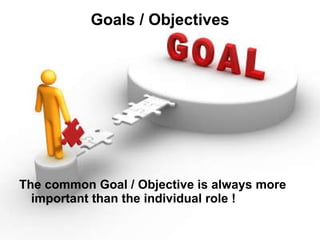
Goals / Objectives The common Goal / Objective is always more important than the individual role !
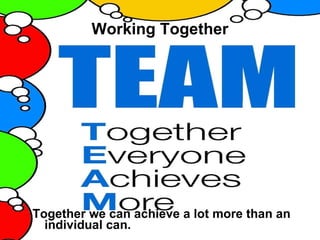
Working Together Together we can achieve a lot more than an individual can.
Roles All team members play a vital role where they add value with their contributions. The idea is to focus on common objectives and not fight for credit.
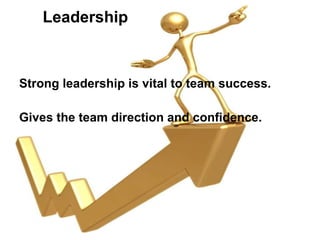
Leadership Strong leadership is vital to team success. Gives the team direction and confidence.
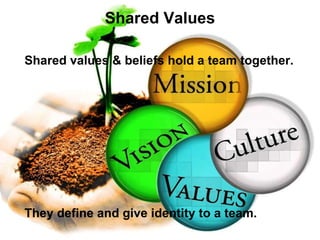
Shared Values Shared values & beliefs hold a team together. They define and give identity to a team.
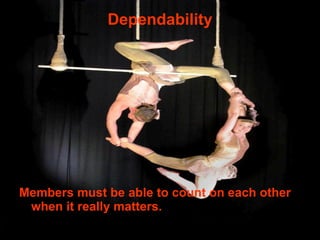
Dependability Members must be able to count on each other when it really matters.
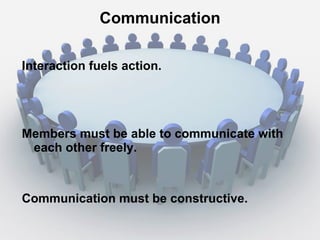
Communication Interaction fuels action. Members must be able to communicate with each other freely. Communication must be constructive.
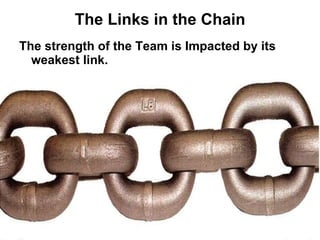
The Links in the Chain The strength of the Team is Impacted by its weakest link.
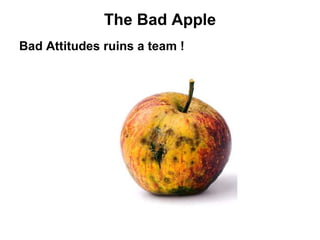
The Bad Apple Bad Attitudes ruins a team !
Questions ?

Interpersonal & Group Behaviour

  • 1.
    Interpersonal &Group Behaviour A Presentation by Rajiv Bajaj
  • 2.
    What is Behaviour? A word with many different definitions… probably no such thing as an absolute definition. 1. Manner of behaving or acting. 2. Psychology, Animal Behavior. a. observable activity in a human or animal. b. the aggregate of responses to internal and external stimuli. 3. Often, behaviours. a behaviour pattern. (www.dictionary.com)
  • 3.
    At the coreof this definition lie the ideas of stimulus and response . Stimuli - Sets of circumstances or individual events. Cause people to act or react (respond) to them.
  • 4.
  • 5.
    Harmonious Interpersonal Relationshipsare the secret of success. “ I will pay more for the ability to deal with people than for any other ability under the sun.” – John Rockfeller
  • 6.
    Different people, however,have different responses to particular stimuli. In any given situation, different people may react in different ways. Behaviour = The sum of all of a person's varying response styles to varying stimuli.
  • 7.
    A Closer LookAt Behaviour Communication Stimulus & Response – Transactional Analysis Life Positions Johari Window
  • 8.
    Communication “ Meaningsare in people, not in words.”
  • 9.
    Communication - The bridge of meaning that forms the basis of understanding between the members of an organisation. Communication connects all Human Beings. Effective Communication is one where a message is understood in the same sense in which it has been communicated.
  • 10.
    Communication : TheFlow Sender Receiver Message Feedback Channel Perception Delivery Formulating Response Understanding
  • 11.
    Barriers to EffectiveCommunication Barriers to effective communication Noise Distractions Put downs Lack of interest Disability Discomfort with the topic Distance Too many Questions Other people Time Language Cultural Differences
  • 12.
    Perceptions & Attitudes…Their Impact on Communication
  • 13.
    Perceptions Perception isa process of making sense of events – the process by which we perceive meaning of any event. Perception and reality are not necessarily one and the same – different people will have different perceptions.
  • 14.
    Perceptions influence humanbehaviour in a variety of ways. They qualify or evaluate individuals or events as either – Complete or Incomplete Beautiful or Ugly Sincere or Manipulative Fair or Unfair Precise or Exaggerated Good or Bad Reasonable or Unreasonable
  • 15.
    Good communicators recognisethe fact that others may not necessarily perceive their intentions as they themselves do A classic example: Two salesmen of a shoe company visit a remote village and make the following observations: Salesman A – “There is absolutely no scope. No one wears shoes here !” Salesman B – “No one wears shoes here. There is tremendous scope !” Although the event or information base is the same, the inferences are quite different !
  • 16.
    Attitudes Attitude exercisesa strong influence on human relationships in any sphere. It essentially relates to a predisposition and concerns an individual’s likes or dislikes. Attitudes can be both positive and negative. Positive attitude contributes to the effectiveness of any process. Negative attitude hinders the process
  • 17.
    Negative attitude =Barrier. A person with the wrong attitude is often unwilling to listen or to understand reason. Brings negative feelings that undermine the achievement of personal and group objectives. Attitudes, however, are not necessarily permanent in nature – it is possible, with conscious effort, to change the attitude of a person.
  • 18.
    Behavioural psychologists stresson the need to develop RMA – Right Mental Attitude . People work together better by developing the RMA. Effective communication, like other aspects of human behaviour, relies heavily on positive thinking and the RMA.
  • 19.
    Attitude is adecision… YOUR decision !!
  • 20.
  • 21.
    One of themost promising breakthroughs in psychiatry. A valuable approach to understanding of Human Behaviour & Action. Developed by Dr Eric Berne, author of the book ‘Games People Play’ & subsequently discussed by Dr Thomas A Harris in his book ‘ I’m OK – You’re OK ’
  • 22.
    Starting-point of thetheory – When two people encounter each other, one of them will speak to the other. This is called the Transaction Stimulus. The reaction from the other person is called the Transaction Response.
  • 23.
    The person sendingthe Stimulus is called the Agent. The person who responds is called the Respondent T.A. became the method of examining the transaction wherein: 'I do something to you, and you do something back'.
  • 24.
    In any personalinteraction, a study of TA is useful in understanding & appropriately responding to varied behaviour. TA divides an individual’s personality into three Ego States. Ego State has been defined as a constant pattern of thinking, feeling or behaving. These states are produced by recalling past events involving real people, real times, real places & real feelings.
  • 25.
    PARENT EGO STATEBehaviours, thoughts & feelings copied from parents or parent figures. ADULT EGO STATE Behaviours, thoughts & feelings which are direct responses to the here and now. CHILD EGO STATE Behaviours, thoughts & feelings replayed from childhood. P A C
  • 26.
    The Parent State - Our ingrained voice of authority, absorbed conditioning, learning and attitudes from when we were young. We were conditioned by our real parents, teachers, and ALL older people, next door neighbours, aunts and uncles. Parent is made up of huge number of hidden and overt recorded playbacks.
  • 27.
    Typically embodied byphrases and attitudes starting with 'how to', 'under no circumstances', 'always' and 'never forget', 'don't lie, cheat, steal', etc, etc. Formed by external events and influences upon us as we grow through early childhood. We can change it, but this is easier said than done.
  • 28.
    The Child State - Our internal reaction and feelings to external events form the ‘Child’. This is the seeing, hearing, feeling, and emotional body of data within each of us. When anger or despair dominates reason, the Child is in control. Like our Parent we can change it, but it is no easier.
  • 29.
    The Adult State - Our ability to think and determine action for ourselves, based on received data. The adult in us begins to form at around ten months old. Is the means by which we keep our Parent and Child under control. If we are to change our Parent or Child we must do so through our adult.
  • 30.
    In other words:Parent is our 'Taught' concept of life. Adult is our 'Thought' concept of life. Child is our 'Felt' concept of life.
  • 31.
    When we communicatewe are doing so from one of our own Ego States, our P, A or C. Our feelings at the time determine which one we use, and at any time something can trigger a shift from one state to another. When we respond, we are also doing this from one of the three states. It is in the analysis of these stimuli and responses that the essence of TA lies.
  • 32.
    Core of Berne'stheory - Effective transactions must be complementary. They must go back from the receiving ego state to the sending ego state. For example, if the stimulus is Parent to Child, the response must be Child to Parent, or the transaction is 'crossed', and there will be a problem between sender and receiver.
  • 33.
    If a crossedtransaction occurs, there is an ineffective communication. Worse still, either or both parties will be upset. For the relationship to continue smoothly the agent or the respondent must rescue the situation with a complementary transaction.
  • 34.
    In serious break-downs,there is no chance of immediately resuming a discussion about the original subject matter. Attention is focused on the relationship. Discussion can only continue constructively when and if the relationship is mended. TA also refers to FOUR LIFE POSITIONS concerning one’s own self as well as others.
  • 35.
    Life Positions Lifepositions - Basic beliefs about self and others, which are used to justify decisions and behaviour. These are perceptions of the world and the people that we ‘transact’ with, as well as of ourselves. Life positions are existential positions, one of which we are more likely to go to under stress.
  • 36.
    I’M OK, YOU’RENOT OK One Up Position I’M NOT OK, YOU’RE NOT OK Hopeless Position I’M OK, YOU’RE OK Healthy Position I’M NOT OK, YOU’RE OK One Down Position
  • 37.
    I’m OK –You’re OK Eminently desirable position. Indicates an acceptance of one’s own self-worth as well as that of others. Positive approach in dealing with real life situations. Person concerned shows sense of maturity & comfort in dealing with others.
  • 38.
    People with thisattitude enjoy positions of leadership. They succeed in developing & sustaining meaningful interpersonal relationships. Attitude Displayed - "It's no-one's fault, blame isn't the issue - what matters is how we go forward and sort things out." (I'm okay and you are okay - 'happy')
  • 39.
    I’m Not OK– You’re OK Relates to acceptance of others but not of self. Person suffers from an inferiority complex – feels there is something lacking in him. Shows a shortcoming in dealing with real life situations. Will be submissive or passive. Often display subservient attitude.
  • 40.
    Often look upto others for advice & seek constant guidance. Display lack of confidence in their own abilities. Attitude Displayed – I’m to blame (You are okay and I'm not okay – ‘helpless’).
  • 41.
    I’m OK –You’re Not OK Relates to acceptance of self but not of others. Feels there is something lacking in others. Suffers from superiority complex. Is aggressive & even intimidating. Tries to dominate and tends to give unsolicited advice to others. Displays Attitude - You are to blame (I'm okay and you are not okay - 'angry').
  • 42.
    I’m Not OK– You’re Not OK Refers to rejection of both self & others. Nothing is right. Something is lacking in them and in others as well. Opposite of “ I’m OK – You’re OK ” kind of person. Visibly negative & pessimistic approach. Undermine themselves as well as others.
  • 43.
    Look down uponothers, and do not give others credit for positive developments. Does not see the positive side of anything. Not capable of becoming an effective leader. Displays Attitude - We are both to blame (I’m not okay and you are not okay – ‘hopeless’).
  • 44.
    Against backdrop ofthese Life Positions, TA attempts to analyse a transaction. Transaction forms a basic unit of communication – stimulus by one person and response by another. Transactions take place each time people meet or a communication takes place.
  • 45.
    The Three TransactionsThree Categories: Complementary – Smooth conversations with expected responses emanating. Crossed – Unexpected response, breakdown in communication. Hidden – Words spoken do not express real meanings. Real responses conveyed through facial expressions or other actions.
  • 46.
    Understanding life positionsfrom which a person operates is essential for making communication effective. Knowledge of human behaviours and of transaction types helps to enhance the interpersonal skills of an individual.
  • 47.
  • 48.
    A cognitive psychologicaltool created by Joseph Luft and Harry Ingham in 1955. Used for helping people better understand their interpersonal communication and relationships.
  • 49.
  • 50.
  • 51.
    Smile Cheerfulness flowsfrom goodness. A smile reflects friendliness & openness. It takes more muscles to frown than to smile. It is easier to smile than to frown. Smile often & make it a habit.
  • 52.
    Show Respect Weall want respect, no matter what age we are, no matter what position we hold or what job function we do. The key is to know that each person, no matter how long they've worked or how adept their skill-set, deserves respect, because we are all human beings.
  • 53.
    Kindness Anyone whothinks that kindness isn't a necessity in today's work environment isn't thinking. Kindness is one of the most important skills in dealing with people of all ages. Every living thing responds to kindness. Use this skill for good results in handling people. Help others whenever you possibly can.
  • 54.
    Control Bad FeelingsPeople come to work not only with their hands & heads, but also their hearts. They come not only with knowledge, wisdom & intelligence, but also feelings & emotions. Dealing with other people requires control over moods !
  • 55.
    Any work situationis a mix of positive & negative, good & bad strokes. Good Interpersonal skills require underplaying negative strokes & not letting them spoil one’s temper. Learn to rise above bad feelings coming from any quarter and do not let these show up or hinder dealings with people.
  • 56.
    Responsibility Accept responsibility. Responsible behavior is to accept accountability. It represents maturity and sincerity. Acceptance of responsibility is a reflection of our attitude.
  • 57.
    Mind Your Language! Language counts. Choose what you say rather than say what you choose. Your point won’t come across any better if you use rude, derogatory, or obscene language, no matter whom you’re addressing. Talk like a professional and you’ll be seen and treated as one.
  • 58.
    Admit Mistakes Whenwe make a mistake, we should accept it immediately & willingly. Some people live & learn while others live & never learn. Learn from mistakes. The greatest mistake a person can make is to repeat it.
  • 59.
    Avoid Arguments Discuss.Don’t argue. It is like fighting a losing battle. Even if one wins, the cost may be more than the victory is worth. It will take you nowhere & the more you argue with people, the more they distance away from you. Emotional battles leave a residual ill will even if you win.
  • 60.
    Avoid Gossip Gossipis the art of saying nothing in a way that leaves nothing unsaid. Keep gossip or hurtful information to yourself. Do not spread rumors or encourage them. Gossiping is against the principles of kindness. Would you like someone to gossip about you?
  • 61.
    Respect Privacy Donot eavesdrop on anyone. It is a RUDE thing to do ! Give each individual the space he or she is due, as you would expect to be given your own space and privacy. Respect their individuality and privacy.
  • 62.
    Do not encourageor indulge in politics at workplace …
  • 63.
    Refrain from Politics! Indulging in Office Politics is against the accepted norms of Etiquettes… Refrain from getting involved in such politics.
  • 64.
  • 65.
    Leave gender outof the equation Coworkers are peers, regardless of gender. Be sensitive towards female colleagues. Of course, dirty jokes, off-color remarks, and discussion of certain private matters are an absolute no-no. Period.
  • 66.
    Integrity Maintain yourintegrity at all times. When you make a promise or give your word, you need to follow through on it. If you are unable to keep the promise or fulfill the commitment, you must be prepared to make amends and set things right.
  • 67.
    Remember… Trust isfragile... Very easily broken and very difficult to regain. Only People with integrity are the people we can trust !
  • 68.
    Part II Group& Team Behaviour
  • 69.
    "It's possible toachieve almost anything as long as you are not worried about who gets the credit." – Harry S. Truman
  • 70.
    Why do peoplejoin a group? GROUP SYNERGY Refers to the idea that two heads (or more) are better than one; OR "The whole is greater than the sum of its parts," which also refers to group synergy. Groups are often capable of producing higher quality work and better decisions than can an individual working alone.
  • 71.
    SUPPORT & COMMITMENTGroup may be more willing to take on a large project than would an individual. With increased ability to perform work, group can provide encouragement and support to its members while working on a big project.
  • 72.
    SOCIAL GROUPS Whileall groups will have both social and task dimensions, some groups are predominantly social in their orientation. Examples of these groups would be families and social clubs. These provide for our safety & solidarity needs and they help us develop self-esteem.
  • 73.
    WORK GROUPS Workgroups function to complete a particular task. The task dimension is emphasized. Group members pool their expertise to accomplish the task. Examples - Workplaces, Campus Organizations, or Juries etc.
  • 74.
    Tuckman's Group DevelopmentTheory 1. Forming 2. Storming 3. Norming 4. Performing 5. Adjourning Forming - Group members learn about each other and the task at hand. Storming - As group members become more comfortable with each other, they will engage each other in arguments and vie for status in the group. These activities mark the storming phase.
  • 75.
    Norming -Group members establish implicit or explicit rules about how they will achieve their goal. They address the types of communication that will or will not help with the task. Performing - Groups reach a conclusion and implement the conclusion. Adjourning - As the group project ends, the group disbands in the adjournment phase.
  • 76.
  • 77.
    Goals / ObjectivesThe common Goal / Objective is always more important than the individual role !
  • 78.
    Working Together Togetherwe can achieve a lot more than an individual can.
  • 79.
    Roles All teammembers play a vital role where they add value with their contributions. The idea is to focus on common objectives and not fight for credit.
  • 80.
    Leadership Strong leadershipis vital to team success. Gives the team direction and confidence.
  • 81.
    Shared Values Sharedvalues & beliefs hold a team together. They define and give identity to a team.
  • 82.
    Dependability Members mustbe able to count on each other when it really matters.
  • 83.
    Communication Interaction fuelsaction. Members must be able to communicate with each other freely. Communication must be constructive.
  • 84.
    The Links inthe Chain The strength of the Team is Impacted by its weakest link.
  • 85.
    The Bad AppleBad Attitudes ruins a team !
  • 86.