“EXAMINATION OF A NEW PARADIGM”
WHAT IS RELATIONSHIP MARKETING?
Relationship Marketing is an integrated effort to identity,
maintain and build a network with individual customers and
to continuously strengthen the network for the benefit of
both the sides.
DEFINITIONS:
Relationship marketing is defined as the process of
attracting, maintaining and ,in multi-service organizations,
enhancing customer relationships. (BERRY,1983).
VAVRA(1992) defines it as a customer retention program
in which a variety of after marketing tactics are used for
customer bonding or staying in touch after the sale is
Some factors that led to the rapid development of relationship marketing
are:-
SOPHISTICATED TECHNOLOGY like computers and
telecommunications that allow the producers to interact with the
customers.
TOTAL QUALITY MOVEMENT DRIVE among the companies has led to
the enhancement of relationship marketing.
WHAT IS THE DIFFERENCE BETWEEN
TRADITIONAL AND RELATIONSHIP MARKETING?
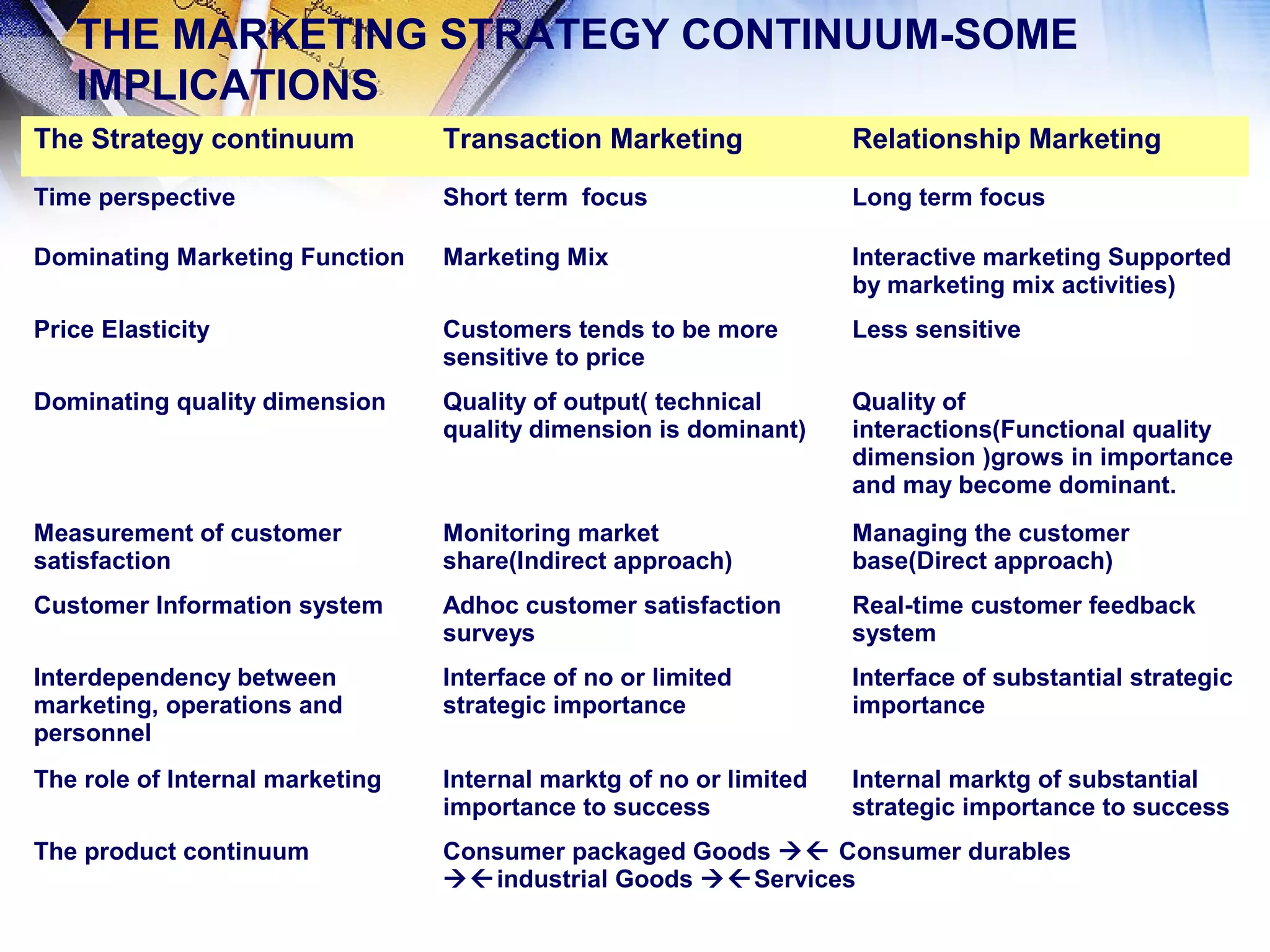
The Strategy continuum Transaction Marketing Relationship Marketing
Time perspective Short term focus Long term focus
Dominating Marketing Function Marketing Mix Interactive marketing Supported
by marketing mix activities)
Price Elasticity Customers tends to be more
sensitive to price
Less sensitive
Dominating quality dimension Quality of output( technical
quality dimension is dominant)
Quality of
interactions(Functional quality
dimension )grows in importance
and may become dominant.
Measurement of customer
satisfaction
Monitoring market
share(Indirect approach)
Managing the customer
base(Direct approach)
Customer Information system Adhoc customer satisfaction
surveys
Real-time customer feedback
system
Interdependency between
marketing, operations and
personnel
Interface of no or limited
strategic importance
Interface of substantial strategic
importance
The role of Internal marketing Internal marktg of no or limited
importance to success
Internal marktg of substantial
strategic importance to success
The product continuum Consumer packaged Goods  Consumer durables
industrial Goods Services
THE MARKETING STRATEGY CONTINUUM-SOME
IMPLICATIONS
Key Elements in Relationship Marketing
•To identify and build a database of the current and potential customers
,which incorporates the information regarding the demographic ,lifestyle
and purchase behavior of the customers.
•To deliver the right messages to the right target customers at the right
time through proper communication channels.
•To keep track of each and every relationship and monitoring the cost
of acquiring the consumers and their lifetime value.
•The emphasis on the interaction between suppliers and customers is
shifting from a transaction to a relationship focus.
• The relationship marketing focuses on maximizing the lifetime
value of desirable customers and customer segments.
• Quality ,customer service and marketing are closely related
,but most of the time they are managed separately. The
relationship marketing makes these elements coherent.
• Delivering differentiated messages to theses people through
established and new media channels based on the consumers
characteristics and preferences.
PURPOSE OF RELATIONSHIP
MARKETING
CUSTOMER RETENTION IS THE ONLY PURPOSE
Relationship marketing attempts to involve and integrate customers
,suppliers and other infrastructural partners into a firm’s developmental
and marketing activities .Such involvement results in close interactive
relationships with suppliers, customers or other value chain partners of
the firm.
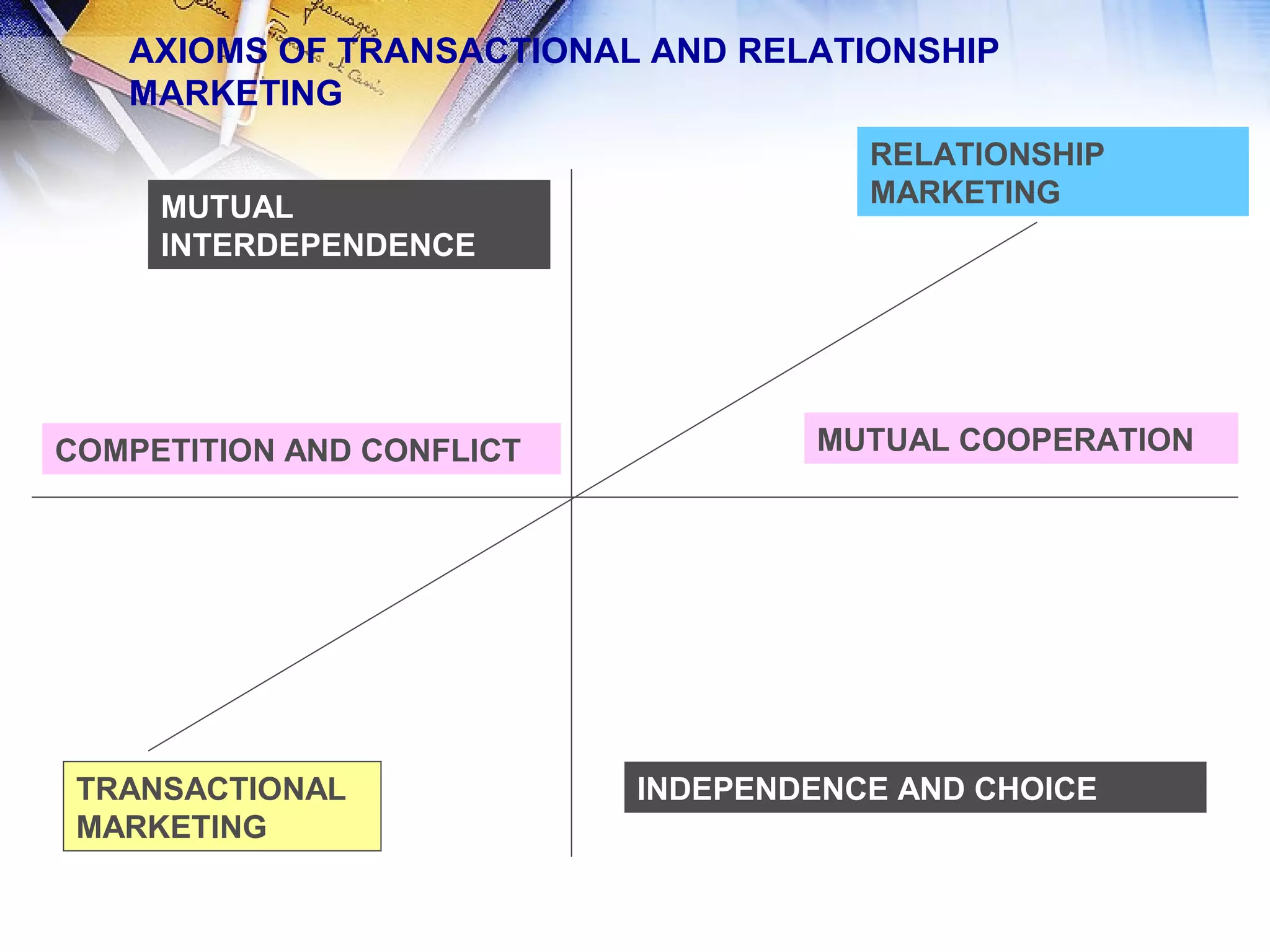
Thus RM reflects interdependence rather than independence of
choice among the parties and emphasizes cooperation rather than
competition and consequent conflict among the marketing actors.
So development of relationship marketing points a significant shift in
the axioms of marketing competition :
COMPETITION AND CONFLICT TO MUTUAL COOPERATION.
CHOICE INDEPENDENCE TO MUTUAL INTERDEPENDENCE.
TRANSACTIONAL
MARKETING
RELATIONSHIP
MARKETING
INDEPENDENCE AND CHOICE
MUTUAL
INTERDEPENDENCE
COMPETITION AND CONFLICT MUTUAL COOPERATION
AXIOMS OF TRANSACTIONAL AND RELATIONSHIP
MARKETING
SIX MARKET FRAMEWORK OF
RELATIONSHIP MARKETING
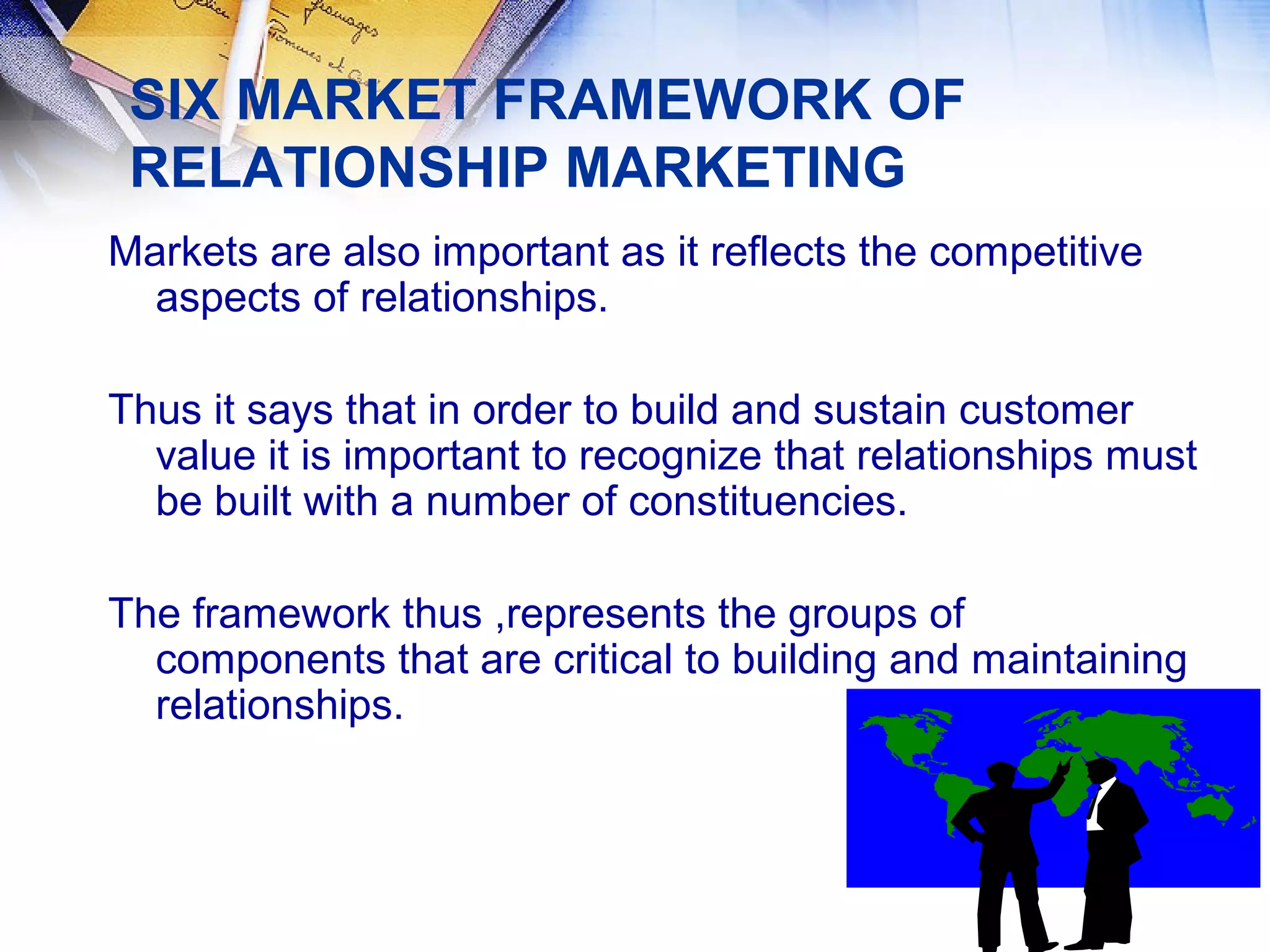
Markets are also important as it reflects the competitive
aspects of relationships.
Thus it says that in order to build and sustain customer
value it is important to recognize that relationships must
be built with a number of constituencies.
The framework thus ,represents the groups of
components that are critical to building and maintaining
relationships.
CUSTOMER
MARKETS
RECRUITMENT
MARKETS
SUPPLIER
&
ALLIANCE
MARKETS
INFLUENCE
MARKETS
REFERRAL
MARKETS
INTERNAL
MARKETS
The essence of this framework is that although customer markets are
at the center of the figure it is not the only market of importance in
terms of relationship marketing; the other markets are as influential
as customer markets depending on the situation and context.
CONSUMER MARKETS
Many organizations market to trade customers (Intermediaries,
distributors or retailers) and consumers (end purchasers ,user and
consumer), but their relative power within the supply chain is likely to
determine which relationships are in focus and which are not.
REFERRAL MARKETS (WOM)
Referrals are characterized by their credibility towards the
environment of the relationships or as endorsers of one of the parties
involved .Referrals can be decisive as they posses a high credibility
factor. They aren’t gained from publishing their point of view.
INTERNAL MARKETS
Each and every employee of an organization is responsible for creating
and distributing value to the customers. According to BERRY
(1984),employees are an organizations first customers.
RECRUITMENT MARKETS
Recruiting right employees for the right post in an organization is a very
important factor in the overall performance of the organization. Recruitment
has slowly become a marketing related task. The potential employee will
search for internal qualitative factors that go far beyond its products and
services.
INFLUENCE MARKETS
Influence Markets are the markets that may or may not influence a
relationship ;however they share the potential to influence relationships
regardless of whether they are internal or external.
SUPPLIER MARKETS
In the marketing system ,suppliers should be included as relationship
partners. In SCM(supply chain management), the whole marketing system is
considered the unit of analysis. This is in synchronization with the six market
framework.
RELATIONSHIP MARKETING PROGRAMS
By observations of the corporate practices ,there are three types of
relationship marketing programs
•Continuity marketing
•One- to – marketing
•Partnering programs
They take different forms depending upon whether they are
meant for end-customer, distributor customers ,or business –to-
business customers.
Marketers use a combination of one or more types of theses
to build closer and mutually beneficial relationships with their
customers.
PROGRAM
TYPES
CUSTOMER TYPES
Individual
customers
Distributors/Re
sellers
Institutional
Buyers (B2B)
Continuity
marketing
Loyalty
programs
Continuous
Replenishment
Special supply
arrangements
E.g.-JIT,MRP
Individual
marketing
Data
warehousing
and data
mining
Customer
business
development
Key account
management
and co-
development
Co-marketing/
Partnering
Co-branding Co-operative
marketing
Joint marketing
and co-
development
VARIOUS TYPES OF RELATIONSHIP MARKETING PROGRAMS
PREVALENT AMONG DIFFERENT TYPES OF CUSTOMERS
FOR INSTANCE …
TELECOMMUNICATION
SECTOR..
CHALLENGES FOR RELATIONSHIP MARKETING
Once the strategy of RM is established, implementing RM requires application
of a range of skills and resources from the initial database and product to
fulfillment capabilities and feedback mechanisms.
Some of the challenges faced by RM marketers are:
Gaining access to the appropriate systems and executional capabilities.
Developing the right organizational structure.
Budgeting for lifetime customer value.
Managing an integrated communication program.
Building alliances between manufacturers and retailers.
CONCULSION
To conclude,relationship marketing emerged as a result of
shift from customer acquisition to customer interactions.
RM provides advertisers with a richer set of
tools for building brand image and awareness and
spending promotional money more effectively. Advertisers
who fail to master the techniques of RM will find
themselves outplayed by the smarter competitors .
The important question to be answered now
is to decide whether to deploy RM or not and to
determine how and when to do so.
Relationship marketing

Relationship marketing

  • 1.
    “EXAMINATION OF ANEW PARADIGM”
  • 2.
    WHAT IS RELATIONSHIPMARKETING? Relationship Marketing is an integrated effort to identity, maintain and build a network with individual customers and to continuously strengthen the network for the benefit of both the sides. DEFINITIONS: Relationship marketing is defined as the process of attracting, maintaining and ,in multi-service organizations, enhancing customer relationships. (BERRY,1983). VAVRA(1992) defines it as a customer retention program in which a variety of after marketing tactics are used for customer bonding or staying in touch after the sale is
  • 3.
    Some factors thatled to the rapid development of relationship marketing are:- SOPHISTICATED TECHNOLOGY like computers and telecommunications that allow the producers to interact with the customers. TOTAL QUALITY MOVEMENT DRIVE among the companies has led to the enhancement of relationship marketing. WHAT IS THE DIFFERENCE BETWEEN TRADITIONAL AND RELATIONSHIP MARKETING?
  • 4.
    The Strategy continuumTransaction Marketing Relationship Marketing Time perspective Short term focus Long term focus Dominating Marketing Function Marketing Mix Interactive marketing Supported by marketing mix activities) Price Elasticity Customers tends to be more sensitive to price Less sensitive Dominating quality dimension Quality of output( technical quality dimension is dominant) Quality of interactions(Functional quality dimension )grows in importance and may become dominant. Measurement of customer satisfaction Monitoring market share(Indirect approach) Managing the customer base(Direct approach) Customer Information system Adhoc customer satisfaction surveys Real-time customer feedback system Interdependency between marketing, operations and personnel Interface of no or limited strategic importance Interface of substantial strategic importance The role of Internal marketing Internal marktg of no or limited importance to success Internal marktg of substantial strategic importance to success The product continuum Consumer packaged Goods  Consumer durables industrial Goods Services THE MARKETING STRATEGY CONTINUUM-SOME IMPLICATIONS
  • 5.
    Key Elements inRelationship Marketing •To identify and build a database of the current and potential customers ,which incorporates the information regarding the demographic ,lifestyle and purchase behavior of the customers. •To deliver the right messages to the right target customers at the right time through proper communication channels. •To keep track of each and every relationship and monitoring the cost of acquiring the consumers and their lifetime value. •The emphasis on the interaction between suppliers and customers is shifting from a transaction to a relationship focus.
  • 6.
    • The relationshipmarketing focuses on maximizing the lifetime value of desirable customers and customer segments. • Quality ,customer service and marketing are closely related ,but most of the time they are managed separately. The relationship marketing makes these elements coherent. • Delivering differentiated messages to theses people through established and new media channels based on the consumers characteristics and preferences.
  • 7.
    PURPOSE OF RELATIONSHIP MARKETING CUSTOMERRETENTION IS THE ONLY PURPOSE Relationship marketing attempts to involve and integrate customers ,suppliers and other infrastructural partners into a firm’s developmental and marketing activities .Such involvement results in close interactive relationships with suppliers, customers or other value chain partners of the firm. Thus RM reflects interdependence rather than independence of choice among the parties and emphasizes cooperation rather than competition and consequent conflict among the marketing actors. So development of relationship marketing points a significant shift in the axioms of marketing competition : COMPETITION AND CONFLICT TO MUTUAL COOPERATION. CHOICE INDEPENDENCE TO MUTUAL INTERDEPENDENCE.
  • 8.
    TRANSACTIONAL MARKETING RELATIONSHIP MARKETING INDEPENDENCE AND CHOICE MUTUAL INTERDEPENDENCE COMPETITIONAND CONFLICT MUTUAL COOPERATION AXIOMS OF TRANSACTIONAL AND RELATIONSHIP MARKETING
  • 9.
    SIX MARKET FRAMEWORKOF RELATIONSHIP MARKETING Markets are also important as it reflects the competitive aspects of relationships. Thus it says that in order to build and sustain customer value it is important to recognize that relationships must be built with a number of constituencies. The framework thus ,represents the groups of components that are critical to building and maintaining relationships.
  • 10.
  • 11.
    The essence ofthis framework is that although customer markets are at the center of the figure it is not the only market of importance in terms of relationship marketing; the other markets are as influential as customer markets depending on the situation and context. CONSUMER MARKETS Many organizations market to trade customers (Intermediaries, distributors or retailers) and consumers (end purchasers ,user and consumer), but their relative power within the supply chain is likely to determine which relationships are in focus and which are not. REFERRAL MARKETS (WOM) Referrals are characterized by their credibility towards the environment of the relationships or as endorsers of one of the parties involved .Referrals can be decisive as they posses a high credibility factor. They aren’t gained from publishing their point of view.
  • 12.
    INTERNAL MARKETS Each andevery employee of an organization is responsible for creating and distributing value to the customers. According to BERRY (1984),employees are an organizations first customers. RECRUITMENT MARKETS Recruiting right employees for the right post in an organization is a very important factor in the overall performance of the organization. Recruitment has slowly become a marketing related task. The potential employee will search for internal qualitative factors that go far beyond its products and services. INFLUENCE MARKETS Influence Markets are the markets that may or may not influence a relationship ;however they share the potential to influence relationships regardless of whether they are internal or external. SUPPLIER MARKETS In the marketing system ,suppliers should be included as relationship partners. In SCM(supply chain management), the whole marketing system is considered the unit of analysis. This is in synchronization with the six market framework.
  • 13.
    RELATIONSHIP MARKETING PROGRAMS Byobservations of the corporate practices ,there are three types of relationship marketing programs •Continuity marketing •One- to – marketing •Partnering programs They take different forms depending upon whether they are meant for end-customer, distributor customers ,or business –to- business customers. Marketers use a combination of one or more types of theses to build closer and mutually beneficial relationships with their customers.
  • 14.
    PROGRAM TYPES CUSTOMER TYPES Individual customers Distributors/Re sellers Institutional Buyers (B2B) Continuity marketing Loyalty programs Continuous Replenishment Specialsupply arrangements E.g.-JIT,MRP Individual marketing Data warehousing and data mining Customer business development Key account management and co- development Co-marketing/ Partnering Co-branding Co-operative marketing Joint marketing and co- development VARIOUS TYPES OF RELATIONSHIP MARKETING PROGRAMS PREVALENT AMONG DIFFERENT TYPES OF CUSTOMERS
  • 15.
  • 16.
    CHALLENGES FOR RELATIONSHIPMARKETING Once the strategy of RM is established, implementing RM requires application of a range of skills and resources from the initial database and product to fulfillment capabilities and feedback mechanisms. Some of the challenges faced by RM marketers are: Gaining access to the appropriate systems and executional capabilities. Developing the right organizational structure. Budgeting for lifetime customer value. Managing an integrated communication program. Building alliances between manufacturers and retailers.
  • 17.
    CONCULSION To conclude,relationship marketingemerged as a result of shift from customer acquisition to customer interactions. RM provides advertisers with a richer set of tools for building brand image and awareness and spending promotional money more effectively. Advertisers who fail to master the techniques of RM will find themselves outplayed by the smarter competitors . The important question to be answered now is to decide whether to deploy RM or not and to determine how and when to do so.