ADVANCED TRAUMA 
LIFE SUPPORT (ATLS) 
AANN OOVVEERRVVIIEEWW 
A 
P 
O 
L 
L 
O 
L 
O 
G 
A
DR.B.SELVARAJ,MMSS;;MMcchh;;FFIICCSS;; 
• General & Pediatric Surgeon 
• Endoscopist & Laparoscopic Surgeon 
• Apollo Loga Hospital 
• Karur 
•India 
A 
P 
O 
L 
L 
O 
L 
O 
G 
A
ADVANCED TRAUMA 
LIFE SUPPORT 
•ATLS In US 
•EMST In Australia 
•PTC In UK 
•Most Countries having an epidemic of trauma 
•In India one of the major killer is trauma 60,000 
deaths/year ; In TN5000/year 
A 
P 
O 
L 
L 
O 
L 
O 
G 
A
AATTLLSSOOBBJJEECCTTIIVVEESS 
•To rapidly  accurately assess trauma patients 
•Early recognition  timely intervention of life 
threatening conditions 
•To resuscitate  stabilise trauma patients 
•To understand the priorities in trauma management 
 Triage 
•To organise quality trauma care in your hospital 
A 
P 
O 
L 
L 
O 
L 
O 
G 
A
TRAUMA MANAGEMENT 
Six Phases 
• Access Phase 
• Pre hospital  Triage Phase 
• Early Hospital or Resuscitation Phase 
• Operative Phase 
• Intensive care Phase 
• Rehabilitative Phase 
A 
P 
O 
L 
L 
O 
L 
O 
G 
A
ATLS TRIMODAL DEATH 
By Arnold D.Trunkey 
• Within Seconds to Minutes 
Brainstem injury 
 Aortic rupture 
• Within Minutes to Hours 
 Sub dural Hematoma 
 Rupture of Liver  Spleen 
• Within Days to Weeks 
Sepsis  MODS 
A 
P 
O 
L 
L 
O 
L 
O 
G 
A
AATTLLSS 
• Emergency life saving precedes examination of 
trauma patients 
• Once immediate survival is achieved definitive 
assessment  treatment begins 
• Priorities in management must always be salvage of 
 Life, Limb, Function  Cosmetic 
A 
P 
O 
L 
L 
O 
L 
O 
G 
A
Pre Hospital Trauma Life Support 
•Scene size up  Extrication 
•Primary Survey  Basic Life Support 
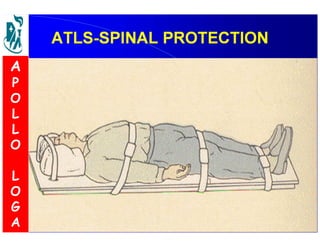
•Spinal Protection in LSB 
•Splinting Extremities 
•Control of External Hemorrhage 
•Aim: To Stabilize the Patient Platinum 10 
Minutes 
•Load  Go within Golden first hour 
A 
P 
O 
L 
L 
O 
L 
O 
G 
A
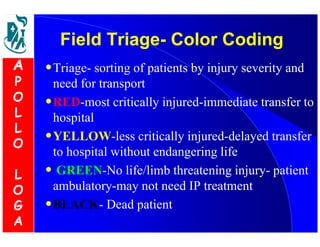
Field Triage- CCoolloorr CCooddiinngg 
•Triage- sorting of patients by injury severity and 
need for transport 
•RED-most critically injured-immediate transfer to 
hospital 
•YELLOW-less critically injured-delayed transfer 
to hospital without endangering life 
• GREEN-No life/limb threatening injury- patient 
ambulatory-may not need IP treatment 
•BLACK- Dead patient 
A 
P 
O 
L 
L 
O 
L 
O 
G 
A
ATLS-SSPPIINNAALL PPRROOTTEECCTTIIOONN 
A 
P 
O 
L 
L 
O 
L 
O 
G 
A
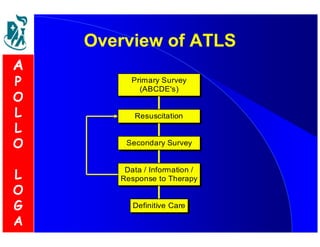
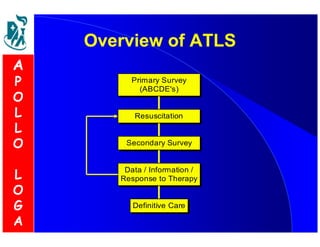
OOvveerrvviieeww ooff AATTLLSS 
Primary Survey 
(ABCDE's) 
Resuscitation 
Secondary Survey 
Data / Information / 
Response to Therapy 
Definitive Care 
A 
P 
O 
L 
L 
O 
L 
O 
G 
A
AATTLLSSPPRRIIMMAARRYY SSUURRVVEEYY 
•A- Airway  Cervical Spine Control 
•B-Breathing  Ventilation 
•C-Circulation  Hemorrhage Control 
•D-Disability  Neurological Status 
•E-Exposure Completely undress the patient 
A 
P 
O 
L 
L 
O 
L 
O 
G 
A
ATLS—PRIMARY SURVEY 
Airway Cervical Spine Control 
•Chin lift or Jaw Thrust 
•Removal of FB,Blood  Vomitus 
•Oropharyngeal or Nasopharyngeal Airway 
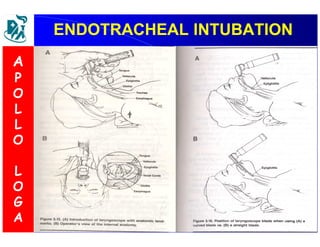
•Intubate With E T T 
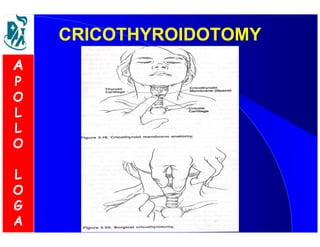
•Cricothyroidotomy 
•Keep the neck immobilised 
A 
P 
O 
L 
L 
O 
L 
O 
G 
A
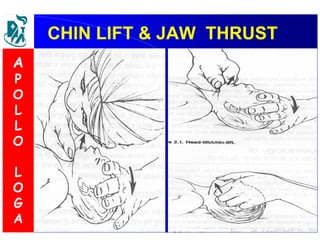
CHIN LLIIFFTT  JJAAWW TTHHRRUUSSTT 
A 
P 
O 
L 
L 
O 
L 
O 
G 
A
ENDOTRACHEAL IINNTTUUBBAATTIIOONN 
A 
P 
O 
L 
L 
O 
L 
O 
G 
A
CCRRIICCOOTTHHYYRROOIIDDOOTTOOMMYY 
A 
P 
O 
L 
L 
O 
L 
O 
G 
A
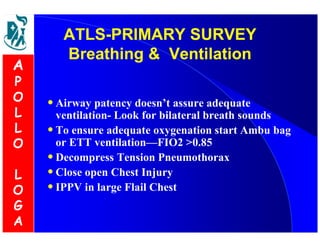
ATLS-PRIMARY SURVEY 
Breathing  Ventilation 
• Airway patency doesn’t assure adequate 
ventilation- Look for bilateral breath sounds 
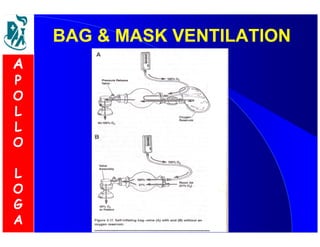
• To ensure adequate oxygenation start Ambu bag 
or ETT ventilation—FIO2 0.85 
• Decompress Tension Pneumothorax 
• Close open Chest Injury 
• IPPV in large Flail Chest 
A 
P 
O 
L 
L 
O 
L 
O 
G 
A
BAG  MMAASSKK VVEENNTTIILLAATTIIOONN 
A 
P 
O 
L 
L 
O 
L 
O 
G 
A
ATLS-PRIMARY SURVEY 
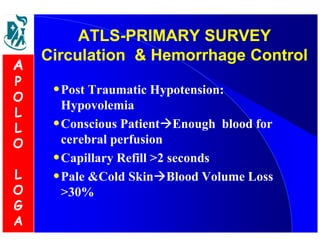
Circulation  Hemorrhage Control 
•Post Traumatic Hypotension: 
Hypovolemia 
•Conscious PatientEnough blood for 
cerebral perfusion 
•Capillary Refill 2 seconds 
•Pale Cold SkinBlood Volume Loss 
30% 
A 
P 
O 
L 
L 
O 
L 
O 
G 
A
SURVEY 
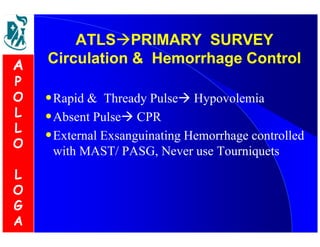
ATLSPRIMARY Circulation  Hemorrhage Control 
•Rapid  Thready Pulse Hypovolemia 
•Absent Pulse CPR 
•External Exsanguinating Hemorrhage controlled 
with MAST/ PASG, Never use Tourniquets 
A 
P 
O 
L 
L 
O 
L 
O 
G 
A
ATLS-PRIMARY SURVEY 
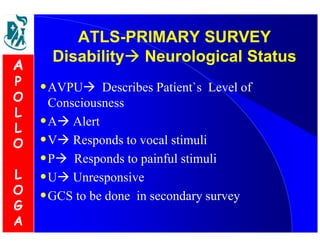
Disability Neurological Status 
•AVPU Describes Patient`s Level of 
Consciousness 
•A Alert 
•V Responds to vocal stimuli 
•P Responds to painful stimuli 
•U Unresponsive 
•GCS to be done in secondary survey 
A 
P 
O 
L 
L 
O 
L 
O 
G 
A
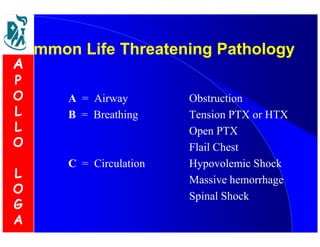
Common Life Threatening PPaatthhoollooggyy 
A = Airway 
B = Breathing 
C = Circulation 
Obstruction 
Tension PTX or HTX 
Open PTX 
Flail Chest 
Hypovolemic Shock 
Massive hemorrhage 
Spinal Shock 
A 
P 
O 
L 
L 
O 
L 
O 
G 
A
AATTLLSS--RREESSUUSSCCIITTAATTIIOONN 
• Start 2 Large Bore IV Lines 
• Infuse Crystalloids 2 to 3 Litres 
• Then Transfuse Type Specific WB or O-ve Packed 
RBCs 
• Tissue Aerobic Metabolism is assured by Perfusion with 
well oxygenated RBCs 
• Never treat Hypovolemic Shock with Vasopressors, 
Steroids or NaHco3 
A 
P 
O 
L 
L 
O 
L 
O 
G 
A
AATTLLSS --RREESSUUSSCCIITTAATTIIOONN 
•CBD  NGT aspiration if not contraindicated 
•Careful ECG Monitoring  Correction of 
Arrhythmias 
•Data Flow sheet of Vital Parameters to assess 
effectiveness of Resuscitation 
•Reevaluate Airway, Breathing and 
Circulation. If needed CPR 
A 
P 
O 
L 
L 
O 
L 
O 
G 
A
Adjuncts ttoo PPrriimmaarryy SSuurrvveeyy 
•Vital Signs/ECG monitoring 
•ABGs 
•POX/ETCO2 
•Urinary/gastric catheters 
•Urinary output 
•Supplemental Oxygen 
A 
P 
O 
L 
L 
O 
L 
O 
G 
A
Adjuncts ttoo PPrriimmaarryy SSuurrvveeyy 
•Diagnostic tools 
•CXR, C-spine, Pelvis 
•DPL 
•Ultrasound FAST 
A 
P 
O 
L 
L 
O 
L 
O 
G 
A
SSeeccoonnddaarryy SSuurrvveeyy 
•Secondary Survey does not begin until the 
primary Survey( ABCDEs) is completed, 
resuscitative efforts are well established, and 
patient is demonstrating normalisation of vital 
functions 
A 
P 
O 
L 
L 
O 
L 
O 
G 
A
ATLSSSEECCOONNDDAARRYY SSUURRVVEEYY 
•Head and Skull 
•Faciomaxillary Injuries 
•Neck 
•Chest  Spine 
•Abdomen 
A 
P 
O 
L 
L 
O 
L 
O 
G 
A
ATLSSSEECCOONNDDAARRYY SSUURRVVEEYY 
•Perineum/ Rectum/ Vagina 
•Extremities Fractures 
•Complete Neurological Exam GCS 
•Appropriate X-Rays, Lab Tests and Special 
Studies 
•“Tubes  fingers” in every orifice 
A 
P 
O 
L 
L 
O 
L 
O 
G 
A
ATLS PPaattiieenntt``ss HHiissttoorryy 
•A Allergies 
•M Medications Currently Taken 
•P Past Illness 
•L Last Meal 
•E Events/ Environment related to injury 
A 
P 
O 
L 
L 
O 
L 
O 
G 
A
ATLSMechanism ooff IInnjjuurryy 
• Blunt Trauma 
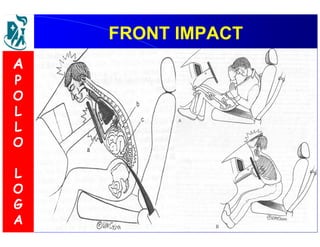
- Front Impact Myocardial contusion, 
Pneumothorax, Flail Chest, Cervical Spine# 
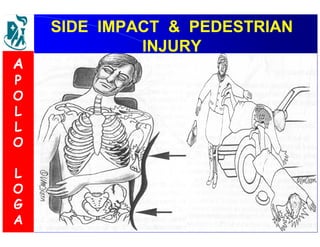
- Side Impact.# Spleen or Liver,# Pelvis, Flail 
Chest, Opposite Cervical Spine Sprain/ # 
-Rear Impact Whiplash Injury Cervical Spine 
-Ejection from Vehicle Multiple Injuries 
• Penetrating Trauma 
-Sharp objects, Missiles 
A 
P 
O 
L 
L 
O 
L 
O 
G 
A
FFRROONNTT IIMMPPAACCTT 
A 
P 
O 
L 
L 
O 
L 
O 
G 
A
SIDE IMPACT  PEDESTRIAN 
INJURY 
A 
P 
O 
L 
L 
O 
L 
O 
G 
A
RReeeevvaalluuaattiioonn 
•Minimizing missed injuries 
•high index of suspicion 
•frequent reevaluation and continuous monitoring 
A 
P 
O 
L 
L 
O 
L 
O 
G 
A
ATLSDDeeffiinniittiivvee CCaarree 
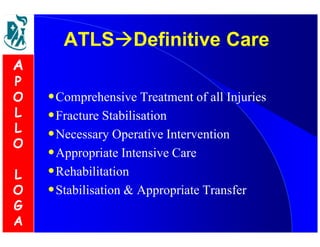
•Comprehensive Treatment of all Injuries 
•Fracture Stabilisation 
•Necessary Operative Intervention 
•Appropriate Intensive Care 
•Rehabilitation 
•Stabilisation  Appropriate Transfer 
A 
P 
O 
L 
L 
O 
L 
O 
G 
A
AATTLLSSTTRRIIAAGGEE 
• Sorting of patients based on severity of injuries 
and availability of resources 
•Number of patients  severity of injuries do not 
exceed facility multiple casualties treat the 
most critically injured first 
•The same exceed the facility Mass casualties 
treat as many as salvageable patients as possible 
A 
P 
O 
L 
L 
O 
L 
O 
G 
A
AATTLLSSSSKKIILLLL SSTTAATTIIOONNSS 
•Airway Management 
•Vascular access and Fluid Resuscitation 
•ECG Monitoring  CPR including defibrillation 
•Pediatric Priorities 
•Transport of Critically Ill Patients 
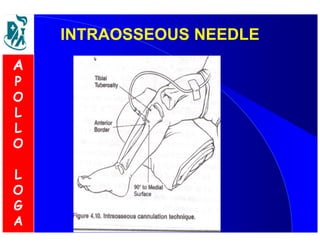
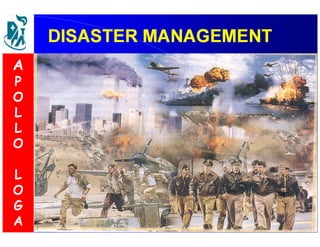
•Disaster Management 
A 
P 
O 
L 
L 
O 
L 
O 
G 
A
IINNTTRRAAOOSSSSEEOOUUSS NNEEEEDDLLEE 
A 
P 
O 
L 
L 
O 
L 
O 
G 
A
DDIISSAASSTTEERR MMAANNAAGGEEMMEENNTT 
A 
P 
O 
L 
L 
O 
L 
O 
G 
A
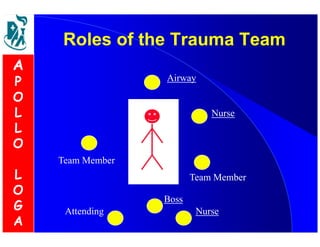
Roles ooff tthhee TTrraauummaa TTeeaamm 
Airway 
Nurse 
Boss 
Team Member 
Attending 
Team Member 
Nurse 
A 
P 
O 
L 
L 
O 
L 
O 
G 
A
Things to remember0 
The Ideal Trauma Resuscitation 
•Roles are pre-assigned Multidisciplinary team 
•Clear direction  communication 
•Pertinent findings verbalized in proper order 
•All team members know all findings 
•Rapid, Efficient 
•Calm  Quiet! 
A 
P 
O 
L 
L 
O 
L 
O 
G 
A
OOvveerrvviieeww ooff AATTLLSS 
Primary Survey 
(ABCDE's) 
Resuscitation 
Secondary Survey 
Data / Information / 
Response to Therapy 
Definitive Care 
A 
P 
O 
L 
L 
O 
L 
O 
G 
A
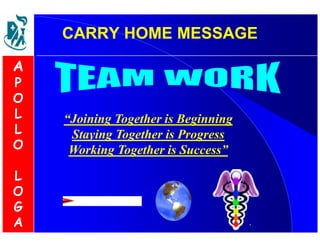
CARRY HOME MESSAGE 
“Joining Together is Beginning 
Staying Together is Progress 
Working Together is Success” 
A 
P 
O 
L 
L 
O 
L 
O 
G 
A
A 
P 
O 
L 
L 
O 
L 
O 
G 
A

Advanced Trauma Life Support- An overview

  • 1.
    ADVANCED TRAUMA LIFESUPPORT (ATLS) AANN OOVVEERRVVIIEEWW A P O L L O L O G A
  • 3.
    DR.B.SELVARAJ,MMSS;;MMcchh;;FFIICCSS;; • General& Pediatric Surgeon • Endoscopist & Laparoscopic Surgeon • Apollo Loga Hospital • Karur •India A P O L L O L O G A
  • 4.
    ADVANCED TRAUMA LIFESUPPORT •ATLS In US •EMST In Australia •PTC In UK •Most Countries having an epidemic of trauma •In India one of the major killer is trauma 60,000 deaths/year ; In TN5000/year A P O L L O L O G A
  • 5.
    AATTLLSSOOBBJJEECCTTIIVVEESS •To rapidly accurately assess trauma patients •Early recognition timely intervention of life threatening conditions •To resuscitate stabilise trauma patients •To understand the priorities in trauma management Triage •To organise quality trauma care in your hospital A P O L L O L O G A
  • 6.
    TRAUMA MANAGEMENT SixPhases • Access Phase • Pre hospital Triage Phase • Early Hospital or Resuscitation Phase • Operative Phase • Intensive care Phase • Rehabilitative Phase A P O L L O L O G A
  • 7.
    ATLS TRIMODAL DEATH By Arnold D.Trunkey • Within Seconds to Minutes Brainstem injury Aortic rupture • Within Minutes to Hours Sub dural Hematoma Rupture of Liver Spleen • Within Days to Weeks Sepsis MODS A P O L L O L O G A
  • 8.
    AATTLLSS • Emergencylife saving precedes examination of trauma patients • Once immediate survival is achieved definitive assessment treatment begins • Priorities in management must always be salvage of Life, Limb, Function Cosmetic A P O L L O L O G A
  • 9.
    Pre Hospital TraumaLife Support •Scene size up Extrication •Primary Survey Basic Life Support •Spinal Protection in LSB •Splinting Extremities •Control of External Hemorrhage •Aim: To Stabilize the Patient Platinum 10 Minutes •Load Go within Golden first hour A P O L L O L O G A
  • 10.
    Field Triage- CCoolloorrCCooddiinngg •Triage- sorting of patients by injury severity and need for transport •RED-most critically injured-immediate transfer to hospital •YELLOW-less critically injured-delayed transfer to hospital without endangering life • GREEN-No life/limb threatening injury- patient ambulatory-may not need IP treatment •BLACK- Dead patient A P O L L O L O G A
  • 11.
  • 12.
    OOvveerrvviieeww ooff AATTLLSS Primary Survey (ABCDE's) Resuscitation Secondary Survey Data / Information / Response to Therapy Definitive Care A P O L L O L O G A
  • 13.
    AATTLLSSPPRRIIMMAARRYY SSUURRVVEEYY •A-Airway Cervical Spine Control •B-Breathing Ventilation •C-Circulation Hemorrhage Control •D-Disability Neurological Status •E-Exposure Completely undress the patient A P O L L O L O G A
  • 14.
    ATLS—PRIMARY SURVEY AirwayCervical Spine Control •Chin lift or Jaw Thrust •Removal of FB,Blood Vomitus •Oropharyngeal or Nasopharyngeal Airway •Intubate With E T T •Cricothyroidotomy •Keep the neck immobilised A P O L L O L O G A
  • 15.
    CHIN LLIIFFTT JJAAWW TTHHRRUUSSTT A P O L L O L O G A
  • 16.
  • 17.
  • 18.
    ATLS-PRIMARY SURVEY Breathing Ventilation • Airway patency doesn’t assure adequate ventilation- Look for bilateral breath sounds • To ensure adequate oxygenation start Ambu bag or ETT ventilation—FIO2 0.85 • Decompress Tension Pneumothorax • Close open Chest Injury • IPPV in large Flail Chest A P O L L O L O G A
  • 19.
    BAG MMAASSKKVVEENNTTIILLAATTIIOONN A P O L L O L O G A
  • 20.
    ATLS-PRIMARY SURVEY Circulation Hemorrhage Control •Post Traumatic Hypotension: Hypovolemia •Conscious PatientEnough blood for cerebral perfusion •Capillary Refill 2 seconds •Pale Cold SkinBlood Volume Loss 30% A P O L L O L O G A
  • 21.
    SURVEY ATLSPRIMARY Circulation Hemorrhage Control •Rapid Thready Pulse Hypovolemia •Absent Pulse CPR •External Exsanguinating Hemorrhage controlled with MAST/ PASG, Never use Tourniquets A P O L L O L O G A
  • 22.
    ATLS-PRIMARY SURVEY DisabilityNeurological Status •AVPU Describes Patient`s Level of Consciousness •A Alert •V Responds to vocal stimuli •P Responds to painful stimuli •U Unresponsive •GCS to be done in secondary survey A P O L L O L O G A
  • 23.
    Common Life ThreateningPPaatthhoollooggyy A = Airway B = Breathing C = Circulation Obstruction Tension PTX or HTX Open PTX Flail Chest Hypovolemic Shock Massive hemorrhage Spinal Shock A P O L L O L O G A
  • 24.
    AATTLLSS--RREESSUUSSCCIITTAATTIIOONN • Start2 Large Bore IV Lines • Infuse Crystalloids 2 to 3 Litres • Then Transfuse Type Specific WB or O-ve Packed RBCs • Tissue Aerobic Metabolism is assured by Perfusion with well oxygenated RBCs • Never treat Hypovolemic Shock with Vasopressors, Steroids or NaHco3 A P O L L O L O G A
  • 25.
    AATTLLSS --RREESSUUSSCCIITTAATTIIOONN •CBD NGT aspiration if not contraindicated •Careful ECG Monitoring Correction of Arrhythmias •Data Flow sheet of Vital Parameters to assess effectiveness of Resuscitation •Reevaluate Airway, Breathing and Circulation. If needed CPR A P O L L O L O G A
  • 26.
    Adjuncts ttoo PPrriimmaarryySSuurrvveeyy •Vital Signs/ECG monitoring •ABGs •POX/ETCO2 •Urinary/gastric catheters •Urinary output •Supplemental Oxygen A P O L L O L O G A
  • 27.
    Adjuncts ttoo PPrriimmaarryySSuurrvveeyy •Diagnostic tools •CXR, C-spine, Pelvis •DPL •Ultrasound FAST A P O L L O L O G A
  • 28.
    SSeeccoonnddaarryy SSuurrvveeyy •SecondarySurvey does not begin until the primary Survey( ABCDEs) is completed, resuscitative efforts are well established, and patient is demonstrating normalisation of vital functions A P O L L O L O G A
  • 29.
    ATLSSSEECCOONNDDAARRYY SSUURRVVEEYY •Headand Skull •Faciomaxillary Injuries •Neck •Chest Spine •Abdomen A P O L L O L O G A
  • 30.
    ATLSSSEECCOONNDDAARRYY SSUURRVVEEYY •Perineum/Rectum/ Vagina •Extremities Fractures •Complete Neurological Exam GCS •Appropriate X-Rays, Lab Tests and Special Studies •“Tubes fingers” in every orifice A P O L L O L O G A
  • 31.
    ATLS PPaattiieenntt``ss HHiissttoorryy •A Allergies •M Medications Currently Taken •P Past Illness •L Last Meal •E Events/ Environment related to injury A P O L L O L O G A
  • 32.
    ATLSMechanism ooff IInnjjuurryy • Blunt Trauma - Front Impact Myocardial contusion, Pneumothorax, Flail Chest, Cervical Spine# - Side Impact.# Spleen or Liver,# Pelvis, Flail Chest, Opposite Cervical Spine Sprain/ # -Rear Impact Whiplash Injury Cervical Spine -Ejection from Vehicle Multiple Injuries • Penetrating Trauma -Sharp objects, Missiles A P O L L O L O G A
  • 33.
    FFRROONNTT IIMMPPAACCTT A P O L L O L O G A
  • 34.
    SIDE IMPACT PEDESTRIAN INJURY A P O L L O L O G A
  • 35.
    RReeeevvaalluuaattiioonn •Minimizing missedinjuries •high index of suspicion •frequent reevaluation and continuous monitoring A P O L L O L O G A
  • 36.
    ATLSDDeeffiinniittiivvee CCaarree •ComprehensiveTreatment of all Injuries •Fracture Stabilisation •Necessary Operative Intervention •Appropriate Intensive Care •Rehabilitation •Stabilisation Appropriate Transfer A P O L L O L O G A
  • 37.
    AATTLLSSTTRRIIAAGGEE • Sortingof patients based on severity of injuries and availability of resources •Number of patients severity of injuries do not exceed facility multiple casualties treat the most critically injured first •The same exceed the facility Mass casualties treat as many as salvageable patients as possible A P O L L O L O G A
  • 38.
    AATTLLSSSSKKIILLLL SSTTAATTIIOONNSS •AirwayManagement •Vascular access and Fluid Resuscitation •ECG Monitoring CPR including defibrillation •Pediatric Priorities •Transport of Critically Ill Patients •Disaster Management A P O L L O L O G A
  • 39.
  • 40.
  • 41.
    Roles ooff tthheeTTrraauummaa TTeeaamm Airway Nurse Boss Team Member Attending Team Member Nurse A P O L L O L O G A
  • 42.
    Things to remember0 The Ideal Trauma Resuscitation •Roles are pre-assigned Multidisciplinary team •Clear direction communication •Pertinent findings verbalized in proper order •All team members know all findings •Rapid, Efficient •Calm Quiet! A P O L L O L O G A
  • 43.
    OOvveerrvviieeww ooff AATTLLSS Primary Survey (ABCDE's) Resuscitation Secondary Survey Data / Information / Response to Therapy Definitive Care A P O L L O L O G A
  • 45.
    CARRY HOME MESSAGE “Joining Together is Beginning Staying Together is Progress Working Together is Success” A P O L L O L O G A
  • 46.
    A P O L L O L O G A