The Advanced Trauma Life Support
A.T.L.S.
Dr. Haydar Muneer Salih
ATLS has its origins in
the United States in
1976, when James K
Styner, an
Orthopedic surgeon
piloting a light aircraft,
crashed his plane into a
field in Nebraska. His
wife Charlene was
killed instantly and
three of his four
children, Richard,
Randy, and Kim
sustained critical
injuries.
His son Chris suffered a
broken arm. He carried out
the initial Triage of his
children at the crash site.
Dr. Styner had to flag down
a car to transport him to
the nearest hospital; upon
arrival, he found it closed.
Even once the hospital was
opened and a doctor called
in, he found that the
emergency care provided
at the small regional
hospital where they were
treated was inadequate
and inappropriate.
the initial ATLS course
which was held in
1978. In 1980, the
American College of
Surgeons Committee
on Trauma adopted
ATLS and began US and
international
dissemination of the
course. Styner himself
recently recertified as
an ATLS instructor,
teaching his Instructor
Candidate course in
Nottingham in the UK,
July 2007
• The Advanced Trauma Life Support
(ATLS) system was therefore created
initially in the USA and rapidly taken up
globally. At present, over 50 countries
worldwide are actively providing the
ATLS course to their physicians
Triage
Triage is an important concept in modern
health-care systems, and three essential
phases have developed:
1 pre-hospital triage – in order to dispatch
ambulance and pre hospital care
resources;
2 at the scene of trauma;
3 on arrival at the receiving hospital
2 types of triage
1 Multiple casualties: Here, the number and
severity of injuries do not exceed the ability of
the facility to render care. Priority is given to
the life-threatening injuries
2 Mass casualties: The number and severity of
the injuries exceed the capability and facilities
available to the staff. In this situation, those
with the greatest chance of survival and the
least expenditure of time, equipment and
supplies are prioritized
Multiple causalities
Massive causalities
Types of injuries
1. Blunt trauma
2. Penetrating injuries
3. Blast injury
4. Crushed injuries
5. Thermal Injuries
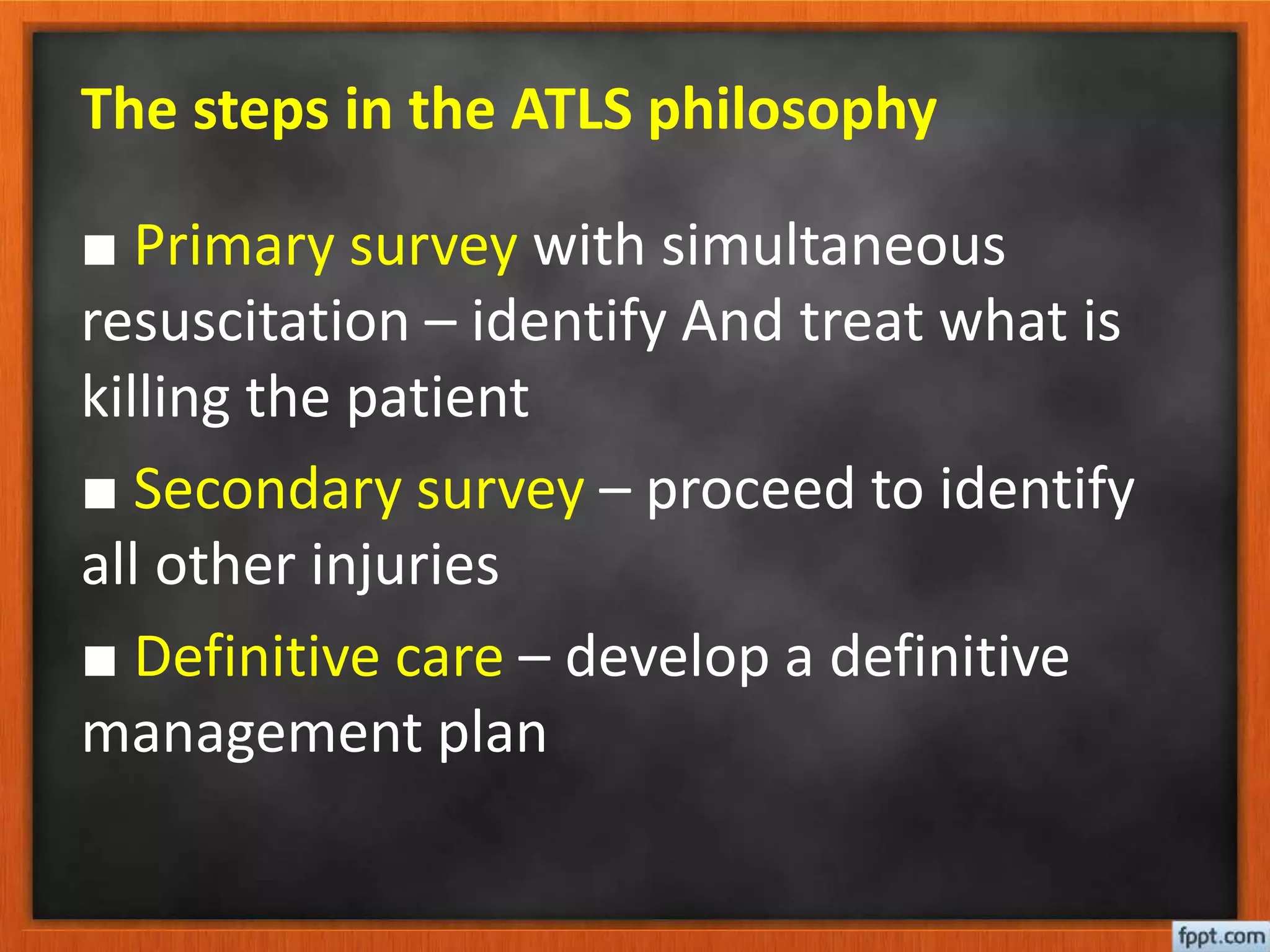
The steps in the ATLS philosophy
■ Primary survey with simultaneous
resuscitation – identify And treat what is
killing the patient
■ Secondary survey – proceed to identify
all other injuries
■ Definitive care – develop a definitive
management plan
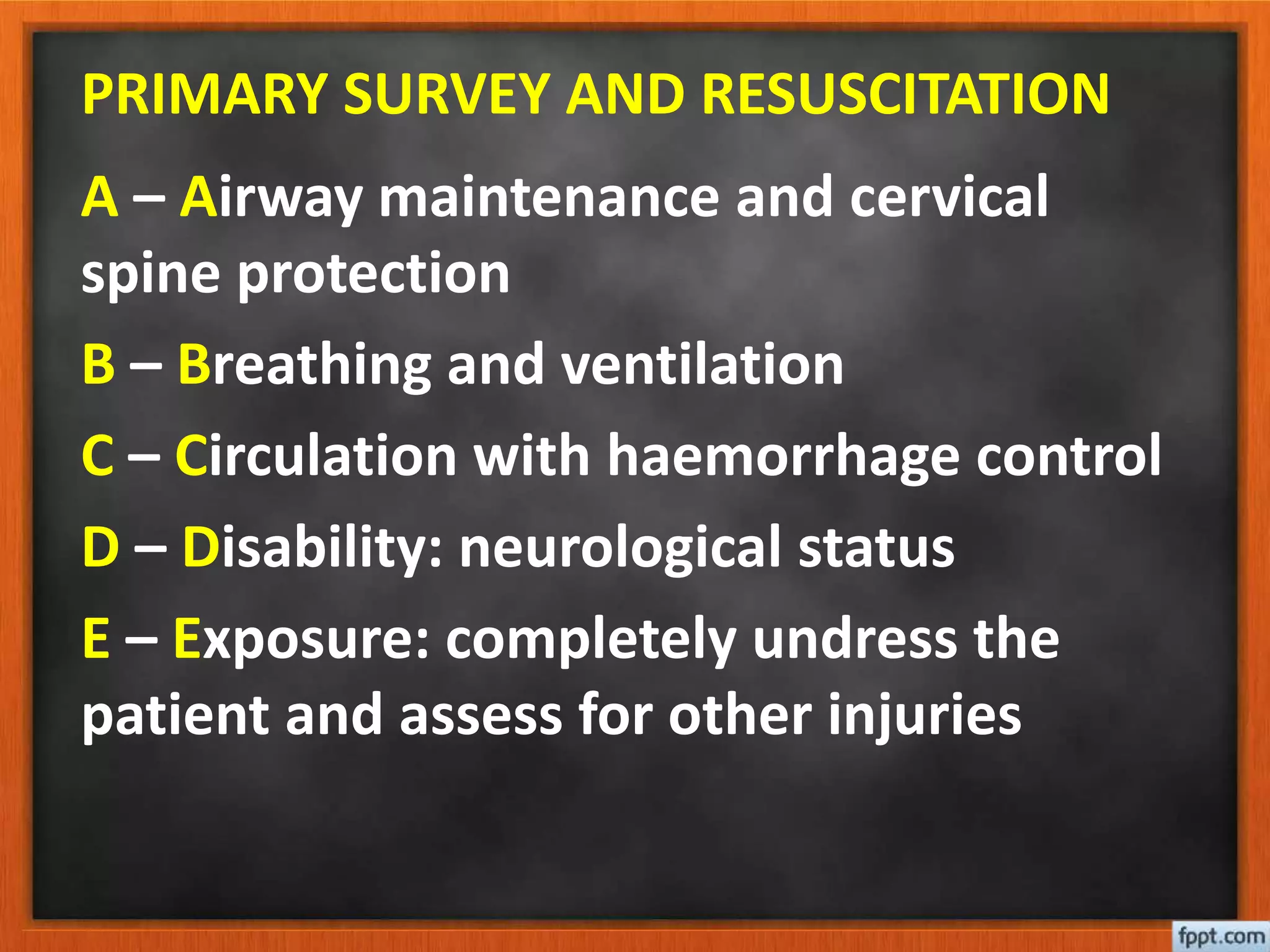
PRIMARY SURVEY AND RESUSCITATION
A – Airway maintenance and cervical
spine protection
B – Breathing and ventilation
C – Circulation with haemorrhage control
D – Disability: neurological status
E – Exposure: completely undress the
patient and assess for other injuries
1. Airway
The airway must be evaluated first. If there
is vocal response from the patient, then
the patient’s airway is not immediately at
risk, but repeated assessment is prudent. If
there is no or limited response, then a
rapid investigation and assessment for
signs of airway obstruction should be
undertaken. This includes inspection for
foreign bodies, maxillofacial or mandibular
fractures, tracheal or laryngeal injury or
oedema
1. Airway
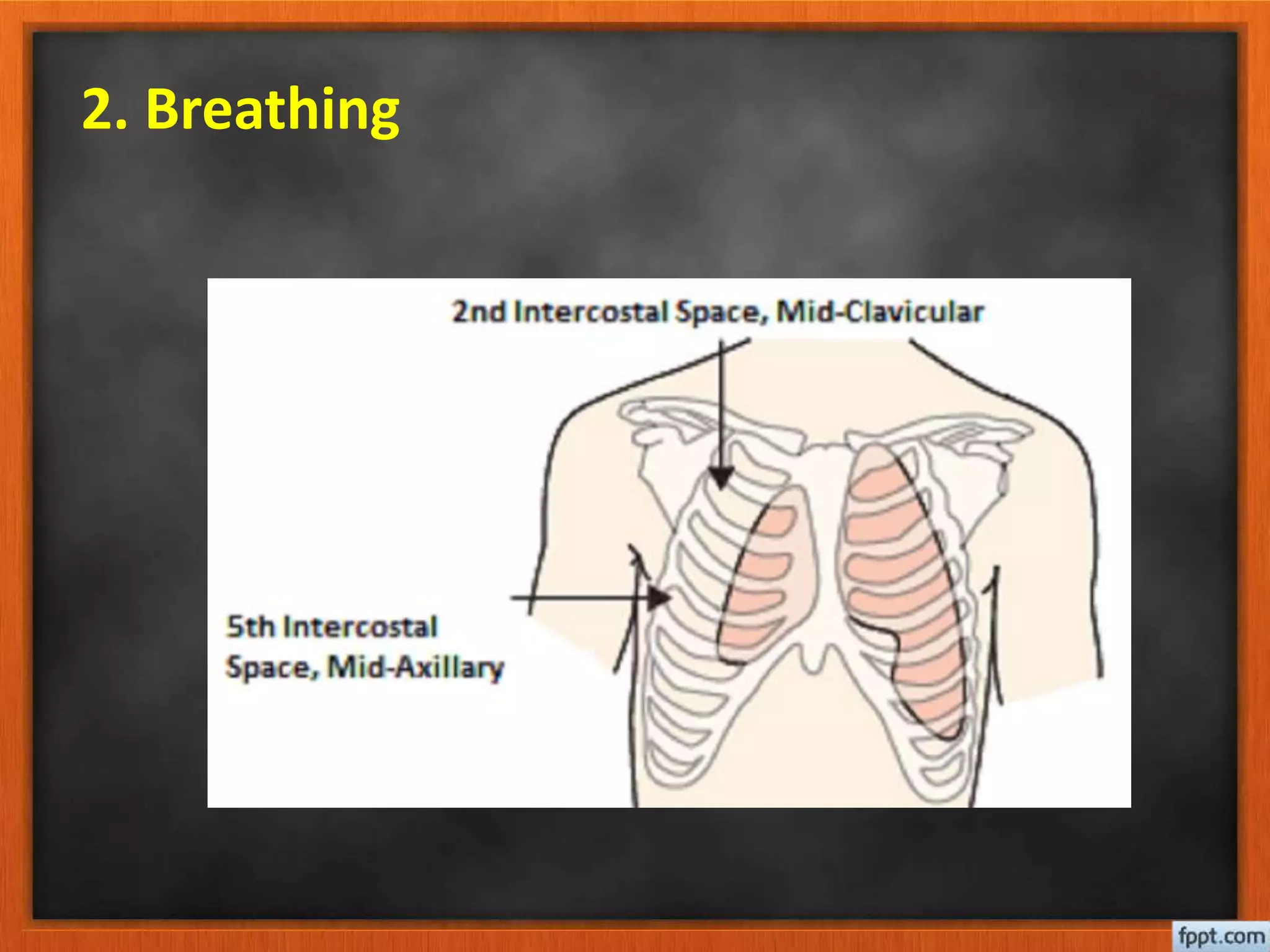
2. Breathing
• Oxygen must be administered to all trauma
patients, usually at high flow and via a
reservoir mask.
• Ventilation requires an adequately functioning
chest wall, lungs and diaphragm, and each
must be systematically evaluated.
• Signs of surgical emphysema, dilatation of the
neck veins, symmetry of the chest wall,
respiratory effort and rate should be evaluated
and recorded.
• Percussion and auscultation should be
performed both front and back after log rolling
This young man fell off his bike and landed on his left
side. His CXR shows a large left pneumothorax
(pleural line indicated by white arrows) with shift of
the trachea and mediastinum to the right side
2. Breathing
3. Circulation and control of bleeding
1. Conscious level: lost a
significant amount of blood
2. Skin color: a pale, ashen, grey-
looking patient
3. Pulse: a rapid, thready pulse or,
worse still, one that is not
peripherally palpable
4. Disability : (G.C.S.)
5. Exposure
• The patient must be fully exposed and
examined front and back using a
carefully controlled log roll. Spinal
alignment must be maintained during
this procedure with in-line traction.
Hypothermia can be rapid following
trauma, and warming air blankets are
vitally important in the resuscitative
phase.
Adjuncts to the primary survey
■ Blood – FBC, urea and electrolytes, clotting
screen, glucose, toxicology, cross-match
■ ECG
■ Two wide-bore cannulae for intravenous
fluids
■ Urinary and gastric catheters
■ Radiographs of the cervical spine and chest
SECONDARY SURVEY
This starts after completion of the primary
survey and once initial resuscitative
measures have commenced. The purpose
of the secondary survey is to identify all
injuries and perform a more thorough
‘head to toe’ examination.
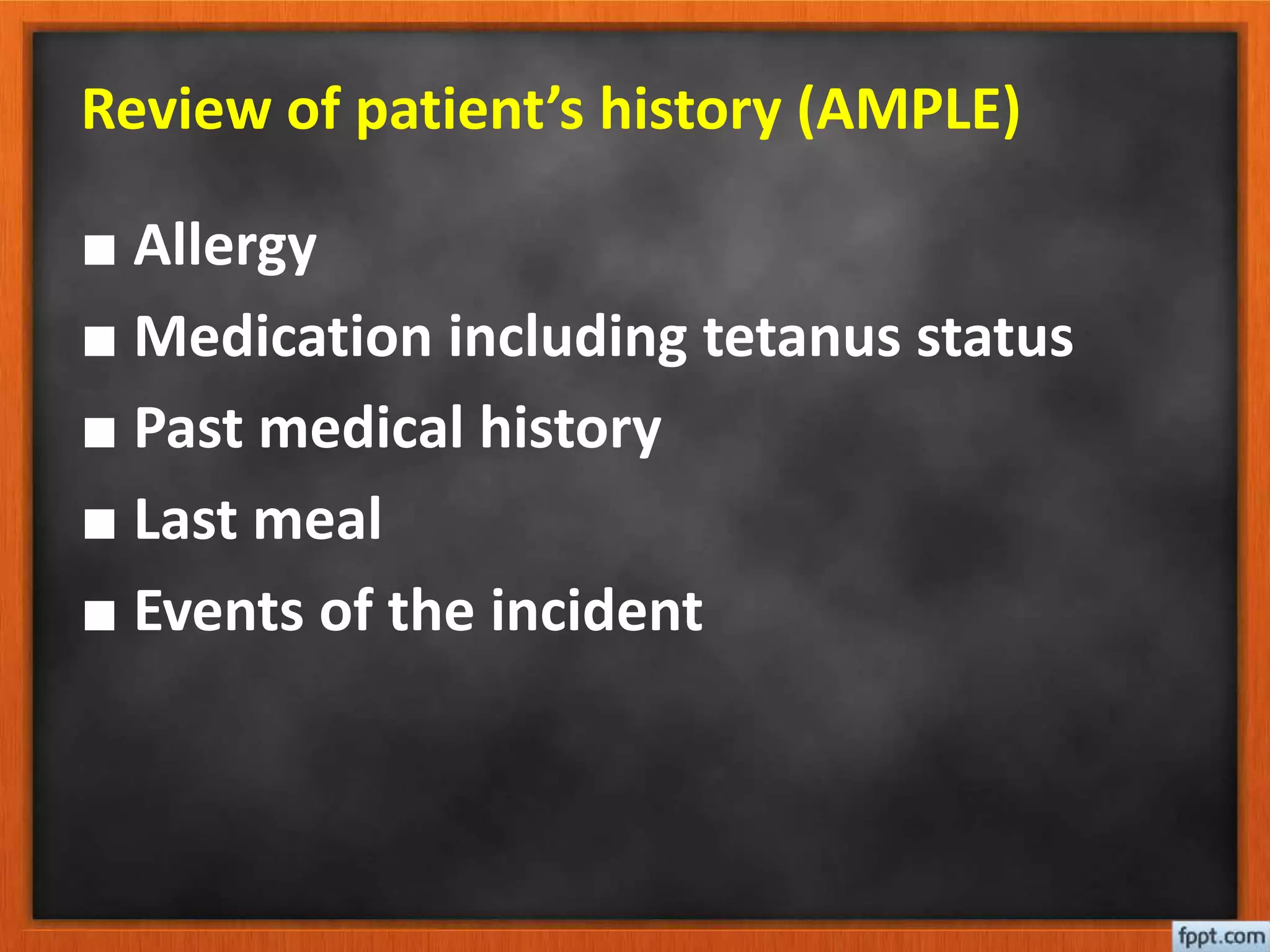
Review of patient’s history (AMPLE)
■ Allergy
■ Medication including tetanus status
■ Past medical history
■ Last meal
■ Events of the incident
Definitive care and transfer
Definitive care will be discussed in
subsequent chapters, but it is important to
recognize that there should be as little
delay as possible in reaching this stage.
Much has been made of the ‘golden hour’
concept, and one often finds that the
majority of patients spend this hour at the
scene of injury.
Atls

Atls

  • 1.
    The Advanced TraumaLife Support A.T.L.S. Dr. Haydar Muneer Salih
  • 2.
    ATLS has itsorigins in the United States in 1976, when James K Styner, an Orthopedic surgeon piloting a light aircraft, crashed his plane into a field in Nebraska. His wife Charlene was killed instantly and three of his four children, Richard, Randy, and Kim sustained critical injuries.
  • 3.
    His son Chrissuffered a broken arm. He carried out the initial Triage of his children at the crash site. Dr. Styner had to flag down a car to transport him to the nearest hospital; upon arrival, he found it closed. Even once the hospital was opened and a doctor called in, he found that the emergency care provided at the small regional hospital where they were treated was inadequate and inappropriate.
  • 4.
    the initial ATLScourse which was held in 1978. In 1980, the American College of Surgeons Committee on Trauma adopted ATLS and began US and international dissemination of the course. Styner himself recently recertified as an ATLS instructor, teaching his Instructor Candidate course in Nottingham in the UK, July 2007
  • 5.
    • The AdvancedTrauma Life Support (ATLS) system was therefore created initially in the USA and rapidly taken up globally. At present, over 50 countries worldwide are actively providing the ATLS course to their physicians
  • 6.
    Triage Triage is animportant concept in modern health-care systems, and three essential phases have developed: 1 pre-hospital triage – in order to dispatch ambulance and pre hospital care resources; 2 at the scene of trauma; 3 on arrival at the receiving hospital
  • 7.
    2 types oftriage 1 Multiple casualties: Here, the number and severity of injuries do not exceed the ability of the facility to render care. Priority is given to the life-threatening injuries 2 Mass casualties: The number and severity of the injuries exceed the capability and facilities available to the staff. In this situation, those with the greatest chance of survival and the least expenditure of time, equipment and supplies are prioritized
  • 8.
  • 9.
  • 10.
  • 11.
  • 12.
  • 13.
  • 15.
  • 16.
  • 17.
    The steps inthe ATLS philosophy ■ Primary survey with simultaneous resuscitation – identify And treat what is killing the patient ■ Secondary survey – proceed to identify all other injuries ■ Definitive care – develop a definitive management plan
  • 18.
    PRIMARY SURVEY ANDRESUSCITATION A – Airway maintenance and cervical spine protection B – Breathing and ventilation C – Circulation with haemorrhage control D – Disability: neurological status E – Exposure: completely undress the patient and assess for other injuries
  • 20.
    1. Airway The airwaymust be evaluated first. If there is vocal response from the patient, then the patient’s airway is not immediately at risk, but repeated assessment is prudent. If there is no or limited response, then a rapid investigation and assessment for signs of airway obstruction should be undertaken. This includes inspection for foreign bodies, maxillofacial or mandibular fractures, tracheal or laryngeal injury or oedema
  • 21.
  • 23.
    2. Breathing • Oxygenmust be administered to all trauma patients, usually at high flow and via a reservoir mask. • Ventilation requires an adequately functioning chest wall, lungs and diaphragm, and each must be systematically evaluated. • Signs of surgical emphysema, dilatation of the neck veins, symmetry of the chest wall, respiratory effort and rate should be evaluated and recorded. • Percussion and auscultation should be performed both front and back after log rolling
  • 25.
    This young manfell off his bike and landed on his left side. His CXR shows a large left pneumothorax (pleural line indicated by white arrows) with shift of the trachea and mediastinum to the right side
  • 26.
  • 31.
    3. Circulation andcontrol of bleeding 1. Conscious level: lost a significant amount of blood 2. Skin color: a pale, ashen, grey- looking patient 3. Pulse: a rapid, thready pulse or, worse still, one that is not peripherally palpable
  • 32.
  • 34.
    5. Exposure • Thepatient must be fully exposed and examined front and back using a carefully controlled log roll. Spinal alignment must be maintained during this procedure with in-line traction. Hypothermia can be rapid following trauma, and warming air blankets are vitally important in the resuscitative phase.
  • 35.
    Adjuncts to theprimary survey ■ Blood – FBC, urea and electrolytes, clotting screen, glucose, toxicology, cross-match ■ ECG ■ Two wide-bore cannulae for intravenous fluids ■ Urinary and gastric catheters ■ Radiographs of the cervical spine and chest
  • 36.
    SECONDARY SURVEY This startsafter completion of the primary survey and once initial resuscitative measures have commenced. The purpose of the secondary survey is to identify all injuries and perform a more thorough ‘head to toe’ examination.
  • 37.
    Review of patient’shistory (AMPLE) ■ Allergy ■ Medication including tetanus status ■ Past medical history ■ Last meal ■ Events of the incident
  • 38.
    Definitive care andtransfer Definitive care will be discussed in subsequent chapters, but it is important to recognize that there should be as little delay as possible in reaching this stage. Much has been made of the ‘golden hour’ concept, and one often finds that the majority of patients spend this hour at the scene of injury.