Dr.B.Selvaraj MS;MCh;FICS
Professor of Surgery
Melaka Manipal Medical college
Melaka Malaysia 75150
GROIN SWELLINGS
INTRODUCTION
Must to know core clinical
problems
1.Acute RLQ pain
2.Acute RUQ pain
3.Acute epigastric pain
4.Acute LLQ pain
5.Dysphagia
6.Abdominal lumps
7.Upper GI haemorrhage
8.Lower GI haemorrhage
9.Obstructive Jaundice
10.Breast lumps, mastalgia & nipple discharge
11.Neck swellings- Thyroid & non thyroidal
12.Groin swellings
13.Scrotal swellings
14.Limb ischemia- Acute & Chronic
15.Varicose veins
16.Renal & ureteric colic
17.Hematuria
18.Acute retention of urine
Groin swellings- Introduction
 Causes of groin swellings
 Anatomy of inguinal canal
 Anatomy of femoral canal
 Embryology of testicular descend
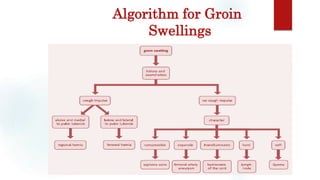
 Algorithm to clinch the correct diagnosis
Causes of Groin swellings
 Inguinal hernia- Indirect & direct
 Femoral hernia
 Undescended testis
 Inguinal lymphadenitis
 Lipoma of spermatic cord
 Encysted hydrocele
 Saphena varix
 Femoral artery aneurysm
 Psoas abscess
 Femoral nerve neuroma
Anatomy- Inguinal canal
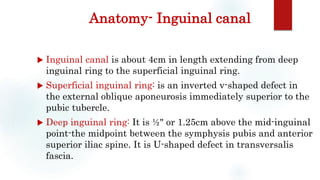
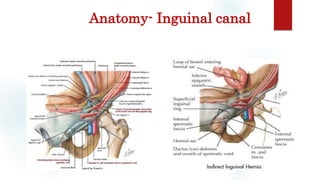
 Inguinal canal is about 4cm in length extending from deep
inguinal ring to the superficial inguinal ring.
 Superficial inguinal ring: is an inverted v-shaped defect in
the external oblique aponeurosis immediately superior to the
pubic tubercle.
 Deep inguinal ring: It is ½" or 1.25cm above the mid-inguinal
point-the midpoint between the symphysis pubis and anterior
superior iliac spine. It is U-shaped defect in transversalis
fascia.
Anatomy- Inguinal canal
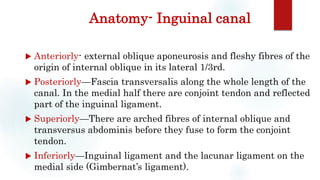
 Anteriorly- external oblique aponeurosis and fleshy fibres of the
origin of internal oblique in its lateral 1/3rd.
 Posteriorly—Fascia transversalis along the whole length of the
canal. In the medial half there are conjoint tendon and reflected
part of the inguinal ligament.
 Superiorly—There are arched fibres of internal oblique and
transversus abdominis before they fuse to form the conjoint
tendon.
 Inferiorly—Inguinal ligament and the lacunar ligament on the
medial side (Gimbernat’s ligament).
Anatomy- Inguinal canal
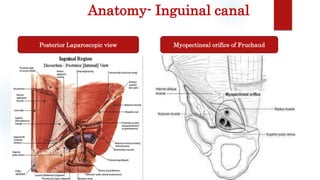
Myopectineal orifice of FruchaudPosterior Laparoscopic view
Anatomy- Femoral canal
 Femoral Canal: It extends from the femoral ring above to the
saphenous opening (fossa ovalis) below, being the innermost
compartment of the femoral sheath.
 Length – 2cm, shape: It looks like the inverted truncated cone, the
upper end being the femoral ring
Contents of the femoral canal
 1. Fibrofatty tissue
 2. Lymph nodes and lymphatics. Lymph node situated at the ring is
known as Cloquet’s node.
Anatomy- Femoral ring
Femoral Ring: Boundary
 Anterior—Inguinal ligament
 Posterior—Iliopectineal ligament and pubis.
 Medially—Crescentic edge of the lacunar ligament
 Laterally—Fibrous septum separating the canal from the
femoral vein (Silver fascia).
 The ring is closed above by the septum crurale – a condensed
extraperitoneal tissue pierced by the lymphatic vessels.
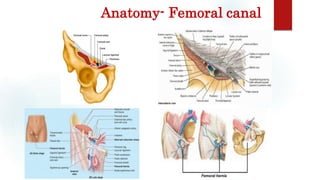
Anatomy- Femoral canal
Embryology of testicular
Descend
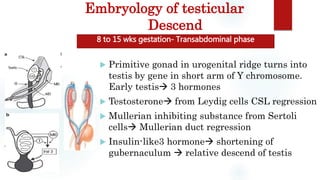
 Primitive gonad in urogenital ridge turns into
testis by gene in short arm of Y chromosome.
Early testis 3 hormones
 Testosterone from Leydig cells CSL regression
 Mullerian inhibiting substance from Sertoli
cells Mullerian duct regression
 Insulin-like3 hormone shortening of
gubernaculum  relative descend of testis
8 to 15 wks gestation- Transabdominal phase
Embryology of testicular
Descend
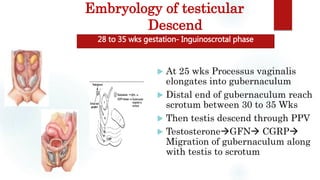
 At 25 wks Processus vaginalis
elongates into gubernaculum
 Distal end of gubernaculum reach
scrotum between 30 to 35 Wks
 Then testis descend through PPV
 TestosteroneGFN CGRP
Migration of gubernaculum along
with testis to scrotum
28 to 35 wks gestation- Inguinoscrotal phase
Algorithm for Groin
Swellings
https://www.youtube.com/watch?v=YXsCUv6dj3M

Groin swellings- Introduction

  • 1.
    Dr.B.Selvaraj MS;MCh;FICS Professor ofSurgery Melaka Manipal Medical college Melaka Malaysia 75150 GROIN SWELLINGS INTRODUCTION
  • 2.
    Must to knowcore clinical problems 1.Acute RLQ pain 2.Acute RUQ pain 3.Acute epigastric pain 4.Acute LLQ pain 5.Dysphagia 6.Abdominal lumps 7.Upper GI haemorrhage 8.Lower GI haemorrhage 9.Obstructive Jaundice 10.Breast lumps, mastalgia & nipple discharge 11.Neck swellings- Thyroid & non thyroidal 12.Groin swellings 13.Scrotal swellings 14.Limb ischemia- Acute & Chronic 15.Varicose veins 16.Renal & ureteric colic 17.Hematuria 18.Acute retention of urine
  • 3.
    Groin swellings- Introduction Causes of groin swellings  Anatomy of inguinal canal  Anatomy of femoral canal  Embryology of testicular descend  Algorithm to clinch the correct diagnosis
  • 4.
    Causes of Groinswellings  Inguinal hernia- Indirect & direct  Femoral hernia  Undescended testis  Inguinal lymphadenitis  Lipoma of spermatic cord  Encysted hydrocele  Saphena varix  Femoral artery aneurysm  Psoas abscess  Femoral nerve neuroma
  • 5.
    Anatomy- Inguinal canal Inguinal canal is about 4cm in length extending from deep inguinal ring to the superficial inguinal ring.  Superficial inguinal ring: is an inverted v-shaped defect in the external oblique aponeurosis immediately superior to the pubic tubercle.  Deep inguinal ring: It is ½" or 1.25cm above the mid-inguinal point-the midpoint between the symphysis pubis and anterior superior iliac spine. It is U-shaped defect in transversalis fascia.
  • 6.
    Anatomy- Inguinal canal Anteriorly- external oblique aponeurosis and fleshy fibres of the origin of internal oblique in its lateral 1/3rd.  Posteriorly—Fascia transversalis along the whole length of the canal. In the medial half there are conjoint tendon and reflected part of the inguinal ligament.  Superiorly—There are arched fibres of internal oblique and transversus abdominis before they fuse to form the conjoint tendon.  Inferiorly—Inguinal ligament and the lacunar ligament on the medial side (Gimbernat’s ligament).
  • 7.
  • 8.
    Anatomy- Inguinal canal Myopectinealorifice of FruchaudPosterior Laparoscopic view
  • 9.
    Anatomy- Femoral canal Femoral Canal: It extends from the femoral ring above to the saphenous opening (fossa ovalis) below, being the innermost compartment of the femoral sheath.  Length – 2cm, shape: It looks like the inverted truncated cone, the upper end being the femoral ring Contents of the femoral canal  1. Fibrofatty tissue  2. Lymph nodes and lymphatics. Lymph node situated at the ring is known as Cloquet’s node.
  • 10.
    Anatomy- Femoral ring FemoralRing: Boundary  Anterior—Inguinal ligament  Posterior—Iliopectineal ligament and pubis.  Medially—Crescentic edge of the lacunar ligament  Laterally—Fibrous septum separating the canal from the femoral vein (Silver fascia).  The ring is closed above by the septum crurale – a condensed extraperitoneal tissue pierced by the lymphatic vessels.
  • 11.
  • 12.
    Embryology of testicular Descend Primitive gonad in urogenital ridge turns into testis by gene in short arm of Y chromosome. Early testis 3 hormones  Testosterone from Leydig cells CSL regression  Mullerian inhibiting substance from Sertoli cells Mullerian duct regression  Insulin-like3 hormone shortening of gubernaculum  relative descend of testis 8 to 15 wks gestation- Transabdominal phase
  • 13.
    Embryology of testicular Descend At 25 wks Processus vaginalis elongates into gubernaculum  Distal end of gubernaculum reach scrotum between 30 to 35 Wks  Then testis descend through PPV  TestosteroneGFN CGRP Migration of gubernaculum along with testis to scrotum 28 to 35 wks gestation- Inguinoscrotal phase
  • 14.
  • 15.