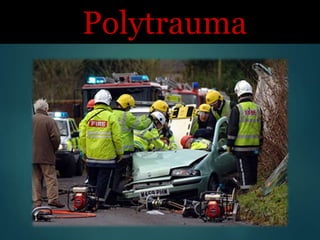
Polytrauma
B Y : -
MAHESH S
MEDICAL SURGICAL NURSING
KGNC
polytrauma
Objective
• Definition
• Epidemiology Etiology
• Pathophysiology
• Type of shock in polytrauma
• Management of trauma
definition
Polytrauma is a significant injury in at least two of the
following six body regions:
Head , neck and cervical spine
Face
Chest and thoracic spine
Abdomen and lumbar spine
Limbs and bony pelvis
External (skin) Significant
injury in AIS>=3
Polytrauma expanded to include concurrent injury to two or
more body parts or systems that result in cognitive ,physical
,psychological or other psychosocial impairment.
Ex : TBI in combination with other disabiling condition like
amputation,auditory or visual impairment, PTSD and other
mental condition
definition
Abbreviated injury score AIS
>=3 injury severity score ISS
>=16
Criteria of polytrauma include any
one of the following combination
injury
•Two major system injury + one major limb injury
•One major system injury +two major limb injury
•One major system injury + one open grade 3 skeletal
injury
•Unstable pelvis # with associated visceral injury
The Golden Hour
• originated by R Adams Cowley
• first sixty minutes after the occurrence of
multi- system trauma
• victim's chances of survival are greatest
if they receive definitive care in the OR
within the first hour after a severe injury
Etiology of polytrauma
RTA
Fall from height (blunt or penetrating
injury)
Airplane crashes ,train derailment
Assault
Blast
Thermal ,chemical injury
 Polytrauma is the third most common
cause of death in all age group.
1-first peak-major neurological or vascular injury
2-second peak-intracranial hematoma , major
thoracic or abdominal injury
3-third peak-sepsis and multiple organ fail
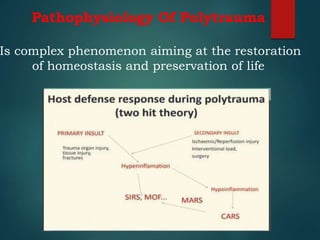
Pathophysiology Of Polytrauma
Is complex phenomenon aiming at the restoration
of homeostasis and preservation of life
SIRS
Type of shock in polytraumatized
patient
1.Hemorrhagic shock
duo to loss blood voulme ,diagnosis based on vital sign and
examination characterized by hypotention tachycardia
and cold skin
2.neurogenic shock
duo to spinal cord injury that causes distribution of
sympathetic outflow to heart and blood vessles
characterized by hpotention .bradycardia .warm skin
3.hypoxic shock
4.septic shock
PHASES OF TRAUMA
CARE
CONCEPTS OF INITIAL
ASSESSMENT
1. Preparation
2. Triage
3. Primary survey
4. Resuscitation
5. Adjuncts to primary survey and resuscitation
6. Secondary survey
7. Adjuncts to secondary survey
8. Continued post-resuscitation monitoring
and re-evaluation
9. Definitive care
Preparation
• Prehospital phase
➣coordination of EMS with hospital physicians
before the patient transport from the scene
• Time of injury
• Mechanism of injury
• Patient history
➣ airway maintenance
➣ control external bleeding and shock
➣ immobilization
➣ immediate transport to closest, appropriate facility
Step 1
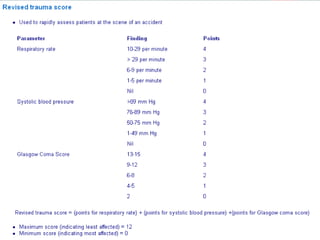
Measure of vital signs and level of
consciousness
• GCS
• RR
• Systolic BP
• RTS
< 14
< 10 or > 29
< 90
< 11
YES - Take to Trauma center
NO - Assess Anatomy of Injury
Triage decision scheme
Step2 Assess Anatomy of Injury
• Pelvic fracture
• Flail chest
• Two or more proximal long-bone fractures
• Combination trauma with burns of 10% or inhalation
injuries
• All penetrating injuries to head, neck, torso, and
extremities proximal to elbow and knee
YES - Take to Trauma center
NO – Evaluate for evidence of mechanism of injury and high-
energy impact
Triage decision scheme
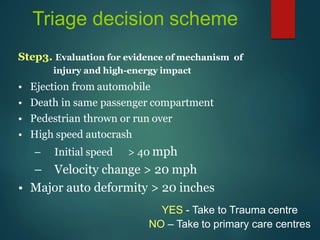
Step3. Evaluation for evidence of mechanism of
injury and high-energy impact
• Ejection from automobile
• Death in same passenger compartment
• Pedestrian thrown or run over
• High speed autocrash
– Initial speed > 40 mph
– Velocity change > 20 mph
• Major auto deformity > 20 inches
YES - Take to Trauma centre
NO – Take to primary care centres
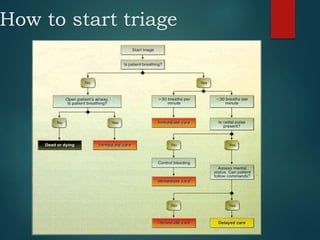
How to start triage
Inhospital phase
• Planning arrival
• Trauma room with equipment:
– For resuscitation
– Monitoring
– Warmed solutions
• Trauma staff
• Laboratory and radiology personnel
• Personnel protection from communicable
diseases (hepatitis & AIDS)
Minimum precautions
• Face mask
• Eye protection - goggles
• Water impervious apron
• Leggings
• Gloves
• Head covering
• Needles, blades, body fluids and tissues –
strictly enforced
ATLS
Primary survey
Identify what is killing the patient.
Resuscitation
Treat what is killing the patient.
Secondary survey
Proceed to identify other injuries.
Definitive care
Develop a definitive management plan.
ATLS- PRIMARY SURVEY
A – Airway maintenance & control of C.Spine.
B –Breathing & ventilation.
C– Circulation & haemorrhage control
D – Disability limitation
E –Exposure & environment.
F – Fracture stabilization, folly catheter.
ATLS- PRIMARY SURVEY
A – Airway maintenance & Control of
C.Spine
If conscious- Ask the pt’s name
If unconscious-Look for added
sounds (stridor,cyanosis etc)
If the pt does not respond to any
questions- resuscitate.
Always assume a cervical spine
injury is present
ATLS- PRIMARY SURVEY
A-AIRWAY
Sequence of events:
CHIN LIFT Jaw thrust
OPA
LMA
ENDO
-
TRACHEAL
TUBE
CRICO-
THYROIDOTO
MY
TRACHE-
OSTOMY
Primary Survey
B- Breathing & ventilation
• Exposure
• Inspection
• Auscultation
• Palpation
• Pulse oximetry
The aim is to hunt out & treat the life
threatening thoracic condns which include:
Primary Survey
B- Breathing & ventilation
life threatening
thoracic conditions:
1. Tension Pneumothorax
2. Open pneumothorax
3. Flail segment
4. Cardiac tamponade
Primary Survey
B- Breathing & ventilation
Respiratory distress
 Tracheal deviation
Diminished breath sounds
 Distended neck veins
Tension pneumothorax
Immediate needle thoracocentesis thro’
2ndintercostal space in mid clavicular
line reqd.
Primary Survey
B- Breathing & ventilation
Open pneumothorax:
Sealing of the wound
Tube thoracostomy
Flail segment:
Endotracheal intubation
Mechanical ventilation
Primary Survey
B- Breathing & ventilation
Cardiac tamponade
(almost always seen with a penetrating wound)
Beck’s triad:
Treatment: needle pericardiocentes
Thoracotomy
ATLS- Primary Survey
C- Circulation and hemorrhage control
Assessment of blood loss
External or obvious
Internal
Resuscitation
Arrest bleeding
Obtain vascular access
• Verify pulses, bilateral blood
pressures
– Radial pulse = SBP 90
mmHg
– Femoral pulse = SBP 70-
80 mmHg
– Carotid pulse = SBP 60
mmHg
• Largest blood loss in thorax,
abdomen, pelvis, extremities
ATLS- Primary Survey
C- Circulation and hemorrhage control
Adults- 2 lit of Ringer lactate solution as
initial fluid challenge
Children- 20mg/kg of body wt
Response to initial fluid challenge:
• Immediate & sustained return of vital
signs.
• Transient response with later
deterioration
• No improvement.
• General : sign & symptoms of inadequate
perfusion
• Urinary Output : 0.5 ml/kg/hour in adult
• Acid/Base Balance : respiratory alkalosis
follow by metabolic acidosis
ATLS- Primary Survey
C- Circulation and hemorrhage control
ATLS- Primary Survey
C- Circulation and hemorrhage control
Immediate responders-<20% blood loss
Bleeding ceases
spontaneously
Transient responders-
bleeding within body
cavities
Surgical intervention reqd.
Non responders- <40%of blood vol lost require
immediate surgery, Continued IV fluids
ATLS- Primary Survey
C- Circulation and hemorrhage control
Estimation of blood loss
ATLS- Primary Survey D-
Disability limitation
C.N.S.
Rapid assessment
of motor & sensory
functions
AVPU
A.-Alert
V.-Responds to
Voice
P.-Responds to
Pain
U.-Unresponsive
Pupil.-Size and
reaction
ATLS- Primary Survey D- Disability
limitation
• Remove remaining clothing
• Prevent hypothermia
CRITICAL DECISIONS
Decision making
Responding well
Secondary
assessment
Transient responders
Critical care unit
Failure to respond
Critical care unit
ATLS- Primary Survey
E-EXPOSURE
• Undresses for assessment
• After assessment is completed, it is
imperative to cover patient with warm
blankets or external warming devices to
prevent ‘Hypothermia’
• IV should be warmed before infusion and
warm environment
ADJUNCTS TO
PRIMARY
SURVEY
AND RESUSCITATION
FAST
Focused Assessment with
Sonography for Trauma (FAST)
 Detect intra-abdominal fluid
 Rapid, noninvasive, accurate, inexpensive, can
repeat frequently
 Factors that compromise its utility are obesity,
presence of subcutaneous air, previous
abdominal operation
FAST
Secondary Survey
• Does not begin until the primary survey
(ABCDEs) is completed
• Head-to-toe evaluation (complete history,
physical examination, reassessment of all
vital signs)
History
• A Allergy
• M Medication currently being taken
by the patient
• P Past illness and operation
• L Last meal
• E Event and Environment related to
the injury
Secondary Survey
Rapid Head-to-Toe Examination
• HEAD: scalp, pupils, ears, face, mouth
• Neck: distended neck veins, trachea
midline, posterior midline deformity
• Chest wall: paradoxical movement, breath sounds
• Abdomen: scaphoid or distended,
tender
• Pelvis: stable or unstable
• Genitourinary: blood, bruising
• Rectal: tone, blood
• Back: spinal deformity, exit wounds
• Extremities: deformity, pulses
• Neurologic: feels all four/moves all
four
Adjuncts to the Secondary survey
Further investigation for specific injuries
that non-life threatening condition e.g.
- x-ray spine and extremities
- CT scan
- contrast angiography
- Transesophageal ultrasound
- Bronchoscopy
TRAUMA TEAM MEMBERS
Patient
Airway: RT/EMT
Ventilation,assist withintubation,
keep patient informed
Vitals & Recorder: LPN/EMT
Takes serial vitals and records on Trauma Form
Other duties as needed
IV /Procedures: RN
Insert large bore IV,remove clothing from left
side of body, Intake/Output neuro assessment,
Scribe: EMT/LPN
Record case on white board
Provider Assist: RN
Assist with procedures as directed
Provider
Runner: EMT/CNA/Secretary
Retrieve equipment/supplies, assist with
ER traffic control, answer phone
TRAUMA TEAM ROLES - Guidelines
IV/Meds: RN
Insert large bore IV,remove clothing
from right side of body,
attach/observe monitor, access crashcart
Prepare/Administer Meds
Foley as appropriate
C-Spine: EMT
Alert physician of any
change in LOC
Polytrauma
Polytrauma

Polytrauma

  • 1.
  • 2.
    B Y :- MAHESH S MEDICAL SURGICAL NURSING KGNC polytrauma
  • 3.
    Objective • Definition • EpidemiologyEtiology • Pathophysiology • Type of shock in polytrauma • Management of trauma
  • 4.
    definition Polytrauma is asignificant injury in at least two of the following six body regions: Head , neck and cervical spine Face Chest and thoracic spine Abdomen and lumbar spine Limbs and bony pelvis External (skin) Significant injury in AIS>=3
  • 5.
    Polytrauma expanded toinclude concurrent injury to two or more body parts or systems that result in cognitive ,physical ,psychological or other psychosocial impairment. Ex : TBI in combination with other disabiling condition like amputation,auditory or visual impairment, PTSD and other mental condition definition
  • 6.
    Abbreviated injury scoreAIS >=3 injury severity score ISS >=16
  • 7.
    Criteria of polytraumainclude any one of the following combination injury •Two major system injury + one major limb injury •One major system injury +two major limb injury •One major system injury + one open grade 3 skeletal injury •Unstable pelvis # with associated visceral injury
  • 8.
    The Golden Hour •originated by R Adams Cowley • first sixty minutes after the occurrence of multi- system trauma • victim's chances of survival are greatest if they receive definitive care in the OR within the first hour after a severe injury
  • 9.
    Etiology of polytrauma RTA Fallfrom height (blunt or penetrating injury) Airplane crashes ,train derailment Assault Blast Thermal ,chemical injury
  • 10.
     Polytrauma isthe third most common cause of death in all age group. 1-first peak-major neurological or vascular injury 2-second peak-intracranial hematoma , major thoracic or abdominal injury 3-third peak-sepsis and multiple organ fail
  • 11.
    Pathophysiology Of Polytrauma Iscomplex phenomenon aiming at the restoration of homeostasis and preservation of life
  • 12.
  • 13.
    Type of shockin polytraumatized patient 1.Hemorrhagic shock duo to loss blood voulme ,diagnosis based on vital sign and examination characterized by hypotention tachycardia and cold skin 2.neurogenic shock duo to spinal cord injury that causes distribution of sympathetic outflow to heart and blood vessles characterized by hpotention .bradycardia .warm skin 3.hypoxic shock 4.septic shock
  • 14.
  • 15.
    CONCEPTS OF INITIAL ASSESSMENT 1.Preparation 2. Triage 3. Primary survey 4. Resuscitation 5. Adjuncts to primary survey and resuscitation 6. Secondary survey 7. Adjuncts to secondary survey 8. Continued post-resuscitation monitoring and re-evaluation 9. Definitive care
  • 16.
    Preparation • Prehospital phase ➣coordinationof EMS with hospital physicians before the patient transport from the scene • Time of injury • Mechanism of injury • Patient history ➣ airway maintenance ➣ control external bleeding and shock ➣ immobilization ➣ immediate transport to closest, appropriate facility
  • 18.
    Step 1 Measure ofvital signs and level of consciousness • GCS • RR • Systolic BP • RTS < 14 < 10 or > 29 < 90 < 11 YES - Take to Trauma center NO - Assess Anatomy of Injury Triage decision scheme
  • 20.
    Triage decision scheme Step2Assess Anatomy of Injury • Pelvic fracture • Flail chest • Two or more proximal long-bone fractures • Combination trauma with burns of 10% or inhalation injuries • All penetrating injuries to head, neck, torso, and extremities proximal to elbow and knee YES - Take to Trauma center NO – Evaluate for evidence of mechanism of injury and high- energy impact
  • 21.
    Triage decision scheme Step3.Evaluation for evidence of mechanism of injury and high-energy impact • Ejection from automobile • Death in same passenger compartment • Pedestrian thrown or run over • High speed autocrash – Initial speed > 40 mph – Velocity change > 20 mph • Major auto deformity > 20 inches YES - Take to Trauma centre NO – Take to primary care centres
  • 22.
  • 23.
    Inhospital phase • Planningarrival • Trauma room with equipment: – For resuscitation – Monitoring – Warmed solutions • Trauma staff • Laboratory and radiology personnel • Personnel protection from communicable diseases (hepatitis & AIDS)
  • 24.
    Minimum precautions • Facemask • Eye protection - goggles • Water impervious apron • Leggings • Gloves • Head covering • Needles, blades, body fluids and tissues – strictly enforced
  • 25.
    ATLS Primary survey Identify whatis killing the patient. Resuscitation Treat what is killing the patient. Secondary survey Proceed to identify other injuries. Definitive care Develop a definitive management plan.
  • 26.
    ATLS- PRIMARY SURVEY A– Airway maintenance & control of C.Spine. B –Breathing & ventilation. C– Circulation & haemorrhage control D – Disability limitation E –Exposure & environment. F – Fracture stabilization, folly catheter.
  • 27.
    ATLS- PRIMARY SURVEY A– Airway maintenance & Control of C.Spine If conscious- Ask the pt’s name If unconscious-Look for added sounds (stridor,cyanosis etc) If the pt does not respond to any questions- resuscitate. Always assume a cervical spine injury is present
  • 28.
    ATLS- PRIMARY SURVEY A-AIRWAY Sequenceof events: CHIN LIFT Jaw thrust OPA LMA ENDO - TRACHEAL TUBE CRICO- THYROIDOTO MY TRACHE- OSTOMY
  • 30.
    Primary Survey B- Breathing& ventilation • Exposure • Inspection • Auscultation • Palpation • Pulse oximetry The aim is to hunt out & treat the life threatening thoracic condns which include:
  • 31.
    Primary Survey B- Breathing& ventilation life threatening thoracic conditions: 1. Tension Pneumothorax 2. Open pneumothorax 3. Flail segment 4. Cardiac tamponade
  • 32.
    Primary Survey B- Breathing& ventilation Respiratory distress  Tracheal deviation Diminished breath sounds  Distended neck veins Tension pneumothorax Immediate needle thoracocentesis thro’ 2ndintercostal space in mid clavicular line reqd.
  • 33.
    Primary Survey B- Breathing& ventilation Open pneumothorax: Sealing of the wound Tube thoracostomy Flail segment: Endotracheal intubation Mechanical ventilation
  • 34.
    Primary Survey B- Breathing& ventilation Cardiac tamponade (almost always seen with a penetrating wound) Beck’s triad: Treatment: needle pericardiocentes Thoracotomy
  • 35.
    ATLS- Primary Survey C-Circulation and hemorrhage control Assessment of blood loss External or obvious Internal Resuscitation Arrest bleeding Obtain vascular access
  • 36.
    • Verify pulses,bilateral blood pressures – Radial pulse = SBP 90 mmHg – Femoral pulse = SBP 70- 80 mmHg – Carotid pulse = SBP 60 mmHg • Largest blood loss in thorax, abdomen, pelvis, extremities
  • 37.
    ATLS- Primary Survey C-Circulation and hemorrhage control Adults- 2 lit of Ringer lactate solution as initial fluid challenge Children- 20mg/kg of body wt Response to initial fluid challenge: • Immediate & sustained return of vital signs. • Transient response with later deterioration • No improvement.
  • 38.
    • General :sign & symptoms of inadequate perfusion • Urinary Output : 0.5 ml/kg/hour in adult • Acid/Base Balance : respiratory alkalosis follow by metabolic acidosis ATLS- Primary Survey C- Circulation and hemorrhage control
  • 39.
    ATLS- Primary Survey C-Circulation and hemorrhage control Immediate responders-<20% blood loss Bleeding ceases spontaneously Transient responders- bleeding within body cavities Surgical intervention reqd. Non responders- <40%of blood vol lost require immediate surgery, Continued IV fluids
  • 40.
    ATLS- Primary Survey C-Circulation and hemorrhage control Estimation of blood loss
  • 41.
    ATLS- Primary SurveyD- Disability limitation C.N.S. Rapid assessment of motor & sensory functions AVPU A.-Alert V.-Responds to Voice P.-Responds to Pain U.-Unresponsive Pupil.-Size and reaction
  • 42.
    ATLS- Primary SurveyD- Disability limitation • Remove remaining clothing • Prevent hypothermia
  • 43.
    CRITICAL DECISIONS Decision making Respondingwell Secondary assessment Transient responders Critical care unit Failure to respond Critical care unit
  • 44.
    ATLS- Primary Survey E-EXPOSURE •Undresses for assessment • After assessment is completed, it is imperative to cover patient with warm blankets or external warming devices to prevent ‘Hypothermia’ • IV should be warmed before infusion and warm environment
  • 45.
  • 46.
  • 47.
    Focused Assessment with Sonographyfor Trauma (FAST)  Detect intra-abdominal fluid  Rapid, noninvasive, accurate, inexpensive, can repeat frequently  Factors that compromise its utility are obesity, presence of subcutaneous air, previous abdominal operation
  • 48.
  • 49.
    Secondary Survey • Doesnot begin until the primary survey (ABCDEs) is completed • Head-to-toe evaluation (complete history, physical examination, reassessment of all vital signs)
  • 50.
    History • A Allergy •M Medication currently being taken by the patient • P Past illness and operation • L Last meal • E Event and Environment related to the injury
  • 51.
    Secondary Survey Rapid Head-to-ToeExamination • HEAD: scalp, pupils, ears, face, mouth • Neck: distended neck veins, trachea midline, posterior midline deformity • Chest wall: paradoxical movement, breath sounds • Abdomen: scaphoid or distended, tender • Pelvis: stable or unstable • Genitourinary: blood, bruising • Rectal: tone, blood • Back: spinal deformity, exit wounds • Extremities: deformity, pulses • Neurologic: feels all four/moves all four
  • 52.
    Adjuncts to theSecondary survey Further investigation for specific injuries that non-life threatening condition e.g. - x-ray spine and extremities - CT scan - contrast angiography - Transesophageal ultrasound - Bronchoscopy
  • 53.
  • 54.
    Patient Airway: RT/EMT Ventilation,assist withintubation, keeppatient informed Vitals & Recorder: LPN/EMT Takes serial vitals and records on Trauma Form Other duties as needed IV /Procedures: RN Insert large bore IV,remove clothing from left side of body, Intake/Output neuro assessment, Scribe: EMT/LPN Record case on white board Provider Assist: RN Assist with procedures as directed Provider Runner: EMT/CNA/Secretary Retrieve equipment/supplies, assist with ER traffic control, answer phone TRAUMA TEAM ROLES - Guidelines IV/Meds: RN Insert large bore IV,remove clothing from right side of body, attach/observe monitor, access crashcart Prepare/Administer Meds Foley as appropriate C-Spine: EMT Alert physician of any change in LOC