Advanced Trauma Life Support
(ATLS®): The ninth edition
Journal of Trauma and Acute Care Surgery
2013; 72(5): 1363–1366
Major Changes In The ATLS® 9th Edition
1. Content Changes
2. Format Changes
3. MyATLS
CONTENT CHANGES
Team Training
Preparation of the team, along with
team dynamics and debriefing,
are important parts of team-
based care that are highlighted
in the Initial Assessment chapter.
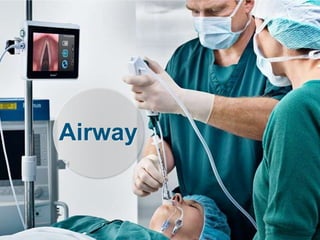
Airway
The use of additional advanced
airway techniques is highlighted,
along with the use of
videolaryngoscopy.
For pediatric patients, the use of
cuffed endotracheal tubes for
all children (with the exception of
infants <1 year of age) is
suggested.
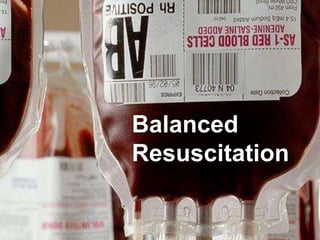
Balanced
Resuscitation
The concept of balanced resuscitation is
further emphasized, and the term
aggressive resuscitation has been
eliminated.
The standard use of 2 L of crystalloid
resuscitation as the starting point for all
resuscitation has been modified to
initiation of 1 L of crystalloid.
Early use of blood and blood products for
patients in shock is also
emphasized, without mandating or
suggesting any specific ratio of plasma and
Heat Injury
There is optional expanded content
on heat injury provided for those
courses that are taught in areas
where heat injury is either a
primary problem or has the
potential to significantly
compromise the care of injured
patients.
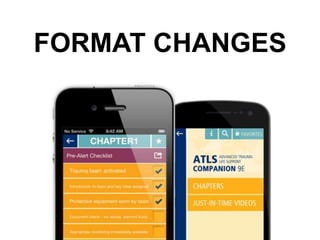
FORMAT CHANGES
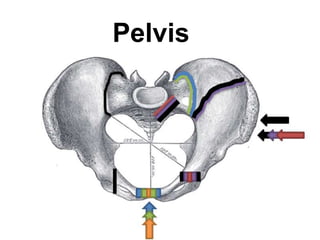
Pelvis
More emphasis is placed on the
pelvis as a source of blood loss.
This has been done by moving all
of the content to the abdomen
and pelvis chapter and the shock
and surgical skills stations.
Skills Stations
Both diagnostic peritoneal lavage (DPL)
and pericardiocentesis have been made
optional skill stations.
If the course director chooses not to teach
DPL, the new Focused Assessment with
Sonography for Trauma (FAST) skill
station must be taught; one way of
assessing the abdomen as a source of
potential blood loss remains mandatory.
The FAST skill station is only to introduce
the concept of the use of FAST to evaluate
the abdomen and to provide example
images for the student to recognize.
Initial
Assessment
Scenarios
There are several new initial
assessment scenarios,
emphasizing geriatric patients,
blunt trauma, rib fracture
treatment, and pelvic fractures.
MYATLSAPP
ATLS 9E Major Changes

ATLS 9E Major Changes

  • 1.
    Advanced Trauma LifeSupport (ATLS®): The ninth edition Journal of Trauma and Acute Care Surgery 2013; 72(5): 1363–1366
  • 2.
    Major Changes InThe ATLS® 9th Edition 1. Content Changes 2. Format Changes 3. MyATLS
  • 3.
  • 4.
  • 5.
    Preparation of theteam, along with team dynamics and debriefing, are important parts of team- based care that are highlighted in the Initial Assessment chapter.
  • 6.
  • 7.
    The use ofadditional advanced airway techniques is highlighted, along with the use of videolaryngoscopy. For pediatric patients, the use of cuffed endotracheal tubes for all children (with the exception of infants <1 year of age) is suggested.
  • 8.
  • 9.
    The concept ofbalanced resuscitation is further emphasized, and the term aggressive resuscitation has been eliminated. The standard use of 2 L of crystalloid resuscitation as the starting point for all resuscitation has been modified to initiation of 1 L of crystalloid. Early use of blood and blood products for patients in shock is also emphasized, without mandating or suggesting any specific ratio of plasma and
  • 10.
  • 11.
    There is optionalexpanded content on heat injury provided for those courses that are taught in areas where heat injury is either a primary problem or has the potential to significantly compromise the care of injured patients.
  • 12.
  • 13.
  • 14.
    More emphasis isplaced on the pelvis as a source of blood loss. This has been done by moving all of the content to the abdomen and pelvis chapter and the shock and surgical skills stations.
  • 15.
  • 16.
    Both diagnostic peritoneallavage (DPL) and pericardiocentesis have been made optional skill stations. If the course director chooses not to teach DPL, the new Focused Assessment with Sonography for Trauma (FAST) skill station must be taught; one way of assessing the abdomen as a source of potential blood loss remains mandatory. The FAST skill station is only to introduce the concept of the use of FAST to evaluate the abdomen and to provide example images for the student to recognize.
  • 17.
  • 18.
    There are severalnew initial assessment scenarios, emphasizing geriatric patients, blunt trauma, rib fracture treatment, and pelvic fractures.
  • 19.