A Problem oriented approach
BENIGN BREAST
DISEASE
Dr.B.SELVARAJ MS;Mch;FICS;
PEDIATRIC SURGEON
ASSOCIATE PROFESSOR
MELAKA MANIPAL MEDICAL COLLEGE
MALAYSIA
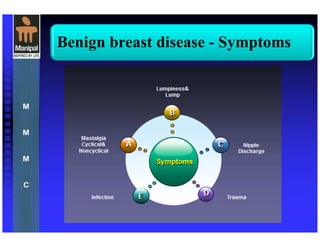
Benign breast disease - Symptoms
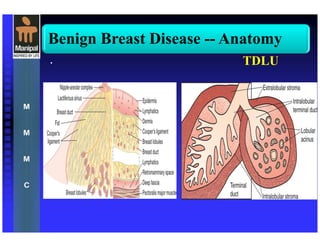
Benign Breast Disease -- Anatomy
• TDLU
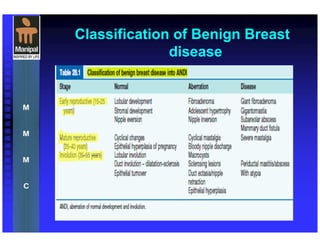
Classification of Benign Breast
disease
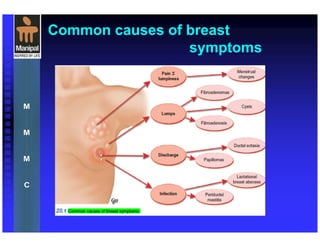
Common causes of breast
symptoms
INTRODUCTION
Breast is host to a spectrum of benign and
malignant diseases.
Benign breast conditions are practically a
universal phenomena among women.
It accounts for 80% of clinical presentation
related to the breast.
CONGENITAL & DEVELOPMENTAL
ABNORMALITIES
Although the normal location of the breast is
the anterior thorax, breast tissue with or
without a nipple or just nipple and areola
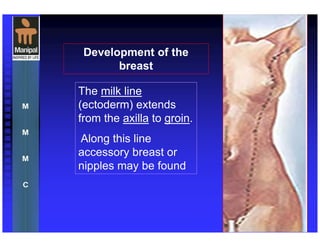
alone can occur any where along the milk line
The milk line is an ectodermal thickening
appearing at 6 weeks of gestation running
from axilla to the midportion of inguinal
ligament
The milk line
(ectoderm) extends
from the axilla to groin.
Along this line
accessory breast or
nipples may be found
Development of the
breast
CONGENITAL & DEVELOPMENTAL
ABNORMALITIES
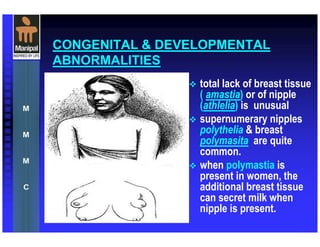
total lack of breast tissue
( amastia) or of nipple
(athlelia) is unusual
supernumerary nipples
polythelia & breast
polymasita are quite
common.
when polymastia is
present in women, the
additional breast tissue
can secret milk when
nipple is present.
Amastia
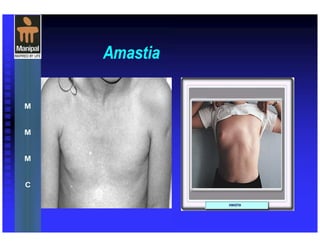
Amastia: A rare condition wherein the normal growth
of the breast or nipple does not occur.
Unilateral amastia (just on one side) is often associated
with absence of the pectoral muscles Poland’s
syndrome
Bilateral amastia (with absence of both breasts) is
associated in 40% of cases with multiple congenital
anomalies involving other parts of the body as well.
Amastia is distinguished from amazia wherein the
breast tissue is absent, but the nipple is present. Amazia
typically is a result of radiation or surgery.
Amastia
Mastalgia
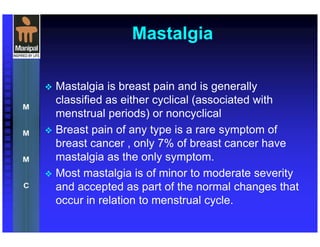
Mastalgia is breast pain and is generally
classified as either cyclical (associated with
menstrual periods) or noncyclical
Breast pain of any type is a rare symptom of
breast cancer , only 7% of breast cancer have
mastalgia as the only symptom.
Most mastalgia is of minor to moderate severity
and accepted as part of the normal changes that
occur in relation to menstrual cycle.
Mastalgia
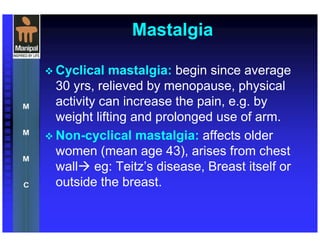
Cyclical mastalgia: begin since average
30 yrs, relieved by menopause, physical
activity can increase the pain, e.g. by
weight lifting and prolonged use of arm.
Non-cyclical mastalgia: affects older
women (mean age 43), arises from chest
wall eg: Teitz’s disease, Breast itself or
outside the breast.
Cyclical Mastalgia - treatment
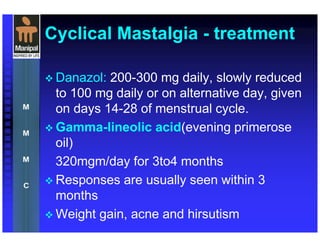
Danazol: 200-300 mg daily, slowly reduced
to 100 mg daily or on alternative day, given
on days 14-28 of menstrual cycle.
Gamma-lineolic acid(evening primerose
oil)
320mgm/day for 3to4 months
Responses are usually seen within 3
months
Weight gain, acne and hirsutism
Non Cyclical Mastalgia -
treatment
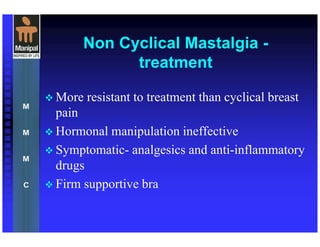
More resistant to treatment than cyclical breast
pain
Hormonal manipulation ineffective
Symptomatic- analgesics and anti-inflammatory
drugs
Firm supportive bra
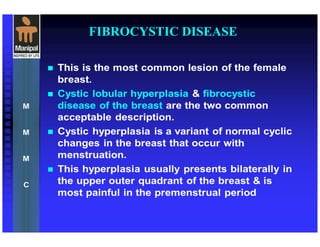
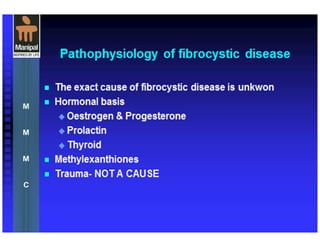
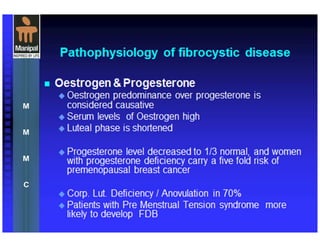
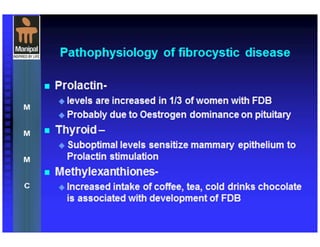
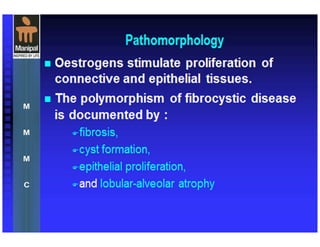
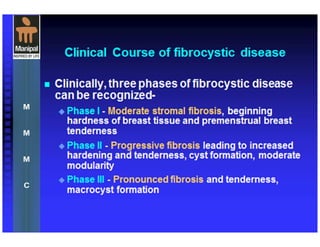
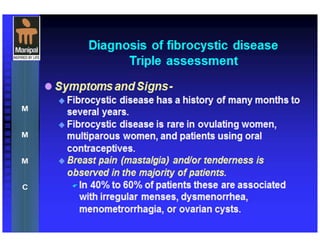
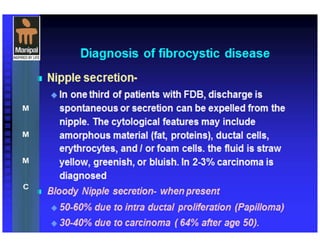
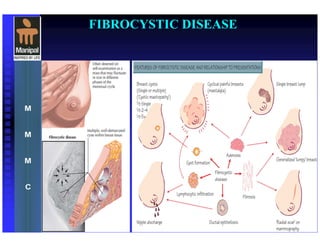
FIBROCYSTIC DISEASE
FIBROCYSTIC DISEASE
FAT NECROSIS
This is traumatic in nature & is met with women
with large fatty breast
Results from injury to breast fat by Trauma,
surgery, biopsy .
Causes to focal fibrosis and cicatrix formation.
Early: edema of the fat lobules,increased
echogenicity.
Post surgical scar, hematoma, seroma
FAT NECROSIS
Clinically:
The patient develop sever bruising after moderately sever
trauma, When the bruise settles the woman notice
swelling which is clinically Impossible to distinguish from
carcinoma of the breast because the Irregular mass is
often attached to the skin.
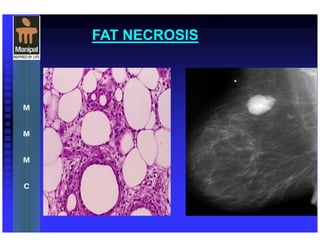
Microscopically a central area of necrotic fat cells are
surrounded by a granulomatous reaction consisting of
macrophage cells.
FAT NECROSIS
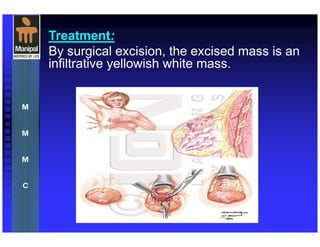
Treatment:
By surgical excision, the excised mass is an
infiltrative yellowish white mass.
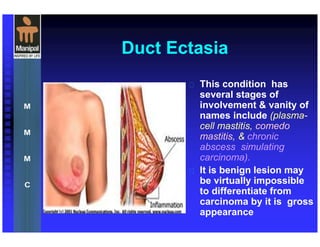
Duct Ectasia
 This condition has
several stages of
involvement & vanity of
names include (plasma-
cell mastitis, comedo
mastitis, & chronic
abscess simulating
carcinoma).
 It is benign lesion may
be virtually impossible
to differentiate from
carcinoma by it is gross
appearance
Duct Ectasia
 is a widening of the ducts of the breast, a
condition that occurs most frequently in women in
their 40s and 50s. A thick and sticky discharge,
usually gray to green in color, is the most
common symptom.
 Tenderness and redness of the nipple and
surrounding breast tissue may also be present.
Sometimes, scar tissue forms around the
abnormal duct, leading to a lump that may be
initially mistaken for cancer.
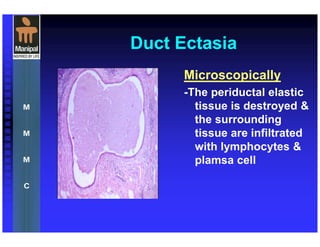
Duct Ectasia
Microscopically
-The periductal elastic
tissue is destroyed &
the surrounding
tissue are infiltrated
with lymphocytes &
plamsa cell
Duct Ectasia
Clinically:-
this condition present as solitary or multiple tender
swelling in the sub or Peri-areolar region of the breast.
- Nipple retraction, skin adherence, edema & axillary
adenopathy may accompany a hard, diffuse mass within
the
breast
- palpation reveals a number of cord like swelling which
radiate from the areola.
- the ducts are dilated & contain an inspissated yellow
cheesy material that can be expressed like toothpaste
from the cut end of a duct.
- occasionally, the inflammatory response are so acute
that
skin changes occur & the condition may be mistaken for
a breast abscess.
Duct Ectasia
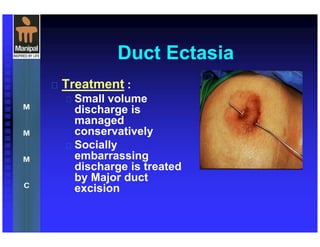
 Treatment :
 Small volume
discharge is
managed
conservatively
 Socially
embarrassing
discharge is treated
by Major duct
excision
Galactocele
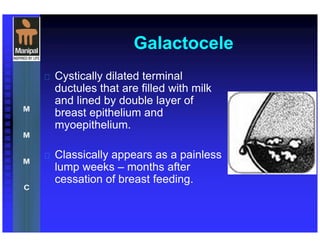
 Cystically dilated terminal
ductules that are filled with milk
and lined by double layer of
breast epithelium and
myoepithelium.
 Classically appears as a painless
lump weeks – months after
cessation of breast feeding.
GALACTOCELE
 It is probably formed by obstruction to a duct
in the puerperium . the milk retained proximal
to the obstruction eventually becomes
cheese-like.
 The common complication of this type of
swelling is infection.
 The treatment is by surgical excision.
INTRA-DUCTAL PAPILLOMA
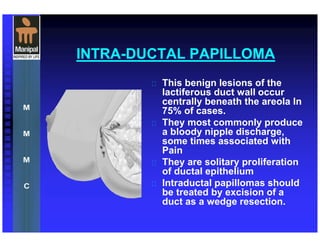
 This benign lesions of the
lactiferous duct wall occur
centrally beneath the areola In
75% of cases.
 They most commonly produce
a bloody nipple discharge,
some times associated with
Pain
 They are solitary proliferation
of ductal epithelium
 Intraductal papillomas should
be treated by excision of a
duct as a wedge resection.
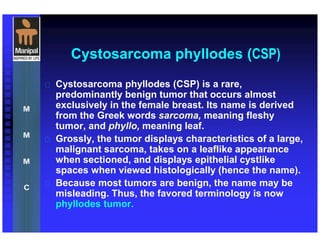
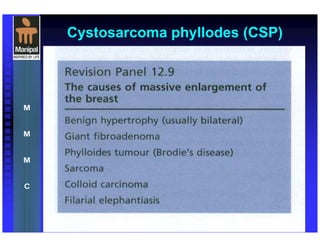
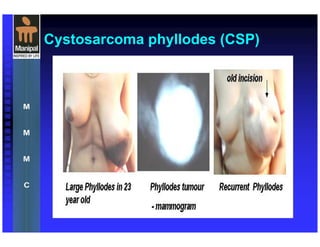
Cystosarcoma phyllodes (CSP)
 Cystosarcoma phyllodes (CSP) is a rare,
predominantly benign tumor that occurs almost
exclusively in the female breast. Its name is derived
from the Greek words sarcoma, meaning fleshy
tumor, and phyllo, meaning leaf.
 Grossly, the tumor displays characteristics of a large,
malignant sarcoma, takes on a leaflike appearance
when sectioned, and displays epithelial cystlike
spaces when viewed histologically (hence the name).
 Because most tumors are benign, the name may be
misleading. Thus, the favored terminology is now
phyllodes tumor.
Cystosarcoma phyllodes (CSP)
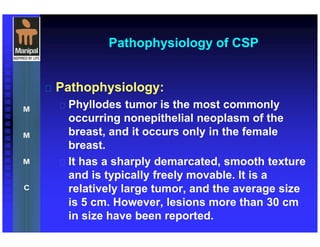
Pathophysiology of CSP
 Pathophysiology:
 Phyllodes tumor is the most commonly
occurring nonepithelial neoplasm of the
breast, and it occurs only in the female
breast.
 It has a sharply demarcated, smooth texture
and is typically freely movable. It is a
relatively large tumor, and the average size
is 5 cm. However, lesions more than 30 cm
in size have been reported.
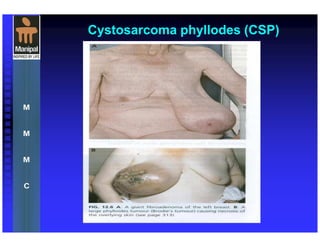
Cystosarcoma phyllodes (CSP)
TREATMENT of CSP
 Surgical Care:
 In most cases, perform wide local excision with a
rim of normal tissue
 If the tumor/breast ratio is sufficiently high to
preclude a satisfactory cosmetic result by
segmental excision
 total mastectomy, with or without reconstruction, is
an alternative.
 More radical procedures generally are not
warranted
 Perform axillary lymph node dissection only for
clinically suspicious nodes. However, virtually all
of these nodes are reactive and do not contain
malignant cells.
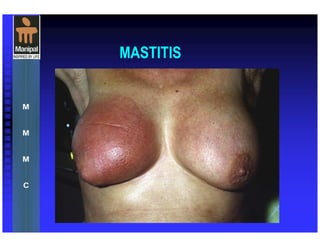
MASTITIS
MASTITIS
 Breast mastitis is an infection that commonly
affects women who are breast-feeding
(especially during the first two months after
childbirth) but can occur in all women at any
time.
 Mastitis is a benign condition that can usually
be treated successfully with antibiotics.
 Inflammation can be caused by many types of
injury including :
 infectious agents and their toxins,
 physical trauma
 or chemical irritants
SIGNS AND SYMPTOMS OF MASTITIS
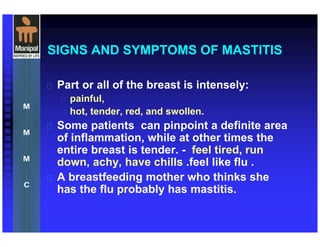
 Part or all of the breast is intensely:
 painful,
 hot, tender, red, and swollen.
 Some patients can pinpoint a definite area
of inflammation, while at other times the
entire breast is tender. - feel tired, run
down, achy, have chills .feel like flu .
 A breastfeeding mother who thinks she
has the flu probably has mastitis.
SIGNS AND SYMPTOMS OF
MASTITIS
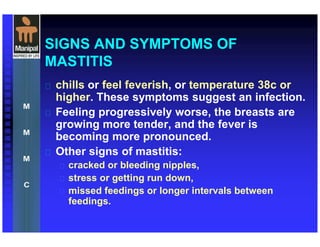
 chills or feel feverish, or temperature 38c or
higher. These symptoms suggest an infection.
 Feeling progressively worse, the breasts are
growing more tender, and the fever is
becoming more pronounced.
 Other signs of mastitis:
 cracked or bleeding nipples,
 stress or getting run down,
 missed feedings or longer intervals between
feedings.
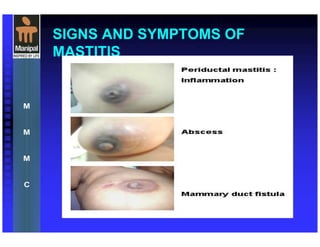
SIGNS AND SYMPTOMS OF
MASTITIS
TREATMENT OF MASTITIS
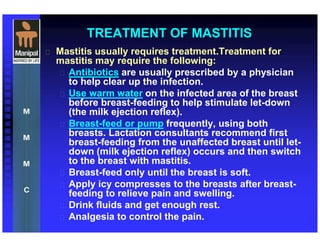
 Mastitis usually requires treatment.Treatment for
mastitis may require the following:
 Antibiotics are usually prescribed by a physician
to help clear up the infection.
 Use warm water on the infected area of the breast
before breast-feeding to help stimulate let-down
(the milk ejection reflex).
 Breast-feed or pump frequently, using both
breasts. Lactation consultants recommend first
breast-feeding from the unaffected breast until let-
down (milk ejection reflex) occurs and then switch
to the breast with mastitis.
 Breast-feed only until the breast is soft.
 Apply icy compresses to the breasts after breast-
feeding to relieve pain and swelling.
 Drink fluids and get enough rest.
 Analgesia to control the pain.
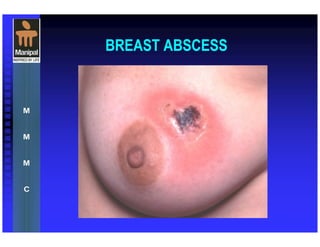
BREAST ABSCESS
BREAST ABSCESS
 This condition is usually found during
lactation . as role the infecting organism is :
 staphylococcus aureus, and less commonly
streptococcus pyogenes .
 the usual mode of infection is via the nipple,
the infection being carried by suckling infant
in the nasopharynx.
 The infection is at first limited to the
segment drained by the lactiferous duct but
it may subsequently spread to involve other
areas of the breast.
BREAST ABSCESS
 CAUSES :
 Staphylococcus aureus and streptococcal
species are the most common organisms
isolated in puerperal breast abscesses.
 Nonpuerperal abscesses typically contain
mixed flora (S aureus, streptococcal
species) and anaerobes.
BREAST ABSCESS
 CLINICAL FEATURES
 SYMPTOM
 Localized breast area edematous,
erythematous, warm, and painful
 History of previous breast abscess
 Associated symptoms of fever, vomiting,
and spontaneous drainage from the mass or
nipple
 May be lactating
BREAST ABSCESS
 CLINICAL FEATURES
 SIGNS
 Localized breast area erythematous, hot,
edematous, and extremely painful
 Most commonly found in the areolar or periareolar
area
 Fluctuance of the mass
 May have associated fever or axillary
lymphadenopathy
 Discharge with palpation from nipple or mass
 Nipple inversion
Investigations
1-Ultrasound: used to localize the abscess
2. FNAC: used to exclude underlying carcinoma
especially in chronic Breast abscess where the
abscess become encapsulated with a thick
fibrous capsule & the condition can’t be
distinguished from a carcinoma without a biopsy.
3. Needle Aspiration: to confirm presence of pus.
4. Mammogram: to exclude underlying carcinoma.
BREAST ABSCESS
 MANAGEMENT
1- If the patient present in the cellulitis stage the patient should
be treated with an appropriate Antibiotic.
2- Breast rested with feeding on the opposite side only.
3- The milk should be expressed from the healthy segments of
the affected breast.
4- Support of the breast
5- Local heat & analgesia to relive the pain.
6- If the infection doesn’t resolve within 48 h, the breast should
be incised & drained.
N.B. if antibiotics used in the presence of undrained pus, an
Antibioma form. This is a large sterile brawny edematous
swelling which takes many weeks to resolve.
BREAST ABSCESS
MANAGEMENT
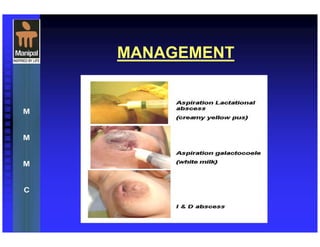
7.If pus is present at the time of presentation, which can
be confirmed by Needle aspiration, Incision &
Drainage is done which can be achieved by :
Simple Needle Aspiration: using a wide pore needle under
local anesthesia.
Guided drainage: under image control with radiological or
ultrasound techniques a tube drain can be inserted & left until
the cavity has collapse.
Surgical drainage: it is the most certain method, not only can
all loculi be reached, but also dead tissue can be removed.
The cavity is then dressed regularly & left open to heal by 2ry
intention.
Excision of all of the major ducts in case of Periductal
Mastitis.
BREAST ABSCESS
Prevention
Taking care of Breasts during pregnancy &
Lactation
Stop lactating from cracked nipple.
Treating Mastitis in its early stages with
appropriate medication & duration.
Drainage of Post-traumatic Hematoma.
Excision of Sebaceous Cyst.
Self Examination for any masses or
tenderness.
Control of concomitant disease that
increase the tendency to get infections
such as DM
MANAGEMENT
 Lactational breast abscess
 Usually due to Staph. aureus
 Usually peripherally situated
 Surgery may be pre-empted by early
diagnosis
 Attempt aspiration
 If no pus - antibiotics
 If pus present consider repeated
aspiration or incision and drainage
 Consider biopsy of cavity wall
 Continue breast feeding from opposite
breast
 No need to suppress lactation
 Non-lactational breast abscess
 Occur in periareolar tissue
 Culture yield - Bacteroides, anaerobic strep,
enterococci
 Usually manifestation of duct ectasia /
periductal mastitis
 Occur 30- 60 years , More common in
smokers
 Often give history of recurrent breast sepsis
 Repeated aspiration is the treatment of
choice
 Metronidazole and flucloxacillin
 Drain through small incision if non-resolving
 Definitive treatment when quiescent with
antibiotic prophylaxis
 Usually a major duct excision = Adair's
operation
 Spontaneous discharge or surgical excision
can result in mammary fistula
BREAST ABSCESS
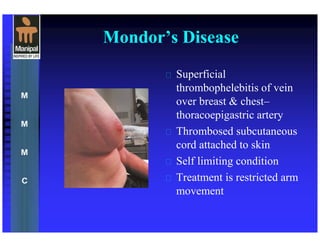
Mondor’s Disease
 Superficial
thrombophelebitis of vein
over breast & chest–
thoracoepigastric artery
 Thrombosed subcutaneous
cord attached to skin
 Self limiting condition
 Treatment is restricted arm
movement
Benign breast disease
Video Podcast
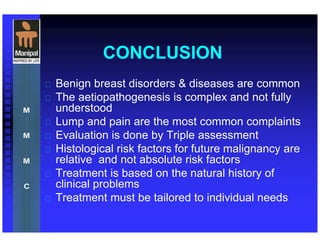
CONCLUSION
 Benign breast disorders & diseases are common
 The aetiopathogenesis is complex and not fully
understood
 Lump and pain are the most common complaints
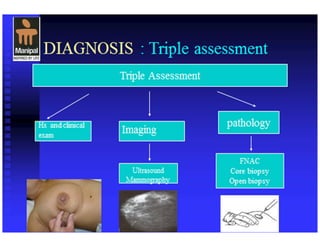
 Evaluation is done by Triple assessment
 Histological risk factors for future malignancy are
relative and not absolute risk factors
 Treatment is based on the natural history of
clinical problems
 Treatment must be tailored to individual needs
EMQ
Benignbreastdisease 121116083120-phpapp01 1

Benignbreastdisease 121116083120-phpapp01 1

  • 1.
    A Problem orientedapproach BENIGN BREAST DISEASE
  • 2.
    Dr.B.SELVARAJ MS;Mch;FICS; PEDIATRIC SURGEON ASSOCIATEPROFESSOR MELAKA MANIPAL MEDICAL COLLEGE MALAYSIA
  • 3.
  • 4.
    Benign Breast Disease-- Anatomy • TDLU
  • 5.
  • 6.
    Common causes ofbreast symptoms
  • 7.
    INTRODUCTION Breast is hostto a spectrum of benign and malignant diseases. Benign breast conditions are practically a universal phenomena among women. It accounts for 80% of clinical presentation related to the breast.
  • 8.
    CONGENITAL & DEVELOPMENTAL ABNORMALITIES Althoughthe normal location of the breast is the anterior thorax, breast tissue with or without a nipple or just nipple and areola alone can occur any where along the milk line The milk line is an ectodermal thickening appearing at 6 weeks of gestation running from axilla to the midportion of inguinal ligament
  • 9.
    The milk line (ectoderm)extends from the axilla to groin. Along this line accessory breast or nipples may be found Development of the breast
  • 10.
    CONGENITAL & DEVELOPMENTAL ABNORMALITIES totallack of breast tissue ( amastia) or of nipple (athlelia) is unusual supernumerary nipples polythelia & breast polymasita are quite common. when polymastia is present in women, the additional breast tissue can secret milk when nipple is present.
  • 11.
    Amastia Amastia: A rarecondition wherein the normal growth of the breast or nipple does not occur. Unilateral amastia (just on one side) is often associated with absence of the pectoral muscles Poland’s syndrome Bilateral amastia (with absence of both breasts) is associated in 40% of cases with multiple congenital anomalies involving other parts of the body as well. Amastia is distinguished from amazia wherein the breast tissue is absent, but the nipple is present. Amazia typically is a result of radiation or surgery.
  • 12.
  • 13.
    Mastalgia Mastalgia is breastpain and is generally classified as either cyclical (associated with menstrual periods) or noncyclical Breast pain of any type is a rare symptom of breast cancer , only 7% of breast cancer have mastalgia as the only symptom. Most mastalgia is of minor to moderate severity and accepted as part of the normal changes that occur in relation to menstrual cycle.
  • 14.
    Mastalgia Cyclical mastalgia: beginsince average 30 yrs, relieved by menopause, physical activity can increase the pain, e.g. by weight lifting and prolonged use of arm. Non-cyclical mastalgia: affects older women (mean age 43), arises from chest wall eg: Teitz’s disease, Breast itself or outside the breast.
  • 15.
    Cyclical Mastalgia -treatment Danazol: 200-300 mg daily, slowly reduced to 100 mg daily or on alternative day, given on days 14-28 of menstrual cycle. Gamma-lineolic acid(evening primerose oil) 320mgm/day for 3to4 months Responses are usually seen within 3 months Weight gain, acne and hirsutism
  • 16.
    Non Cyclical Mastalgia- treatment More resistant to treatment than cyclical breast pain Hormonal manipulation ineffective Symptomatic- analgesics and anti-inflammatory drugs Firm supportive bra
  • 17.
  • 25.
  • 38.
    FAT NECROSIS This istraumatic in nature & is met with women with large fatty breast Results from injury to breast fat by Trauma, surgery, biopsy . Causes to focal fibrosis and cicatrix formation. Early: edema of the fat lobules,increased echogenicity. Post surgical scar, hematoma, seroma
  • 39.
    FAT NECROSIS Clinically: The patientdevelop sever bruising after moderately sever trauma, When the bruise settles the woman notice swelling which is clinically Impossible to distinguish from carcinoma of the breast because the Irregular mass is often attached to the skin. Microscopically a central area of necrotic fat cells are surrounded by a granulomatous reaction consisting of macrophage cells.
  • 40.
  • 41.
    Treatment: By surgical excision,the excised mass is an infiltrative yellowish white mass.
  • 42.
    Duct Ectasia  Thiscondition has several stages of involvement & vanity of names include (plasma- cell mastitis, comedo mastitis, & chronic abscess simulating carcinoma).  It is benign lesion may be virtually impossible to differentiate from carcinoma by it is gross appearance
  • 43.
    Duct Ectasia  isa widening of the ducts of the breast, a condition that occurs most frequently in women in their 40s and 50s. A thick and sticky discharge, usually gray to green in color, is the most common symptom.  Tenderness and redness of the nipple and surrounding breast tissue may also be present. Sometimes, scar tissue forms around the abnormal duct, leading to a lump that may be initially mistaken for cancer.
  • 44.
    Duct Ectasia Microscopically -The periductalelastic tissue is destroyed & the surrounding tissue are infiltrated with lymphocytes & plamsa cell
  • 45.
    Duct Ectasia Clinically:- this conditionpresent as solitary or multiple tender swelling in the sub or Peri-areolar region of the breast. - Nipple retraction, skin adherence, edema & axillary adenopathy may accompany a hard, diffuse mass within the breast - palpation reveals a number of cord like swelling which radiate from the areola. - the ducts are dilated & contain an inspissated yellow cheesy material that can be expressed like toothpaste from the cut end of a duct. - occasionally, the inflammatory response are so acute that skin changes occur & the condition may be mistaken for a breast abscess.
  • 46.
    Duct Ectasia  Treatment:  Small volume discharge is managed conservatively  Socially embarrassing discharge is treated by Major duct excision
  • 47.
    Galactocele  Cystically dilatedterminal ductules that are filled with milk and lined by double layer of breast epithelium and myoepithelium.  Classically appears as a painless lump weeks – months after cessation of breast feeding.
  • 48.
    GALACTOCELE  It isprobably formed by obstruction to a duct in the puerperium . the milk retained proximal to the obstruction eventually becomes cheese-like.  The common complication of this type of swelling is infection.  The treatment is by surgical excision.
  • 49.
    INTRA-DUCTAL PAPILLOMA  Thisbenign lesions of the lactiferous duct wall occur centrally beneath the areola In 75% of cases.  They most commonly produce a bloody nipple discharge, some times associated with Pain  They are solitary proliferation of ductal epithelium  Intraductal papillomas should be treated by excision of a duct as a wedge resection.
  • 50.
    Cystosarcoma phyllodes (CSP) Cystosarcoma phyllodes (CSP) is a rare, predominantly benign tumor that occurs almost exclusively in the female breast. Its name is derived from the Greek words sarcoma, meaning fleshy tumor, and phyllo, meaning leaf.  Grossly, the tumor displays characteristics of a large, malignant sarcoma, takes on a leaflike appearance when sectioned, and displays epithelial cystlike spaces when viewed histologically (hence the name).  Because most tumors are benign, the name may be misleading. Thus, the favored terminology is now phyllodes tumor.
  • 51.
  • 52.
    Pathophysiology of CSP Pathophysiology:  Phyllodes tumor is the most commonly occurring nonepithelial neoplasm of the breast, and it occurs only in the female breast.  It has a sharply demarcated, smooth texture and is typically freely movable. It is a relatively large tumor, and the average size is 5 cm. However, lesions more than 30 cm in size have been reported.
  • 53.
  • 54.
  • 55.
    TREATMENT of CSP Surgical Care:  In most cases, perform wide local excision with a rim of normal tissue  If the tumor/breast ratio is sufficiently high to preclude a satisfactory cosmetic result by segmental excision  total mastectomy, with or without reconstruction, is an alternative.  More radical procedures generally are not warranted  Perform axillary lymph node dissection only for clinically suspicious nodes. However, virtually all of these nodes are reactive and do not contain malignant cells.
  • 56.
  • 57.
    MASTITIS  Breast mastitisis an infection that commonly affects women who are breast-feeding (especially during the first two months after childbirth) but can occur in all women at any time.  Mastitis is a benign condition that can usually be treated successfully with antibiotics.  Inflammation can be caused by many types of injury including :  infectious agents and their toxins,  physical trauma  or chemical irritants
  • 58.
    SIGNS AND SYMPTOMSOF MASTITIS  Part or all of the breast is intensely:  painful,  hot, tender, red, and swollen.  Some patients can pinpoint a definite area of inflammation, while at other times the entire breast is tender. - feel tired, run down, achy, have chills .feel like flu .  A breastfeeding mother who thinks she has the flu probably has mastitis.
  • 59.
    SIGNS AND SYMPTOMSOF MASTITIS  chills or feel feverish, or temperature 38c or higher. These symptoms suggest an infection.  Feeling progressively worse, the breasts are growing more tender, and the fever is becoming more pronounced.  Other signs of mastitis:  cracked or bleeding nipples,  stress or getting run down,  missed feedings or longer intervals between feedings.
  • 60.
    SIGNS AND SYMPTOMSOF MASTITIS
  • 61.
    TREATMENT OF MASTITIS Mastitis usually requires treatment.Treatment for mastitis may require the following:  Antibiotics are usually prescribed by a physician to help clear up the infection.  Use warm water on the infected area of the breast before breast-feeding to help stimulate let-down (the milk ejection reflex).  Breast-feed or pump frequently, using both breasts. Lactation consultants recommend first breast-feeding from the unaffected breast until let- down (milk ejection reflex) occurs and then switch to the breast with mastitis.  Breast-feed only until the breast is soft.  Apply icy compresses to the breasts after breast- feeding to relieve pain and swelling.  Drink fluids and get enough rest.  Analgesia to control the pain.
  • 62.
  • 63.
    BREAST ABSCESS  Thiscondition is usually found during lactation . as role the infecting organism is :  staphylococcus aureus, and less commonly streptococcus pyogenes .  the usual mode of infection is via the nipple, the infection being carried by suckling infant in the nasopharynx.  The infection is at first limited to the segment drained by the lactiferous duct but it may subsequently spread to involve other areas of the breast.
  • 64.
    BREAST ABSCESS  CAUSES:  Staphylococcus aureus and streptococcal species are the most common organisms isolated in puerperal breast abscesses.  Nonpuerperal abscesses typically contain mixed flora (S aureus, streptococcal species) and anaerobes.
  • 65.
    BREAST ABSCESS  CLINICALFEATURES  SYMPTOM  Localized breast area edematous, erythematous, warm, and painful  History of previous breast abscess  Associated symptoms of fever, vomiting, and spontaneous drainage from the mass or nipple  May be lactating
  • 66.
    BREAST ABSCESS  CLINICALFEATURES  SIGNS  Localized breast area erythematous, hot, edematous, and extremely painful  Most commonly found in the areolar or periareolar area  Fluctuance of the mass  May have associated fever or axillary lymphadenopathy  Discharge with palpation from nipple or mass  Nipple inversion
  • 67.
    Investigations 1-Ultrasound: used tolocalize the abscess 2. FNAC: used to exclude underlying carcinoma especially in chronic Breast abscess where the abscess become encapsulated with a thick fibrous capsule & the condition can’t be distinguished from a carcinoma without a biopsy. 3. Needle Aspiration: to confirm presence of pus. 4. Mammogram: to exclude underlying carcinoma.
  • 68.
    BREAST ABSCESS  MANAGEMENT 1-If the patient present in the cellulitis stage the patient should be treated with an appropriate Antibiotic. 2- Breast rested with feeding on the opposite side only. 3- The milk should be expressed from the healthy segments of the affected breast. 4- Support of the breast 5- Local heat & analgesia to relive the pain. 6- If the infection doesn’t resolve within 48 h, the breast should be incised & drained. N.B. if antibiotics used in the presence of undrained pus, an Antibioma form. This is a large sterile brawny edematous swelling which takes many weeks to resolve.
  • 69.
    BREAST ABSCESS MANAGEMENT 7.If pusis present at the time of presentation, which can be confirmed by Needle aspiration, Incision & Drainage is done which can be achieved by : Simple Needle Aspiration: using a wide pore needle under local anesthesia. Guided drainage: under image control with radiological or ultrasound techniques a tube drain can be inserted & left until the cavity has collapse. Surgical drainage: it is the most certain method, not only can all loculi be reached, but also dead tissue can be removed. The cavity is then dressed regularly & left open to heal by 2ry intention. Excision of all of the major ducts in case of Periductal Mastitis.
  • 70.
    BREAST ABSCESS Prevention Taking careof Breasts during pregnancy & Lactation Stop lactating from cracked nipple. Treating Mastitis in its early stages with appropriate medication & duration. Drainage of Post-traumatic Hematoma. Excision of Sebaceous Cyst. Self Examination for any masses or tenderness. Control of concomitant disease that increase the tendency to get infections such as DM
  • 71.
  • 72.
     Lactational breastabscess  Usually due to Staph. aureus  Usually peripherally situated  Surgery may be pre-empted by early diagnosis  Attempt aspiration  If no pus - antibiotics  If pus present consider repeated aspiration or incision and drainage  Consider biopsy of cavity wall  Continue breast feeding from opposite breast  No need to suppress lactation  Non-lactational breast abscess  Occur in periareolar tissue  Culture yield - Bacteroides, anaerobic strep, enterococci  Usually manifestation of duct ectasia / periductal mastitis  Occur 30- 60 years , More common in smokers  Often give history of recurrent breast sepsis  Repeated aspiration is the treatment of choice  Metronidazole and flucloxacillin  Drain through small incision if non-resolving  Definitive treatment when quiescent with antibiotic prophylaxis  Usually a major duct excision = Adair's operation  Spontaneous discharge or surgical excision can result in mammary fistula BREAST ABSCESS
  • 73.
    Mondor’s Disease  Superficial thrombophelebitisof vein over breast & chest– thoracoepigastric artery  Thrombosed subcutaneous cord attached to skin  Self limiting condition  Treatment is restricted arm movement
  • 74.
  • 75.
    CONCLUSION  Benign breastdisorders & diseases are common  The aetiopathogenesis is complex and not fully understood  Lump and pain are the most common complaints  Evaluation is done by Triple assessment  Histological risk factors for future malignancy are relative and not absolute risk factors  Treatment is based on the natural history of clinical problems  Treatment must be tailored to individual needs
  • 76.