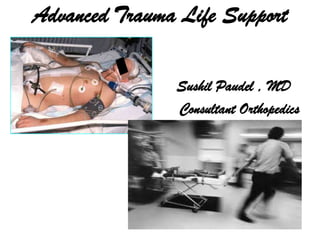
Advanced Trauma Life Support
Sushil Paudel , MD
Consultant Orthopedics
Polytrauma
 Prime most on national
agenda world over
Involves diverse
specialists and
procedures
Polytrauma
Management starts
ROADSIDE
Emphasis on QUICK
DIAGNOSIS AND RAPID
INTERVENTION
Management at site of
accident :
 Access trapped & buried
 Do not Pull or Twist
Priority
 Freeing head, neck &
trunk by clearing
depress
Gently move out patient
Transport
 Severely injured
 Move patient on stretcher
 Three people ideally
required
 Transfer like one piece of
log
Emergency Room
management :
 TAILORED
 RAPID
 ACTIVE
 URGENT
 METHODICAL
 AUTHORITATIVE
Death from trauma : trimodol
distribution
 The first peak of death- sec-
min Cause: Aortic Rupture
 The second peak of death –
min-hr This is the Golden
hour on which ATLS focuses
 The third peak of death –
days-wks Causes: Sepsis,
SIRS
Establishing assessment and
management
Vital functions
Rapid primary evolution
 Resuscitation
Secondary assessment
Definitive care
Primary Survey
A- airway
B- breathing
C- circulation
D-Disability
E- exposure
Resuscitation phase
Shock management,
patient oxygenation and
hemorrhage control
Replacement of fluid
Urinary and nasogastric
catheter inserted
Secondary survey
 Head-to-toe evaluation
 Look, listen and feel
 Examine each region
 Neurological examination
 X-ray of chest and cervical
spine
 Tubes and fingers in every
orifice
Definitive care phase
All injuries managed
Comprehensive
management, fracture
stabilization operative
intervention and
transfer
Triage
Sorting of patients based on need for treatment
Two type
No. of patients and severity of their injuries do not
exceed ability of the facility. Here patient with life
threatening problems and there sustaining multiple
system are treated first
No. of patients and severity of their injuries exceed
capability of the facility and staff. Here patients with
the greatest chance of survival with the least
expenditure of time, equipment supplies and
personnel are managed first
Priority plan- treatment and
management
A.Primary survey
Airway and cervical spine
 Assessment
 Management- patent
airway
 Chin lift or jaw thrust
 Clear foreign bodies
 Oropharyngeal airway
 Orotracheal/ nasotracheal
intubation
 Cricothyroidotomy
 Cervical spine in a neutral
position
Airway management
Airway obstruction
“Look”
Agitation.
Poor air movement
Rib retraction
Foreign material
“Listen”
 Speech
 Hoarseness.
 Noisy breathing
 Stridor
“Feel”
 Airway structure in neck
 Tracheal deviation
 Hemorrhage
Abnormal Breathing
• “ Look”
Cyanosis
 Mental State
Chest asymmetry
Tachyponea
Paralysis
• “Listen”
 Can’t breath
 Stridor, wheezing
 Breath sound
• “Feel”
 Surgical emphysema
 Chest tenderness
Treatment
 Clear secretion, Debris
 Pull jaw foreword
 Oral airway
 Nasopharangeal airway
 Endotracheal airway
 Procedure
Definitive airway
“Cuffed tube in the trachea.
Indications
A- Airway- obstructed gag reflex.
B- Breathing- O2 Saturation < 90%.
C- Circulation systolic BP <75mm.
D- Disability
Glasgow coma scale score < 8
E- Environment
hypothermia (core temp <330C)
When to ventilate.
Apnoea
 Hypoventilation
 Flail chest
 Spiral cord injury
 Glasgow come score < 9
Surgical airway
 Inability to intubate
 Neck injury
 Maxilo facial injury
 Needle
cricothyroiodectomy
 Tracheostomy.
Assume a cervical spine injury in any
patient with Polytrauma who has
- Altered level of consciousness.
- Blunt or penetrating injury above the
level of clavicles.
Protecting the cervical spine
 Aim to prevent damage or
transection of the spinal cord in
case patient has a fracture or
unstable dislocation of cervical
spine
 One member of team holds head
in the line of the body
 Another member applies a well-
fitting hard collar and immobilises
the head by placing sandbags on
either side of the head
 Sticky-tape is passed from one
side of the bed across the
forehead to the opposite side of
bed to further reduce movement
of the head and neck
Protecting the cervical spine
Breathing control
 life-threatening chest
injuries, and treatment
should be expedited
immediately:
 sucking chest wound
 tension
pneumothorax/Hemothorax
 large flail segment
 cardiac tamponade
 Management
 High conc. of oxygen
 Alleviate tension
pneumothorax
 Seal open pneumothorax
Management of a Tension Pneumothorax
 Insert a large-bore intravenous
cannula into second
intercostal space in
midclavicular line on affected
side
 If there is a sudden release of
air, the diagnosis is confirmed
and should be followed
immediately by an intercostal
chest drain in the fifth
intercostal space in the
midaxillary line
 If the diagnosis is in doubt,
order a chest x-ray and
proceed with the chest drain if
confirmatory
Circulation and Hemorrhage control
Assessment
 State of consciousness
 Pulse
 Color of skin
 Capillary blanch test
 Identity exsanguinating
hemorrhage
SHOCK
“Principle problem is poor
oxygen delivery.”
Shock should be
recognized before B.P.
figure is available.
 Cool, pale skin, sweating
peripheries (Poor blood
flow in skin)
 Anxiety, confusion &
restlessness (Poor blood
flow in brain)
 Oliguria after
catheterization
( Poor blood flow in kidneys)
After recognition of shock
 Initiate 2 I/V catheter
 Blood for examination
 Initiate ringer lactate and blood
replacement
 Pneumatic antishock garment
 E.C.G. monitor
 Urinary and nasogastric catheter
 Restore oxygen delivery
 Immediate intervention
 Stop external bleeding by local
pressure
 For extremity bleeding compression
bandage
 Elevate with traction
Difficult venous access
 If access cannot be gained within
5 minutes and patient is shocked,
then further measures should be
taken until access is gained
 Sites for cannulation include:
 Cut-down in the antecubital fossa -
safest, most effective site
 Cut-down to the long saphenous
vein in the groin, rather than at the
ankle, as intense vasospasm may
prevent infusion
 Percutaneous cannulation of the
femoral vein - using the Seldinger
technique
 Percutaneous cannulation of neck
veins using Seldinger technique
 Intra-osseous infusion in a severely
ill child
Disability- brief neurological
Level of consciousness
using AVPU method
A-alert
V-Responds to vocal
stimuli
P-Responds to
painful stimuli
U-Unresponsive
The pupils for size,
equality and reaction
Glasgow coma scale
GCS
Exposure
 Patient should be fully
exposed in the ATLS setting.
 Clothes should be cut off, if
necessary.
 Every orifice, i.e. ear, eye,
nostril, mouth, etc. should be
looked at
 All limbs palpated for fractures
so that nothing is missed
 Also, one should not forget to
perform a log roll and look at
the back
Secondary Survey
 Head and face
 Assessment
Inspection
Re-evaluate pupils
Palpation
Cranial nerve function
 Management
Maintain airway
Hemorrhage control
Cervical spine/neck
Assessment
Inspection
Auscultation
Palpation
Lateral, cross table cervical x-ray
Management
Inline immobilization of the cervical
spine
Chest
Assessment
Inspection
Percussion
Auscultation
Palpation
Management
Pleural decompression
Thoracocentesis
Pericardiocentesis
Chest X-ray
Abdomen
Assessment
Inspection
Percussion
Auscultation
Palpation
Management
Peritoneal lavage
Pneumatic antishock
garment
Perineal and rectal
Evaluate for
Anal sphincter tone
Rectal blood
Bowel well integrity
Prostate position
Blood on urinary meat us
Scrotol hemotoma
Back
Evaluate for
Bony of deformity
Evidence of penetrating
/ blunt trauma
He
Priorities Unstable Stable
Highest 1. Dislocations
2. Vascular injuries requiring repair
3. Open fracture
4. Unstable pelvic ring fracture
5. Femur fracture
6. Unstable spinal fracture
7. Other wounds .
8. Unstable spinal fractures
Lowest 9. Intraarticular fractures
10. Other long bone injuries
11.Deep hand injuries
Musculoskeletal Injury
Extremities
Assessment
 Inspection-
contusion/deformity
 Palpation – tenderness/
crepitation
Management
 Splinting for fractures
 Pneumatic antishock
garment
 Relief of pain
 Tetanus injection
Neurological Evaluation
Assessment
Sensorimotor
evaluation
Paralysis
Paresis
Management
Immobilization of
entire patient
Definitive care
Inter hospital triage
criteria help determine
the level, pace and
intensity of initial
management
Outline rationale for
patient transfer
Re-evaluate the patient
Re-evaluate
continuously – new
sign/symptoms
Monitor vitals sign and
urinary output
Records and legal consideration
Records
Record keeping
Reporting
chronologically
Consent for treatment
Consent
In life-threatening
emergencies- treatment
first
Forensic evidence
Overcoming poverty is not a task of charity, it is an act of justice
Thank you

Polytrauma sushil