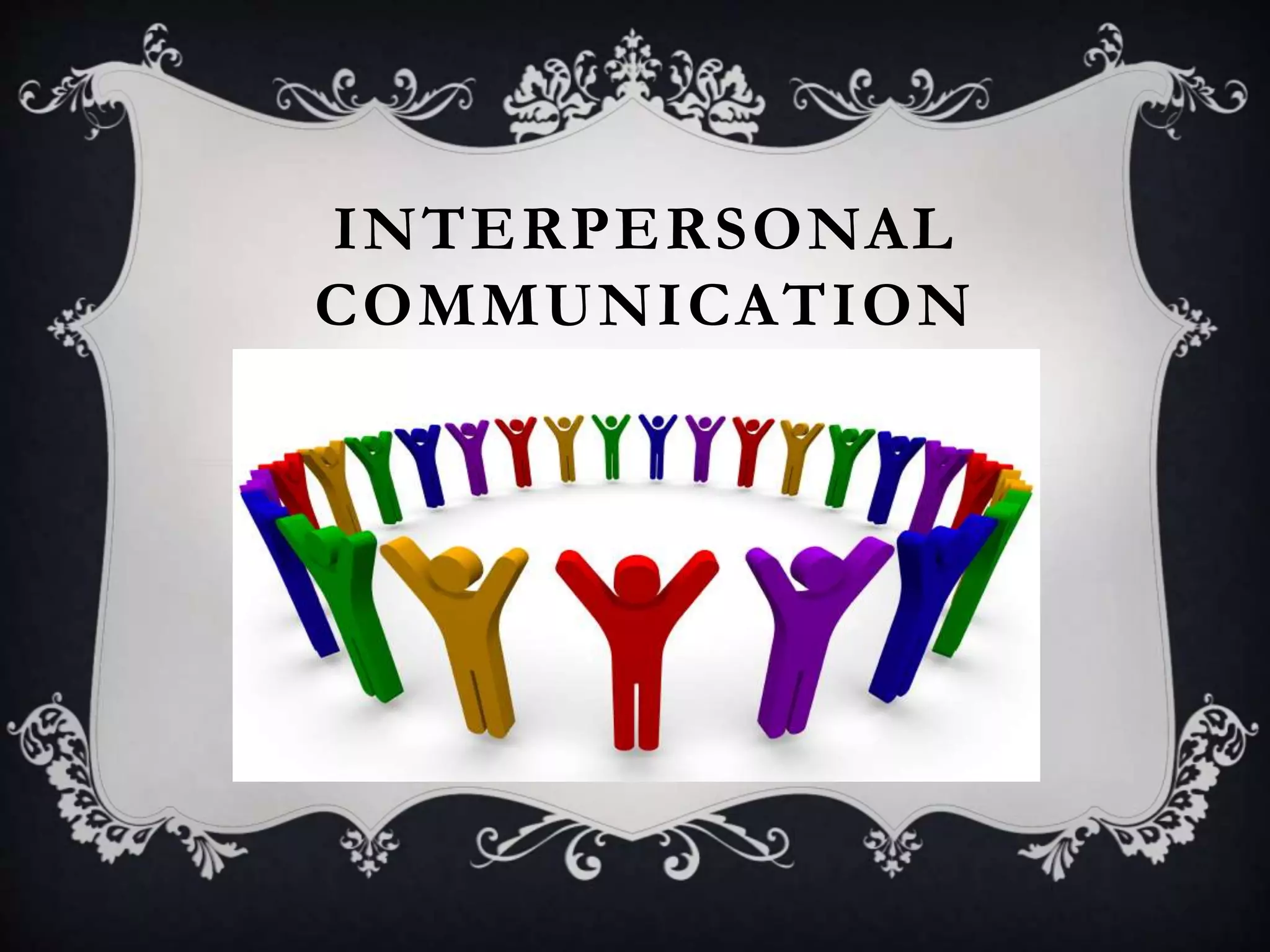
INTERPERSONAL
COMMUNICATION
INTER PER SONAL COMMUNICA TION
2
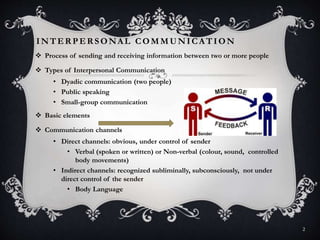
 Process of sending and receiving information between two or more people
 Types of Interpersonal Communication

• Dyadic communication (two people)
• Public speaking
• Small-group communication
 Basic elements
 Communication channels
• Direct channels: obvious, under control of sender
• Verbal (spoken or written) or Non-verbal (colour, sound, controlled
body movements)
• Indirect channels: recognized subliminally, subconsciously, not under
direct control of the sender
• Body Language
INTER PER SONAL COMMUNICA TION :
W HA T FOR ?
3
• Gaining Information about other individual
• For interacting more effectively
• Better prediction about how they think, feel, and act
• How? Passively (by observing them), Actively (having others
engage them) or Interactively (engaging them ourselves)
• Better Understanding others
• Words can mean very different things depending on how they are
said or in what context
• What and how are sent simultaneously, and both affect the
meaning
• Establishing Identity
• Roles we play and public self-image we present
• Interpersonal Needs
• Inclusion, Control and Affection
INTERPERSONAL CONFLICT
4
 Expressed struggle between at least two interdependent parties
who perceive incompatible goals, scarce resources, and interference
from the other party in achieving their goals
 Important concepts in definition:
• The two sides must communicate about the problem
• Often involves perceptions
 Common Problems:
• Avoiding conflict: damaging, greater problems in the future
• Individuals blaming other individuals
• Adopting a win-lose strategy
INTERPERSONAL
COMMUNICATION
5
We are going to explicitly work
on
• Effective Listening
• “You have two ears and one mouth.
I suggest that you use them in that
proportion”
• Assertiveness
• “Too many of us fail to fulfill our
needs because we say no rather
than yes, or perhaps later in life, yes
when we should say no”
• Effective Questioning
• “Only the crystal-clear question
yields a transparent answer”
EFFECTIVE LISTENING: ACTIVE
LISTENING
 Communication = Speaking & Listening = good speaking and effective listening
skills
 Difference between Hearing & Listening?
 Effective Listening Tips
• Make an effort to block out outer distractions.
• Resist the urge to day dream.
• Try to understand and correctly interprete body language.
• Pay attention to tone also, as it is vital to the correct interpretation of the
message.
• Have an open mind. Try not to make judgments about the speaker or the
message.
• Don't hesitate to ask and clarify (do not interrupt, jot questions down)
• Big mistake: being preoccupied on what you want to say.
6
ASSERTIVE COMMUNICATION
7
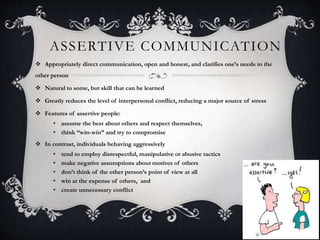
 Appropriately direct communication, open and honest, and clarifies one’s needs to the
other person
 Natural to some, but skill that can be learned
 Greatly reduces the level of interpersonal conflict, reducing a major source of stress
 Features of assertive people:
• assume the best about others and respect themselves,
• think “win-win” and try to compromise
 In contrast, individuals behaving aggressively
• tend to employ disrespectful, manipulative or abusive tactics
• make negative assumptions about motives of others
• don’t think of the other person’s point of view at all
• win at the expense of others, and
• create unnecessary conflict
E FFE CTIVE QUE STIONING TE CHNIQUES
8
 Open Questions (what, why, how):
long answers
• Developing an open
conversation
• Finding our more detail
• Finding out the other person's
opinion or issues
 Close Questions: short answers, yes
or no.
• For Gathering facts, testing your
understanding or the other
person's
• Concluding a discussion or
making a decision
• Frame setting
• Misplaced closed question: kill
the conversation, awkward
silences
 Funnel Questions
• Start with general questions, then
focus on a point in each answer, and
ask more and more detail at each
level
• Tip: start with closed questions and
progress to open ones
 Good for:
• Finding out more detail about a
specific point
• Gaining the interest or increasing the
confidence of the person you are
with
 Rhetorical Questions
• An answer is not expected, they are
statements phrased in question form
• For engaging the listener
EFFECTIVE QUESTIONING TECHNIQUES
9
 Probing Questions
• Strategy for finding out
more detail
• Tip: ask ‘Why?’ And use
‘exactly’.
 Good for:
• Gaining clarification to
ensure you have the
whole story and that you
understand it thoroughly
• Drawing information
out of people who are
trying to avoid telling
you something
 Leading Questions
• That will lead the respondent in
your way of thinking
• To be used with care
• Can be seen as manipulative
and dishonest
 How:
• Phrasing the question so that
the "easiest" response is yes
• Adding personal appeal to
agree
• Choice between fixed options
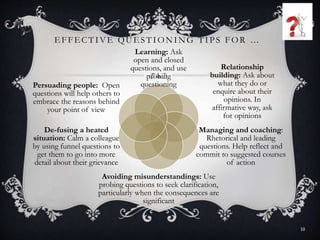
E FFE CTIVE QUE STIONING TIPS FOR …
10
Learning: Ask
open and closed
questions, and use
probing
questioning
Relationship
building: Ask about
what they do or
enquire about their
opinions. In
affirmative way, ask
for opinions
Managing and coaching:
Rhetorical and leading
questions. Help reflect and
commit to suggested courses
of action
Avoiding misunderstandings: Use
probing questions to seek clarification,
particularly when the consequences are
significant
De-fusing a heated
situation: Calm a colleague
by using funnel questions to
get them to go into more
detail about their grievance
Persuading people: Open
questions will help others to
embrace the reasons behind
your point of view
INTERPERSONAL
COMMUNICATION
According to Petersen (2007), good communication is just as
important in business, family, and social life. Listening well matters
for coworkers, when intimacy is not the goal, but being able to
work together effectively is. It helps keep friendships vital and even
makes a difference in casual relationships where you merely want
ease (p. 4).
11
Stewart (2009) defines interpersonal communication as the type
or kind of communication that happens when the people involved
talk and listen in ways that maximize the presence of the personal
(p. 33).
In the information age, we have to send, receive, and
process huge numbers of messages every day. But effective
communication is about more than just exchanging information.
Effective communication requires you to also understand the
emotion behind the information.
12
Elements of Interpersonal Communication
The Communicators
• one-way process
• two-way processes
The Message
facial expressions, tone of
voice, gestures and body language
Noise
complicated jargon, inappropriate body
language, inattention, disinterest, and
cultural differences
Feedback
Feedback consists of messages the receiver returns, which allows the sender to
know how accurately the message has been received, as well as the receiver's
reaction.
Context
All communication is influenced by the context in which it takes place.
Channel
The channel refers to the physical means by which the message is transferred
from one person to another
14
Four Principles of Interpersonal
Communication
Remember a basic principle of
communication in general: people are not
mind readers. Another way to put this is:
people judge you by your behavior, not your
intent.
Interpersonal communication is inescapable
Interpersonal communication is
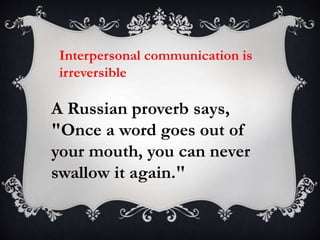
irreversible
A Russian proverb says,
"Once a word goes out of
your mouth, you can never
swallow it again."
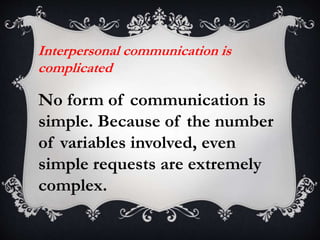
Interpersonal communication is
complicated
No form of communication is
simple. Because of the number
of variables involved, even
simple requests are extremely
complex.
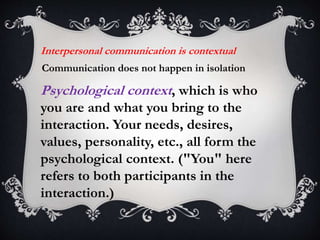
Interpersonal communication is contextual
Communication does not happen in isolation
Psychological context, which is who
you are and what you bring to the
interaction. Your needs, desires,
values, personality, etc., all form the
psychological context. ("You" here
refers to both participants in the
interaction.)
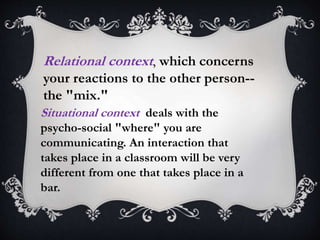
Relational context, which concerns
your reactions to the other person--
the "mix."
Situational context deals with the
psycho-social "where" you are
communicating. An interaction that
takes place in a classroom will be very
different from one that takes place in a
bar.
Environmental context deals with the physical
"where" you are communicating. Furniture, location,
noise level, temperature, season, time of day, all are
examples of factors in the environmental context.
Cultural context includes all the learned
behaviors and rules that affect the interaction. If
you come from a culture (foreign or within your
own country) where it is considered rude to make
long, direct eye contact, you will out of politeness
avoid eye contact
Importance of Interpersonal Communication
Skills
Listening is a vital interpersonal
communication skill
Good interpersonal communication
skills enable us to work more effectively
in groups and teams
Interpersonal communication skills are
essential to developing other key life
skills
All about working with other people
An ability to get along with others while performing
the job
Characteristic traits like Manners, attitude, courtesy, habits,
behavior and appearance which helps us to communicate and
maintain relationship with others
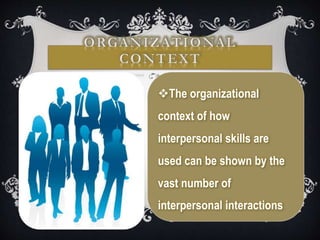
The organizational
context of how
interpersonal skills are
used can be shown by the
vast number of
interpersonal interactions
Take the relationship viewpoint:
• Effective relationships within the
organization
• Effective relationships with
suppliers
• Effective relationships with
competitors
Internally
• In Teams
• Across Teams
• Within and between
departments and
business units
Externally
• With Suppliers
• With
Customers
 To gain real competitive advantage through such relationships in
the long term is dependent upon your level of interpersonal skills
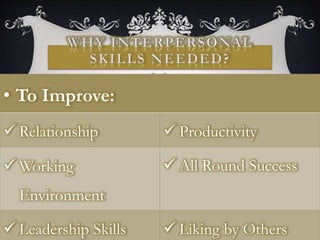
• To Improve:
 Relationship  Productivity
 Working
Environment
 All Round Success
 Leadership Skills  Liking by Others
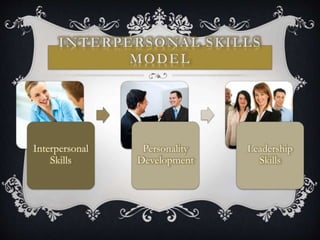
Interpersonal
Skills
Personality
Development
Leadership
Skills
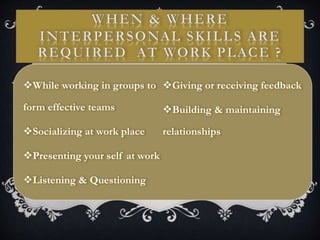
While working in groups to
form effective teams
Socializing at work place
Presenting your self at work
Listening & Questioning
Giving or receiving feedback
Building & maintaining
relationships
Smile
Be Appreciative
Pay Attention
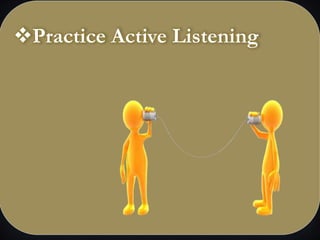
Practice Active Listening
Bring People Together
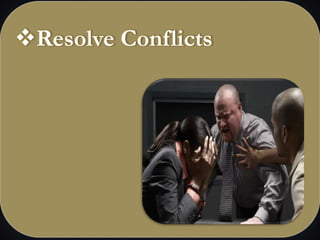
Resolve Conflicts
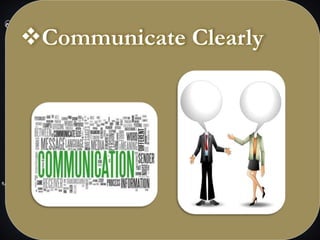
Communicate Clearly
Humor Them
Empathy/See It On Their Side
Interpersonal communication (final)

Interpersonal communication (final)

  • 1.
  • 2.
    INTER PER SONALCOMMUNICA TION 2  Process of sending and receiving information between two or more people  Types of Interpersonal Communication • Dyadic communication (two people) • Public speaking • Small-group communication  Basic elements  Communication channels • Direct channels: obvious, under control of sender • Verbal (spoken or written) or Non-verbal (colour, sound, controlled body movements) • Indirect channels: recognized subliminally, subconsciously, not under direct control of the sender • Body Language
  • 3.
    INTER PER SONALCOMMUNICA TION : W HA T FOR ? 3 • Gaining Information about other individual • For interacting more effectively • Better prediction about how they think, feel, and act • How? Passively (by observing them), Actively (having others engage them) or Interactively (engaging them ourselves) • Better Understanding others • Words can mean very different things depending on how they are said or in what context • What and how are sent simultaneously, and both affect the meaning • Establishing Identity • Roles we play and public self-image we present • Interpersonal Needs • Inclusion, Control and Affection
  • 4.
    INTERPERSONAL CONFLICT 4  Expressedstruggle between at least two interdependent parties who perceive incompatible goals, scarce resources, and interference from the other party in achieving their goals  Important concepts in definition: • The two sides must communicate about the problem • Often involves perceptions  Common Problems: • Avoiding conflict: damaging, greater problems in the future • Individuals blaming other individuals • Adopting a win-lose strategy
  • 5.
    INTERPERSONAL COMMUNICATION 5 We are goingto explicitly work on • Effective Listening • “You have two ears and one mouth. I suggest that you use them in that proportion” • Assertiveness • “Too many of us fail to fulfill our needs because we say no rather than yes, or perhaps later in life, yes when we should say no” • Effective Questioning • “Only the crystal-clear question yields a transparent answer”
  • 6.
    EFFECTIVE LISTENING: ACTIVE LISTENING Communication = Speaking & Listening = good speaking and effective listening skills  Difference between Hearing & Listening?  Effective Listening Tips • Make an effort to block out outer distractions. • Resist the urge to day dream. • Try to understand and correctly interprete body language. • Pay attention to tone also, as it is vital to the correct interpretation of the message. • Have an open mind. Try not to make judgments about the speaker or the message. • Don't hesitate to ask and clarify (do not interrupt, jot questions down) • Big mistake: being preoccupied on what you want to say. 6
  • 7.
    ASSERTIVE COMMUNICATION 7  Appropriatelydirect communication, open and honest, and clarifies one’s needs to the other person  Natural to some, but skill that can be learned  Greatly reduces the level of interpersonal conflict, reducing a major source of stress  Features of assertive people: • assume the best about others and respect themselves, • think “win-win” and try to compromise  In contrast, individuals behaving aggressively • tend to employ disrespectful, manipulative or abusive tactics • make negative assumptions about motives of others • don’t think of the other person’s point of view at all • win at the expense of others, and • create unnecessary conflict
  • 8.
    E FFE CTIVEQUE STIONING TE CHNIQUES 8  Open Questions (what, why, how): long answers • Developing an open conversation • Finding our more detail • Finding out the other person's opinion or issues  Close Questions: short answers, yes or no. • For Gathering facts, testing your understanding or the other person's • Concluding a discussion or making a decision • Frame setting • Misplaced closed question: kill the conversation, awkward silences  Funnel Questions • Start with general questions, then focus on a point in each answer, and ask more and more detail at each level • Tip: start with closed questions and progress to open ones  Good for: • Finding out more detail about a specific point • Gaining the interest or increasing the confidence of the person you are with  Rhetorical Questions • An answer is not expected, they are statements phrased in question form • For engaging the listener
  • 9.
    EFFECTIVE QUESTIONING TECHNIQUES 9 Probing Questions • Strategy for finding out more detail • Tip: ask ‘Why?’ And use ‘exactly’.  Good for: • Gaining clarification to ensure you have the whole story and that you understand it thoroughly • Drawing information out of people who are trying to avoid telling you something  Leading Questions • That will lead the respondent in your way of thinking • To be used with care • Can be seen as manipulative and dishonest  How: • Phrasing the question so that the "easiest" response is yes • Adding personal appeal to agree • Choice between fixed options
  • 10.
    E FFE CTIVEQUE STIONING TIPS FOR … 10 Learning: Ask open and closed questions, and use probing questioning Relationship building: Ask about what they do or enquire about their opinions. In affirmative way, ask for opinions Managing and coaching: Rhetorical and leading questions. Help reflect and commit to suggested courses of action Avoiding misunderstandings: Use probing questions to seek clarification, particularly when the consequences are significant De-fusing a heated situation: Calm a colleague by using funnel questions to get them to go into more detail about their grievance Persuading people: Open questions will help others to embrace the reasons behind your point of view
  • 11.
    INTERPERSONAL COMMUNICATION According to Petersen(2007), good communication is just as important in business, family, and social life. Listening well matters for coworkers, when intimacy is not the goal, but being able to work together effectively is. It helps keep friendships vital and even makes a difference in casual relationships where you merely want ease (p. 4). 11
  • 12.
    Stewart (2009) definesinterpersonal communication as the type or kind of communication that happens when the people involved talk and listen in ways that maximize the presence of the personal (p. 33). In the information age, we have to send, receive, and process huge numbers of messages every day. But effective communication is about more than just exchanging information. Effective communication requires you to also understand the emotion behind the information. 12
  • 13.
    Elements of InterpersonalCommunication The Communicators • one-way process • two-way processes The Message facial expressions, tone of voice, gestures and body language Noise complicated jargon, inappropriate body language, inattention, disinterest, and cultural differences
  • 14.
    Feedback Feedback consists ofmessages the receiver returns, which allows the sender to know how accurately the message has been received, as well as the receiver's reaction. Context All communication is influenced by the context in which it takes place. Channel The channel refers to the physical means by which the message is transferred from one person to another 14
  • 15.
    Four Principles ofInterpersonal Communication Remember a basic principle of communication in general: people are not mind readers. Another way to put this is: people judge you by your behavior, not your intent. Interpersonal communication is inescapable
  • 16.
    Interpersonal communication is irreversible ARussian proverb says, "Once a word goes out of your mouth, you can never swallow it again."
  • 17.
    Interpersonal communication is complicated Noform of communication is simple. Because of the number of variables involved, even simple requests are extremely complex.
  • 18.
    Interpersonal communication iscontextual Communication does not happen in isolation Psychological context, which is who you are and what you bring to the interaction. Your needs, desires, values, personality, etc., all form the psychological context. ("You" here refers to both participants in the interaction.)
  • 19.
    Relational context, whichconcerns your reactions to the other person-- the "mix." Situational context deals with the psycho-social "where" you are communicating. An interaction that takes place in a classroom will be very different from one that takes place in a bar.
  • 20.
    Environmental context dealswith the physical "where" you are communicating. Furniture, location, noise level, temperature, season, time of day, all are examples of factors in the environmental context. Cultural context includes all the learned behaviors and rules that affect the interaction. If you come from a culture (foreign or within your own country) where it is considered rude to make long, direct eye contact, you will out of politeness avoid eye contact
  • 21.
    Importance of InterpersonalCommunication Skills Listening is a vital interpersonal communication skill Good interpersonal communication skills enable us to work more effectively in groups and teams Interpersonal communication skills are essential to developing other key life skills
  • 23.
    All about workingwith other people An ability to get along with others while performing the job Characteristic traits like Manners, attitude, courtesy, habits, behavior and appearance which helps us to communicate and maintain relationship with others
  • 24.
    The organizational context ofhow interpersonal skills are used can be shown by the vast number of interpersonal interactions
  • 25.
    Take the relationshipviewpoint: • Effective relationships within the organization • Effective relationships with suppliers • Effective relationships with competitors
  • 26.
    Internally • In Teams •Across Teams • Within and between departments and business units
  • 27.
  • 28.
     To gainreal competitive advantage through such relationships in the long term is dependent upon your level of interpersonal skills
  • 29.
    • To Improve: Relationship  Productivity  Working Environment  All Round Success  Leadership Skills  Liking by Others
  • 31.
  • 32.
    While working ingroups to form effective teams Socializing at work place Presenting your self at work Listening & Questioning Giving or receiving feedback Building & maintaining relationships
  • 33.
  • 34.
  • 35.
  • 36.
  • 37.
  • 38.
  • 39.
  • 40.
  • 41.

Editor's Notes

  • #3 http://www.selfgrowth.com/articles/Definition_Interpersonal_Communication.html
  • #4 http://www.abacon.com/commstudies/interpersonal/infunctions.html
  • #5 http://www.abacon.com/commstudies/interpersonal/inconflict.html
  • #7 http://www.buzzle.com/articles/effective-listening-skills.html
  • #9 http://www.mindtools.com/pages/article/newTMC_88.htm
  • #10 http://www.mindtools.com/pages/article/newTMC_88.htm
  • #11 http://www.mindtools.com/pages/article/newTMC_88.htm