Communication

Principles of effective communication
      Barriers in communication


                                        1
Communication

• Efficient communication is ESSENTIAL to
  being success in life.
• The biggest source of interpersonal
  problems is poor communications.
• The key to the communication process is to
  be understood.
• Language is rarely a barrier for
  communication

                                           2
Communication
• The aim of communication is the transference
  and understanding of information between two
  or more people.

• Communication must always be between two or
  more people, one the sender and the other
  receiver. You participate in both roles and your
  role will change alternatively and frequently in
  conversation.


                                                     3
Effective Communication
Overview


•   Functions of Communication
•   The Communication Process
•   Communication Fundamentals
•   Key Communication Skills
Functions of Communication


•   Control
•   Motivation
•   Emotional Expression
•   Information
The Communication Process


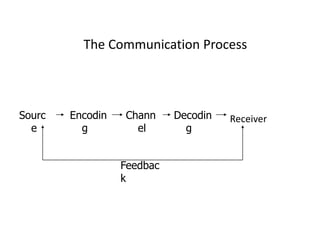
Sourc   Encodin   Chann     Decodin   Receiver
  e       g         el        g


                  Feedbac
                  k
Communication Fundamentals

Direction:
• Downward
• Upward
• Crosswise


Networks:
• Formal vs. Informal
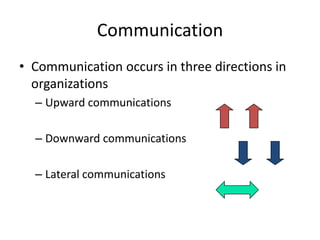
Communication
• Communication occurs in three directions in
  organizations
  – Upward communications

  – Downward communications

  – Lateral communications
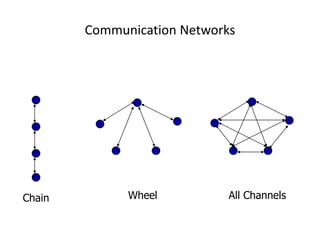
Communication Networks


Chain         Wheel          All Channels
Barriers to Effective Communication


•   Filtering
•   Selective Perception
•   Emotions
•   Language
Key Communication Skills
• Listening Skills
• Feedback Skills
• Presentation skills
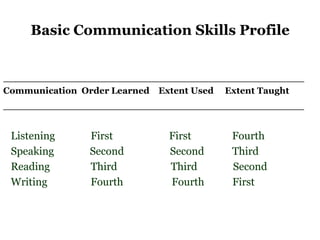
Basic Communication Skills Profile


________________________________________________
Communication Order Learned Extent Used Extent Taught
____________________________________________

 Listening     First         First      Fourth
 Speaking      Second        Second     Third
 Reading       Third         Third      Second
 Writing       Fourth        Fourth     First
Meaning
•   Listening Is With The Mind
•   Hearing With The Senses
•   Listening Is Conscious.
•   An Active Process Of Eliciting Information
•   Ideas, Attitudes And Emotions
•   Interpersonal, Oral Exchange
The Ten Commandments of Good
                  Communication
• Seek to clarify your ideas before   • Take the opportunity to convey
  communicating                         something of help or value to the
                                        receiver
• Examine the true purpose of each
  communication                       • Follow-up your communication
                                      • Communicate for tomorrow as
• Consider the total physical and       well as today
  human setting
                                      • Be sure your actions support your
• Consult with others in planning       communications
  communications                      • Seek not only to be understood
• Be mindful of the overtones as        but to understand - be a good
  well as the basic content of your     listener
  message
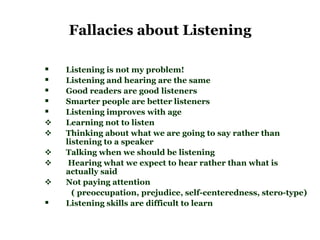
Fallacies about Listening

   Listening is not my problem!
   Listening and hearing are the same
   Good readers are good listeners
   Smarter people are better listeners
   Listening improves with age
   Learning not to listen
   Thinking about what we are going to say rather than
    listening to a speaker
   Talking when we should be listening
    Hearing what we expect to hear rather than what is
    actually said
   Not paying attention
      ( preoccupation, prejudice, self-centeredness, stero-type)
   Listening skills are difficult to learn
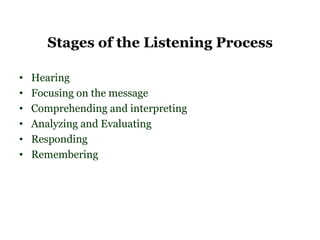
Stages of the Listening Process

•   Hearing
•   Focusing on the message
•   Comprehending and interpreting
•   Analyzing and Evaluating
•   Responding
•   Remembering
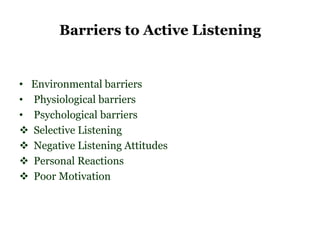
Barriers to Active Listening


• Environmental barriers
• Physiological barriers
• Psychological barriers
 Selective Listening
 Negative Listening Attitudes
 Personal Reactions
 Poor Motivation
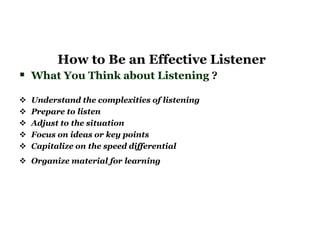
How to Be an Effective Listener
 What You Think about Listening ?
   Understand the complexities of listening
   Prepare to listen
   Adjust to the situation
   Focus on ideas or key points
   Capitalize on the speed differential
 Organize material for learning
How to Be an Effective Listener
                  (cont.)


 What You Feel about Listening ?
   Want to listen
   Delay judgment
   Admit your biases
   Don’t tune out “dry” subjects
   Accept responsibility for understanding
   Encourage others to talk
How to Be an Effective Listener
                  (cont.)

 What You Do about Listening ?
   Establish eye contact with the speaker
   Take notes effectively
   Be a physically involved listener
   Avoid negative mannerisms
   Exercise your listening muscles
Feedback Skills

• Positive vs. Negative Feedback
• Positive feedback is more readily and accurately perceived
  than negative feedback
• Positive feedback fits what most people wish to hear and
  already believe about themselves
• Negative feedback is most likely to be accepted when it comes
  from a credible source if it is objective in form
• Subjective impressions carry weight only when they come
  from a person with high status and credibility
Developing Effective Feedback Skills


•   Focus on specific behaviours
•   Keep feedback impersonal
•   Keep feedback goal oriented
•   Make feedback well timed
•   Ensure understanding
•   Direct feedback toward behaviour that is controllable
    by the recipient
Presentation Skills
Ideas, concepts or issues talked about or spoken to a
  group or audience

Public speaking is one of the most feared things
      “I could make such a fool of myself”

Skills required to give a good presentation can be
  developed
        Preparation is the Key
Presentation Skills
Preparation/ Planning is the first step on the ladder to
 success

Aspects in the development of a good presentation
 Self Centered (Self)
 Audience Centered (Audience)
 Subject Centered (Material)

“I want (who) to (what) (where, when and how)
because (why)”
Presentation Skills

• Helpers

What do you want to present (content)?
Why do you want to present (purpose)?
Where will you be presenting (place)?
How do you want to present (words to be used or not,
  slides to be used)
Who is your audience?
Presentation Skills
• Preparation: Audience Analysis

What is the audience interested in
What does the audience want
What does the audience already know and needs to
 know
What are their needs, expectations from this
 presentation
How will the audience benefit from this presentation
Presentation Skills
• Structure the content in line with the
  audience’s needs
• What do you want to tell the audience?
• What is your objective?
• Prepare keeping in mind the time allotted
• Anticipate the questions and prepare
• Collect material from a variety of sources
• Arrange points logically and sequentially
• Prepare handouts as well
Presentation Skills
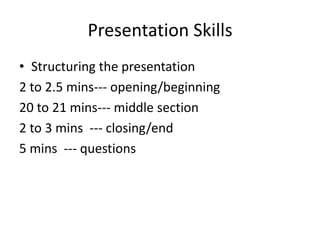
• Structuring the presentation
2 to 2.5 mins--- opening/beginning
20 to 21 mins--- middle section
2 to 3 mins --- closing/end
5 mins --- questions
Presentation Skills

The Beginning
Should be carefully designed
Get attention
  - shock, humor, question, story, facts &figures
  - well rehearsed yet natural
Motivate audience to listen
  - listen to their needs
Presentation Skills

Preparation – Structure
Sequence should be logical & understandable
Interim summaries- Recaps
Value of visual aids-flip charts, handouts etc.
Presentation Skills

Prepare Closing
Last 2 to 2.5 minutes are as critical as the first
  five minutes for a successful presentation
Summarize- highlight important points
Suggest action- what to do and when, where and
  how to do it
Presentation Skills

Stage Fright
Everyone has it to some degree
Can be used constructively
Key issue is not elimination of fear
  Instead channel the energy it generates for an
   effective presentation
Presentation Skills
Effective Delivery
Be active - move
Be purposeful - controlled gestures
Variations – vocal (pitch, volume, rate)
Be natural
Be direct – don’t just talk in front of the
  audience talk to them
Group Facilitation
Verbal Communication- barriers
Speaking too fast
Using jargon
Tone and content
Complicated or ambiguous language
Not questioning
Physical State of the audience
Presentation Skills

Sensitivity to the audience

“see” the audience
Take non-verbal feedback
 -congruent and incongruent body language
Modify to meet audience needs
Don’t just make it as a presentation
Presentation Skills

Handling Questions

Do not get confused
You are not supposed to know everything
Anticipate and keep answers ready
Sometime questions themselves give you a lead
 to highlight your point of view
Presentation Skills
Visual Aids
While using a over head projector face the
  audience while talking
Point with a pen
Appropriate lighting
Watch the colours
Ensure clear visibility
10 lines, 10 words per line
Presentation Skills

So to conclude :
           Always prepare
           Channelize you fear
          Interact with your audience
Communication Feedback
• We may say that communication has
  occurred only when the message has
  been understood.
• Understanding occurs in the mind of the
  receiver.
• Feedback is critical to ensure that
  accurate understanding of the message
  has occurred.
                                            40
Barriers to
                  Communication
• Barriers to accurate communication
  – Unfamiliar language – including dialects and accents
  – Improper timing – Is the boss distracted today?
  – Noise and distractions in the environment
  – Attitude of both the source and the receiver
  – Differences between people – gender, age, culture, education,
    intelligence, etc.
  – Relationship between the sender and the receiver – status, boss-
    employee, parent-child, etc.


                                                                       41
Barriers to Communications
– Filtering – manipulation of information so that it will seem more
  favorably to the receiver.
– Selective Perception – receiver hears message based on his/her
  interests, needs, motivations, experience, background and other
  personal characteristics.
– Defensiveness – response when receiver interprets message as
  threatening
– Language – Words mean different things to different people.


                                                                      42
Rumors
• Response to situations that are IMPORTANT
  to us, and
• There is AMBIGUITY between what is going
  on and what was said, and
• Under conditions that arouse ANXIETY, such
  as time off, pay programs, layoffs, etc.


                                               43
Suggestions for Reducing the Negative
            Consequences of Rumors
• Announce timetables for making important decisions
• Explain decisions and behaviors that may appear
  inconsistent or secretive
• Emphasize the downside, as well as the upside, of
  current decisions and future plans.
• Openly discuss worst case possibilities – it is almost
  never as anxiety provoking as the unspoken fantasy.


                                                           44
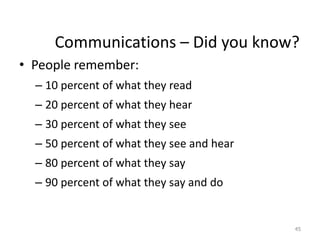
Communications – Did you know?
• People remember:
  – 10 percent of what they read
  – 20 percent of what they hear
  – 30 percent of what they see
  – 50 percent of what they see and hear
  – 80 percent of what they say
  – 90 percent of what they say and do


                                           45
Summary

• Successful communication requires
  understanding by the receiver.
• The communication process model includes a
  source, a message, encoding, a channel,
  decoding, a receiver, and, especially feedback.
• Communication in organizations occurs in
  upward, downward, and lateral directions.


                                                    46
Final thoughts
• Communicating to be understood and being a
  good listener are crucial.
• Another important aspect of communication
  is to think about what you are saying before
  you say it.
• Today’s communications set the tone for
  tomorrow’s relationships.


                                             47
Conclusions
• The key to the communication process is to
  have understanding on the part of the
  receiver.
• There are many barriers to good
  communications that must be overcome for
  communications to be successful.
• Learn to be an active listener as part of
  successful communications.
•End

7. communication

  • 1.
    Communication Principles of effectivecommunication Barriers in communication 1
  • 2.
    Communication • Efficient communicationis ESSENTIAL to being success in life. • The biggest source of interpersonal problems is poor communications. • The key to the communication process is to be understood. • Language is rarely a barrier for communication 2
  • 3.
    Communication • The aimof communication is the transference and understanding of information between two or more people. • Communication must always be between two or more people, one the sender and the other receiver. You participate in both roles and your role will change alternatively and frequently in conversation. 3
  • 4.
  • 5.
    Overview • Functions of Communication • The Communication Process • Communication Fundamentals • Key Communication Skills
  • 6.
    Functions of Communication • Control • Motivation • Emotional Expression • Information
  • 7.
    The Communication Process Sourc Encodin Chann Decodin Receiver e g el g Feedbac k
  • 8.
    Communication Fundamentals Direction: • Downward •Upward • Crosswise Networks: • Formal vs. Informal
  • 9.
    Communication • Communication occursin three directions in organizations – Upward communications – Downward communications – Lateral communications
  • 10.
  • 11.
    Barriers to EffectiveCommunication • Filtering • Selective Perception • Emotions • Language
  • 12.
    Key Communication Skills •Listening Skills • Feedback Skills • Presentation skills
  • 13.
    Basic Communication SkillsProfile ________________________________________________ Communication Order Learned Extent Used Extent Taught ____________________________________________ Listening First First Fourth Speaking Second Second Third Reading Third Third Second Writing Fourth Fourth First
  • 14.
    Meaning • Listening Is With The Mind • Hearing With The Senses • Listening Is Conscious. • An Active Process Of Eliciting Information • Ideas, Attitudes And Emotions • Interpersonal, Oral Exchange
  • 15.
    The Ten Commandmentsof Good Communication • Seek to clarify your ideas before • Take the opportunity to convey communicating something of help or value to the receiver • Examine the true purpose of each communication • Follow-up your communication • Communicate for tomorrow as • Consider the total physical and well as today human setting • Be sure your actions support your • Consult with others in planning communications communications • Seek not only to be understood • Be mindful of the overtones as but to understand - be a good well as the basic content of your listener message
  • 16.
    Fallacies about Listening  Listening is not my problem!  Listening and hearing are the same  Good readers are good listeners  Smarter people are better listeners  Listening improves with age  Learning not to listen  Thinking about what we are going to say rather than listening to a speaker  Talking when we should be listening  Hearing what we expect to hear rather than what is actually said  Not paying attention ( preoccupation, prejudice, self-centeredness, stero-type)  Listening skills are difficult to learn
  • 17.
    Stages of theListening Process • Hearing • Focusing on the message • Comprehending and interpreting • Analyzing and Evaluating • Responding • Remembering
  • 18.
    Barriers to ActiveListening • Environmental barriers • Physiological barriers • Psychological barriers  Selective Listening  Negative Listening Attitudes  Personal Reactions  Poor Motivation
  • 19.
    How to Bean Effective Listener  What You Think about Listening ?  Understand the complexities of listening  Prepare to listen  Adjust to the situation  Focus on ideas or key points  Capitalize on the speed differential  Organize material for learning
  • 20.
    How to Bean Effective Listener (cont.)  What You Feel about Listening ?  Want to listen  Delay judgment  Admit your biases  Don’t tune out “dry” subjects  Accept responsibility for understanding  Encourage others to talk
  • 21.
    How to Bean Effective Listener (cont.)  What You Do about Listening ?  Establish eye contact with the speaker  Take notes effectively  Be a physically involved listener  Avoid negative mannerisms  Exercise your listening muscles
  • 22.
    Feedback Skills • Positivevs. Negative Feedback • Positive feedback is more readily and accurately perceived than negative feedback • Positive feedback fits what most people wish to hear and already believe about themselves • Negative feedback is most likely to be accepted when it comes from a credible source if it is objective in form • Subjective impressions carry weight only when they come from a person with high status and credibility
  • 23.
    Developing Effective FeedbackSkills • Focus on specific behaviours • Keep feedback impersonal • Keep feedback goal oriented • Make feedback well timed • Ensure understanding • Direct feedback toward behaviour that is controllable by the recipient
  • 24.
    Presentation Skills Ideas, conceptsor issues talked about or spoken to a group or audience Public speaking is one of the most feared things “I could make such a fool of myself” Skills required to give a good presentation can be developed Preparation is the Key
  • 25.
    Presentation Skills Preparation/ Planningis the first step on the ladder to success Aspects in the development of a good presentation  Self Centered (Self)  Audience Centered (Audience)  Subject Centered (Material) “I want (who) to (what) (where, when and how) because (why)”
  • 26.
    Presentation Skills • Helpers Whatdo you want to present (content)? Why do you want to present (purpose)? Where will you be presenting (place)? How do you want to present (words to be used or not, slides to be used) Who is your audience?
  • 27.
    Presentation Skills • Preparation:Audience Analysis What is the audience interested in What does the audience want What does the audience already know and needs to know What are their needs, expectations from this presentation How will the audience benefit from this presentation
  • 28.
    Presentation Skills • Structurethe content in line with the audience’s needs • What do you want to tell the audience? • What is your objective? • Prepare keeping in mind the time allotted • Anticipate the questions and prepare • Collect material from a variety of sources • Arrange points logically and sequentially • Prepare handouts as well
  • 29.
    Presentation Skills • Structuringthe presentation 2 to 2.5 mins--- opening/beginning 20 to 21 mins--- middle section 2 to 3 mins --- closing/end 5 mins --- questions
  • 30.
    Presentation Skills The Beginning Shouldbe carefully designed Get attention - shock, humor, question, story, facts &figures - well rehearsed yet natural Motivate audience to listen - listen to their needs
  • 31.
    Presentation Skills Preparation –Structure Sequence should be logical & understandable Interim summaries- Recaps Value of visual aids-flip charts, handouts etc.
  • 32.
    Presentation Skills Prepare Closing Last2 to 2.5 minutes are as critical as the first five minutes for a successful presentation Summarize- highlight important points Suggest action- what to do and when, where and how to do it
  • 33.
    Presentation Skills Stage Fright Everyonehas it to some degree Can be used constructively Key issue is not elimination of fear Instead channel the energy it generates for an effective presentation
  • 34.
    Presentation Skills Effective Delivery Beactive - move Be purposeful - controlled gestures Variations – vocal (pitch, volume, rate) Be natural Be direct – don’t just talk in front of the audience talk to them
  • 35.
    Group Facilitation Verbal Communication-barriers Speaking too fast Using jargon Tone and content Complicated or ambiguous language Not questioning Physical State of the audience
  • 36.
    Presentation Skills Sensitivity tothe audience “see” the audience Take non-verbal feedback -congruent and incongruent body language Modify to meet audience needs Don’t just make it as a presentation
  • 37.
    Presentation Skills Handling Questions Donot get confused You are not supposed to know everything Anticipate and keep answers ready Sometime questions themselves give you a lead to highlight your point of view
  • 38.
    Presentation Skills Visual Aids Whileusing a over head projector face the audience while talking Point with a pen Appropriate lighting Watch the colours Ensure clear visibility 10 lines, 10 words per line
  • 39.
    Presentation Skills So toconclude : Always prepare Channelize you fear Interact with your audience
  • 40.
    Communication Feedback • Wemay say that communication has occurred only when the message has been understood. • Understanding occurs in the mind of the receiver. • Feedback is critical to ensure that accurate understanding of the message has occurred. 40
  • 41.
    Barriers to Communication • Barriers to accurate communication – Unfamiliar language – including dialects and accents – Improper timing – Is the boss distracted today? – Noise and distractions in the environment – Attitude of both the source and the receiver – Differences between people – gender, age, culture, education, intelligence, etc. – Relationship between the sender and the receiver – status, boss- employee, parent-child, etc. 41
  • 42.
    Barriers to Communications –Filtering – manipulation of information so that it will seem more favorably to the receiver. – Selective Perception – receiver hears message based on his/her interests, needs, motivations, experience, background and other personal characteristics. – Defensiveness – response when receiver interprets message as threatening – Language – Words mean different things to different people. 42
  • 43.
    Rumors • Response tosituations that are IMPORTANT to us, and • There is AMBIGUITY between what is going on and what was said, and • Under conditions that arouse ANXIETY, such as time off, pay programs, layoffs, etc. 43
  • 44.
    Suggestions for Reducingthe Negative Consequences of Rumors • Announce timetables for making important decisions • Explain decisions and behaviors that may appear inconsistent or secretive • Emphasize the downside, as well as the upside, of current decisions and future plans. • Openly discuss worst case possibilities – it is almost never as anxiety provoking as the unspoken fantasy. 44
  • 45.
    Communications – Didyou know? • People remember: – 10 percent of what they read – 20 percent of what they hear – 30 percent of what they see – 50 percent of what they see and hear – 80 percent of what they say – 90 percent of what they say and do 45
  • 46.
    Summary • Successful communicationrequires understanding by the receiver. • The communication process model includes a source, a message, encoding, a channel, decoding, a receiver, and, especially feedback. • Communication in organizations occurs in upward, downward, and lateral directions. 46
  • 47.
    Final thoughts • Communicatingto be understood and being a good listener are crucial. • Another important aspect of communication is to think about what you are saying before you say it. • Today’s communications set the tone for tomorrow’s relationships. 47
  • 48.
    Conclusions • The keyto the communication process is to have understanding on the part of the receiver. • There are many barriers to good communications that must be overcome for communications to be successful. • Learn to be an active listener as part of successful communications.
  • 49.