Organization Development Presentation by: Aman Arora Student (PhD - HRM) University Business School, Chandigarh, INDIA [email_address]
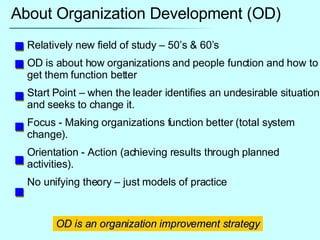
About Organization Development (OD) Relatively new field of study – 50’s & 60’s OD is about how organizations and people function and how to get them function better Start Point – when the leader identifies an undesirable situation and seeks to change it. Focus - Making organizations function better (total system change). Orientation - Action (achieving results through planned activities). No unifying theory – just models of practice OD is an organization improvement strategy
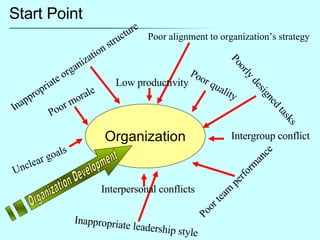
Poor morale Unclear goals Poor quality Poor team performance Intergroup conflict Organization Poorly designed tasks Inappropriate leadership style Interpersonal conflicts Low productivity Poor alignment to organization’s strategy Start Point Inappropriate organization structure Organization Development
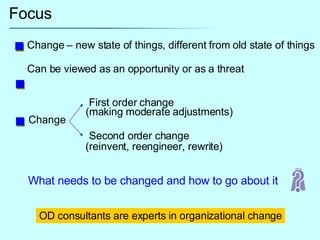
Focus Change – new state of things, different from old state of things Can be viewed as an opportunity or as a threat Change First order change Second order change (making moderate adjustments) (reinvent, reengineer, rewrite) OD consultants are experts in organizational change What needs to be changed and how to go about it
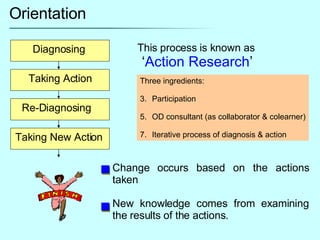
Orientation Diagnosing Taking Action Re-Diagnosing Taking New Action This process is known as  ‘ Action Research ’ Change occurs based on the actions taken  New knowledge comes from examining the results of the actions. Three ingredients: Participation OD consultant (as collaborator & colearner) Iterative process of diagnosis & action
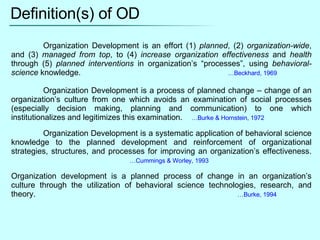
Definition(s) of OD Organization Development is an effort (1)  planned , (2)  organization-wide , and (3)  managed from top , to (4)  increase organization effectiveness  and  health  through (5)  planned interventions  in organization’s “processes”, using  behavioral-science  knowledge.   …Beckhard, 1969 Organization Development is a process of planned change – change of an organization’s culture from one which avoids an examination of social processes (especially decision making, planning and communication) to one which institutionalizes and legitimizes this examination.  …Burke & Hornstein, 1972 Organization Development is a systematic application of behavioral science knowledge to the planned development and reinforcement of organizational strategies, structures, and processes for improving an organization’s effectiveness.   …Cummings & Worley, 1993 Organization development is a planned process of change in an organization’s culture through the utilization of behavioral science technologies, research, and theory.    …Burke, 1994
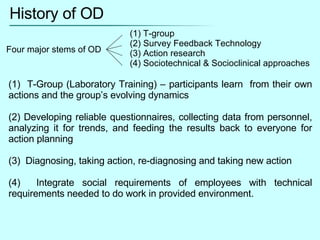
History of OD Four major stems of OD (1) T-group  (2) Survey Feedback Technology (3) Action research (4) Sociotechnical & Socioclinical approaches (1)  T-Group (Laboratory Training) – participants learn  from their own actions and the group’s evolving dynamics  (2) Developing reliable questionnaires, collecting data from personnel, analyzing it for trends, and feeding the results back to everyone for action planning (3)  Diagnosing, taking action, re-diagnosing and taking new action (4)  Integrate social requirements of employees with technical requirements needed to do work in provided environment.
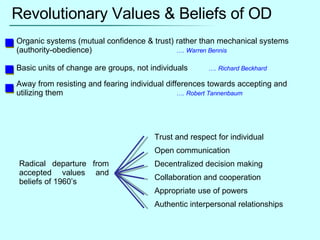
Revolutionary Values & Beliefs of OD Organic systems (mutual confidence & trust) rather than mechanical systems (authority-obedience)  …. Warren Bennis Basic units of change are groups, not individuals  …. Richard Beckhard Away from resisting and fearing individual differences towards accepting and utilizing them …. Robert Tannenbaum Trust and respect for individual Open communication Decentralized decision making Collaboration and cooperation Appropriate use of powers Authentic interpersonal relationships Radical departure from accepted values and beliefs of 1960’s
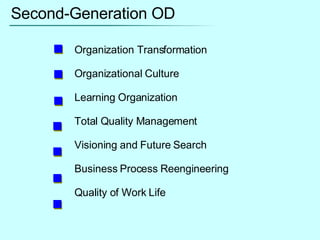
Second-Generation OD Organization Transformation Organizational Culture Learning Organization Total Quality Management Visioning and Future Search Business Process Reengineering Quality of Work Life
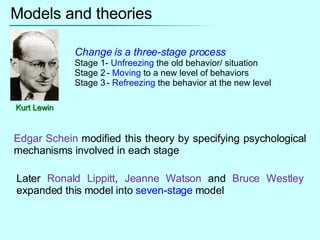
Models and theories Kurt Lewin Change is a three-stage process Stage 1-  Unfreezing  the old behavior/ situation Stage 2 -  Moving  to a new level of behaviors Stage 3 -  Refreezing  the behavior at the new level Edgar Schein  modified this theory by specifying psychological mechanisms involved in each stage Later  Ronald Lippitt ,  Jeanne Watson  and  Bruce Westley  expanded this model into  seven-stage  model
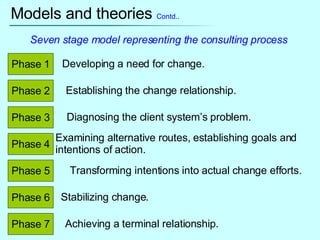
Models and theories  Contd.. Phase 1 Phase 2 Phase 7 Phase 6 Phase 5 Phase 4 Phase 3 Developing a need for change.  Establishing the change relationship. Diagnosing the client system’s problem. Examining alternative routes, establishing goals and intentions of action. Transforming intentions into actual change efforts. Stabilizing change. Achieving a terminal relationship. Seven stage model representing the consulting process
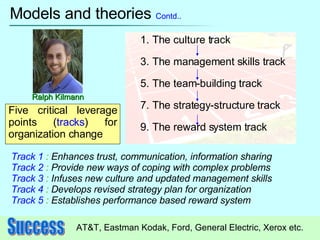
Models and theories  Contd.. Five critical leverage points ( tracks ) for organization change The culture track The management skills track The team-building track The strategy-structure track The reward system track AT&T, Eastman Kodak, Ford, General Electric, Xerox etc. Success Track 1  :  Enhances trust, communication, information sharing Track 2  :  Provide new ways of coping with complex problems Track 3  :  Infuses new culture and updated management skills Track 4  :  Develops revised strategy plan for organization Track 5  :  Establishes performance based reward system Ralph Kilmann
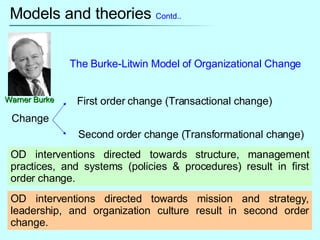
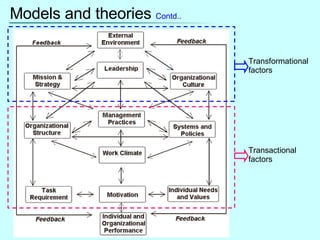
Models and theories  Contd.. Warner Burke The Burke-Litwin Model of Organizational Change Change First order change (Transactional change) Second order change (Transformational change) OD interventions directed towards structure, management practices, and systems (policies & procedures) result in first order change. OD interventions directed towards mission and strategy, leadership, and organization culture result in second order change.
Models and theories  Contd.. Transformational factors Transactional factors
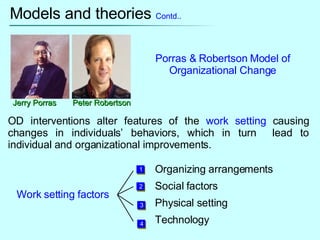
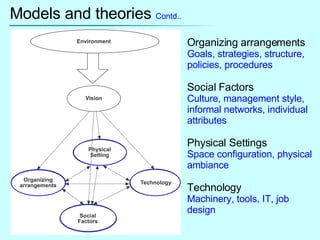
Models and theories  Contd.. Jerry Porras Peter Robertson Porras & Robertson Model of Organizational Change OD interventions alter features of the  work setting  causing changes in individuals’ behaviors, which in turn  lead to individual and organizational improvements. Work setting factors Organizing arrangements Social factors Physical setting Technology 1 2 3 4
Models and theories  Contd.. Organizing arrangements Goals, strategies, structure, policies, procedures Social Factors Culture, management style, informal networks, individual attributes Physical Settings Space configuration, physical ambiance Technology Machinery, tools, IT, job design
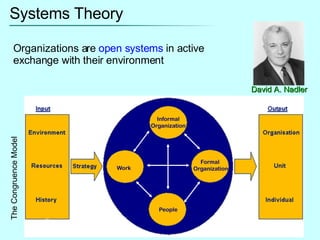
Systems Theory Organizations are  open systems  in active exchange with their environment David A. Nadler The Congruence Model
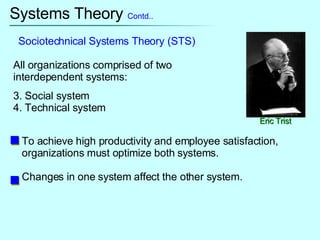
Systems Theory  Contd.. Eric Trist Sociotechnical Systems Theory (STS) All organizations comprised of two interdependent systems: Social system Technical system To achieve high productivity and employee satisfaction, organizations must optimize both systems. Changes in one system affect the other system.
Participation & Empowerment Participation in OD programs is not restricted to elites or top people; it is extended broadly throughout the organization. Increased participation and empowerment have always been central goals and fundamental values of OD. Participation enhances empowerment and empowerment in turn enhances performance. Empowerment is the key to getting people to want to  participate in change .
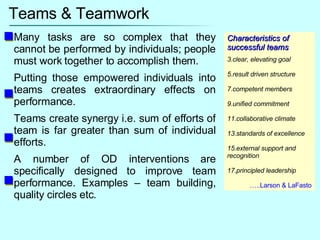
Teams & Teamwork Many tasks are so complex that they cannot be performed by individuals; people must work together to accomplish them. Putting those empowered individuals into teams creates extraordinary effects on performance. Teams create synergy i.e. sum of efforts of team is far greater than sum of individual efforts. A number of OD interventions are specifically designed to improve team performance. Examples – team building, quality circles etc. Characteristics of successful teams clear, elevating goal result driven structure competent members unified commitment collaborative climate standards of excellence external support and recognition principled leadership … ..Larson & LaFasto
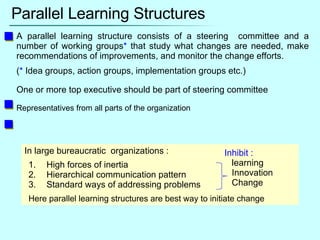
Parallel Learning Structures A parallel learning structure consists of a steering  committee and a number of working groups *  that study what changes are needed, make recommendations of improvements, and monitor the change efforts. ( *  Idea groups, action groups, implementation groups etc.) One or more top executive should be part of steering committee Representatives from all parts of the organization In large bureaucratic  organizations : High forces of inertia Hierarchical communication pattern Standard ways of addressing problems Here parallel learning structures are best way to initiate change   Inhibit :   learning Innovation Change
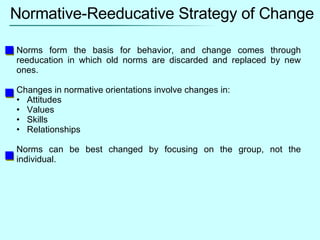
Normative-Reeducative Strategy of Change Norms form the basis for behavior, and change comes through reeducation in which old norms are discarded and replaced by new ones. Changes in normative orientations involve changes in: Attitudes Values Skills Relationships Norms can be best changed by focusing on the group, not the individual.
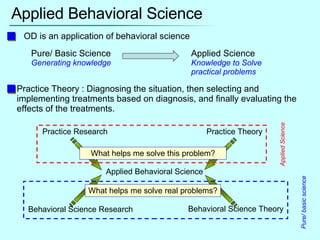
Applied Behavioral Science OD is an application of behavioral science Pure/ Basic Science  Applied Science Generating knowledge   Knowledge to Solve  practical problems Practice Theory : Diagnosing the situation, then selecting and implementing treatments based on diagnosis, and finally evaluating the effects of the treatments. What helps me solve this problem? What helps me solve real problems? Applied Behavioral Science Practice Research Practice Theory Behavioral Science Research Behavioral Science Theory Pure/ basic science Applied Science
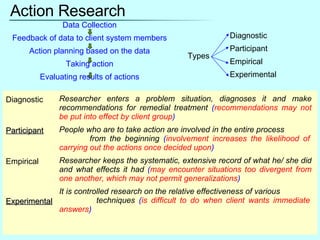
Action Research Types Diagnostic Participant Empirical Experimental Researcher enters a problem situation, diagnoses it and make recommendations for remedial treatment  ( recommendations may not be put into effect by client group ) People who are to take action are involved in the entire process  from the beginning  ( involvement increases the likelihood of carrying out the actions once decided upon ) Researcher keeps the systematic, extensive record of what he/ she did and what effects it had  ( may encounter situations too divergent from one another, which may not permit generalizations )  It is controlled research on the relative effectiveness of various  techniques  ( is difficult to do when client wants immediate answers ) Diagnostic Participant Empirical Experimental Data Collection Feedback of data to client system members Action planning based on the data Taking action Evaluating results of actions
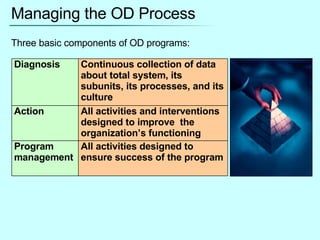
Managing the OD Process Three basic components of OD programs: Diagnosis Continuous collection of data about total system, its subunits, its processes, and its culture Action All activities and interventions designed to improve  the organization’s functioning Program management All activities designed to ensure success of the program
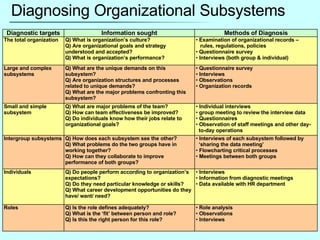
Diagnosing Organizational Subsystems Diagnostic targets Information sought Methods of Diagnosis The total organization Q) What is organization’s culture? Q) Are organizational goals and strategy understood and accepted? Q) What is organization’s performance? Examination of organizational records –    rules, regulations, policies Questionnaire survey Interviews (both group & individual) Large and complex subsystems Q) What are the unique demands on this subsystem? Q) Are organization structures and processes related to unique demands? Q) What are the major problems confronting this subsystem? Questionnaire survey Interviews  Observations Organization records Small and simple subsystem Q) What are major problems of the team? Q) How can team effectiveness be improved? Q) Do individuals know how their jobs relate to organizational goals? Individual interviews group meeting to review the interview data Questionnaires Observation of staff meetings and other day-   to-day operations Intergroup subsystems Q) How does each subsystem see the other? Q) What problems do the two groups have in working together? Q) How can they collaborate to improve performance of both groups? Interviews of each subsystem followed by    ‘sharing the data meeting’ Flowcharting critical processes Meetings between both groups Individuals Q) Do people perform according to organization’s expectations? Q) Do they need particular knowledge or skills? Q) What career development opportunities do they have/ want/ need? Interviews Information from diagnostic meetings Data available with HR department Roles Q) Is the role defines adequately? Q) What is the ‘fit’ between person and role? Q) Is this the right person for this role? Role analysis Observations Interviews
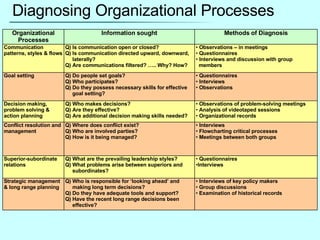
Diagnosing Organizational Processes Organizational Processes Information sought Methods of Diagnosis Communication patterns, styles & flows Q) Is communication open or closed? Q) Is communication directed upward, downward,    laterally? Q) Are communications filtered? ….. Why? How? Observations – in meetings Questionnaires Interviews and discussion with group    members Goal setting Q) Do people set goals? Q) Who participates?  Q) Do they possess necessary skills for effective    goal setting? Questionnaires Interviews  Observations Decision making, problem solving & action planning Q) Who makes decisions? Q) Are they effective? Q) Are additional decision making skills needed? Observations of problem-solving meetings Analysis of videotaped sessions Organizational records Conflict resolution and management Q) Where does conflict exist?  Q) Who are involved parties? Q) How is it being managed? Interviews Flowcharting critical processes Meetings between both groups Superior-subordinate relations Q) What are the prevailing leadership styles? Q) What problems arise between superiors and    subordinates? Questionnaires Interviews Strategic management & long range planning Q) Who is responsible for ‘looking ahead’ and    making long term decisions? Q) Do they have adequate tools and support? Q) Have the recent long range decisions been    effective? Interviews of key policy makers Group discussions Examination of historical records
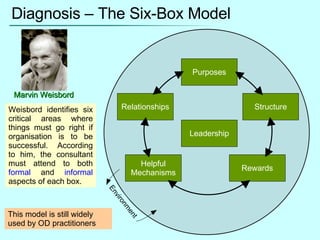
Diagnosis – The Six-Box Model Leadership Purposes Relationships Helpful Mechanisms Rewards Structure Environment Weisbord identifies six critical areas where things must go right if organisation is to be successful. According to him, the consultant must attend to both  formal  and  informal  aspects of each box. This model is still widely used by OD practitioners Marvin Weisbord
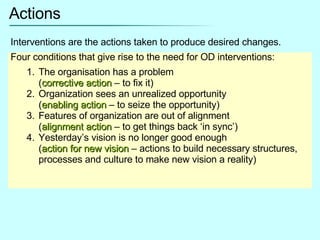
Actions Interventions are the actions taken to produce desired changes. Four conditions that give rise to the need for OD interventions: The organisation has a problem  ( corrective action  – to fix it) Organization sees an unrealized opportunity  ( enabling action  – to seize the opportunity) Features of organization are out of alignment  ( alignment action  – to get things back ‘in sync’) Yesterday’s vision is no longer good enough ( action for new vision  – actions to build necessary structures, processes and culture to make new vision a reality)
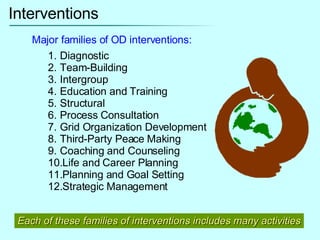
Interventions Major families of OD interventions: Diagnostic  Team-Building Intergroup Education and Training Structural Process Consultation Grid Organization Development Third-Party Peace Making Coaching and Counseling Life and Career Planning Planning and Goal Setting Strategic Management Each of these families of interventions includes many activities
 
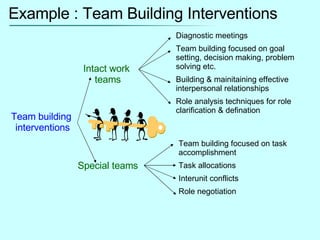
Example : Team Building Interventions Team building  interventions Intact work  teams Special teams Diagnostic meetings Team building focused on goal setting, decision making, problem solving etc. Building & mainitaining effective interpersonal relationships Role analysis techniques for role clarification & defination Team building focused on task accomplishment Task allocations Interunit conflicts Role negotiation
 
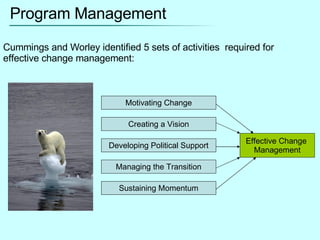
Program Management Cummings and Worley identified 5 sets of activities  required for effective change management: Motivating Change Creating a Vision Developing Political Support Managing the Transition Sustaining Momentum Effective Change  Management
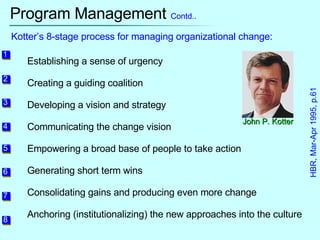
Program Management  Contd.. John P. Kotter Kotter’s 8-stage process for managing organizational change: Establishing a sense of urgency Creating a guiding coalition Developing a vision and strategy Communicating the change vision  Empowering a broad base of people to take action  Generating short term wins  Consolidating gains and producing even more change  Anchoring (institutionalizing) the new approaches into the culture  1 2 3 4 5 6 7 8 HBR, Mar-Apr 1995, p.61
Summary OD can make a difference Good understanding Proper response Adaptability
www.odnetwork.org An international association of professionals engaged in work that makes organizations healthier and more effective  How much do you know about the effects of organizational development on the people affected by the change?  http://www.buzzle.com/editorials/9-13-2006-108634.asp Membership Quiz http://www.orkut.co.in/Main#Community.aspx?cmm=55127430 OD community
 

Organization Development

  • 1.
    Organization Development Presentationby: Aman Arora Student (PhD - HRM) University Business School, Chandigarh, INDIA [email_address]
  • 2.
    About Organization Development(OD) Relatively new field of study – 50’s & 60’s OD is about how organizations and people function and how to get them function better Start Point – when the leader identifies an undesirable situation and seeks to change it. Focus - Making organizations function better (total system change). Orientation - Action (achieving results through planned activities). No unifying theory – just models of practice OD is an organization improvement strategy
  • 3.
    Poor morale Uncleargoals Poor quality Poor team performance Intergroup conflict Organization Poorly designed tasks Inappropriate leadership style Interpersonal conflicts Low productivity Poor alignment to organization’s strategy Start Point Inappropriate organization structure Organization Development
  • 4.
    Focus Change –new state of things, different from old state of things Can be viewed as an opportunity or as a threat Change First order change Second order change (making moderate adjustments) (reinvent, reengineer, rewrite) OD consultants are experts in organizational change What needs to be changed and how to go about it
  • 5.
    Orientation Diagnosing TakingAction Re-Diagnosing Taking New Action This process is known as ‘ Action Research ’ Change occurs based on the actions taken New knowledge comes from examining the results of the actions. Three ingredients: Participation OD consultant (as collaborator & colearner) Iterative process of diagnosis & action
  • 6.
    Definition(s) of ODOrganization Development is an effort (1) planned , (2) organization-wide , and (3) managed from top , to (4) increase organization effectiveness and health through (5) planned interventions in organization’s “processes”, using behavioral-science knowledge. …Beckhard, 1969 Organization Development is a process of planned change – change of an organization’s culture from one which avoids an examination of social processes (especially decision making, planning and communication) to one which institutionalizes and legitimizes this examination. …Burke & Hornstein, 1972 Organization Development is a systematic application of behavioral science knowledge to the planned development and reinforcement of organizational strategies, structures, and processes for improving an organization’s effectiveness. …Cummings & Worley, 1993 Organization development is a planned process of change in an organization’s culture through the utilization of behavioral science technologies, research, and theory. …Burke, 1994
  • 7.
    History of ODFour major stems of OD (1) T-group (2) Survey Feedback Technology (3) Action research (4) Sociotechnical & Socioclinical approaches (1) T-Group (Laboratory Training) – participants learn from their own actions and the group’s evolving dynamics (2) Developing reliable questionnaires, collecting data from personnel, analyzing it for trends, and feeding the results back to everyone for action planning (3) Diagnosing, taking action, re-diagnosing and taking new action (4) Integrate social requirements of employees with technical requirements needed to do work in provided environment.
  • 8.
    Revolutionary Values &Beliefs of OD Organic systems (mutual confidence & trust) rather than mechanical systems (authority-obedience) …. Warren Bennis Basic units of change are groups, not individuals …. Richard Beckhard Away from resisting and fearing individual differences towards accepting and utilizing them …. Robert Tannenbaum Trust and respect for individual Open communication Decentralized decision making Collaboration and cooperation Appropriate use of powers Authentic interpersonal relationships Radical departure from accepted values and beliefs of 1960’s
  • 9.
    Second-Generation OD OrganizationTransformation Organizational Culture Learning Organization Total Quality Management Visioning and Future Search Business Process Reengineering Quality of Work Life
  • 10.
    Models and theoriesKurt Lewin Change is a three-stage process Stage 1- Unfreezing the old behavior/ situation Stage 2 - Moving to a new level of behaviors Stage 3 - Refreezing the behavior at the new level Edgar Schein modified this theory by specifying psychological mechanisms involved in each stage Later Ronald Lippitt , Jeanne Watson and Bruce Westley expanded this model into seven-stage model
  • 11.
    Models and theories Contd.. Phase 1 Phase 2 Phase 7 Phase 6 Phase 5 Phase 4 Phase 3 Developing a need for change. Establishing the change relationship. Diagnosing the client system’s problem. Examining alternative routes, establishing goals and intentions of action. Transforming intentions into actual change efforts. Stabilizing change. Achieving a terminal relationship. Seven stage model representing the consulting process
  • 12.
    Models and theories Contd.. Five critical leverage points ( tracks ) for organization change The culture track The management skills track The team-building track The strategy-structure track The reward system track AT&T, Eastman Kodak, Ford, General Electric, Xerox etc. Success Track 1 : Enhances trust, communication, information sharing Track 2 : Provide new ways of coping with complex problems Track 3 : Infuses new culture and updated management skills Track 4 : Develops revised strategy plan for organization Track 5 : Establishes performance based reward system Ralph Kilmann
  • 13.
    Models and theories Contd.. Warner Burke The Burke-Litwin Model of Organizational Change Change First order change (Transactional change) Second order change (Transformational change) OD interventions directed towards structure, management practices, and systems (policies & procedures) result in first order change. OD interventions directed towards mission and strategy, leadership, and organization culture result in second order change.
  • 14.
    Models and theories Contd.. Transformational factors Transactional factors
  • 15.
    Models and theories Contd.. Jerry Porras Peter Robertson Porras & Robertson Model of Organizational Change OD interventions alter features of the work setting causing changes in individuals’ behaviors, which in turn lead to individual and organizational improvements. Work setting factors Organizing arrangements Social factors Physical setting Technology 1 2 3 4
  • 16.
    Models and theories Contd.. Organizing arrangements Goals, strategies, structure, policies, procedures Social Factors Culture, management style, informal networks, individual attributes Physical Settings Space configuration, physical ambiance Technology Machinery, tools, IT, job design
  • 17.
    Systems Theory Organizationsare open systems in active exchange with their environment David A. Nadler The Congruence Model
  • 18.
    Systems Theory Contd.. Eric Trist Sociotechnical Systems Theory (STS) All organizations comprised of two interdependent systems: Social system Technical system To achieve high productivity and employee satisfaction, organizations must optimize both systems. Changes in one system affect the other system.
  • 19.
    Participation & EmpowermentParticipation in OD programs is not restricted to elites or top people; it is extended broadly throughout the organization. Increased participation and empowerment have always been central goals and fundamental values of OD. Participation enhances empowerment and empowerment in turn enhances performance. Empowerment is the key to getting people to want to participate in change .
  • 20.
    Teams & TeamworkMany tasks are so complex that they cannot be performed by individuals; people must work together to accomplish them. Putting those empowered individuals into teams creates extraordinary effects on performance. Teams create synergy i.e. sum of efforts of team is far greater than sum of individual efforts. A number of OD interventions are specifically designed to improve team performance. Examples – team building, quality circles etc. Characteristics of successful teams clear, elevating goal result driven structure competent members unified commitment collaborative climate standards of excellence external support and recognition principled leadership … ..Larson & LaFasto
  • 21.
    Parallel Learning StructuresA parallel learning structure consists of a steering committee and a number of working groups * that study what changes are needed, make recommendations of improvements, and monitor the change efforts. ( * Idea groups, action groups, implementation groups etc.) One or more top executive should be part of steering committee Representatives from all parts of the organization In large bureaucratic organizations : High forces of inertia Hierarchical communication pattern Standard ways of addressing problems Here parallel learning structures are best way to initiate change Inhibit : learning Innovation Change
  • 22.
    Normative-Reeducative Strategy ofChange Norms form the basis for behavior, and change comes through reeducation in which old norms are discarded and replaced by new ones. Changes in normative orientations involve changes in: Attitudes Values Skills Relationships Norms can be best changed by focusing on the group, not the individual.
  • 23.
    Applied Behavioral ScienceOD is an application of behavioral science Pure/ Basic Science Applied Science Generating knowledge Knowledge to Solve practical problems Practice Theory : Diagnosing the situation, then selecting and implementing treatments based on diagnosis, and finally evaluating the effects of the treatments. What helps me solve this problem? What helps me solve real problems? Applied Behavioral Science Practice Research Practice Theory Behavioral Science Research Behavioral Science Theory Pure/ basic science Applied Science
  • 24.
    Action Research TypesDiagnostic Participant Empirical Experimental Researcher enters a problem situation, diagnoses it and make recommendations for remedial treatment ( recommendations may not be put into effect by client group ) People who are to take action are involved in the entire process from the beginning ( involvement increases the likelihood of carrying out the actions once decided upon ) Researcher keeps the systematic, extensive record of what he/ she did and what effects it had ( may encounter situations too divergent from one another, which may not permit generalizations ) It is controlled research on the relative effectiveness of various techniques ( is difficult to do when client wants immediate answers ) Diagnostic Participant Empirical Experimental Data Collection Feedback of data to client system members Action planning based on the data Taking action Evaluating results of actions
  • 25.
    Managing the ODProcess Three basic components of OD programs: Diagnosis Continuous collection of data about total system, its subunits, its processes, and its culture Action All activities and interventions designed to improve the organization’s functioning Program management All activities designed to ensure success of the program
  • 26.
    Diagnosing Organizational SubsystemsDiagnostic targets Information sought Methods of Diagnosis The total organization Q) What is organization’s culture? Q) Are organizational goals and strategy understood and accepted? Q) What is organization’s performance? Examination of organizational records – rules, regulations, policies Questionnaire survey Interviews (both group & individual) Large and complex subsystems Q) What are the unique demands on this subsystem? Q) Are organization structures and processes related to unique demands? Q) What are the major problems confronting this subsystem? Questionnaire survey Interviews Observations Organization records Small and simple subsystem Q) What are major problems of the team? Q) How can team effectiveness be improved? Q) Do individuals know how their jobs relate to organizational goals? Individual interviews group meeting to review the interview data Questionnaires Observation of staff meetings and other day- to-day operations Intergroup subsystems Q) How does each subsystem see the other? Q) What problems do the two groups have in working together? Q) How can they collaborate to improve performance of both groups? Interviews of each subsystem followed by ‘sharing the data meeting’ Flowcharting critical processes Meetings between both groups Individuals Q) Do people perform according to organization’s expectations? Q) Do they need particular knowledge or skills? Q) What career development opportunities do they have/ want/ need? Interviews Information from diagnostic meetings Data available with HR department Roles Q) Is the role defines adequately? Q) What is the ‘fit’ between person and role? Q) Is this the right person for this role? Role analysis Observations Interviews
  • 27.
    Diagnosing Organizational ProcessesOrganizational Processes Information sought Methods of Diagnosis Communication patterns, styles & flows Q) Is communication open or closed? Q) Is communication directed upward, downward, laterally? Q) Are communications filtered? ….. Why? How? Observations – in meetings Questionnaires Interviews and discussion with group members Goal setting Q) Do people set goals? Q) Who participates? Q) Do they possess necessary skills for effective goal setting? Questionnaires Interviews Observations Decision making, problem solving & action planning Q) Who makes decisions? Q) Are they effective? Q) Are additional decision making skills needed? Observations of problem-solving meetings Analysis of videotaped sessions Organizational records Conflict resolution and management Q) Where does conflict exist? Q) Who are involved parties? Q) How is it being managed? Interviews Flowcharting critical processes Meetings between both groups Superior-subordinate relations Q) What are the prevailing leadership styles? Q) What problems arise between superiors and subordinates? Questionnaires Interviews Strategic management & long range planning Q) Who is responsible for ‘looking ahead’ and making long term decisions? Q) Do they have adequate tools and support? Q) Have the recent long range decisions been effective? Interviews of key policy makers Group discussions Examination of historical records
  • 28.
    Diagnosis – TheSix-Box Model Leadership Purposes Relationships Helpful Mechanisms Rewards Structure Environment Weisbord identifies six critical areas where things must go right if organisation is to be successful. According to him, the consultant must attend to both formal and informal aspects of each box. This model is still widely used by OD practitioners Marvin Weisbord
  • 29.
    Actions Interventions arethe actions taken to produce desired changes. Four conditions that give rise to the need for OD interventions: The organisation has a problem ( corrective action – to fix it) Organization sees an unrealized opportunity ( enabling action – to seize the opportunity) Features of organization are out of alignment ( alignment action – to get things back ‘in sync’) Yesterday’s vision is no longer good enough ( action for new vision – actions to build necessary structures, processes and culture to make new vision a reality)
  • 30.
    Interventions Major familiesof OD interventions: Diagnostic Team-Building Intergroup Education and Training Structural Process Consultation Grid Organization Development Third-Party Peace Making Coaching and Counseling Life and Career Planning Planning and Goal Setting Strategic Management Each of these families of interventions includes many activities
  • 31.
  • 32.
    Example : TeamBuilding Interventions Team building interventions Intact work teams Special teams Diagnostic meetings Team building focused on goal setting, decision making, problem solving etc. Building & mainitaining effective interpersonal relationships Role analysis techniques for role clarification & defination Team building focused on task accomplishment Task allocations Interunit conflicts Role negotiation
  • 33.
  • 34.
    Program Management Cummingsand Worley identified 5 sets of activities required for effective change management: Motivating Change Creating a Vision Developing Political Support Managing the Transition Sustaining Momentum Effective Change Management
  • 35.
    Program Management Contd.. John P. Kotter Kotter’s 8-stage process for managing organizational change: Establishing a sense of urgency Creating a guiding coalition Developing a vision and strategy Communicating the change vision Empowering a broad base of people to take action Generating short term wins Consolidating gains and producing even more change Anchoring (institutionalizing) the new approaches into the culture 1 2 3 4 5 6 7 8 HBR, Mar-Apr 1995, p.61
  • 36.
    Summary OD canmake a difference Good understanding Proper response Adaptability
  • 37.
    www.odnetwork.org An internationalassociation of professionals engaged in work that makes organizations healthier and more effective How much do you know about the effects of organizational development on the people affected by the change? http://www.buzzle.com/editorials/9-13-2006-108634.asp Membership Quiz http://www.orkut.co.in/Main#Community.aspx?cmm=55127430 OD community
  • 38.