Victor Vroom’s Expectancy
          Theory


                  by
          NORAIN BINTI ZAINAL
              2011210522
  ADM501 – ORGANIZATIONAL BEHAVIOR
                  for
 MISS JULIZAERMA MOHAMAD KHUDZAIRI
QUESTION.
 Use all three components of
 expectancy theory to explain why
 some employees are motivated to
 show up for work during a snowstorm
 whereas others don’t make any effort
 to leave their home.
INTRODUCTION
 Motivation – force that drive a person into
  action
 This model based upon the assumption that
  the man is a rational being & will try to
  maximize his pay off
 Choose the alternative that give the most
  benefit
 Motivation to work is strongly determined by
  – individual perception that a certain type of
  behavior will lead to certain type of outcome
  and his personal preference for the type of
  outcome
OVERVIEW
  Expectancy        Instrumentality        Valence

• “Can I achieve   • “What work        • “How highly do
  the desired        outcomes will       I value work
  level of task      be received as      outcome?”
  performance?”      a result of the
                     performance?”
Expectancy Theory
 The theory assumes that behavior
  results from conscious choices among
  alternatives whose purpose is to
  maximize pleasure and minimize
  pain.
 Key elements:
    ◦ Valence (V)
    ◦ Instrumentality (I)
    ◦ Expectancy (E)
Valence
   The emotional orientation people hold with respect
    to outcomes (rewards).

   Value varies from -1 to +1.

   -1  individual prefers not accomplish an outcome
    compared with achieving it.

   0  individual is unconcerned to the outcome.

   +1  individual has the strong preference to the
    outcome.

     Valence must be +1  for higher motivation.
Valence
   -1  employees feels that the rewards that
    they received are not worthy with their
    efforts to show up for work during a
    snowstorm.


   +1  employees are motivated go to work
    during a snowstorm as they has the high
    inclination to the outcome.
Instrumentality
   The belief that the first level outcome will
    lead to the second level outcome.

   Value varies from 0 to 1.
   High instrumentality rate  employee sees
    that promotions are based on performance.
   Low instrumentality will be made if the
    employee fails to see the relation between
    performance and reward.
Instrumentality
   Employees believed that excellent
    performance will be given a good rewards
     they will be motivated to come to work in
    any conditions


   If employees didn’t see the correlation
    between performance and reward they don’t
    care and not make any effort to leave their
    home.
Expectancy
   The belief that an effort will lead to
    completion of a task.

   Value varies from 0 to 1.

   0  employee sees no possibility that any
    effort will lead to the desired performance.

   1  employee is confident that the task will
    be completed.
Expectancy
   Don’t make any effort to leave home during
    snowstorm  employee believed that he
    will not achieved the desired performance
    even he come to work.

   Motivated to show up for work  with the
    right amount of effort he is confident the
    task will be completed.
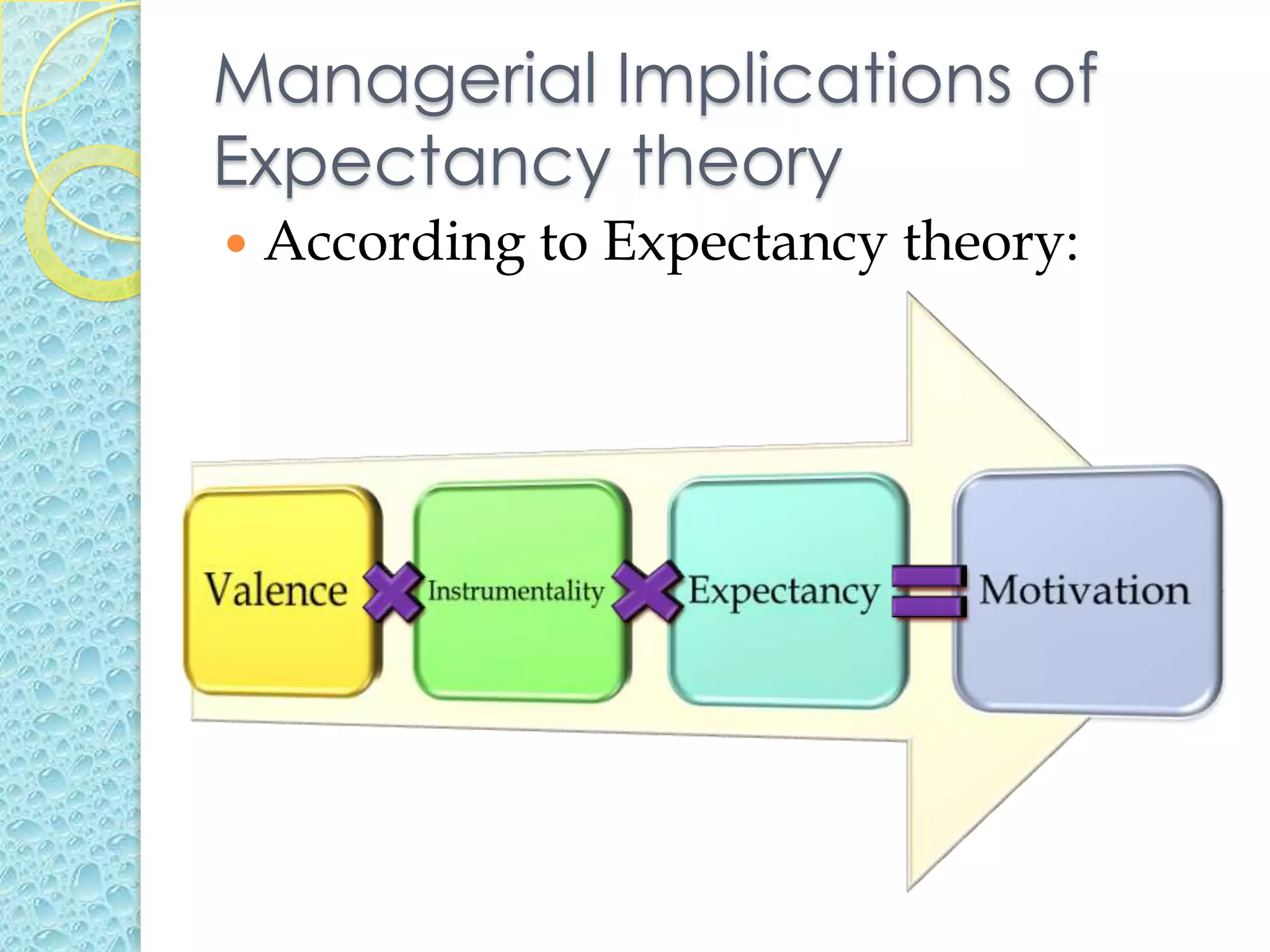
Managerial Implications of
Expectancy theory
   According to Expectancy theory:
Influence of components in
      Expectancy theory of motivation
Valenc Instrume Expect Motiva
e      ntality ancy    tion
High         High     High    High
Low          High     High
                             Moderat
                             e
High         Low      High
                             Moderat
                             e
Low          Low      High     Low
CONCLUSION
 The Expectancy Theory of Victor
 Vroom deals with motivation and
 management. It assumes that
 behavior result from conscious
 choices among alternative whose
 purpose it is to maximize pleasure and
 minimize pain.
THANK YOU 


      Q&A

Victor vroom’s expectancy theory

  • 1.
    Victor Vroom’s Expectancy Theory by NORAIN BINTI ZAINAL 2011210522 ADM501 – ORGANIZATIONAL BEHAVIOR for MISS JULIZAERMA MOHAMAD KHUDZAIRI
  • 2.
    QUESTION. Use allthree components of expectancy theory to explain why some employees are motivated to show up for work during a snowstorm whereas others don’t make any effort to leave their home.
  • 3.
    INTRODUCTION  Motivation –force that drive a person into action  This model based upon the assumption that the man is a rational being & will try to maximize his pay off  Choose the alternative that give the most benefit  Motivation to work is strongly determined by – individual perception that a certain type of behavior will lead to certain type of outcome and his personal preference for the type of outcome
  • 4.
    OVERVIEW Expectancy Instrumentality Valence • “Can I achieve • “What work • “How highly do the desired outcomes will I value work level of task be received as outcome?” performance?” a result of the performance?”
  • 5.
    Expectancy Theory  Thetheory assumes that behavior results from conscious choices among alternatives whose purpose is to maximize pleasure and minimize pain.  Key elements: ◦ Valence (V) ◦ Instrumentality (I) ◦ Expectancy (E)
  • 6.
    Valence  The emotional orientation people hold with respect to outcomes (rewards).  Value varies from -1 to +1.  -1  individual prefers not accomplish an outcome compared with achieving it.  0  individual is unconcerned to the outcome.  +1  individual has the strong preference to the outcome.  Valence must be +1  for higher motivation.
  • 7.
    Valence  -1  employees feels that the rewards that they received are not worthy with their efforts to show up for work during a snowstorm.  +1  employees are motivated go to work during a snowstorm as they has the high inclination to the outcome.
  • 8.
    Instrumentality  The belief that the first level outcome will lead to the second level outcome.  Value varies from 0 to 1.  High instrumentality rate  employee sees that promotions are based on performance.  Low instrumentality will be made if the employee fails to see the relation between performance and reward.
  • 9.
    Instrumentality  Employees believed that excellent performance will be given a good rewards  they will be motivated to come to work in any conditions  If employees didn’t see the correlation between performance and reward they don’t care and not make any effort to leave their home.
  • 10.
    Expectancy  The belief that an effort will lead to completion of a task.  Value varies from 0 to 1.  0  employee sees no possibility that any effort will lead to the desired performance.  1  employee is confident that the task will be completed.
  • 11.
    Expectancy  Don’t make any effort to leave home during snowstorm  employee believed that he will not achieved the desired performance even he come to work.  Motivated to show up for work  with the right amount of effort he is confident the task will be completed.
  • 12.
    Managerial Implications of Expectancytheory  According to Expectancy theory:
  • 13.
    Influence of componentsin Expectancy theory of motivation Valenc Instrume Expect Motiva e ntality ancy tion High High High High Low High High Moderat e High Low High Moderat e Low Low High Low
  • 14.
    CONCLUSION The ExpectancyTheory of Victor Vroom deals with motivation and management. It assumes that behavior result from conscious choices among alternative whose purpose it is to maximize pleasure and minimize pain.
  • 15.