INTERNAL COMBUSTION
ENGINES
The Four Stroke Engine
CONTENTS
• Parts and their processes
• The Four Strokes
• Compression Ratio and Displacement
• Torque and Power
• DOHC, SOHC, OHV (Push Rod)
• Turbochargers and Superchargers
ENGINE BLOCK
• The engine block is one of the largest and most
intricate pieces of metal in the car. It houses and links
all the other engine components.
• Engine blocks were once made of iron, but are now
sand mould cast from one piece of lightweight
aluminium alloy for fuel efficiency. Each mould is made
up of sections called cores which fit together to make
the final mould.
• http://www.youtube.com/watch?v=yXVLbzI3xTE
CYLINDER HEAD AND
HEAD GASKET
• The cylinder head sits above the cylinders on top of
the engine block. It closes in the top of the cylinders,
forming the combustion chamber. This joint is sealed
by a head gasket. In most engines, the head also
provides space for the passages that feed air and fuel
to the cylinder, and that allow the exhaust to escape.
The head can also be a place to mount the valves,
spark plugs, and fuel injectors.
Head
Gasket
CRANKSHAFT
• The Crankshaft is a crucial part of the engine system
as it coverts the vertical movement of the pistons into
a turning force. It is connected to the transmission via
the flywheel, which rotates the driveshaft and moves
the car. The pistons are connected to the crankshaft
via connecting rods, whether it is an
inline,‘V’or‘W’shaped engine.
• https://www.youtube.com/watch?v=u2WuMz_styI
PISTONS
• Piston Head- It has a very hard and durable surface as it has to withstand extreme
temperatures and pressures exerted on it by explosions in the combustion chamber.
Also it must not expand too much at high temperatures, or contract at low temperatures.
The piston rings also stop this happening.
• Piston Rings- three rings which wrap around the piston heads. Two of them act as a
gasket to create an airtight seal in the cylinder making the combustion more efficient as
no pressure is lost at any stage and reduce expansion of the piston head at high
temperatures. The third ring holds oil which lubricates the cylinder as the piston moves
up and down.
• Pivot Bushing- hollow cylindrical piece of metal which attaches the piston head to the
piston arm. This must be able to withstand the huge forces applied on it by the vertical
movement of the pistons.
• Connecting Rod- an arm connected to the piston head and the crankshaft, which moves
the piston up and down. An oil thrower is attached to the piston arm which is used to
disperse oil inside the crank case, maintaining lubrication throughout the system.
SPARK PLUGS
• Spark Plugs are responsible for igniting the pressurised
air/fuel mixture when it is fully compressed in the
cylinder, at the top of the piston’s stroke. This causes an
explosion which drives the piston back down rotating the
Crankshaft.
• Spark Plugs are a common fault in the working of the
combustion engine, but are often easily replaceable, as
are the electrical leads that connect them to the electrical
supply.
• https://www.youtube.com/watch?NR=1&v=aEjddrcX03s&
feature=fvwp
FUEL INJECTORS• Multipoint Port- the fuel injector is mounted before the intake valve on the intake
manifold, and after the throttle body. As air comes down the intake manifold, fuel
is injected and the valve opens, and a mixture of the air and fuel is drawn into the
cylinder. If this system is used there would be one fuel injector per cylinder. This
system provides even fuel distribution over the cylinders.
• Direct Injection- Petrol: Wall Guided- Petrol is injected from the wall of the
cylinder onto the piston head. The Piston Head is shaped in a way that means
the petrol is reflected off the surface and circulated around the cylinder before
the compression stroke.
• Direct Injection- Petrol: Spray Guided- The fuel is injected from the top of the
cylinder and the shape of the injector means that the fuel spreads around the
cylinder and the piston can be flat headed. The advantages of these two systems
are that fuel can be injected when the intake is closed (after ignition and
efficiency and/or performance can be increased.
• Direct Injection- Diesel: Similar to wall guided petrol injection, the shape of the
cylinder head is altered so that the air inside the cylinder is turbulent as the
piston moves up and down in the cylinder meaning the fuel is mixed more
efficiently with the air. This also means that the diesel is injected at extremely
high pressure.
INTAKE AND EXHAUST
VALVES• Intake and exhaust valves work together to put clean air from the
air intakes into the cylinders- along with the fuel- and remove
exhaust fumes after the compression stroke and ignition of the fuel-
air mixture.
• Older cars usually have one exhaust valve and one intake valve
per cylinder, more modern cars sometimes have two intake valves
and one larger exhaust valve.
• Most modern cars have two intake valves and two exhaust valves,
as this increases performance and efficiency. The camshaft is
crucial to the working of the valves, as it opens and closes the
valve at the right moment to ensure the engine breathes correctly.
There are three main systems for this process to be carried out,
DOHC, SOHC and OHV.
THE CAMSHAFT
• The camshaft is one the most important components in an engine, it
decides how the engine is going to breathe- it must be made very
accurately to work correctly. If it does not work as it should, neither
will the engine, so the design and manufacture of a camshaft is
meticulously planned and executed with extreme precision-
http://www.youtube.com/watch?v=sYO0Yp4Ag5g
• The camshaft is CNC milled and lathed out of a billet of steel. Lobes
are formed by removing material from the billet. These are very
important; they decide when to open the valves, how long to keep
them open for, how far to open them and the overlap between
exhaust and intake valves.
• The camshaft and lobes dictate the engines behaviour: if you want
more horsepower, less horsepower, more or less torque, or better
fuel economy, all these characteristics can be changed by the
camshaft lobes, and all the processes dictated by the camshaft must
happen at exactly the right time, which is why camshafts have timing
TIMING CHAIN/BELT
• The Timing Chain is connected to both the crankshaft and the
camshaft. As the crankshaft turns, the belt turns, which turns the
camshaft- or camshafts if using DOHC- which opens and closes the
valves at exactly the right moment to deliver air or remove exhaust
fumes, in time with the movement of the pistons. If the timing is off
the engine will malfunction.
• There are two abbreviations used when referring to engine timing:
• TDC- Top dead centre
• BDC- Bottoms dead centre
• This refers to the position of the crankshaft, and hence the position
of the piston within the cylinder; TDC is when the piston is at the
highest point in its stroke, BDC is when it is at its lowest point in its
stroke.
THE FOUR STROKES
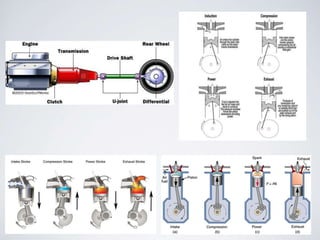
• Stroke One/ The Intake Stroke- The piston moves down on its first
downward stroke and the intake valve opens, allowing a mixture of
fuel and air into the combustion chamber.
• Stroke Two/ The Compression Stroke - The valve closes as the piston
moves back up, compressing the explosive mixture.
• Stroke Three/ The Power Stroke- At the very top of the stroke, the
spark plug fires and ignites the compressed vapour causing a very
violent explosion as the gas expands rapidly, pushing the piston back
down violently. The mixture is more combustable at high pressure
than normal pressure, hence the compression stroke.
• Stroke Four/ The Exhaust Stroke- As the piston begins to rise for the
second time the exhaust valve opens allowing the gas to escape
through the exhaust manifold.
COMPRESSION RATIO
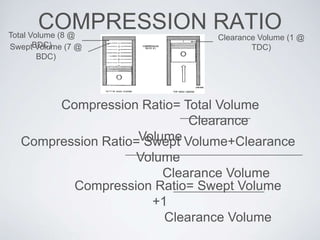
Compression Ratio= Total Volume
Clearance
Volume
Total Volume (8 @
BDC)
Clearance Volume (1 @
TDC)Swept Volume (7 @
BDC)
Compression Ratio= Swept Volume+Clearance
Volume
Clearance Volume
Compression Ratio= Swept Volume
+1
Clearance Volume
DISPLACEMENT
• To calculate the displacement of one cylinder use :
• Displacement= Bore xπx Stroke Length
• Bore is the diameter of the cylinder, stroke length is the
swept volume of the cylinder, the volume the piston takes
up when it goes from BDC to TDC. This is the total
volume minus the clearance volume.
• Then times the displacement of one cylinder by the total
number of cylinder to find the total displacement of the
engine.
TORQUE
• Torque is a twisting force, like a moment. In terms of an engine, torque is an indication of the
average twisting force available at the crankshaft. It is an average value, because the torque
available is different at different revolutions per minute (RPM.) Because of this often included in
a car or motorbike’s documentation is the maximum torque available and at what RPM this
occurs.
• Torque is measured in units of Nm. It is possible to measure the torque of an engine by
attaching a device to the flywheel while the engine is running (out of the car,) but a
dynamometer is a more practical and common way of measuring a cars torque.
• Maximum torque is usually achieved at medium RPM because this is when the cylinder is
receiving the largest charge of the air/fuel mix, exerting the greatest force on the piston and
greatest twisting force on the crankshaft.
• There is also differentiating torque at different points of the power stroke; at the start,
immediately after the ignition of the mixture, the force exerted on the piston is greatest because
the compressed gas is expanding most rapidly at this point. As the piston moves further down
its stroke, the mixture is exploding less violently, meaning the force exerted on the piston
reduces. Another factor affecting the torque during the power stroke is the angle at which the
connecting rods meet the crankshaft. Just after TDC, and just before BDC is when it is most
difficult to turn the crankshaft. The crankshaft is easiest to turn when the angle between the
centre line (imagine a line going down the centre of the piston, while you are facing the
crankshaft end on) and the point at which the connecting rod meets the crankshaft is 90˚. See
the diagram on the next slide for a simpler explanation.
The most affective point at which the force is
transferred to the crankshaft is when this angle is 90˚
Engine data for a Mercedes
Actros commercial vehicle
POWER
• The power of an engine is the work it does over a period of time. There
are different units used to measure an engine’s power and a car’s
power. Horse Power is the amount of power at the crankshaft, Brake
Horse Power is the amount of power available at the tyres, which is
significantly less because energy is wasted in the transmission and
drivetrain.
• There is another unit for Horsepower, originating in Germany, PS. This
is an abbreviation for Horsepower in German, where 1PS=0.986 HP.
One Horsepower is equal to 33,000 ft.lbs per minute, because when
horses were the most common source of power it was calculated that
one horse could move 33,000lbs one foot in a minute.
• The equation for power is: Horsepower = (RPM x Torque)/5252
or Horsepower = (Torque x RPM x 2π)33,000
• Power and torque are always equal at 5252 RPM
• Torque is work done and power is work done over time so an engine
DOHC, SOHC, OHV (Push
rod)
OHV (Push Rod)- In a ‘V’ shaped engine the camshaft would sit at the bottom
of the ‘V’ between the two cylinder blocks. The lobes of the cam would push
against a push rod that is connected to a rocker arm at the top of the cylinder
block. A valve would also be attached to this rocker arm which would move up
and down as the push rod does, opening and closing the valve. There is a
spring between the rocker arm and the body of the cylinder block around the
valve, which forces the valve back up when the pressure from the cam is
released. One advantage of OHV is that is a very compact system, however it
limits the number of valves per cylinder to two which is in-efficient. It is possible
to have four valves per cylinder with an OHV system but this is rare. OHV is a
less complicated valve system and is therefore cheaper to produce.
Rocker arm
Valve
Cam lobe
Push rod
Cylinder
Camshaft
Cylinde
r
Rocker
Arm
Push
rod
TOP VIEW
(V6)
Front
SOHC (Single Overhead Cam)- With this set up the camshaft, rocker arm
and valves are all positioned above the cylinder. SOHC involves one
camshaft per row of cylinders controlling two, three or four valves per
cylinder; the exhaust and intake valves. Again, the valves are fixed onto a
rocker arm, which is pushed up by the camshaft, pushing the valve down
into the cylinder, allowing clean air into the combustion chamber then
exhaust gases out of the cylinder. Advantages of SOHC are that there
are less inertia forces created by the movement of the components as
they are smaller and are moving in a smaller area and they are more
efficient because they can have more valves per cylinder.
DOHC, SOHC, OHV (Push
rod)
Camsha
ft
Cam
lobe
Exhaust
ValveIntake
Valve
Rocker
arm
Piston
Top View (Straight
4)
Camshaft
Rocker
Arm
DOHC, SOHC, OHV (Push
rod)DOHC (Dual Overhead Cam)- DOHC is different to both
SOHC and OHV in the way that it does not involve a rocker
arm. Instead the intake valves have their own camshaft and
the exhaust valves have their own camshaft. This set up
brings better performance, higher RPMs but also lower fuel
consumption which makes it the most popular choice for
production and motorsport cars. Camsha
ft
Intake
Valve
Exhaust
Valve
Top
View
Valv
e
Camshaf
t
Pushro
d
DOHC
Timing set ups
for
OHV and DOHC
SOHC
FORCED INDUCTION
Turbochargers and Superchargers
The purpose of forced induction is to increase the amount of air going into the
combustion chamber before it is in the cylinder, so it expands at a greater force and
exerts more pressure on the pistons. These two contraptions change a ‘Naturally
Aspirated’ engine into a ‘Forced Induction’engine. The concept of turbochargers and
superchargers is the same, but they do their jobs in different ways.
Turbocharger- Exhaust gases from the combustion chamber are feed down pipes into
one half of a double sided turbine; this is the turbocharger. The exhaust gases spin the
turbine, which is connected to another turbine by a shaft, so in turn that starts to spin.
This forces in air from outside and compresses it. This compressed air which will go into
the engine is called boost. As the air is compressed it heats up, so it must go through an
intercooler. This is a water or air based section of coils which conduct heat from the air,
cooling it down. The cool air then travels through the intake manifold and into the
combustion chamber.
Waste-gates- This is a device on the turbocharger that sets a limit on the pressure the
the primary turbine can generate. When it senses that the desired pressure has been
reached it opens allowing the exhaust gases to flow out through the exhaust pipe.
Blow off Valve- This is similar to the waste gate but it is positioned in the intake pipes
leading into the combustion chamber. If the pressure in these pipes reaches a certain
FORCED INDUCTION
Turbochargers and Superchargers
Roots Supercharger- A supercharger is a positive displacement pump. It does not
compress air like a turbocharger does. The compression of the air happens in the
intake manifold, the supercharger just increases the speed at which the air moves
into the manifold.
Air is pulled into the supercharger from the intake at the top, and pulled around
the outside of the casing by the rotating fans. In this case the fans have three lobes
but it is possible to get superchargers with two-lobed fans. The air is trapped between
the fans and the wall of the case like a revolving door, and is then forced out of the
chamber when the teeth come together at the end of the revolution. This air then
flows very quickly towards the intake manifold where it is compressed before entering
the combustion chamber. One of the fan shafts is connected to a pulley that is
connected to part of the engine. This shaft has a cog on it which links in with a cog on
the shaft of the other fan, so they spin in unison.
Supercharger V
Turbocharger
Supercharger
• Higher power band than a turbo- create high amounts of boost at high and low RPM which means
they work well in extreme power situations
• Spool up immediately because they are connected to the engines crank pulley
• They involve less parts and modification so they are easier to install and tune
• There is no possibility of back flow of the air
• They do not get as hot as turbos or surge like a turbocharger can
• They do not create as much boost as turbochargers which reduces the chances of the engine
exploding so they are much safer
• They have a negative effect on the engine output because they take energy from the crankshaft to
work
• They are less fuel efficient than turbochargers for the same reason
Turbocharger
• Spin much faster; up to 150,000 RPM and so they make more boost and more horsepower
• They are more efficient because they utilise energy from the exhaust gases
• They are quieter because they act as a silencer, apart from the whistling from the blow off valve
• They require an oil line from the engine
• They get incredibly hot because of the heat of the exhaust gases and so require intercoolers just
to produce moderate levels of boost
• They can spike or surge to huge levels of boost which can lead to engine detonation
• They can run in reverse if the pressure from the exhaust gases is reduced which causes massive
amounts of turbo lag and can damage the turbocharger
• There are lots of components and necessary modifications which makes them hard to install and
tune
Thank you for
reading
Any questions or suggestions please contact
me on
adamkeir97@gmail.com

Internal Combustion Engine

  • 1.
  • 2.
    CONTENTS • Parts andtheir processes • The Four Strokes • Compression Ratio and Displacement • Torque and Power • DOHC, SOHC, OHV (Push Rod) • Turbochargers and Superchargers
  • 3.
    ENGINE BLOCK • Theengine block is one of the largest and most intricate pieces of metal in the car. It houses and links all the other engine components. • Engine blocks were once made of iron, but are now sand mould cast from one piece of lightweight aluminium alloy for fuel efficiency. Each mould is made up of sections called cores which fit together to make the final mould. • http://www.youtube.com/watch?v=yXVLbzI3xTE
  • 5.
    CYLINDER HEAD AND HEADGASKET • The cylinder head sits above the cylinders on top of the engine block. It closes in the top of the cylinders, forming the combustion chamber. This joint is sealed by a head gasket. In most engines, the head also provides space for the passages that feed air and fuel to the cylinder, and that allow the exhaust to escape. The head can also be a place to mount the valves, spark plugs, and fuel injectors.
  • 6.
  • 7.
    CRANKSHAFT • The Crankshaftis a crucial part of the engine system as it coverts the vertical movement of the pistons into a turning force. It is connected to the transmission via the flywheel, which rotates the driveshaft and moves the car. The pistons are connected to the crankshaft via connecting rods, whether it is an inline,‘V’or‘W’shaped engine. • https://www.youtube.com/watch?v=u2WuMz_styI
  • 9.
    PISTONS • Piston Head-It has a very hard and durable surface as it has to withstand extreme temperatures and pressures exerted on it by explosions in the combustion chamber. Also it must not expand too much at high temperatures, or contract at low temperatures. The piston rings also stop this happening. • Piston Rings- three rings which wrap around the piston heads. Two of them act as a gasket to create an airtight seal in the cylinder making the combustion more efficient as no pressure is lost at any stage and reduce expansion of the piston head at high temperatures. The third ring holds oil which lubricates the cylinder as the piston moves up and down. • Pivot Bushing- hollow cylindrical piece of metal which attaches the piston head to the piston arm. This must be able to withstand the huge forces applied on it by the vertical movement of the pistons. • Connecting Rod- an arm connected to the piston head and the crankshaft, which moves the piston up and down. An oil thrower is attached to the piston arm which is used to disperse oil inside the crank case, maintaining lubrication throughout the system.
  • 11.
    SPARK PLUGS • SparkPlugs are responsible for igniting the pressurised air/fuel mixture when it is fully compressed in the cylinder, at the top of the piston’s stroke. This causes an explosion which drives the piston back down rotating the Crankshaft. • Spark Plugs are a common fault in the working of the combustion engine, but are often easily replaceable, as are the electrical leads that connect them to the electrical supply. • https://www.youtube.com/watch?NR=1&v=aEjddrcX03s& feature=fvwp
  • 13.
    FUEL INJECTORS• MultipointPort- the fuel injector is mounted before the intake valve on the intake manifold, and after the throttle body. As air comes down the intake manifold, fuel is injected and the valve opens, and a mixture of the air and fuel is drawn into the cylinder. If this system is used there would be one fuel injector per cylinder. This system provides even fuel distribution over the cylinders. • Direct Injection- Petrol: Wall Guided- Petrol is injected from the wall of the cylinder onto the piston head. The Piston Head is shaped in a way that means the petrol is reflected off the surface and circulated around the cylinder before the compression stroke. • Direct Injection- Petrol: Spray Guided- The fuel is injected from the top of the cylinder and the shape of the injector means that the fuel spreads around the cylinder and the piston can be flat headed. The advantages of these two systems are that fuel can be injected when the intake is closed (after ignition and efficiency and/or performance can be increased. • Direct Injection- Diesel: Similar to wall guided petrol injection, the shape of the cylinder head is altered so that the air inside the cylinder is turbulent as the piston moves up and down in the cylinder meaning the fuel is mixed more efficiently with the air. This also means that the diesel is injected at extremely high pressure.
  • 15.
    INTAKE AND EXHAUST VALVES•Intake and exhaust valves work together to put clean air from the air intakes into the cylinders- along with the fuel- and remove exhaust fumes after the compression stroke and ignition of the fuel- air mixture. • Older cars usually have one exhaust valve and one intake valve per cylinder, more modern cars sometimes have two intake valves and one larger exhaust valve. • Most modern cars have two intake valves and two exhaust valves, as this increases performance and efficiency. The camshaft is crucial to the working of the valves, as it opens and closes the valve at the right moment to ensure the engine breathes correctly. There are three main systems for this process to be carried out, DOHC, SOHC and OHV.
  • 17.
    THE CAMSHAFT • Thecamshaft is one the most important components in an engine, it decides how the engine is going to breathe- it must be made very accurately to work correctly. If it does not work as it should, neither will the engine, so the design and manufacture of a camshaft is meticulously planned and executed with extreme precision- http://www.youtube.com/watch?v=sYO0Yp4Ag5g • The camshaft is CNC milled and lathed out of a billet of steel. Lobes are formed by removing material from the billet. These are very important; they decide when to open the valves, how long to keep them open for, how far to open them and the overlap between exhaust and intake valves. • The camshaft and lobes dictate the engines behaviour: if you want more horsepower, less horsepower, more or less torque, or better fuel economy, all these characteristics can be changed by the camshaft lobes, and all the processes dictated by the camshaft must happen at exactly the right time, which is why camshafts have timing
  • 19.
    TIMING CHAIN/BELT • TheTiming Chain is connected to both the crankshaft and the camshaft. As the crankshaft turns, the belt turns, which turns the camshaft- or camshafts if using DOHC- which opens and closes the valves at exactly the right moment to deliver air or remove exhaust fumes, in time with the movement of the pistons. If the timing is off the engine will malfunction. • There are two abbreviations used when referring to engine timing: • TDC- Top dead centre • BDC- Bottoms dead centre • This refers to the position of the crankshaft, and hence the position of the piston within the cylinder; TDC is when the piston is at the highest point in its stroke, BDC is when it is at its lowest point in its stroke.
  • 21.
    THE FOUR STROKES •Stroke One/ The Intake Stroke- The piston moves down on its first downward stroke and the intake valve opens, allowing a mixture of fuel and air into the combustion chamber. • Stroke Two/ The Compression Stroke - The valve closes as the piston moves back up, compressing the explosive mixture. • Stroke Three/ The Power Stroke- At the very top of the stroke, the spark plug fires and ignites the compressed vapour causing a very violent explosion as the gas expands rapidly, pushing the piston back down violently. The mixture is more combustable at high pressure than normal pressure, hence the compression stroke. • Stroke Four/ The Exhaust Stroke- As the piston begins to rise for the second time the exhaust valve opens allowing the gas to escape through the exhaust manifold.
  • 23.
    COMPRESSION RATIO Compression Ratio=Total Volume Clearance Volume Total Volume (8 @ BDC) Clearance Volume (1 @ TDC)Swept Volume (7 @ BDC) Compression Ratio= Swept Volume+Clearance Volume Clearance Volume Compression Ratio= Swept Volume +1 Clearance Volume
  • 24.
    DISPLACEMENT • To calculatethe displacement of one cylinder use : • Displacement= Bore xπx Stroke Length • Bore is the diameter of the cylinder, stroke length is the swept volume of the cylinder, the volume the piston takes up when it goes from BDC to TDC. This is the total volume minus the clearance volume. • Then times the displacement of one cylinder by the total number of cylinder to find the total displacement of the engine.
  • 25.
    TORQUE • Torque isa twisting force, like a moment. In terms of an engine, torque is an indication of the average twisting force available at the crankshaft. It is an average value, because the torque available is different at different revolutions per minute (RPM.) Because of this often included in a car or motorbike’s documentation is the maximum torque available and at what RPM this occurs. • Torque is measured in units of Nm. It is possible to measure the torque of an engine by attaching a device to the flywheel while the engine is running (out of the car,) but a dynamometer is a more practical and common way of measuring a cars torque. • Maximum torque is usually achieved at medium RPM because this is when the cylinder is receiving the largest charge of the air/fuel mix, exerting the greatest force on the piston and greatest twisting force on the crankshaft. • There is also differentiating torque at different points of the power stroke; at the start, immediately after the ignition of the mixture, the force exerted on the piston is greatest because the compressed gas is expanding most rapidly at this point. As the piston moves further down its stroke, the mixture is exploding less violently, meaning the force exerted on the piston reduces. Another factor affecting the torque during the power stroke is the angle at which the connecting rods meet the crankshaft. Just after TDC, and just before BDC is when it is most difficult to turn the crankshaft. The crankshaft is easiest to turn when the angle between the centre line (imagine a line going down the centre of the piston, while you are facing the crankshaft end on) and the point at which the connecting rod meets the crankshaft is 90˚. See the diagram on the next slide for a simpler explanation.
  • 26.
    The most affectivepoint at which the force is transferred to the crankshaft is when this angle is 90˚ Engine data for a Mercedes Actros commercial vehicle
  • 27.
    POWER • The powerof an engine is the work it does over a period of time. There are different units used to measure an engine’s power and a car’s power. Horse Power is the amount of power at the crankshaft, Brake Horse Power is the amount of power available at the tyres, which is significantly less because energy is wasted in the transmission and drivetrain. • There is another unit for Horsepower, originating in Germany, PS. This is an abbreviation for Horsepower in German, where 1PS=0.986 HP. One Horsepower is equal to 33,000 ft.lbs per minute, because when horses were the most common source of power it was calculated that one horse could move 33,000lbs one foot in a minute. • The equation for power is: Horsepower = (RPM x Torque)/5252 or Horsepower = (Torque x RPM x 2π)33,000 • Power and torque are always equal at 5252 RPM • Torque is work done and power is work done over time so an engine
  • 28.
    DOHC, SOHC, OHV(Push rod) OHV (Push Rod)- In a ‘V’ shaped engine the camshaft would sit at the bottom of the ‘V’ between the two cylinder blocks. The lobes of the cam would push against a push rod that is connected to a rocker arm at the top of the cylinder block. A valve would also be attached to this rocker arm which would move up and down as the push rod does, opening and closing the valve. There is a spring between the rocker arm and the body of the cylinder block around the valve, which forces the valve back up when the pressure from the cam is released. One advantage of OHV is that is a very compact system, however it limits the number of valves per cylinder to two which is in-efficient. It is possible to have four valves per cylinder with an OHV system but this is rare. OHV is a less complicated valve system and is therefore cheaper to produce. Rocker arm Valve Cam lobe Push rod Cylinder Camshaft Cylinde r Rocker Arm Push rod TOP VIEW (V6) Front
  • 29.
    SOHC (Single OverheadCam)- With this set up the camshaft, rocker arm and valves are all positioned above the cylinder. SOHC involves one camshaft per row of cylinders controlling two, three or four valves per cylinder; the exhaust and intake valves. Again, the valves are fixed onto a rocker arm, which is pushed up by the camshaft, pushing the valve down into the cylinder, allowing clean air into the combustion chamber then exhaust gases out of the cylinder. Advantages of SOHC are that there are less inertia forces created by the movement of the components as they are smaller and are moving in a smaller area and they are more efficient because they can have more valves per cylinder. DOHC, SOHC, OHV (Push rod) Camsha ft Cam lobe Exhaust ValveIntake Valve Rocker arm Piston Top View (Straight 4) Camshaft Rocker Arm
  • 30.
    DOHC, SOHC, OHV(Push rod)DOHC (Dual Overhead Cam)- DOHC is different to both SOHC and OHV in the way that it does not involve a rocker arm. Instead the intake valves have their own camshaft and the exhaust valves have their own camshaft. This set up brings better performance, higher RPMs but also lower fuel consumption which makes it the most popular choice for production and motorsport cars. Camsha ft Intake Valve Exhaust Valve Top View Valv e Camshaf t
  • 31.
  • 32.
    FORCED INDUCTION Turbochargers andSuperchargers The purpose of forced induction is to increase the amount of air going into the combustion chamber before it is in the cylinder, so it expands at a greater force and exerts more pressure on the pistons. These two contraptions change a ‘Naturally Aspirated’ engine into a ‘Forced Induction’engine. The concept of turbochargers and superchargers is the same, but they do their jobs in different ways. Turbocharger- Exhaust gases from the combustion chamber are feed down pipes into one half of a double sided turbine; this is the turbocharger. The exhaust gases spin the turbine, which is connected to another turbine by a shaft, so in turn that starts to spin. This forces in air from outside and compresses it. This compressed air which will go into the engine is called boost. As the air is compressed it heats up, so it must go through an intercooler. This is a water or air based section of coils which conduct heat from the air, cooling it down. The cool air then travels through the intake manifold and into the combustion chamber. Waste-gates- This is a device on the turbocharger that sets a limit on the pressure the the primary turbine can generate. When it senses that the desired pressure has been reached it opens allowing the exhaust gases to flow out through the exhaust pipe. Blow off Valve- This is similar to the waste gate but it is positioned in the intake pipes leading into the combustion chamber. If the pressure in these pipes reaches a certain
  • 34.
    FORCED INDUCTION Turbochargers andSuperchargers Roots Supercharger- A supercharger is a positive displacement pump. It does not compress air like a turbocharger does. The compression of the air happens in the intake manifold, the supercharger just increases the speed at which the air moves into the manifold. Air is pulled into the supercharger from the intake at the top, and pulled around the outside of the casing by the rotating fans. In this case the fans have three lobes but it is possible to get superchargers with two-lobed fans. The air is trapped between the fans and the wall of the case like a revolving door, and is then forced out of the chamber when the teeth come together at the end of the revolution. This air then flows very quickly towards the intake manifold where it is compressed before entering the combustion chamber. One of the fan shafts is connected to a pulley that is connected to part of the engine. This shaft has a cog on it which links in with a cog on the shaft of the other fan, so they spin in unison.
  • 35.
    Supercharger V Turbocharger Supercharger • Higherpower band than a turbo- create high amounts of boost at high and low RPM which means they work well in extreme power situations • Spool up immediately because they are connected to the engines crank pulley • They involve less parts and modification so they are easier to install and tune • There is no possibility of back flow of the air • They do not get as hot as turbos or surge like a turbocharger can • They do not create as much boost as turbochargers which reduces the chances of the engine exploding so they are much safer • They have a negative effect on the engine output because they take energy from the crankshaft to work • They are less fuel efficient than turbochargers for the same reason Turbocharger • Spin much faster; up to 150,000 RPM and so they make more boost and more horsepower • They are more efficient because they utilise energy from the exhaust gases • They are quieter because they act as a silencer, apart from the whistling from the blow off valve • They require an oil line from the engine • They get incredibly hot because of the heat of the exhaust gases and so require intercoolers just to produce moderate levels of boost • They can spike or surge to huge levels of boost which can lead to engine detonation • They can run in reverse if the pressure from the exhaust gases is reduced which causes massive amounts of turbo lag and can damage the turbocharger • There are lots of components and necessary modifications which makes them hard to install and tune
  • 36.
    Thank you for reading Anyquestions or suggestions please contact me on adamkeir97@gmail.com