DAMIAN CASTELINO
ELECTRONIC FUEL INJECTION
SYSTEM
1
Contents :
 Introduction to fuel Injection
 Classification
 EFIS overview
 Working
2
Fuel Injection :
Fuel injection is the process of injecting fuel in the air to
provide an air-fuel mixture to the engine.
This supply has to be precisely controlled and accurately
timed to ensure an optimum performance of engine with
maximum possible efficiency.
3
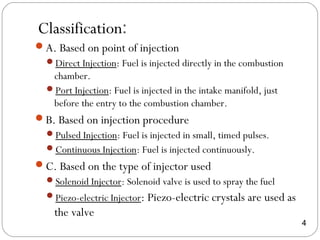
Classification:
A. Based on point of injection
Direct Injection: Fuel is injected directly in the combustion
chamber.
Port Injection: Fuel is injected in the intake manifold, just
before the entry to the combustion chamber.
B. Based on injection procedure
Pulsed Injection: Fuel is injected in small, timed pulses.
Continuous Injection: Fuel is injected continuously.
C. Based on the type of injector used
Solenoid Injector: Solenoid valve is used to spray the fuel
Piezo-electric Injector: Piezo-electric crystals are used as
the valve
4
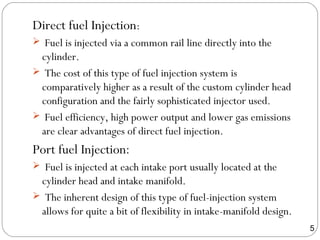
Direct fuel Injection:
 Fuel is injected via a common rail line directly into the
cylinder.
 The cost of this type of fuel injection system is
comparatively higher as a result of the custom cylinder head
configuration and the fairly sophisticated injector used.
 Fuel efficiency, high power output and lower gas emissions
are clear advantages of direct fuel injection.
Port fuel Injection:
 Fuel is injected at each intake port usually located at the
cylinder head and intake manifold.
 The inherent design of this type of fuel-injection system
allows for quite a bit of flexibility in intake-manifold design.
5
Electronic Fuel Injection Overview
6
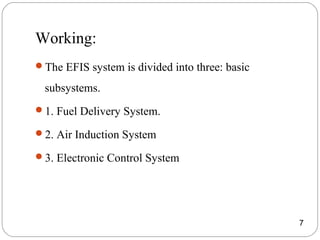
Working:
The EFIS system is divided into three: basic
subsystems.
1. Fuel Delivery System.
2. Air Induction System
3. Electronic Control System
7
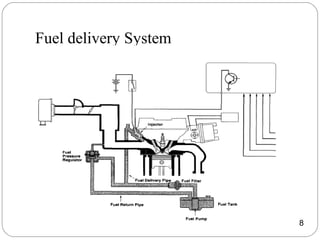
Fuel delivery System
8
Consists of fuel tank, fuel pump, fuel filter, fuel
delivery pipe, fuel injector, fuel pressure regulator &
fuel return pipe.
Fuel is delivered from tank to the injector by electric
fuel pump.
Contaminants are filtered out by a high capacity fuel
filter.
Fuel is maintained at constant pressure by means of a
fuel pressure regulator.
Fuel undelivered returns to tank through a fuel return
pipe.
9
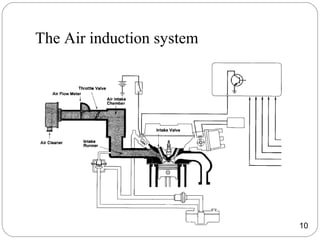
The Air induction system
10
Consists of air cleaner, air flow meter, throttle valve,
air intake chamber, intake manifold runner & intake
valve.
When throttle valve is opened air flows through air
cleaner, through air flow meter to and through a intake
manifold runner to the intake valve.
Air delivered to the engine depends on throttle valve
opening.
11
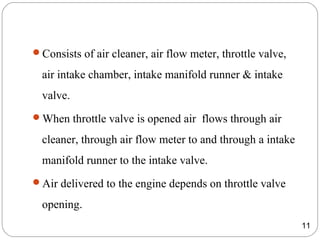
Electronic Control system:
12
Consists of Electronic Sensors, Electronic control unit
(ECU), fuel injector assemblies & related wiring.
ECU determines quantity of fuel delivered by injector
by monitoring the engine sensors.
ECU turns the injector on for precise amount of time
to deliver proper air/fuel ratio to the engine.
13
System Operation:
Air enters through the air induction system, as air flows
into cylinder, fuel is mixed into the air by the fuel injector.
Fuel injectors are arranged in the intake manifold behind
each intake valve & these are operated by the ECU.
The Electric Control Unit (ECU) decides the instant of
opening of the valve and the timing of operation. Decision
making depends on various sensors placed at various parts
of engine.
When the injector is turned ON, Fuel sprayed into intake
air stream mixes with incoming air & vaporizes due to low
pressure in intake manifold.
ECU monitors variables like coolant temperature. Speed,
Throttle angle etc.
14
Fuel injector:
 A fuel injector is nothing but an electronically
controlled valve. It is supplied with pressurized fuel
and is capable of opening and closing many times a
second.
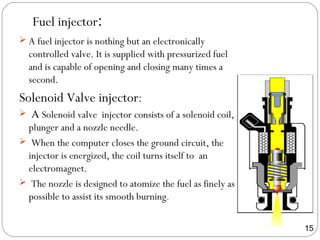
Solenoid Valve injector:
 A Solenoid valve injector consists of a solenoid coil,
plunger and a nozzle needle.
 When the computer closes the ground circuit, the
injector is energized, the coil turns itself to an
electromagnet.
 The nozzle is designed to atomize the fuel as finely as
possible to assist its smooth burning.
15
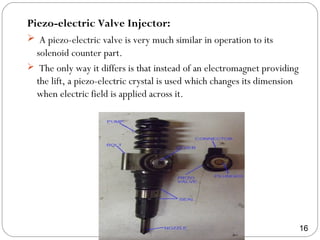
Piezo-electric Valve Injector:
 A piezo-electric valve is very much similar in operation to its
solenoid counter part.
 The only way it differs is that instead of an electromagnet providing
the lift, a piezo-electric crystal is used which changes its dimension
when electric field is applied across it.
16
Components:
ECU inputs:
 A throttle position sensor that tells the computer how hard your foot is
on the accelerator pedal.
 A crank angle sensor that basically tells the computer where the pistons
are in their travels.
 A knock sensor which detects any sign of detonation (pre-ignition or
'pinging') which is where the air/fuel mixture is exploding violently inside
the combustion chamber instead of as a controlled progressive burning.
 A Manifold Absolute Pressure (MAP) sensor which measures manifold
vacuum (or boost!).
 An oil pressure sensor as an emergency input, if the oil pressure is too
low, some EFI ECU actually turn the engine off after triggering a warning
to the driver to restrict engine damage.
 An oxygen sensor that is plumbed into the exhaust manifold that
examines the exhaust gases leaving the engine and informs the ECU what
the air/fuel ratio is.
17
ECU Outputs:
 Injector Firing – The ECU decides the precise instance of opening of the
valve and the duration of its operation.
Fan Control – The computer controls the cooling fan circuit by
grounding of an independent relay. Usually the fan enables temperature
operation with a 10F hystersis.
Fuel Pump – The computer uses a micro relay to power-up the fuel
pump and the Oxygen sensor heating element.
Timing Control – The timing to the ignition module is controlled by
varying the frequency of the square wave output.
Idle Air Control – The ECU have a closed loop idle speed control
through the use of a stepper motor air bypass valve. The computer
alternates the internal ground to command the idle air control position.
18
Advantages :
Uniform air/fuel mixture distribution: Each cylinder has its
own injector which delivers fuel directly to the intake valve.
This eliminates the need fuel to travel through the intake
manifold, improving cylinder to cylinder distribution.
Highly accurate air/fuel control throughout all engine
operating conditions: EFI supplies a continuously accurate
air/fuel ratio to the engine no matter what operating
conditions are encountered. This provides better drivability,
fuel economy and emissions control.
Superior throttle response and power: by delivering fuel
directly at the back of the intake valve, the intake manifold
design can be optimized to improve air velocity at the intake
valve. This improves torque and throttle response.
19
Excellent fuel economy with improved emissions control:
cold engine and wide open throttle enrichment can be
reduced with an EFI engine because fuel puddling in the intake
manifold is not a problem. This results in better overall fuel
economy and improved emissions control.
Improved cold engine startability and operation: the
combination of better fuel atomization and injection directly
at the intake valve improves ability to start and run a cold
engine.
Simpler mechanics reduced adjustment sensitivity: The EFI
system does not rely on any major adjustments for cold
enrichment or fuel metering. Because the system is
mechanically simple maintenance requirements are reduced.
20
Disadvantages :
The biggest disadvantage with electronic fuel injection
systems is that they are expensive.
EFI conversions are not cheap, in fact they are usually
expensive. Steer clear of modern car's EFI systems, they
aren't readily programmable and are difficult to get working
correctly.
21
Conclusion:
Today’s fuel injection unit not only improves engine
performance, but also helps in giving a cleaner exhaust that
too with a increased fuel economy.
With emission norms getting stricter and changing trends in
engine technology – high-speed engines, Variable
displacement engines, Hybrid engines, etc –
it became more and more of a necessity than a luxury to
improve the fuel supply system.
22
08. REFERENCES
1. WILLIAM, H, CROUSE, 1983, Automotive Mechanics
(Tata-McGraw Hill Publishing House, New Delhi)
2. Wikipedia.org
3. http://auto.howstuffworks.com/fuel-injection.html
23

Electronic fuel injection system

  • 1.
  • 2.
    Contents :  Introductionto fuel Injection  Classification  EFIS overview  Working 2
  • 3.
    Fuel Injection : Fuelinjection is the process of injecting fuel in the air to provide an air-fuel mixture to the engine. This supply has to be precisely controlled and accurately timed to ensure an optimum performance of engine with maximum possible efficiency. 3
  • 4.
    Classification: A. Based onpoint of injection Direct Injection: Fuel is injected directly in the combustion chamber. Port Injection: Fuel is injected in the intake manifold, just before the entry to the combustion chamber. B. Based on injection procedure Pulsed Injection: Fuel is injected in small, timed pulses. Continuous Injection: Fuel is injected continuously. C. Based on the type of injector used Solenoid Injector: Solenoid valve is used to spray the fuel Piezo-electric Injector: Piezo-electric crystals are used as the valve 4
  • 5.
    Direct fuel Injection: Fuel is injected via a common rail line directly into the cylinder.  The cost of this type of fuel injection system is comparatively higher as a result of the custom cylinder head configuration and the fairly sophisticated injector used.  Fuel efficiency, high power output and lower gas emissions are clear advantages of direct fuel injection. Port fuel Injection:  Fuel is injected at each intake port usually located at the cylinder head and intake manifold.  The inherent design of this type of fuel-injection system allows for quite a bit of flexibility in intake-manifold design. 5
  • 6.
  • 7.
    Working: The EFIS systemis divided into three: basic subsystems. 1. Fuel Delivery System. 2. Air Induction System 3. Electronic Control System 7
  • 8.
  • 9.
    Consists of fueltank, fuel pump, fuel filter, fuel delivery pipe, fuel injector, fuel pressure regulator & fuel return pipe. Fuel is delivered from tank to the injector by electric fuel pump. Contaminants are filtered out by a high capacity fuel filter. Fuel is maintained at constant pressure by means of a fuel pressure regulator. Fuel undelivered returns to tank through a fuel return pipe. 9
  • 10.
  • 11.
    Consists of aircleaner, air flow meter, throttle valve, air intake chamber, intake manifold runner & intake valve. When throttle valve is opened air flows through air cleaner, through air flow meter to and through a intake manifold runner to the intake valve. Air delivered to the engine depends on throttle valve opening. 11
  • 12.
  • 13.
    Consists of ElectronicSensors, Electronic control unit (ECU), fuel injector assemblies & related wiring. ECU determines quantity of fuel delivered by injector by monitoring the engine sensors. ECU turns the injector on for precise amount of time to deliver proper air/fuel ratio to the engine. 13
  • 14.
    System Operation: Air entersthrough the air induction system, as air flows into cylinder, fuel is mixed into the air by the fuel injector. Fuel injectors are arranged in the intake manifold behind each intake valve & these are operated by the ECU. The Electric Control Unit (ECU) decides the instant of opening of the valve and the timing of operation. Decision making depends on various sensors placed at various parts of engine. When the injector is turned ON, Fuel sprayed into intake air stream mixes with incoming air & vaporizes due to low pressure in intake manifold. ECU monitors variables like coolant temperature. Speed, Throttle angle etc. 14
  • 15.
    Fuel injector:  Afuel injector is nothing but an electronically controlled valve. It is supplied with pressurized fuel and is capable of opening and closing many times a second. Solenoid Valve injector:  A Solenoid valve injector consists of a solenoid coil, plunger and a nozzle needle.  When the computer closes the ground circuit, the injector is energized, the coil turns itself to an electromagnet.  The nozzle is designed to atomize the fuel as finely as possible to assist its smooth burning. 15
  • 16.
    Piezo-electric Valve Injector: A piezo-electric valve is very much similar in operation to its solenoid counter part.  The only way it differs is that instead of an electromagnet providing the lift, a piezo-electric crystal is used which changes its dimension when electric field is applied across it. 16
  • 17.
    Components: ECU inputs:  Athrottle position sensor that tells the computer how hard your foot is on the accelerator pedal.  A crank angle sensor that basically tells the computer where the pistons are in their travels.  A knock sensor which detects any sign of detonation (pre-ignition or 'pinging') which is where the air/fuel mixture is exploding violently inside the combustion chamber instead of as a controlled progressive burning.  A Manifold Absolute Pressure (MAP) sensor which measures manifold vacuum (or boost!).  An oil pressure sensor as an emergency input, if the oil pressure is too low, some EFI ECU actually turn the engine off after triggering a warning to the driver to restrict engine damage.  An oxygen sensor that is plumbed into the exhaust manifold that examines the exhaust gases leaving the engine and informs the ECU what the air/fuel ratio is. 17
  • 18.
    ECU Outputs:  InjectorFiring – The ECU decides the precise instance of opening of the valve and the duration of its operation. Fan Control – The computer controls the cooling fan circuit by grounding of an independent relay. Usually the fan enables temperature operation with a 10F hystersis. Fuel Pump – The computer uses a micro relay to power-up the fuel pump and the Oxygen sensor heating element. Timing Control – The timing to the ignition module is controlled by varying the frequency of the square wave output. Idle Air Control – The ECU have a closed loop idle speed control through the use of a stepper motor air bypass valve. The computer alternates the internal ground to command the idle air control position. 18
  • 19.
    Advantages : Uniform air/fuelmixture distribution: Each cylinder has its own injector which delivers fuel directly to the intake valve. This eliminates the need fuel to travel through the intake manifold, improving cylinder to cylinder distribution. Highly accurate air/fuel control throughout all engine operating conditions: EFI supplies a continuously accurate air/fuel ratio to the engine no matter what operating conditions are encountered. This provides better drivability, fuel economy and emissions control. Superior throttle response and power: by delivering fuel directly at the back of the intake valve, the intake manifold design can be optimized to improve air velocity at the intake valve. This improves torque and throttle response. 19
  • 20.
    Excellent fuel economywith improved emissions control: cold engine and wide open throttle enrichment can be reduced with an EFI engine because fuel puddling in the intake manifold is not a problem. This results in better overall fuel economy and improved emissions control. Improved cold engine startability and operation: the combination of better fuel atomization and injection directly at the intake valve improves ability to start and run a cold engine. Simpler mechanics reduced adjustment sensitivity: The EFI system does not rely on any major adjustments for cold enrichment or fuel metering. Because the system is mechanically simple maintenance requirements are reduced. 20
  • 21.
    Disadvantages : The biggestdisadvantage with electronic fuel injection systems is that they are expensive. EFI conversions are not cheap, in fact they are usually expensive. Steer clear of modern car's EFI systems, they aren't readily programmable and are difficult to get working correctly. 21
  • 22.
    Conclusion: Today’s fuel injectionunit not only improves engine performance, but also helps in giving a cleaner exhaust that too with a increased fuel economy. With emission norms getting stricter and changing trends in engine technology – high-speed engines, Variable displacement engines, Hybrid engines, etc – it became more and more of a necessity than a luxury to improve the fuel supply system. 22
  • 23.
    08. REFERENCES 1. WILLIAM,H, CROUSE, 1983, Automotive Mechanics (Tata-McGraw Hill Publishing House, New Delhi) 2. Wikipedia.org 3. http://auto.howstuffworks.com/fuel-injection.html 23

Editor's Notes

  • #9 Consists of fuel tank, fuel pump, fuel filter, fuel delivery pipe, fuel injector, fuel pressure regulator & fuel return pipe. Fuel is delivered from tank to the injector by electric fuel pump. Contaminants are filtered out by a high capacity fuel filter. Fuel is maintained at constant pressure by means of a fuel pressure regulator. Fuel undelivered returns to tank through a fuel return pipe.