MEE-306 : DESIGN OF TRANSMISSION SYSTEM
Clutches
Working and Application
Faculty Guide : Professor Gokul Kumar
1
VIT University
TABLE OF CONTENT
 Introduction to Clutches
 Components in a Clutch
 Types of Clutch
 Working of a Clutch
 Equations Involved in a Clutch
 Material used to make Clutch
2
3
INTRODUCTION TO CLUTCHES 
4
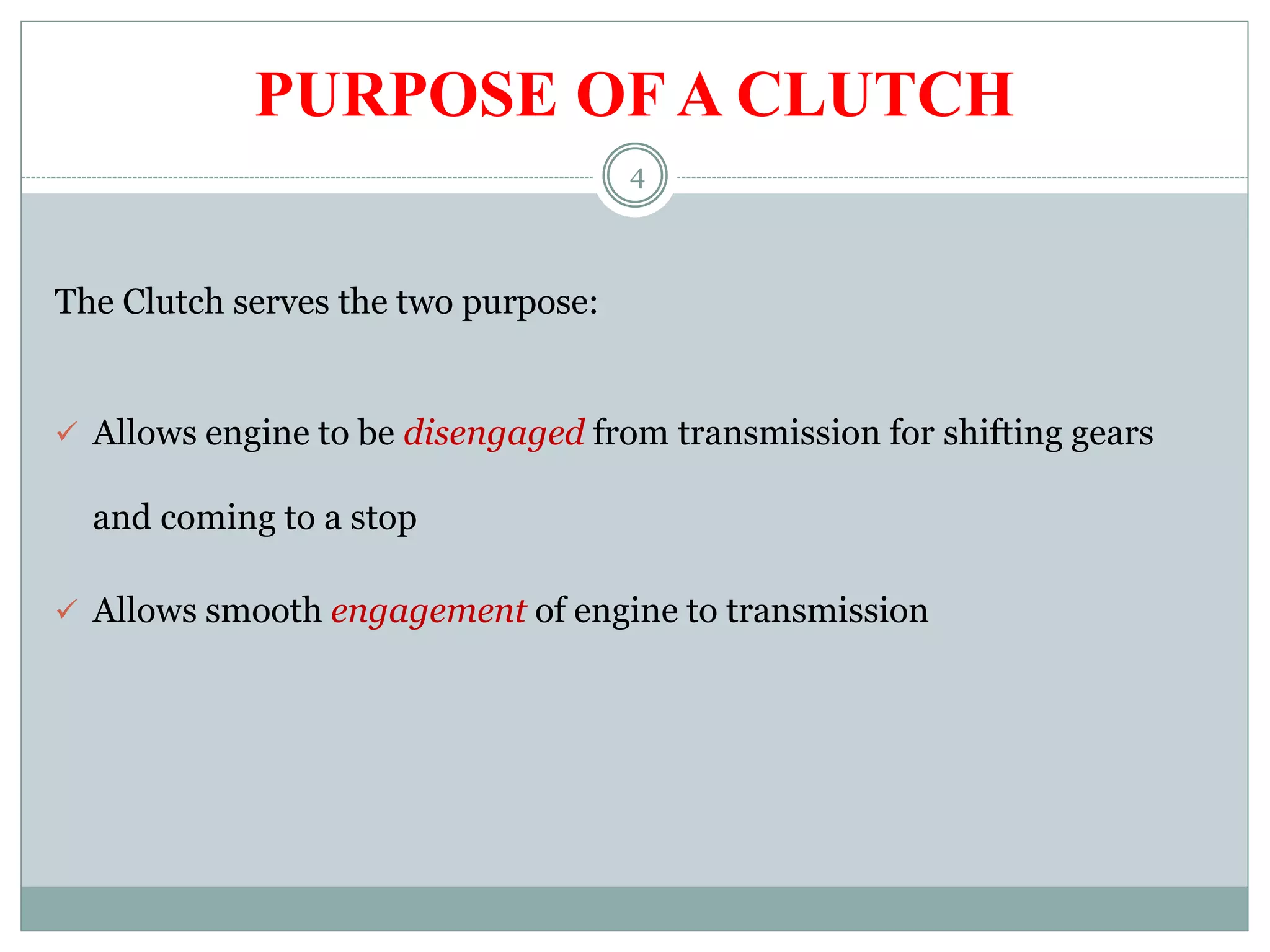
PURPOSE OF A CLUTCH
The Clutch serves the two purpose:
 Allows engine to be disengaged from transmission for shifting gears
and coming to a stop
 Allows smooth engagement of engine to transmission
5
WHO REQUIRES A CLUTCH
The Clutch serves the two purpose:
 Allows engine to be disengaged from transmission for shifting gears
and coming to a stop
 Allows smooth engagement of engine to transmission
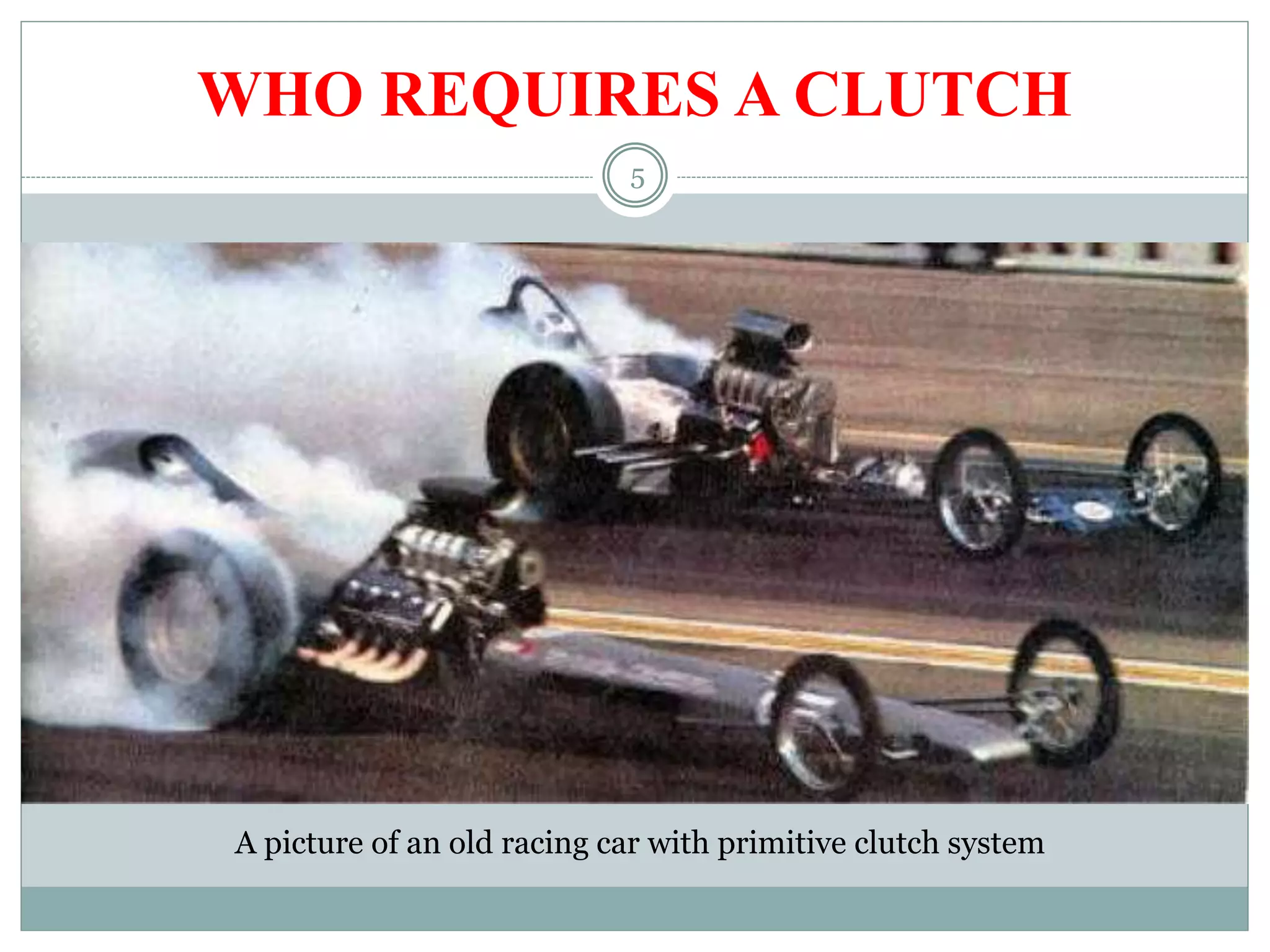
A picture of an old racing car with primitive clutch system
6
LOCATION OF A CLUTCH
Depending on the type of drive, the clutch changes its location:
 Rear wheel drive
 Front engine
 Rear engine
 Mid engine
 Front wheel drive
7
COMPONENTS IN A CLUTCHES 
8
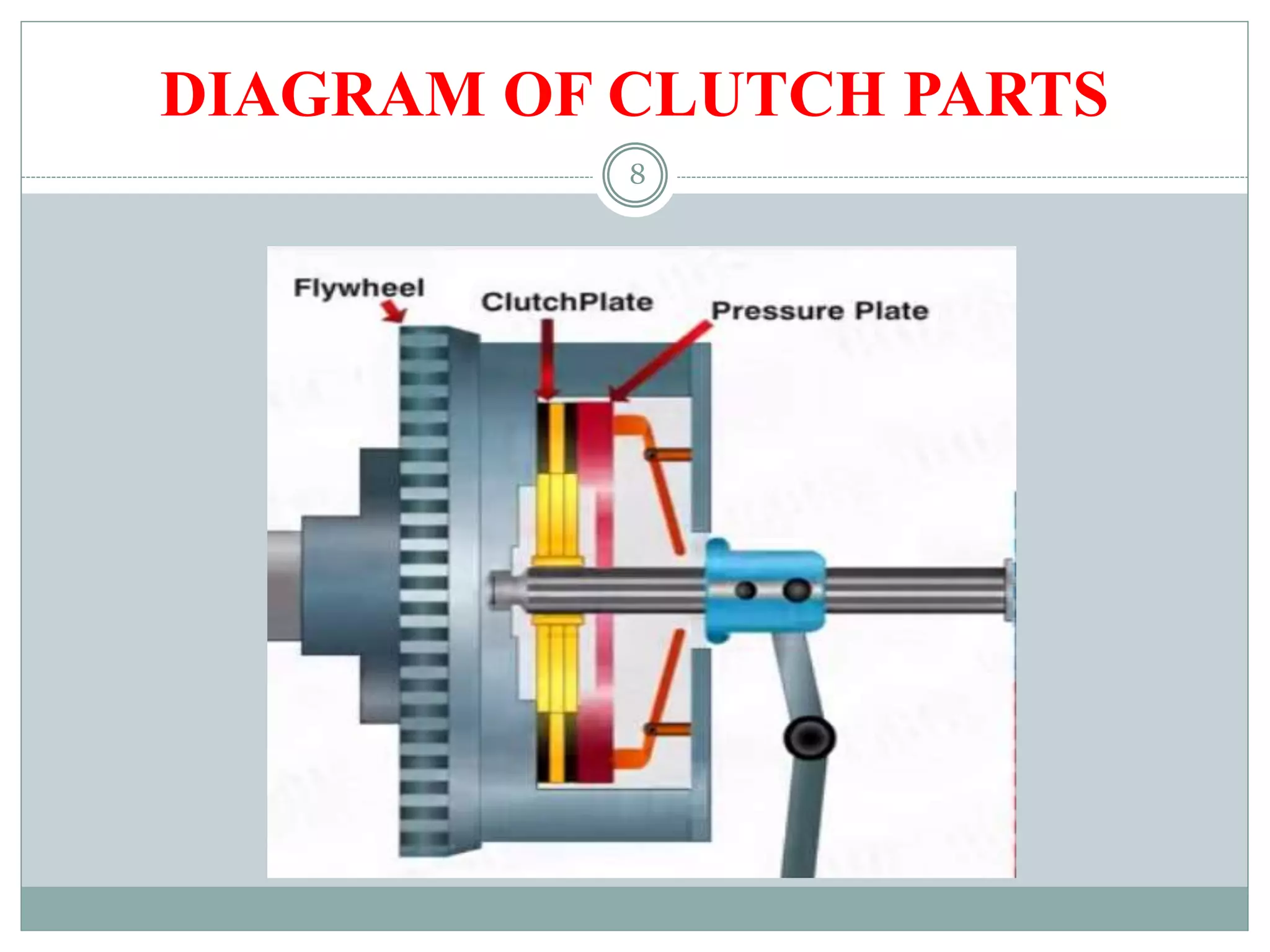
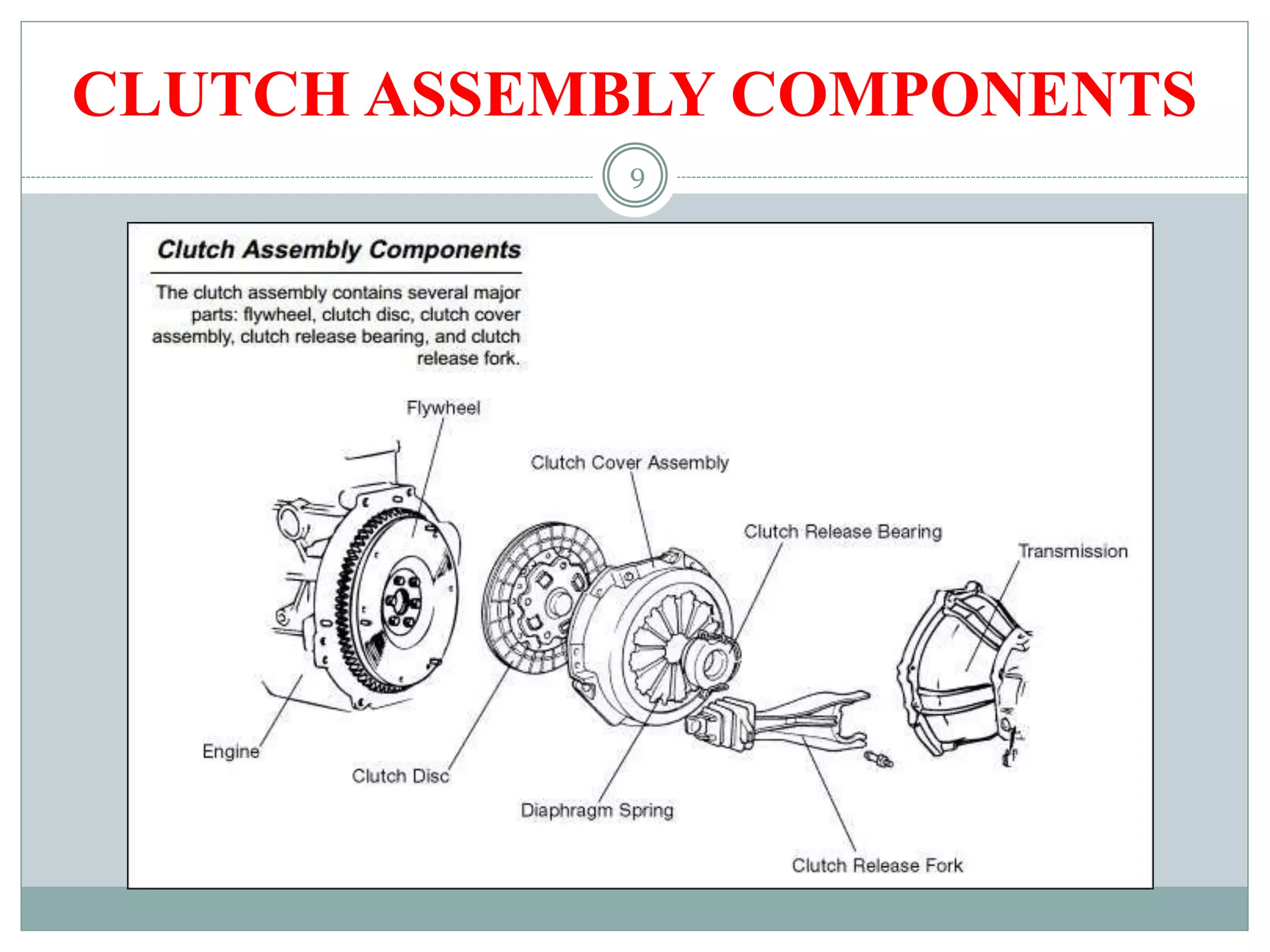
DIAGRAM OF CLUTCH PARTS
9
CLUTCH ASSEMBLY COMPONENTS
10
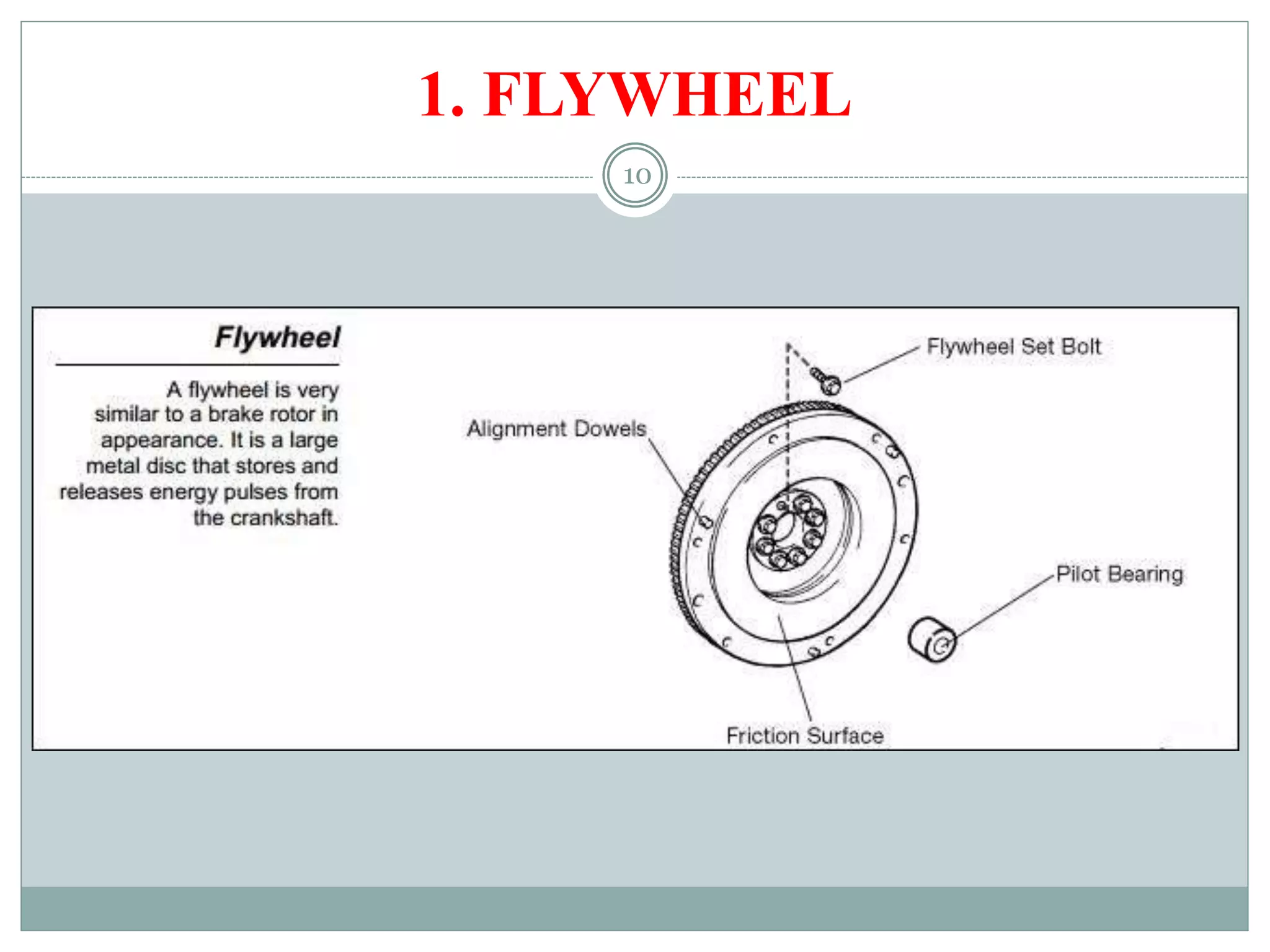
1. FLYWHEEL
11
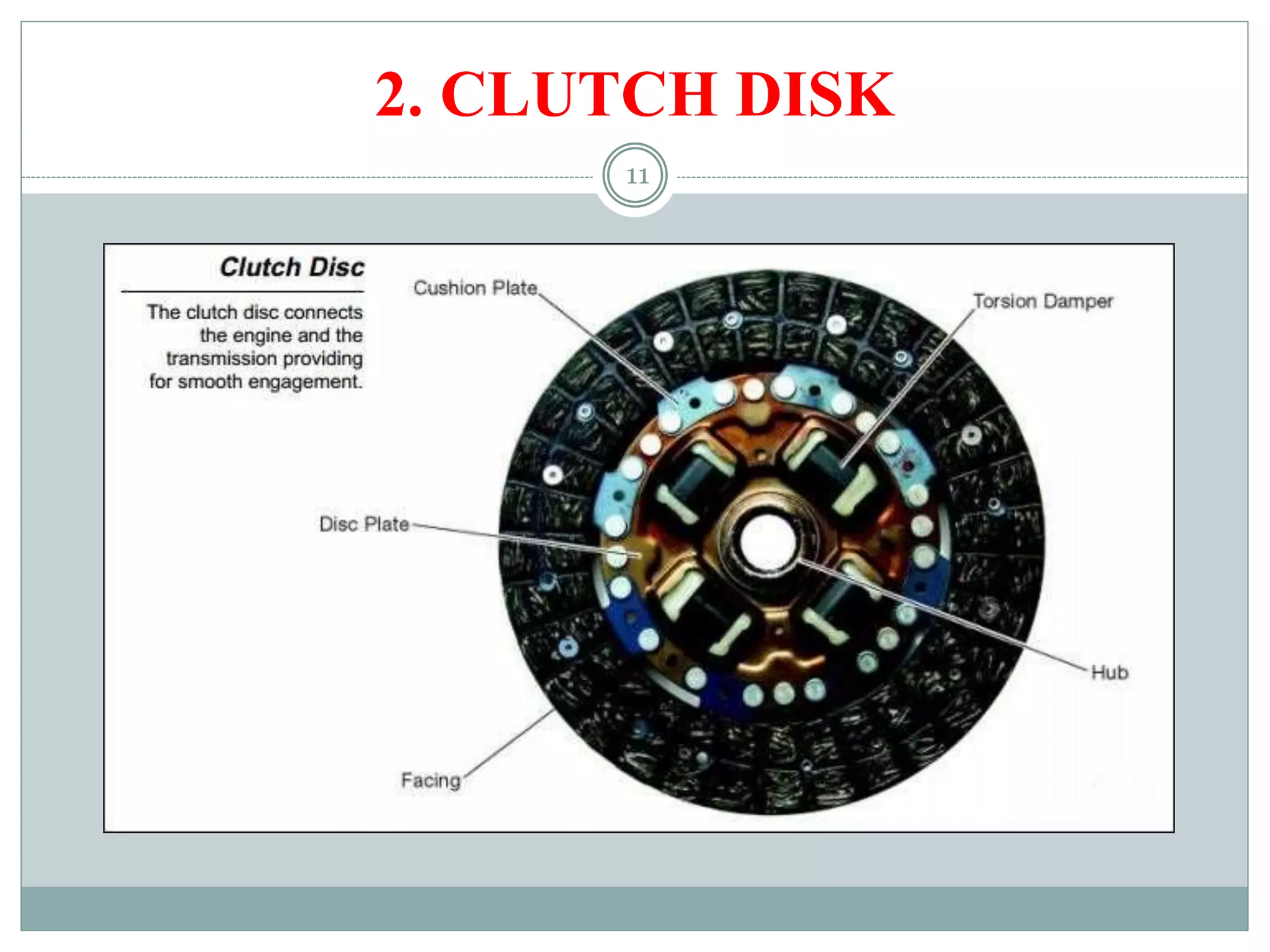
2. CLUTCH DISK
12
3. CIRCULAR GROOVE
13
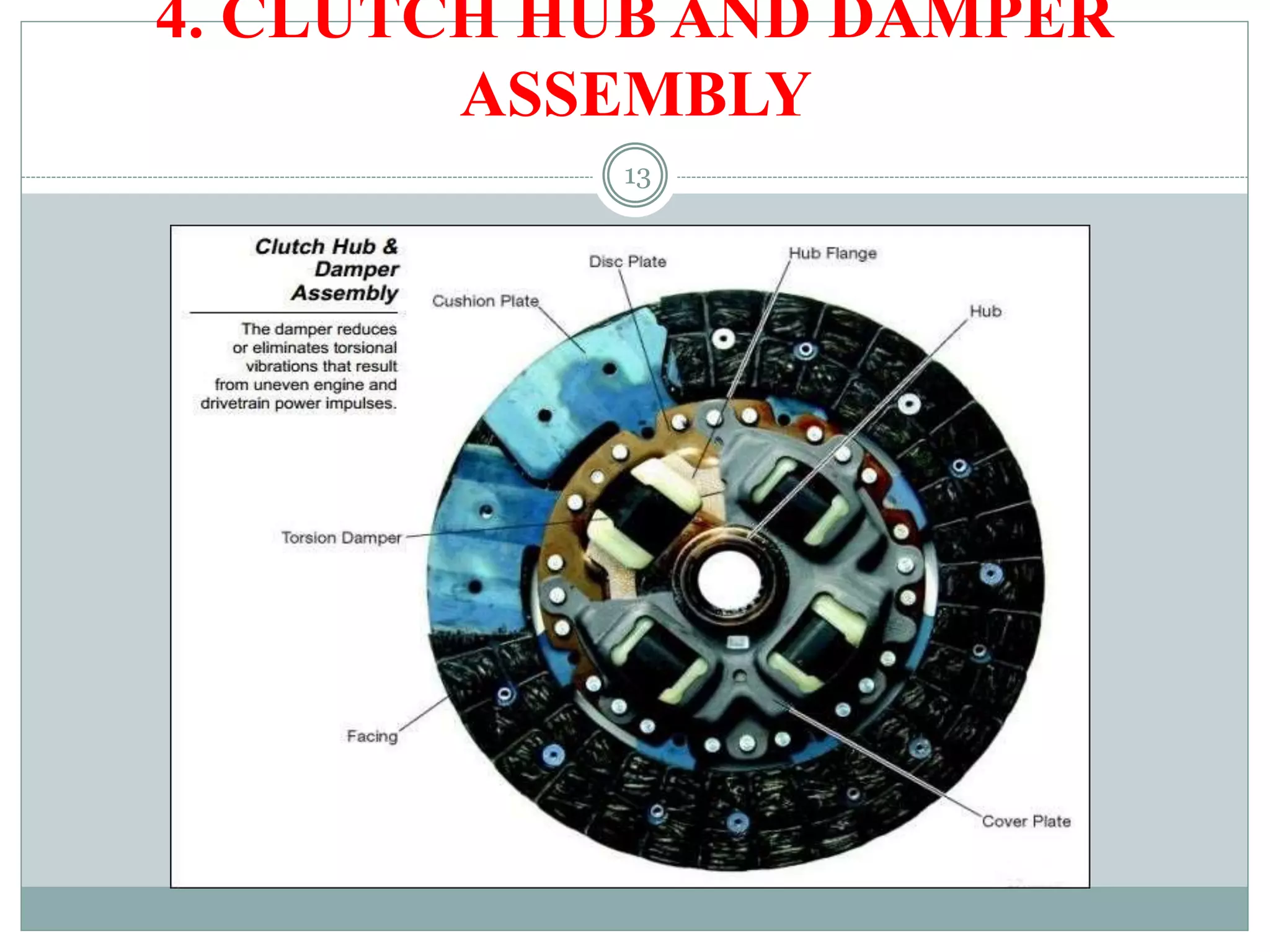
4. CLUTCH HUB AND DAMPER
ASSEMBLY
14
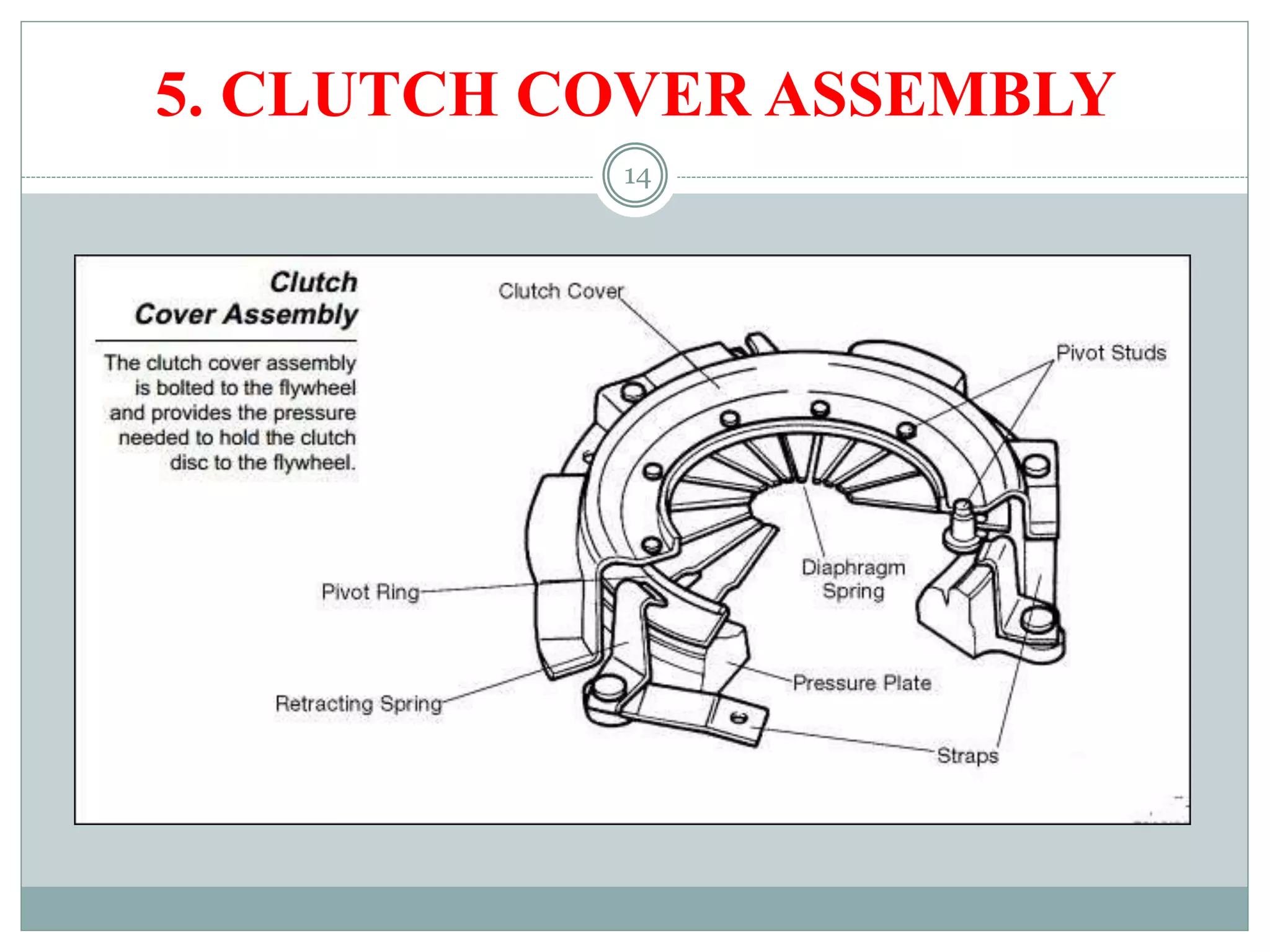
5. CLUTCH COVER ASSEMBLY
15
6. DIAPHRAGM SPRING TURNOVER
16
TYPES OF CLUTCHES 
17
DIFFERENT TYPES OF CLUTCH
In this presentation, basically three types of clutch has been explained:
 Dog Clutch
 Belt Clutch
 Centrifugal Clutch
18
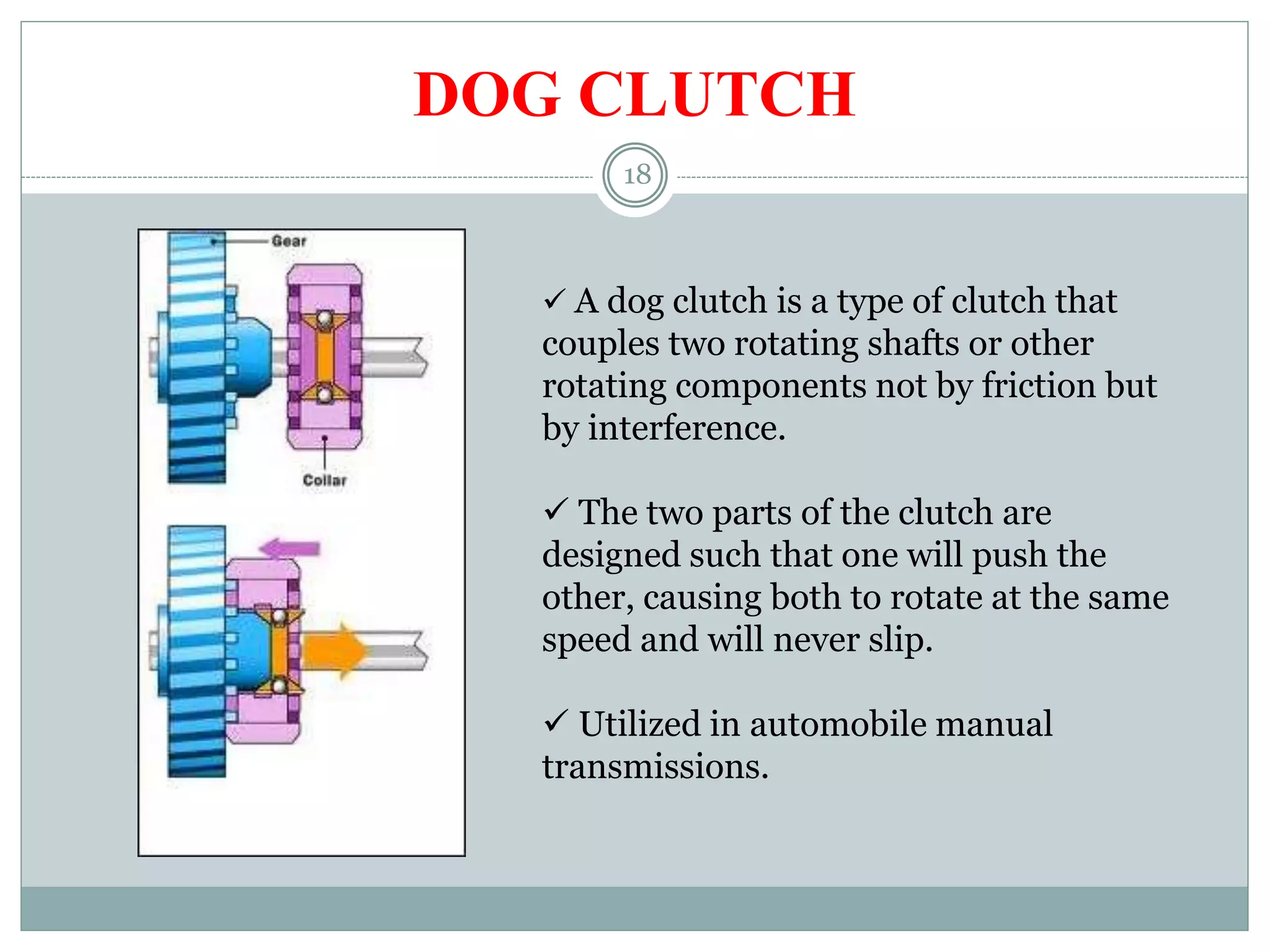
DOG CLUTCH
 A dog clutch is a type of clutch that
couples two rotating shafts or other
rotating components not by friction but
by interference.
 The two parts of the clutch are
designed such that one will push the
other, causing both to rotate at the same
speed and will never slip.
 Utilized in automobile manual
transmissions.
19
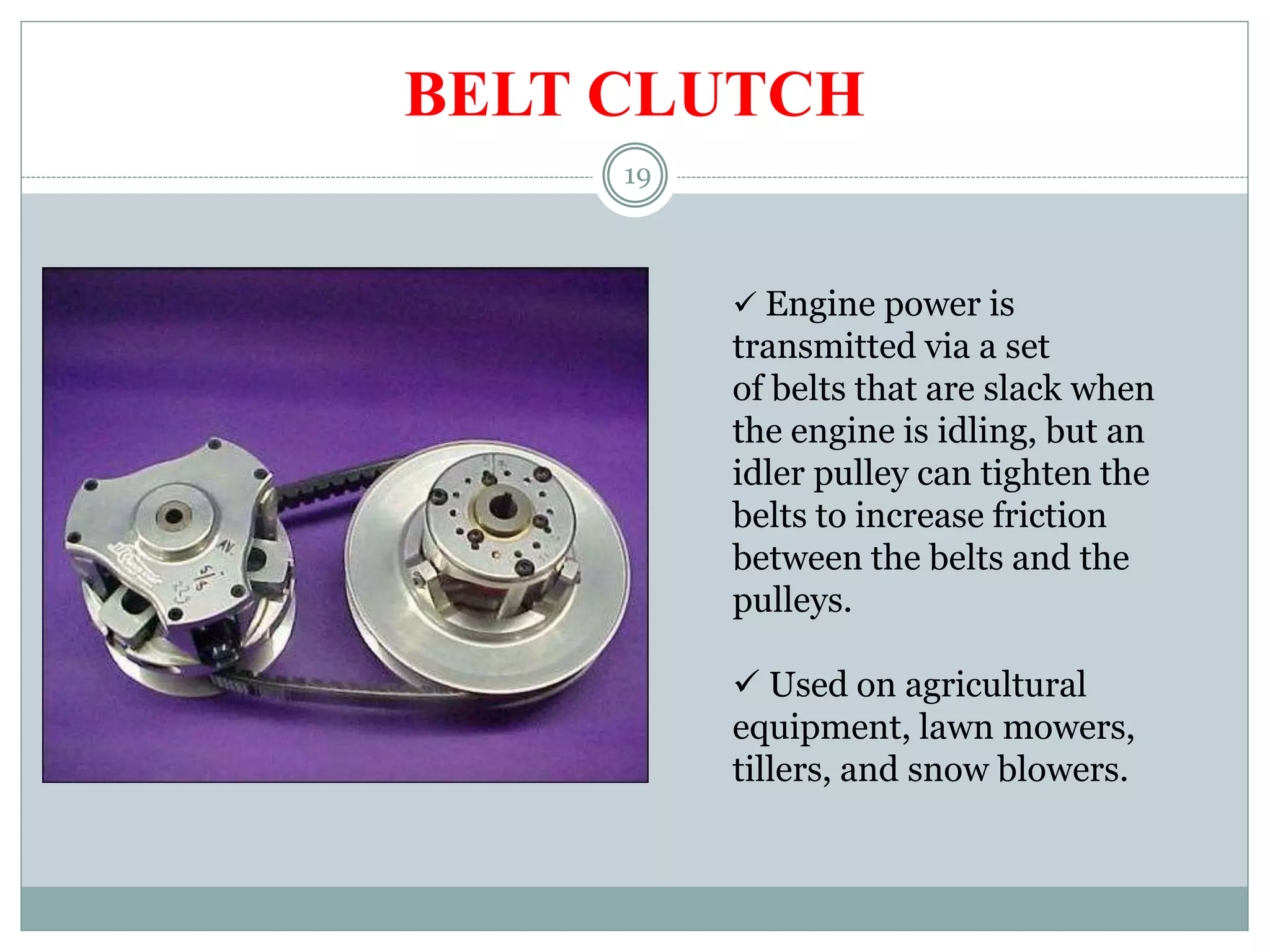
BELT CLUTCH
 Engine power is
transmitted via a set
of belts that are slack when
the engine is idling, but an
idler pulley can tighten the
belts to increase friction
between the belts and the
pulleys.
 Used on agricultural
equipment, lawn mowers,
tillers, and snow blowers.
20
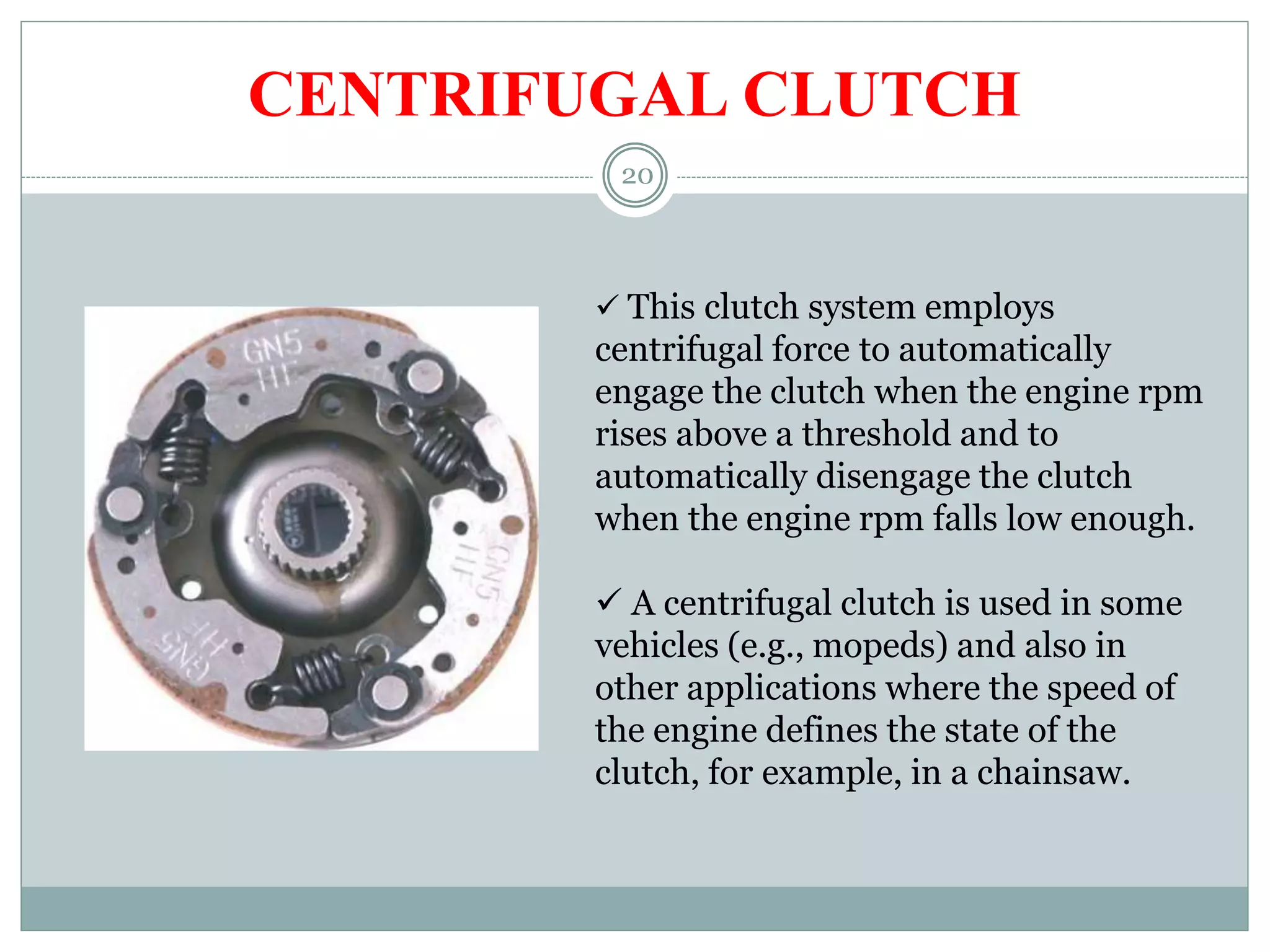
CENTRIFUGAL CLUTCH
 This clutch system employs
centrifugal force to automatically
engage the clutch when the engine rpm
rises above a threshold and to
automatically disengage the clutch
when the engine rpm falls low enough.
 A centrifugal clutch is used in some
vehicles (e.g., mopeds) and also in
other applications where the speed of
the engine defines the state of the
clutch, for example, in a chainsaw.
21
WORKING OF A CLUTCH 
22
STEP-WISE WORKING OF A
CLUTCH
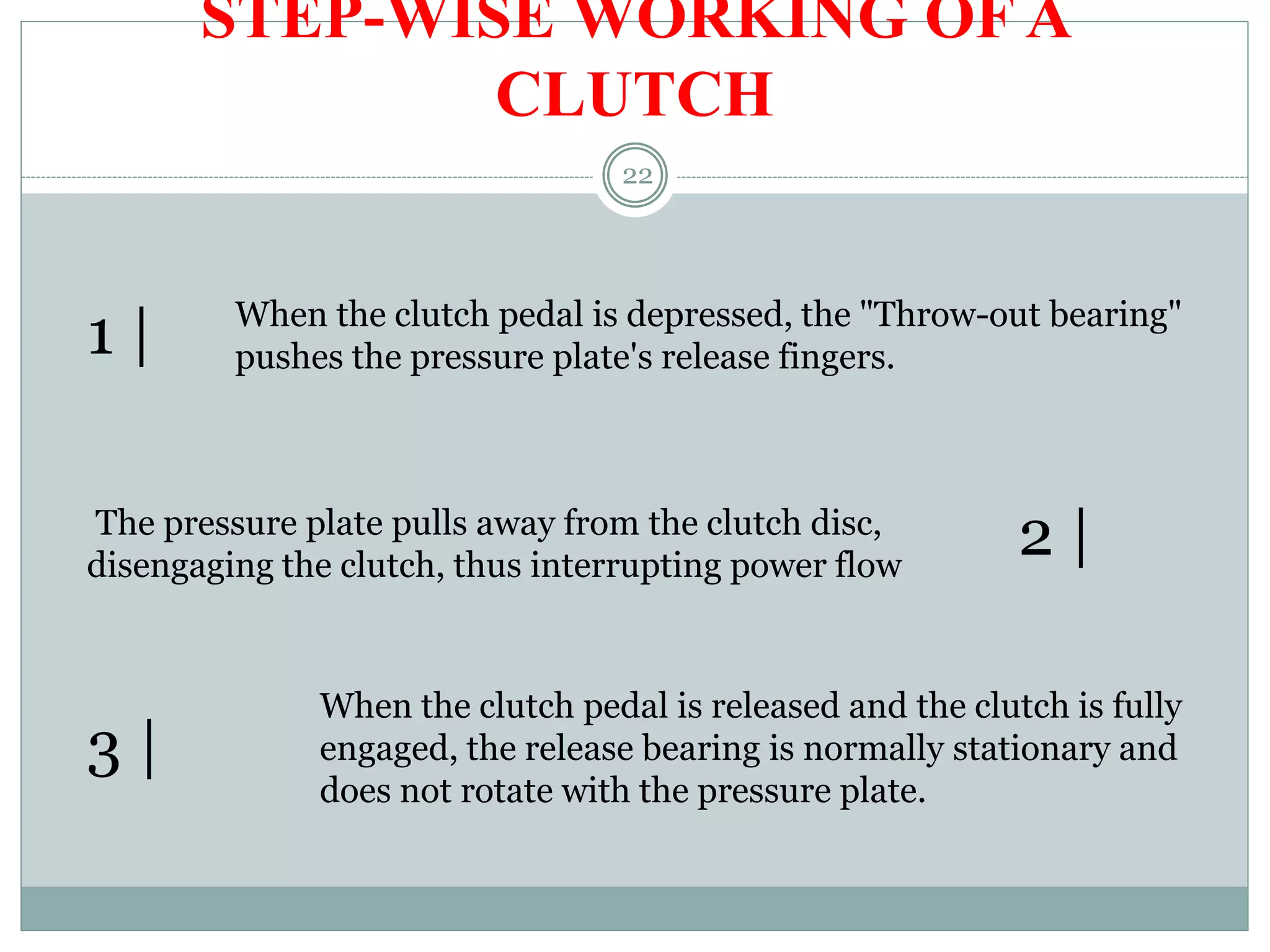
When the clutch pedal is depressed, the "Throw-out bearing"
pushes the pressure plate's release fingers.1 |
The pressure plate pulls away from the clutch disc,
disengaging the clutch, thus interrupting power flow
2 |
When the clutch pedal is released and the clutch is fully
engaged, the release bearing is normally stationary and
does not rotate with the pressure plate.
3 |
23
STEP-WISE WORKING OF A
CLUTCH -2
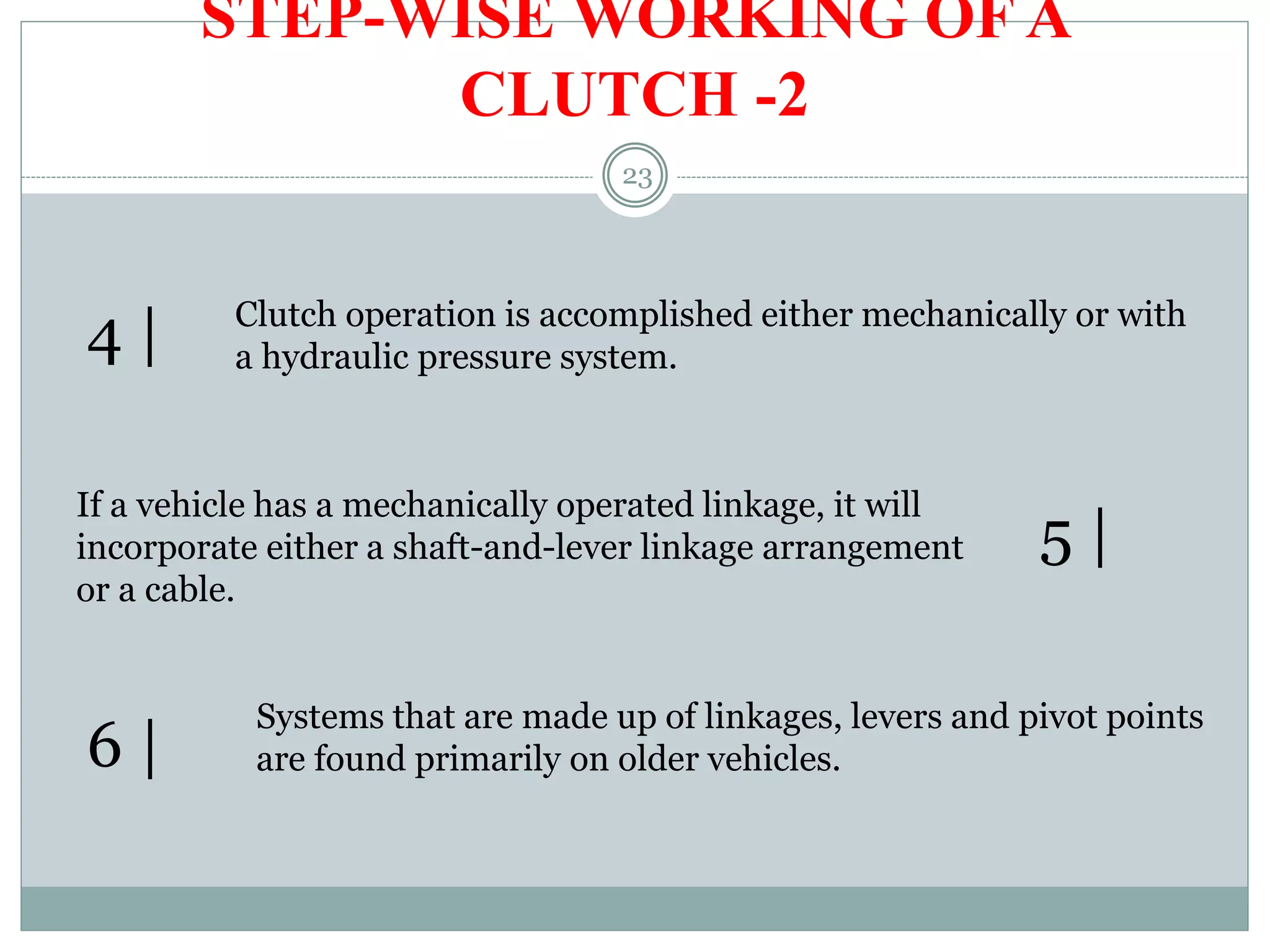
Clutch operation is accomplished either mechanically or with
a hydraulic pressure system.4 |
If a vehicle has a mechanically operated linkage, it will
incorporate either a shaft-and-lever linkage arrangement
or a cable.
5 |
6 |
Systems that are made up of linkages, levers and pivot points
are found primarily on older vehicles.
24
PRESSURE EQUATIONS - CLUTCH 
25
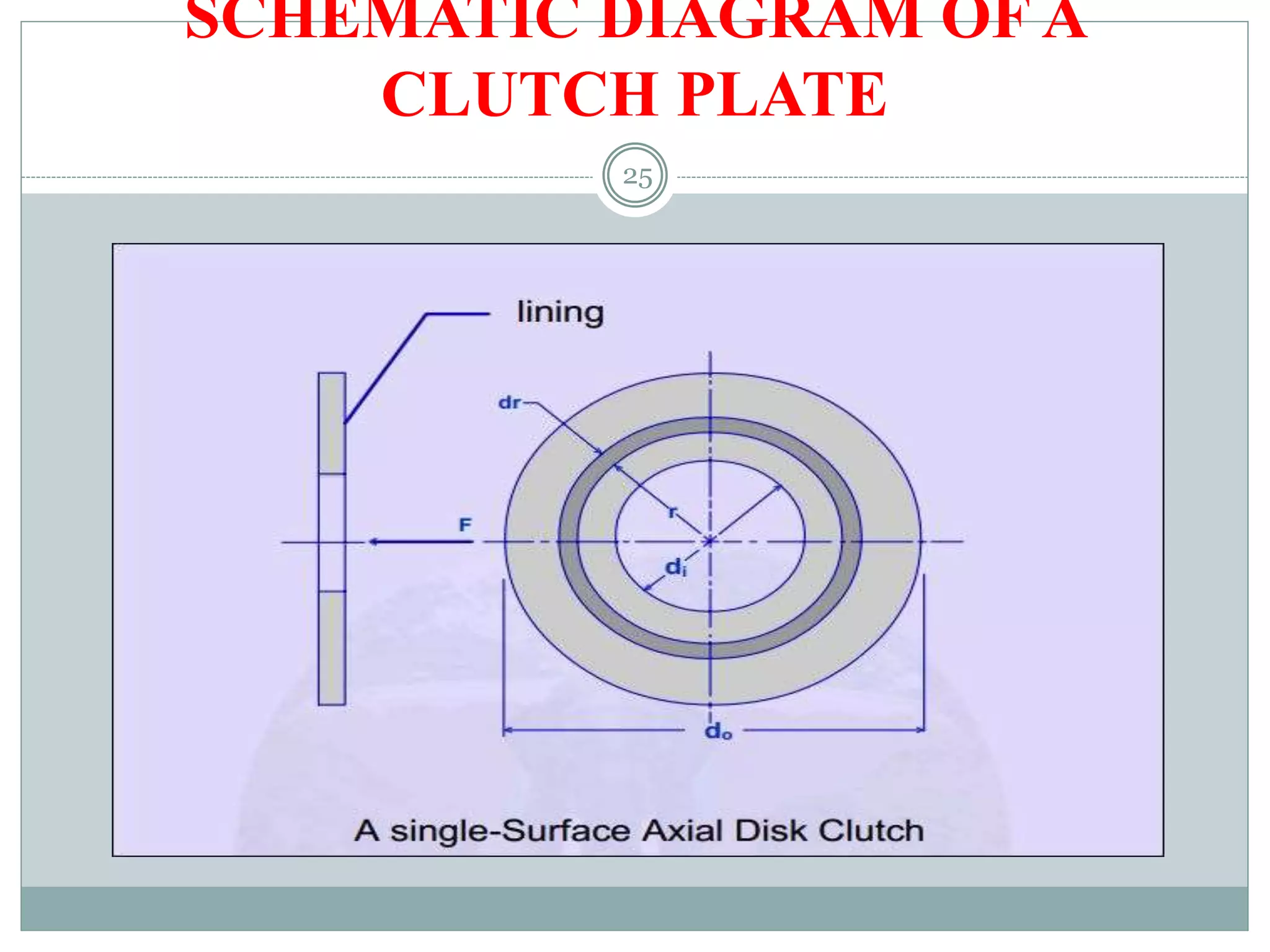
SCHEMATIC DIAGRAM OF A
CLUTCH PLATE
26
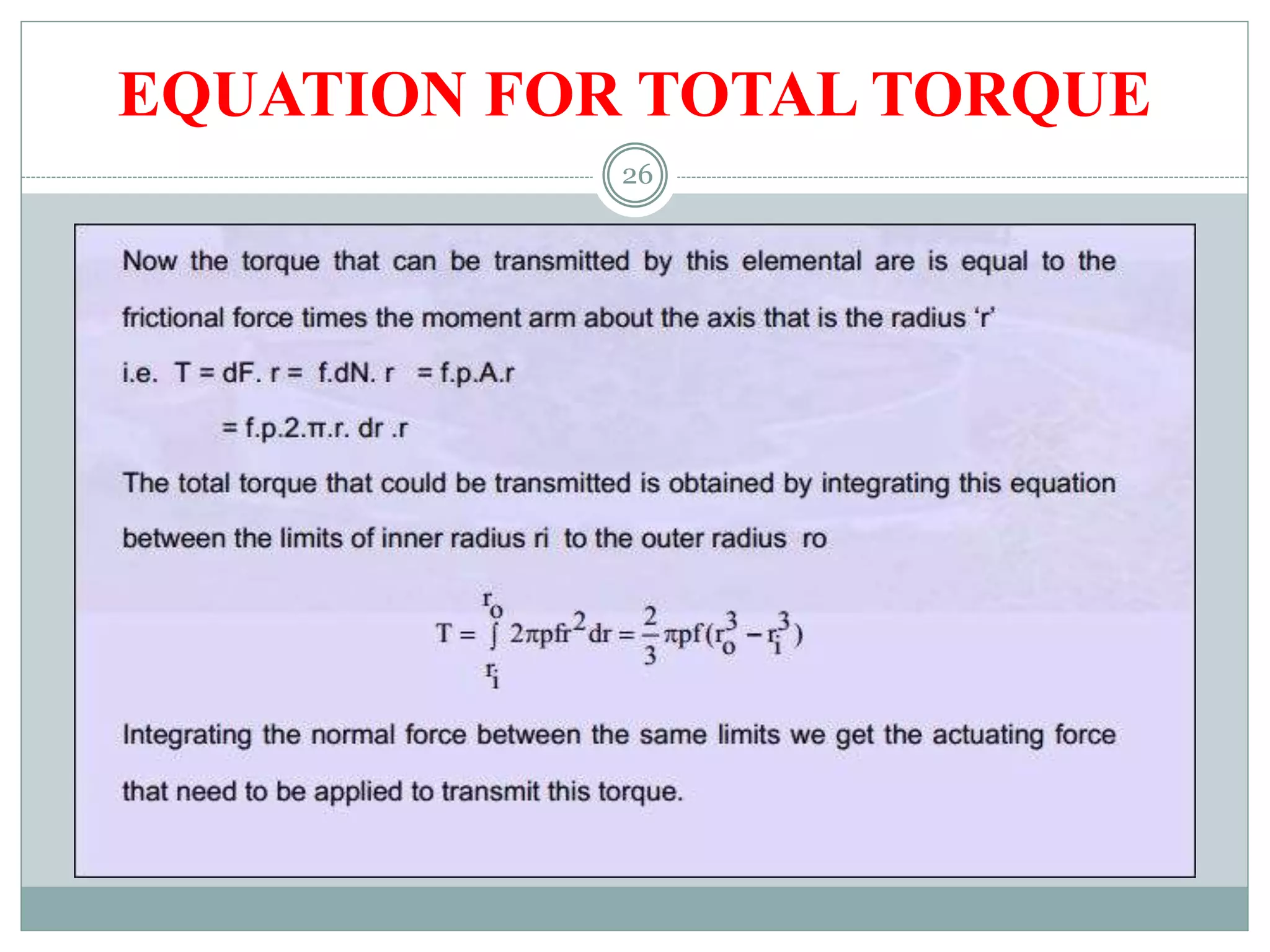
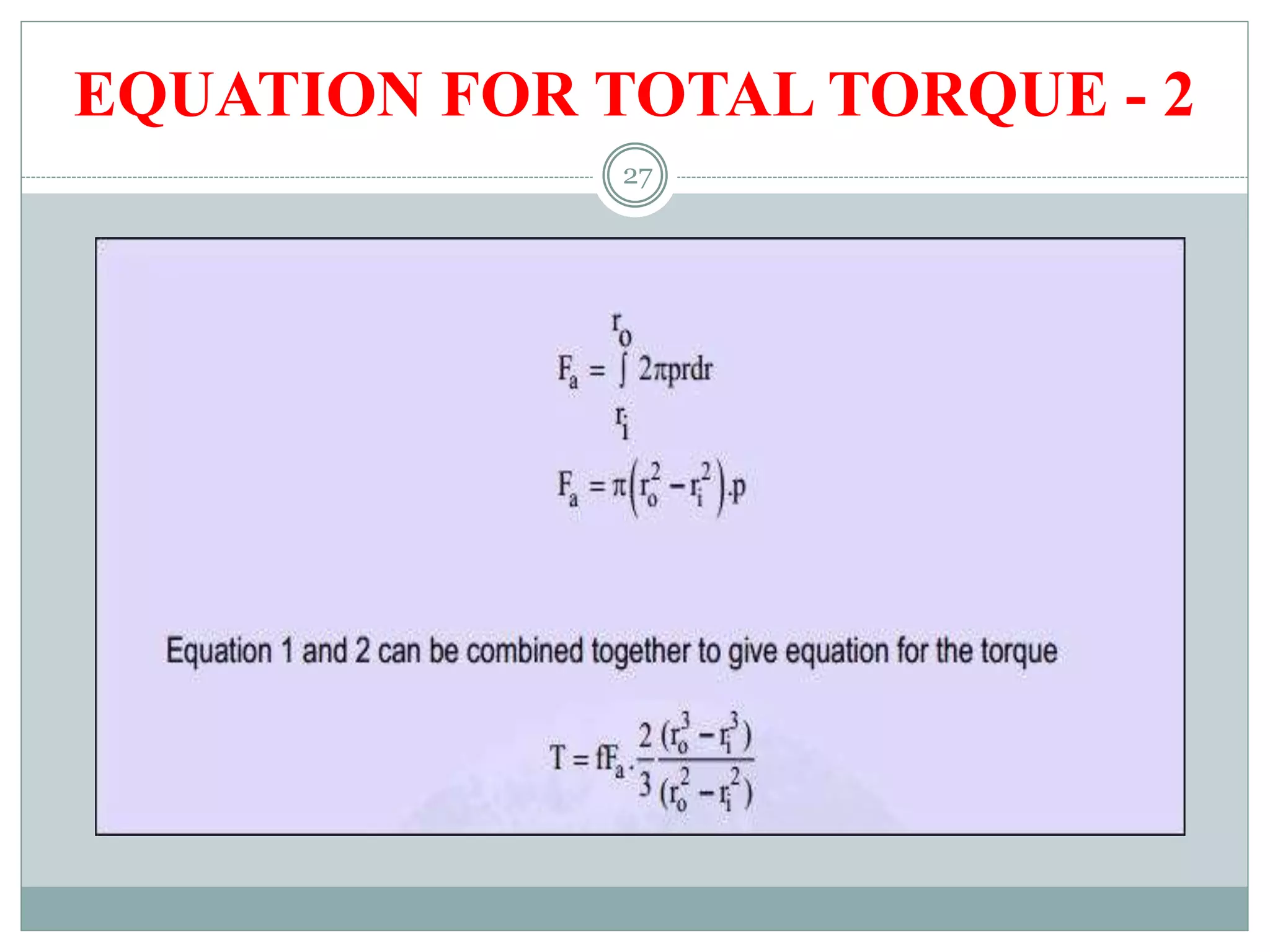
EQUATION FOR TOTAL TORQUE
27
EQUATION FOR TOTAL TORQUE - 2
28
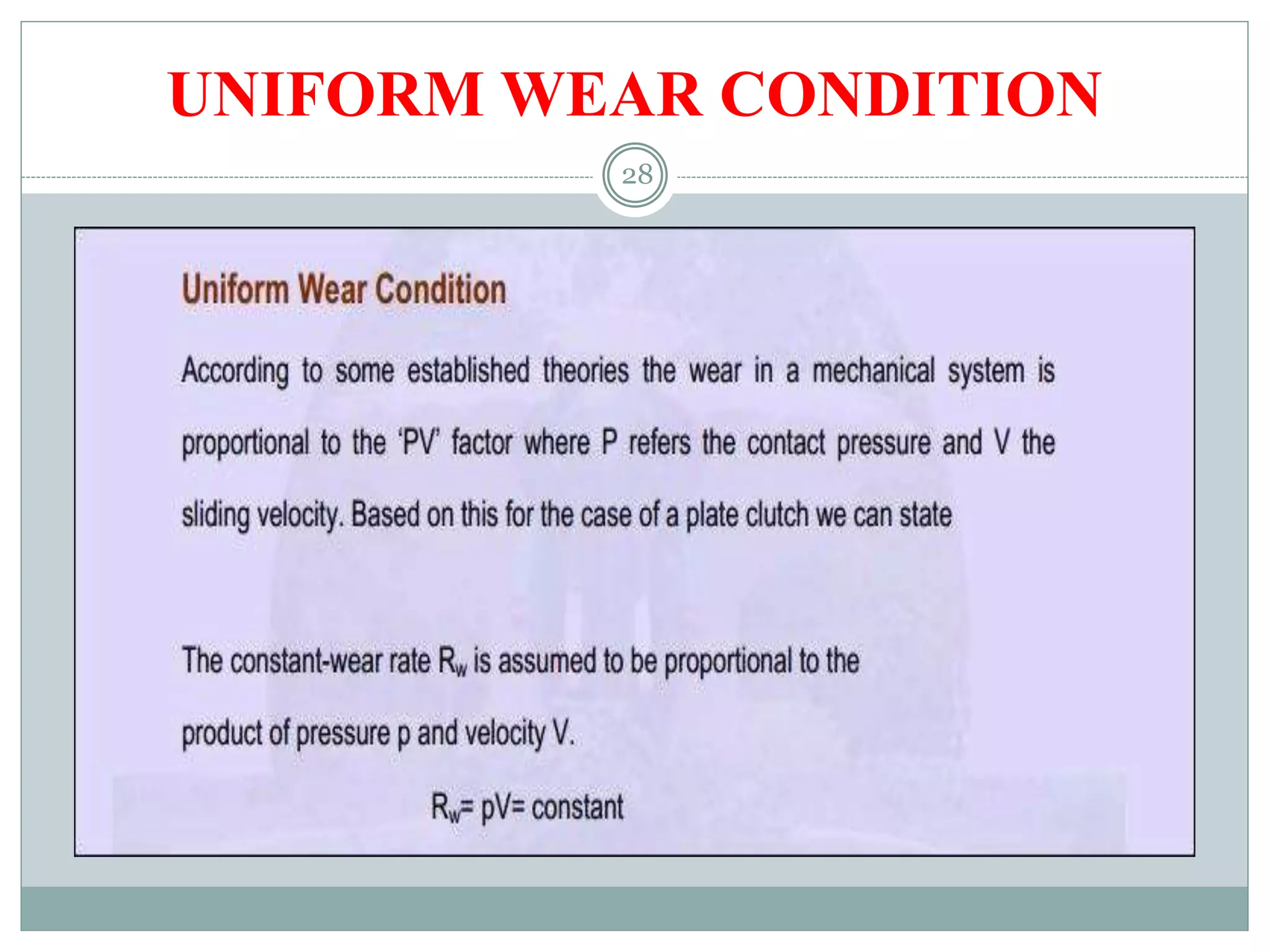
UNIFORM WEAR CONDITION
29
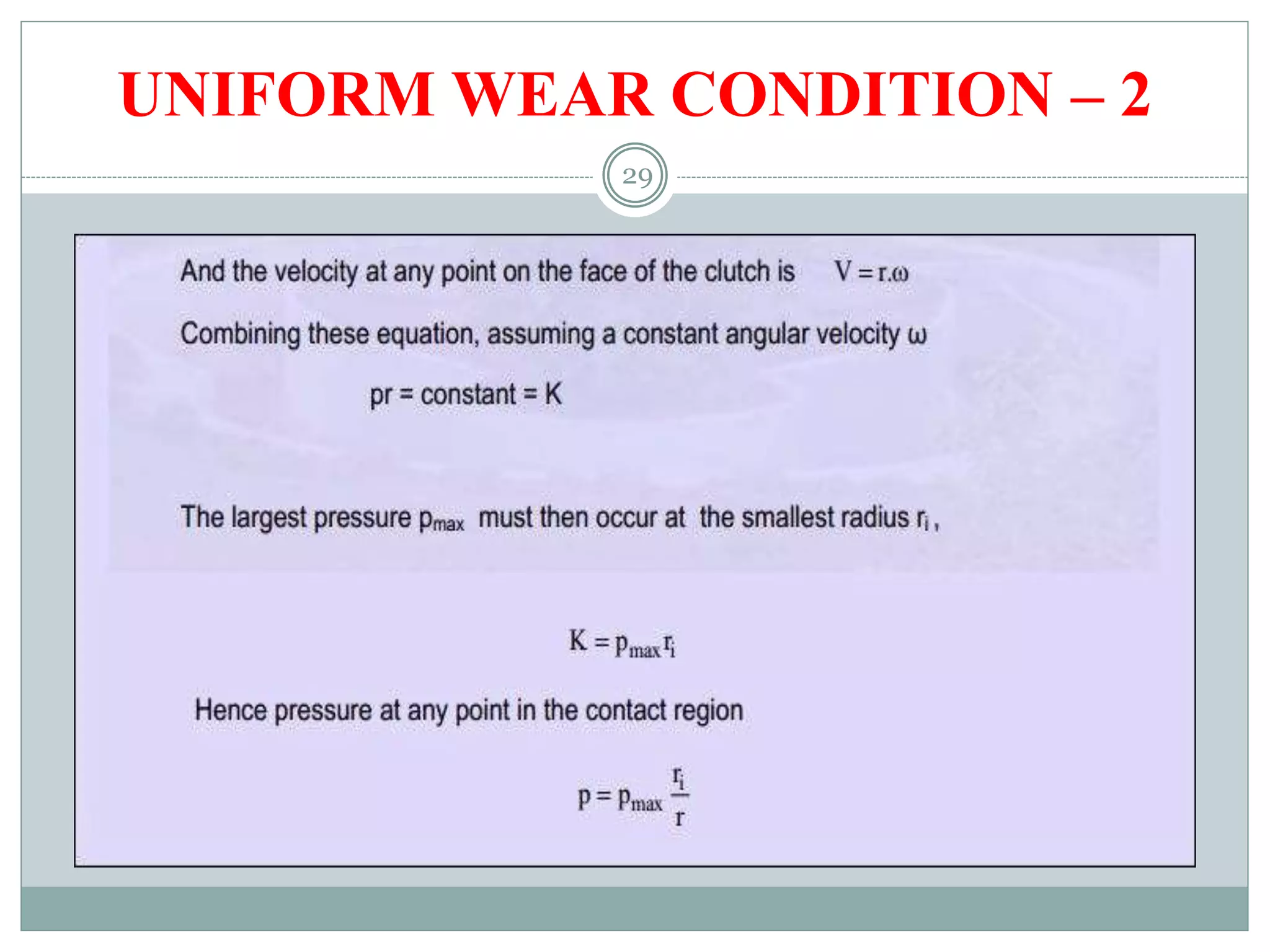
UNIFORM WEAR CONDITION – 2
30
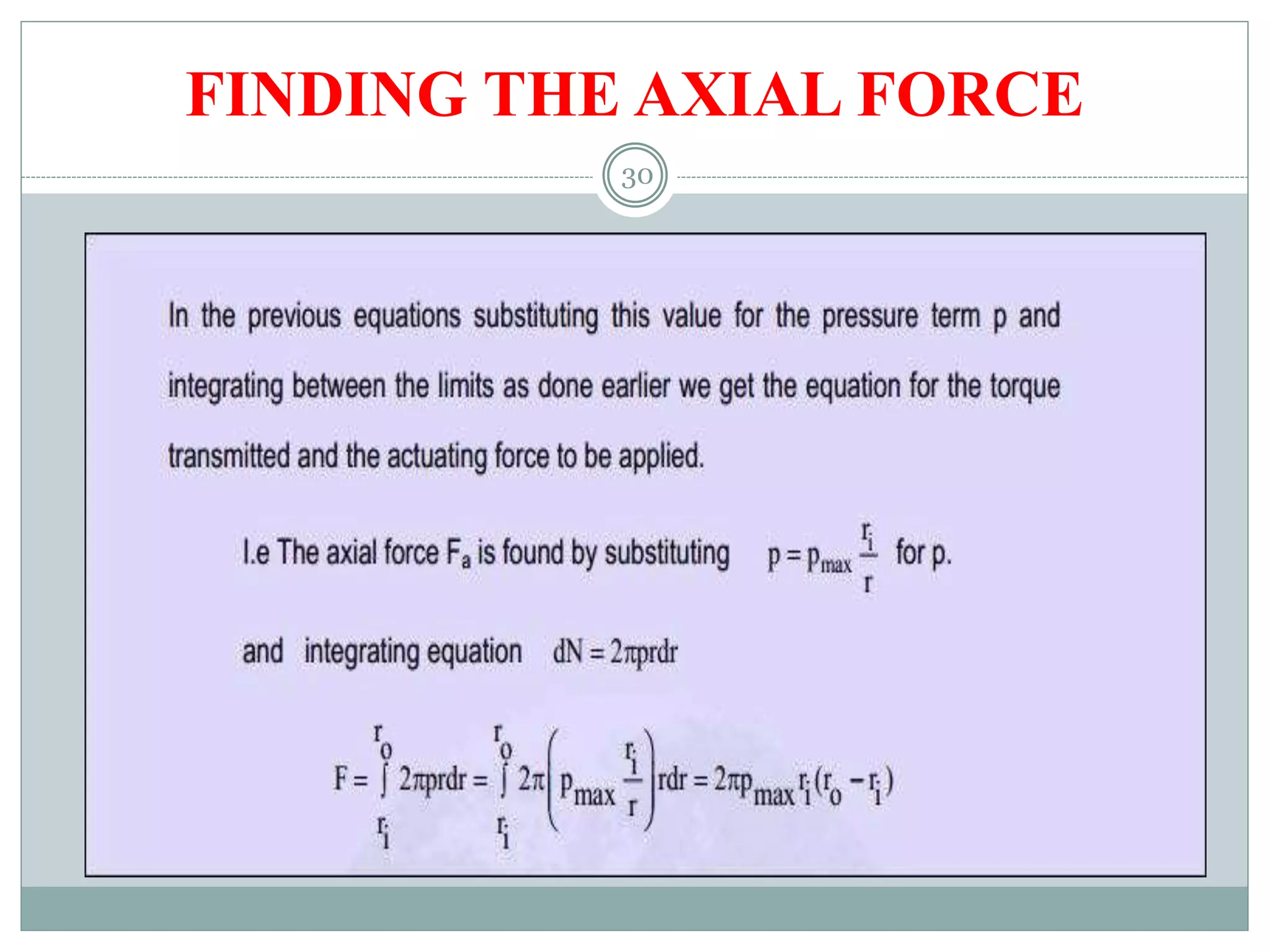
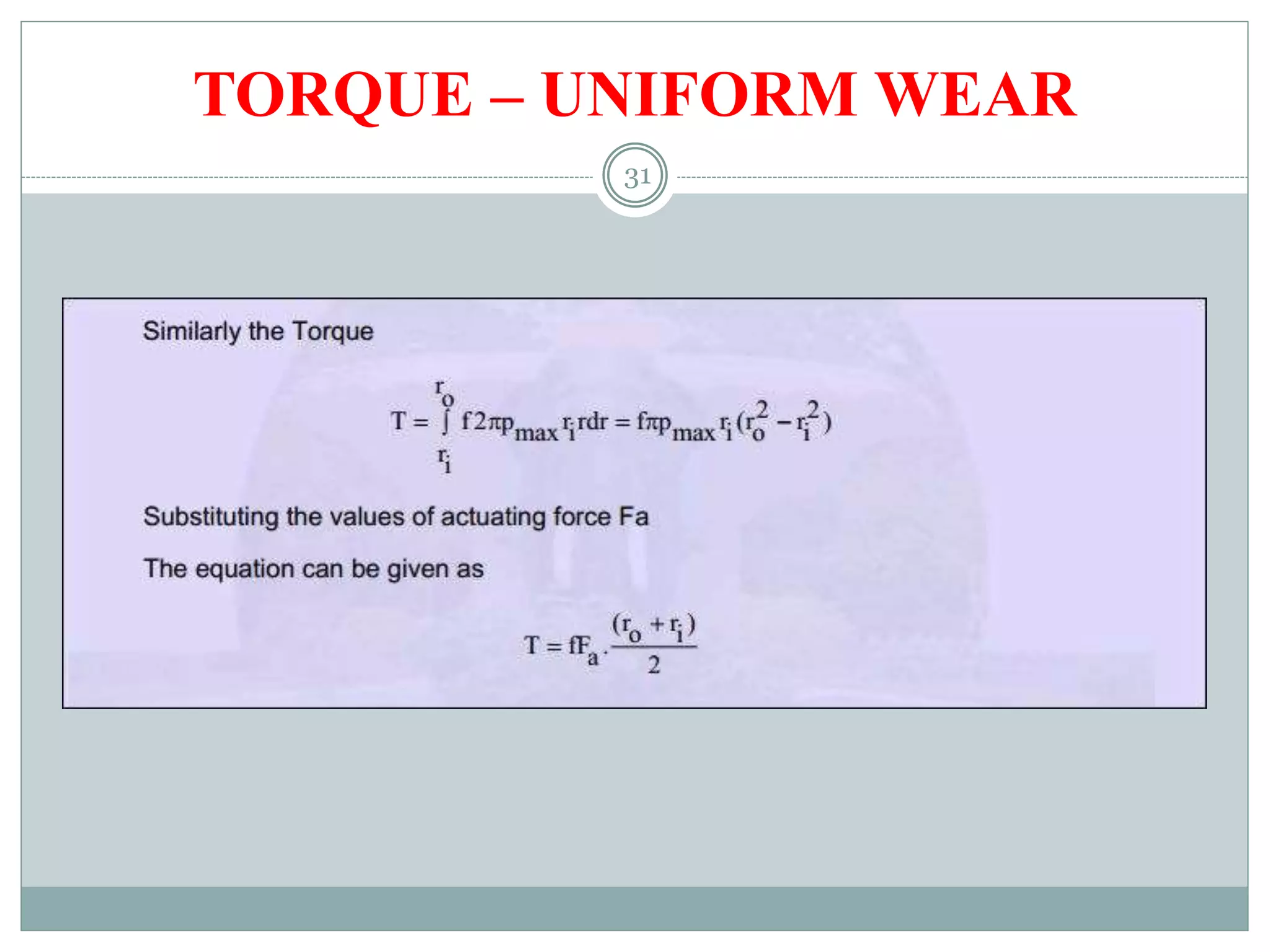
FINDING THE AXIAL FORCE
31
TORQUE – UNIFORM WEAR
32
MATERIALS USED - CLUTCH 
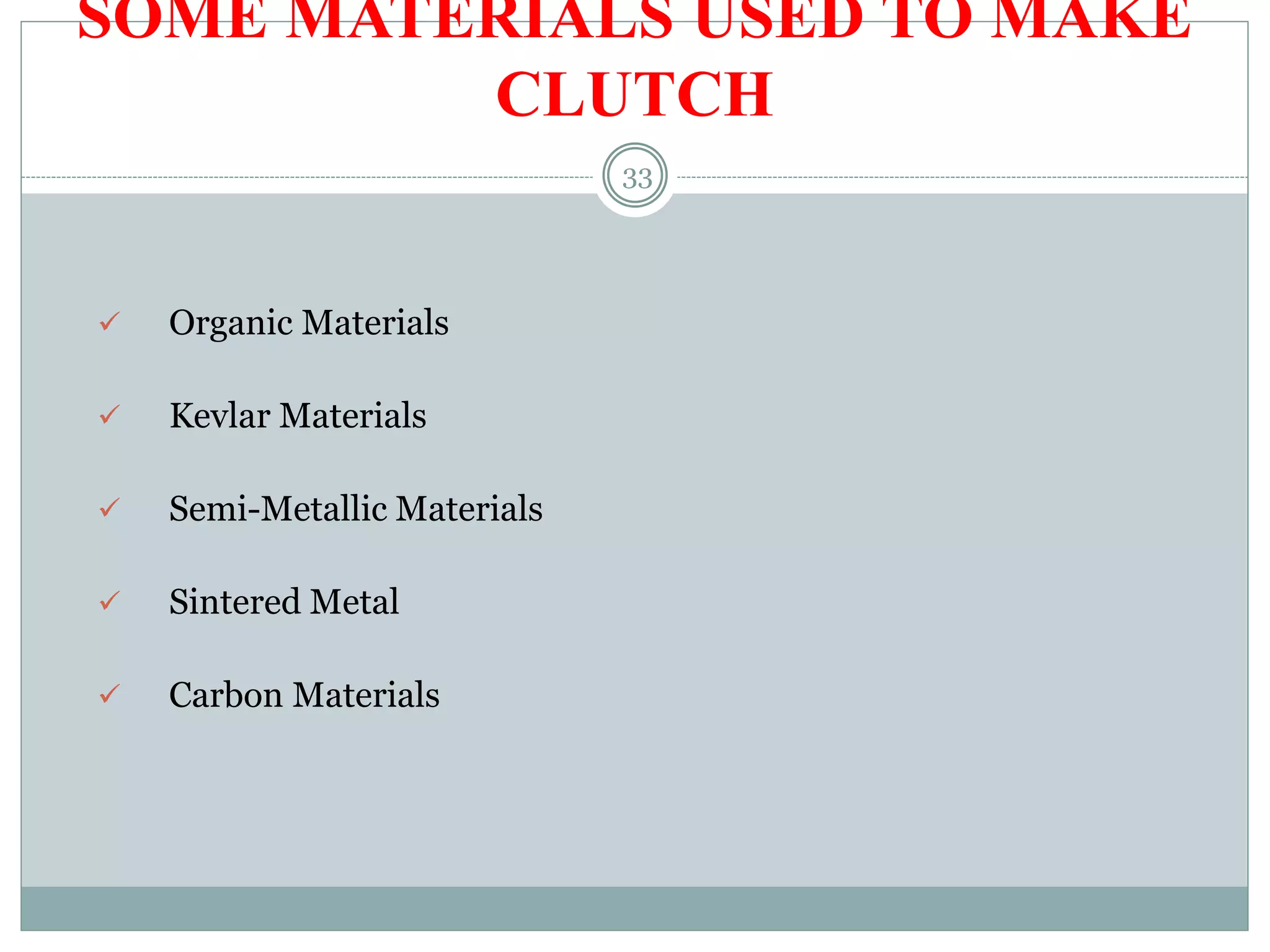
SOME MATERIALS USED TO MAKE
CLUTCH
 Organic Materials
 Kevlar Materials
 Semi-Metallic Materials
 Sintered Metal
 Carbon Materials
33
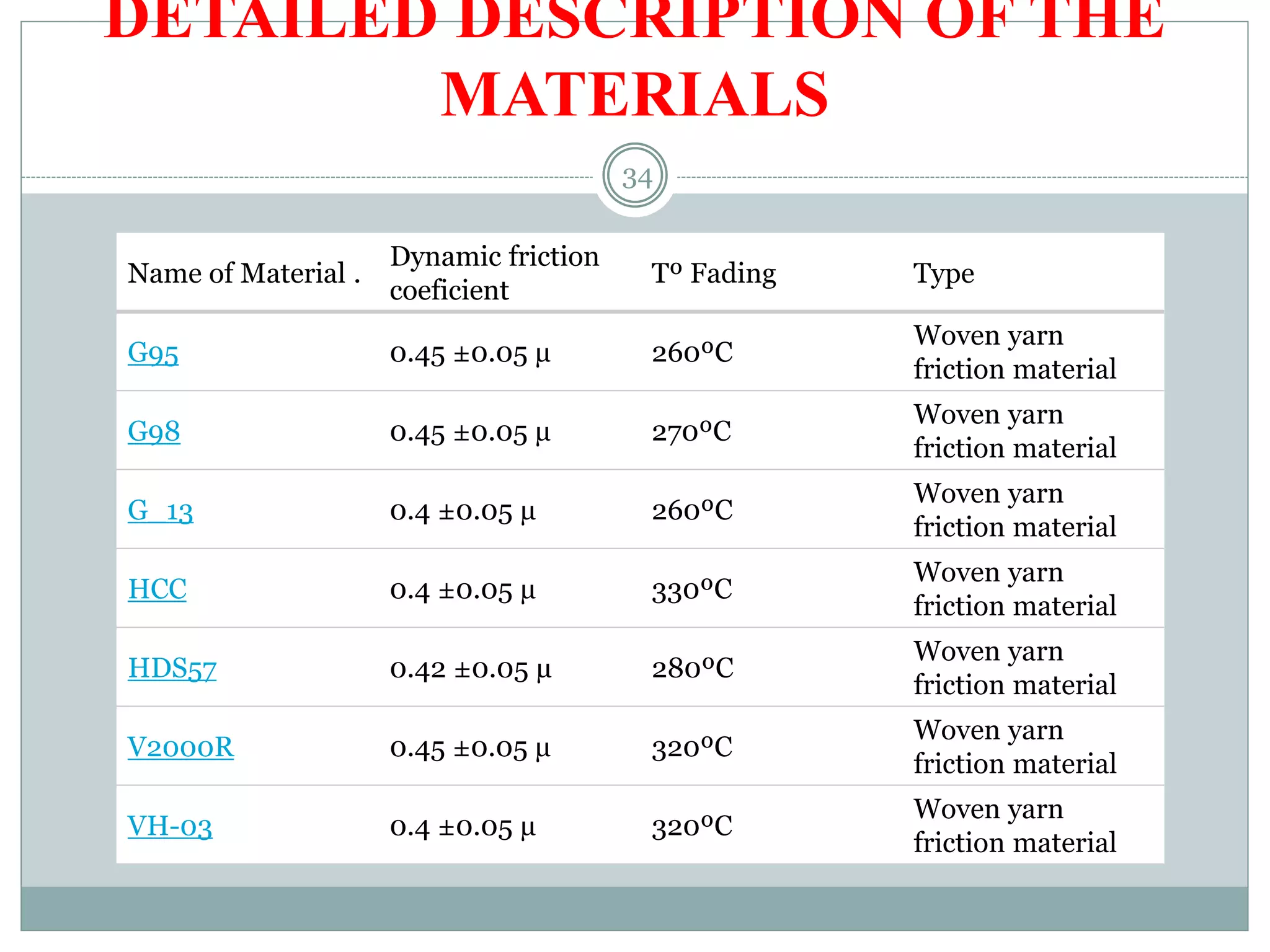
DETAILED DESCRIPTION OF THE
MATERIALS
34
Name of Material .
Dynamic friction
coeficient
Tº Fading Type
G95 0.45 ±0.05 µ 260ºC
Woven yarn
friction material
G98 0.45 ±0.05 µ 270ºC
Woven yarn
friction material
G_13 0.4 ±0.05 µ 260ºC
Woven yarn
friction material
HCC 0.4 ±0.05 µ 330ºC
Woven yarn
friction material
HDS57 0.42 ±0.05 µ 280ºC
Woven yarn
friction material
V2000R 0.45 ±0.05 µ 320ºC
Woven yarn
friction material
VH-03 0.4 ±0.05 µ 320ºC
Woven yarn
friction material
DETAILED DESCRIPTION OF THE
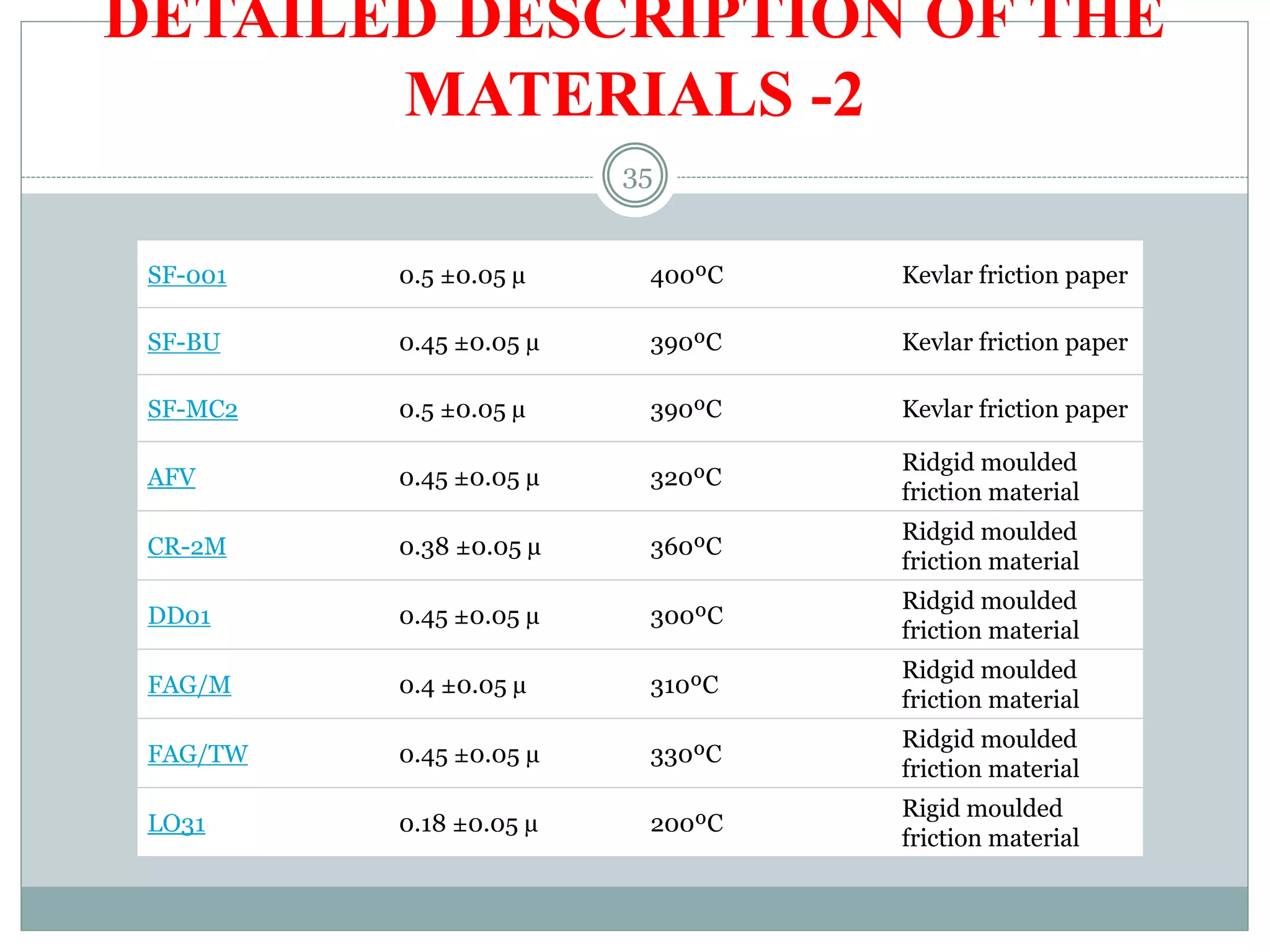
MATERIALS -2
35
SF-001 0.5 ±0.05 µ 400ºC Kevlar friction paper
SF-BU 0.45 ±0.05 µ 390ºC Kevlar friction paper
SF-MC2 0.5 ±0.05 µ 390ºC Kevlar friction paper
AFV 0.45 ±0.05 µ 320ºC
Ridgid moulded
friction material
CR-2M 0.38 ±0.05 µ 360ºC
Ridgid moulded
friction material
DD01 0.45 ±0.05 µ 300ºC
Ridgid moulded
friction material
FAG/M 0.4 ±0.05 µ 310ºC
Ridgid moulded
friction material
FAG/TW 0.45 ±0.05 µ 330ºC
Ridgid moulded
friction material
LO31 0.18 ±0.05 µ 200ºC
Rigid moulded
friction material
36
THANK YOU

Clutches - Working and Application

  • 1.
    MEE-306 : DESIGNOF TRANSMISSION SYSTEM Clutches Working and Application Faculty Guide : Professor Gokul Kumar 1 VIT University
  • 2.
    TABLE OF CONTENT Introduction to Clutches  Components in a Clutch  Types of Clutch  Working of a Clutch  Equations Involved in a Clutch  Material used to make Clutch 2
  • 3.
  • 4.
    4 PURPOSE OF ACLUTCH The Clutch serves the two purpose:  Allows engine to be disengaged from transmission for shifting gears and coming to a stop  Allows smooth engagement of engine to transmission
  • 5.
    5 WHO REQUIRES ACLUTCH The Clutch serves the two purpose:  Allows engine to be disengaged from transmission for shifting gears and coming to a stop  Allows smooth engagement of engine to transmission A picture of an old racing car with primitive clutch system
  • 6.
    6 LOCATION OF ACLUTCH Depending on the type of drive, the clutch changes its location:  Rear wheel drive  Front engine  Rear engine  Mid engine  Front wheel drive
  • 7.
    7 COMPONENTS IN ACLUTCHES 
  • 8.
  • 9.
  • 10.
  • 11.
  • 12.
  • 13.
    13 4. CLUTCH HUBAND DAMPER ASSEMBLY
  • 14.
  • 15.
  • 16.
  • 17.
    17 DIFFERENT TYPES OFCLUTCH In this presentation, basically three types of clutch has been explained:  Dog Clutch  Belt Clutch  Centrifugal Clutch
  • 18.
    18 DOG CLUTCH  Adog clutch is a type of clutch that couples two rotating shafts or other rotating components not by friction but by interference.  The two parts of the clutch are designed such that one will push the other, causing both to rotate at the same speed and will never slip.  Utilized in automobile manual transmissions.
  • 19.
    19 BELT CLUTCH  Enginepower is transmitted via a set of belts that are slack when the engine is idling, but an idler pulley can tighten the belts to increase friction between the belts and the pulleys.  Used on agricultural equipment, lawn mowers, tillers, and snow blowers.
  • 20.
    20 CENTRIFUGAL CLUTCH  Thisclutch system employs centrifugal force to automatically engage the clutch when the engine rpm rises above a threshold and to automatically disengage the clutch when the engine rpm falls low enough.  A centrifugal clutch is used in some vehicles (e.g., mopeds) and also in other applications where the speed of the engine defines the state of the clutch, for example, in a chainsaw.
  • 21.
    21 WORKING OF ACLUTCH 
  • 22.
    22 STEP-WISE WORKING OFA CLUTCH When the clutch pedal is depressed, the "Throw-out bearing" pushes the pressure plate's release fingers.1 | The pressure plate pulls away from the clutch disc, disengaging the clutch, thus interrupting power flow 2 | When the clutch pedal is released and the clutch is fully engaged, the release bearing is normally stationary and does not rotate with the pressure plate. 3 |
  • 23.
    23 STEP-WISE WORKING OFA CLUTCH -2 Clutch operation is accomplished either mechanically or with a hydraulic pressure system.4 | If a vehicle has a mechanically operated linkage, it will incorporate either a shaft-and-lever linkage arrangement or a cable. 5 | 6 | Systems that are made up of linkages, levers and pivot points are found primarily on older vehicles.
  • 24.
  • 25.
  • 26.
  • 27.
  • 28.
  • 29.
  • 30.
  • 31.
  • 32.
  • 33.
    SOME MATERIALS USEDTO MAKE CLUTCH  Organic Materials  Kevlar Materials  Semi-Metallic Materials  Sintered Metal  Carbon Materials 33
  • 34.
    DETAILED DESCRIPTION OFTHE MATERIALS 34 Name of Material . Dynamic friction coeficient Tº Fading Type G95 0.45 ±0.05 µ 260ºC Woven yarn friction material G98 0.45 ±0.05 µ 270ºC Woven yarn friction material G_13 0.4 ±0.05 µ 260ºC Woven yarn friction material HCC 0.4 ±0.05 µ 330ºC Woven yarn friction material HDS57 0.42 ±0.05 µ 280ºC Woven yarn friction material V2000R 0.45 ±0.05 µ 320ºC Woven yarn friction material VH-03 0.4 ±0.05 µ 320ºC Woven yarn friction material
  • 35.
    DETAILED DESCRIPTION OFTHE MATERIALS -2 35 SF-001 0.5 ±0.05 µ 400ºC Kevlar friction paper SF-BU 0.45 ±0.05 µ 390ºC Kevlar friction paper SF-MC2 0.5 ±0.05 µ 390ºC Kevlar friction paper AFV 0.45 ±0.05 µ 320ºC Ridgid moulded friction material CR-2M 0.38 ±0.05 µ 360ºC Ridgid moulded friction material DD01 0.45 ±0.05 µ 300ºC Ridgid moulded friction material FAG/M 0.4 ±0.05 µ 310ºC Ridgid moulded friction material FAG/TW 0.45 ±0.05 µ 330ºC Ridgid moulded friction material LO31 0.18 ±0.05 µ 200ºC Rigid moulded friction material
  • 36.