ON
DESIGN AND ANALYSIS OF
REPLACING
LEAF SPRINGS
WITH
COMPOSITE LEAF SPRING
Submitted by
D.SantoshKumar
.
Under Guidance of
Prof:P.Ravindhra Babu(M.s, Ph.d, vice principa
Gudlavalleru Engineering College
TOPICS:
 INTRODUCTION
 LEAF SPRINGS
 COMPOSITE MATERIALS
 COMPOSITE LEAF SPRINGS
 ANALYSIS AND RESULTS
 MERITS AND DEMERITS
INTRODUCTION:
Composite materials are the one of the main
applications of the aerospace, automobiles and
marine Industries. Because of their less weight,
good stiffness and less corrosive properties.
Weight reduction is one of the major factors of
that one. It results in less fuel consumption;
economize maintenance of vehicle and optimum
utilization of natural resources. The suspension
leaf spring is one of the potential items for
weight reduction in
automobile
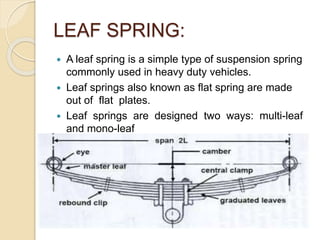
LEAF SPRING:
 A leaf spring is a simple type of suspension spring
commonly used in heavy duty vehicles.
 Leaf springs also known as flat spring are made
out of flat plates.
 Leaf springs are designed two ways: multi-leaf
and mono-leaf
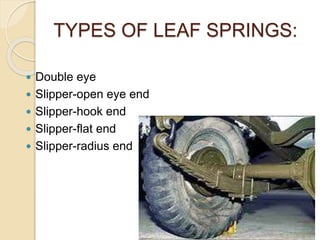
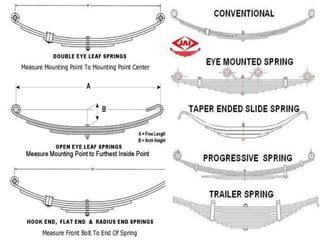
TYPES OF LEAF SPRINGS:
 Double eye
 Slipper-open eye end
 Slipper-hook end
 Slipper-flat end
 Slipper-radius end
COMPOSITE MATERIAL:
Composite materials (also called composition
materials or shortened to composites) are materials
made from two or more constituent materials with
significantly different physical or chemical properties, that
when combined, produce a material with characteristics
different from the individual components. The individual
components remain separate and distinct within the
finished structure. The new material may be preferred for
many reasons: common examples include materials
which are stronger, lighter or less expensive when
compared to traditional materials.
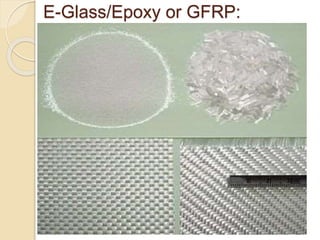
Generally we use E-Glass/Epoxy or GFRP for
composite leaf spring
E-Glass/Epoxy or GFRP:
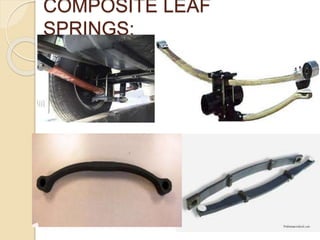
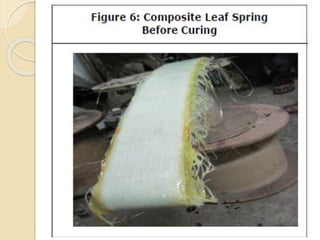
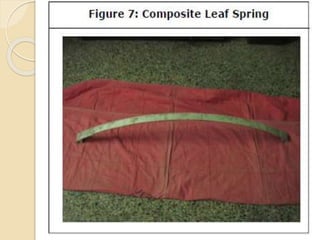
COMPOSITE LEAF
SPRINGS:
ANLYSIS AND RESULTS:
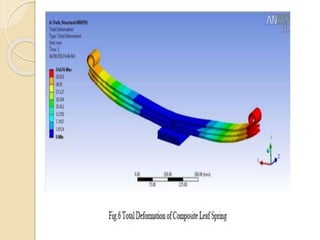
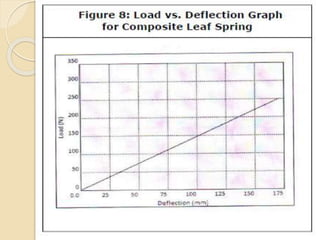
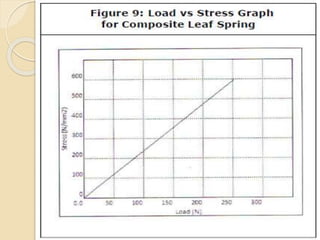
Leaf Spring is Modeled in PRO-E and it is
imported to ANSYS and then it is subjected to
different load conditions and changes like
Stress,Strain,Bending Von Mises Stress,
Deformation will be taken as graphs and Ansys
results We analyze the variations from values
shown by ansys.We compare parameters of
both leaf spring and composite leaf spring.
Some of the ansys and tabular results are
shown below
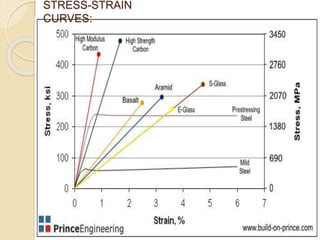
STRESS-STRAIN
CURVES:
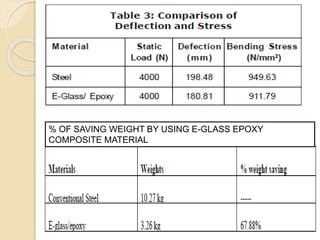
% OF SAVING WEIGHT BY USING E-GLASS EPOXY
COMPOSITE MATERIAL
Demerits of Conventional Leaf
Spring:
They have less specific modulus and
strength
Increased weight.
Conventional leaf springs are usually
manufactured and assembled by
using number of leafs made of steel
and hence the weight is more.
Its corrosion resistance is less
compared to composite materials
Steel leaf springs have less damping
Advantages of Composite leaf spring
suspension:
 Minimum wear and tear of body parts and tyre due to
delicate tendency of absorbing road shocks, jerks and
vibrations.
 Softer ride, Lower noise level, excellent stability due to
better damping characteristics.
 Excellent corrosion resistance against atmospheric
pollutants.
 Five times stronger than conventional metal leaf springs.
 Fully interchangeable with the conventional spring
without any modifications.
 Increase in fuel efficiency due to better aerodynamics
and around 60% weight reduction.
 No cracking sound since mono leaf and hence no inter-
leaf friction and no greasing required.
 Fatigue life 1 million cycles as compared to only 2 lacks
Any Queries

LEAF SPRING

  • 1.
    ON DESIGN AND ANALYSISOF REPLACING LEAF SPRINGS WITH COMPOSITE LEAF SPRING Submitted by D.SantoshKumar . Under Guidance of Prof:P.Ravindhra Babu(M.s, Ph.d, vice principa Gudlavalleru Engineering College
  • 2.
    TOPICS:  INTRODUCTION  LEAFSPRINGS  COMPOSITE MATERIALS  COMPOSITE LEAF SPRINGS  ANALYSIS AND RESULTS  MERITS AND DEMERITS
  • 3.
    INTRODUCTION: Composite materials arethe one of the main applications of the aerospace, automobiles and marine Industries. Because of their less weight, good stiffness and less corrosive properties. Weight reduction is one of the major factors of that one. It results in less fuel consumption; economize maintenance of vehicle and optimum utilization of natural resources. The suspension leaf spring is one of the potential items for weight reduction in automobile
  • 4.
    LEAF SPRING:  Aleaf spring is a simple type of suspension spring commonly used in heavy duty vehicles.  Leaf springs also known as flat spring are made out of flat plates.  Leaf springs are designed two ways: multi-leaf and mono-leaf
  • 5.
    TYPES OF LEAFSPRINGS:  Double eye  Slipper-open eye end  Slipper-hook end  Slipper-flat end  Slipper-radius end
  • 7.
    COMPOSITE MATERIAL: Composite materials(also called composition materials or shortened to composites) are materials made from two or more constituent materials with significantly different physical or chemical properties, that when combined, produce a material with characteristics different from the individual components. The individual components remain separate and distinct within the finished structure. The new material may be preferred for many reasons: common examples include materials which are stronger, lighter or less expensive when compared to traditional materials. Generally we use E-Glass/Epoxy or GFRP for composite leaf spring
  • 8.
  • 9.
  • 12.
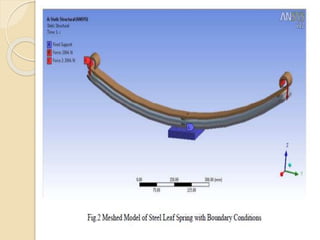
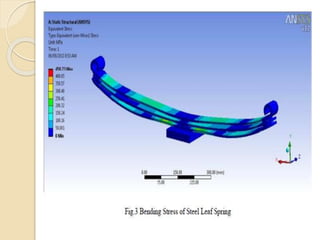
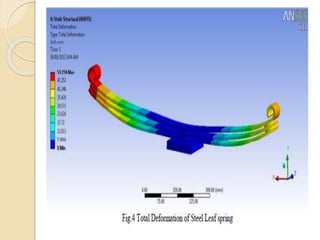
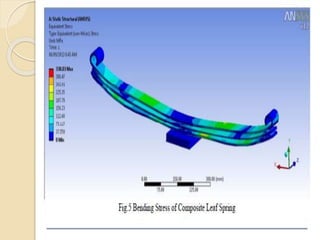
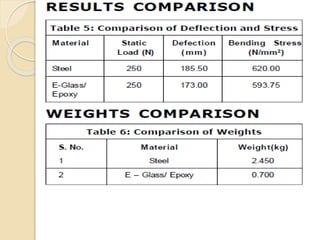
    ANLYSIS AND RESULTS: LeafSpring is Modeled in PRO-E and it is imported to ANSYS and then it is subjected to different load conditions and changes like Stress,Strain,Bending Von Mises Stress, Deformation will be taken as graphs and Ansys results We analyze the variations from values shown by ansys.We compare parameters of both leaf spring and composite leaf spring. Some of the ansys and tabular results are shown below
  • 18.
  • 22.
    % OF SAVINGWEIGHT BY USING E-GLASS EPOXY COMPOSITE MATERIAL
  • 23.
    Demerits of ConventionalLeaf Spring: They have less specific modulus and strength Increased weight. Conventional leaf springs are usually manufactured and assembled by using number of leafs made of steel and hence the weight is more. Its corrosion resistance is less compared to composite materials Steel leaf springs have less damping
  • 24.
    Advantages of Compositeleaf spring suspension:  Minimum wear and tear of body parts and tyre due to delicate tendency of absorbing road shocks, jerks and vibrations.  Softer ride, Lower noise level, excellent stability due to better damping characteristics.  Excellent corrosion resistance against atmospheric pollutants.  Five times stronger than conventional metal leaf springs.  Fully interchangeable with the conventional spring without any modifications.  Increase in fuel efficiency due to better aerodynamics and around 60% weight reduction.  No cracking sound since mono leaf and hence no inter- leaf friction and no greasing required.  Fatigue life 1 million cycles as compared to only 2 lacks
  • 25.