Automobile Engineering
Dr. V.K Pramod
Associate Professor
Dept. of Mechanical Engineering
GEC, Idukki
ENERGY AND POWER
Energy is used to produce power.
Engine power or horsepower is the maximum power that
an engine can put out. It can be expressed in kilowatts or
horsepower. The power output depends on the size and
design of the engine, but also on the speed at which it is
running and the load or torque.
The chemical energy in fuel is converted to heat by the
burning of the fuel at a controlled rate.
This process is called combustion.
-If engine combustion occurs within the power chamber,
the engine is called an internal combustion engine
Torque
Torque, moment, or moment of force is the tendency of a
force to rotate an object about an axis or pivot. Just as a force
is a push or a pull, a torque can be thought of as a twist to an
object.
torque is a measure of the turning force on an object such as a
bolt or a flywheel .For example, pushing or pulling the handle of
a wrench connected to a nut or bolt produces a torque (turning
force) that loosens or tightens the nut or bolt.
HP and BHP
• Horsepower is a unit of measurement of power, or the rate at
which work is done.
•HP is the output power rating of an engine.
•BHP is the maximum power produced before it is delivered to
the drive train.
•BHP is the measurement of an engine’s power without any
power losses.
•HP is measured by hooking up the engine to a dynamometer,
while BHP is measured in a controlled environment without
anything attached to the engine.
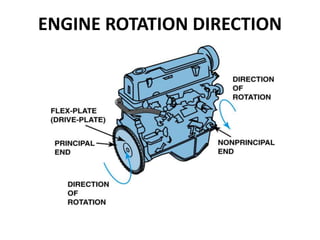
ENGINE ROTATION DIRECTION
• The SAE(Society of Automotive Engineers) standard
for automotive engine rotation is counterclockwise
(CCW) as viewed from the flywheel end (clockwise as
viewed from the front of the engine).
• The flywheel end of the engine is the end to which
the power is applied to drive the vehicle.
• This is called the principal end of the engine.
• The non principal end of the engine is opposite the
principal end and is generally referred to as the front
of the engine, where the accessory belts are used.
ENGINE ROTATION DIRECTION
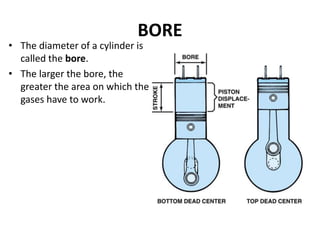
BORE
• The diameter of a cylinder is
called the bore.
• The larger the bore, the
greater the area on which the
gases have to work.
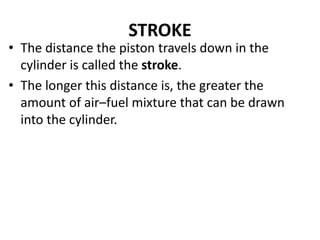
STROKE
• The distance the piston travels down in the
cylinder is called the stroke.
• The longer this distance is, the greater the
amount of air–fuel mixture that can be drawn
into the cylinder.
ENGINE DISPLACEMENT
• Engine size is described as displacement.
• Displacement is the cubic inch (cu. in.) or cubic
centimeter (cc) volume displaced or swept by all
of the pistons.
• A liter (L) is equal to 1,000 cubic centimeters;
therefore, most engines today are identified by
their displacement in liters.
– 1 L = 1,000 cc
– 1 L = 61 cu. in.
– 1 cu. in. = 16.4 cc
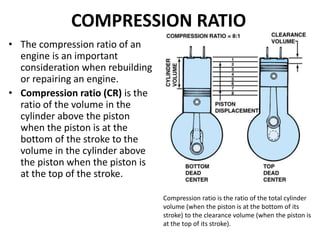
COMPRESSION RATIO
• The compression ratio of an
engine is an important
consideration when rebuilding
or repairing an engine.
• Compression ratio (CR) is the
ratio of the volume in the
cylinder above the piston
when the piston is at the
bottom of the stroke to the
volume in the cylinder above
the piston when the piston is
at the top of the stroke.
Compression ratio is the ratio of the total cylinder
volume (when the piston is at the bottom of its
stroke) to the clearance volume (when the piston is
at the top of its stroke).
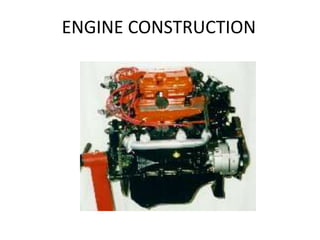
ENGINE CONSTRUCTION
12
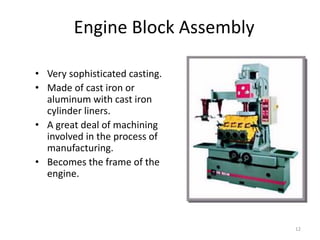
Engine Block Assembly
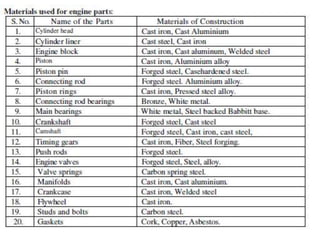
• Very sophisticated casting.
• Made of cast iron or
aluminum with cast iron
cylinder liners.
• A great deal of machining
involved in the process of
manufacturing.
• Becomes the frame of the
engine.
13
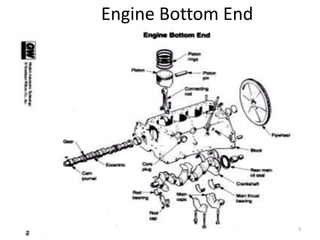
Engine Bottom End
14
Bottom End Parts
• Block
• Crankshaft
• Connecting Rod
• Pistons, Rings, & Wrist Pin
• Bearings (Main and Connecting rod)
• Caps (main and Connecting Rod)
• Fly Wheel and nuts and bolts
15
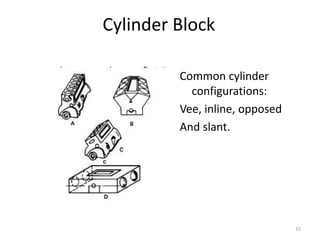
Cylinder Block
Common cylinder
configurations:
Vee, inline, opposed
And slant.
16
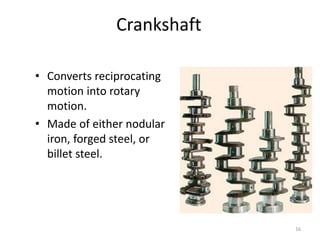
Crankshaft
• Converts reciprocating
motion into rotary
motion.
• Made of either nodular
iron, forged steel, or
billet steel.
17
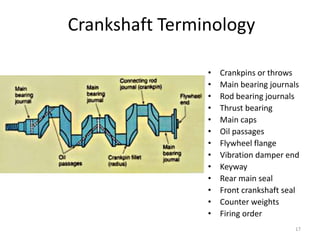
Crankshaft Terminology
• Crankpins or throws
• Main bearing journals
• Rod bearing journals
• Thrust bearing
• Main caps
• Oil passages
• Flywheel flange
• Vibration damper end
• Keyway
• Rear main seal
• Front crankshaft seal
• Counter weights
• Firing order
18
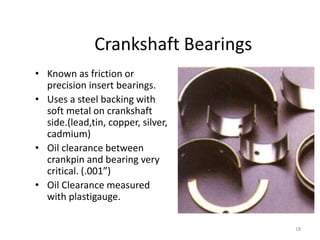
Crankshaft Bearings
• Known as friction or
precision insert bearings.
• Uses a steel backing with
soft metal on crankshaft
side.(lead,tin, copper, silver,
cadmium)
• Oil clearance between
crankpin and bearing very
critical. (.001”)
• Oil Clearance measured
with plastigauge.
19
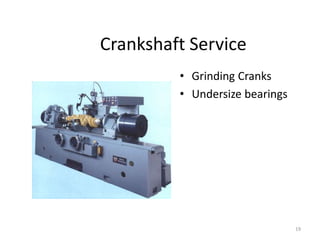
Crankshaft Service
• Grinding Cranks
• Undersize bearings
20
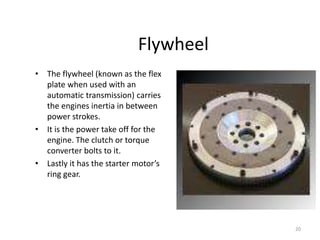
Flywheel
• The flywheel (known as the flex
plate when used with an
automatic transmission) carries
the engines inertia in between
power strokes.
• It is the power take off for the
engine. The clutch or torque
converter bolts to it.
• Lastly it has the starter motor’s
ring gear.
21
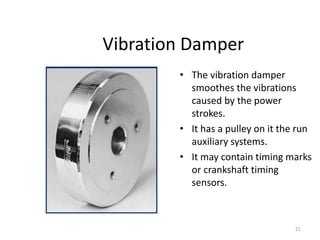
Vibration Damper
• The vibration damper
smoothes the vibrations
caused by the power
strokes.
• It has a pulley on it the run
auxiliary systems.
• It may contain timing marks
or crankshaft timing
sensors.
22
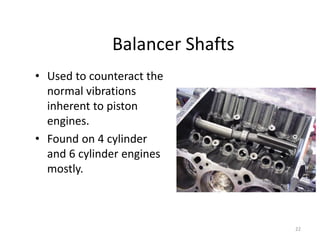
Balancer Shafts
• Used to counteract the
normal vibrations
inherent to piston
engines.
• Found on 4 cylinder
and 6 cylinder engines
mostly.
23
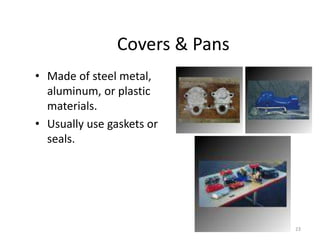
Covers & Pans
• Made of steel metal,
aluminum, or plastic
materials.
• Usually use gaskets or
seals.
24
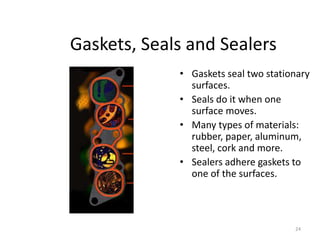
Gaskets, Seals and Sealers
• Gaskets seal two stationary
surfaces.
• Seals do it when one
surface moves.
• Many types of materials:
rubber, paper, aluminum,
steel, cork and more.
• Sealers adhere gaskets to
one of the surfaces.
25
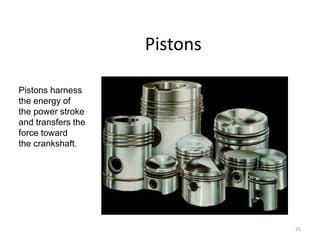
Pistons
Pistons harness
the energy of
the power stroke
and transfers the
force toward
the crankshaft.
26
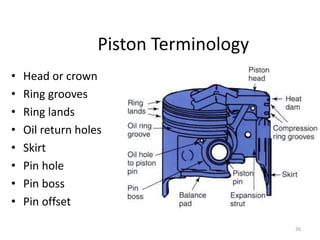
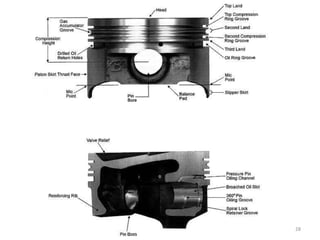
Piston Terminology
• Head or crown
• Ring grooves
• Ring lands
• Oil return holes
• Skirt
• Pin hole
• Pin boss
• Pin offset
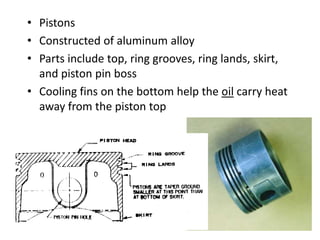
• Pistons
• Constructed of aluminum alloy
• Parts include top, ring grooves, ring lands, skirt,
and piston pin boss
• Cooling fins on the bottom help the oil carry heat
away from the piston top
28
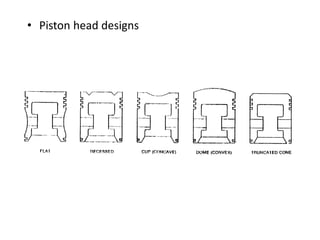
• Piston head designs
• Piston rings (general)
• Provide seal between cylinder wall and piston
• Rings ride on a thin film of oil
• Conduct heat from the piston out to the cylinder
and the fins
• Material is cast iron or chrome steel
• Piston rings (type)
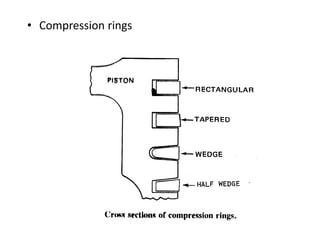
• Compression rings are located at the top of the
piston and seal the combustion chamber
• Types include rectangular, tapered,wedge
31
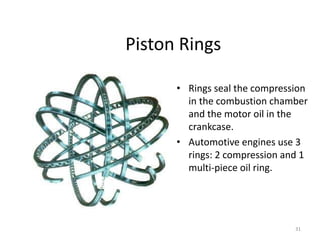
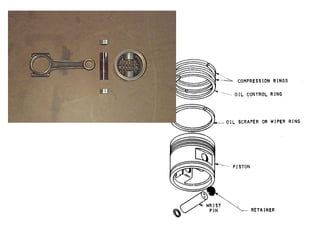
Piston Rings
• Rings seal the compression
in the combustion chamber
and the motor oil in the
crankcase.
• Automotive engines use 3
rings: 2 compression and 1
multi-piece oil ring.
• Compression rings
• Oil control rings
• On bottom of piston below compression rings
• Regulates oil film thickness on cylinder wall
• Holes in ring and piston allow excess oil to drain
back to crankcase
• Too much oil film and the engine will use excessive
oil and too little oil causes heat and insufficient
lubrication
• Oil scraper rings
• Directs the oil away from or towards the oil control
rings depending upon the requirements of the
engine
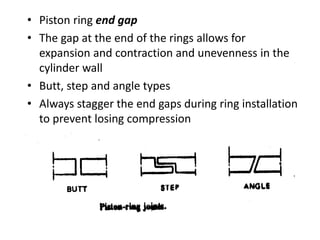
• Piston ring end gap
• The gap at the end of the rings allows for
expansion and contraction and unevenness in the
cylinder wall
• Butt, step and angle types
• Always stagger the end gaps during ring installation
to prevent losing compression
• Piston Pins (wrist pins)
• Connects the piston to the end of the connecting
rod
• Constructed of hardened steel
• The pin is retained in the piston with clips or plugs
to prevent cylinder wall scoring
• Typical Lycoming and Continental pins are free-
floating, meaning the pin is not secured to the
piston or the rod.
37
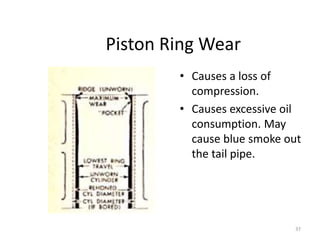
Piston Ring Wear
• Causes a loss of
compression.
• Causes excessive oil
consumption. May
cause blue smoke out
the tail pipe.
38
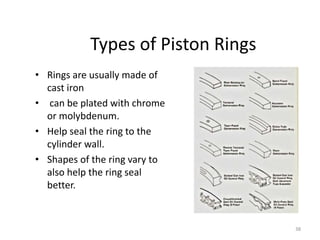
Types of Piston Rings
• Rings are usually made of
cast iron
• can be plated with chrome
or molybdenum.
• Help seal the ring to the
cylinder wall.
• Shapes of the ring vary to
also help the ring seal
better.
39
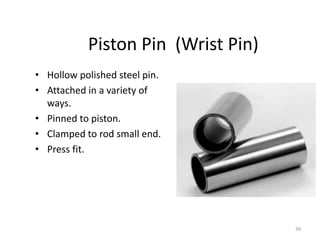
Piston Pin (Wrist Pin)
• Hollow polished steel pin.
• Attached in a variety of
ways.
• Pinned to piston.
• Clamped to rod small end.
• Press fit.
40
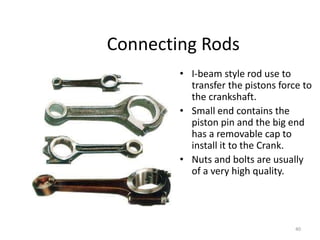
Connecting Rods
• I-beam style rod use to
transfer the pistons force to
the crankshaft.
• Small end contains the
piston pin and the big end
has a removable cap to
install it to the Crank.
• Nuts and bolts are usually
of a very high quality.
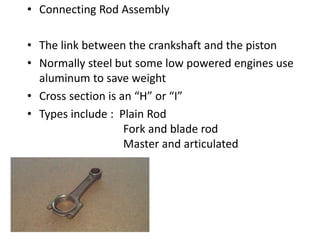
• Connecting Rod Assembly
• The link between the crankshaft and the piston
• Normally steel but some low powered engines use
aluminum to save weight
• Cross section is an “H” or “I”
• Types include : Plain Rod
Fork and blade rod
Master and articulated
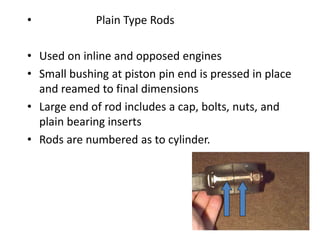
• Plain Type Rods
• Used on inline and opposed engines
• Small bushing at piston pin end is pressed in place
and reamed to final dimensions
• Large end of rod includes a cap, bolts, nuts, and
plain bearing inserts
• Rods are numbered as to cylinder.
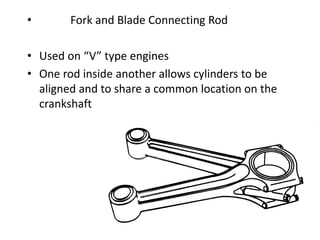
• Fork and Blade Connecting Rod
• Used on “V” type engines
• One rod inside another allows cylinders to be
aligned and to share a common location on the
crankshaft
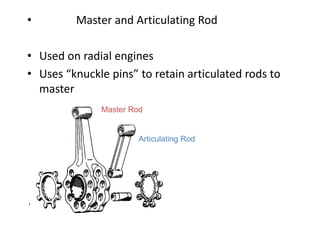
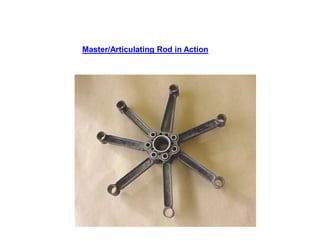
• Master and Articulating Rod
• Used on radial engines
• Uses “knuckle pins” to retain articulated rods to
master
Master Rod
Articulating Rod
Master/Articulating Rod in Action
46
Installation of Pistons
• Cylinder number
• Piston number
• Notch to the front
• Position ring gaps
• Remove rod cap check bearing inserts
• Cover bolts with fuel line if needed
• Crankshaft at TDC or BDC
• Install ring compressor
• Oil piston, cylinder wall, & crank journal
• Carefully tap in piston with hammer handle.
• Properly replace rod cap
47
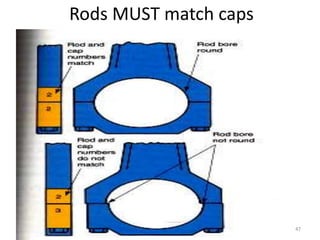
Rods MUST match caps
48
Weird Science of Engines
• Free running and Non-free running
• Crankshaft rotation versus piston travel
• Piston side thrust
• Piston pin offset
• Cylinder bore wear
• Crankshaft journal wear
49
Free and Non-Free running Engines
• Free running engines
can have their piston at
TDC and their valves
wide open and the
valve won’t touch the
piston.
• Non-free running
engines will crash the
valves into the piston if
the piston is at TDC and
the valves are wide
open. This will wreck
the engine.
50
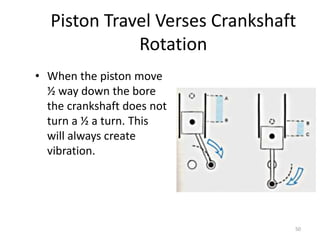
Piston Travel Verses Crankshaft
Rotation
• When the piston move
½ way down the bore
the crankshaft does not
turn a ½ a turn. This
will always create
vibration.
51
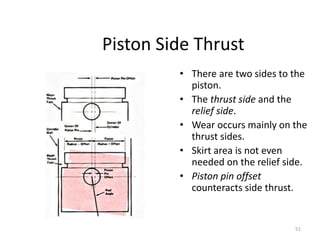
Piston Side Thrust
• There are two sides to the
piston.
• The thrust side and the
relief side.
• Wear occurs mainly on the
thrust sides.
• Skirt area is not even
needed on the relief side.
• Piston pin offset
counteracts side thrust.
52
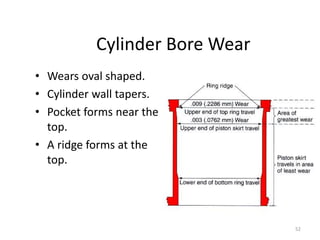
Cylinder Bore Wear
• Wears oval shaped.
• Cylinder wall tapers.
• Pocket forms near the
top.
• A ridge forms at the
top.
53
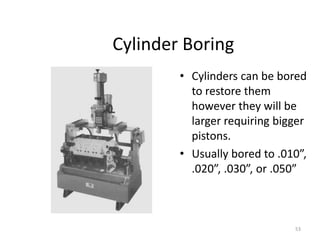
Cylinder Boring
• Cylinders can be bored
to restore them
however they will be
larger requiring bigger
pistons.
• Usually bored to .010”,
.020”, .030”, or .050”
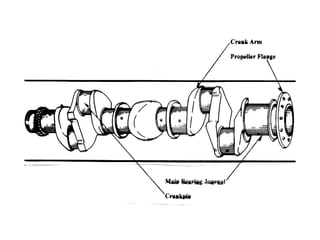
• Crankshaft
• Changes reciprocating motion of pistons into
rotating motion to drive propeller
• Constructed of chrome-nickel-molybdenum-steel
• May be one piece or as many as three separate
pieces
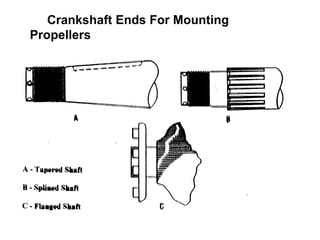
• The propeller mounts to the front of the crankshaft
using a spline, taper, or flange
• The crankshaft rotates within the crankcase and is
supported by main bearing journals
• Crankshaft throws or crankpins are off center and
account for the reciprocating motion of the pistons
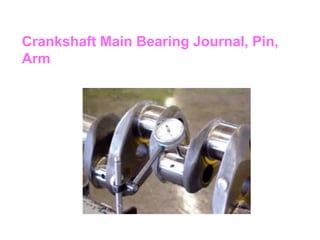
Crankshaft Main Bearing Journal, Pin,
Arm
Crankshaft Ends For Mounting
Propellers
58
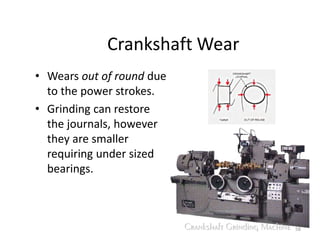
Crankshaft Wear
• Wears out of round due
to the power strokes.
• Grinding can restore
the journals, however
they are smaller
requiring under sized
bearings.
• Dynamic Dampers can be mounted to the
crankshaft to reduce vibration (floating)
• Counterweights are also used to reduce vibration
but they are rigid and do not float
• Counterweights and dampers are used in piston
engines because the power pulses and movement
of the pistons create large amounts of vibration
• Vibration shortens airframe and engine life and can
lead to premature component failure
• The engine is also mounted in rubber bushings to
absorb vibration
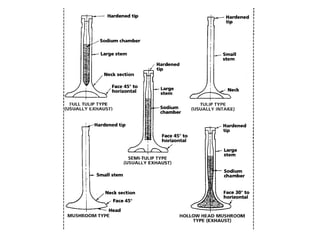
• Valves and the Valve System
• Valves control the flow of gases inside the engine
• Poppet valves are the most common and get their
name from the popping open and closed during
operation
• Intake valves are chrome steel and are cooled by
the incoming air and fuel mixture
• Exhaust valves are also alloy steel but are often
filled with metallic sodium for cooling. Valve faces
may be coated with Stellite to reduce wear and
corrosion
• Valve faces are ground to 30 degrees for intake
(airflow) and 45 degrees (cooling) for exhaust
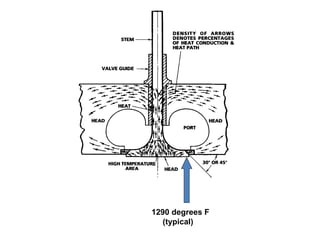
1290 degrees F
(typical)
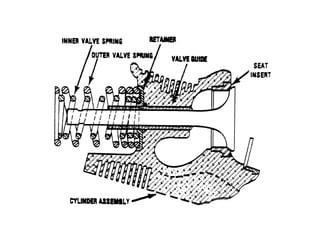
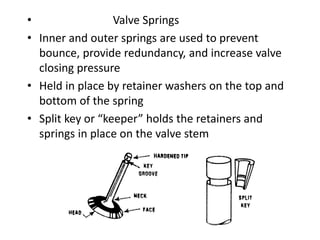
• Valve Springs
• Inner and outer springs are used to prevent
bounce, provide redundancy, and increase valve
closing pressure
• Held in place by retainer washers on the top and
bottom of the spring
• Split key or “keeper” holds the retainers and
springs in place on the valve stem
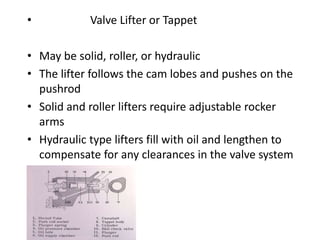
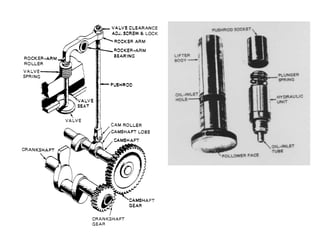
• Valve Lifter or Tappet
• May be solid, roller, or hydraulic
• The lifter follows the cam lobes and pushes on the
pushrod
• Solid and roller lifters require adjustable rocker
arms
• Hydraulic type lifters fill with oil and lengthen to
compensate for any clearances in the valve system
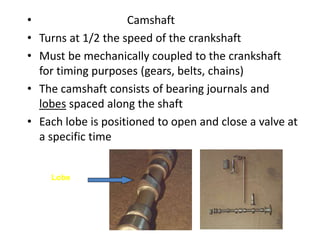
• Camshaft
• Turns at 1/2 the speed of the crankshaft
• Must be mechanically coupled to the crankshaft
for timing purposes (gears, belts, chains)
• The camshaft consists of bearing journals and
lobes spaced along the shaft
• Each lobe is positioned to open and close a valve at
a specific time
Lobe
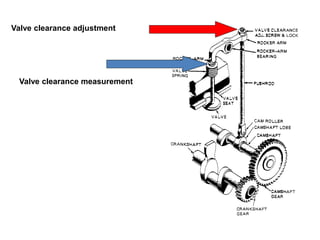
• Pushrod
• transmits push of lifter up to rocker arm
• Hollow to allow oil to flow to the top of the
cylinder for valve part lubrication
• Length can be varied to adjust valve clearance
• Valve clearance is the space between the top of
the valve stem and the rocker arm. This clearance
is to prevent a valve from being held open with the
resulting heat build-up and loss of compression
• valve clearance increases as the engine operates
due to cylinder expansion (solid lifters)
• Hydraulic lifters have a “0” clearance in operation
Valve clearance adjustment
Valve clearance measurement
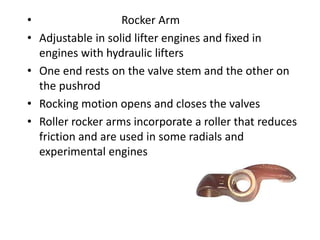
• Rocker Arm
• Adjustable in solid lifter engines and fixed in
engines with hydraulic lifters
• One end rests on the valve stem and the other on
the pushrod
• Rocking motion opens and closes the valves
• Roller rocker arms incorporate a roller that reduces
friction and are used in some radials and
experimental engines
• Bearings
Must be able to withstand forces inside an
engine with minimal friction and heat build-
up. Must accept radial and thrust loads
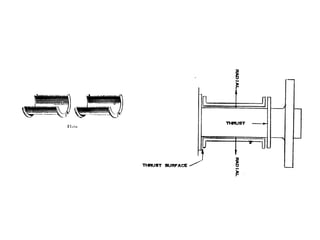
• Plain Bearings
• A steel insert with babbitt (lead alloy) bonded to
the bearing surface
• Plain bearings are keyed to keep them in place
• A lip or flange allows the plain bearing to accept
thrust loads
• Commonly used as crankshaft and rod bearings in
opposed engines
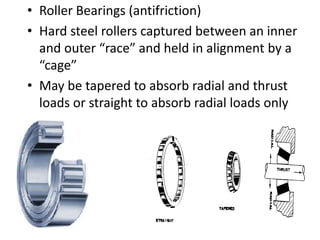
• Roller Bearings (antifriction)
• Hard steel rollers captured between an inner
and outer “race” and held in alignment by a
“cage”
• May be tapered to absorb radial and thrust
loads or straight to absorb radial loads only
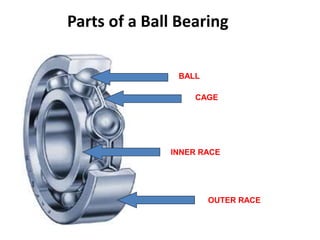
Parts of a Ball Bearing
OUTER RACE
INNER RACE
CAGE
BALL
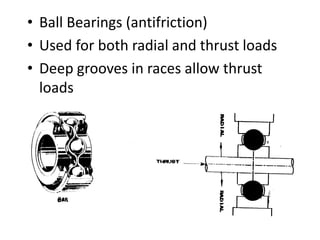
• Ball Bearings (antifriction)
• Used for both radial and thrust loads
• Deep grooves in races allow thrust
loads
Bearing cleaning and safety
• Wash old grease and debris with solvent
• Blow dry with shop air but do not spin the bearing
with the air blast
• Reapply grease or oil immediately to prevent
corrosion
• Protect skin and eyes from solvent contact
Propeller Reduction Gearing
• Purpose is to reduce propeller rpm to its optimal
speed and to increase engine rpm to its optimal
speed
• Propeller always turns slower than the engine
• Gear Ratios:
• Expressed as 2:1, .64:1, 300:1
• At what speed will the propeller be turning if the
engine rpm is 2000 and the gear ratio is 2:1?
• 1000 rpm
• Which reduction ratio will provide the fastest
propeller speed 10:1 or 4:1?
• 4:1 (it is the closest to 1:1)
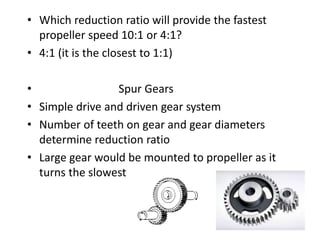
• Spur Gears
• Simple drive and driven gear system
• Number of teeth on gear and gear diameters
determine reduction ratio
• Large gear would be mounted to propeller as it
turns the slowest
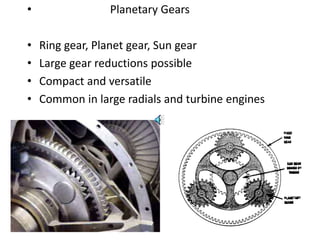
• Planetary Gears
• Ring gear, Planet gear, Sun gear
• Large gear reductions possible
• Compact and versatile
• Common in large radials and turbine engines
ENERGY AND POWER PVK.ppt

ENERGY AND POWER PVK.ppt

  • 1.
    Automobile Engineering Dr. V.KPramod Associate Professor Dept. of Mechanical Engineering GEC, Idukki
  • 2.
    ENERGY AND POWER Energyis used to produce power. Engine power or horsepower is the maximum power that an engine can put out. It can be expressed in kilowatts or horsepower. The power output depends on the size and design of the engine, but also on the speed at which it is running and the load or torque. The chemical energy in fuel is converted to heat by the burning of the fuel at a controlled rate. This process is called combustion. -If engine combustion occurs within the power chamber, the engine is called an internal combustion engine
  • 3.
    Torque Torque, moment, ormoment of force is the tendency of a force to rotate an object about an axis or pivot. Just as a force is a push or a pull, a torque can be thought of as a twist to an object. torque is a measure of the turning force on an object such as a bolt or a flywheel .For example, pushing or pulling the handle of a wrench connected to a nut or bolt produces a torque (turning force) that loosens or tightens the nut or bolt.
  • 4.
    HP and BHP •Horsepower is a unit of measurement of power, or the rate at which work is done. •HP is the output power rating of an engine. •BHP is the maximum power produced before it is delivered to the drive train. •BHP is the measurement of an engine’s power without any power losses. •HP is measured by hooking up the engine to a dynamometer, while BHP is measured in a controlled environment without anything attached to the engine.
  • 5.
    ENGINE ROTATION DIRECTION •The SAE(Society of Automotive Engineers) standard for automotive engine rotation is counterclockwise (CCW) as viewed from the flywheel end (clockwise as viewed from the front of the engine). • The flywheel end of the engine is the end to which the power is applied to drive the vehicle. • This is called the principal end of the engine. • The non principal end of the engine is opposite the principal end and is generally referred to as the front of the engine, where the accessory belts are used.
  • 6.
  • 7.
    BORE • The diameterof a cylinder is called the bore. • The larger the bore, the greater the area on which the gases have to work.
  • 8.
    STROKE • The distancethe piston travels down in the cylinder is called the stroke. • The longer this distance is, the greater the amount of air–fuel mixture that can be drawn into the cylinder.
  • 9.
    ENGINE DISPLACEMENT • Enginesize is described as displacement. • Displacement is the cubic inch (cu. in.) or cubic centimeter (cc) volume displaced or swept by all of the pistons. • A liter (L) is equal to 1,000 cubic centimeters; therefore, most engines today are identified by their displacement in liters. – 1 L = 1,000 cc – 1 L = 61 cu. in. – 1 cu. in. = 16.4 cc
  • 10.
    COMPRESSION RATIO • Thecompression ratio of an engine is an important consideration when rebuilding or repairing an engine. • Compression ratio (CR) is the ratio of the volume in the cylinder above the piston when the piston is at the bottom of the stroke to the volume in the cylinder above the piston when the piston is at the top of the stroke. Compression ratio is the ratio of the total cylinder volume (when the piston is at the bottom of its stroke) to the clearance volume (when the piston is at the top of its stroke).
  • 11.
  • 12.
    12 Engine Block Assembly •Very sophisticated casting. • Made of cast iron or aluminum with cast iron cylinder liners. • A great deal of machining involved in the process of manufacturing. • Becomes the frame of the engine.
  • 13.
  • 14.
    14 Bottom End Parts •Block • Crankshaft • Connecting Rod • Pistons, Rings, & Wrist Pin • Bearings (Main and Connecting rod) • Caps (main and Connecting Rod) • Fly Wheel and nuts and bolts
  • 15.
  • 16.
    16 Crankshaft • Converts reciprocating motioninto rotary motion. • Made of either nodular iron, forged steel, or billet steel.
  • 17.
    17 Crankshaft Terminology • Crankpinsor throws • Main bearing journals • Rod bearing journals • Thrust bearing • Main caps • Oil passages • Flywheel flange • Vibration damper end • Keyway • Rear main seal • Front crankshaft seal • Counter weights • Firing order
  • 18.
    18 Crankshaft Bearings • Knownas friction or precision insert bearings. • Uses a steel backing with soft metal on crankshaft side.(lead,tin, copper, silver, cadmium) • Oil clearance between crankpin and bearing very critical. (.001”) • Oil Clearance measured with plastigauge.
  • 19.
    19 Crankshaft Service • GrindingCranks • Undersize bearings
  • 20.
    20 Flywheel • The flywheel(known as the flex plate when used with an automatic transmission) carries the engines inertia in between power strokes. • It is the power take off for the engine. The clutch or torque converter bolts to it. • Lastly it has the starter motor’s ring gear.
  • 21.
    21 Vibration Damper • Thevibration damper smoothes the vibrations caused by the power strokes. • It has a pulley on it the run auxiliary systems. • It may contain timing marks or crankshaft timing sensors.
  • 22.
    22 Balancer Shafts • Usedto counteract the normal vibrations inherent to piston engines. • Found on 4 cylinder and 6 cylinder engines mostly.
  • 23.
    23 Covers & Pans •Made of steel metal, aluminum, or plastic materials. • Usually use gaskets or seals.
  • 24.
    24 Gaskets, Seals andSealers • Gaskets seal two stationary surfaces. • Seals do it when one surface moves. • Many types of materials: rubber, paper, aluminum, steel, cork and more. • Sealers adhere gaskets to one of the surfaces.
  • 25.
    25 Pistons Pistons harness the energyof the power stroke and transfers the force toward the crankshaft.
  • 26.
    26 Piston Terminology • Heador crown • Ring grooves • Ring lands • Oil return holes • Skirt • Pin hole • Pin boss • Pin offset
  • 27.
    • Pistons • Constructedof aluminum alloy • Parts include top, ring grooves, ring lands, skirt, and piston pin boss • Cooling fins on the bottom help the oil carry heat away from the piston top
  • 28.
  • 29.
  • 30.
    • Piston rings(general) • Provide seal between cylinder wall and piston • Rings ride on a thin film of oil • Conduct heat from the piston out to the cylinder and the fins • Material is cast iron or chrome steel • Piston rings (type) • Compression rings are located at the top of the piston and seal the combustion chamber • Types include rectangular, tapered,wedge
  • 31.
    31 Piston Rings • Ringsseal the compression in the combustion chamber and the motor oil in the crankcase. • Automotive engines use 3 rings: 2 compression and 1 multi-piece oil ring.
  • 32.
  • 33.
    • Oil controlrings • On bottom of piston below compression rings • Regulates oil film thickness on cylinder wall • Holes in ring and piston allow excess oil to drain back to crankcase • Too much oil film and the engine will use excessive oil and too little oil causes heat and insufficient lubrication • Oil scraper rings • Directs the oil away from or towards the oil control rings depending upon the requirements of the engine
  • 34.
    • Piston ringend gap • The gap at the end of the rings allows for expansion and contraction and unevenness in the cylinder wall • Butt, step and angle types • Always stagger the end gaps during ring installation to prevent losing compression
  • 35.
    • Piston Pins(wrist pins) • Connects the piston to the end of the connecting rod • Constructed of hardened steel • The pin is retained in the piston with clips or plugs to prevent cylinder wall scoring • Typical Lycoming and Continental pins are free- floating, meaning the pin is not secured to the piston or the rod.
  • 37.
    37 Piston Ring Wear •Causes a loss of compression. • Causes excessive oil consumption. May cause blue smoke out the tail pipe.
  • 38.
    38 Types of PistonRings • Rings are usually made of cast iron • can be plated with chrome or molybdenum. • Help seal the ring to the cylinder wall. • Shapes of the ring vary to also help the ring seal better.
  • 39.
    39 Piston Pin (WristPin) • Hollow polished steel pin. • Attached in a variety of ways. • Pinned to piston. • Clamped to rod small end. • Press fit.
  • 40.
    40 Connecting Rods • I-beamstyle rod use to transfer the pistons force to the crankshaft. • Small end contains the piston pin and the big end has a removable cap to install it to the Crank. • Nuts and bolts are usually of a very high quality.
  • 41.
    • Connecting RodAssembly • The link between the crankshaft and the piston • Normally steel but some low powered engines use aluminum to save weight • Cross section is an “H” or “I” • Types include : Plain Rod Fork and blade rod Master and articulated
  • 42.
    • Plain TypeRods • Used on inline and opposed engines • Small bushing at piston pin end is pressed in place and reamed to final dimensions • Large end of rod includes a cap, bolts, nuts, and plain bearing inserts • Rods are numbered as to cylinder.
  • 43.
    • Fork andBlade Connecting Rod • Used on “V” type engines • One rod inside another allows cylinders to be aligned and to share a common location on the crankshaft
  • 44.
    • Master andArticulating Rod • Used on radial engines • Uses “knuckle pins” to retain articulated rods to master Master Rod Articulating Rod
  • 45.
  • 46.
    46 Installation of Pistons •Cylinder number • Piston number • Notch to the front • Position ring gaps • Remove rod cap check bearing inserts • Cover bolts with fuel line if needed • Crankshaft at TDC or BDC • Install ring compressor • Oil piston, cylinder wall, & crank journal • Carefully tap in piston with hammer handle. • Properly replace rod cap
  • 47.
  • 48.
    48 Weird Science ofEngines • Free running and Non-free running • Crankshaft rotation versus piston travel • Piston side thrust • Piston pin offset • Cylinder bore wear • Crankshaft journal wear
  • 49.
    49 Free and Non-Freerunning Engines • Free running engines can have their piston at TDC and their valves wide open and the valve won’t touch the piston. • Non-free running engines will crash the valves into the piston if the piston is at TDC and the valves are wide open. This will wreck the engine.
  • 50.
    50 Piston Travel VersesCrankshaft Rotation • When the piston move ½ way down the bore the crankshaft does not turn a ½ a turn. This will always create vibration.
  • 51.
    51 Piston Side Thrust •There are two sides to the piston. • The thrust side and the relief side. • Wear occurs mainly on the thrust sides. • Skirt area is not even needed on the relief side. • Piston pin offset counteracts side thrust.
  • 52.
    52 Cylinder Bore Wear •Wears oval shaped. • Cylinder wall tapers. • Pocket forms near the top. • A ridge forms at the top.
  • 53.
    53 Cylinder Boring • Cylinderscan be bored to restore them however they will be larger requiring bigger pistons. • Usually bored to .010”, .020”, .030”, or .050”
  • 54.
    • Crankshaft • Changesreciprocating motion of pistons into rotating motion to drive propeller • Constructed of chrome-nickel-molybdenum-steel • May be one piece or as many as three separate pieces • The propeller mounts to the front of the crankshaft using a spline, taper, or flange • The crankshaft rotates within the crankcase and is supported by main bearing journals • Crankshaft throws or crankpins are off center and account for the reciprocating motion of the pistons
  • 55.
    Crankshaft Main BearingJournal, Pin, Arm
  • 57.
    Crankshaft Ends ForMounting Propellers
  • 58.
    58 Crankshaft Wear • Wearsout of round due to the power strokes. • Grinding can restore the journals, however they are smaller requiring under sized bearings.
  • 59.
    • Dynamic Damperscan be mounted to the crankshaft to reduce vibration (floating) • Counterweights are also used to reduce vibration but they are rigid and do not float • Counterweights and dampers are used in piston engines because the power pulses and movement of the pistons create large amounts of vibration • Vibration shortens airframe and engine life and can lead to premature component failure • The engine is also mounted in rubber bushings to absorb vibration
  • 60.
    • Valves andthe Valve System • Valves control the flow of gases inside the engine • Poppet valves are the most common and get their name from the popping open and closed during operation • Intake valves are chrome steel and are cooled by the incoming air and fuel mixture • Exhaust valves are also alloy steel but are often filled with metallic sodium for cooling. Valve faces may be coated with Stellite to reduce wear and corrosion • Valve faces are ground to 30 degrees for intake (airflow) and 45 degrees (cooling) for exhaust
  • 63.
  • 64.
    • Valve Springs •Inner and outer springs are used to prevent bounce, provide redundancy, and increase valve closing pressure • Held in place by retainer washers on the top and bottom of the spring • Split key or “keeper” holds the retainers and springs in place on the valve stem
  • 65.
    • Valve Lifteror Tappet • May be solid, roller, or hydraulic • The lifter follows the cam lobes and pushes on the pushrod • Solid and roller lifters require adjustable rocker arms • Hydraulic type lifters fill with oil and lengthen to compensate for any clearances in the valve system
  • 67.
    • Camshaft • Turnsat 1/2 the speed of the crankshaft • Must be mechanically coupled to the crankshaft for timing purposes (gears, belts, chains) • The camshaft consists of bearing journals and lobes spaced along the shaft • Each lobe is positioned to open and close a valve at a specific time Lobe
  • 68.
    • Pushrod • transmitspush of lifter up to rocker arm • Hollow to allow oil to flow to the top of the cylinder for valve part lubrication • Length can be varied to adjust valve clearance • Valve clearance is the space between the top of the valve stem and the rocker arm. This clearance is to prevent a valve from being held open with the resulting heat build-up and loss of compression • valve clearance increases as the engine operates due to cylinder expansion (solid lifters) • Hydraulic lifters have a “0” clearance in operation
  • 69.
    Valve clearance adjustment Valveclearance measurement
  • 70.
    • Rocker Arm •Adjustable in solid lifter engines and fixed in engines with hydraulic lifters • One end rests on the valve stem and the other on the pushrod • Rocking motion opens and closes the valves • Roller rocker arms incorporate a roller that reduces friction and are used in some radials and experimental engines
  • 71.
    • Bearings Must beable to withstand forces inside an engine with minimal friction and heat build- up. Must accept radial and thrust loads • Plain Bearings • A steel insert with babbitt (lead alloy) bonded to the bearing surface • Plain bearings are keyed to keep them in place • A lip or flange allows the plain bearing to accept thrust loads • Commonly used as crankshaft and rod bearings in opposed engines
  • 73.
    • Roller Bearings(antifriction) • Hard steel rollers captured between an inner and outer “race” and held in alignment by a “cage” • May be tapered to absorb radial and thrust loads or straight to absorb radial loads only
  • 74.
    Parts of aBall Bearing OUTER RACE INNER RACE CAGE BALL
  • 75.
    • Ball Bearings(antifriction) • Used for both radial and thrust loads • Deep grooves in races allow thrust loads
  • 76.
    Bearing cleaning andsafety • Wash old grease and debris with solvent • Blow dry with shop air but do not spin the bearing with the air blast • Reapply grease or oil immediately to prevent corrosion • Protect skin and eyes from solvent contact
  • 77.
    Propeller Reduction Gearing •Purpose is to reduce propeller rpm to its optimal speed and to increase engine rpm to its optimal speed • Propeller always turns slower than the engine • Gear Ratios: • Expressed as 2:1, .64:1, 300:1 • At what speed will the propeller be turning if the engine rpm is 2000 and the gear ratio is 2:1? • 1000 rpm
  • 78.
    • Which reductionratio will provide the fastest propeller speed 10:1 or 4:1? • 4:1 (it is the closest to 1:1) • Spur Gears • Simple drive and driven gear system • Number of teeth on gear and gear diameters determine reduction ratio • Large gear would be mounted to propeller as it turns the slowest
  • 79.
    • Planetary Gears •Ring gear, Planet gear, Sun gear • Large gear reductions possible • Compact and versatile • Common in large radials and turbine engines