A
SEMINOR
ON
“BRAKE DRUM ”
Guided By
Prof. S.N.DATEY
Submitted By
Sk Samsuddin.
INTRODUCTION
A drum brake is a brake in which the friction is
caused by a set of shoes or pads that press against a
rotating drum-shaped part called a brake drum.
The term "drum brake" usually means a brake in
which shoes press on the inner surface of the drum.
When shoes press on the outside of the drum, it is
usually called a clasp brake.
HISTORY
The modern automobile drum brake was invented
in 1902 by “Louis Renault” though a less-
sophisticated drum brake had been used by Maybach a
year earlier.
In the first drum brakes, the shoes were
mechanically operated with levers and rods or cables.
From the mid-1930s the shoes were operated with oil
pressure in a small wheel cylinder and pistons.
FUNCTIONS
 To stop the vehicle in shortest possible distance in case of
emergency.
 To control the vehicle when it is travel along the hills.
 To keep the vehicle in desired position after bringing it in
complete rest when there is no driver.
CONSTRUCTION
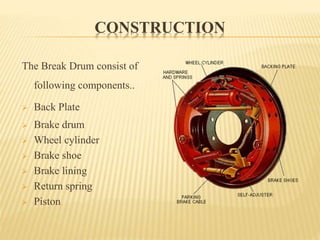
The Break Drum consist of
following components..
 Back Plate
 Brake drum
 Wheel cylinder
 Brake shoe
 Brake lining
 Return spring
 Piston
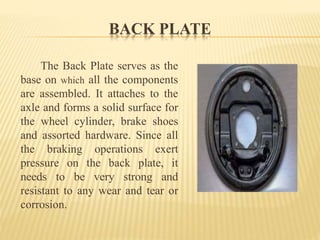
BACK PLATE
The Back Plate serves as the
base on which all the components
are assembled. It attaches to the
axle and forms a solid surface for
the wheel cylinder, brake shoes
and assorted hardware. Since all
the braking operations exert
pressure on the back plate, it
needs to be very strong and
resistant to any wear and tear or
corrosion.
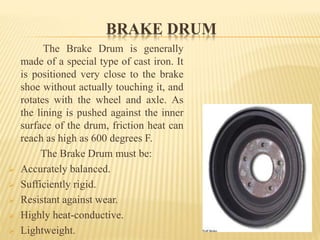
BRAKE DRUM
The Brake Drum is generally
made of a special type of cast iron. It
is positioned very close to the brake
shoe without actually touching it, and
rotates with the wheel and axle. As
the lining is pushed against the inner
surface of the drum, friction heat can
reach as high as 600 degrees F.
The Brake Drum must be:
 Accurately balanced.
 Sufficiently rigid.
 Resistant against wear.
 Highly heat-conductive.
 Lightweight.
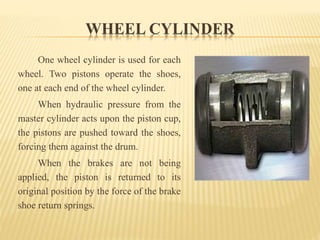
WHEEL CYLINDER
One wheel cylinder is used for each
wheel. Two pistons operate the shoes,
one at each end of the wheel cylinder.
When hydraulic pressure from the
master cylinder acts upon the piston cup,
the pistons are pushed toward the shoes,
forcing them against the drum.
When the brakes are not being
applied, the piston is returned to its
original position by the force of the brake
shoe return springs.
BRAKE SHOE
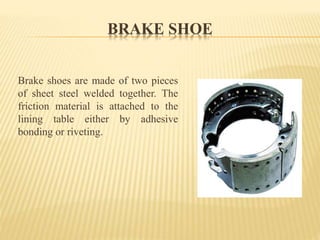
Brake shoes are made of two pieces
of sheet steel welded together. The
friction material is attached to the
lining table either by adhesive
bonding or riveting.
WORKING
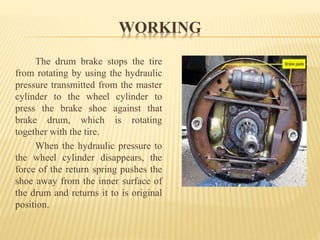
The drum brake stops the tire
from rotating by using the hydraulic
pressure transmitted from the master
cylinder to the wheel cylinder to
press the brake shoe against that
brake drum, which is rotating
together with the tire.
When the hydraulic pressure to
the wheel cylinder disappears, the
force of the return spring pushes the
shoe away from the inner surface of
the drum and returns it to is original
position.
ADVATAGES
 Drum brakes are smaller for the same brake force.
 Drum brakes don't need a hydraulic system for activation.
 Due to simple in construction it can be easiliy repair.
 Due to the fact that a drum brake's friction contact area is at
the circumference of the brake, a drum brake can provide more
braking force than an equal diameter disc brake.
DISADVANTAGES
 The use of many clips and springs makes overhaul of
the brake drum assembly very time-consuming.
 Another problem with drum brakes is that if a vehicle
is driven through water, it takes longer to get the brakes
working effectively.
 When the drums are heated by hard braking, the
diameter of the drum increases slightly due to thermal
expansion, this means the brakes shoes have to move
farther and the brake pedal has to be depressed further.
APPLICATIONS
 It is mainly used to stop the vehicle in shortest possible
distance in trucks, cars and in other automobiles.
REFRENCES
 Automobile Engineering- S.D.Ambatkar
 www.autozone.com
 www.brakesdrumsindia.com
THANK YOU

A Seminar on drum brake

  • 1.
    A SEMINOR ON “BRAKE DRUM ” GuidedBy Prof. S.N.DATEY Submitted By Sk Samsuddin.
  • 2.
    INTRODUCTION A drum brakeis a brake in which the friction is caused by a set of shoes or pads that press against a rotating drum-shaped part called a brake drum. The term "drum brake" usually means a brake in which shoes press on the inner surface of the drum. When shoes press on the outside of the drum, it is usually called a clasp brake.
  • 3.
    HISTORY The modern automobiledrum brake was invented in 1902 by “Louis Renault” though a less- sophisticated drum brake had been used by Maybach a year earlier. In the first drum brakes, the shoes were mechanically operated with levers and rods or cables. From the mid-1930s the shoes were operated with oil pressure in a small wheel cylinder and pistons.
  • 4.
    FUNCTIONS  To stopthe vehicle in shortest possible distance in case of emergency.  To control the vehicle when it is travel along the hills.  To keep the vehicle in desired position after bringing it in complete rest when there is no driver.
  • 5.
    CONSTRUCTION The Break Drumconsist of following components..  Back Plate  Brake drum  Wheel cylinder  Brake shoe  Brake lining  Return spring  Piston
  • 6.
    BACK PLATE The BackPlate serves as the base on which all the components are assembled. It attaches to the axle and forms a solid surface for the wheel cylinder, brake shoes and assorted hardware. Since all the braking operations exert pressure on the back plate, it needs to be very strong and resistant to any wear and tear or corrosion.
  • 7.
    BRAKE DRUM The BrakeDrum is generally made of a special type of cast iron. It is positioned very close to the brake shoe without actually touching it, and rotates with the wheel and axle. As the lining is pushed against the inner surface of the drum, friction heat can reach as high as 600 degrees F. The Brake Drum must be:  Accurately balanced.  Sufficiently rigid.  Resistant against wear.  Highly heat-conductive.  Lightweight.
  • 8.
    WHEEL CYLINDER One wheelcylinder is used for each wheel. Two pistons operate the shoes, one at each end of the wheel cylinder. When hydraulic pressure from the master cylinder acts upon the piston cup, the pistons are pushed toward the shoes, forcing them against the drum. When the brakes are not being applied, the piston is returned to its original position by the force of the brake shoe return springs.
  • 9.
    BRAKE SHOE Brake shoesare made of two pieces of sheet steel welded together. The friction material is attached to the lining table either by adhesive bonding or riveting.
  • 10.
    WORKING The drum brakestops the tire from rotating by using the hydraulic pressure transmitted from the master cylinder to the wheel cylinder to press the brake shoe against that brake drum, which is rotating together with the tire. When the hydraulic pressure to the wheel cylinder disappears, the force of the return spring pushes the shoe away from the inner surface of the drum and returns it to is original position.
  • 11.
    ADVATAGES  Drum brakesare smaller for the same brake force.  Drum brakes don't need a hydraulic system for activation.  Due to simple in construction it can be easiliy repair.  Due to the fact that a drum brake's friction contact area is at the circumference of the brake, a drum brake can provide more braking force than an equal diameter disc brake.
  • 12.
    DISADVANTAGES  The useof many clips and springs makes overhaul of the brake drum assembly very time-consuming.  Another problem with drum brakes is that if a vehicle is driven through water, it takes longer to get the brakes working effectively.  When the drums are heated by hard braking, the diameter of the drum increases slightly due to thermal expansion, this means the brakes shoes have to move farther and the brake pedal has to be depressed further.
  • 13.
    APPLICATIONS  It ismainly used to stop the vehicle in shortest possible distance in trucks, cars and in other automobiles.
  • 14.
    REFRENCES  Automobile Engineering-S.D.Ambatkar  www.autozone.com  www.brakesdrumsindia.com
  • 15.