BASIC OF FUEL AND INTERNAL COMBUSTION ENGINE
CHRISTIAN COLLEGE OF ENGINEERING AND
TECHNOLOGY, BHILAI
By
Dr. Mrinal Kanti Manik
Professor and Head of Mechanical Engineering
hod.mech.ccetb@ gmail.com
TYPES OF FUEL
 Petroleum. Petroleum, or crude oil, is the most extensively used fossil fuel.
 Coal. Coal is the most abundant solid fossil fuel
 Natural Gas. Natural gas is comprised mostly of methane, although it also
contains ethane, propane and butane.
 Orimulsion (It is extracted from the fields of Orinoco river in Venezuela and it is a
mixture of natural bitumen (70%) and fresh water (30%))
Properties of Fuel
External Combustion
XTERNAL COMBUSTION ENGINE
An external combustion engine is an engine where a fluid is heated
by an external source.
 A steam engine is an example of external combustion.
The combustion (or burning) that powers the steam engine that
comes from coal or wood.
 This occurs outside of the engine.
Steam is created when water is turned into a vapor or gas as it is
heated by a combustion chamber.
 The steam expands the volume of water by about 1600 times.
The force caused by this expansion is the source of all steam-
powered engines.
Flow Cause of Pressure difference
 1…………………. expands the volume of water by about 1600 times.
 2. The combustion (or burning) that powers a steam engine comes
from………………. or wood.
 3. A…………… is attached to a crankshaft.
 4. Does the combustion that powers a steam engine
occur inside or outside the engine………………….?
 5. Steam is created when water is turned into a vapor or gas as it is
heated by a…………… chamber.
Answered of the above questions as follows 1. Vapour; 2. Coal; 3. Piston; 4.Outside; 5. Com
=
How pressure and
volume are related with
each other
Internal Combustion engine
 The first person to experiment with an internal-combustion engine was
the Dutch physicist Christian Huygens, about 1680,
 But no effective gasoline-powered engine was developed until 1859,
 when the French engineer J. J. Étienne Lenoir built a double-
acting, spark-ignition engine that could be operated continuously,
 Internal-combustion engine. An engine whose fuel is burned inside the
engine itself rather than in an outside furnace or burner,
 As an Example Gasoline and diesel engines are internal-combustion
engines, as are gas turbine engines such as turbojets.
 Why I C engine is so important?
 An important device based on the internal-combustion engine is the automobile.
 In all internal-combustion engines, however, the basic principles remain the
same.
 Fuel is ignited in a cylinder, or chamber
 The energy created by the combustion, or burning, of the fuel pushes down on
the piston, in turn rotate the wheel and generate efficiency
What are steam Engine and I C Engine
 The term "steam engine" is generally applied only to reciprocating engines as just
described, not to the steam turbine
 Steam engines are external combustion engines
 Where the working fluid is separated from the combustion products
 The dewatering pump of Thomas Savery used steam pressure operating directly on
water
How an I C Engine works
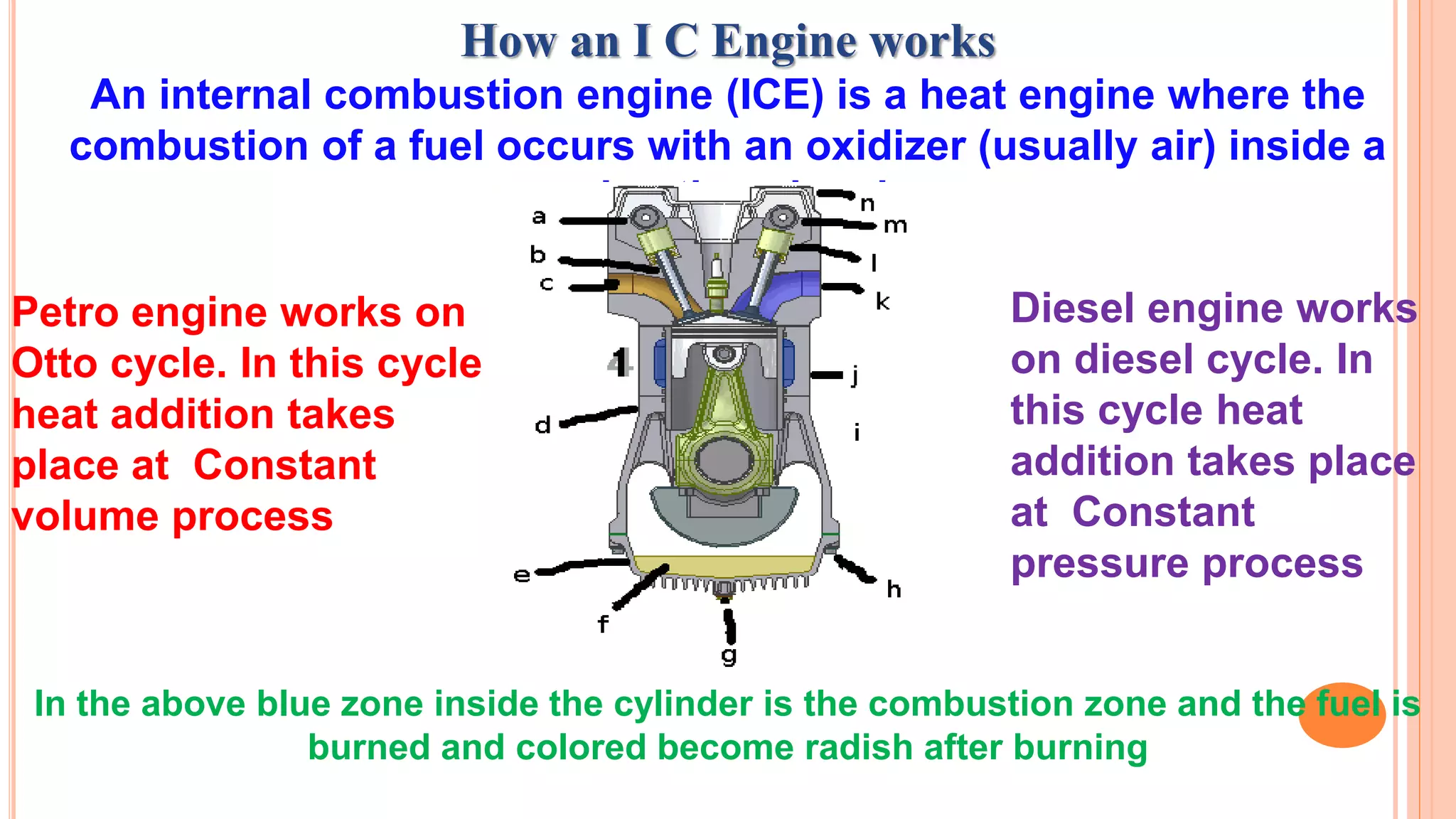
An internal combustion engine (ICE) is a heat engine where the
combustion of a fuel occurs with an oxidizer (usually air) inside a
combustion chamber
In the above blue zone inside the cylinder is the combustion zone and the fuel is
burned and colored become radish after burning
Petro engine works on
Otto cycle. In this cycle
heat addition takes
place at Constant
volume process
Diesel engine works
on diesel cycle. In
this cycle heat
addition takes place
at Constant
pressure process
Otto cycle for petrol engine
Diesel cycle for diesel engine
Efficiency
Two stroke Internal combustion
engine
<--Inlet
port
<--Exhaust port
Four stroke IC engine
Spark plug
Inlet valveExhaust
valve
Operation of two stroke and four stroke IC engine
Mixture of air &fuel/charged
from carburetor
Only air
from
atmosphere
VALVE TIMING AS SHOWN WITH PISTON MOVEMENT
Major parts of IC
engine
Crankcase
Crankshaft
Connecting rod
Cylinder
Piston
Piston Rings
Combustion Chamber
Cylinders head
Inlet Valve/Inlet Port
Exhaust Valve/Port
Valve spring
Camshaft
Rocker arm
Introduction
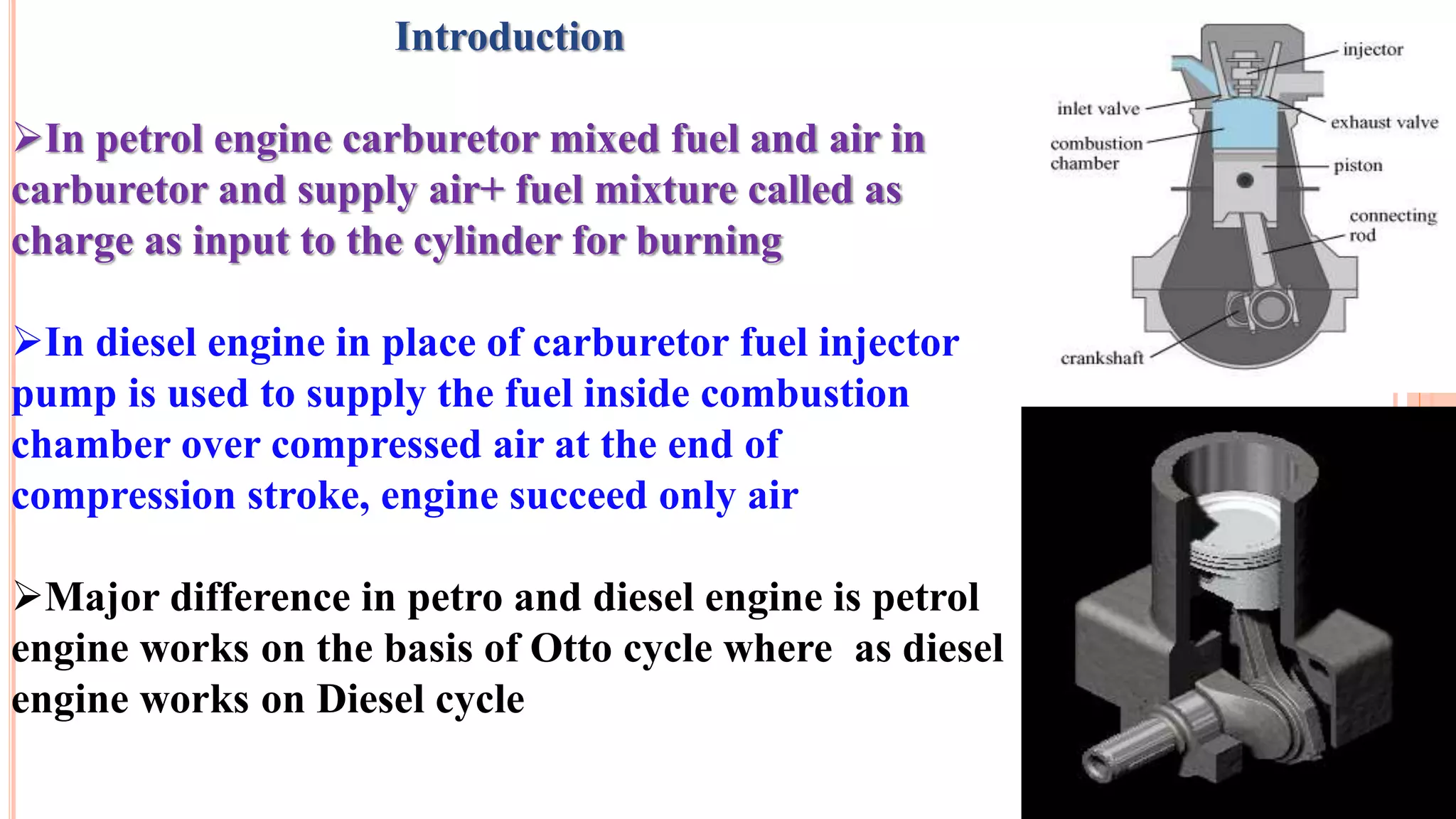
In petrol engine carburetor mixed fuel and air in
carburetor and supply air+ fuel mixture called as
charge as input to the cylinder for burning
In diesel engine in place of carburetor fuel injector
pump is used to supply the fuel inside combustion
chamber over compressed air at the end of
compression stroke, engine succeed only air
Major difference in petro and diesel engine is petrol
engine works on the basis of Otto cycle where as diesel
engine works on Diesel cycle
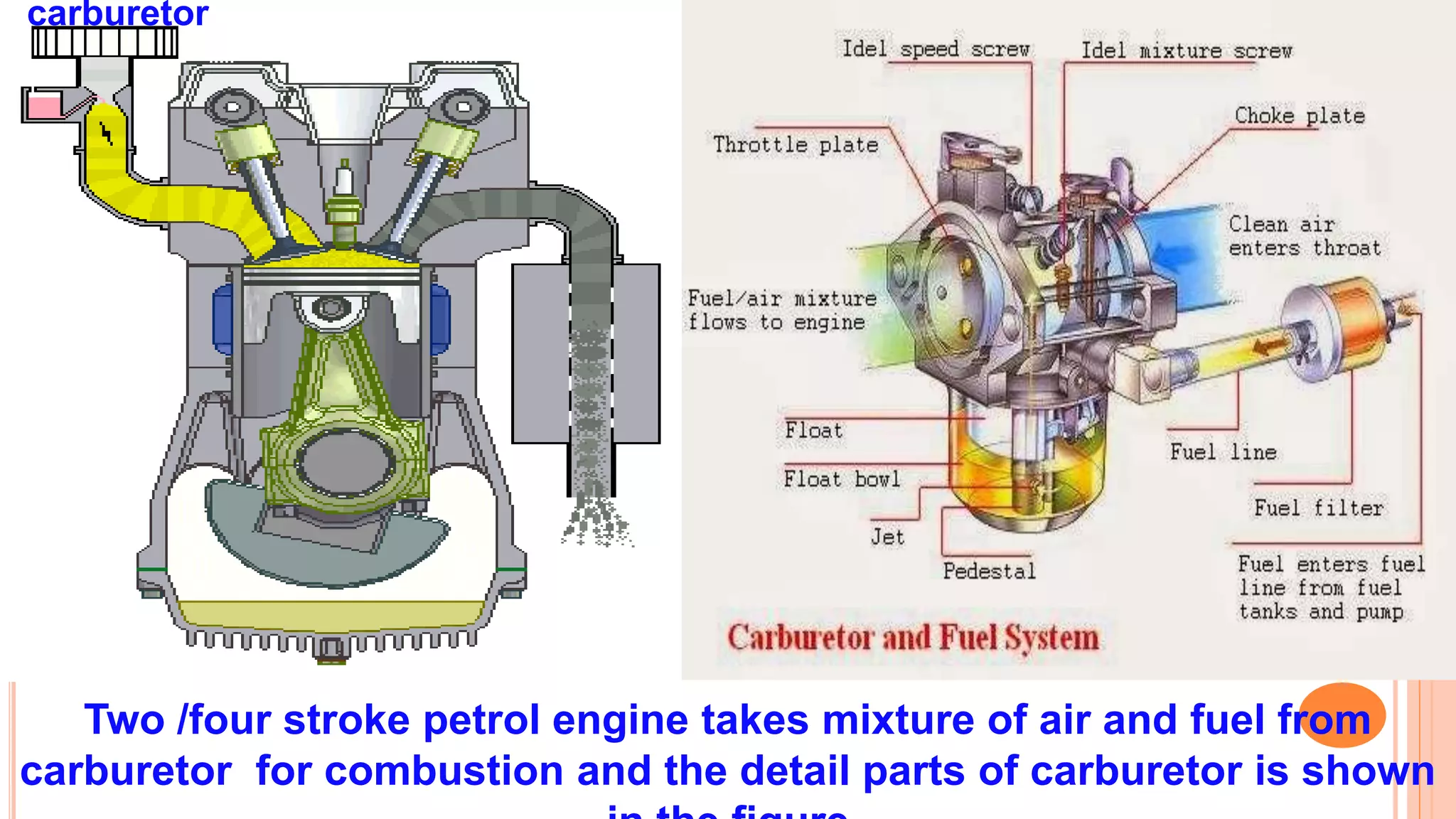
Two /four stroke petrol engine takes mixture of air and fuel from
carburetor for combustion and the detail parts of carburetor is shown
carburetor
Two /four stroke diesel engine initially air is compressed inside the
combustion and fuel inject from injector at end of compression stroke
Injector Injects fuel/diesel only
Detail about injector and carburetor as shown
Spark generation and how it distributed in multi cylinder eng
Circulation of water in engine cooling system
Radiat
or
Coolant tank
Pump
Filter
Major components of lubrication system of an engine
Simple circuit of lubrication
Purpose of cooling system to keep the temperature of the engine with in the specifi
limits
Types of lubrication system used in Engine
Pressure type lubrication system:
pressure type lubrication system in the lubrication oil is
pressurized by using a gear pump
Oil supplied to lubricate various parts of the moving
elements in the system.
Splash type lubrication system:
The splash type lubrication system in this a dipper made up
of metal rod attached at the lower end and of the connecting
rod used to splash the oil.
Then the oil spread over parts and lubricate them.
PROBLEM 1
The following data was recorded during testing of a TWO STROKE gas engine:
Diameter of the piston d= 150 mm
Stroke length L= 180 mm
Clearance volume Vc = 0.89 litre
RPM of the engine N = 300
Indicated mean effective pressure pm= 6.1 bars
Gas consumption m. = 6.1 m3/h
Calorific value of the gas (fuel) CF = 17000 kJ/m3
Determine the followings:
Air Standard Efficiency
Indicated power (IHP)developed by the engine
Indicated thermal efficiency of the engine
SOLUTION
Swept volume Vs = πd2L/4 = π(0.150)2 x 180/4 = 0.00318 m3 Clearance volume Vc=
0.00089 m3
Total volume = Swept volume + clearance volume . VT = 0.00318 + 0.00089 =
0.00407 m3
Compression ratio γ = Total volume/Clearance volume = 0.00407/0.00089 =
4.573
Air standard Efficiency η = 1 –1/(r)γ—1 = 1—1/(4.573)4—1 = 0.456 = 45.6 %
2
PROBLEM 2
Following data is available for a FOUR STROKE petrol engine:
Air fuel ratio 15.5 : 1 Calorific value of fuel 16000 kJ/kg Air Standard Efficiency: 53
Mechanical Efficiency: 80 % Indicated Thermal Efficiency: 37 % Volumetric Efficiency: 80 %
Stroke/bore ratio: 1.25 Suction pressure: 1 bar Suction Temperature: 270C
RPM: 2000 Brake Power: 72 kW Calculate the followings:
Brake specific fuel consumption Bore and stroke
SOLUTION
Find compression ratio from air standard efficiency
As we know η = 1 –1/(r)γ—1 0.53 = 1 –1/(r)1.4—1 r = 6.6
IHP = BP/Mech efficiency = 72/0.80 = 90 kW ηIT =IHP/(Sp. Fuel Consumption x
Cal value)
Brake sfc = sfcIHP/BP = 0.0152/72=0.00021 kg/s /kW 0.37 = 90/sfc x 16000
Brake sfc = 0.7601 kg/kWh sfc is specific fuel
consumption
Bore and stroke of the engine sfc = 0.0152 kg/s
Mass of air fuel mixture/kg of fuel = 15.5 +1 = 16.5
Mass of fuel supplied to the engine = 0.0152 x 16.5 = 0.2508
Volume of air fuel mixture = mRT/p=0.2508x 287×300/(1×105) V = 0.2159 m3/s
Swept volume = volume of mixture supplied/vol efficiency Vs =
IC Engine PPT

IC Engine PPT

  • 1.
    BASIC OF FUELAND INTERNAL COMBUSTION ENGINE CHRISTIAN COLLEGE OF ENGINEERING AND TECHNOLOGY, BHILAI By Dr. Mrinal Kanti Manik Professor and Head of Mechanical Engineering hod.mech.ccetb@ gmail.com
  • 2.
    TYPES OF FUEL Petroleum. Petroleum, or crude oil, is the most extensively used fossil fuel.  Coal. Coal is the most abundant solid fossil fuel  Natural Gas. Natural gas is comprised mostly of methane, although it also contains ethane, propane and butane.  Orimulsion (It is extracted from the fields of Orinoco river in Venezuela and it is a mixture of natural bitumen (70%) and fresh water (30%))
  • 3.
  • 4.
  • 5.
    XTERNAL COMBUSTION ENGINE Anexternal combustion engine is an engine where a fluid is heated by an external source.  A steam engine is an example of external combustion. The combustion (or burning) that powers the steam engine that comes from coal or wood.  This occurs outside of the engine. Steam is created when water is turned into a vapor or gas as it is heated by a combustion chamber.  The steam expands the volume of water by about 1600 times. The force caused by this expansion is the source of all steam- powered engines.
  • 6.
    Flow Cause ofPressure difference  1…………………. expands the volume of water by about 1600 times.  2. The combustion (or burning) that powers a steam engine comes from………………. or wood.  3. A…………… is attached to a crankshaft.  4. Does the combustion that powers a steam engine occur inside or outside the engine………………….?  5. Steam is created when water is turned into a vapor or gas as it is heated by a…………… chamber. Answered of the above questions as follows 1. Vapour; 2. Coal; 3. Piston; 4.Outside; 5. Com
  • 7.
    = How pressure and volumeare related with each other
  • 8.
    Internal Combustion engine The first person to experiment with an internal-combustion engine was the Dutch physicist Christian Huygens, about 1680,  But no effective gasoline-powered engine was developed until 1859,  when the French engineer J. J. Étienne Lenoir built a double- acting, spark-ignition engine that could be operated continuously,  Internal-combustion engine. An engine whose fuel is burned inside the engine itself rather than in an outside furnace or burner,  As an Example Gasoline and diesel engines are internal-combustion engines, as are gas turbine engines such as turbojets.
  • 9.
     Why IC engine is so important?  An important device based on the internal-combustion engine is the automobile.  In all internal-combustion engines, however, the basic principles remain the same.  Fuel is ignited in a cylinder, or chamber  The energy created by the combustion, or burning, of the fuel pushes down on the piston, in turn rotate the wheel and generate efficiency
  • 10.
    What are steamEngine and I C Engine  The term "steam engine" is generally applied only to reciprocating engines as just described, not to the steam turbine  Steam engines are external combustion engines  Where the working fluid is separated from the combustion products  The dewatering pump of Thomas Savery used steam pressure operating directly on water
  • 11.
    How an IC Engine works An internal combustion engine (ICE) is a heat engine where the combustion of a fuel occurs with an oxidizer (usually air) inside a combustion chamber In the above blue zone inside the cylinder is the combustion zone and the fuel is burned and colored become radish after burning Petro engine works on Otto cycle. In this cycle heat addition takes place at Constant volume process Diesel engine works on diesel cycle. In this cycle heat addition takes place at Constant pressure process
  • 12.
    Otto cycle forpetrol engine
  • 13.
    Diesel cycle fordiesel engine Efficiency
  • 15.
    Two stroke Internalcombustion engine <--Inlet port <--Exhaust port Four stroke IC engine Spark plug Inlet valveExhaust valve Operation of two stroke and four stroke IC engine Mixture of air &fuel/charged from carburetor Only air from atmosphere
  • 18.
    VALVE TIMING ASSHOWN WITH PISTON MOVEMENT
  • 19.
    Major parts ofIC engine Crankcase Crankshaft Connecting rod Cylinder Piston Piston Rings Combustion Chamber Cylinders head Inlet Valve/Inlet Port Exhaust Valve/Port Valve spring Camshaft Rocker arm
  • 20.
    Introduction In petrol enginecarburetor mixed fuel and air in carburetor and supply air+ fuel mixture called as charge as input to the cylinder for burning In diesel engine in place of carburetor fuel injector pump is used to supply the fuel inside combustion chamber over compressed air at the end of compression stroke, engine succeed only air Major difference in petro and diesel engine is petrol engine works on the basis of Otto cycle where as diesel engine works on Diesel cycle
  • 22.
    Two /four strokepetrol engine takes mixture of air and fuel from carburetor for combustion and the detail parts of carburetor is shown carburetor
  • 23.
    Two /four strokediesel engine initially air is compressed inside the combustion and fuel inject from injector at end of compression stroke Injector Injects fuel/diesel only
  • 24.
    Detail about injectorand carburetor as shown
  • 25.
    Spark generation andhow it distributed in multi cylinder eng
  • 28.
    Circulation of waterin engine cooling system Radiat or Coolant tank Pump Filter
  • 29.
    Major components oflubrication system of an engine Simple circuit of lubrication Purpose of cooling system to keep the temperature of the engine with in the specifi limits
  • 30.
    Types of lubricationsystem used in Engine Pressure type lubrication system: pressure type lubrication system in the lubrication oil is pressurized by using a gear pump Oil supplied to lubricate various parts of the moving elements in the system. Splash type lubrication system: The splash type lubrication system in this a dipper made up of metal rod attached at the lower end and of the connecting rod used to splash the oil. Then the oil spread over parts and lubricate them.
  • 34.
    PROBLEM 1 The followingdata was recorded during testing of a TWO STROKE gas engine: Diameter of the piston d= 150 mm Stroke length L= 180 mm Clearance volume Vc = 0.89 litre RPM of the engine N = 300 Indicated mean effective pressure pm= 6.1 bars Gas consumption m. = 6.1 m3/h Calorific value of the gas (fuel) CF = 17000 kJ/m3 Determine the followings: Air Standard Efficiency Indicated power (IHP)developed by the engine Indicated thermal efficiency of the engine SOLUTION Swept volume Vs = πd2L/4 = π(0.150)2 x 180/4 = 0.00318 m3 Clearance volume Vc= 0.00089 m3 Total volume = Swept volume + clearance volume . VT = 0.00318 + 0.00089 = 0.00407 m3 Compression ratio γ = Total volume/Clearance volume = 0.00407/0.00089 = 4.573 Air standard Efficiency η = 1 –1/(r)γ—1 = 1—1/(4.573)4—1 = 0.456 = 45.6 % 2
  • 35.
    PROBLEM 2 Following datais available for a FOUR STROKE petrol engine: Air fuel ratio 15.5 : 1 Calorific value of fuel 16000 kJ/kg Air Standard Efficiency: 53 Mechanical Efficiency: 80 % Indicated Thermal Efficiency: 37 % Volumetric Efficiency: 80 % Stroke/bore ratio: 1.25 Suction pressure: 1 bar Suction Temperature: 270C RPM: 2000 Brake Power: 72 kW Calculate the followings: Brake specific fuel consumption Bore and stroke SOLUTION Find compression ratio from air standard efficiency As we know η = 1 –1/(r)γ—1 0.53 = 1 –1/(r)1.4—1 r = 6.6 IHP = BP/Mech efficiency = 72/0.80 = 90 kW ηIT =IHP/(Sp. Fuel Consumption x Cal value) Brake sfc = sfcIHP/BP = 0.0152/72=0.00021 kg/s /kW 0.37 = 90/sfc x 16000 Brake sfc = 0.7601 kg/kWh sfc is specific fuel consumption Bore and stroke of the engine sfc = 0.0152 kg/s Mass of air fuel mixture/kg of fuel = 15.5 +1 = 16.5 Mass of fuel supplied to the engine = 0.0152 x 16.5 = 0.2508 Volume of air fuel mixture = mRT/p=0.2508x 287×300/(1×105) V = 0.2159 m3/s Swept volume = volume of mixture supplied/vol efficiency Vs =