Presented to
Sir Ramzan

Presented by
Sania MME-12-26.
Asia Abbas MME-12-27.
Benish Yaqoob MME-12-28
INTERFERENCE
 Interference

is an effect that occurs
when two or more waves overlap.
 In general, the individual waves do not
affect one another, and the total wave
amplitude at any point in space is
simply the sum of the amplitudes of the
individual waves at that point.
TYPES OF INTERFERENCE
 Constructive interference
 Destructive interference
Constructive Interference
 It

is a type of interference where the two
interfering waves have a displacement
in the same direction


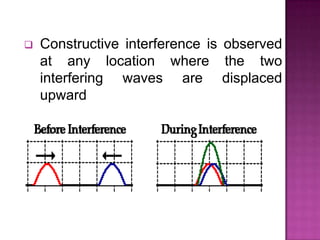
Constructive interference is observed
at any location where the two
interfering waves are displaced
upward
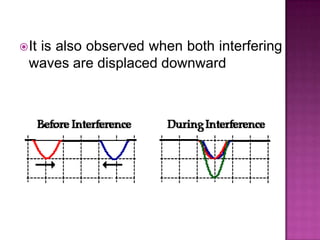
 It

is also observed when both interfering
waves are displaced downward
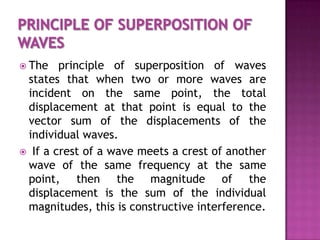
Destructive Interference
 It

is a type of interference where the two
interfering waves have a displacement
in the opposite direction.
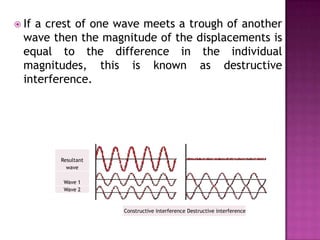
 The

principle of superposition of waves
states that when two or more waves are
incident on the same point, the total
displacement at that point is equal to the
vector sum of the displacements of the
individual waves.
 If a crest of a wave meets a crest of another
wave of the same frequency at the same
point, then the magnitude of the
displacement is the sum of the individual
magnitudes, this is constructive interference.
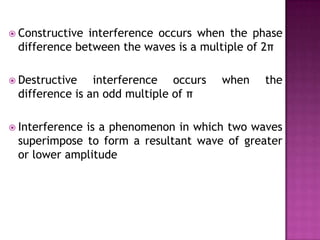
 If

a crest of one wave meets a trough of another
wave then the magnitude of the displacements is
equal to the difference in the individual
magnitudes, this is known as destructive
interference.

Resultant
wave
Wave 1
Wave 2

Constructive interference Destructive interference
 Constructive

interference occurs when the phase
difference between the waves is a multiple of 2π

 Destructive

interference occurs
difference is an odd multiple of π

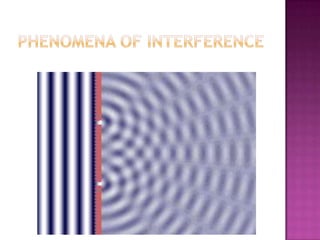
 Interference

when

the

is a phenomenon in which two waves
superimpose to form a resultant wave of greater
or lower amplitude
 If the difference between the phases is
intermediate between these two extremes, then
the magnitude of the displacement of the
summed waves lies between the minimum and
maximum values.
Mechanism
1 .Between two plane waves
2 .Between two spherical waves

3 .Radio
4.Optical interference
 Interference

effects can be observed with all
types of waves, for example

 Light

 Radio
 Acoustic
 Surface

water waves.
(Thomas Young)
 Young's
interference experiment, also
called Young's double-slit interferometer,
was the original version of the modern
double-slit experiment, performed at the
beginning of the nineteenth century by
Thomas Young
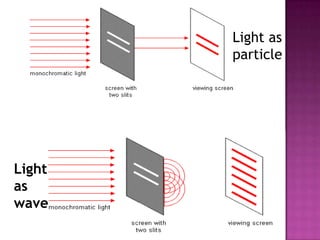
 The
results of Young's Double Slit
Experiment should be very different if light
is a wave or a particle.
Light as
particle

Light
as
wave
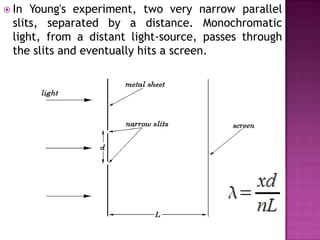
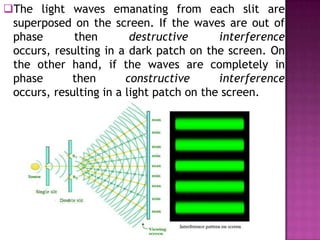
 In

Young's experiment, two very narrow parallel
slits, separated by a distance. Monochromatic
light, from a distant light-source, passes through
the slits and eventually hits a screen.
The light waves emanating from each slit are
superposed on the screen. If the waves are out of
phase
then
destructive
interference
occurs, resulting in a dark patch on the screen. On
the other hand, if the waves are completely in
phase
then
constructive
interference
occurs, resulting in a light patch on the screen.
Interference

Interference

  • 2.
    Presented to Sir Ramzan Presentedby Sania MME-12-26. Asia Abbas MME-12-27. Benish Yaqoob MME-12-28
  • 3.
    INTERFERENCE  Interference is aneffect that occurs when two or more waves overlap.  In general, the individual waves do not affect one another, and the total wave amplitude at any point in space is simply the sum of the amplitudes of the individual waves at that point.
  • 4.
    TYPES OF INTERFERENCE Constructive interference  Destructive interference Constructive Interference  It is a type of interference where the two interfering waves have a displacement in the same direction
  • 5.
     Constructive interference isobserved at any location where the two interfering waves are displaced upward
  • 6.
     It is alsoobserved when both interfering waves are displaced downward
  • 7.
    Destructive Interference  It isa type of interference where the two interfering waves have a displacement in the opposite direction.
  • 8.
     The principle ofsuperposition of waves states that when two or more waves are incident on the same point, the total displacement at that point is equal to the vector sum of the displacements of the individual waves.  If a crest of a wave meets a crest of another wave of the same frequency at the same point, then the magnitude of the displacement is the sum of the individual magnitudes, this is constructive interference.
  • 9.
     If a crestof one wave meets a trough of another wave then the magnitude of the displacements is equal to the difference in the individual magnitudes, this is known as destructive interference. Resultant wave Wave 1 Wave 2 Constructive interference Destructive interference
  • 10.
     Constructive interference occurswhen the phase difference between the waves is a multiple of 2π  Destructive interference occurs difference is an odd multiple of π  Interference when the is a phenomenon in which two waves superimpose to form a resultant wave of greater or lower amplitude
  • 11.
     If thedifference between the phases is intermediate between these two extremes, then the magnitude of the displacement of the summed waves lies between the minimum and maximum values. Mechanism 1 .Between two plane waves 2 .Between two spherical waves 3 .Radio 4.Optical interference
  • 12.
     Interference effects canbe observed with all types of waves, for example  Light  Radio  Acoustic  Surface water waves.
  • 14.
    (Thomas Young)  Young's interferenceexperiment, also called Young's double-slit interferometer, was the original version of the modern double-slit experiment, performed at the beginning of the nineteenth century by Thomas Young  The results of Young's Double Slit Experiment should be very different if light is a wave or a particle.
  • 15.
  • 16.
     In Young's experiment,two very narrow parallel slits, separated by a distance. Monochromatic light, from a distant light-source, passes through the slits and eventually hits a screen.
  • 17.
    The light wavesemanating from each slit are superposed on the screen. If the waves are out of phase then destructive interference occurs, resulting in a dark patch on the screen. On the other hand, if the waves are completely in phase then constructive interference occurs, resulting in a light patch on the screen.