Interference and
its types
Written and Compiled by Sobana Qamar 1
Interference:
Superposition of two waves having same frequency and amplitude is
called the interference of waves.
The combination of two or more waves that exist in the same place at
the same time.
Written and Compile by Sobana Qamar 2
Explanation:
Interference takes place with any kind of wave motion, and
the effects of interference can be more easily seen by
examining the behaviour of water waves, which are in many
ways similar to light waves, but travel more slowly and more
easily noticeable.
Written and Compile by Sobana Qamar 3
How interference occur?
When two stones are dropped into a pool of water,
waves spread out from each source, and interference
occurs when they overlap
Written and Compile by Sobana Qamar 4
Principle of superposition of waves:
When two or more waves travel through the same
medium simultaneously, the resultant displacement at any point is
the vector sum of the displacement due to the individual waves.
Interference is a special case of superposition of waves
which originates from different sources but have the same amplitude
and same frequency.
Written and Compile by Sobana Qamar 5
Types of interference
There are two types of interference.
1. Constructive interference
2. Destructive interference
Written and Compile by Sobana Qamar 6
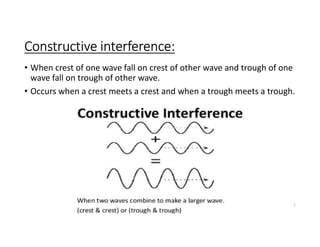
Constructive interference:
• When crest of one wave fall on crest of other wave and trough of one
wave fall on trough of other wave.
• Occurs when a crest meets a crest and when a trough meets a trough.
7
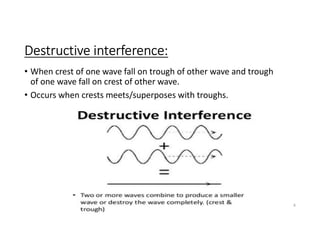
Destructive interference:
• When crest of one wave fall on trough of other wave and trough
of one wave fall on crest of other wave.
• Occurs when crests meets/superposes with troughs.
8
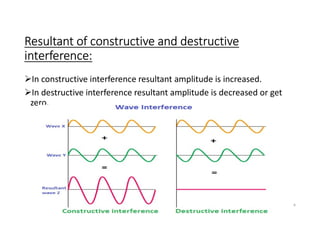
Resultant of constructive and destructive
interference:
In constructive interference resultant amplitude is increased.
In destructive interference resultant amplitude is decreased or get
zero.
9
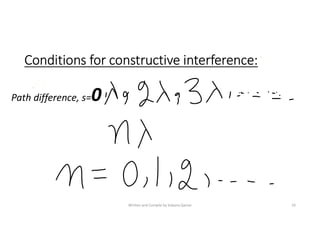
Conditions for constructive interference:
Path difference, s=0
Written and Compile by Sobana Qamar 10
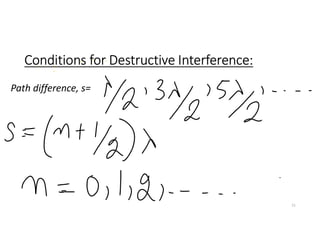
Conditions for Destructive Interference:
Path difference, s=
11
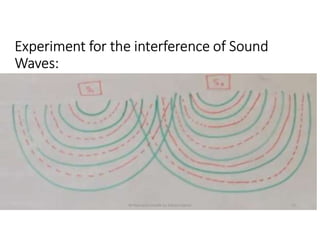
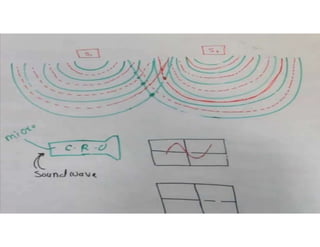
Experiment for the interference of Sound
Waves:
Written and Compile by Sobana Qamar 12
Written and Compile by Sobana Qamar 13
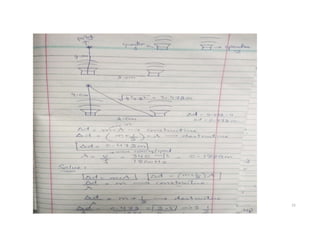
Problem related to interference:
Two identical loudspeakers 2.0 m apart are emitting 1800 Hz
sound waves into a room where the speed of sound is 340
m/s. Is the point 4.0 m directly in front of one of the
speakers, perpendicular to the plane of the speakers, is a
point of constructive interference, destructive interference or
something else in between?
Written and Compile by Sobana Qamar 14
Written and Compile by Sobana Qamar 15
Properties of interference:
The interfering waves must have the following properties:
The two interfering waves must have the same period and
wavelength.
The waves must have the same amplitude or nearly the same
amplitude.
The interfering waves must propagate in the same direction.
If the interfering waves are polarised. They must have the same plane
of polarization.
Written and Compile by Sobana Qamar 16
Written and Compile by Sobana Qamar 17
Written and Compiled by Sobana Qamar 18
Written and Compile by Sobana Qamar 19

Interference and its types

  • 1.
    Interference and its types Writtenand Compiled by Sobana Qamar 1
  • 2.
    Interference: Superposition of twowaves having same frequency and amplitude is called the interference of waves. The combination of two or more waves that exist in the same place at the same time. Written and Compile by Sobana Qamar 2
  • 3.
    Explanation: Interference takes placewith any kind of wave motion, and the effects of interference can be more easily seen by examining the behaviour of water waves, which are in many ways similar to light waves, but travel more slowly and more easily noticeable. Written and Compile by Sobana Qamar 3
  • 4.
    How interference occur? Whentwo stones are dropped into a pool of water, waves spread out from each source, and interference occurs when they overlap Written and Compile by Sobana Qamar 4
  • 5.
    Principle of superpositionof waves: When two or more waves travel through the same medium simultaneously, the resultant displacement at any point is the vector sum of the displacement due to the individual waves. Interference is a special case of superposition of waves which originates from different sources but have the same amplitude and same frequency. Written and Compile by Sobana Qamar 5
  • 6.
    Types of interference Thereare two types of interference. 1. Constructive interference 2. Destructive interference Written and Compile by Sobana Qamar 6
  • 7.
    Constructive interference: • Whencrest of one wave fall on crest of other wave and trough of one wave fall on trough of other wave. • Occurs when a crest meets a crest and when a trough meets a trough. 7
  • 8.
    Destructive interference: • Whencrest of one wave fall on trough of other wave and trough of one wave fall on crest of other wave. • Occurs when crests meets/superposes with troughs. 8
  • 9.
    Resultant of constructiveand destructive interference: In constructive interference resultant amplitude is increased. In destructive interference resultant amplitude is decreased or get zero. 9
  • 10.
    Conditions for constructiveinterference: Path difference, s=0 Written and Compile by Sobana Qamar 10
  • 11.
    Conditions for DestructiveInterference: Path difference, s= 11
  • 12.
    Experiment for theinterference of Sound Waves: Written and Compile by Sobana Qamar 12
  • 13.
    Written and Compileby Sobana Qamar 13
  • 14.
    Problem related tointerference: Two identical loudspeakers 2.0 m apart are emitting 1800 Hz sound waves into a room where the speed of sound is 340 m/s. Is the point 4.0 m directly in front of one of the speakers, perpendicular to the plane of the speakers, is a point of constructive interference, destructive interference or something else in between? Written and Compile by Sobana Qamar 14
  • 15.
    Written and Compileby Sobana Qamar 15
  • 16.
    Properties of interference: Theinterfering waves must have the following properties: The two interfering waves must have the same period and wavelength. The waves must have the same amplitude or nearly the same amplitude. The interfering waves must propagate in the same direction. If the interfering waves are polarised. They must have the same plane of polarization. Written and Compile by Sobana Qamar 16
  • 17.
    Written and Compileby Sobana Qamar 17
  • 18.
    Written and Compiledby Sobana Qamar 18
  • 19.
    Written and Compileby Sobana Qamar 19