Interference of Waves:
•
•
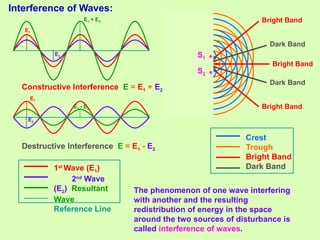
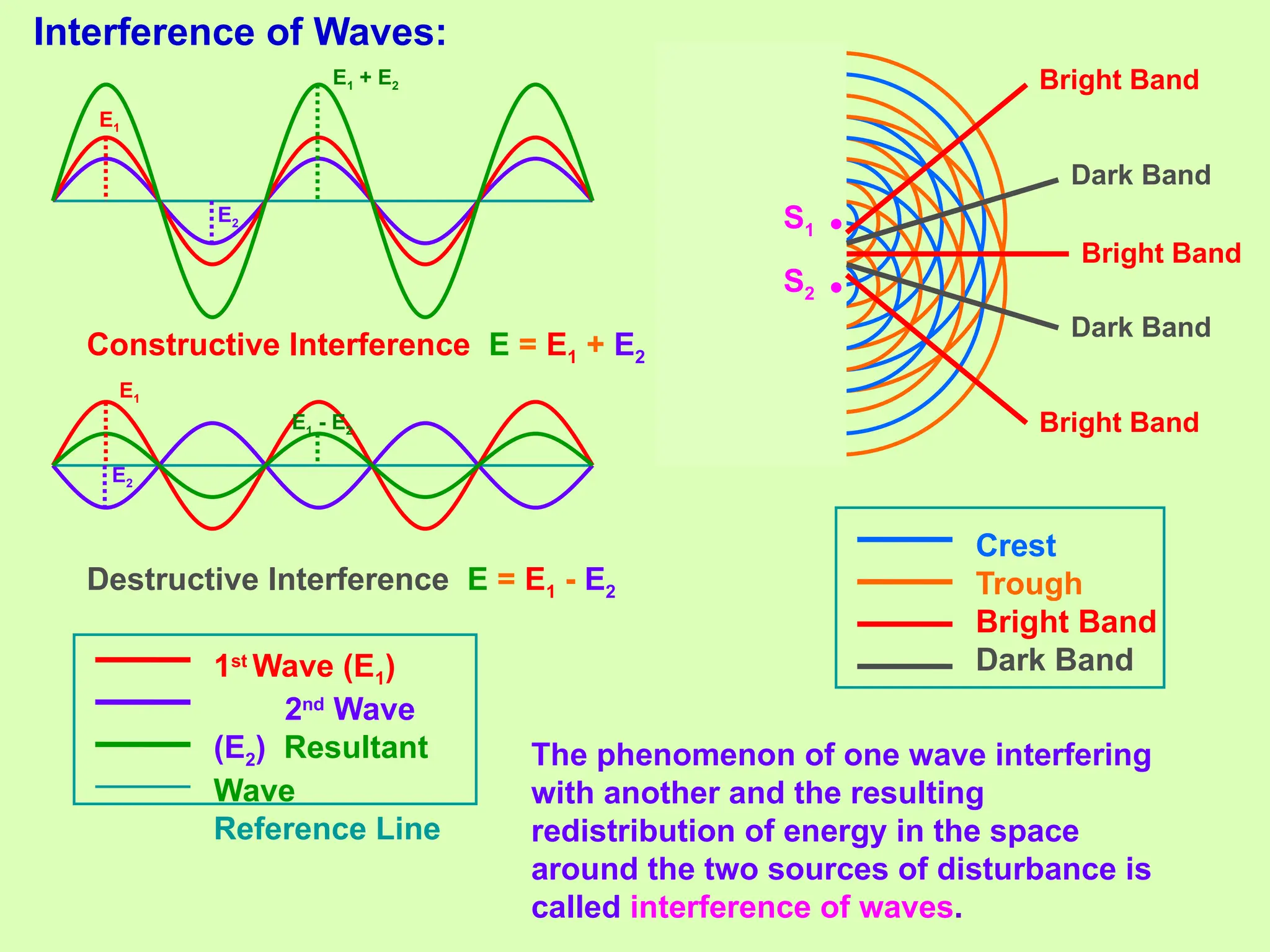
Constructive Interference E = E1 + E2
Destructive Interference E = E1 - E2
S1
S2
Bright Band
Dark Band
Dark Band
Bright Band
Bright Band
Crest
Trough
Bright Band
Dark Band
1st
Wave (E1)
2nd
Wave
(E2) Resultant
Wave
Reference Line
E1
E2
E2
E1
The phenomenon of one wave interfering
with another and the resulting
redistribution of energy in the space
around the two sources of disturbance is
called interference of waves.
E1 + E2
E1 - E2
Theory of Interference of Waves:
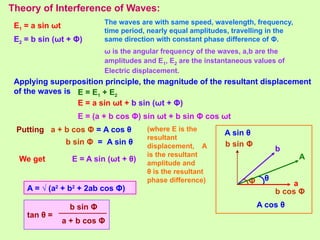
E1 = a sin ωt
E2 = b sin (ωt + Φ)
The waves are with same speed, wavelength, frequency,
time period, nearly equal amplitudes, travelling in the
same direction with constant phase difference of Φ.
ω is the angular frequency of the waves, a,b are the
amplitudes and E1, E2 are the instantaneous values of
Electric displacement.
Applying superposition principle, the magnitude of the resultant displacement
of the waves is E = E1 + E2
E = a sin ωt + b sin (ωt + Φ)
E = (a + b cos Φ) sin ωt + b sin Φ cos ωt
Putting a + b cos Φ = A cos θ
b sin Φ = A sin θ
θ
Φ a
b
A
b cos Φ
b sin Φ
A cos θ
A sin θ
We get E = A sin (ωt + θ)
(where E is the
resultant
displacement, A
is the resultant
amplitude and
θ is the resultant
phase difference)
A = √ (a2
+ b2
+ 2ab cos Φ)
tan θ =
b sin Φ
a + b cos Φ
A = √ (a2
+ b2
+ 2ab cos Φ)
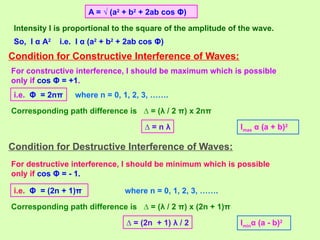
Intensity I is proportional to the square of the amplitude of the wave.
So, I α A2
i.e. I α (a2
+ b2
+ 2ab cos Φ)
Condition for Constructive Interference of Waves:
For constructive interference, I should be maximum which is possible
only if cos Φ = +1.
i.e. Φ = 2nπ
Corresponding path difference is ∆ = (λ / 2 π) x 2nπ
where n = 0, 1, 2, 3, …….
∆ = n λ
Condition for Destructive Interference of Waves:
For destructive interference, I should be minimum which is possible
only if cos Φ = - 1.
i.e. Φ = (2n + 1)π
Corresponding path difference is ∆ = (λ / 2 π) x (2n + 1)π
where n = 0, 1, 2, 3, …….
∆ = (2n + 1) λ / 2
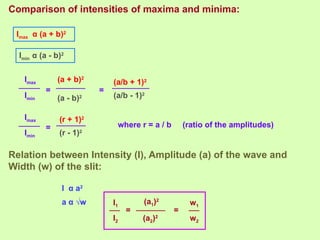
Imax α (a + b)2
Iminα (a - b)2
Comparison of intensities of maxima and minima:
Imax α (a + b)2
Imin α (a - b)2
Imax
Imin
=
(a + b)2
(a - b)2
(a/b + 1)2
(a/b - 1)2
=
Imax
Imin
=
(r + 1)2
(r - 1)2
where r = a / b (ratio of the amplitudes)
Relation between Intensity (I), Amplitude (a) of the wave and
Width (w) of the slit:
I α a2
a α √w I1
I2
=
(a1)2
(a2)2
=
w1
w2
Young’s Double Slit Experiment:
•
S
S• O
P
D
S1
S2
d
y
d/2
d/2
Single Slit Double Slit
Screen
The waves from S1 and S2 reach the point P with
some phase difference and hence path difference
∆ = S2P – S1P
S2P2
– S1P2
= [D2
+ {y + (d/2)}2
] - [D2
+ {y - (d/2)}2
]
(S2P – S1P) (S2P + S1P) = 2 yd ∆ (2D) = 2 yd ∆ = yd / D
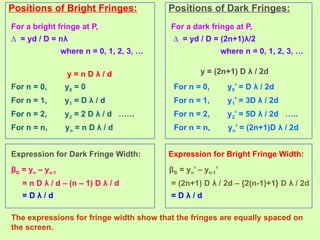
Positions of Bright Fringes:
For a bright fringe at P,
∆ = yd / D = nλ
where n = 0, 1, 2, 3, …
For n = 0, y0 = 0
For n = 1, y1 = D λ / d
For n = 2, y2 = 2 D λ / d ……
For n = n, yn = n D λ / d
y = n D λ / d
Positions of Dark Fringes:
For a dark fringe at P,
∆ = yd / D = (2n+1)λ/2
where n = 0, 1, 2, 3, …
For n = 0, y0’ = D λ / 2d
For n = 1, y1’ = 3D λ / 2d
For n = 2, y2’ = 5D λ / 2d …..
For n = n, yn’ = (2n+1)D λ / 2d
y = (2n+1) D λ / 2d
Expression for Dark Fringe Width:
βD = yn – yn-1
= n D λ / d – (n – 1) D λ / d
= D λ / d
Expression for Bright Fringe Width:
βB = yn’ – yn-1’
= (2n+1) D λ / 2d – {2(n-1)+1} D λ / 2d
= D λ / d
The expressions for fringe width show that the fringes are equally spaced on
the screen.
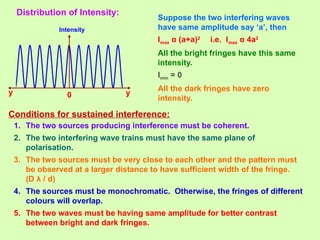
Distribution of Intensity:
Intensity
0 y
y
Suppose the two interfering waves
have same amplitude say ‘a’, then
Imax α (a+a)2
i.e. Imax α 4a2
All the bright fringes have this same
intensity.
Imin = 0
All the dark fringes have zero
intensity.
Conditions for sustained interference:
1. The two sources producing interference must be coherent.
2. The two interfering wave trains must have the same plane of
polarisation.
3. The two sources must be very close to each other and the pattern must
be observed at a larger distance to have sufficient width of the fringe.
(D λ / d)
4. The sources must be monochromatic. Otherwise, the fringes of different
colours will overlap.
5. The two waves must be having same amplitude for better contrast
between bright and dark fringes.

Interference of waves and superposition principle.pptx

  • 1.
    Interference of Waves: • • ConstructiveInterference E = E1 + E2 Destructive Interference E = E1 - E2 S1 S2 Bright Band Dark Band Dark Band Bright Band Bright Band Crest Trough Bright Band Dark Band 1st Wave (E1) 2nd Wave (E2) Resultant Wave Reference Line E1 E2 E2 E1 The phenomenon of one wave interfering with another and the resulting redistribution of energy in the space around the two sources of disturbance is called interference of waves. E1 + E2 E1 - E2
  • 2.
    Theory of Interferenceof Waves: E1 = a sin ωt E2 = b sin (ωt + Φ) The waves are with same speed, wavelength, frequency, time period, nearly equal amplitudes, travelling in the same direction with constant phase difference of Φ. ω is the angular frequency of the waves, a,b are the amplitudes and E1, E2 are the instantaneous values of Electric displacement. Applying superposition principle, the magnitude of the resultant displacement of the waves is E = E1 + E2 E = a sin ωt + b sin (ωt + Φ) E = (a + b cos Φ) sin ωt + b sin Φ cos ωt Putting a + b cos Φ = A cos θ b sin Φ = A sin θ θ Φ a b A b cos Φ b sin Φ A cos θ A sin θ We get E = A sin (ωt + θ) (where E is the resultant displacement, A is the resultant amplitude and θ is the resultant phase difference) A = √ (a2 + b2 + 2ab cos Φ) tan θ = b sin Φ a + b cos Φ
  • 3.
    A = √(a2 + b2 + 2ab cos Φ) Intensity I is proportional to the square of the amplitude of the wave. So, I α A2 i.e. I α (a2 + b2 + 2ab cos Φ) Condition for Constructive Interference of Waves: For constructive interference, I should be maximum which is possible only if cos Φ = +1. i.e. Φ = 2nπ Corresponding path difference is ∆ = (λ / 2 π) x 2nπ where n = 0, 1, 2, 3, ……. ∆ = n λ Condition for Destructive Interference of Waves: For destructive interference, I should be minimum which is possible only if cos Φ = - 1. i.e. Φ = (2n + 1)π Corresponding path difference is ∆ = (λ / 2 π) x (2n + 1)π where n = 0, 1, 2, 3, ……. ∆ = (2n + 1) λ / 2 Imax α (a + b)2 Iminα (a - b)2
  • 4.
    Comparison of intensitiesof maxima and minima: Imax α (a + b)2 Imin α (a - b)2 Imax Imin = (a + b)2 (a - b)2 (a/b + 1)2 (a/b - 1)2 = Imax Imin = (r + 1)2 (r - 1)2 where r = a / b (ratio of the amplitudes) Relation between Intensity (I), Amplitude (a) of the wave and Width (w) of the slit: I α a2 a α √w I1 I2 = (a1)2 (a2)2 = w1 w2
  • 5.
    Young’s Double SlitExperiment: • S S• O P D S1 S2 d y d/2 d/2 Single Slit Double Slit Screen The waves from S1 and S2 reach the point P with some phase difference and hence path difference ∆ = S2P – S1P S2P2 – S1P2 = [D2 + {y + (d/2)}2 ] - [D2 + {y - (d/2)}2 ] (S2P – S1P) (S2P + S1P) = 2 yd ∆ (2D) = 2 yd ∆ = yd / D
  • 6.
    Positions of BrightFringes: For a bright fringe at P, ∆ = yd / D = nλ where n = 0, 1, 2, 3, … For n = 0, y0 = 0 For n = 1, y1 = D λ / d For n = 2, y2 = 2 D λ / d …… For n = n, yn = n D λ / d y = n D λ / d Positions of Dark Fringes: For a dark fringe at P, ∆ = yd / D = (2n+1)λ/2 where n = 0, 1, 2, 3, … For n = 0, y0’ = D λ / 2d For n = 1, y1’ = 3D λ / 2d For n = 2, y2’ = 5D λ / 2d ….. For n = n, yn’ = (2n+1)D λ / 2d y = (2n+1) D λ / 2d Expression for Dark Fringe Width: βD = yn – yn-1 = n D λ / d – (n – 1) D λ / d = D λ / d Expression for Bright Fringe Width: βB = yn’ – yn-1’ = (2n+1) D λ / 2d – {2(n-1)+1} D λ / 2d = D λ / d The expressions for fringe width show that the fringes are equally spaced on the screen.
  • 7.
    Distribution of Intensity: Intensity 0y y Suppose the two interfering waves have same amplitude say ‘a’, then Imax α (a+a)2 i.e. Imax α 4a2 All the bright fringes have this same intensity. Imin = 0 All the dark fringes have zero intensity. Conditions for sustained interference: 1. The two sources producing interference must be coherent. 2. The two interfering wave trains must have the same plane of polarisation. 3. The two sources must be very close to each other and the pattern must be observed at a larger distance to have sufficient width of the fringe. (D λ / d) 4. The sources must be monochromatic. Otherwise, the fringes of different colours will overlap. 5. The two waves must be having same amplitude for better contrast between bright and dark fringes.