Rebecca Slater
LO #9
A substance that is normally clear and colorless
can appear to give off an array of colors when
it is found in a very thin layer
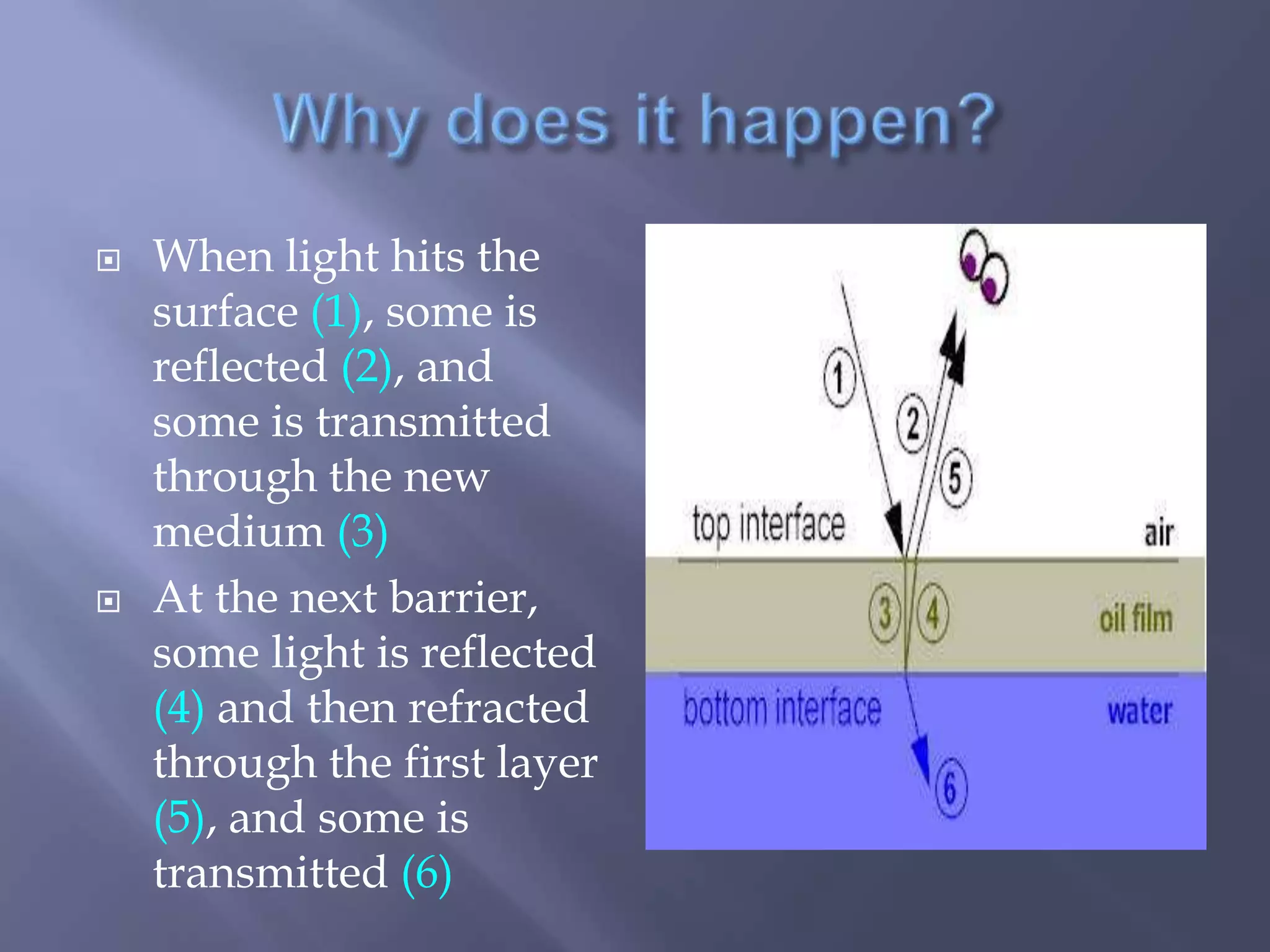
 When light hits the
surface (1), some is
reflected (2), and
some is transmitted
through the new
medium (3)
 At the next barrier,
some light is reflected
(4) and then refracted
through the first layer
(5), and some is
transmitted (6)
Constructive Destructive
 Since the speed of light decreases in any
medium other than a vacuum, the wavelength
also decreases
 Wavelength in a new medium is equal to the
original wavelength divided by the index of
refraction of the medium
OR
 The type of reflection experienced by the light
waves at each boundary depends on the
refraction indexes of the two mediums:
 Hard reflection – reflects off a medium with a
higher refraction index resulting in a phase shift
of λ/2
 Soft reflection – reflects off a medium with a
lower refraction index, resulting in no phase
shift
 If both waves undergo the same type of reflection,
either both hard or both soft, use:
- because there is no phase shift
between waves
 If one wave undergoes a hard reflection, and the
other a soft reflection, we use:
- because there is a phase shift
of λ/2 for the wave that
undergoes the hard reflection
**Where m is a whole number ≥ 0, t is the thickness of
the thin film, and λn is the wavelength in medium
 Again, there are two cases:
- use this if there are an
even number of hard
reflections, so that the end
result is a λ/2 phase shift
- use this if there are an odd
number of hard reflections, to keep
the waves at their λ/2 phase shift
**Where m is a whole number ≥ 0, t is the thickness of
the thin film, and λn is the wavelength in medium
 Since each colour of light has a different
wavelength, different thicknesses of the film
layer correspond to different colours
interfering constructively/destructively
 This creates a rainbow-like effect as the
thickness of the film changes at different points
A beam of light is aimed almost perpendicular to
a soap bubble floating through the air. The air and
soapy water have refraction indexes of 1.00 and
1.33, respectively. At the point on the bubble
where the light beam is aimed, the bubble
appears
to be green. What is the thinnest layer of soapy
water that would provide this result?
(λgreen = 510 nm)
 Since the light beam is being reflected off of a
medium with a higher index of refraction
(1.33>1.00), a hard reflection will occur
 Because there is one hard and one soft reflection
in a soap bubble, and the green light waves must
interfere constructively, to counteract the λ/2
phase shift that occurs due to the hard reflection,
we use the formula:
 Since the question asks for the thinnest possible
film, we use m = 0
 Subbing in 0 for m and rearranging the formula
to find t, we get:
 Now, to find λn:
 Lastly, just sub in all our values!
 Therefore, the thinnest soapy water layer that
would produce a green-looking surface, is
95.8 nm!
 http://hyperphysics.phy-
astr.gsu.edu/hbase/phyopt/oilfilm.html
 http://en.wikipedia.org/wiki/Iridescence
 http://www.quora.com/Are-there-any-real-life-
examples-or-cases-of-light-waves-undergoing-
constructive-or-destructive-interference
 http://imgarcade.com/1/images-of-peacock-feathers/
 http://dev.physicslab.org/Document.aspx?doctype=5
&filename=PhysicalOptics_ThinFilmInterference.xml
 http://www.webexhibits.org/causesofcolor/15.html
 http://www.hk-
phy.org/iq/oil_rainbow/oil_rainbow_e.html
 https://alicethroughthemacrolens.wordpress.com/tag
/oil-and-water/

LO9 - Thin Film Interference

  • 1.
  • 2.
    A substance thatis normally clear and colorless can appear to give off an array of colors when it is found in a very thin layer
  • 3.
     When lighthits the surface (1), some is reflected (2), and some is transmitted through the new medium (3)  At the next barrier, some light is reflected (4) and then refracted through the first layer (5), and some is transmitted (6)
  • 4.
  • 5.
     Since thespeed of light decreases in any medium other than a vacuum, the wavelength also decreases  Wavelength in a new medium is equal to the original wavelength divided by the index of refraction of the medium OR
  • 6.
     The typeof reflection experienced by the light waves at each boundary depends on the refraction indexes of the two mediums:  Hard reflection – reflects off a medium with a higher refraction index resulting in a phase shift of λ/2  Soft reflection – reflects off a medium with a lower refraction index, resulting in no phase shift
  • 7.
     If bothwaves undergo the same type of reflection, either both hard or both soft, use: - because there is no phase shift between waves  If one wave undergoes a hard reflection, and the other a soft reflection, we use: - because there is a phase shift of λ/2 for the wave that undergoes the hard reflection **Where m is a whole number ≥ 0, t is the thickness of the thin film, and λn is the wavelength in medium
  • 8.
     Again, thereare two cases: - use this if there are an even number of hard reflections, so that the end result is a λ/2 phase shift - use this if there are an odd number of hard reflections, to keep the waves at their λ/2 phase shift **Where m is a whole number ≥ 0, t is the thickness of the thin film, and λn is the wavelength in medium
  • 9.
     Since eachcolour of light has a different wavelength, different thicknesses of the film layer correspond to different colours interfering constructively/destructively  This creates a rainbow-like effect as the thickness of the film changes at different points
  • 10.
    A beam oflight is aimed almost perpendicular to a soap bubble floating through the air. The air and soapy water have refraction indexes of 1.00 and 1.33, respectively. At the point on the bubble where the light beam is aimed, the bubble appears to be green. What is the thinnest layer of soapy water that would provide this result? (λgreen = 510 nm)
  • 11.
     Since thelight beam is being reflected off of a medium with a higher index of refraction (1.33>1.00), a hard reflection will occur  Because there is one hard and one soft reflection in a soap bubble, and the green light waves must interfere constructively, to counteract the λ/2 phase shift that occurs due to the hard reflection, we use the formula:  Since the question asks for the thinnest possible film, we use m = 0
  • 12.
     Subbing in0 for m and rearranging the formula to find t, we get:  Now, to find λn:
  • 13.
     Lastly, justsub in all our values!  Therefore, the thinnest soapy water layer that would produce a green-looking surface, is 95.8 nm!
  • 14.
     http://hyperphysics.phy- astr.gsu.edu/hbase/phyopt/oilfilm.html  http://en.wikipedia.org/wiki/Iridescence http://www.quora.com/Are-there-any-real-life- examples-or-cases-of-light-waves-undergoing- constructive-or-destructive-interference  http://imgarcade.com/1/images-of-peacock-feathers/  http://dev.physicslab.org/Document.aspx?doctype=5 &filename=PhysicalOptics_ThinFilmInterference.xml  http://www.webexhibits.org/causesofcolor/15.html  http://www.hk- phy.org/iq/oil_rainbow/oil_rainbow_e.html  https://alicethroughthemacrolens.wordpress.com/tag /oil-and-water/