1.5 Interference of waves


       www.myfunphysicsworld.blogspot.com
Learning Outcomes
state the principle of superposition,
explain the interference of waves,
draw interference patterns,
interpret interference patterns, and
solve problems involving


             www.myfunphysicsworld.blogspot.com
Water waves move towards the side of the boat
and are reflected back
The incident waves and the reflected waves are
superposed.
Ripples can be seen clearly in areas where the
water is calm
principle of superposition.
               www.myfunphysicsworld.blogspot.com
Wave interference
Phenomenon when two or more
waves meet while traveling along
the same medium at the same
time


         www.myfunphysicsworld.blogspot.com
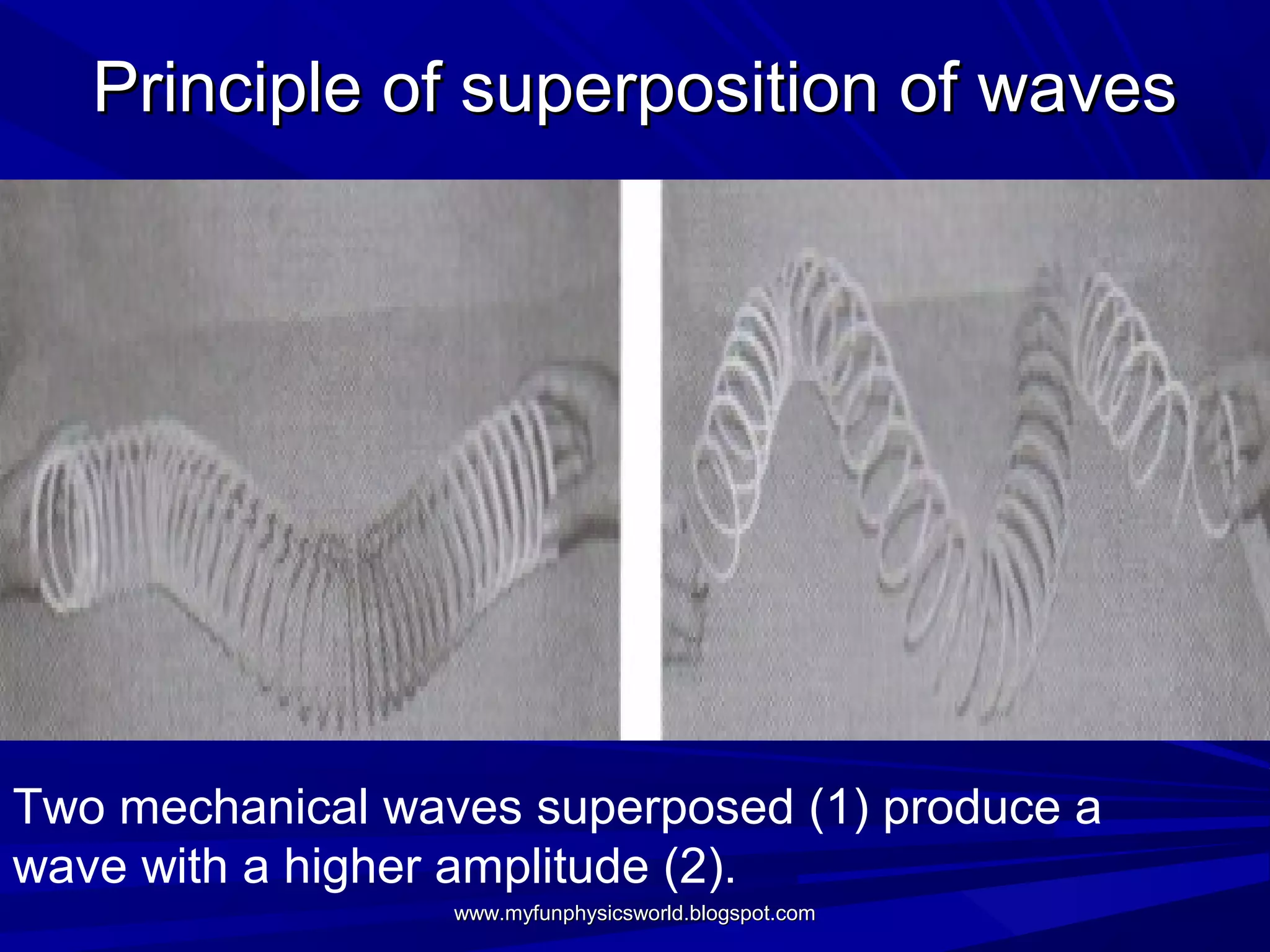
Principle of superposition of waves


Two mechanical waves superposed (1) produce a
wave with a higher amplitude (2).
                  www.myfunphysicsworld.blogspot.com
Principle of Superposition of waves

  When two waves superpose,
  the resulting displacement
of the medium at any location is the
      algebraic sum of the
          displacements
       of individual waves.
            www.myfunphysicsworld.blogspot.com
5cekap here 22feb2011


           www.myfunphysicsworld.blogspot.com
www.myfunphysicsworld.blogspot.com


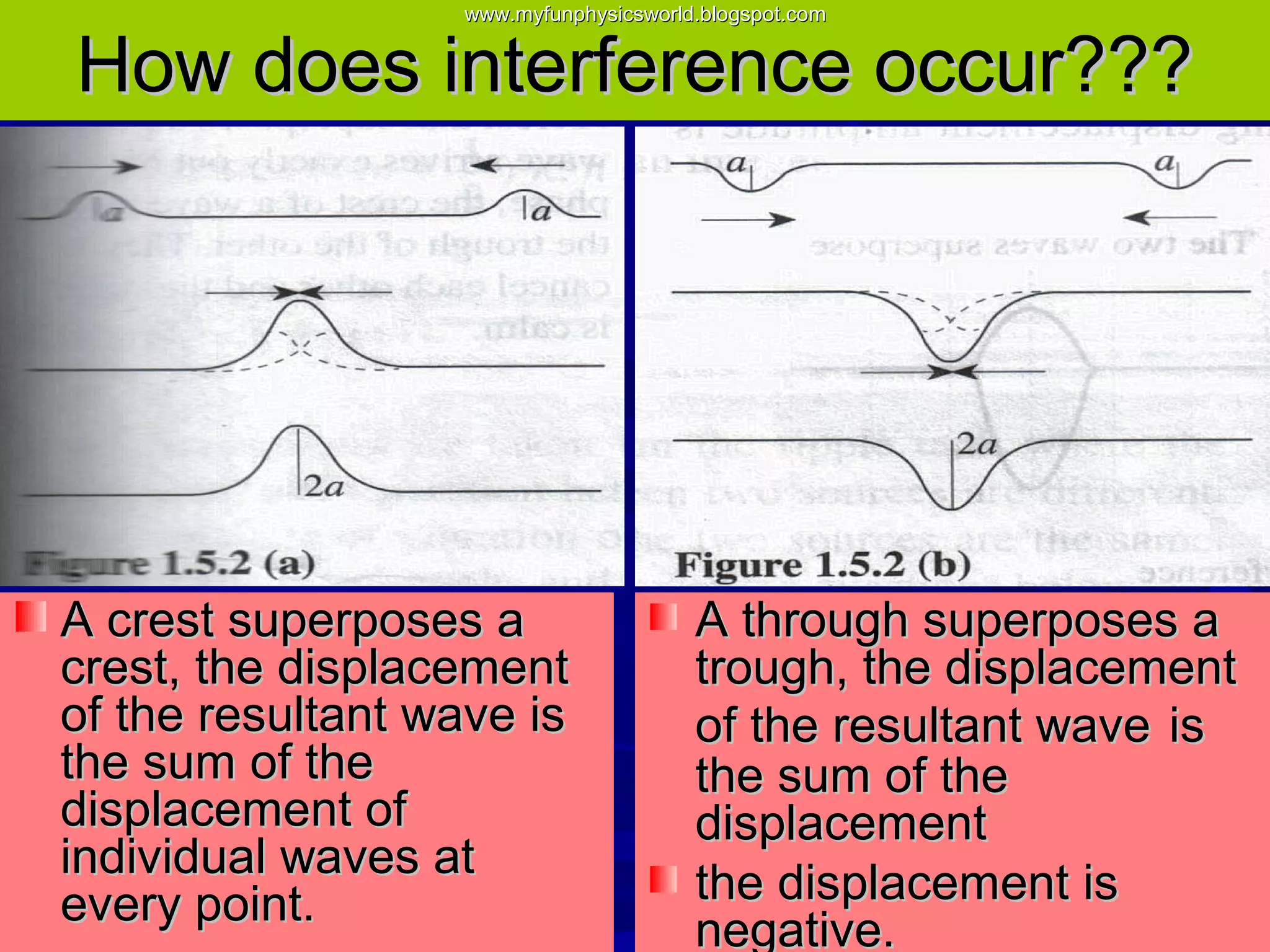
How does interference occur???


A crest superposes a                   A through superposes a
crest, the displacement                trough, the displacement
of the resultant wave is               of the resultant wave is
the sum of the                         the sum of the
displacement of                        displacement
individual waves at
every point.                           the displacement is
                                       negative.
2 type of Interference
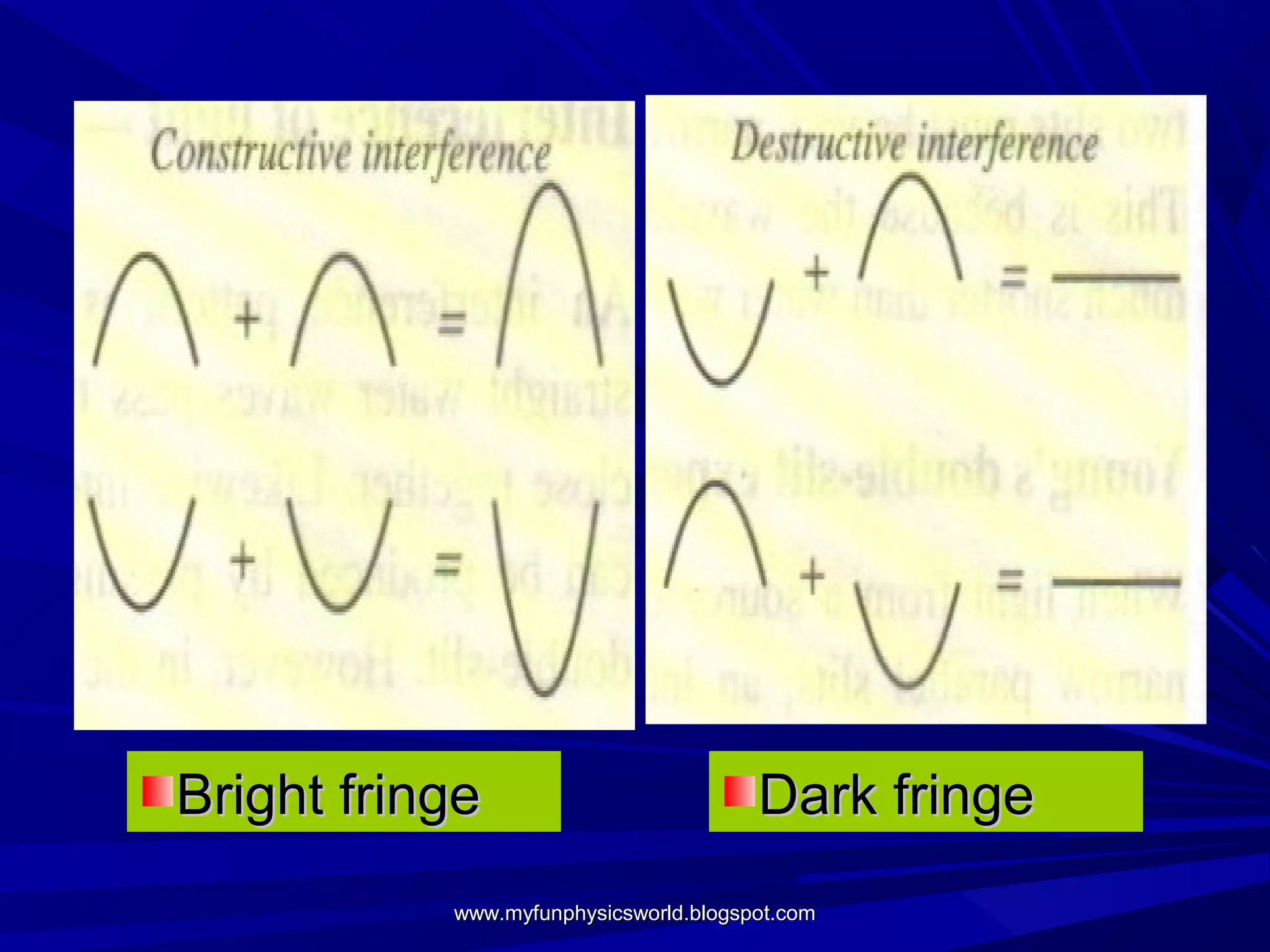
1. Constructive interference
  occurs when a crest meets a crest and
  when a trough meets a trough.

2. Destructive interference
  occurs crests meets/superposes with
  troughs.


              www.myfunphysicsworld.blogspot.com
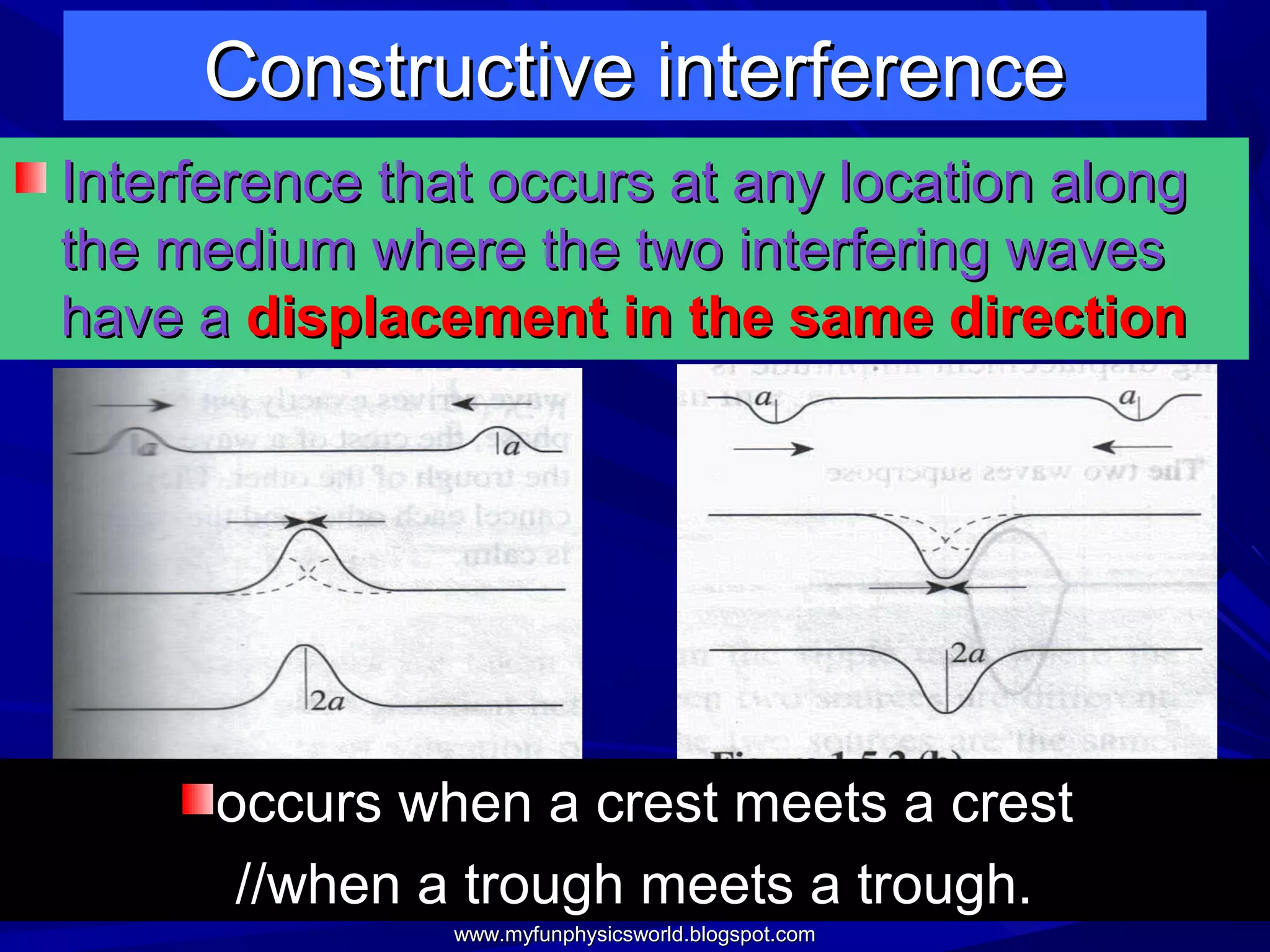
Constructive interference
Interference that occurs at any location along
the medium where the two interfering waves
have a displacement in the same direction


      occurs when a crest meets a crest
       //when a trough meets a trough.
                www.myfunphysicsworld.blogspot.com
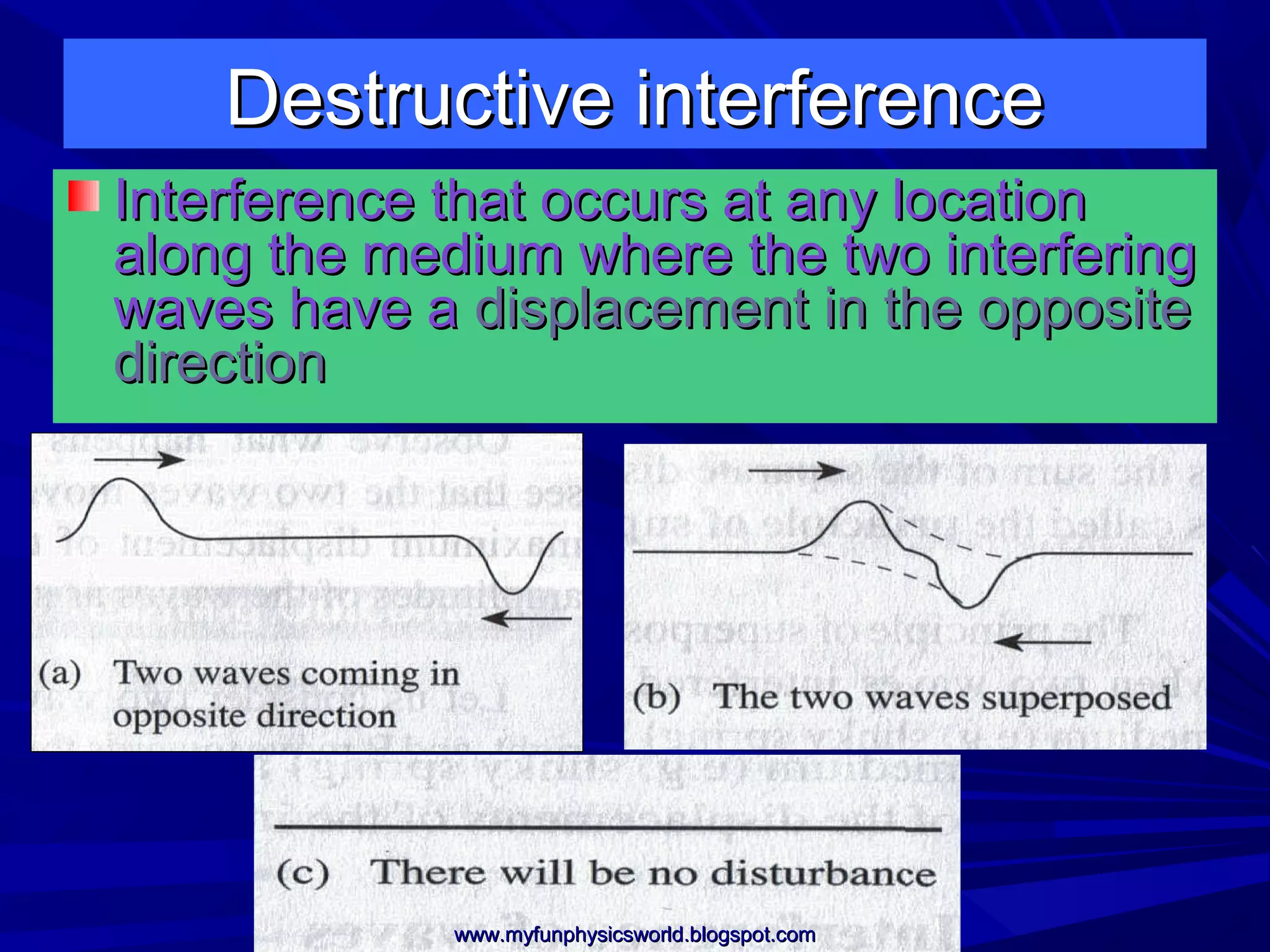
Destructive interference
Interference that occurs at any location
along the medium where the two interfering
waves have a displacement in the opposite
direction


             www.myfunphysicsworld.blogspot.com
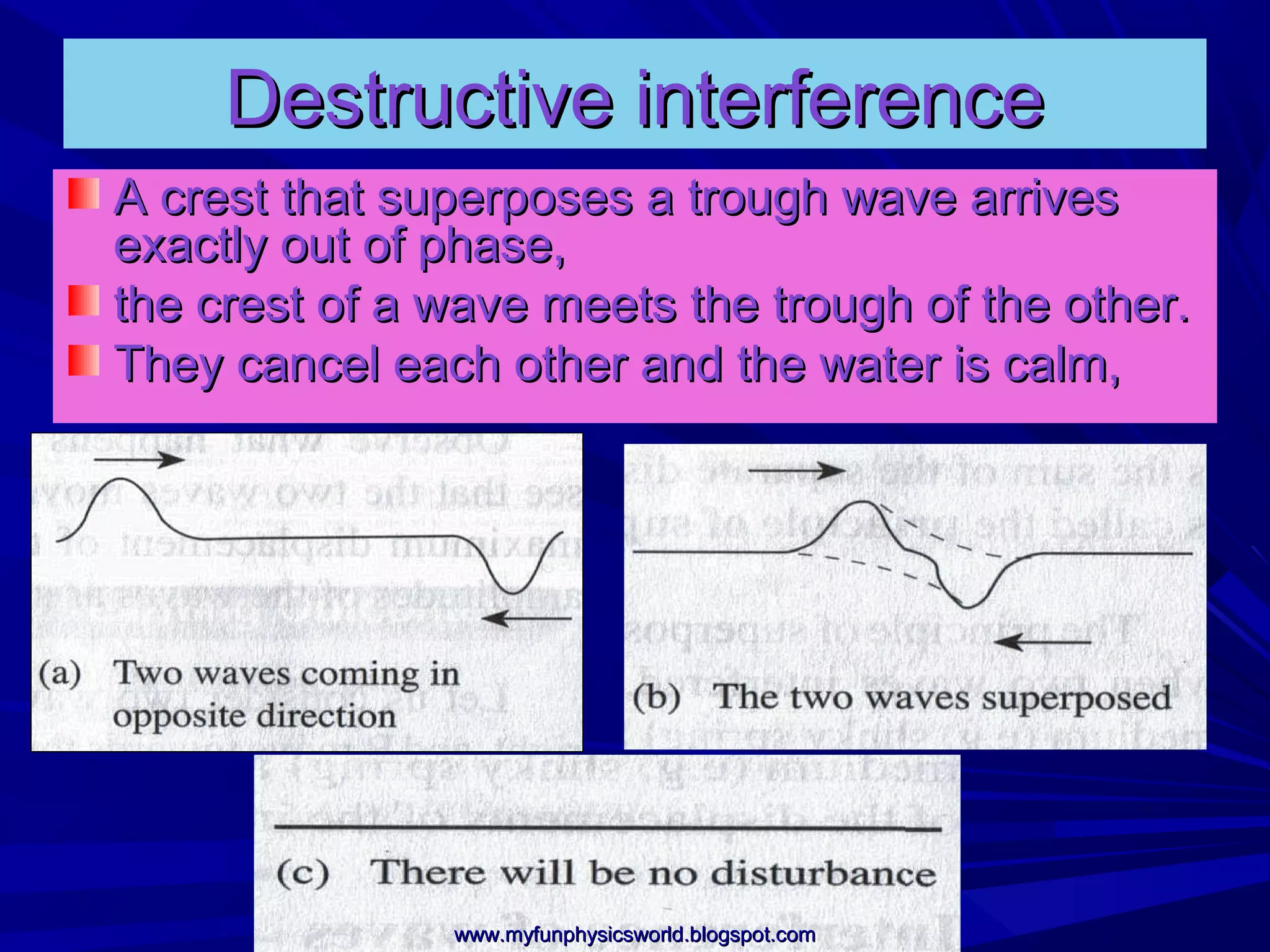
Destructive interference
A crest that superposes a trough wave arrives
exactly out of phase,
the crest of a wave meets the trough of the other.
They cancel each other and the water is calm,


               www.myfunphysicsworld.blogspot.com
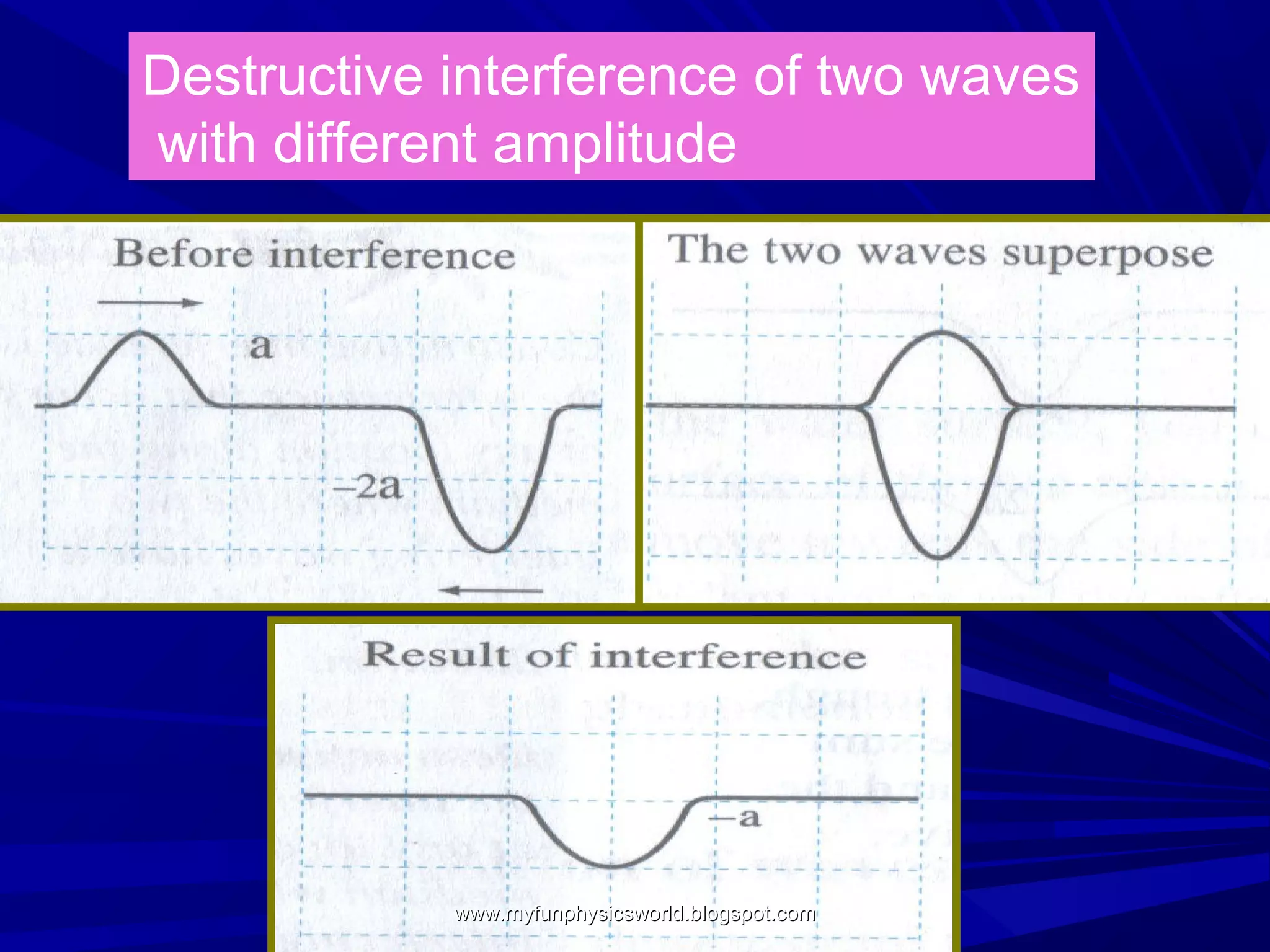
Destructive interference of two waves
with different amplitude


            www.myfunphysicsworld.blogspot.com
www.myfunphysicsworld.blogspot.com
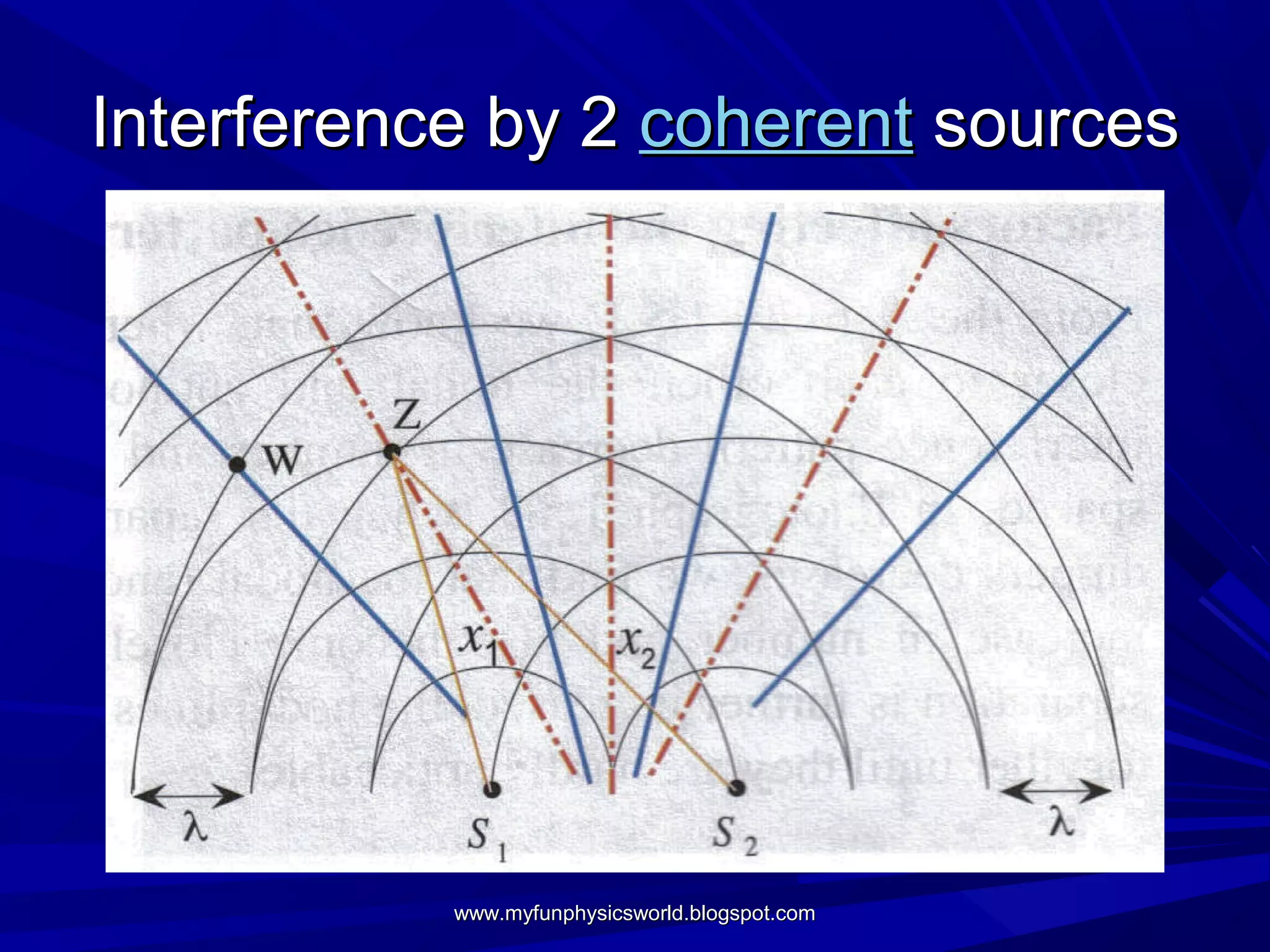
Interference by 2 coherent sources


           www.myfunphysicsworld.blogspot.com
Coherent sources
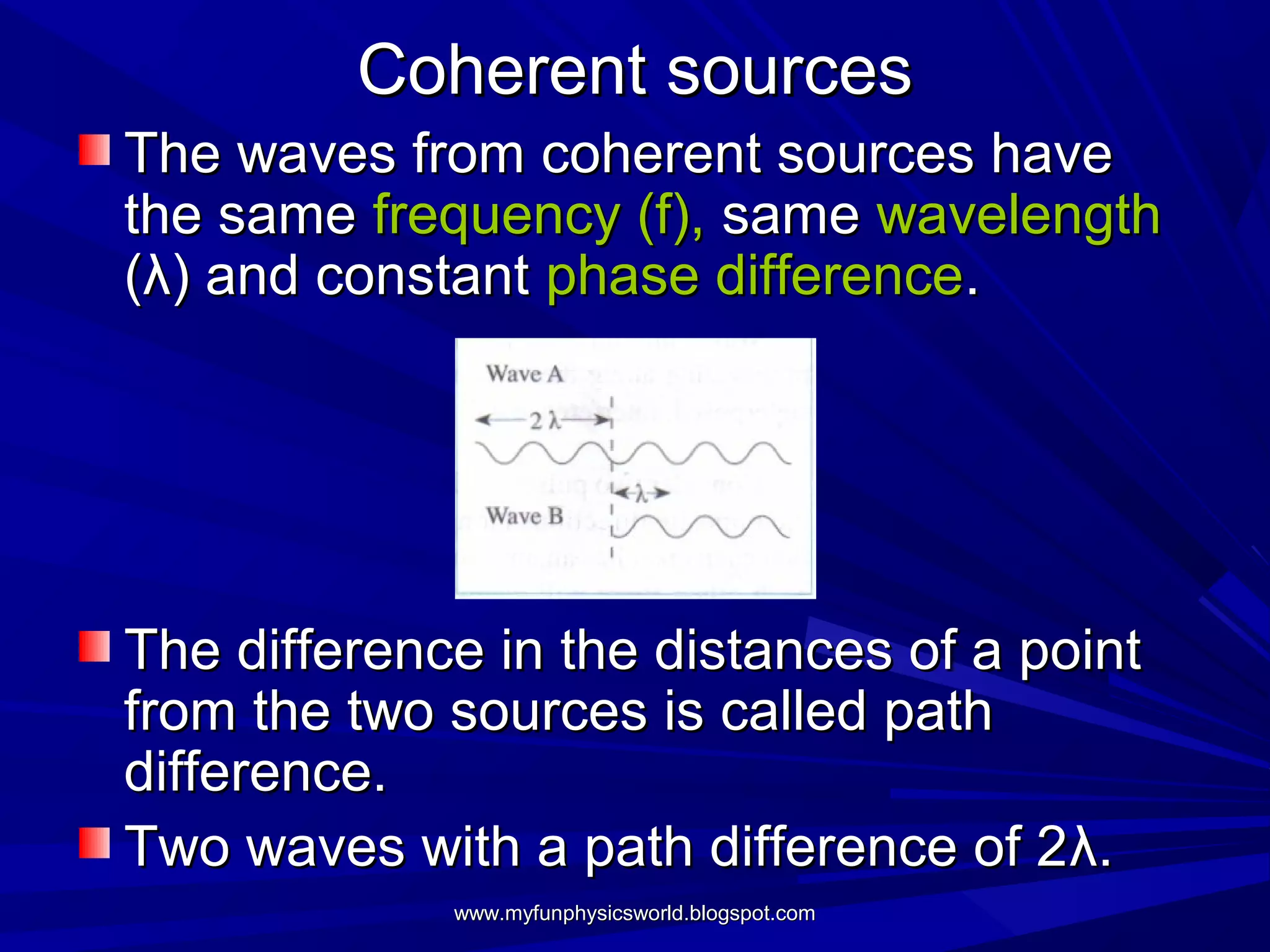
The waves from coherent sources have
the same frequency (f), same wavelength
(λ) and constant phase difference.


The difference in the distances of a point
from the two sources is called path
difference.
Two waves with a path difference of 2λ.
             www.myfunphysicsworld.blogspot.com
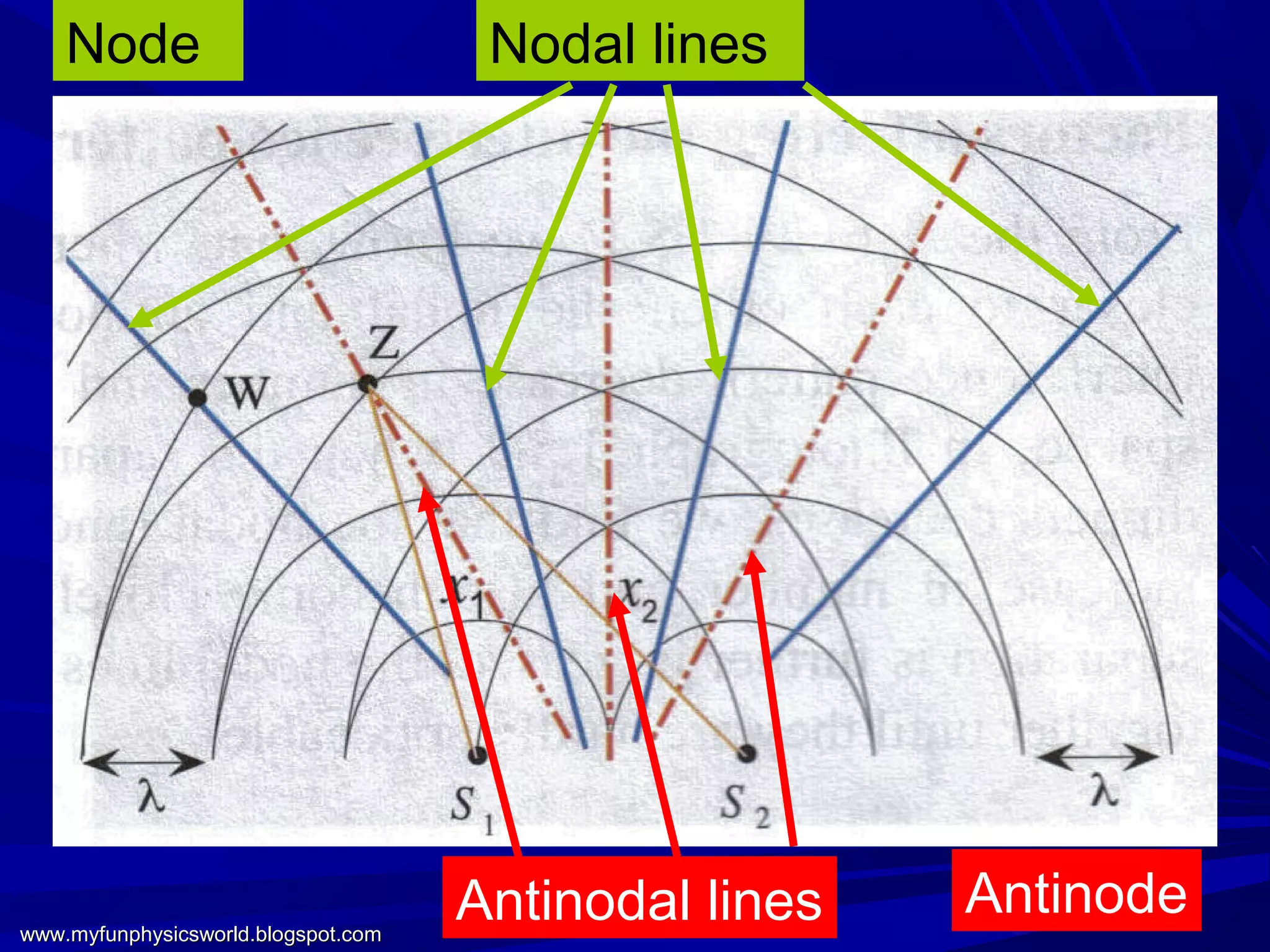
Node                              Nodal lines


                                     Antinodal lines   Antinode
www.myfunphysicsworld.blogspot.com
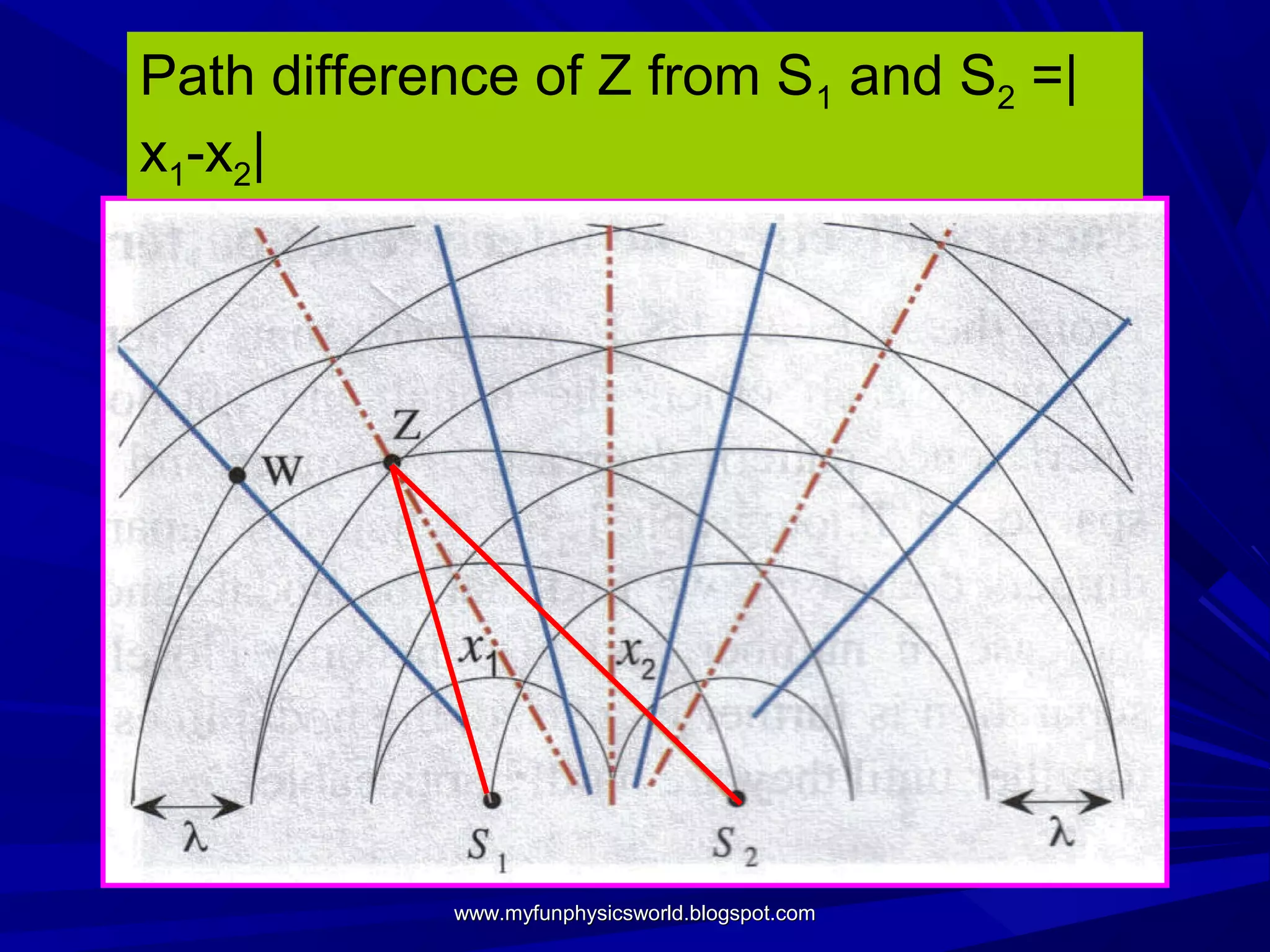
Path difference of Z from S1 and S2 =|
x1-x2|


            www.myfunphysicsworld.blogspot.com
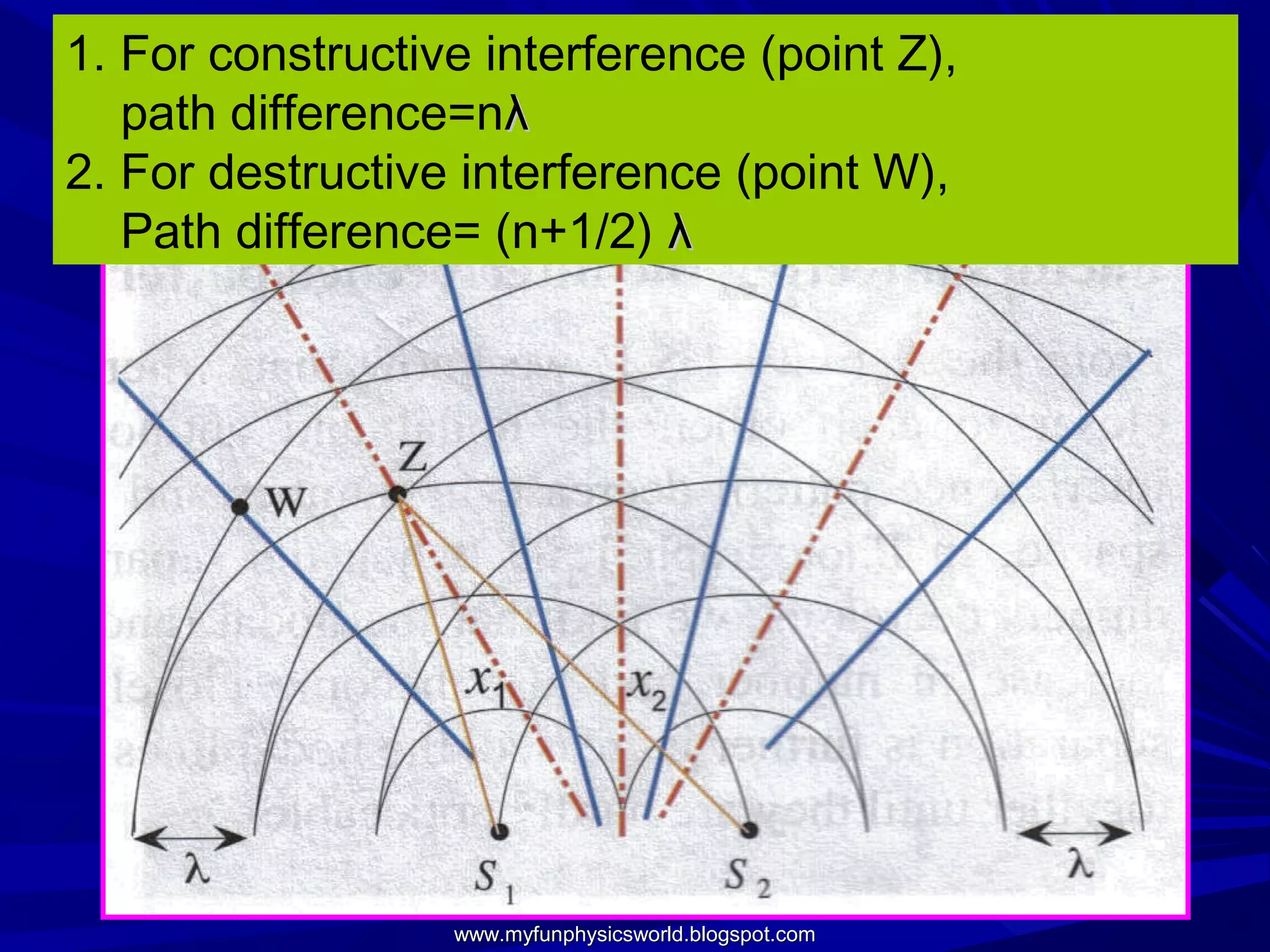
1. For constructive interference (point Z),
   path difference=nλ
2. For destructive interference (point W),
   Path difference= (n+1/2) λ


                  www.myfunphysicsworld.blogspot.com
Factors affecting the
    interference


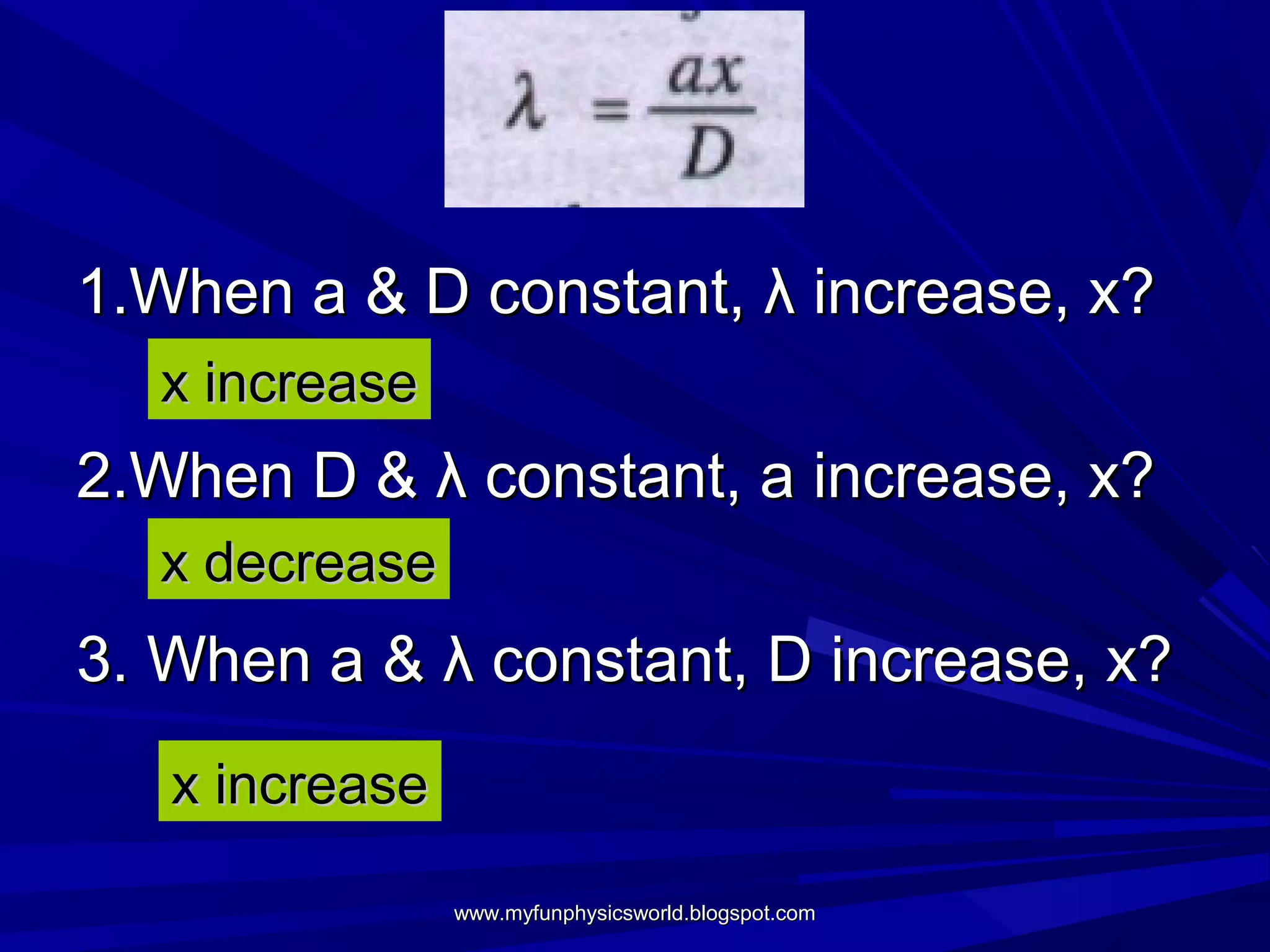
      Young’s Formula
                        www.myfunphysicsworld.blogspot.com
Young’s formula
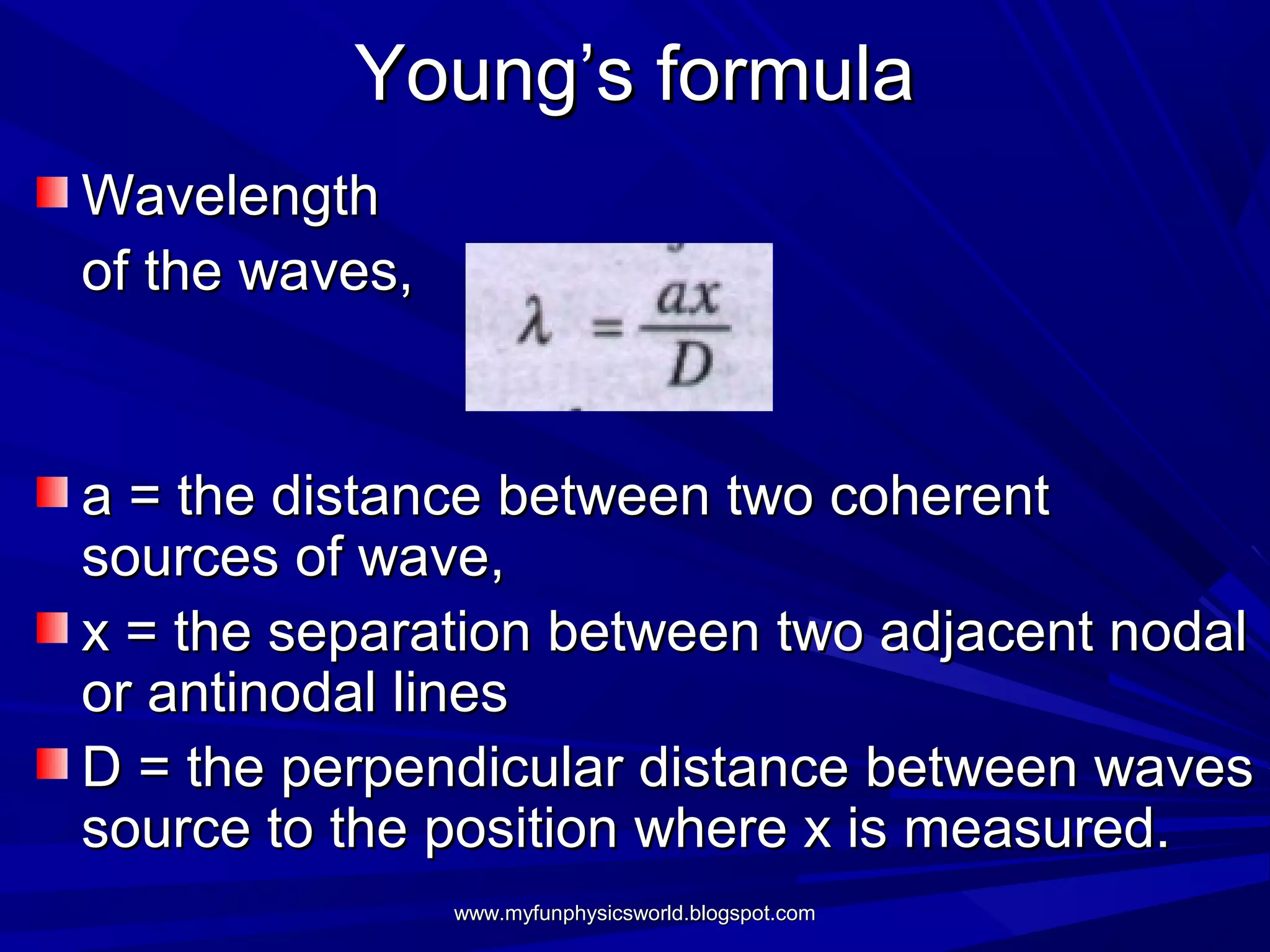
Wavelength
of the waves,


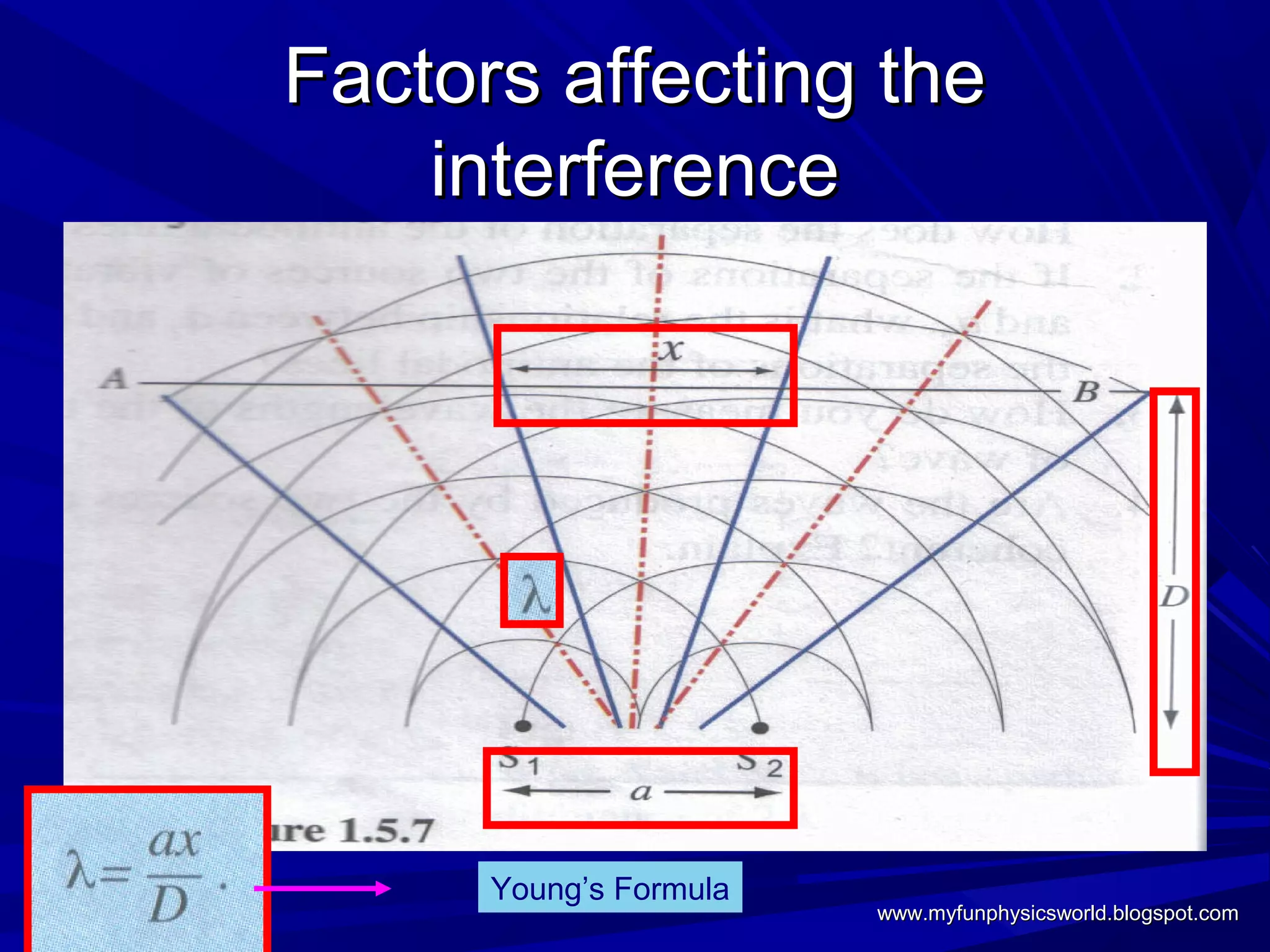
a = the distance between two coherent
sources of wave,
x = the separation between two adjacent nodal
or antinodal lines
D = the perpendicular distance between waves
source to the position where x is measured.
                www.myfunphysicsworld.blogspot.com
1.When a & D constant, λ increase, x?
  x increase
2.When D & λ constant, a increase, x?
  x decrease
3. When a & λ constant, D increase, x?
   x increase

                www.myfunphysicsworld.blogspot.com
www.myfunphysicsworld.blogspot.com
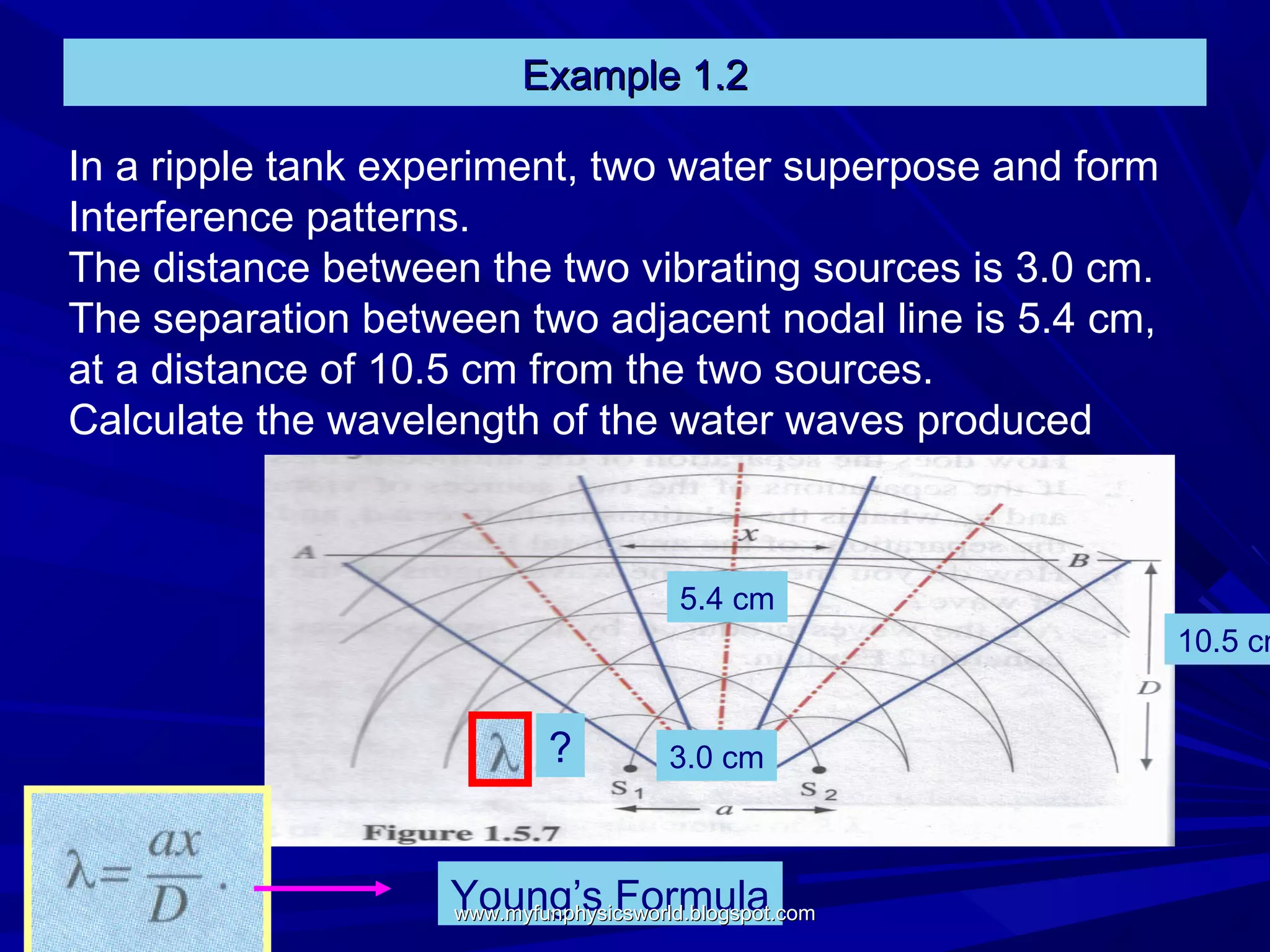
Example 1.2

In a ripple tank experiment, two water superpose and form
Interference patterns.
The distance between the two vibrating sources is 3.0 cm.
The separation between two adjacent nodal line is 5.4 cm,
at a distance of 10.5 cm from the two sources.
Calculate the wavelength of the water waves produced


                                        5.4 cm
                                                            10.5 cm


                            ?          3.0 cm


                   Young’s Formula
                   www.myfunphysicsworld.blogspot.com
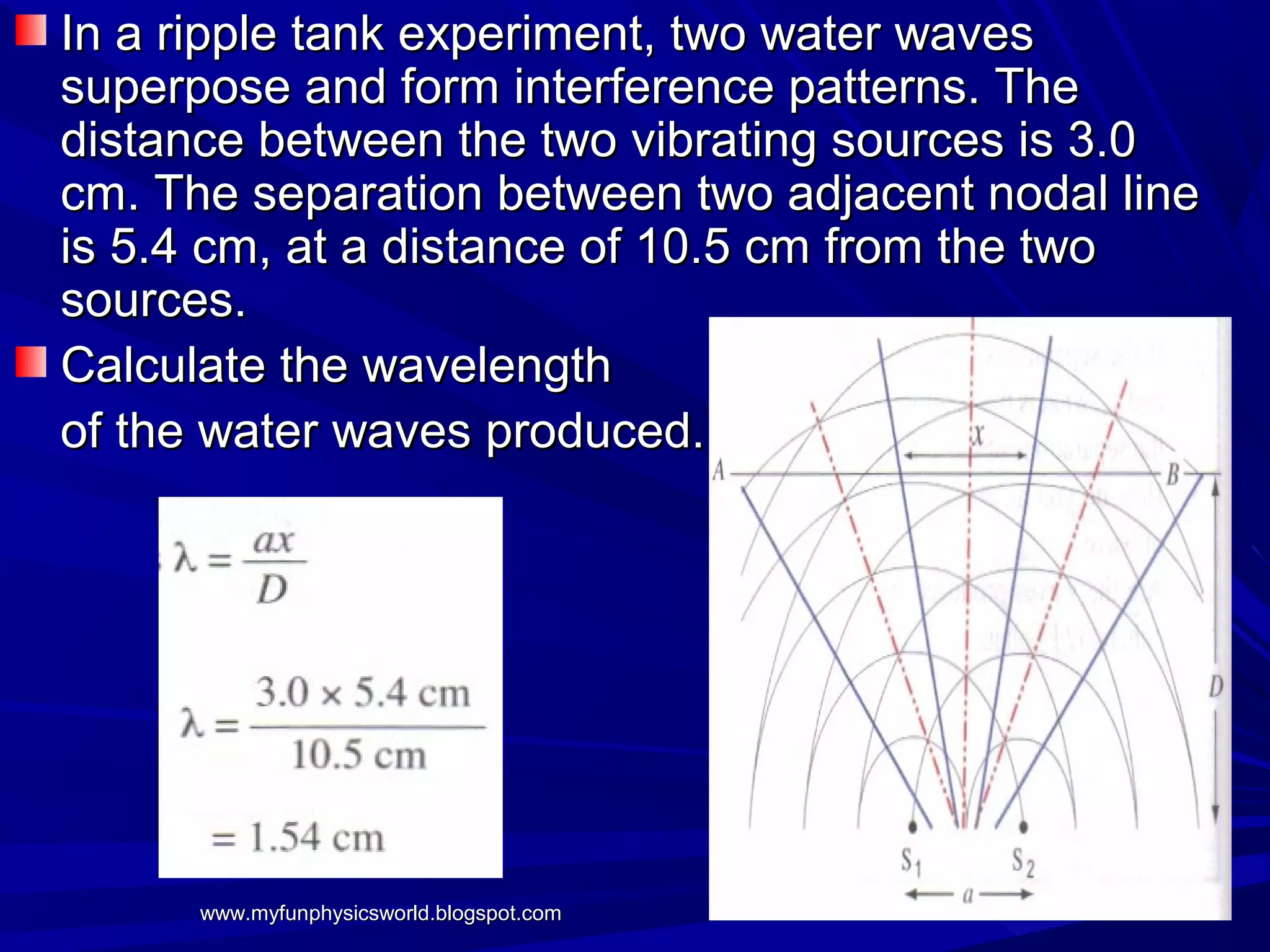
In a ripple tank experiment, two water waves
superpose and form interference patterns. The
distance between the two vibrating sources is 3.0
cm. The separation between two adjacent nodal line
is 5.4 cm, at a distance of 10.5 cm from the two
sources.
Calculate the wavelength
of the water waves produced.


      www.myfunphysicsworld.blogspot.com
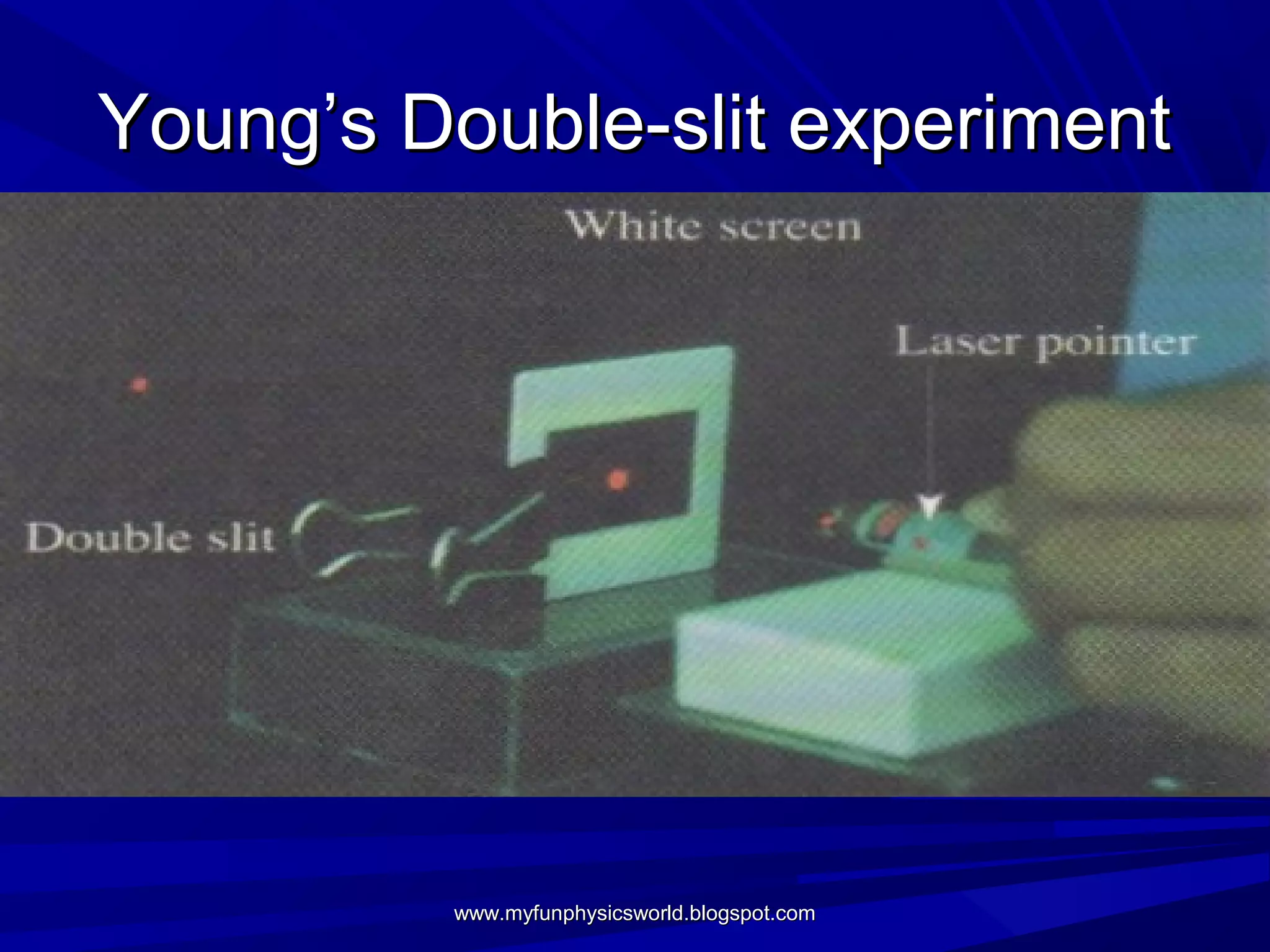
Young’s Double-slit experiment


         www.myfunphysicsworld.blogspot.com
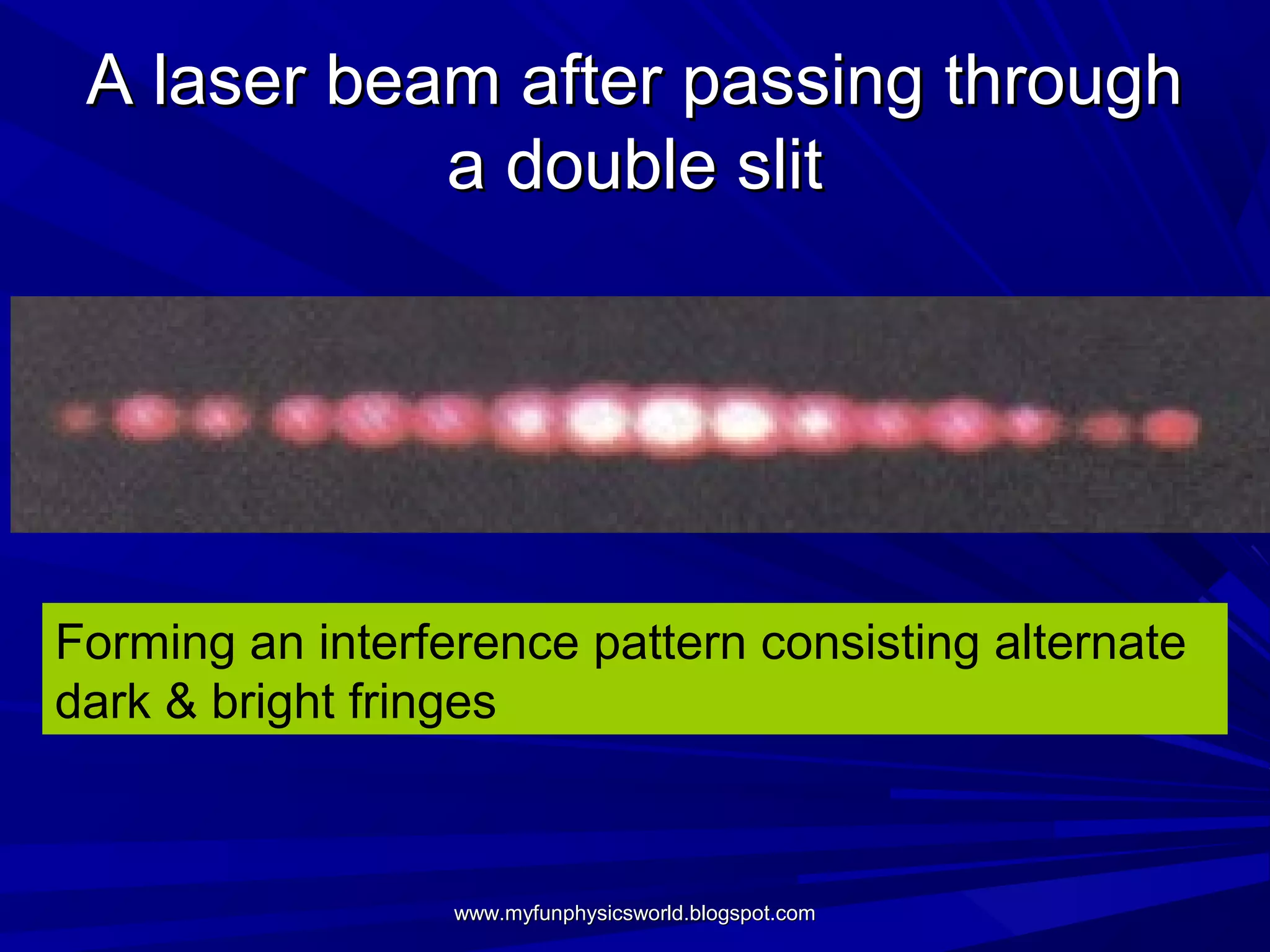
A laser beam after passing through
            a double slit


Forming an interference pattern consisting alternate
dark & bright fringes


                  www.myfunphysicsworld.blogspot.com
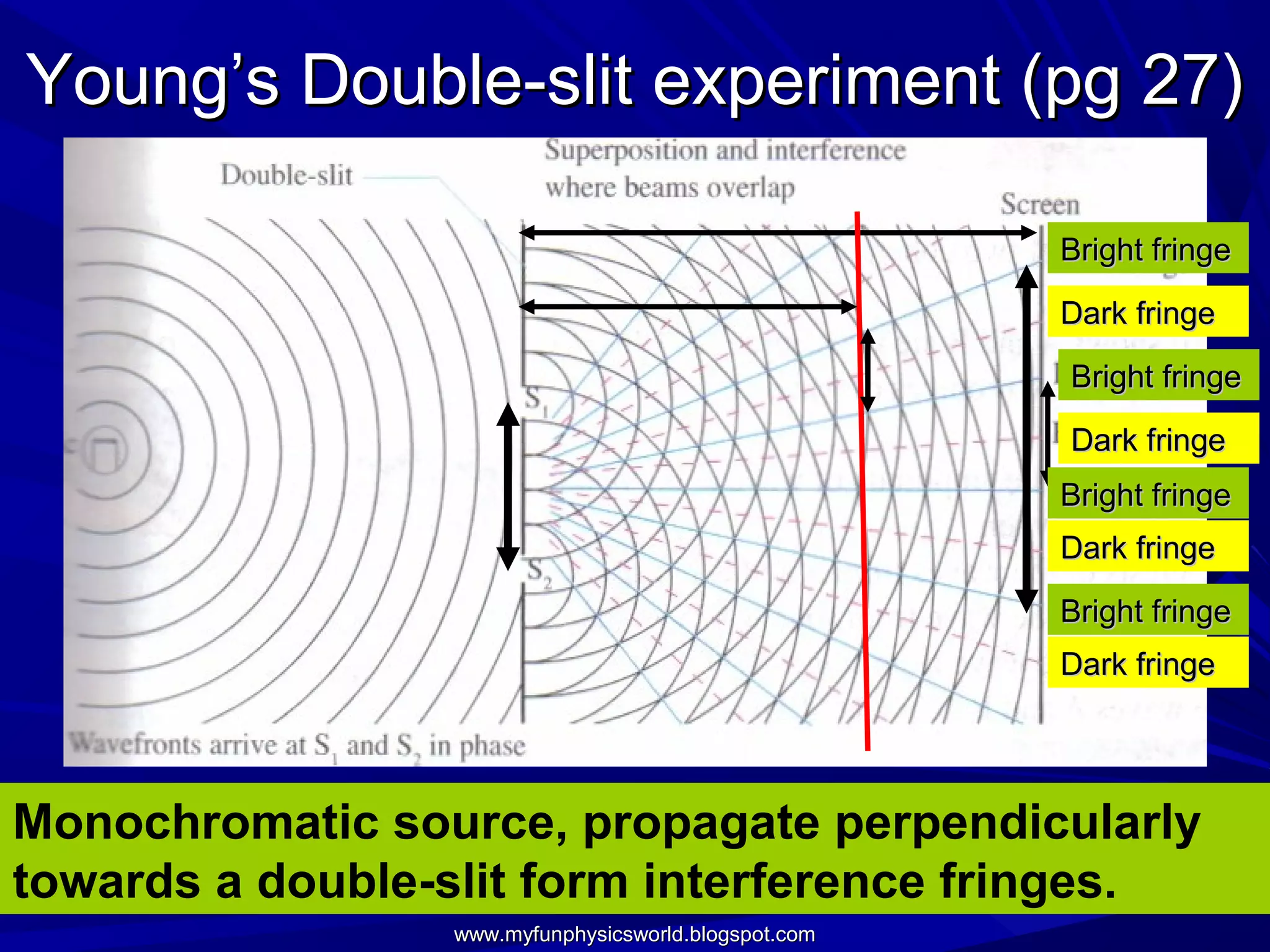
Young’s Double-slit experiment (pg 27)

                                                      Bright fringe
                                                       bri
                                                       gh
                                                      Dark fringe
                                                       t
                                                       Bright fringe

                                                      Dark fringe
                                                      Bright fringe
                                                      Dark fringe

                                                      Bright fringe
                                                      Dark fringe


Monochromatic source, propagate perpendicularly
towards a double-slit form interference fringes.
                 www.myfunphysicsworld.blogspot.com
Bright fringe                          Dark fringe
           www.myfunphysicsworld.blogspot.com
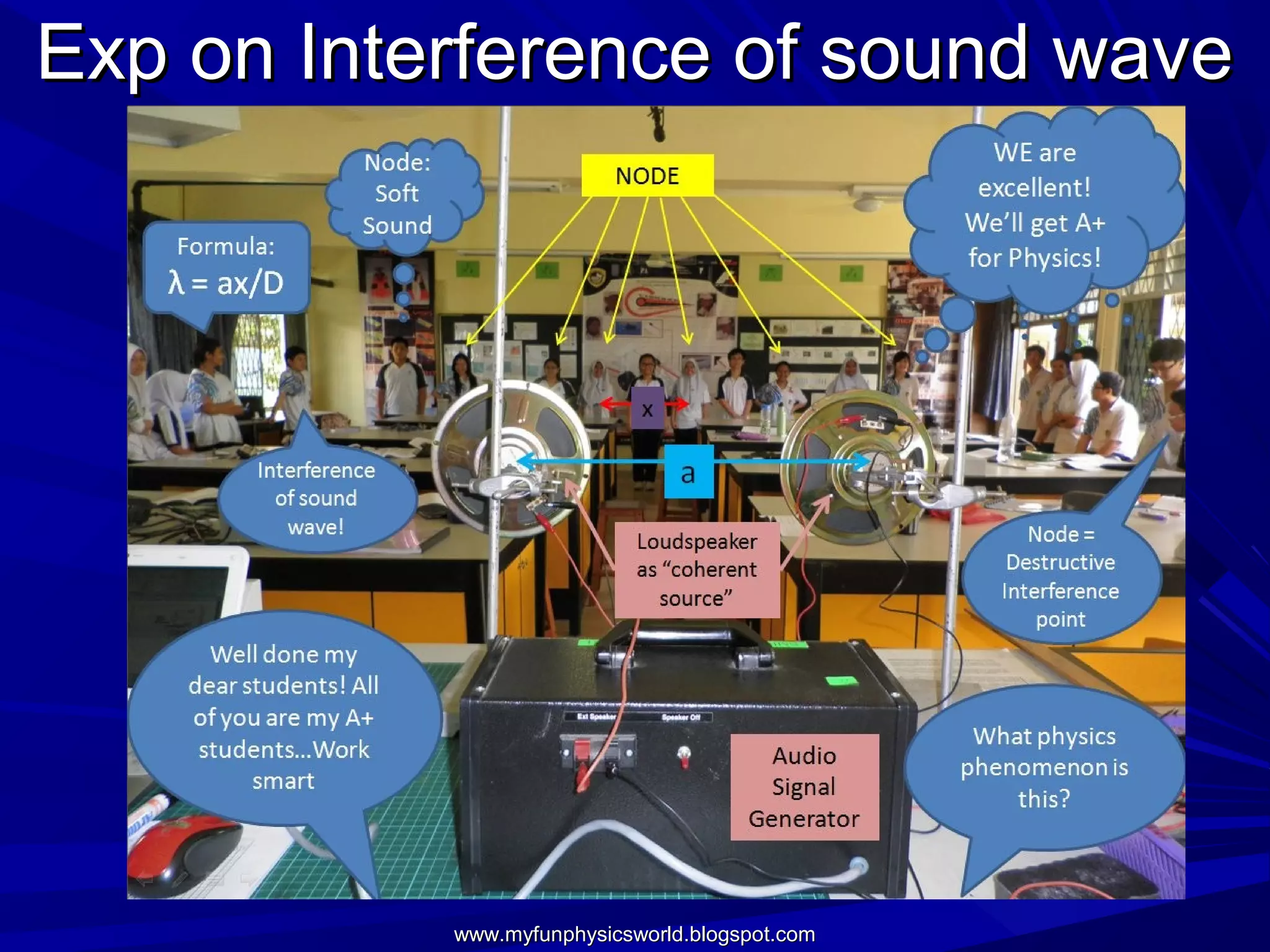
Exp on Interference of sound wave


           www.myfunphysicsworld.blogspot.com
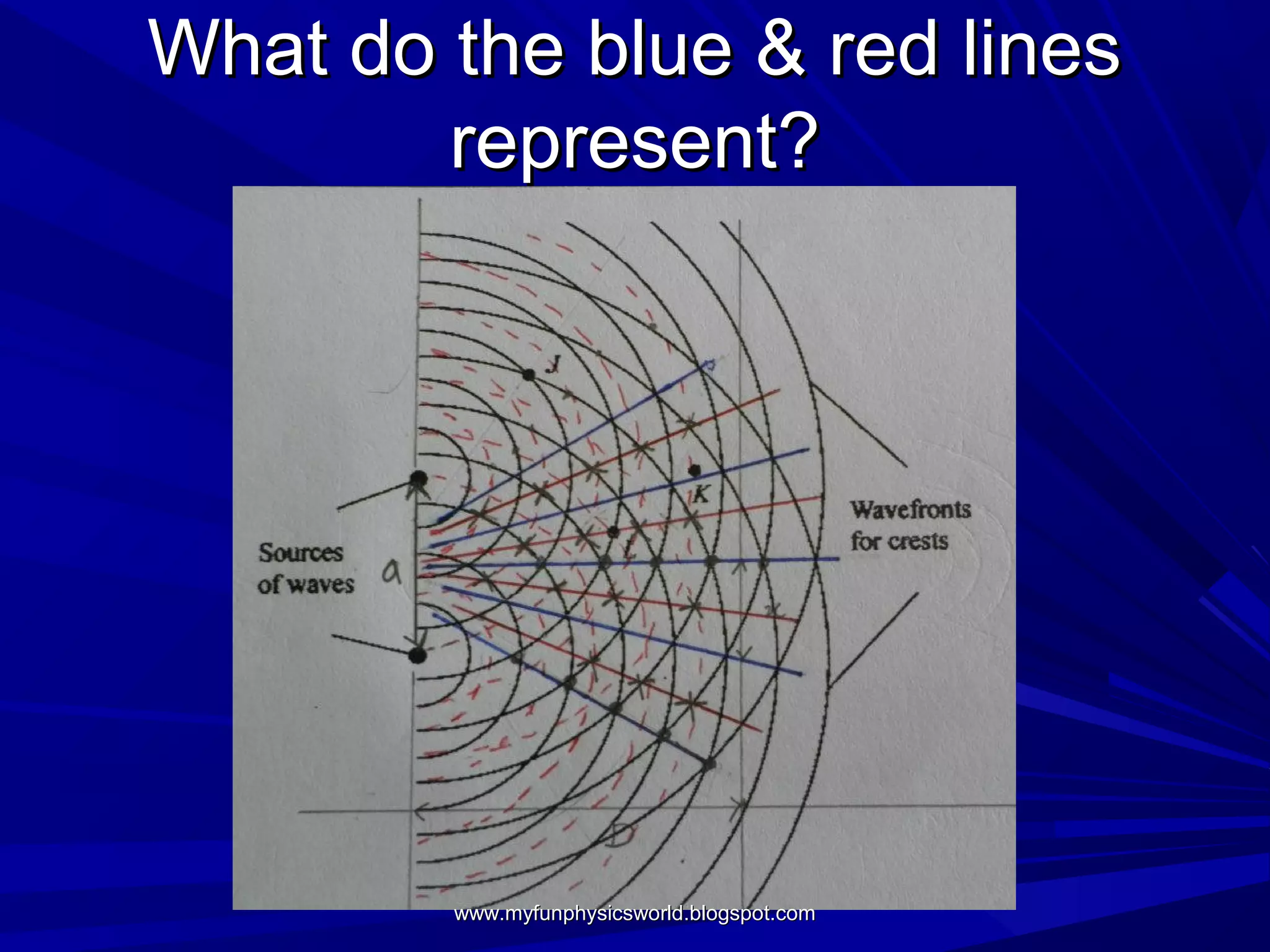
What do the blue & red lines
        represent?


        www.myfunphysicsworld.blogspot.com
Homework:
1. QR 1.5 page 28 (#1-3)
 2. Page 46, Section B.


       www.myfunphysicsworld.blogspot.com
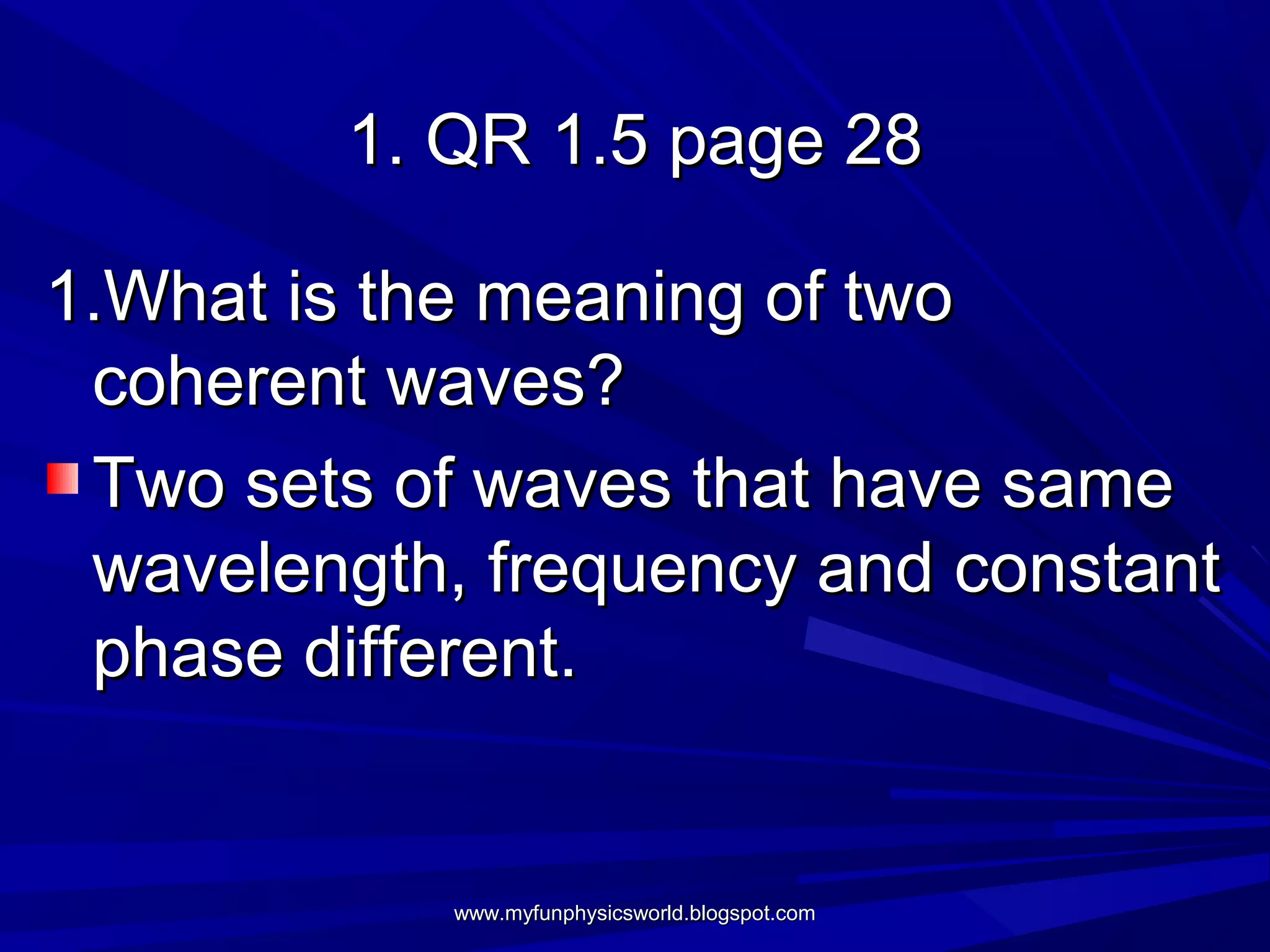
1. QR 1.5 page 28

1.What is the meaning of two
 coherent waves?
 Two sets of waves that have same
 wavelength, frequency and constant
 phase different.


            www.myfunphysicsworld.blogspot.com
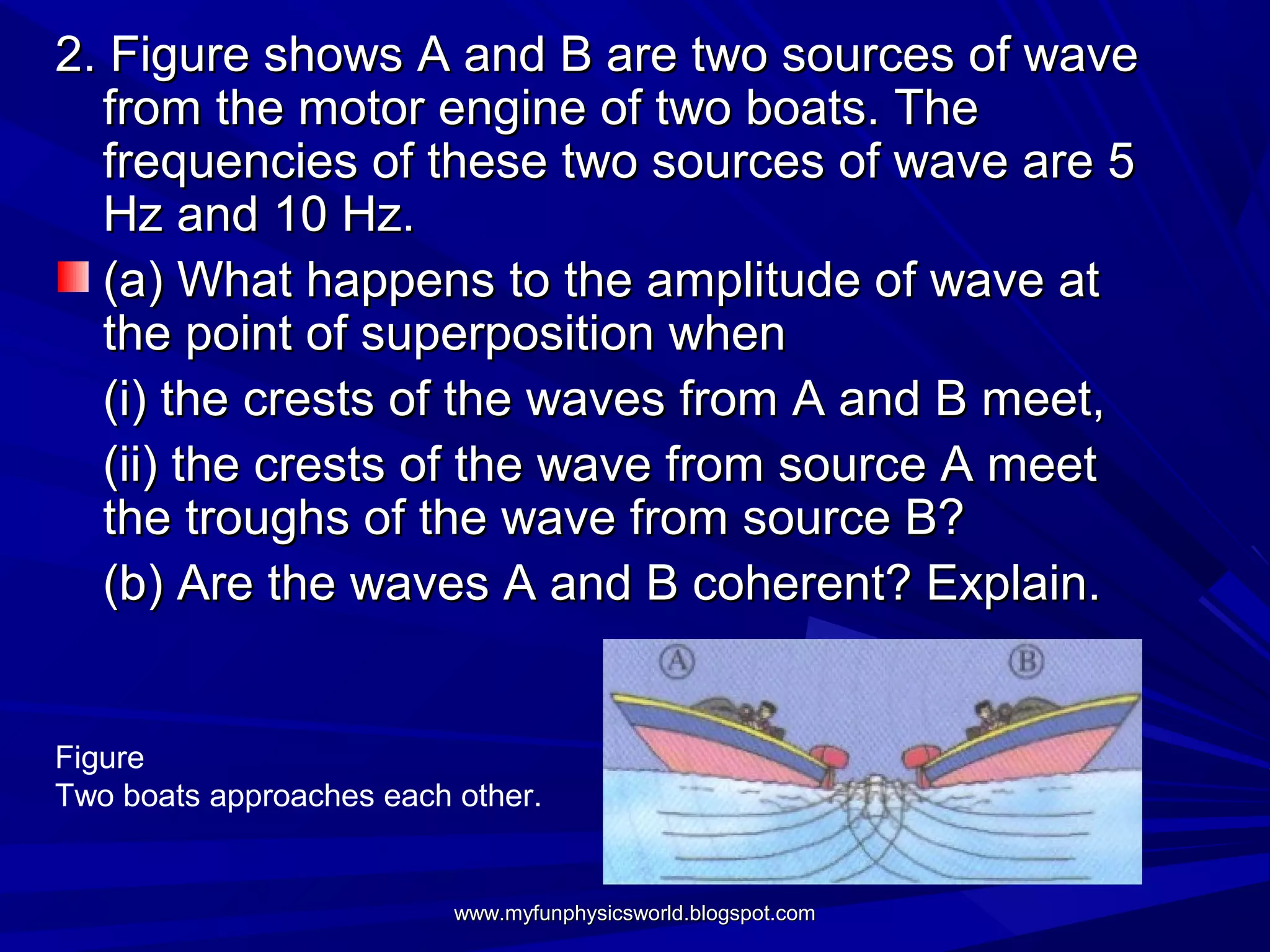
2. Figure shows A and B are two sources of wave
  from the motor engine of two boats. The
  frequencies of these two sources of wave are 5
  Hz and 10 Hz.
  (a) What happens to the amplitude of wave at
  the point of superposition when
  (i) the crests of the waves from A and B meet,
  (ii) the crests of the wave from source A meet
  the troughs of the wave from source B?
  (b) Are the waves A and B coherent? Explain.


Figure
Two boats approaches each other.


                          www.myfunphysicsworld.blogspot.com
2.
(a) (i) The amplitude will be twice
    (ii) The amplitude will be zero
(b) No, different frequency


               www.myfunphysicsworld.blogspot.com
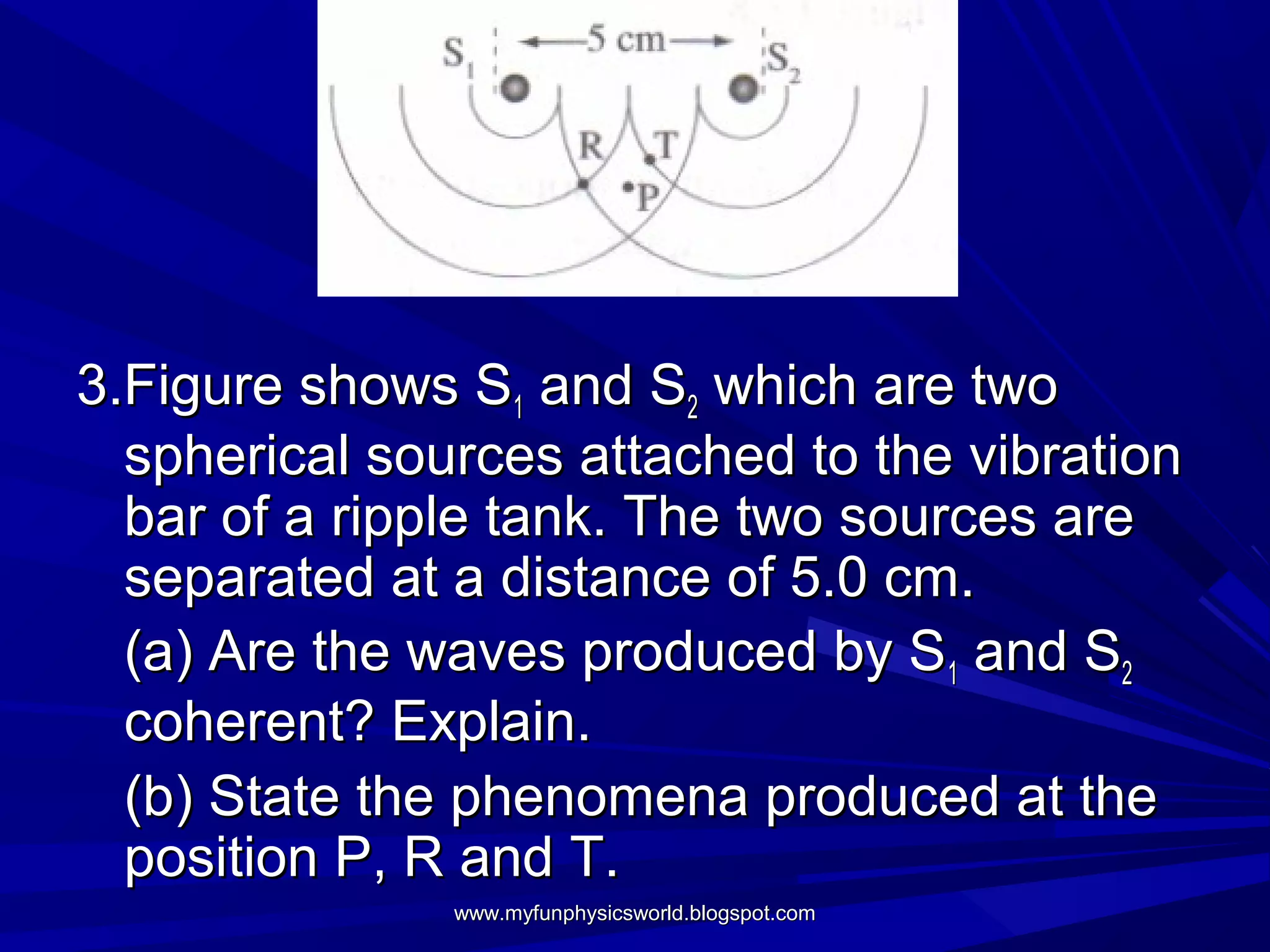
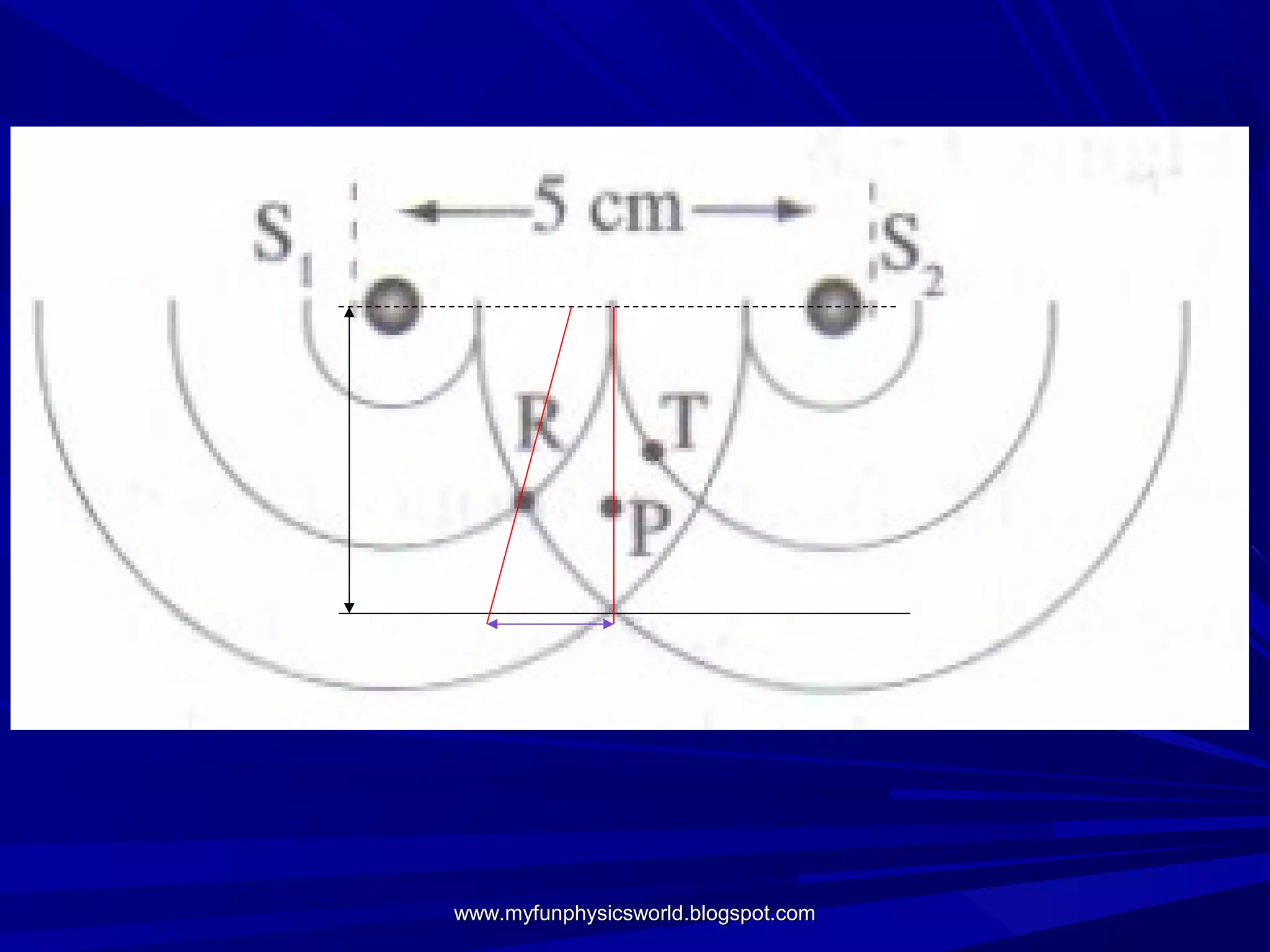
3.Figure shows S1 and S2 which are two
  spherical sources attached to the vibration
  bar of a ripple tank. The two sources are
  separated at a distance of 5.0 cm.
  (a) Are the waves produced by S1 and S2
  coherent? Explain.
  (b) State the phenomena produced at the
  position P, R and T.
               www.myfunphysicsworld.blogspot.com
3
(a) Yes, they come from the same source
    (Same f, λ and phase difference)
(a) R and P     : Constructive Interference
    T           : destructive Interference


               www.myfunphysicsworld.blogspot.com
Homework
Page 46, Section B.
*Both semicircular waves must have same
size of λ.
(c) From the diagram, measure D and x.
(d) Calculate λ.


            www.myfunphysicsworld.blogspot.com
www.myfunphysicsworld.blogspot.com
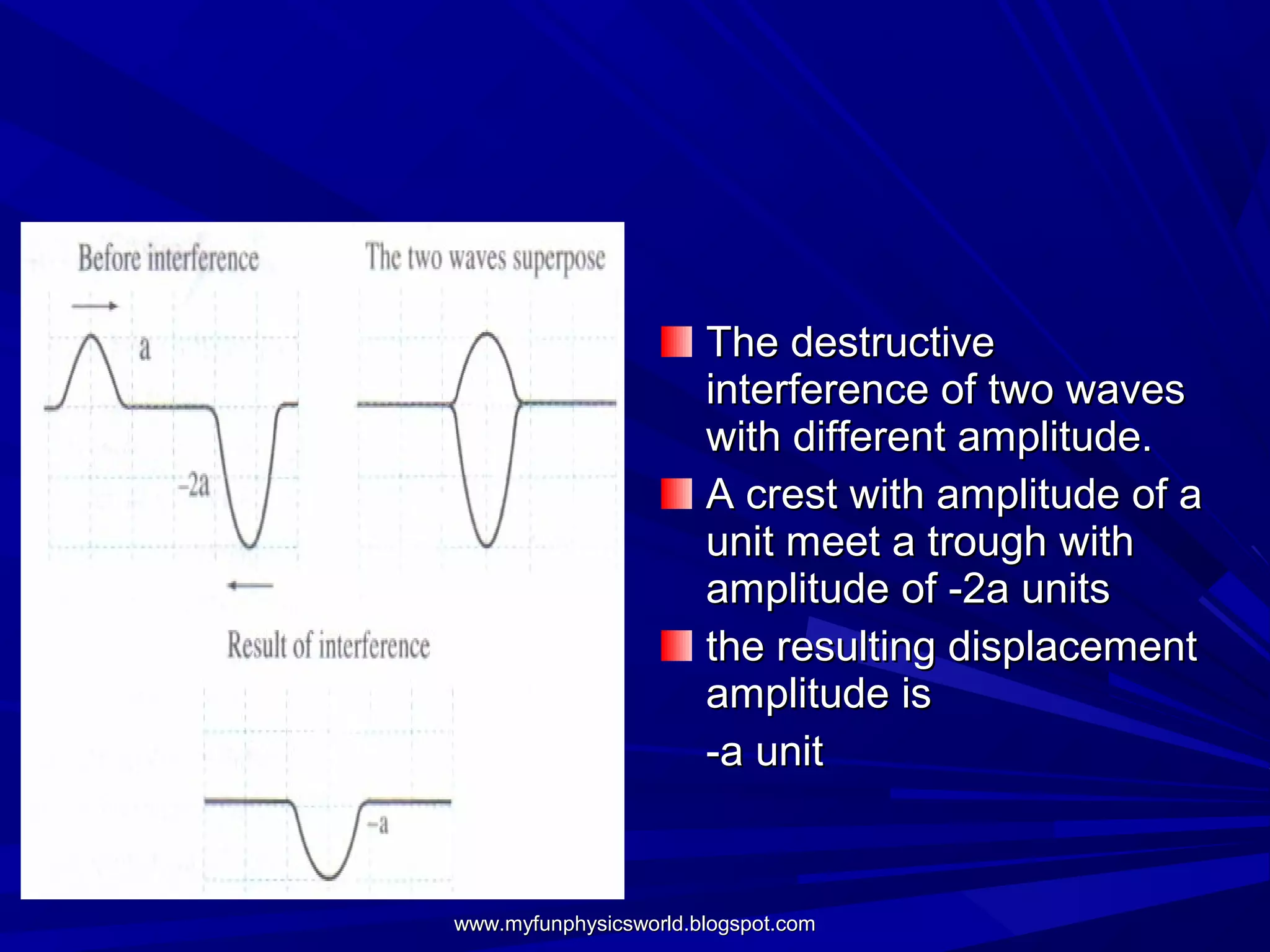
The destructive
                       interference of two waves
                       with different amplitude.
                       A crest with amplitude of a
                       unit meet a trough with
                       amplitude of -2a units
                       the resulting displacement
                       amplitude is
                       -a unit


www.myfunphysicsworld.blogspot.com
Destructive
  interference
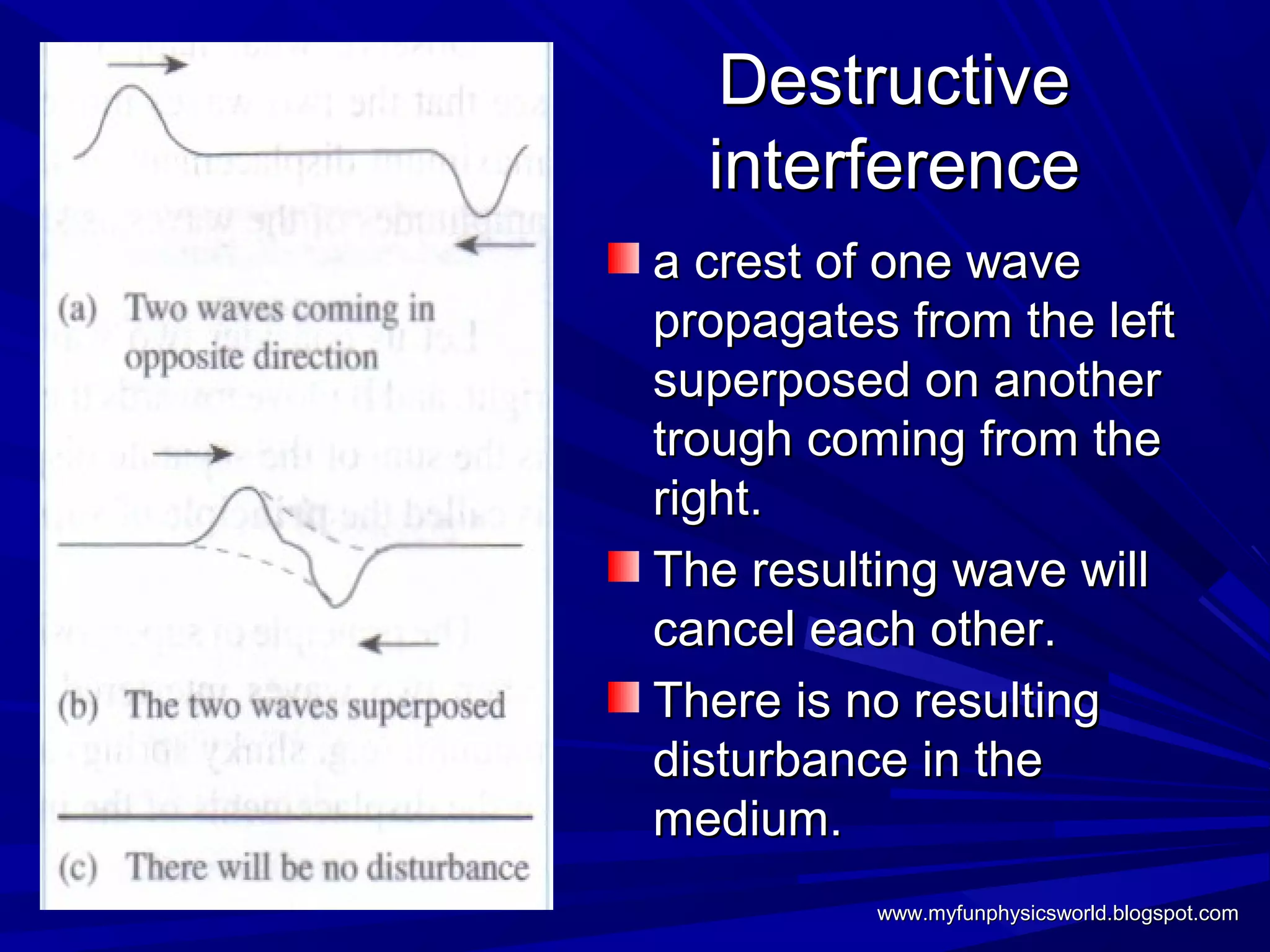
a crest of one wave
propagates from the left
superposed on another
trough coming from the
right.
The resulting wave will
cancel each other.
There is no resulting
disturbance in the
medium.
          www.myfunphysicsworld.blogspot.com
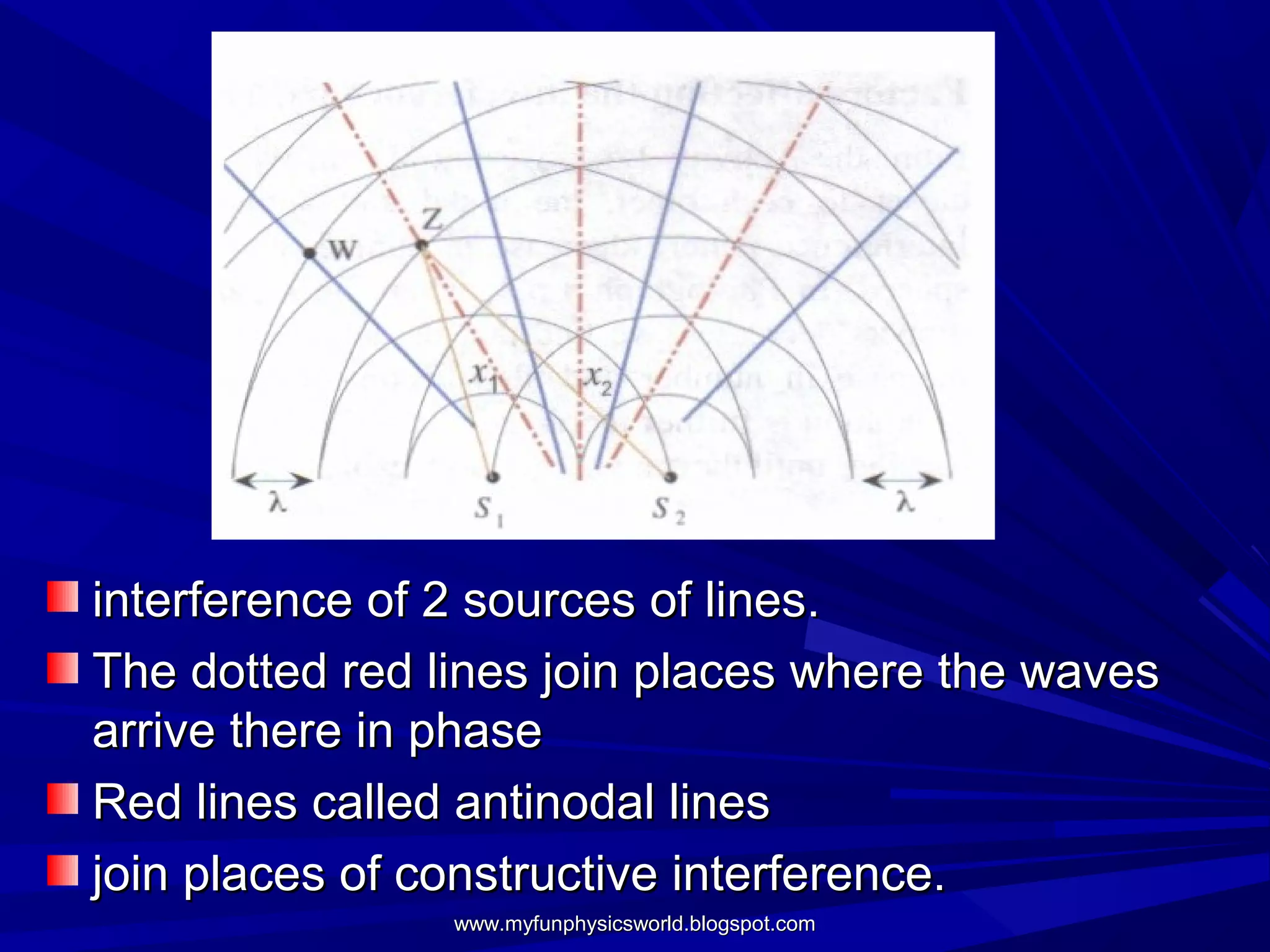
interference of 2 sources of lines.
The dotted red lines join places where the waves
arrive there in phase
Red lines called antinodal lines
join places of constructive interference.
                www.myfunphysicsworld.blogspot.com
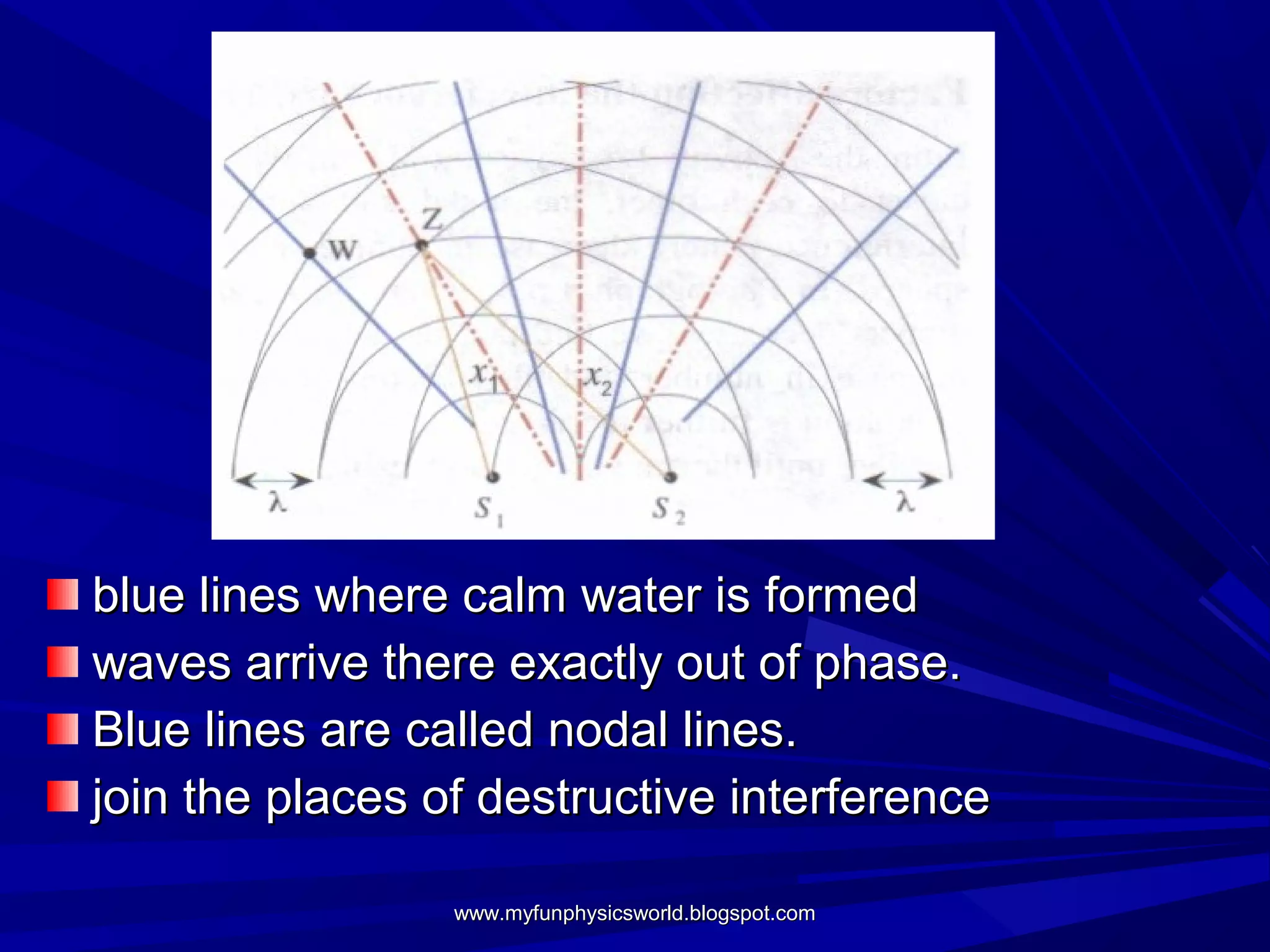
blue lines where calm water is formed
waves arrive there exactly out of phase.
Blue lines are called nodal lines.
join the places of destructive interference

                 www.myfunphysicsworld.blogspot.com
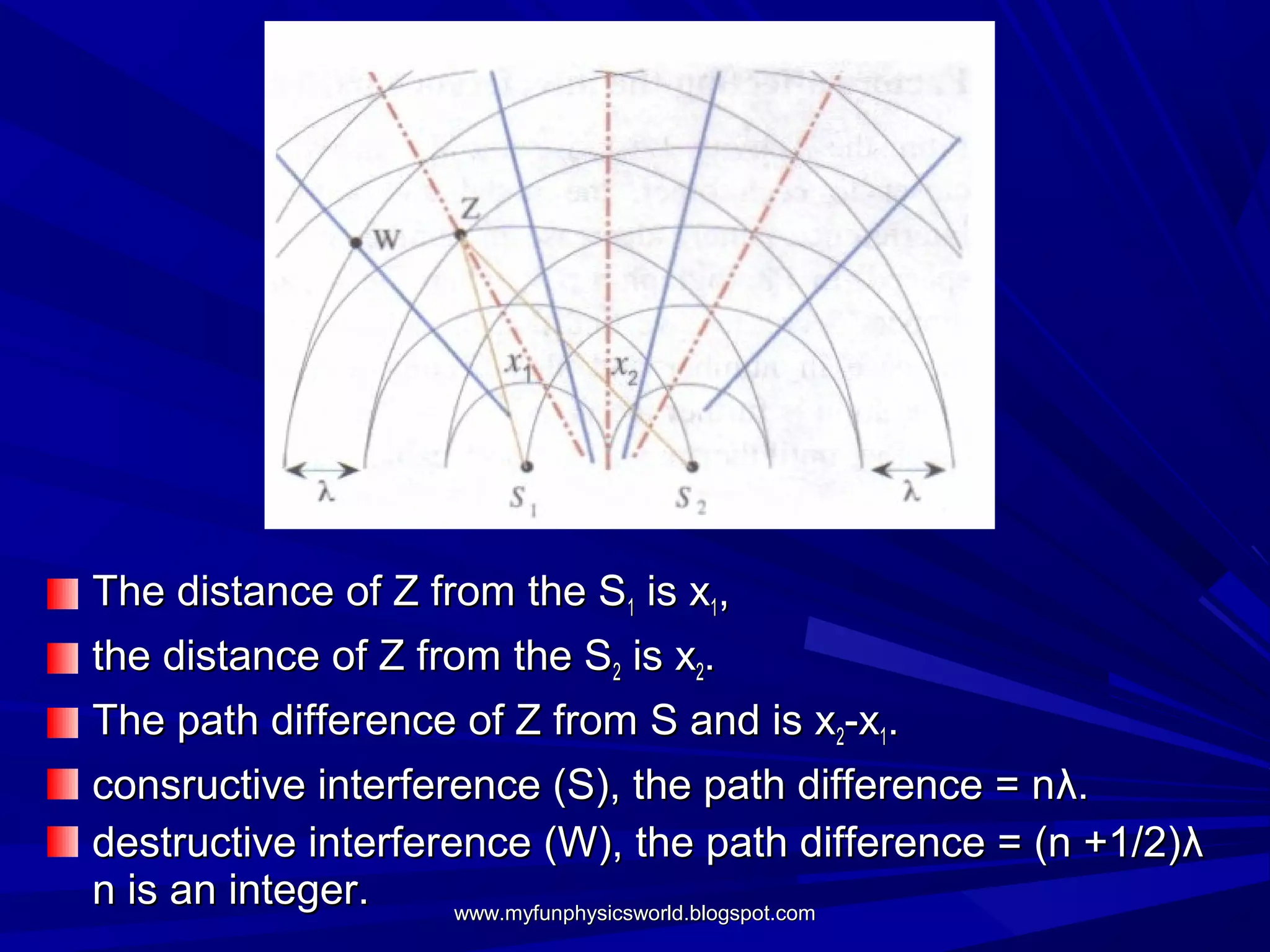
The distance of Z from the S1 is x1,
the distance of Z from the S2 is x2.
The path difference of Z from S and is x2-x1.
consructive interference (S), the path difference = nλ.
destructive interference (W), the path difference = (n +1/2) λ
n is an integer.     www.myfunphysicsworld.blogspot.com
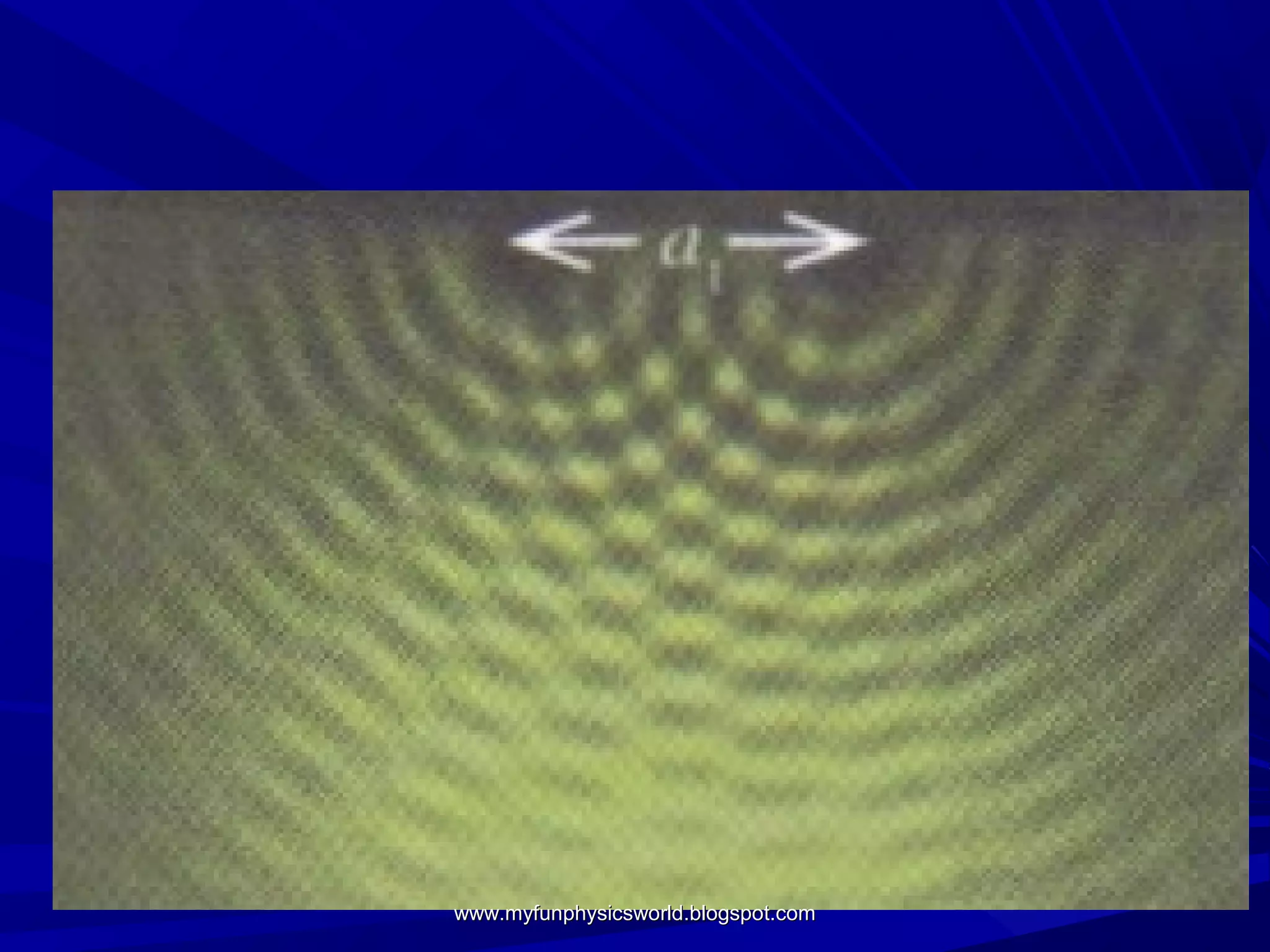
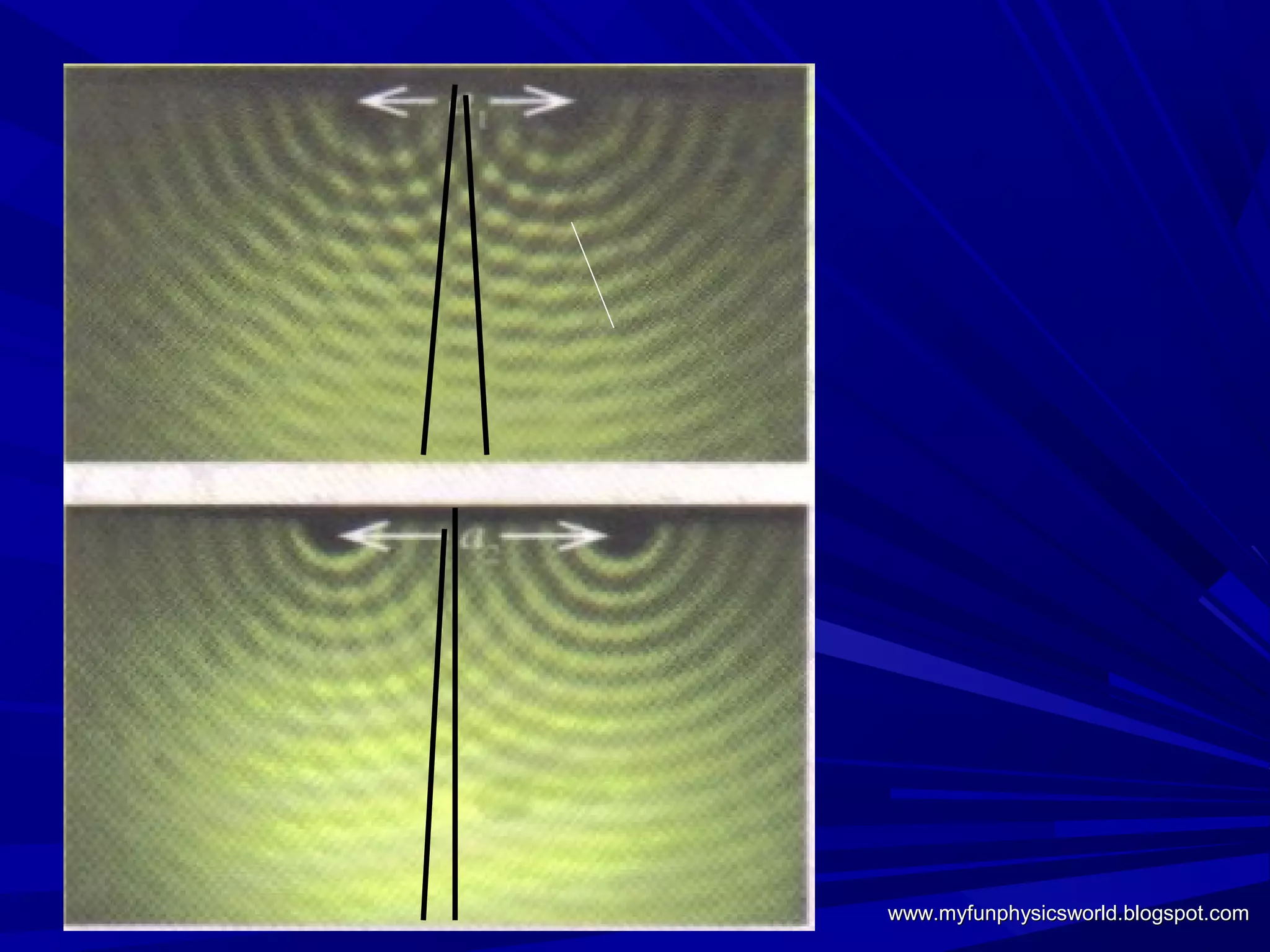
Draw two adjacent antinodal lines on both the
     photographs.
a.   How does the separation of the antinodal lines
     differs?
b.   If the separations of the two sources of
     vibrations are a1, and a2, what is the reIationship
     between a1 and a2 to that of the separations of
     the antinodal lines?
c.   How do you measure the wavelengths of the
     two sources of wave?
d.   Are the waves produced by the two sources of
     vibration coherent? Explain.
                   www.myfunphysicsworld.blogspot.com
when the sources are closer to each other, the nodal
and antinodal lines of the interference pattern
decrease in number and are more widely spaced.
when the separation of the two dippers decrease, the
nodal (and antinodal) lines increase in number and
also become closely spaced.
If the separation is further increased, the nodal lines
become so close together until they are hardly
noticeable.
As the wavelength of the waves increases, the
separations of the nodal and the antinodal lines will
increase.
The number of the antinodal or nodal lines will
decrease.
                 www.myfunphysicsworld.blogspot.com

1.5 Interference of Waves

  • 1.
    1.5 Interference ofwaves www.myfunphysicsworld.blogspot.com
  • 2.
    Learning Outcomes state theprinciple of superposition, explain the interference of waves, draw interference patterns, interpret interference patterns, and solve problems involving www.myfunphysicsworld.blogspot.com
  • 3.
    Water waves movetowards the side of the boat and are reflected back The incident waves and the reflected waves are superposed. Ripples can be seen clearly in areas where the water is calm principle of superposition. www.myfunphysicsworld.blogspot.com
  • 4.
    Wave interference Phenomenon whentwo or more waves meet while traveling along the same medium at the same time www.myfunphysicsworld.blogspot.com
  • 5.
    Principle of superpositionof waves Two mechanical waves superposed (1) produce a wave with a higher amplitude (2). www.myfunphysicsworld.blogspot.com
  • 6.
    Principle of Superpositionof waves When two waves superpose, the resulting displacement of the medium at any location is the algebraic sum of the displacements of individual waves. www.myfunphysicsworld.blogspot.com
  • 7.
    5cekap here 22feb2011 www.myfunphysicsworld.blogspot.com
  • 8.
    www.myfunphysicsworld.blogspot.com How does interferenceoccur??? A crest superposes a A through superposes a crest, the displacement trough, the displacement of the resultant wave is of the resultant wave is the sum of the the sum of the displacement of displacement individual waves at every point. the displacement is negative.
  • 9.
    2 type ofInterference 1. Constructive interference occurs when a crest meets a crest and when a trough meets a trough. 2. Destructive interference occurs crests meets/superposes with troughs. www.myfunphysicsworld.blogspot.com
  • 10.
    Constructive interference Interference thatoccurs at any location along the medium where the two interfering waves have a displacement in the same direction occurs when a crest meets a crest //when a trough meets a trough. www.myfunphysicsworld.blogspot.com
  • 11.
    Destructive interference Interference thatoccurs at any location along the medium where the two interfering waves have a displacement in the opposite direction www.myfunphysicsworld.blogspot.com
  • 12.
    Destructive interference A crestthat superposes a trough wave arrives exactly out of phase, the crest of a wave meets the trough of the other. They cancel each other and the water is calm, www.myfunphysicsworld.blogspot.com
  • 13.
    Destructive interference oftwo waves with different amplitude www.myfunphysicsworld.blogspot.com
  • 14.
  • 15.
    Interference by 2coherent sources www.myfunphysicsworld.blogspot.com
  • 16.
    Coherent sources The wavesfrom coherent sources have the same frequency (f), same wavelength (λ) and constant phase difference. The difference in the distances of a point from the two sources is called path difference. Two waves with a path difference of 2λ. www.myfunphysicsworld.blogspot.com
  • 17.
    Node Nodal lines Antinodal lines Antinode www.myfunphysicsworld.blogspot.com
  • 18.
    Path difference ofZ from S1 and S2 =| x1-x2| www.myfunphysicsworld.blogspot.com
  • 19.
    1. For constructiveinterference (point Z), path difference=nλ 2. For destructive interference (point W), Path difference= (n+1/2) λ www.myfunphysicsworld.blogspot.com
  • 20.
    Factors affecting the interference Young’s Formula www.myfunphysicsworld.blogspot.com
  • 21.
    Young’s formula Wavelength of thewaves, a = the distance between two coherent sources of wave, x = the separation between two adjacent nodal or antinodal lines D = the perpendicular distance between waves source to the position where x is measured. www.myfunphysicsworld.blogspot.com
  • 22.
    1.When a &D constant, λ increase, x? x increase 2.When D & λ constant, a increase, x? x decrease 3. When a & λ constant, D increase, x? x increase www.myfunphysicsworld.blogspot.com
  • 23.
  • 24.
    Example 1.2 In aripple tank experiment, two water superpose and form Interference patterns. The distance between the two vibrating sources is 3.0 cm. The separation between two adjacent nodal line is 5.4 cm, at a distance of 10.5 cm from the two sources. Calculate the wavelength of the water waves produced 5.4 cm 10.5 cm ? 3.0 cm Young’s Formula www.myfunphysicsworld.blogspot.com
  • 25.
    In a rippletank experiment, two water waves superpose and form interference patterns. The distance between the two vibrating sources is 3.0 cm. The separation between two adjacent nodal line is 5.4 cm, at a distance of 10.5 cm from the two sources. Calculate the wavelength of the water waves produced. www.myfunphysicsworld.blogspot.com
  • 26.
    Young’s Double-slit experiment www.myfunphysicsworld.blogspot.com
  • 27.
    A laser beamafter passing through a double slit Forming an interference pattern consisting alternate dark & bright fringes www.myfunphysicsworld.blogspot.com
  • 28.
    Young’s Double-slit experiment(pg 27) Bright fringe bri gh Dark fringe t Bright fringe Dark fringe Bright fringe Dark fringe Bright fringe Dark fringe Monochromatic source, propagate perpendicularly towards a double-slit form interference fringes. www.myfunphysicsworld.blogspot.com
  • 29.
    Bright fringe Dark fringe www.myfunphysicsworld.blogspot.com
  • 30.
    Exp on Interferenceof sound wave www.myfunphysicsworld.blogspot.com
  • 31.
    What do theblue & red lines represent? www.myfunphysicsworld.blogspot.com
  • 32.
    Homework: 1. QR 1.5page 28 (#1-3) 2. Page 46, Section B. www.myfunphysicsworld.blogspot.com
  • 33.
    1. QR 1.5page 28 1.What is the meaning of two coherent waves? Two sets of waves that have same wavelength, frequency and constant phase different. www.myfunphysicsworld.blogspot.com
  • 34.
    2. Figure showsA and B are two sources of wave from the motor engine of two boats. The frequencies of these two sources of wave are 5 Hz and 10 Hz. (a) What happens to the amplitude of wave at the point of superposition when (i) the crests of the waves from A and B meet, (ii) the crests of the wave from source A meet the troughs of the wave from source B? (b) Are the waves A and B coherent? Explain. Figure Two boats approaches each other. www.myfunphysicsworld.blogspot.com
  • 35.
    2. (a) (i) Theamplitude will be twice (ii) The amplitude will be zero (b) No, different frequency www.myfunphysicsworld.blogspot.com
  • 36.
    3.Figure shows S1and S2 which are two spherical sources attached to the vibration bar of a ripple tank. The two sources are separated at a distance of 5.0 cm. (a) Are the waves produced by S1 and S2 coherent? Explain. (b) State the phenomena produced at the position P, R and T. www.myfunphysicsworld.blogspot.com
  • 37.
    3 (a) Yes, theycome from the same source (Same f, λ and phase difference) (a) R and P : Constructive Interference T : destructive Interference www.myfunphysicsworld.blogspot.com
  • 38.
    Homework Page 46, SectionB. *Both semicircular waves must have same size of λ. (c) From the diagram, measure D and x. (d) Calculate λ. www.myfunphysicsworld.blogspot.com
  • 39.
  • 40.
    The destructive interference of two waves with different amplitude. A crest with amplitude of a unit meet a trough with amplitude of -2a units the resulting displacement amplitude is -a unit www.myfunphysicsworld.blogspot.com
  • 41.
    Destructive interference acrest of one wave propagates from the left superposed on another trough coming from the right. The resulting wave will cancel each other. There is no resulting disturbance in the medium. www.myfunphysicsworld.blogspot.com
  • 42.
    interference of 2sources of lines. The dotted red lines join places where the waves arrive there in phase Red lines called antinodal lines join places of constructive interference. www.myfunphysicsworld.blogspot.com
  • 43.
    blue lines wherecalm water is formed waves arrive there exactly out of phase. Blue lines are called nodal lines. join the places of destructive interference www.myfunphysicsworld.blogspot.com
  • 44.
    The distance ofZ from the S1 is x1, the distance of Z from the S2 is x2. The path difference of Z from S and is x2-x1. consructive interference (S), the path difference = nλ. destructive interference (W), the path difference = (n +1/2) λ n is an integer. www.myfunphysicsworld.blogspot.com
  • 45.
    Draw two adjacentantinodal lines on both the photographs. a. How does the separation of the antinodal lines differs? b. If the separations of the two sources of vibrations are a1, and a2, what is the reIationship between a1 and a2 to that of the separations of the antinodal lines? c. How do you measure the wavelengths of the two sources of wave? d. Are the waves produced by the two sources of vibration coherent? Explain. www.myfunphysicsworld.blogspot.com
  • 46.
    when the sourcesare closer to each other, the nodal and antinodal lines of the interference pattern decrease in number and are more widely spaced. when the separation of the two dippers decrease, the nodal (and antinodal) lines increase in number and also become closely spaced. If the separation is further increased, the nodal lines become so close together until they are hardly noticeable. As the wavelength of the waves increases, the separations of the nodal and the antinodal lines will increase. The number of the antinodal or nodal lines will decrease. www.myfunphysicsworld.blogspot.com

Editor's Notes

  • #6 slinky spring demonstrate the superposition of two transverse waves.