Physics 101
John Sung
What is Interference?
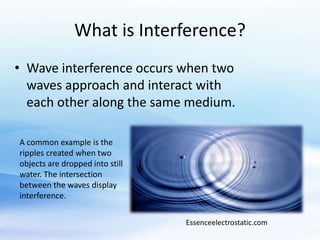
• Wave interference occurs when two
waves approach and interact with
each other along the same medium.
A common example is the
ripples created when two
objects are dropped into still
water. The intersection
between the waves display
interference.
Essenceelectrostatic.com
Types of Wave Interference
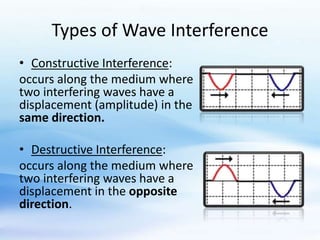
• Constructive Interference:
occurs along the medium where
two interfering waves have a
displacement (amplitude) in the
same direction.
• Destructive Interference:
occurs along the medium where
two interfering waves have a
displacement in the opposite
direction.
Diagram
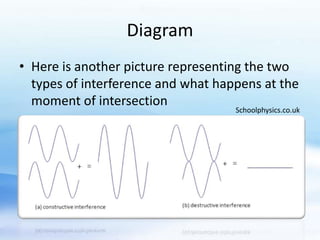
• Here is another picture representing the two
types of interference and what happens at the
moment of intersection
Schoolphysics.co.uk
Identifying Types of Interference
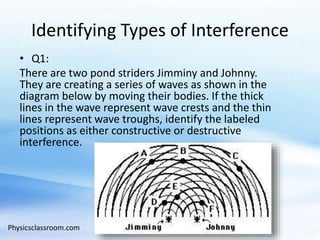
• Q1:
There are two pond striders Jimminy and Johnny.
They are creating a series of waves as shown in the
diagram below by moving their bodies. If the thick
lines in the wave represent wave crests and the thin
lines represent wave troughs, identify the labeled
positions as either constructive or destructive
interference.
Physicsclassroom.com
Question 1 Answers
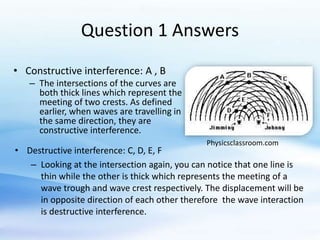
• Constructive interference: A , B
– The intersections of the curves are
both thick lines which represent the
meeting of two crests. As defined
earlier, when waves are travelling in
the same direction, they are
constructive interference.
• Destructive interference: C, D, E, F
– Looking at the intersection again, you can notice that one line is
thin while the other is thick which represents the meeting of a
wave trough and wave crest respectively. The displacement will be
in opposite direction of each other therefore the wave interaction
is destructive interference.
Physicsclassroom.com
Path Difference
• Path difference: the difference in distance traveled by two
sets of waves
• For constructive interference, the waves are in phase so the
path difference is:
∆d=nλ
- n (interger) , λ (wavelenth
• For destructive interference, the waves are out of phase
and occur when one path is an integer number of
wavelength and the other is half-integer multiple so the
path difference is:
∆d=(2n+1)λ/2 = (n+ ½) λ
Identifying Type of Interference with
Path Difference
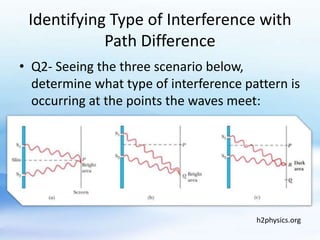
• Q2- Seeing the three scenario below,
determine what type of interference pattern is
occurring at the points the waves meet:
h2physics.org
Q2 Answers
• A) Constructive interference at P because the
waves are meeting in phase and their path
difference is 0 as they are identical waves
• B) Constructive interference also occurs at Q
• C) destructive interference occurs at R
because the waves are out of phase and the
path difference is half a wavelength
Wave interference learning objective

Wave interference learning objective

  • 1.
  • 2.
    What is Interference? •Wave interference occurs when two waves approach and interact with each other along the same medium. A common example is the ripples created when two objects are dropped into still water. The intersection between the waves display interference. Essenceelectrostatic.com
  • 3.
    Types of WaveInterference • Constructive Interference: occurs along the medium where two interfering waves have a displacement (amplitude) in the same direction. • Destructive Interference: occurs along the medium where two interfering waves have a displacement in the opposite direction.
  • 4.
    Diagram • Here isanother picture representing the two types of interference and what happens at the moment of intersection Schoolphysics.co.uk
  • 5.
    Identifying Types ofInterference • Q1: There are two pond striders Jimminy and Johnny. They are creating a series of waves as shown in the diagram below by moving their bodies. If the thick lines in the wave represent wave crests and the thin lines represent wave troughs, identify the labeled positions as either constructive or destructive interference. Physicsclassroom.com
  • 6.
    Question 1 Answers •Constructive interference: A , B – The intersections of the curves are both thick lines which represent the meeting of two crests. As defined earlier, when waves are travelling in the same direction, they are constructive interference. • Destructive interference: C, D, E, F – Looking at the intersection again, you can notice that one line is thin while the other is thick which represents the meeting of a wave trough and wave crest respectively. The displacement will be in opposite direction of each other therefore the wave interaction is destructive interference. Physicsclassroom.com
  • 7.
    Path Difference • Pathdifference: the difference in distance traveled by two sets of waves • For constructive interference, the waves are in phase so the path difference is: ∆d=nλ - n (interger) , λ (wavelenth • For destructive interference, the waves are out of phase and occur when one path is an integer number of wavelength and the other is half-integer multiple so the path difference is: ∆d=(2n+1)λ/2 = (n+ ½) λ
  • 8.
    Identifying Type ofInterference with Path Difference • Q2- Seeing the three scenario below, determine what type of interference pattern is occurring at the points the waves meet: h2physics.org
  • 9.
    Q2 Answers • A)Constructive interference at P because the waves are meeting in phase and their path difference is 0 as they are identical waves • B) Constructive interference also occurs at Q • C) destructive interference occurs at R because the waves are out of phase and the path difference is half a wavelength