Inside Apache SystemML
Fred Reiss
Chief Architect, IBM Spark Technology Center
Member of the IBM Academy of Technology
•  2007-2008: Multiple projects at IBM Research –
Almaden involving machine learning on Hadoop.
•  2009: We create a dedicated team for scalable ML.
•  2009-2010: Through engagements with customers, we
observe how data scientists create machine learning
algorithms.
Origins of the SystemML Project
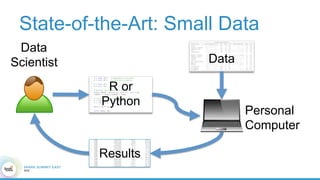
State-of-the-Art: Small Data
R or
Python
Data
Scientist
Personal
Computer
Data
Results
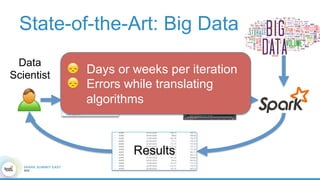
State-of-the-Art: Big Data
R or
Python
Data
Scientist
Results
Systems
Programmer
Scala
State-of-the-Art: Big Data
R or
Python
Data
Scientist
Results
Systems
Programmer
Scala
😞 Days or weeks per iteration
😞 Errors while translating
algorithms
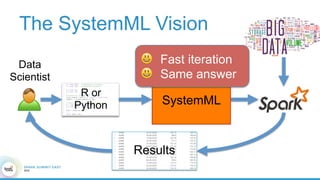
The SystemML Vision
R or
Python
Data
Scientist
Results
SystemML
The SystemML Vision
R or
Python
Data
Scientist
Results
SystemML
😃 Fast iteration
😃 Same answer
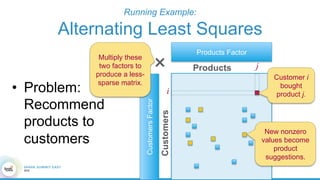
Running Example:
Alternating Least Squares
Products
Customers
i
j
Customer i
bought
product j.
Products Factor
CustomersFactor
Multiply these
two factors to
produce a less-
sparse matrix.
×
New nonzero
values become
product
suggestions.
•  Problem:
Recommend
products to
customers
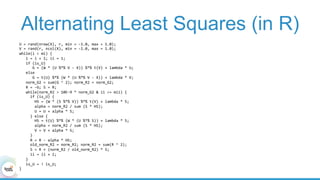
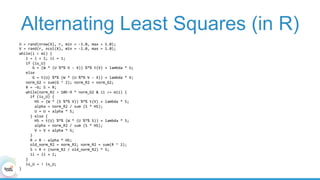
Alternating Least Squares (in R)
U	=	rand(nrow(X),	r,	min	=	-1.0,	max	=	1.0);		
V	=	rand(r,	ncol(X),	min	=	-1.0,	max	=	1.0);		
while(i	<	mi)	{	
			i	=	i	+	1;	ii	=	1;	
			if	(is_U)	
						G	=	(W	*	(U	%*%	V	-	X))	%*%	t(V)	+	lambda	*	U;	
			else	
						G	=	t(U)	%*%	(W	*	(U	%*%	V	-	X))	+	lambda	*	V;	
			norm_G2	=	sum(G	^	2);	norm_R2	=	norm_G2;					
			R	=	-G;	S	=	R;	
			while(norm_R2	>	10E-9	*	norm_G2	&	ii	<=	mii)	{	
					if	(is_U)	{	
							HS	=	(W	*	(S	%*%	V))	%*%	t(V)	+	lambda	*	S;	
							alpha	=	norm_R2	/	sum	(S	*	HS);	
							U	=	U	+	alpha	*	S;			
					}	else	{	
							HS	=	t(U)	%*%	(W	*	(U	%*%	S))	+	lambda	*	S;	
							alpha	=	norm_R2	/	sum	(S	*	HS);	
							V	=	V	+	alpha	*	S;			
					}	
					R	=	R	-	alpha	*	HS;	
					old_norm_R2	=	norm_R2;	norm_R2	=	sum(R	^	2);	
					S	=	R	+	(norm_R2	/	old_norm_R2)	*	S;	
					ii	=	ii	+	1;	
			}			
			is_U	=	!	is_U;	
}
Alternating Least Squares (in R)
U	=	rand(nrow(X),	r,	min	=	-1.0,	max	=	1.0);		
V	=	rand(r,	ncol(X),	min	=	-1.0,	max	=	1.0);		
while(i	<	mi)	{	
			i	=	i	+	1;	ii	=	1;	
			if	(is_U)	
						G	=	(W	*	(U	%*%	V	-	X))	%*%	t(V)	+	lambda	*	U;	
			else	
						G	=	t(U)	%*%	(W	*	(U	%*%	V	-	X))	+	lambda	*	V;	
			norm_G2	=	sum(G	^	2);	norm_R2	=	norm_G2;					
			R	=	-G;	S	=	R;	
			while(norm_R2	>	10E-9	*	norm_G2	&	ii	<=	mii)	{	
					if	(is_U)	{	
							HS	=	(W	*	(S	%*%	V))	%*%	t(V)	+	lambda	*	S;	
							alpha	=	norm_R2	/	sum	(S	*	HS);	
							U	=	U	+	alpha	*	S;			
					}	else	{	
							HS	=	t(U)	%*%	(W	*	(U	%*%	S))	+	lambda	*	S;	
							alpha	=	norm_R2	/	sum	(S	*	HS);	
							V	=	V	+	alpha	*	S;			
					}	
					R	=	R	-	alpha	*	HS;	
					old_norm_R2	=	norm_R2;	norm_R2	=	sum(R	^	2);	
					S	=	R	+	(norm_R2	/	old_norm_R2)	*	S;	
					ii	=	ii	+	1;	
			}			
			is_U	=	!	is_U;	
}	
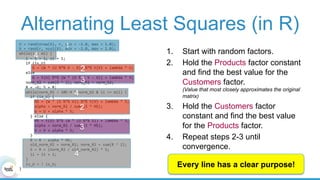
1.  Start with random factors.
2.  Hold the Products factor constant
and find the best value for the
Customers factor.
(Value that most closely approximates the original
matrix)
3.  Hold the Customers factor
constant and find the best value
for the Products factor.
4.  Repeat steps 2-3 until
convergence.
1
2
2
3
3
4
4
4
Every line has a clear purpose!
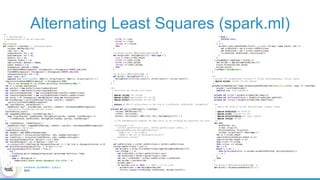
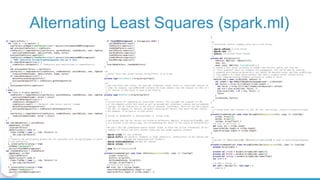
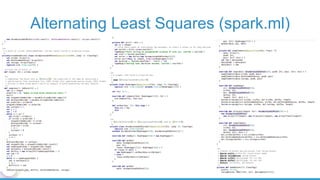
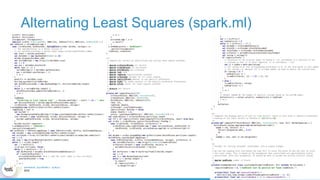
Alternating Least Squares (spark.ml)
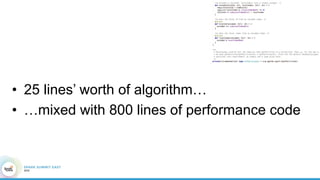
•  25 lines’ worth of algorithm…
•  …mixed with 800 lines of performance code
Alternating Least Squares (in R)
U	=	rand(nrow(X),	r,	min	=	-1.0,	max	=	1.0);		
V	=	rand(r,	ncol(X),	min	=	-1.0,	max	=	1.0);		
while(i	<	mi)	{	
			i	=	i	+	1;	ii	=	1;	
			if	(is_U)	
						G	=	(W	*	(U	%*%	V	-	X))	%*%	t(V)	+	lambda	*	U;	
			else	
						G	=	t(U)	%*%	(W	*	(U	%*%	V	-	X))	+	lambda	*	V;	
			norm_G2	=	sum(G	^	2);	norm_R2	=	norm_G2;					
			R	=	-G;	S	=	R;	
			while(norm_R2	>	10E-9	*	norm_G2	&	ii	<=	mii)	{	
					if	(is_U)	{	
							HS	=	(W	*	(S	%*%	V))	%*%	t(V)	+	lambda	*	S;	
							alpha	=	norm_R2	/	sum	(S	*	HS);	
							U	=	U	+	alpha	*	S;			
					}	else	{	
							HS	=	t(U)	%*%	(W	*	(U	%*%	S))	+	lambda	*	S;	
							alpha	=	norm_R2	/	sum	(S	*	HS);	
							V	=	V	+	alpha	*	S;			
					}	
					R	=	R	-	alpha	*	HS;	
					old_norm_R2	=	norm_R2;	norm_R2	=	sum(R	^	2);	
					S	=	R	+	(norm_R2	/	old_norm_R2)	*	S;	
					ii	=	ii	+	1;	
			}			
			is_U	=	!	is_U;	
}
Alternating Least Squares (in R)
U	=	rand(nrow(X),	r,	min	=	-1.0,	max	=	1.0);		
V	=	rand(r,	ncol(X),	min	=	-1.0,	max	=	1.0);		
while(i	<	mi)	{	
			i	=	i	+	1;	ii	=	1;	
			if	(is_U)	
						G	=	(W	*	(U	%*%	V	-	X))	%*%	t(V)	+	lambda	*	U;	
			else	
						G	=	t(U)	%*%	(W	*	(U	%*%	V	-	X))	+	lambda	*	V;	
			norm_G2	=	sum(G	^	2);	norm_R2	=	norm_G2;					
			R	=	-G;	S	=	R;	
			while(norm_R2	>	10E-9	*	norm_G2	&	ii	<=	mii)	{	
					if	(is_U)	{	
							HS	=	(W	*	(S	%*%	V))	%*%	t(V)	+	lambda	*	S;	
							alpha	=	norm_R2	/	sum	(S	*	HS);	
							U	=	U	+	alpha	*	S;			
					}	else	{	
							HS	=	t(U)	%*%	(W	*	(U	%*%	S))	+	lambda	*	S;	
							alpha	=	norm_R2	/	sum	(S	*	HS);	
							V	=	V	+	alpha	*	S;			
					}	
					R	=	R	-	alpha	*	HS;	
					old_norm_R2	=	norm_R2;	norm_R2	=	sum(R	^	2);	
					S	=	R	+	(norm_R2	/	old_norm_R2)	*	S;	
					ii	=	ii	+	1;	
			}			
			is_U	=	!	is_U;	
}	
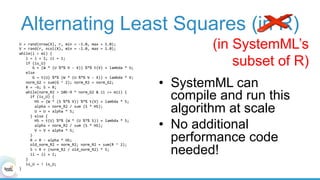
(in SystemML’s
subset of R)
•  SystemML can
compile and run this
algorithm at scale
•  No additional
performance code
needed!
How fast does it run?
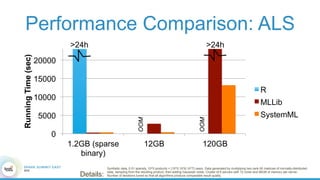
Running time comparisons between
machine learning algorithms are
problematic
–  Different, equally-valid answers
–  Different convergence rates on different
data
–  But we’ll do one anyway
Performance Comparison: ALS
0
5000
10000
15000
20000
1.2GB (sparse
binary)
12GB 120GB
RunningTime(sec)
R
MLLib
SystemML
>24h>24h
OOM
OOM
Synthetic data, 0.01 sparsity, 10^5 products × {10^5,10^6,10^7} users. Data generated by multiplying two rank-50 matrices of normally-distributed
data, sampling from the resulting product, then adding Gaussian noise. Cluster of 6 servers with 12 cores and 96GB of memory per server.
Number of iterations tuned so that all algorithms produce comparable result quality.Details:
Takeaway Points
•  SystemML runs the R script in parallel
– Same answer as original R script
– Performance is comparable to a low-level
RDD-based implementation
•  How does SystemML achieve this result?
Performance Comparison: ALS
0
5000
10000
15000
20000
1.2GB (sparse
binary)
12GB 120GB
RunningTime(sec)
R
MLLib
SystemML
>24h>24h
OOM
OOM
Synthetic data, 0.01 sparsity, 10^5 products × {10^5,10^6,10^7} users. Data generated by multiplying two rank-50 matrices of normally-distributed
data, sampling from the resulting product, then adding Gaussian noise. Cluster of 6 servers with 12 cores and 96GB of memory per server.
Number of iterations tuned so that all algorithms produce comparable result quality.Details:
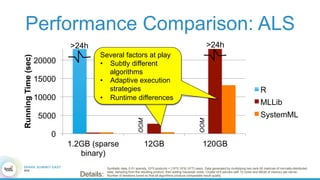
Several factors at play
•  Subtly different
algorithms
•  Adaptive execution
strategies
•  Runtime differences
Several factors at play
•  Subtly different
algorithms
•  Adaptive execution
strategies
•  Runtime differences
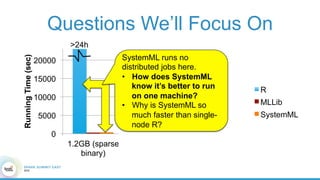
Questions We’ll Focus On
0
5000
10000
15000
20000
1.2GB (sparse
binary)
12GB 120GB
RunningTime(sec)
R
MLLib
SystemML
>24h>24h
OOM
OOM
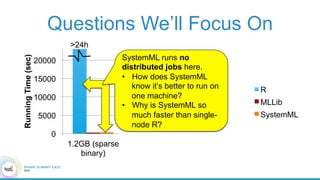
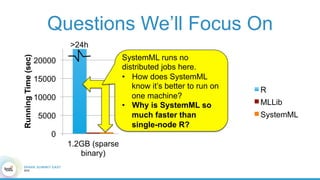
SystemML runs no
distributed jobs here.
•  How does SystemML
know it’s better to run on
one machine?
•  Why is SystemML so
much faster than single-
node R?
Questions We’ll Focus On
0
5000
10000
15000
20000
1.2GB (sparse
binary)
12GB 120GB
RunningTime(sec)
R
MLLib
SystemML
>24h>24h
OOM
OOM
SystemML runs no
distributed jobs here.
•  How does SystemML
know it’s better to run
on one machine?
•  Why is SystemML so
much faster than single-
node R?
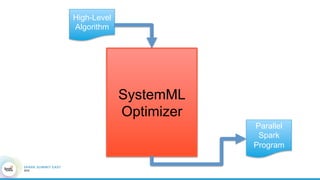
SystemML
Optimizer
High-Level
Algorithm
Parallel
Spark
Program
High-Level
Algorithm
Parallel
Spark
Program
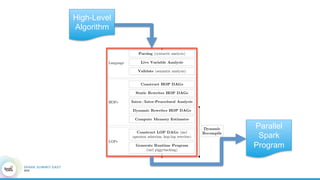
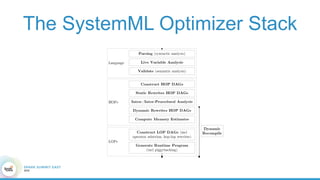
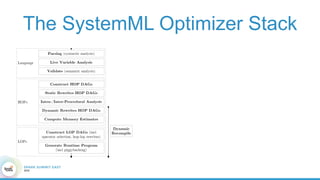
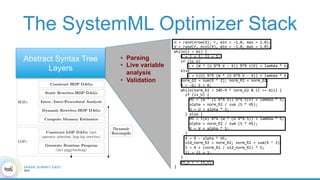
The SystemML Optimizer Stack
Abstract Syntax Tree
Layers
U	=	rand(nrow(X),	r,	min	=	-1.0,	max	=	1.0);		
V	=	rand(r,	ncol(X),	min	=	-1.0,	max	=	1.0);		
while(i	<	mi)	{	
			i	=	i	+	1;	ii	=	1;	
			if	(is_U)	
						G	=	(W	*	(U	%*%	V	-	X))	%*%	t(V)	+	lambda	*	U;	
			else	
						G	=	t(U)	%*%	(W	*	(U	%*%	V	-	X))	+	lambda	*	V;	
			norm_G2	=	sum(G	^	2);	norm_R2	=	norm_G2;					
			R	=	-G;	S	=	R;	
			while(norm_R2	>	10E-9	*	norm_G2	&	ii	<=	mii)	{	
					if	(is_U)	{	
							HS	=	(W	*	(S	%*%	V))	%*%	t(V)	+	lambda	*	S;	
							alpha	=	norm_R2	/	sum	(S	*	HS);	
							U	=	U	+	alpha	*	S;			
					}	else	{	
							HS	=	t(U)	%*%	(W	*	(U	%*%	S))	+	lambda	*	S;	
							alpha	=	norm_R2	/	sum	(S	*	HS);	
							V	=	V	+	alpha	*	S;			
					}	
					R	=	R	-	alpha	*	HS;	
					old_norm_R2	=	norm_R2;	norm_R2	=	sum(R	^	2);	
					S	=	R	+	(norm_R2	/	old_norm_R2)	*	S;	
					ii	=	ii	+	1;	
			}			
			is_U	=	!	is_U;	
}	
•  Parsing
•  Live variable
analysis
•  Validation
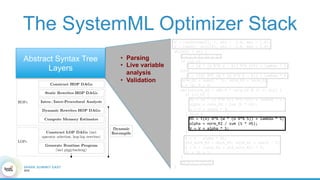
The SystemML Optimizer Stack
Abstract Syntax Tree
Layers
U	=	rand(nrow(X),	r,	min	=	-1.0,	max	=	1.0);		
V	=	rand(r,	ncol(X),	min	=	-1.0,	max	=	1.0);		
while(i	<	mi)	{	
			i	=	i	+	1;	ii	=	1;	
			if	(is_U)	
						G	=	(W	*	(U	%*%	V	-	X))	%*%	t(V)	+	lambda	*	U;	
			else	
						G	=	t(U)	%*%	(W	*	(U	%*%	V	-	X))	+	lambda	*	V;	
			norm_G2	=	sum(G	^	2);	norm_R2	=	norm_G2;					
			R	=	-G;	S	=	R;	
			while(norm_R2	>	10E-9	*	norm_G2	&	ii	<=	mii)	{	
					if	(is_U)	{	
							HS	=	(W	*	(S	%*%	V))	%*%	t(V)	+	lambda	*	S;	
							alpha	=	norm_R2	/	sum	(S	*	HS);	
							U	=	U	+	alpha	*	S;			
					}	else	{	
							HS	=	t(U)	%*%	(W	*	(U	%*%	S))	+	lambda	*	S;	
							alpha	=	norm_R2	/	sum	(S	*	HS);	
							V	=	V	+	alpha	*	S;			
					}	
					R	=	R	-	alpha	*	HS;	
					old_norm_R2	=	norm_R2;	norm_R2	=	sum(R	^	2);	
					S	=	R	+	(norm_R2	/	old_norm_R2)	*	S;	
					ii	=	ii	+	1;	
			}			
			is_U	=	!	is_U;	
}	
•  Parsing
•  Live variable
analysis
•  Validation
+
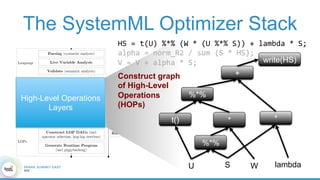
The SystemML Optimizer Stack
High-Level Operations
Layers
HS	=	t(U)	%*%	(W	*	(U	%*%	S))	+	lambda	*	S;	
alpha	=	norm_R2	/	sum	(S	*	HS);	
V	=	V	+	alpha	*	S;			
	
%*%
WU S
*t()
lambda
*
%*%
write(HS)
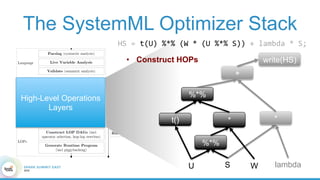
Construct graph
of High-Level
Operations
(HOPs)
+
The SystemML Optimizer Stack
High-Level Operations
Layers
HS	=	t(U)	%*%	(W	*	(U	%*%	S))	+	lambda	*	S;	
%*%
WU S
*t()
lambda
*
%*%
write(HS)•  Construct HOPs
The SystemML Optimizer Stack
High-Level Operations
Layers
HS	=	t(U)	%*%	(W	*	(U	%*%	S))	
%*%
WU S
*t()
%*%
1.2GB

sparse
80GB

dense
80GB

dense
800MB

dense
800MB

dense
800MB

dense
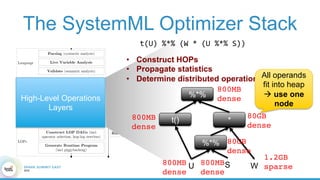
•  Construct HOPs
•  Propagate statistics
•  Determine distributed operationsAll operands
fit into heap
à use one
node
800MB

dense
Questions We’ll Focus On
0
5000
10000
15000
20000
1.2GB (sparse
binary)
12GB 120GB
RunningTime(sec)
R
MLLib
SystemML
>24h>24h
OOM
OOM
SystemML runs no
distributed jobs here.
•  How does SystemML
know it’s better to run on
one machine?
•  Why is SystemML so
much faster than
single-node R?
The SystemML Optimizer Stack
High-Level Operations
Layers
HS	=	t(U)	%*%	(W	*	(U	%*%	S))	
%*%
WU S
*t()
%*%
1.2GB

sparse
80GB

dense
80GB

dense
800MB

dense
800MB

dense
800MB

dense
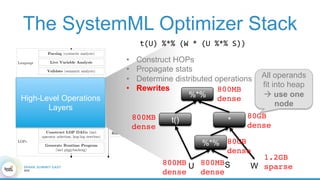
All operands
fit into heap
à use one
node
•  Construct HOPs
•  Propagate stats
•  Determine distributed operations
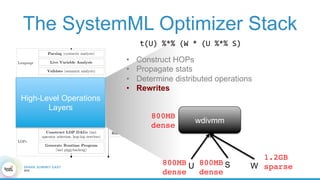
•  Rewrites
800MB

dense
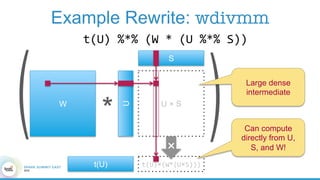
Example Rewrite: wdivmm
W
S
U
U × S
*( (
t(U) t(U)×(W*(U×S)))	
×
Large dense
intermediate
Can compute
directly from U,
S, and W!
t(U)	%*%	(W	*	(U	%*%	S))
The SystemML Optimizer Stack
High-Level Operations
Layers
HS	=	t(U)	%*%	(W	*	(U	%*%	S)	
wdivmm
WU S
1.2GB

sparse
800MB

dense
800MB

dense
•  Construct HOPs
•  Propagate stats
•  Determine distributed operations
•  Rewrites
800MB

dense
The SystemML Optimizer Stack
Low-Level Operations
Layers
HS	=	t(U)	%*%	(W	*	(U	%*%	S)	
wdivmm
WU S
1.2GB

sparse
800MB

dense
800MB

dense
800MB

dense
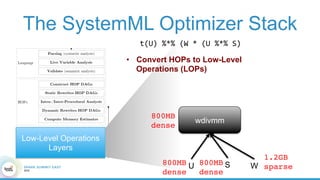
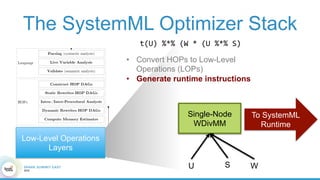
•  Convert HOPs to Low-Level
Operations (LOPs)
The SystemML Optimizer Stack
Low-Level Operations
Layers
HS	=	t(U)	%*%	(W	*	(U	%*%	S)	
Single-Node
WDivMM
WU S
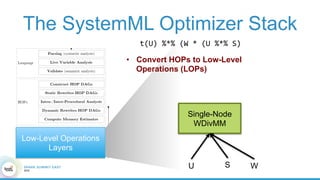
•  Convert HOPs to Low-Level
Operations (LOPs)
The SystemML Optimizer Stack
Low-Level Operations
Layers
HS	=	t(U)	%*%	(W	*	(U	%*%	S)	
Single-Node
WDivMM
WU S
•  Convert HOPs to Low-Level
Operations (LOPs)
•  Generate runtime instructions
To SystemML
Runtime
The SystemML Runtime for Spark
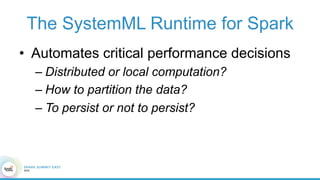
•  Automates critical performance decisions
– Distributed or local computation?
– How to partition the data?
– To persist or not to persist?
The SystemML Runtime for Spark
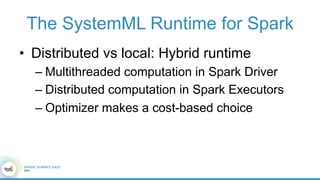
•  Distributed vs local: Hybrid runtime
– Multithreaded computation in Spark Driver
– Distributed computation in Spark Executors
– Optimizer makes a cost-based choice
The SystemML Runtime for Spark
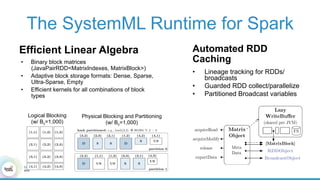
Efficient Linear Algebra
•  Binary block matrices
(JavaPairRDD<MatrixIndexes, MatrixBlock>)
•  Adaptive block storage formats: Dense, Sparse,
Ultra-Sparse, Empty
•  Efficient kernels for all combinations of block
types
Automated RDD
Caching
•  Lineage tracking for RDDs/
broadcasts
•  Guarded RDD collect/parallelize
•  Partitioned Broadcast variables
Logical Blocking
(w/ Bc=1,000)
Physical Blocking and Partitioning
(w/ Bc=1,000)
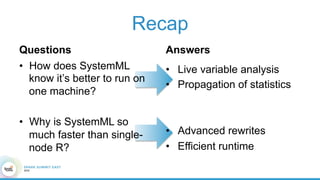
Recap
Questions
•  How does SystemML
know it’s better to run on
one machine?
•  Why is SystemML so
much faster than single-
node R?
Answers
•  Live variable analysis
•  Propagation of statistics
•  Advanced rewrites
•  Efficient runtime
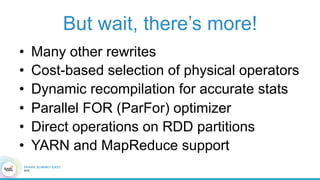
But wait, there’s more!
•  Many other rewrites
•  Cost-based selection of physical operators
•  Dynamic recompilation for accurate stats
•  Parallel FOR (ParFor) optimizer
•  Direct operations on RDD partitions
•  YARN and MapReduce support
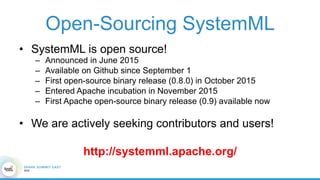
•  SystemML is open source!
–  Announced in June 2015
–  Available on Github since September 1
–  First open-source binary release (0.8.0) in October 2015
–  Entered Apache incubation in November 2015
–  First Apache open-source binary release (0.9) available now
•  We are actively seeking contributors and users!
http://systemml.apache.org/
Open-Sourcing SystemML
THANK YOU.
For more information, go to
http://systemml.apache.org/

Inside Apache SystemML by Frederick Reiss

  • 1.
    Inside Apache SystemML FredReiss Chief Architect, IBM Spark Technology Center Member of the IBM Academy of Technology
  • 2.
    •  2007-2008: Multipleprojects at IBM Research – Almaden involving machine learning on Hadoop. •  2009: We create a dedicated team for scalable ML. •  2009-2010: Through engagements with customers, we observe how data scientists create machine learning algorithms. Origins of the SystemML Project
  • 3.
    State-of-the-Art: Small Data Ror Python Data Scientist Personal Computer Data Results
  • 4.
    State-of-the-Art: Big Data Ror Python Data Scientist Results Systems Programmer Scala
  • 5.
    State-of-the-Art: Big Data Ror Python Data Scientist Results Systems Programmer Scala 😞 Days or weeks per iteration 😞 Errors while translating algorithms
  • 6.
    The SystemML Vision Ror Python Data Scientist Results SystemML
  • 7.
    The SystemML Vision Ror Python Data Scientist Results SystemML 😃 Fast iteration 😃 Same answer
  • 8.
    Running Example: Alternating LeastSquares Products Customers i j Customer i bought product j. Products Factor CustomersFactor Multiply these two factors to produce a less- sparse matrix. × New nonzero values become product suggestions. •  Problem: Recommend products to customers
  • 9.
    Alternating Least Squares(in R) U = rand(nrow(X), r, min = -1.0, max = 1.0); V = rand(r, ncol(X), min = -1.0, max = 1.0); while(i < mi) { i = i + 1; ii = 1; if (is_U) G = (W * (U %*% V - X)) %*% t(V) + lambda * U; else G = t(U) %*% (W * (U %*% V - X)) + lambda * V; norm_G2 = sum(G ^ 2); norm_R2 = norm_G2; R = -G; S = R; while(norm_R2 > 10E-9 * norm_G2 & ii <= mii) { if (is_U) { HS = (W * (S %*% V)) %*% t(V) + lambda * S; alpha = norm_R2 / sum (S * HS); U = U + alpha * S; } else { HS = t(U) %*% (W * (U %*% S)) + lambda * S; alpha = norm_R2 / sum (S * HS); V = V + alpha * S; } R = R - alpha * HS; old_norm_R2 = norm_R2; norm_R2 = sum(R ^ 2); S = R + (norm_R2 / old_norm_R2) * S; ii = ii + 1; } is_U = ! is_U; }
  • 10.
    Alternating Least Squares(in R) U = rand(nrow(X), r, min = -1.0, max = 1.0); V = rand(r, ncol(X), min = -1.0, max = 1.0); while(i < mi) { i = i + 1; ii = 1; if (is_U) G = (W * (U %*% V - X)) %*% t(V) + lambda * U; else G = t(U) %*% (W * (U %*% V - X)) + lambda * V; norm_G2 = sum(G ^ 2); norm_R2 = norm_G2; R = -G; S = R; while(norm_R2 > 10E-9 * norm_G2 & ii <= mii) { if (is_U) { HS = (W * (S %*% V)) %*% t(V) + lambda * S; alpha = norm_R2 / sum (S * HS); U = U + alpha * S; } else { HS = t(U) %*% (W * (U %*% S)) + lambda * S; alpha = norm_R2 / sum (S * HS); V = V + alpha * S; } R = R - alpha * HS; old_norm_R2 = norm_R2; norm_R2 = sum(R ^ 2); S = R + (norm_R2 / old_norm_R2) * S; ii = ii + 1; } is_U = ! is_U; } 1.  Start with random factors. 2.  Hold the Products factor constant and find the best value for the Customers factor. (Value that most closely approximates the original matrix) 3.  Hold the Customers factor constant and find the best value for the Products factor. 4.  Repeat steps 2-3 until convergence. 1 2 2 3 3 4 4 4 Every line has a clear purpose!
  • 11.
  • 12.
  • 13.
  • 14.
  • 15.
    •  25 lines’worth of algorithm… •  …mixed with 800 lines of performance code
  • 16.
    Alternating Least Squares(in R) U = rand(nrow(X), r, min = -1.0, max = 1.0); V = rand(r, ncol(X), min = -1.0, max = 1.0); while(i < mi) { i = i + 1; ii = 1; if (is_U) G = (W * (U %*% V - X)) %*% t(V) + lambda * U; else G = t(U) %*% (W * (U %*% V - X)) + lambda * V; norm_G2 = sum(G ^ 2); norm_R2 = norm_G2; R = -G; S = R; while(norm_R2 > 10E-9 * norm_G2 & ii <= mii) { if (is_U) { HS = (W * (S %*% V)) %*% t(V) + lambda * S; alpha = norm_R2 / sum (S * HS); U = U + alpha * S; } else { HS = t(U) %*% (W * (U %*% S)) + lambda * S; alpha = norm_R2 / sum (S * HS); V = V + alpha * S; } R = R - alpha * HS; old_norm_R2 = norm_R2; norm_R2 = sum(R ^ 2); S = R + (norm_R2 / old_norm_R2) * S; ii = ii + 1; } is_U = ! is_U; }
  • 17.
    Alternating Least Squares(in R) U = rand(nrow(X), r, min = -1.0, max = 1.0); V = rand(r, ncol(X), min = -1.0, max = 1.0); while(i < mi) { i = i + 1; ii = 1; if (is_U) G = (W * (U %*% V - X)) %*% t(V) + lambda * U; else G = t(U) %*% (W * (U %*% V - X)) + lambda * V; norm_G2 = sum(G ^ 2); norm_R2 = norm_G2; R = -G; S = R; while(norm_R2 > 10E-9 * norm_G2 & ii <= mii) { if (is_U) { HS = (W * (S %*% V)) %*% t(V) + lambda * S; alpha = norm_R2 / sum (S * HS); U = U + alpha * S; } else { HS = t(U) %*% (W * (U %*% S)) + lambda * S; alpha = norm_R2 / sum (S * HS); V = V + alpha * S; } R = R - alpha * HS; old_norm_R2 = norm_R2; norm_R2 = sum(R ^ 2); S = R + (norm_R2 / old_norm_R2) * S; ii = ii + 1; } is_U = ! is_U; } (in SystemML’s subset of R) •  SystemML can compile and run this algorithm at scale •  No additional performance code needed!
  • 18.
    How fast doesit run? Running time comparisons between machine learning algorithms are problematic –  Different, equally-valid answers –  Different convergence rates on different data –  But we’ll do one anyway
  • 19.
    Performance Comparison: ALS 0 5000 10000 15000 20000 1.2GB(sparse binary) 12GB 120GB RunningTime(sec) R MLLib SystemML >24h>24h OOM OOM Synthetic data, 0.01 sparsity, 10^5 products × {10^5,10^6,10^7} users. Data generated by multiplying two rank-50 matrices of normally-distributed data, sampling from the resulting product, then adding Gaussian noise. Cluster of 6 servers with 12 cores and 96GB of memory per server. Number of iterations tuned so that all algorithms produce comparable result quality.Details:
  • 20.
    Takeaway Points •  SystemMLruns the R script in parallel – Same answer as original R script – Performance is comparable to a low-level RDD-based implementation •  How does SystemML achieve this result?
  • 21.
    Performance Comparison: ALS 0 5000 10000 15000 20000 1.2GB(sparse binary) 12GB 120GB RunningTime(sec) R MLLib SystemML >24h>24h OOM OOM Synthetic data, 0.01 sparsity, 10^5 products × {10^5,10^6,10^7} users. Data generated by multiplying two rank-50 matrices of normally-distributed data, sampling from the resulting product, then adding Gaussian noise. Cluster of 6 servers with 12 cores and 96GB of memory per server. Number of iterations tuned so that all algorithms produce comparable result quality.Details: Several factors at play •  Subtly different algorithms •  Adaptive execution strategies •  Runtime differences Several factors at play •  Subtly different algorithms •  Adaptive execution strategies •  Runtime differences
  • 22.
    Questions We’ll FocusOn 0 5000 10000 15000 20000 1.2GB (sparse binary) 12GB 120GB RunningTime(sec) R MLLib SystemML >24h>24h OOM OOM SystemML runs no distributed jobs here. •  How does SystemML know it’s better to run on one machine? •  Why is SystemML so much faster than single- node R?
  • 23.
    Questions We’ll FocusOn 0 5000 10000 15000 20000 1.2GB (sparse binary) 12GB 120GB RunningTime(sec) R MLLib SystemML >24h>24h OOM OOM SystemML runs no distributed jobs here. •  How does SystemML know it’s better to run on one machine? •  Why is SystemML so much faster than single- node R?
  • 24.
  • 25.
  • 26.
  • 27.
  • 28.
    The SystemML OptimizerStack Abstract Syntax Tree Layers U = rand(nrow(X), r, min = -1.0, max = 1.0); V = rand(r, ncol(X), min = -1.0, max = 1.0); while(i < mi) { i = i + 1; ii = 1; if (is_U) G = (W * (U %*% V - X)) %*% t(V) + lambda * U; else G = t(U) %*% (W * (U %*% V - X)) + lambda * V; norm_G2 = sum(G ^ 2); norm_R2 = norm_G2; R = -G; S = R; while(norm_R2 > 10E-9 * norm_G2 & ii <= mii) { if (is_U) { HS = (W * (S %*% V)) %*% t(V) + lambda * S; alpha = norm_R2 / sum (S * HS); U = U + alpha * S; } else { HS = t(U) %*% (W * (U %*% S)) + lambda * S; alpha = norm_R2 / sum (S * HS); V = V + alpha * S; } R = R - alpha * HS; old_norm_R2 = norm_R2; norm_R2 = sum(R ^ 2); S = R + (norm_R2 / old_norm_R2) * S; ii = ii + 1; } is_U = ! is_U; } •  Parsing •  Live variable analysis •  Validation
  • 29.
    The SystemML OptimizerStack Abstract Syntax Tree Layers U = rand(nrow(X), r, min = -1.0, max = 1.0); V = rand(r, ncol(X), min = -1.0, max = 1.0); while(i < mi) { i = i + 1; ii = 1; if (is_U) G = (W * (U %*% V - X)) %*% t(V) + lambda * U; else G = t(U) %*% (W * (U %*% V - X)) + lambda * V; norm_G2 = sum(G ^ 2); norm_R2 = norm_G2; R = -G; S = R; while(norm_R2 > 10E-9 * norm_G2 & ii <= mii) { if (is_U) { HS = (W * (S %*% V)) %*% t(V) + lambda * S; alpha = norm_R2 / sum (S * HS); U = U + alpha * S; } else { HS = t(U) %*% (W * (U %*% S)) + lambda * S; alpha = norm_R2 / sum (S * HS); V = V + alpha * S; } R = R - alpha * HS; old_norm_R2 = norm_R2; norm_R2 = sum(R ^ 2); S = R + (norm_R2 / old_norm_R2) * S; ii = ii + 1; } is_U = ! is_U; } •  Parsing •  Live variable analysis •  Validation
  • 30.
    + The SystemML OptimizerStack High-Level Operations Layers HS = t(U) %*% (W * (U %*% S)) + lambda * S; alpha = norm_R2 / sum (S * HS); V = V + alpha * S; %*% WU S *t() lambda * %*% write(HS) Construct graph of High-Level Operations (HOPs)
  • 31.
    + The SystemML OptimizerStack High-Level Operations Layers HS = t(U) %*% (W * (U %*% S)) + lambda * S; %*% WU S *t() lambda * %*% write(HS)•  Construct HOPs
  • 32.
    The SystemML OptimizerStack High-Level Operations Layers HS = t(U) %*% (W * (U %*% S)) %*% WU S *t() %*% 1.2GB
 sparse 80GB
 dense 80GB
 dense 800MB
 dense 800MB
 dense 800MB
 dense •  Construct HOPs •  Propagate statistics •  Determine distributed operationsAll operands fit into heap à use one node 800MB
 dense
  • 33.
    Questions We’ll FocusOn 0 5000 10000 15000 20000 1.2GB (sparse binary) 12GB 120GB RunningTime(sec) R MLLib SystemML >24h>24h OOM OOM SystemML runs no distributed jobs here. •  How does SystemML know it’s better to run on one machine? •  Why is SystemML so much faster than single-node R?
  • 34.
    The SystemML OptimizerStack High-Level Operations Layers HS = t(U) %*% (W * (U %*% S)) %*% WU S *t() %*% 1.2GB
 sparse 80GB
 dense 80GB
 dense 800MB
 dense 800MB
 dense 800MB
 dense All operands fit into heap à use one node •  Construct HOPs •  Propagate stats •  Determine distributed operations •  Rewrites 800MB
 dense
  • 35.
    Example Rewrite: wdivmm W S U U× S *( ( t(U) t(U)×(W*(U×S))) × Large dense intermediate Can compute directly from U, S, and W! t(U) %*% (W * (U %*% S))
  • 36.
    The SystemML OptimizerStack High-Level Operations Layers HS = t(U) %*% (W * (U %*% S) wdivmm WU S 1.2GB
 sparse 800MB
 dense 800MB
 dense •  Construct HOPs •  Propagate stats •  Determine distributed operations •  Rewrites 800MB
 dense
  • 37.
    The SystemML OptimizerStack Low-Level Operations Layers HS = t(U) %*% (W * (U %*% S) wdivmm WU S 1.2GB
 sparse 800MB
 dense 800MB
 dense 800MB
 dense •  Convert HOPs to Low-Level Operations (LOPs)
  • 38.
    The SystemML OptimizerStack Low-Level Operations Layers HS = t(U) %*% (W * (U %*% S) Single-Node WDivMM WU S •  Convert HOPs to Low-Level Operations (LOPs)
  • 39.
    The SystemML OptimizerStack Low-Level Operations Layers HS = t(U) %*% (W * (U %*% S) Single-Node WDivMM WU S •  Convert HOPs to Low-Level Operations (LOPs) •  Generate runtime instructions To SystemML Runtime
  • 40.
    The SystemML Runtimefor Spark •  Automates critical performance decisions – Distributed or local computation? – How to partition the data? – To persist or not to persist?
  • 41.
    The SystemML Runtimefor Spark •  Distributed vs local: Hybrid runtime – Multithreaded computation in Spark Driver – Distributed computation in Spark Executors – Optimizer makes a cost-based choice
  • 42.
    The SystemML Runtimefor Spark Efficient Linear Algebra •  Binary block matrices (JavaPairRDD<MatrixIndexes, MatrixBlock>) •  Adaptive block storage formats: Dense, Sparse, Ultra-Sparse, Empty •  Efficient kernels for all combinations of block types Automated RDD Caching •  Lineage tracking for RDDs/ broadcasts •  Guarded RDD collect/parallelize •  Partitioned Broadcast variables Logical Blocking (w/ Bc=1,000) Physical Blocking and Partitioning (w/ Bc=1,000)
  • 43.
    Recap Questions •  How doesSystemML know it’s better to run on one machine? •  Why is SystemML so much faster than single- node R? Answers •  Live variable analysis •  Propagation of statistics •  Advanced rewrites •  Efficient runtime
  • 44.
    But wait, there’smore! •  Many other rewrites •  Cost-based selection of physical operators •  Dynamic recompilation for accurate stats •  Parallel FOR (ParFor) optimizer •  Direct operations on RDD partitions •  YARN and MapReduce support
  • 45.
    •  SystemML isopen source! –  Announced in June 2015 –  Available on Github since September 1 –  First open-source binary release (0.8.0) in October 2015 –  Entered Apache incubation in November 2015 –  First Apache open-source binary release (0.9) available now •  We are actively seeking contributors and users! http://systemml.apache.org/ Open-Sourcing SystemML
  • 46.
    THANK YOU. For moreinformation, go to http://systemml.apache.org/