Ramya Raghavendra
IBM Research
rraghav@us.ibm.com
IMPROVING TRAFFIC
PREDICTION USING
WEATHER DATA
#EUent7
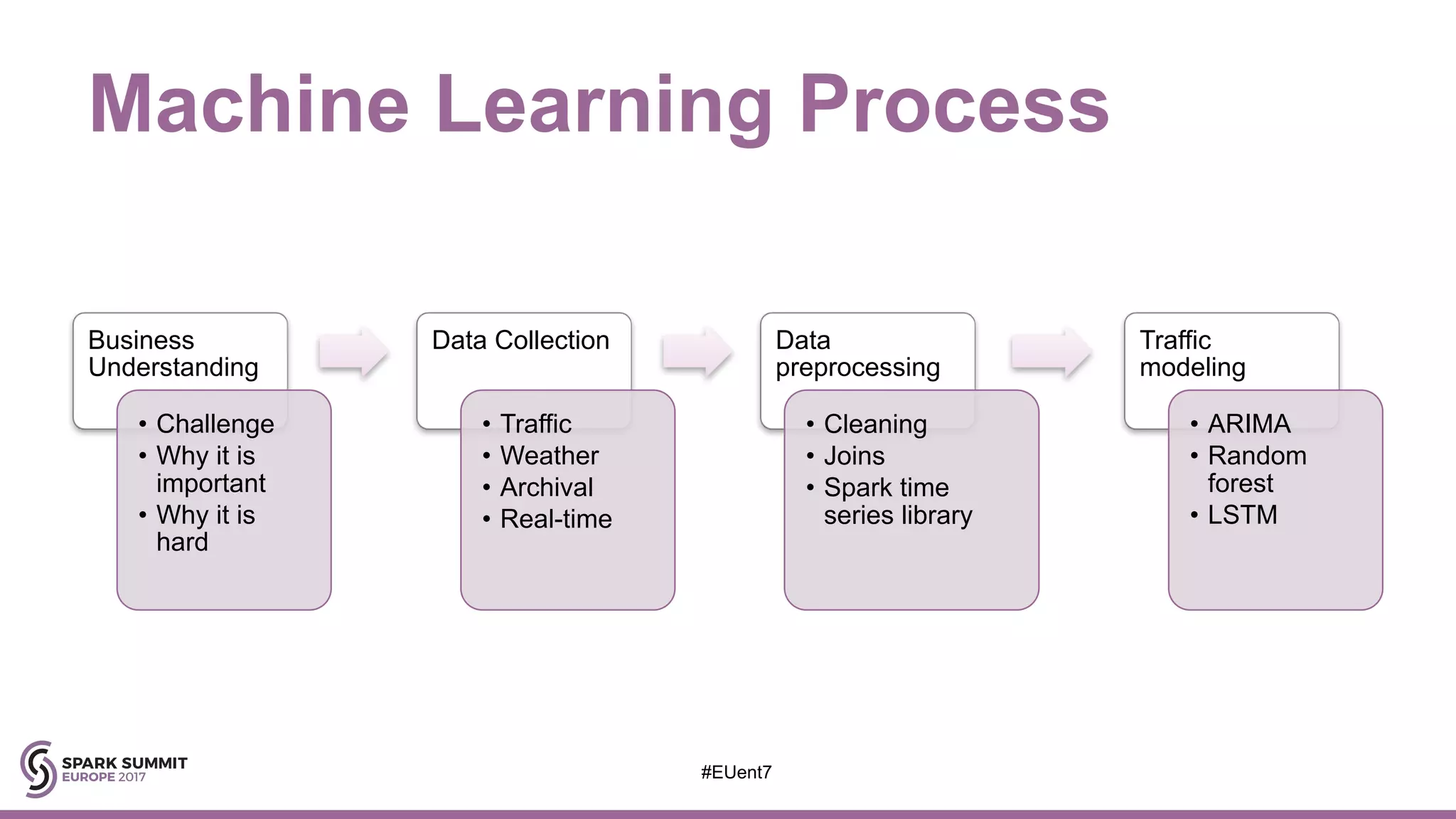
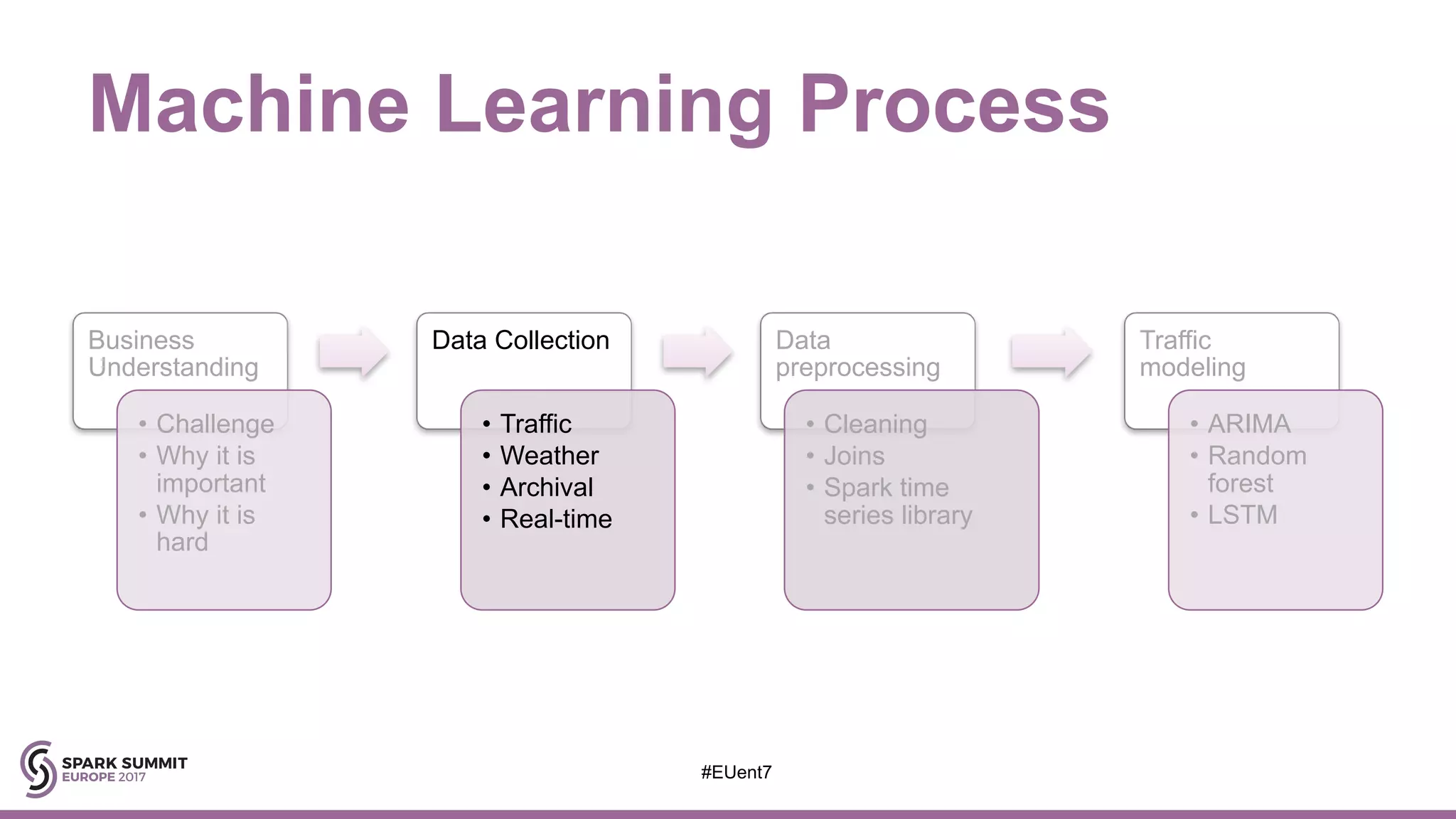
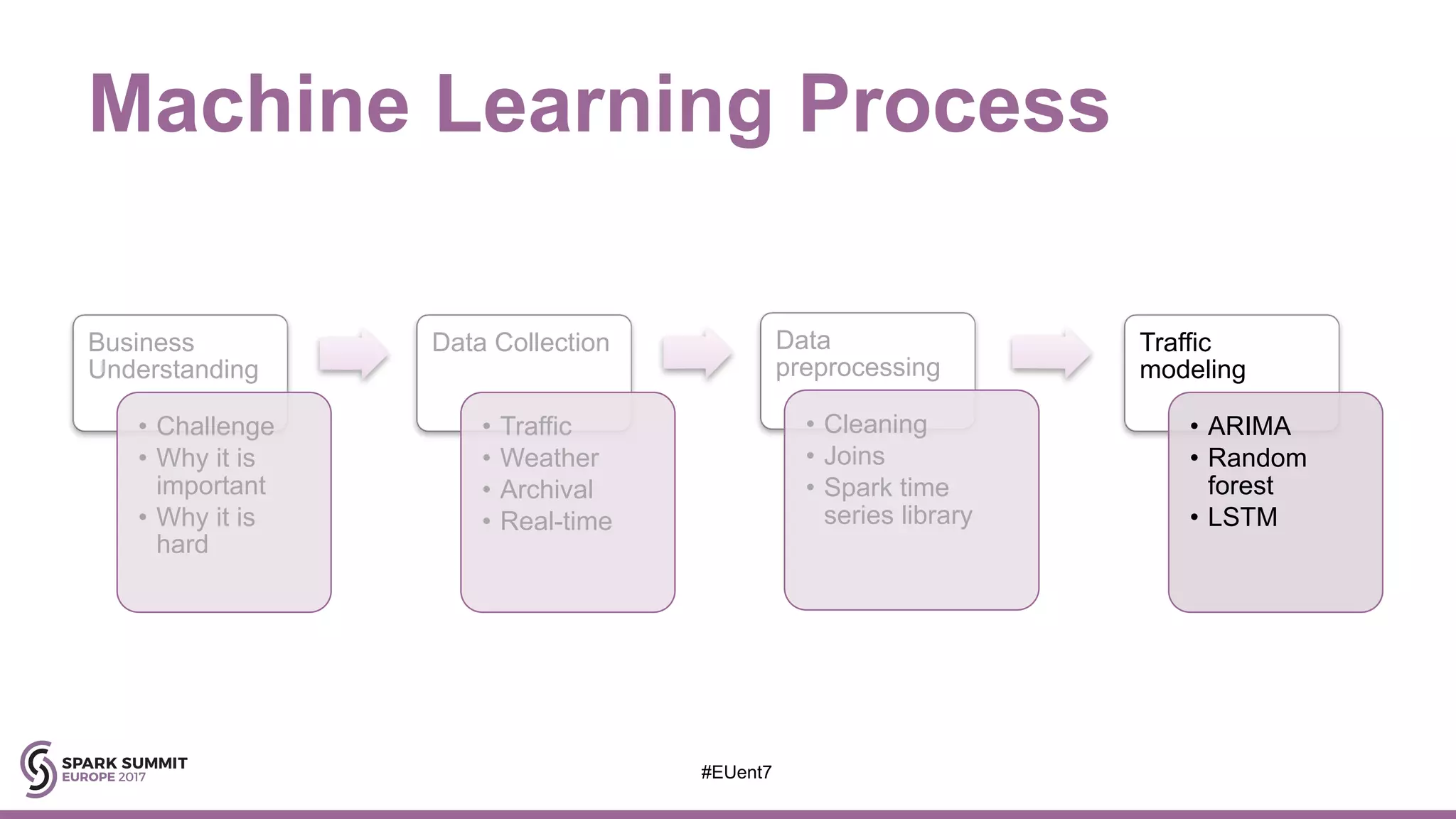
Machine Learning Process
Business
Understanding
• Challenge
• Why it is
important
• Why it is
hard
Data Collection
• Traffic
• Weather
• Archival
• Real-time
Data
preprocessing
• Cleaning
• Joins
• Spark time
series library
Traffic
modeling
• ARIMA
• Random
forest
• LSTM
#EUent7
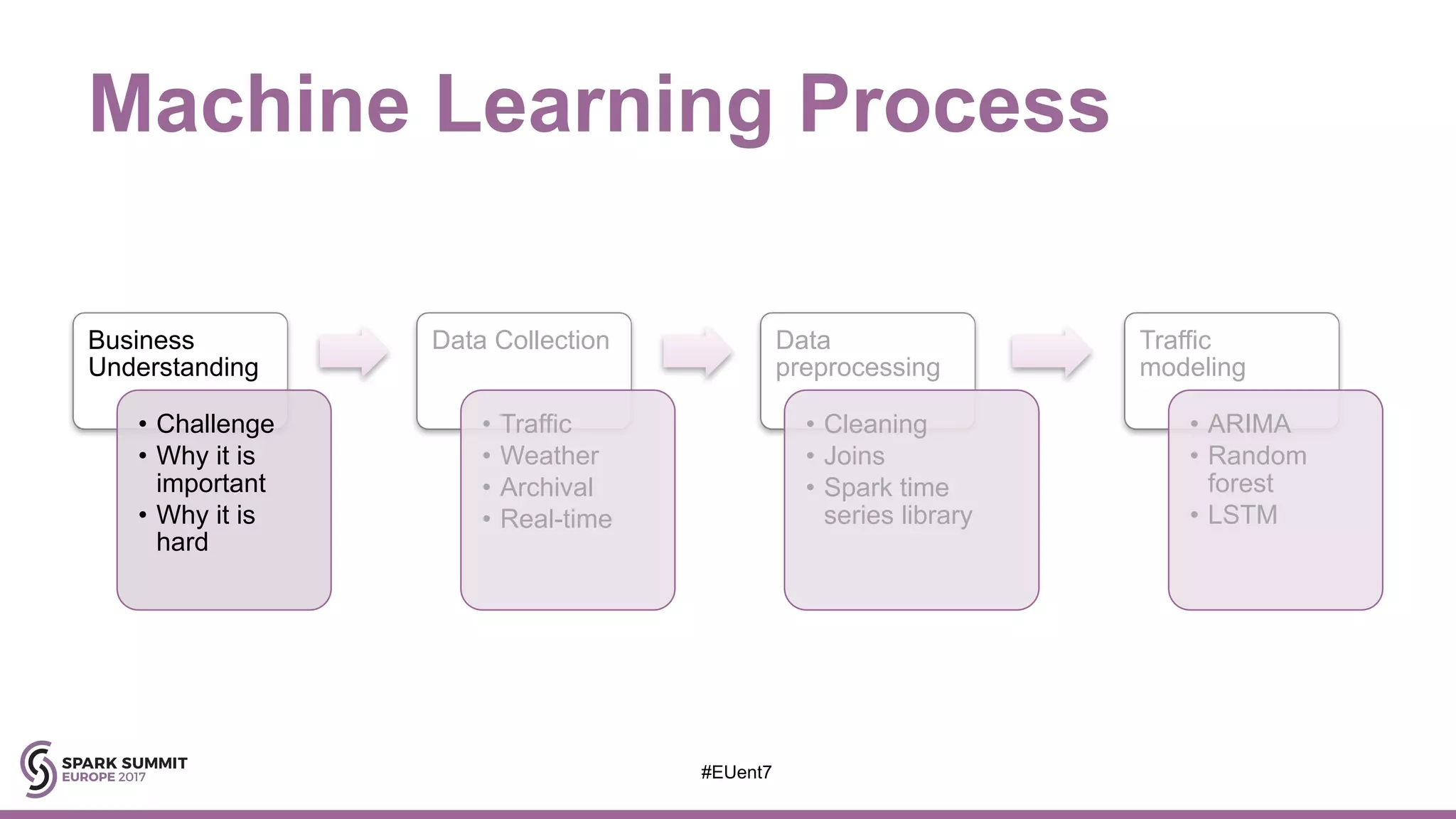
Machine Learning Process
Business
Understanding
• Challenge
• Why it is
important
• Why it is
hard
Data Collection
• Traffic
• Weather
• Archival
• Real-time
Data
preprocessing
• Cleaning
• Joins
• Spark time
series library
Traffic
modeling
• ARIMA
• Random
forest
• LSTM
#EUent7
Driver behavior data is only valid in the context of what is
also happening on the road
UBI – Usage Based Insurance
71 6571 7265 44˚
Driver	
Speed
Driver	
Speed
Speed	
Limit
Speed	
Limit
Reference	
Speed
Weather	
Condition
Temp	
Reading
2
Congestion	
Index
Limited Analysis
can lead to
inaccurate
assessments, and
impact retention
More data, and driver relevant data will
lead to greater understanding of
behavior and associated risk
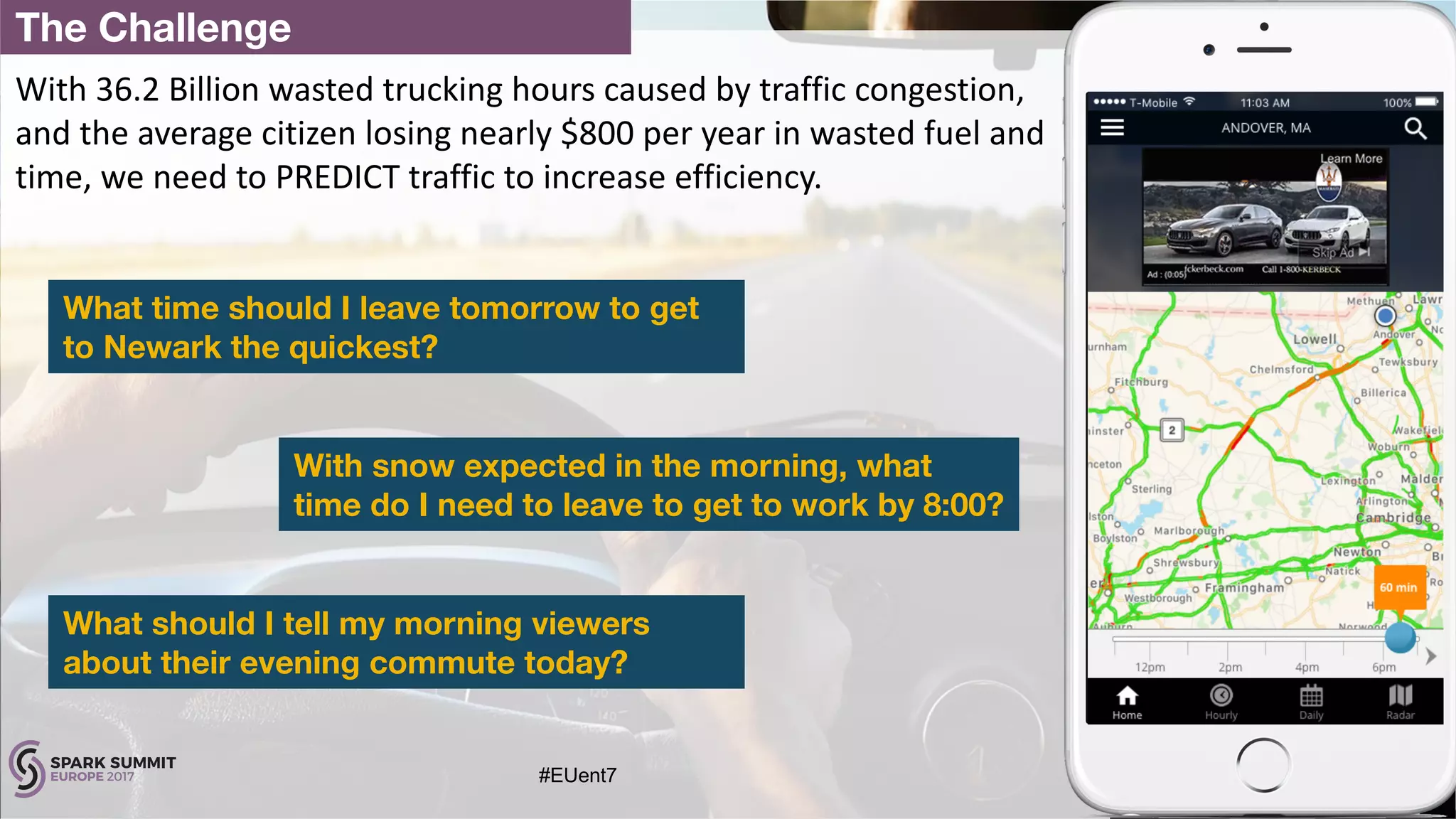
With	36.2	Billion	wasted	trucking	hours	caused	by	traffic	congestion,	
and	the	average	citizen	losing	nearly	$800	per	year	in	wasted	fuel	and	
time,	we	need	to	PREDICT	traffic	to	increase	efficiency.
The Challenge
What time should I leave tomorrow to get
to Newark the quickest?
With snow expected in the morning, what
time do I need to leave to get to work by 8:00?
What should I tell my morning viewers
about their evening commute today?
Predictive	Traffic	Demo
#EUent7
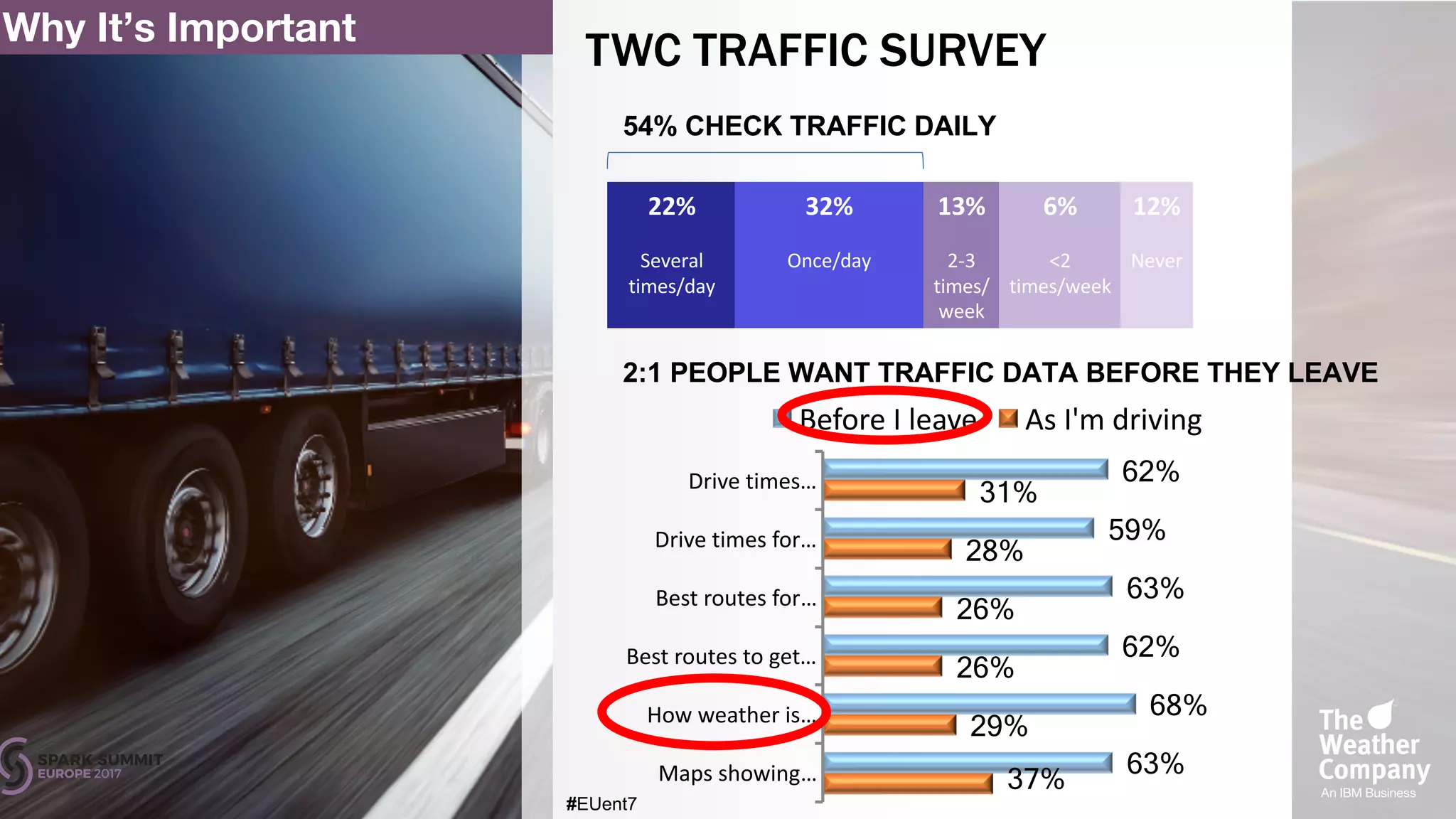
Why It’s Important
22%
Several	
times/day
32%
Once/day
13%
2-3	
times/	
week
6%
<2	
times/week
12%
Never
54% CHECK TRAFFIC DAILY
62%
59%
63%
62%
68%
63%
31%
28%
26%
26%
29%
37%
Drive	times	…
Drive	times	for	…
Best	routes	for	…
Best	routes	to	get	…
How	weather	is	…
Maps	showing	…
Before	I	leave As	I'm	driving
TWC TRAFFIC SURVEY
2:1 PEOPLE WANT TRAFFIC DATA BEFORE THEY LEAVE
#EUent7
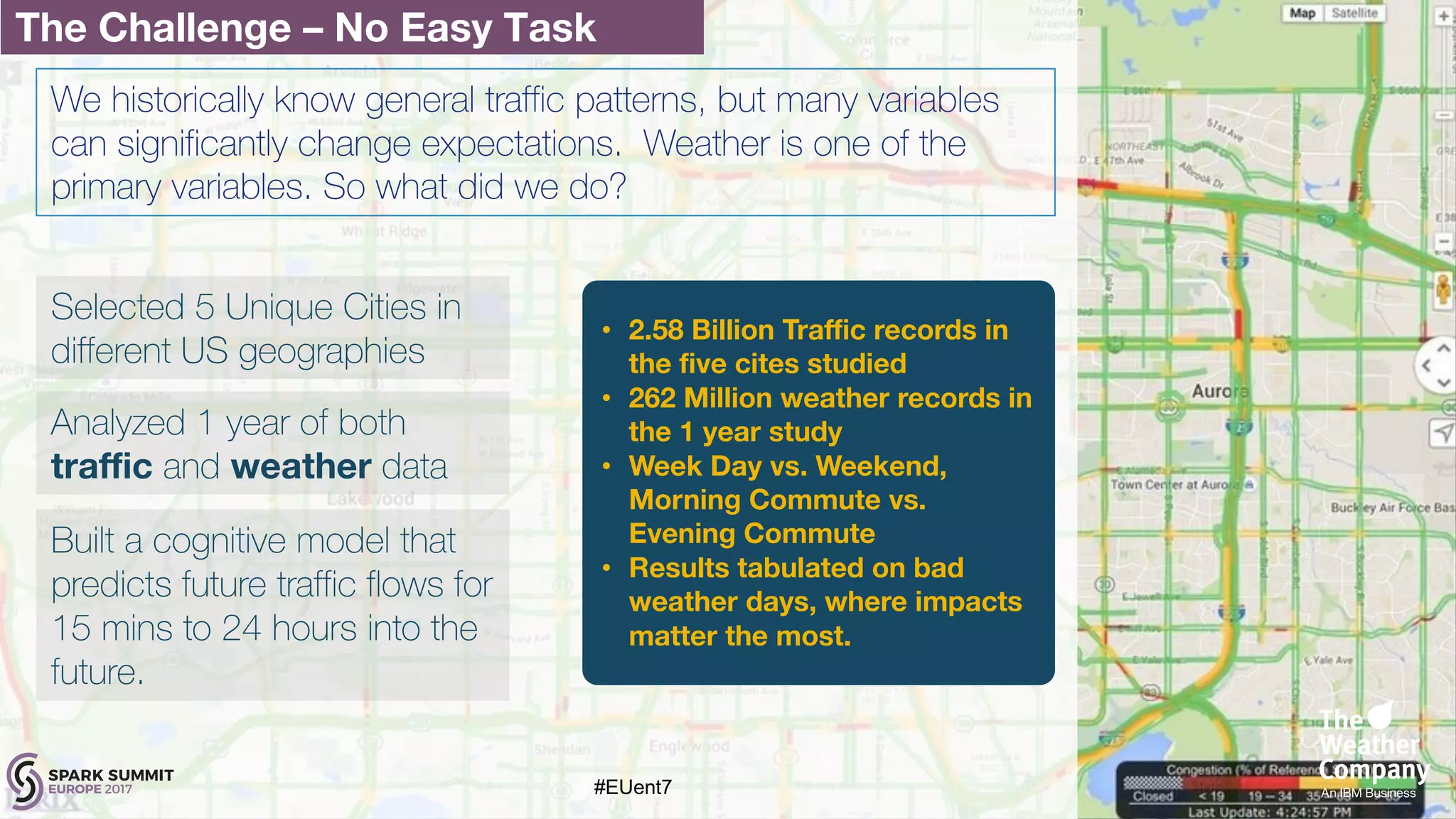
We historically know general traffic patterns, but many variables
can significantly change expectations. Weather is one of the
primary variables. So what did we do?
The Challenge – No Easy Task
• 2.58 Billion Traffic records in
the five cites studied
• 262 Million weather records in
the 1 year study
• Week Day vs. Weekend,
Morning Commute vs.
Evening Commute
• Results tabulated on bad
weather days, where impacts
matter the most.
Selected 5 Unique Cities in
different US geographies
Analyzed 1 year of both
traffic and weather data
Built a cognitive model that
predicts future traffic flows for
15 mins to 24 hours into the
future.
#EUent7
Machine Learning Process
Business
Understanding
• Challenge
• Why it is
important
• Why it is
hard
Data Collection
• Traffic
• Weather
• Archival
• Real-time
Data
preprocessing
• Cleaning
• Joins
• Spark time
series library
Traffic
modeling
• ARIMA
• Random
forest
• LSTM
#EUent7
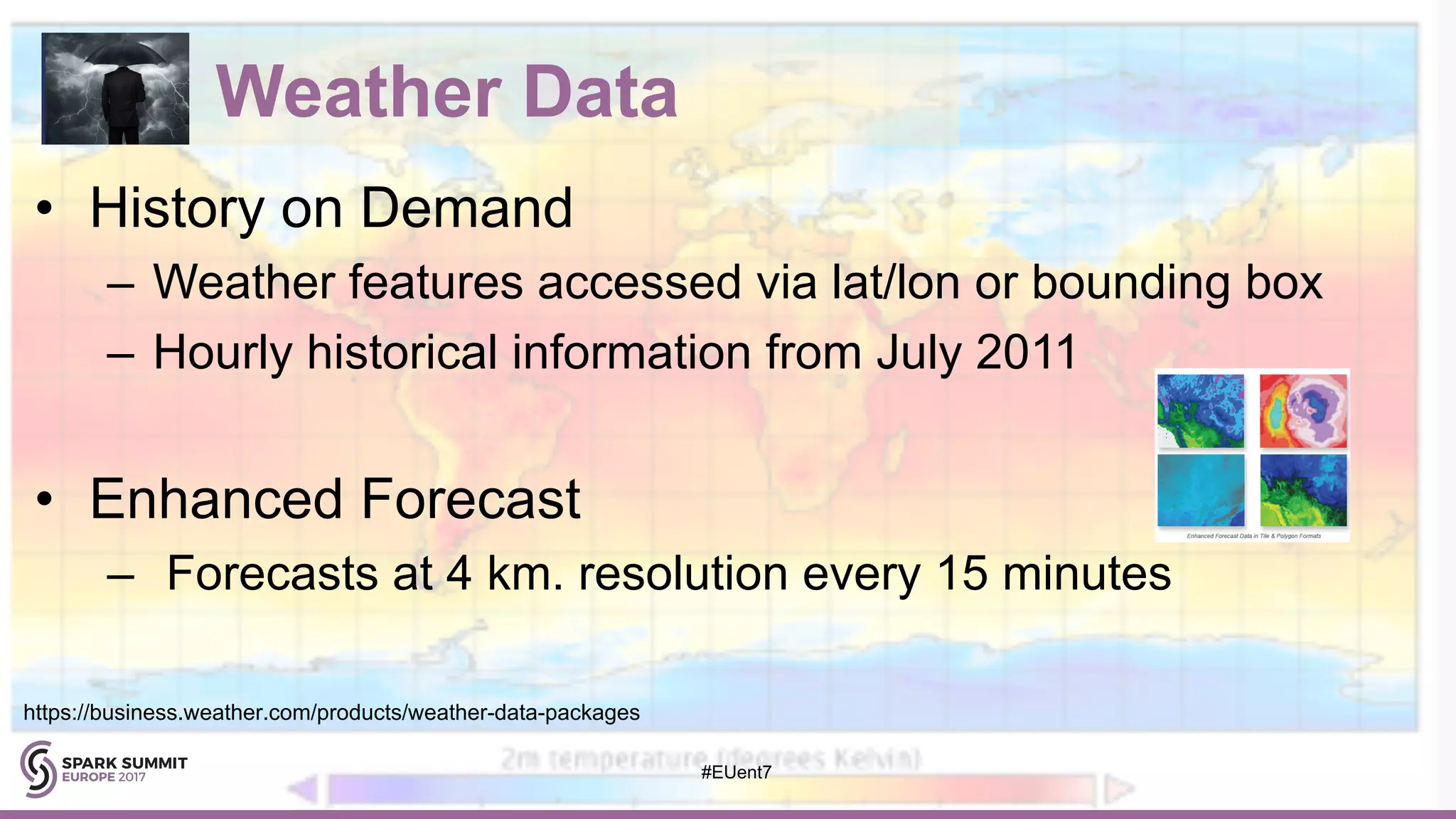
• History on Demand
– Weather features accessed via lat/lon or bounding box
– Hourly historical information from July 2011
• Enhanced Forecast
– Forecasts at 4 km. resolution every 15 minutes
#EUent7
Weather Data
https://business.weather.com/products/weather-data-packages
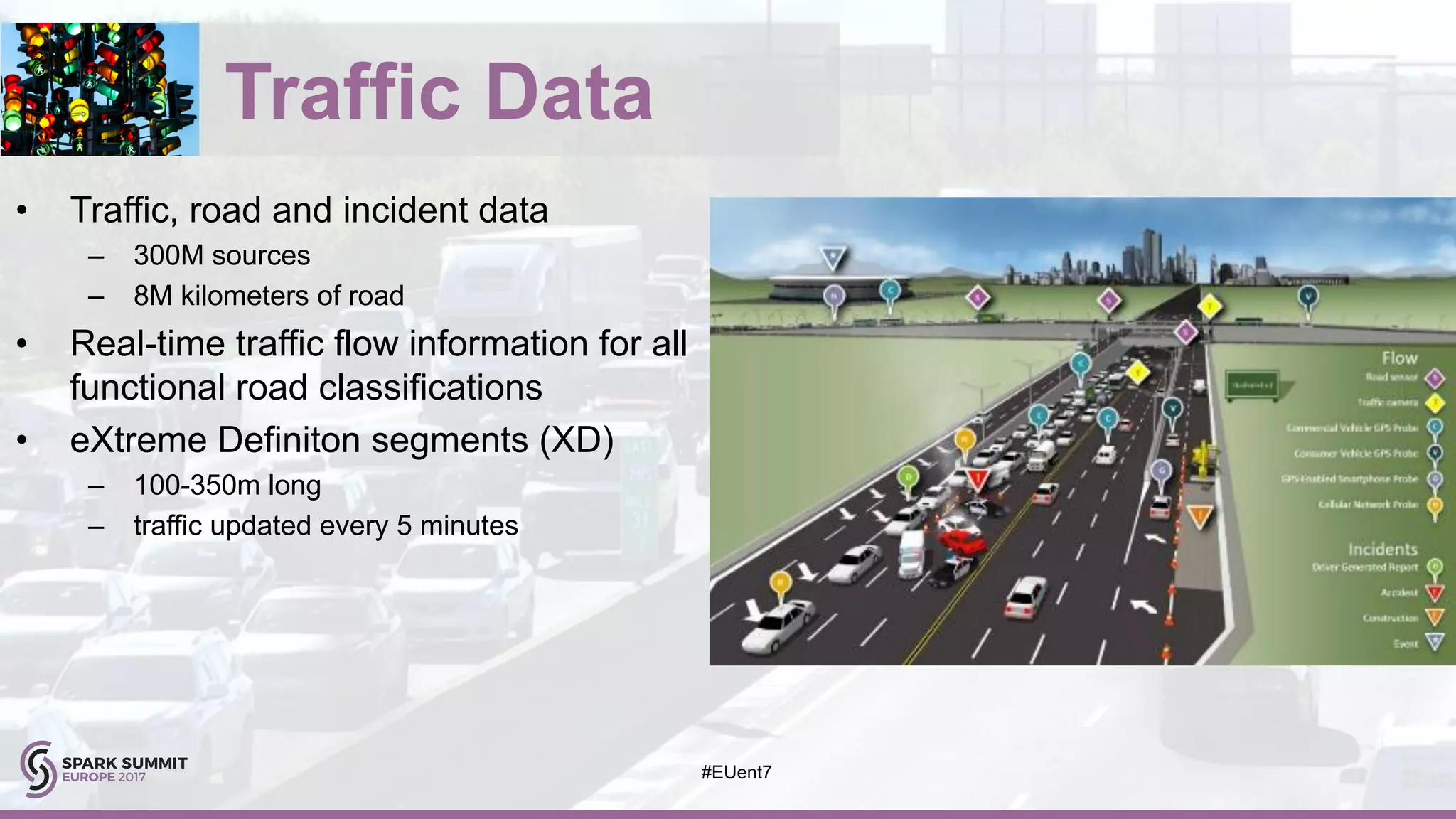
• Traffic, road and incident data
– 300M sources
– 8M kilometers of road
• Real-time traffic flow information for all
functional road classifications
• eXtreme Definiton segments (XD)
– 100-350m long
– traffic updated every 5 minutes
#EUent7
Traffic Data
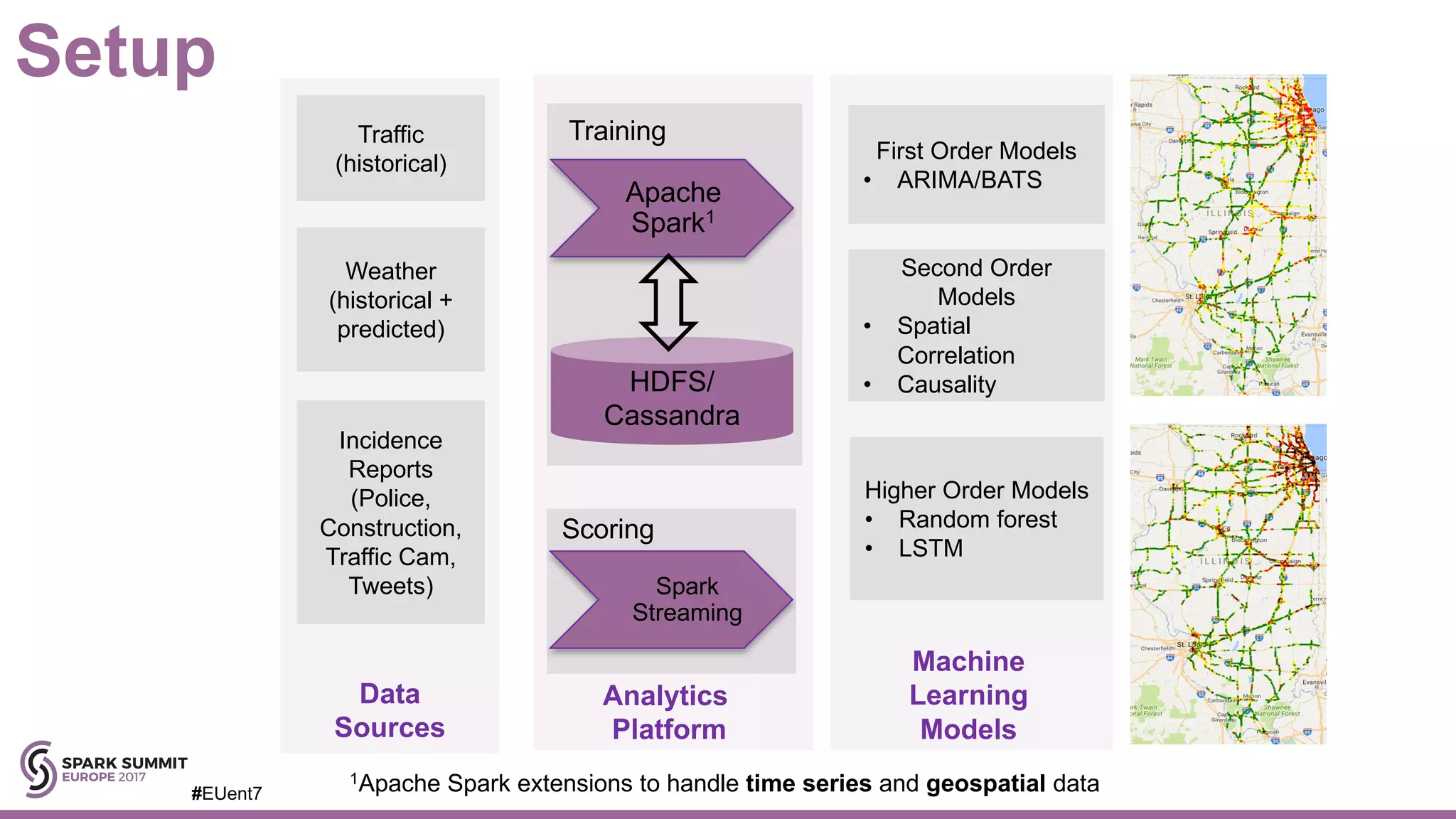
1Apache Spark extensions to handle time series and geospatial data
Traffic
(historical)
Weather
(historical +
predicted)
Incidence
Reports
(Police,
Construction,
Traffic Cam,
Tweets)
Data
Sources
First Order Models
• ARIMA/BATS
Second Order
Models
• Spatial
Correlation
• Causality
Higher Order Models
• Random forest
• LSTM
Machine
Learning
Models
Analytics
Platform
Spark
Streaming
Training
Scoring
Apache
Spark1
HDFS/
Cassandra
#EUent7
Setup
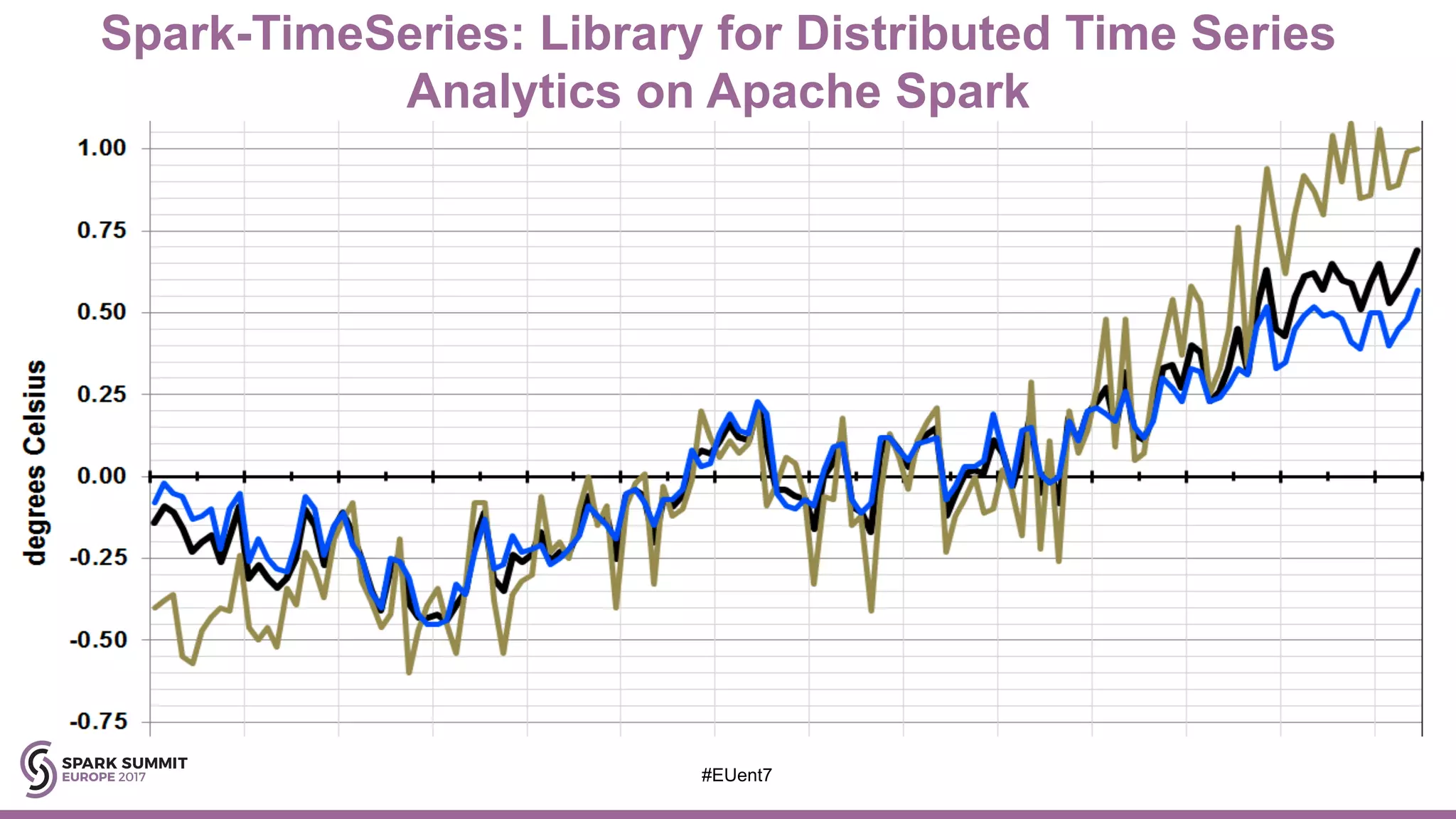
Spark-TimeSeries: Library for Distributed Time Series
Analytics on Apache Spark
#EUent7
Scale	out	
• Single	JVM:	Streams
• Horizontal:	ShortTSRDD
• Longitudinal:	LongTSRDD
Data	types
• Fully	templated
• Integers,	Doubles,	Strings	etc
• Fully	supporting	geo	locations	
Windowing
• Record	based
• Time	based
• Activity	based
Runtime	support
• Periodic,	Aperiodic,	Hybrid
• Aligned/	Unaligned	timeseries
Multivariate	analysis
• Temporal	joins
• Record-based	Join
Languages
• Scala
• Java
• Python*
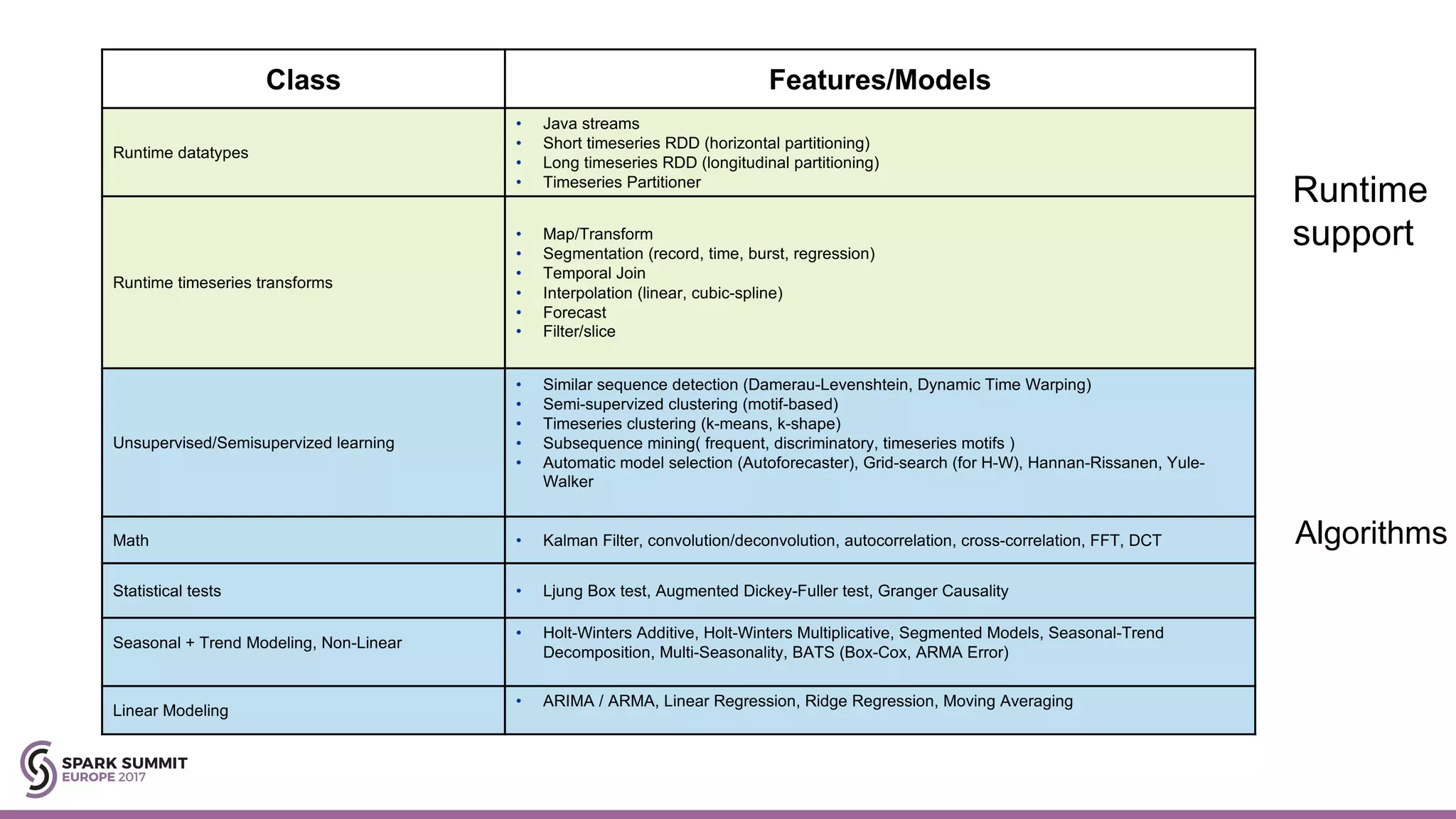
Class Features/Models
Runtime datatypes
• Java streams
• Short timeseries RDD (horizontal partitioning)
• Long timeseries RDD (longitudinal partitioning)
• Timeseries Partitioner
Runtime timeseries transforms
• Map/Transform
• Segmentation (record, time, burst, regression)
• Temporal Join
• Interpolation (linear, cubic-spline)
• Forecast
• Filter/slice
Unsupervised/Semisupervized learning
• Similar sequence detection (Damerau-Levenshtein, Dynamic Time Warping)
• Semi-supervized clustering (motif-based)
• Timeseries clustering (k-means, k-shape)
• Subsequence mining( frequent, discriminatory, timeseries motifs )
• Automatic model selection (Autoforecaster), Grid-search (for H-W), Hannan-Rissanen, Yule-
Walker
Math • Kalman Filter, convolution/deconvolution, autocorrelation, cross-correlation, FFT, DCT
Statistical tests • Ljung Box test, Augmented Dickey-Fuller test, Granger Causality
Seasonal + Trend Modeling, Non-Linear
• Holt-Winters Additive, Holt-Winters Multiplicative, Segmented Models, Seasonal-Trend
Decomposition, Multi-Seasonality, BATS (Box-Cox, ARMA Error)
Linear Modeling
• ARIMA / ARMA, Linear Regression, Ridge Regression, Moving Averaging
Runtime
support
Algorithms
Machine Learning Process
Business
Understanding
• Challenge
• Why it is
important
• Why it is
hard
Data Collection
• Traffic
• Weather
• Archival
• Real-time
Data
preprocessing
• Cleaning
• Joins
• Spark time
series library
Traffic
modeling
• ARIMA
• Random
forest
• LSTM
#EUent7
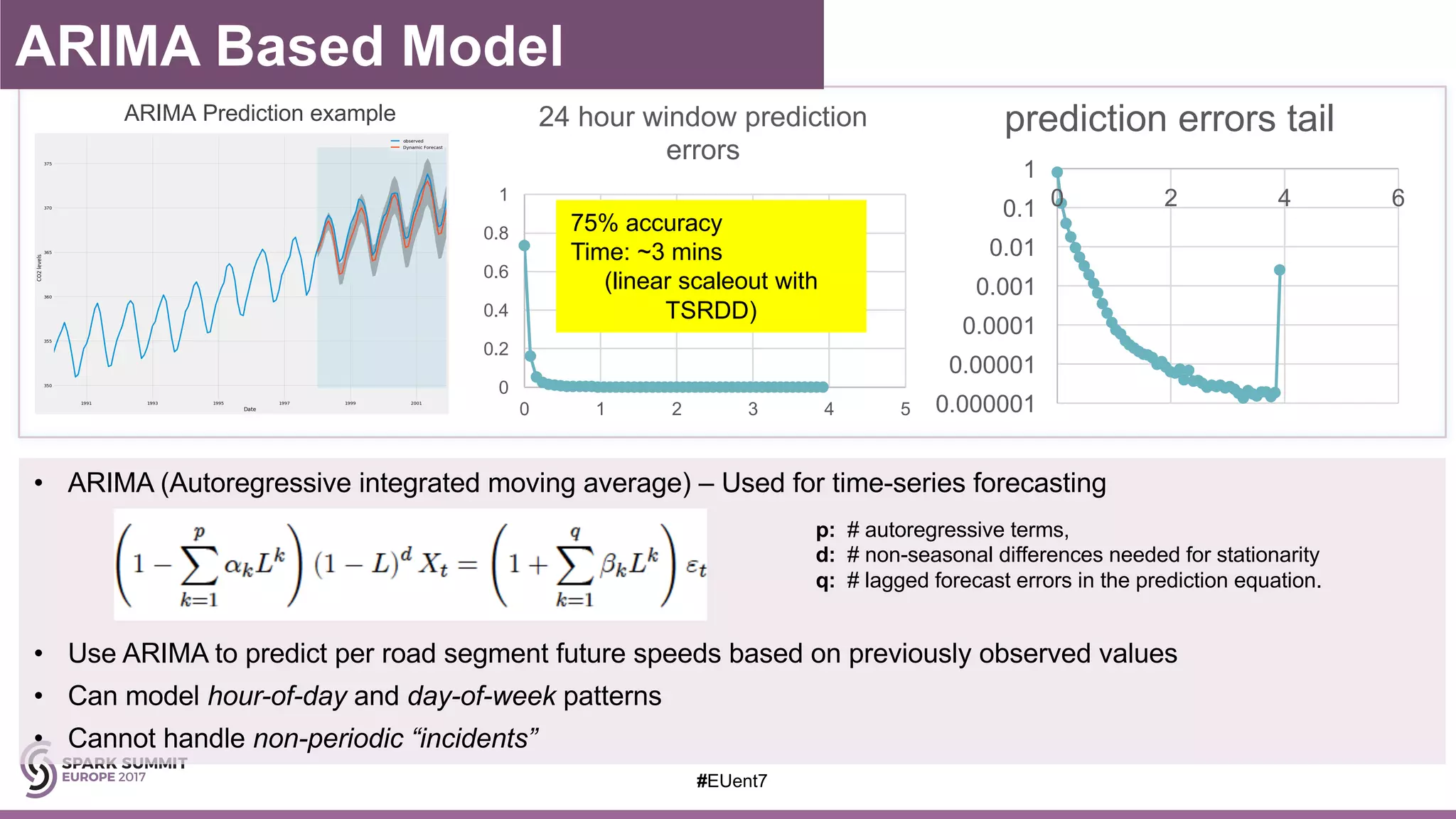
• ARIMA (Autoregressive integrated moving average) – Used for time-series forecasting
• Use ARIMA to predict per road segment future speeds based on previously observed values
• Can model hour-of-day and day-of-week patterns
• Cannot handle non-periodic “incidents”
0
0.2
0.4
0.6
0.8
1
0 1 2 3 4 5
24 hour window prediction
errors
0.000001
0.00001
0.0001
0.001
0.01
0.1
1
0 2 4 6
prediction errors tailARIMA Prediction example
p: # autoregressive terms,
d: # non-seasonal differences needed for stationarity
q: # lagged forecast errors in the prediction equation.
75% accuracy
Time: ~3 mins
(linear scaleout with
TSRDD)
#EUent7
ARIMA Based Model
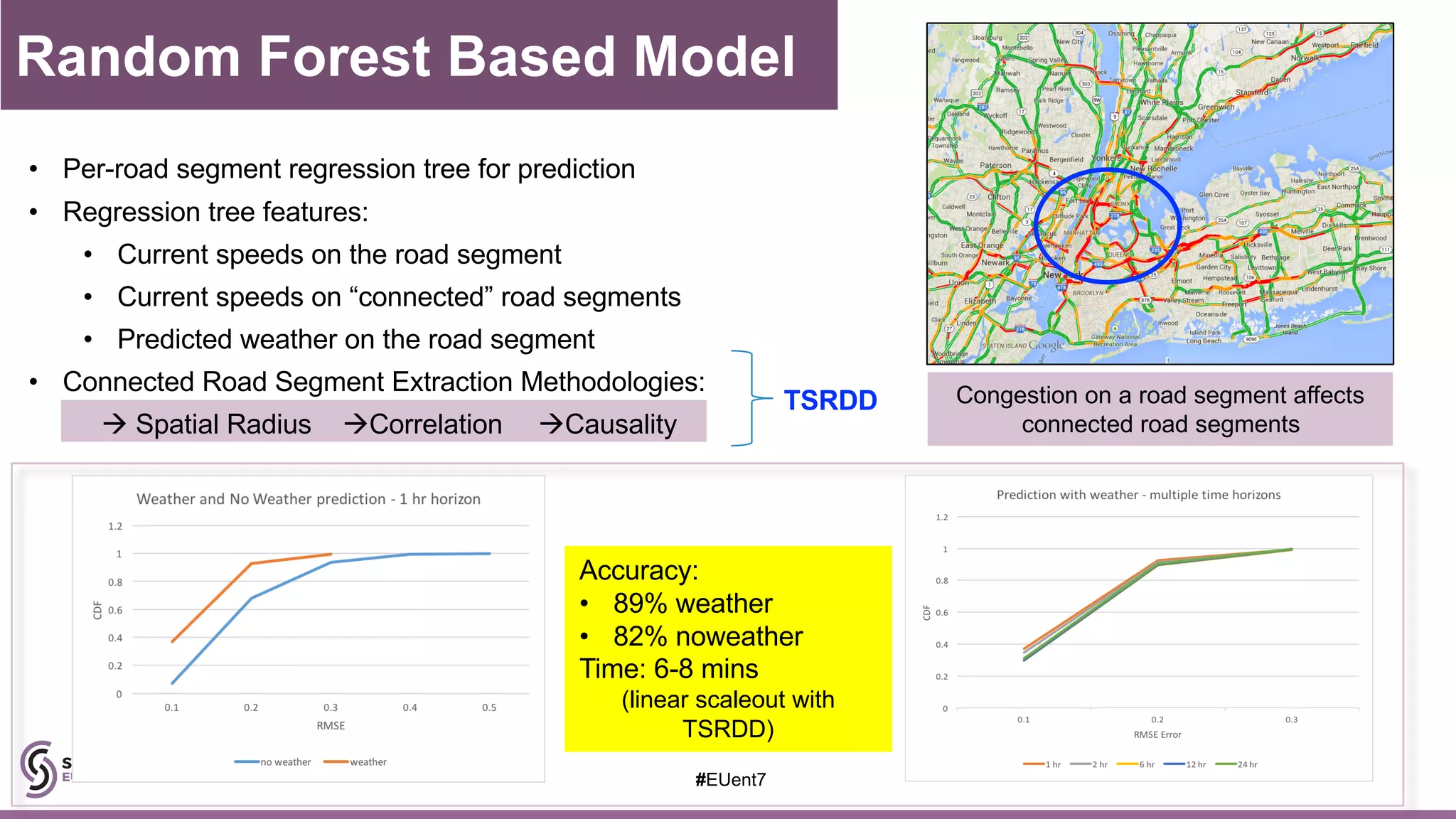
• Per-road segment regression tree for prediction
• Regression tree features:
• Current speeds on the road segment
• Current speeds on “connected” road segments
• Predicted weather on the road segment
• Connected Road Segment Extraction Methodologies:
à Spatial Radius àCorrelation àCausality
Congestion on a road segment affects
connected road segments
Accuracy:
• 89% weather
• 82% noweather
Time: 6-8 mins
(linear scaleout with
TSRDD)
TSRDD
#EUent7
Random Forest Based Model
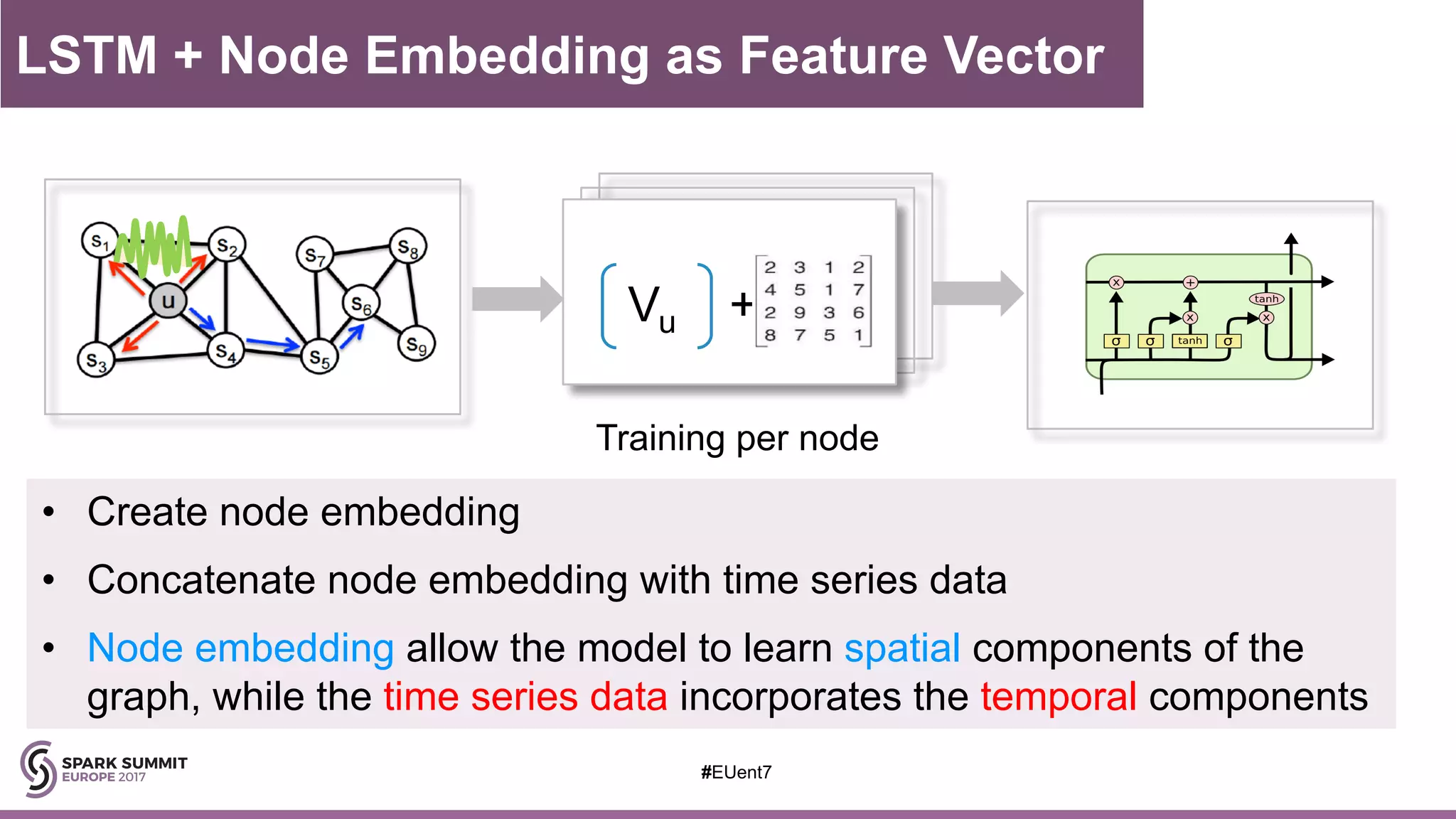
Vu +
Training per node
#EUent7
LSTM + Node Embedding as Feature Vector
• Create node embedding
• Concatenate node embedding with time series data
• Node embedding allow the model to learn spatial components of the
graph, while the time series data incorporates the temporal components
SparkHDFS
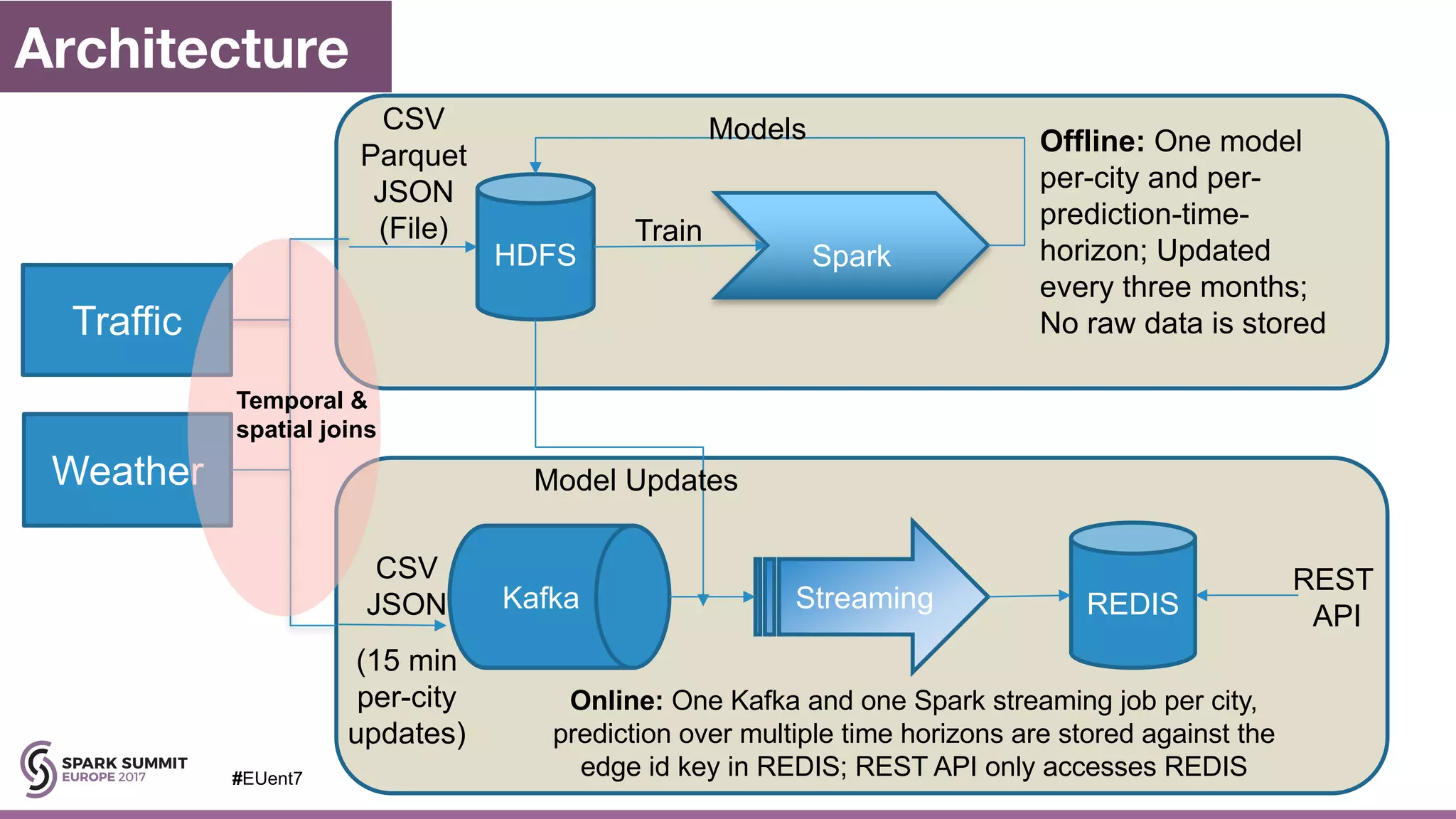
CSV
Parquet
JSON
(File) Train
Models Offline: One model
per-city and per-
prediction-time-
horizon; Updated
every three months;
No raw data is stored
CSV
JSON
(15 min
per-city
updates)
StreamingKafka
Model Updates
REDIS
REST
API
Online: One Kafka and one Spark streaming job per city,
prediction over multiple time horizons are stored against the
edge id key in REDIS; REST API only accesses REDIS
Traffic
Weather
Temporal &
spatial joins
#EUent7
Architecture
Driver behavior data is only valid in the context of what is
also happening on the road
UBI – Usage Based Insurance
71 6571 7265 44˚
Driver	
Speed
Driver	
Speed
Speed	
Limit
Speed	
Limit
Reference	
Speed
Weather	
Condition
Temp	
Reading
2
Congestion	
Index
Limited Analysis
can lead to
inaccurate
assessments, and
impact retention
More data, and driver relevant data will
lead to greater understanding of
behavior and associated risk
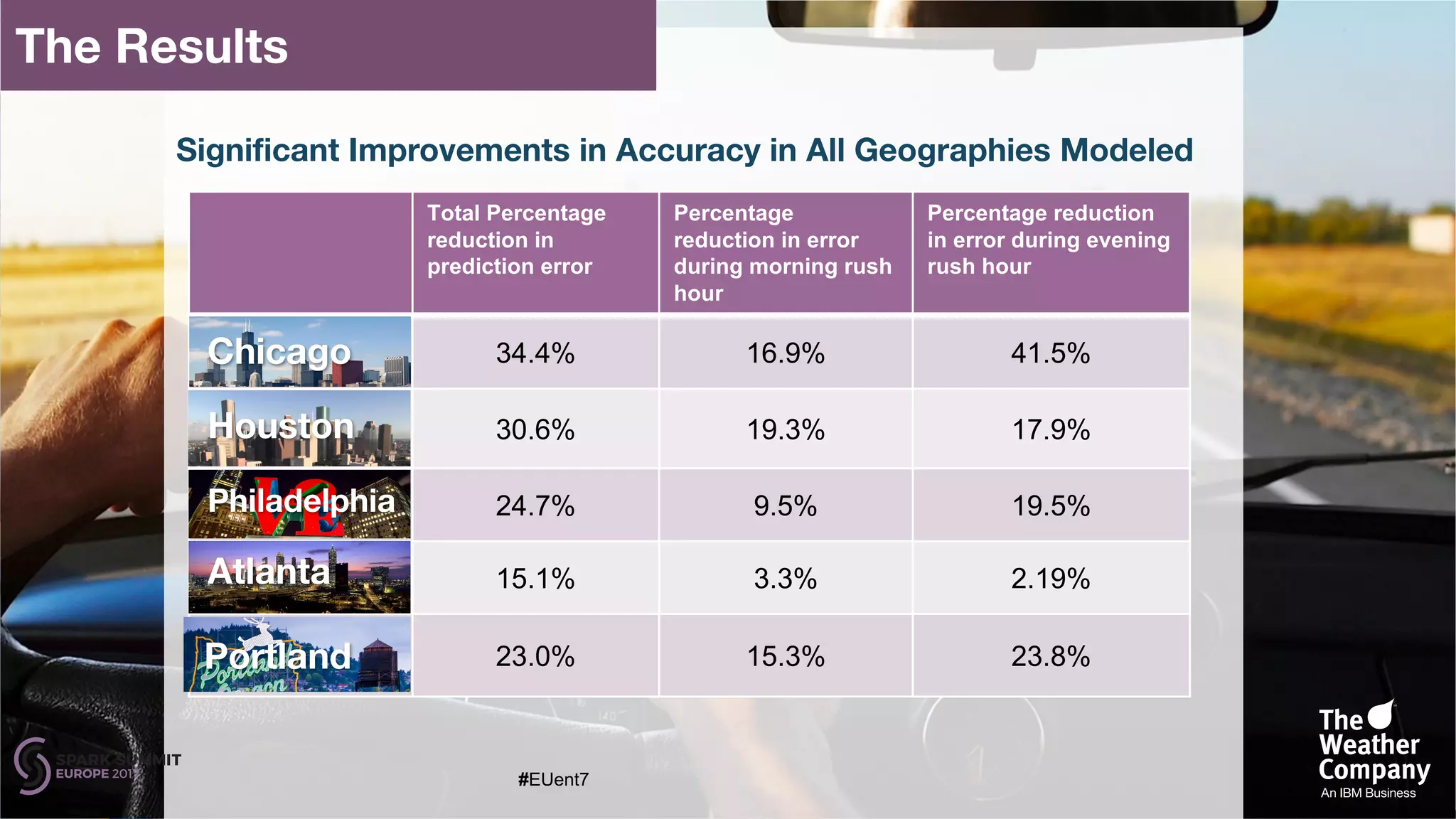
The Results
Total Percentage
reduction in
prediction error
Percentage
reduction in error
during morning rush
hour
Percentage reduction
in error during evening
rush hour
Chicago 34.4% 16.9% 41.5%
Houston 30.6% 19.3% 17.9%
Philadelphia 24.7% 9.5% 19.5%
Atlanta 15.1% 3.3% 2.19%
Portland 23.0% 15.3% 23.8%
Chicago
Houston
Philadelphia
Atlanta
Portland
Significant Improvements in Accuracy in All Geographies Modeled
#EUent7
5
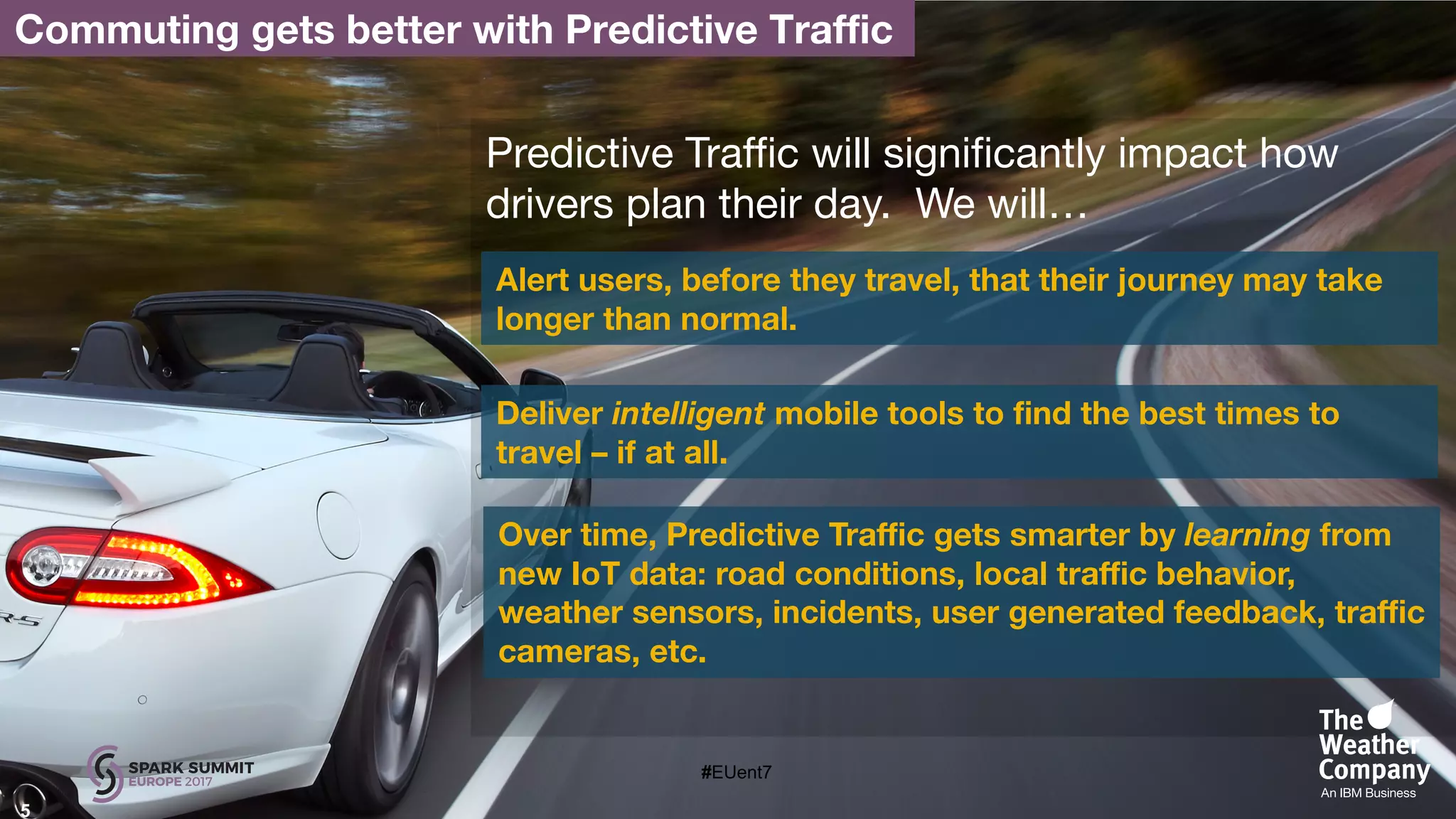
Predictive Traffic will significantly impact how
drivers plan their day. We will…
Alert users, before they travel, that their journey may take
longer than normal.
Deliver intelligent mobile tools to find the best times to
travel – if at all.
Over time, Predictive Traffic gets smarter by learning from
new IoT data: road conditions, local traffic behavior,
weather sensors, incidents, user generated feedback, traffic
cameras, etc.
Commuting gets better with Predictive Traffic
#EUent7
Open source details
#EUent7
https://ibm.github.io/
https://www.ibm.com/developerworks

Improving Traffic Prediction Using Weather Datawith Ramya Raghavendra

  • 1.
    Ramya Raghavendra IBM Research rraghav@us.ibm.com IMPROVINGTRAFFIC PREDICTION USING WEATHER DATA #EUent7
  • 2.
    Machine Learning Process Business Understanding •Challenge • Why it is important • Why it is hard Data Collection • Traffic • Weather • Archival • Real-time Data preprocessing • Cleaning • Joins • Spark time series library Traffic modeling • ARIMA • Random forest • LSTM #EUent7
  • 3.
    Machine Learning Process Business Understanding •Challenge • Why it is important • Why it is hard Data Collection • Traffic • Weather • Archival • Real-time Data preprocessing • Cleaning • Joins • Spark time series library Traffic modeling • ARIMA • Random forest • LSTM #EUent7
  • 4.
    Driver behavior datais only valid in the context of what is also happening on the road UBI – Usage Based Insurance 71 6571 7265 44˚ Driver Speed Driver Speed Speed Limit Speed Limit Reference Speed Weather Condition Temp Reading 2 Congestion Index Limited Analysis can lead to inaccurate assessments, and impact retention More data, and driver relevant data will lead to greater understanding of behavior and associated risk With 36.2 Billion wasted trucking hours caused by traffic congestion, and the average citizen losing nearly $800 per year in wasted fuel and time, we need to PREDICT traffic to increase efficiency. The Challenge What time should I leave tomorrow to get to Newark the quickest? With snow expected in the morning, what time do I need to leave to get to work by 8:00? What should I tell my morning viewers about their evening commute today? Predictive Traffic Demo #EUent7
  • 5.
    Why It’s Important 22% Several times/day 32% Once/day 13% 2-3 times/ week 6% <2 times/week 12% Never 54%CHECK TRAFFIC DAILY 62% 59% 63% 62% 68% 63% 31% 28% 26% 26% 29% 37% Drive times … Drive times for … Best routes for … Best routes to get … How weather is … Maps showing … Before I leave As I'm driving TWC TRAFFIC SURVEY 2:1 PEOPLE WANT TRAFFIC DATA BEFORE THEY LEAVE #EUent7
  • 6.
    We historically knowgeneral traffic patterns, but many variables can significantly change expectations. Weather is one of the primary variables. So what did we do? The Challenge – No Easy Task • 2.58 Billion Traffic records in the five cites studied • 262 Million weather records in the 1 year study • Week Day vs. Weekend, Morning Commute vs. Evening Commute • Results tabulated on bad weather days, where impacts matter the most. Selected 5 Unique Cities in different US geographies Analyzed 1 year of both traffic and weather data Built a cognitive model that predicts future traffic flows for 15 mins to 24 hours into the future. #EUent7
  • 7.
    Machine Learning Process Business Understanding •Challenge • Why it is important • Why it is hard Data Collection • Traffic • Weather • Archival • Real-time Data preprocessing • Cleaning • Joins • Spark time series library Traffic modeling • ARIMA • Random forest • LSTM #EUent7
  • 8.
    • History onDemand – Weather features accessed via lat/lon or bounding box – Hourly historical information from July 2011 • Enhanced Forecast – Forecasts at 4 km. resolution every 15 minutes #EUent7 Weather Data https://business.weather.com/products/weather-data-packages
  • 9.
    • Traffic, roadand incident data – 300M sources – 8M kilometers of road • Real-time traffic flow information for all functional road classifications • eXtreme Definiton segments (XD) – 100-350m long – traffic updated every 5 minutes #EUent7 Traffic Data
  • 10.
    1Apache Spark extensionsto handle time series and geospatial data Traffic (historical) Weather (historical + predicted) Incidence Reports (Police, Construction, Traffic Cam, Tweets) Data Sources First Order Models • ARIMA/BATS Second Order Models • Spatial Correlation • Causality Higher Order Models • Random forest • LSTM Machine Learning Models Analytics Platform Spark Streaming Training Scoring Apache Spark1 HDFS/ Cassandra #EUent7 Setup
  • 11.
    Spark-TimeSeries: Library forDistributed Time Series Analytics on Apache Spark #EUent7 Scale out • Single JVM: Streams • Horizontal: ShortTSRDD • Longitudinal: LongTSRDD Data types • Fully templated • Integers, Doubles, Strings etc • Fully supporting geo locations Windowing • Record based • Time based • Activity based Runtime support • Periodic, Aperiodic, Hybrid • Aligned/ Unaligned timeseries Multivariate analysis • Temporal joins • Record-based Join Languages • Scala • Java • Python*
  • 12.
    Class Features/Models Runtime datatypes •Java streams • Short timeseries RDD (horizontal partitioning) • Long timeseries RDD (longitudinal partitioning) • Timeseries Partitioner Runtime timeseries transforms • Map/Transform • Segmentation (record, time, burst, regression) • Temporal Join • Interpolation (linear, cubic-spline) • Forecast • Filter/slice Unsupervised/Semisupervized learning • Similar sequence detection (Damerau-Levenshtein, Dynamic Time Warping) • Semi-supervized clustering (motif-based) • Timeseries clustering (k-means, k-shape) • Subsequence mining( frequent, discriminatory, timeseries motifs ) • Automatic model selection (Autoforecaster), Grid-search (for H-W), Hannan-Rissanen, Yule- Walker Math • Kalman Filter, convolution/deconvolution, autocorrelation, cross-correlation, FFT, DCT Statistical tests • Ljung Box test, Augmented Dickey-Fuller test, Granger Causality Seasonal + Trend Modeling, Non-Linear • Holt-Winters Additive, Holt-Winters Multiplicative, Segmented Models, Seasonal-Trend Decomposition, Multi-Seasonality, BATS (Box-Cox, ARMA Error) Linear Modeling • ARIMA / ARMA, Linear Regression, Ridge Regression, Moving Averaging Runtime support Algorithms
  • 13.
    Machine Learning Process Business Understanding •Challenge • Why it is important • Why it is hard Data Collection • Traffic • Weather • Archival • Real-time Data preprocessing • Cleaning • Joins • Spark time series library Traffic modeling • ARIMA • Random forest • LSTM #EUent7
  • 14.
    • ARIMA (Autoregressiveintegrated moving average) – Used for time-series forecasting • Use ARIMA to predict per road segment future speeds based on previously observed values • Can model hour-of-day and day-of-week patterns • Cannot handle non-periodic “incidents” 0 0.2 0.4 0.6 0.8 1 0 1 2 3 4 5 24 hour window prediction errors 0.000001 0.00001 0.0001 0.001 0.01 0.1 1 0 2 4 6 prediction errors tailARIMA Prediction example p: # autoregressive terms, d: # non-seasonal differences needed for stationarity q: # lagged forecast errors in the prediction equation. 75% accuracy Time: ~3 mins (linear scaleout with TSRDD) #EUent7 ARIMA Based Model
  • 15.
    • Per-road segmentregression tree for prediction • Regression tree features: • Current speeds on the road segment • Current speeds on “connected” road segments • Predicted weather on the road segment • Connected Road Segment Extraction Methodologies: à Spatial Radius àCorrelation àCausality Congestion on a road segment affects connected road segments Accuracy: • 89% weather • 82% noweather Time: 6-8 mins (linear scaleout with TSRDD) TSRDD #EUent7 Random Forest Based Model
  • 16.
    Vu + Training pernode #EUent7 LSTM + Node Embedding as Feature Vector • Create node embedding • Concatenate node embedding with time series data • Node embedding allow the model to learn spatial components of the graph, while the time series data incorporates the temporal components
  • 17.
    SparkHDFS CSV Parquet JSON (File) Train Models Offline:One model per-city and per- prediction-time- horizon; Updated every three months; No raw data is stored CSV JSON (15 min per-city updates) StreamingKafka Model Updates REDIS REST API Online: One Kafka and one Spark streaming job per city, prediction over multiple time horizons are stored against the edge id key in REDIS; REST API only accesses REDIS Traffic Weather Temporal & spatial joins #EUent7 Architecture
  • 18.
    Driver behavior datais only valid in the context of what is also happening on the road UBI – Usage Based Insurance 71 6571 7265 44˚ Driver Speed Driver Speed Speed Limit Speed Limit Reference Speed Weather Condition Temp Reading 2 Congestion Index Limited Analysis can lead to inaccurate assessments, and impact retention More data, and driver relevant data will lead to greater understanding of behavior and associated risk The Results Total Percentage reduction in prediction error Percentage reduction in error during morning rush hour Percentage reduction in error during evening rush hour Chicago 34.4% 16.9% 41.5% Houston 30.6% 19.3% 17.9% Philadelphia 24.7% 9.5% 19.5% Atlanta 15.1% 3.3% 2.19% Portland 23.0% 15.3% 23.8% Chicago Houston Philadelphia Atlanta Portland Significant Improvements in Accuracy in All Geographies Modeled #EUent7
  • 19.
    5 Predictive Traffic willsignificantly impact how drivers plan their day. We will… Alert users, before they travel, that their journey may take longer than normal. Deliver intelligent mobile tools to find the best times to travel – if at all. Over time, Predictive Traffic gets smarter by learning from new IoT data: road conditions, local traffic behavior, weather sensors, incidents, user generated feedback, traffic cameras, etc. Commuting gets better with Predictive Traffic #EUent7
  • 20.