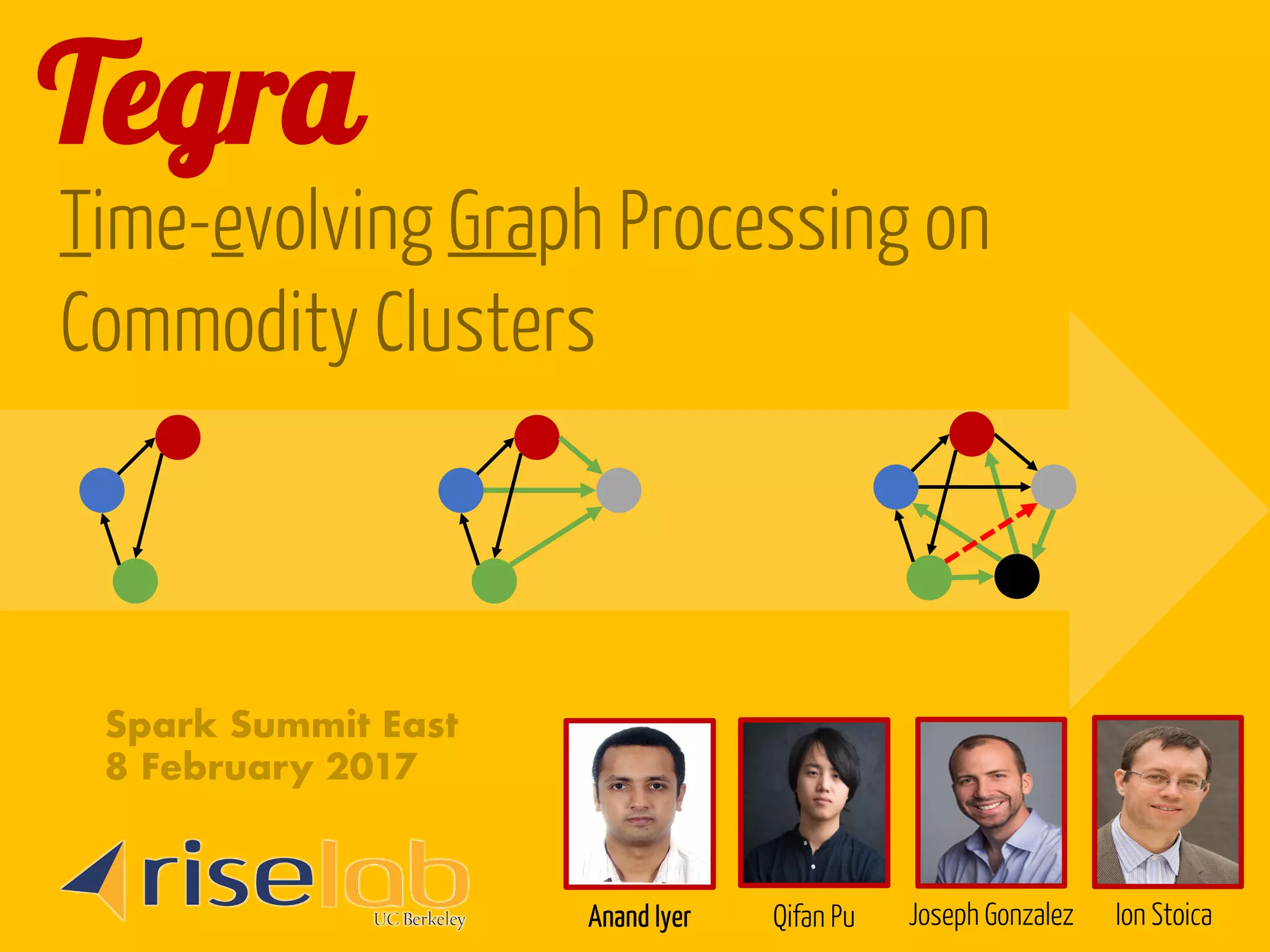
Tegra
Time-evolving Graph Processing on
Commodity Clusters
Anand Iyer Joseph GonzalezQifan Pu Ion Stoica
Spark Summit East
8 February 2017
About Me
1
• PhD Candidate at AMP/RISE Lab at UC Berkeley
• Thesis on time-evolving graph processing
• Previous work:
• Collaborative energy diagnosis for smartphones
(carat.cs.berkeley.edu)
• Approximate query processing (BlinkDB)
• Cellular Network Analytics
• Fundamental trade-offs in applying ML to real-time datasets
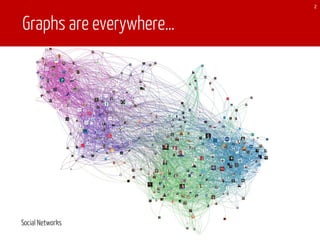
Graphs are everywhere…
Social Networks
2
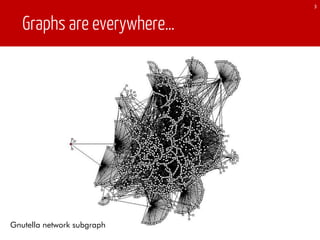
Graphs are everywhere…
Gnutella network subgraph
3
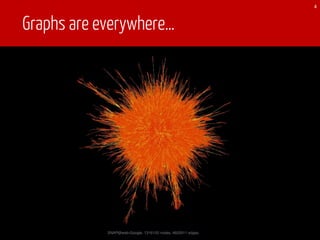
Graphs are everywhere…
4
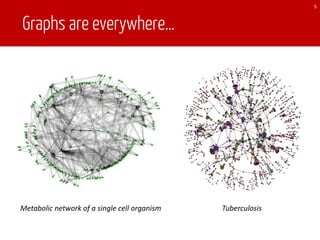
Graphs are everywhere…
Metabolic	network	of	a	single	cell	organism Tuberculosis
5
Plenty of interest in processing them
• Graph DBMS 25% of all enterprises by end of 20171
• Many open-source and research prototypes on distributed graph
processing frameworks: Giraph, Pregel, GraphLab, GraphX, …
1Forrester Research
6
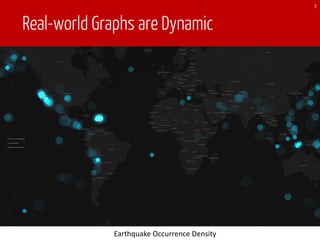
Real-world Graphs are Dynamic
Earthquake	Occurrence	Density
7
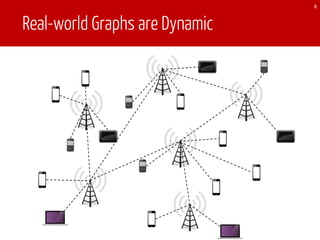
Real-world Graphs are Dynamic
8
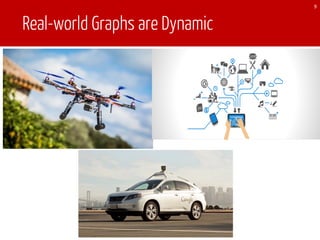
Real-world Graphs are Dynamic
9
Processing Time-evolving Graphs
Many interesting business and research insights
possible by processing such dynamic graphs…
10
… little or no work in supporting such workloads in
existing graph-processing frameworks
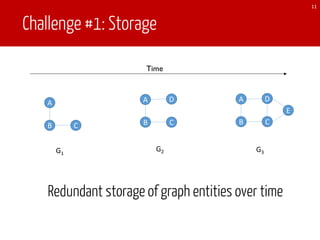
Challenge #1: Storage
11
Time
A
B C
G1
A
B C
D
G2
Redundant storage of graph entities over time
A
B C
D
E
G3
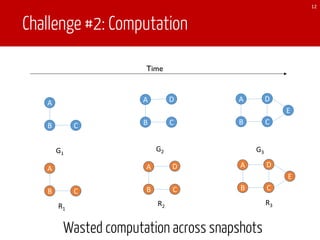
Challenge #2: Computation
12
A
B C
R1
A
B C
D
E
R3
Wasted computation across snapshots
Time
A
B C
G1
A
B C
D
G2
A
B C
D
E
G3
A
B C
D
R2
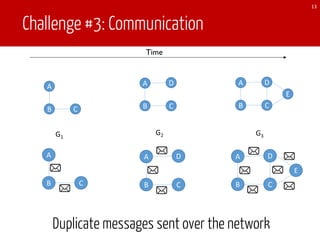
Challenge #3: Communication
13
A
B C
A
B C
D A
B C
D
E
Time
A
B C
G1
A
B C
D
G2
A
B C
D
E
G3
Duplicate messages sent over the network
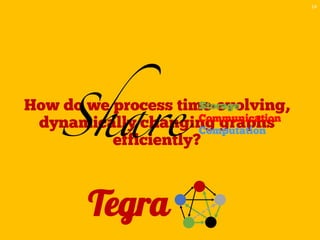
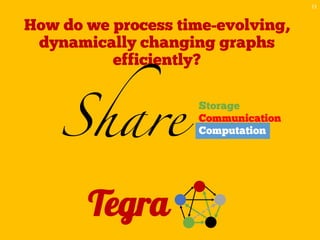
How do we process time-evolving,
dynamically changing graphs
efficiently?
14
Share
Storage
Communication
Computation
Tegra
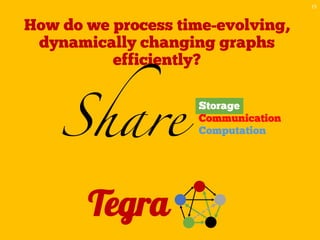
How do we process time-evolving,
dynamically changing graphs
efficiently?
15
Share
Storage
Communication
Computation
Tegra
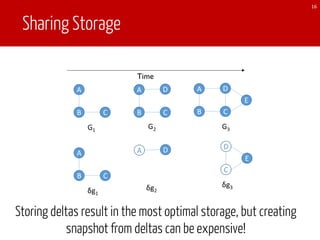
Sharing Storage
16
Time
A
B C
G1
A
B C
δg1
A D
δg2
A
B C
D
G2
A
B C
D
E
G3
C
D
E
δg3
Storing deltas result in the most optimal storage, but creating
snapshot from deltas can be expensive!
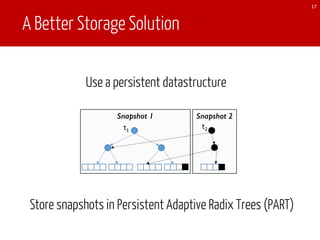
A Better Storage Solution
17
Snapshot 2Snapshot 1
t1
t2
Use a persistent datastructure
Store snapshots in Persistent Adaptive Radix Trees (PART)
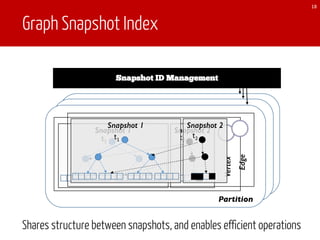
Graph Snapshot Index
18
Snapshot 2Snapshot 1
Vertex
t1
t2
Snapshot 2Snapshot 1
t1
t2
Edge
Partition
Snapshot ID Management
Shares structure between snapshots, and enables efficient operations
How do we process time-evolving,
dynamically changing graphs
efficiently?
19
Share
Storage
Communication
Computation
Tegra
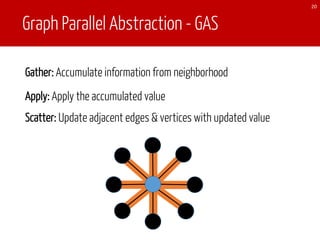
Graph Parallel Abstraction - GAS
Gather: Accumulate information from neighborhood
20
Apply: Apply the accumulated value
Scatter: Update adjacent edges & vertices with updated value
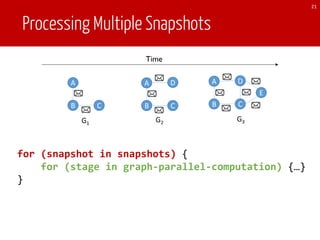
Processing Multiple Snapshots
21
for (snapshot in snapshots) {
for (stage in graph-parallel-computation) {…}
}
A
B C
A
B C
D A
B C
D
E
Time
G1 G2
G3
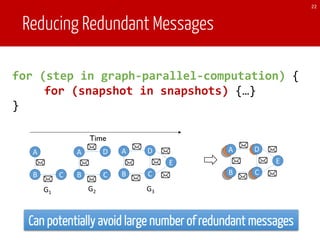
Reducing Redundant Messages
22
A
B C
A
B C
D A
B C
D
E
Time
G1
G2 G3
D
BCBA
AAA
B C
D
E
for (step in graph-parallel-computation) {
for (snapshot in snapshots) {…}
}
Can potentially avoid large number of redundant messages
How do we process time-evolving,
dynamically changing graphs
efficiently?
23
Share
Storage
Communication
Computation
Tegra
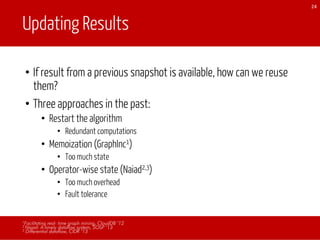
Updating Results
• If result from a previous snapshot is available, how can we reuse
them?
• Three approaches in the past:
• Restart the algorithm
• Redundant computations
• Memoization (GraphInc1)
• Too much state
• Operator-wise state (Naiad2,3)
• Too much overhead
• Fault tolerance
24
1Facilitating real- time graph mining, CloudDB ’12
2 Naiad: A timely dataflow system, SOSP ’13
3 Differential dataflow, CIDR ‘13
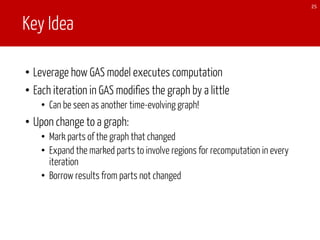
Key Idea
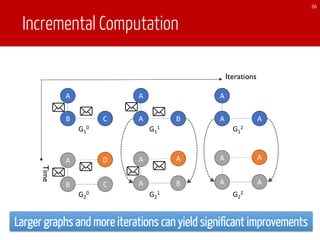
• Leverage how GAS model executes computation
• Each iteration in GAS modifies the graph by a little
• Can be seen as another time-evolving graph!
• Upon change to a graph:
• Mark parts of the graph that changed
• Expand the marked parts to involve regions for recomputation in every
iteration
• Borrow results from parts not changed
25
Incremental Computation
26
A
B C
D
Iterations
Time
A
A B
A A
A A
A
G1
0 G1
1 G1
2
G2
2
A
B C
A
A B
A
A A
G2
0 G2
1
Larger graphs and more iterations can yield significant improvements
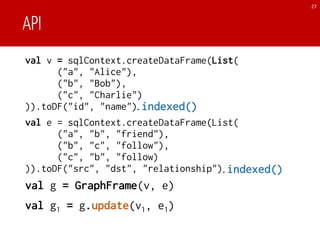
API
val v = sqlContext.createDataFrame(List(
("a", "Alice"),
("b", "Bob"),
("c", "Charlie")
)).toDF("id", "name")
val e = sqlContext.createDataFrame(List(
("a", "b", "friend"),
("b", "c", "follow"),
("c", "b", "follow)
)).toDF("src", "dst", "relationship")
val g = GraphFrame(v, e)
27
val g1 = g.update(v1, e1)
.indexed()
.indexed()
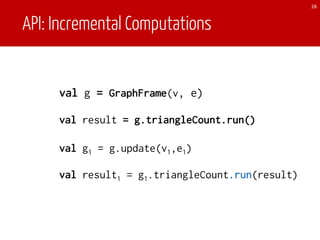
API: Incremental Computations
val g = GraphFrame(v, e)
28
val g1 = g.update(v1,e1)
val result1 = g1.triangleCount.run(result)
val result = g.triangleCount.run()
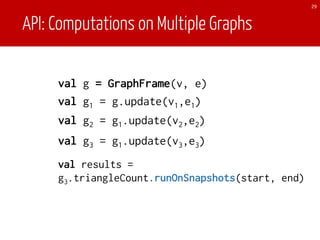
API: Computations on Multiple Graphs
val g = GraphFrame(v, e)
val g1 = g.update(v1,e1)
29
val g2 = g1.update(v2,e2)
val g3 = g1.update(v3,e3)
val results =
g3.triangleCount.runOnSnapshots(start, end)
API
30
B C
A D
F E
A DD
B C
D
E
AA
F
Transition
After 11 iteration on graph 2,
Both converge to 3-digit precision
1.224
0.8490.502
2.07
0.8490.502
he benefit of PSR computation.
For each iteration of Pregel,
y of a new graph. When it
ations on the current graph,
he new graph after copying
The new computation will
w active set continue message
s a function of the old active
n the new graph and the old
lgorithms (e.g. incremental
ve set includes vertices from
w vertices and vertices with
class Graph[V, E] {
// Collection views
def vertices(sid: Int): Collection[(Id, V)]
def edges(sid: Int): Collection[(Id, Id, E)]
def triplets(sid: Int): Collection[Triplet]
// Graph-parallel computation
def mrTriplets(f: (Triplet) => M,
sum: (M, M) => M,
sids: Array[Int]): Collection[(Int, Id, M)]
// Convenience functions
def mapV(f: (Id, V) => V,
sids: Array[Int]): Graph[V, E]
def mapE(f: (Id, Id, E) => E
sids: Array[Int]): Graph[V, E]
def leftJoinV(v: Collection[(Id, V)],
f: (Id, V, V) => V,
sids: Array[Int]): Graph[V, E]
def leftJoinE(e: Collection[(Id, Id, E)],
f: (Id, Id, E, E) => E,
sids: Array[Int]): Graph[V, E]
def subgraph(vPred: (Id, V) => Boolean,
ePred: (Triplet) => Boolean,
sids: Array[Int]): Graph[V, E]
def reverse(sids: Array[Int]): Graph[V, E]
}
Listing 3: GraphX [24] operators modified to support Tegra’s
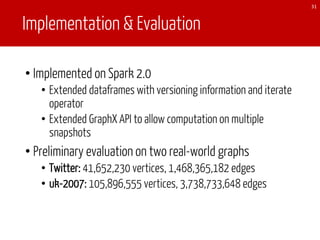
Implementation & Evaluation
• Implemented on Spark 2.0
• Extended dataframes with versioning information and iterate
operator
• Extended GraphX API to allow computation on multiple
snapshots
• Preliminary evaluation on two real-world graphs
• Twitter: 41,652,230 vertices, 1,468,365,182 edges
• uk-2007: 105,896,555 vertices, 3,738,733,648 edges
31
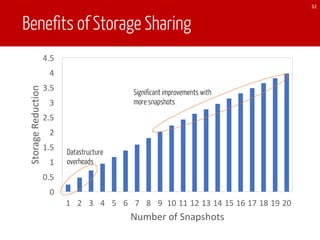
0
0.5
1
1.5
2
2.5
3
3.5
4
4.5
1 2 3 4 5 6 7 8 9 10 11 12 13 14 15 16 17 18 19 20
Storage	Reduction
Number	of	Snapshots
Benefits of Storage Sharing
32
Datastructure
overheads
Significant improvements with
more snapshots
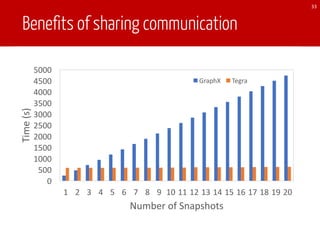
Benefits of sharing communication
33
0
500
1000
1500
2000
2500
3000
3500
4000
4500
5000
1 2 3 4 5 6 7 8 9 10 11 12 13 14 15 16 17 18 19 20
Time	(s)
Number	of	Snapshots
GraphX Tegra
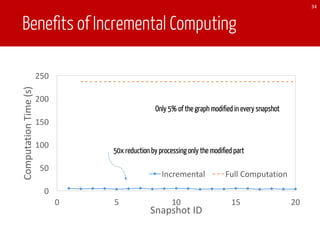
Benefits of Incremental Computing
34
0
50
100
150
200
250
0 5 10 15 20
Computation	Time	(s)
Snapshot	ID	
Incremental Full	Computation
Only 5% of the graph modified in every snapshot
50x reduction by processing only the modified part
Ongoing/Future Work
• Tight(er) integration with Catalyst
• Tungsten improvements
• Code release
• Incremental pattern matching
• Approximate graph analytics
• Geo-distributed graph analytics
35
Summary
• Processing time-evolving graph efficiently can be useful
• Sharing storage, computation and communication key to efficient
time-evolving graph analysis
• We proposed Tegra that implements our ideas
Please talk to us about your interesting use-cases!
api@cs.berkeley.edu
www.cs.berkeley.edu/~api
36

Time-evolving Graph Processing on Commodity Clusters: Spark Summit East talk by Anand Iyer

  • 1.
    Tegra Time-evolving Graph Processingon Commodity Clusters Anand Iyer Joseph GonzalezQifan Pu Ion Stoica Spark Summit East 8 February 2017
  • 2.
    About Me 1 • PhDCandidate at AMP/RISE Lab at UC Berkeley • Thesis on time-evolving graph processing • Previous work: • Collaborative energy diagnosis for smartphones (carat.cs.berkeley.edu) • Approximate query processing (BlinkDB) • Cellular Network Analytics • Fundamental trade-offs in applying ML to real-time datasets
  • 3.
  • 4.
  • 5.
  • 6.
  • 7.
    Plenty of interestin processing them • Graph DBMS 25% of all enterprises by end of 20171 • Many open-source and research prototypes on distributed graph processing frameworks: Giraph, Pregel, GraphLab, GraphX, … 1Forrester Research 6
  • 8.
    Real-world Graphs areDynamic Earthquake Occurrence Density 7
  • 9.
  • 10.
  • 11.
    Processing Time-evolving Graphs Manyinteresting business and research insights possible by processing such dynamic graphs… 10 … little or no work in supporting such workloads in existing graph-processing frameworks
  • 12.
    Challenge #1: Storage 11 Time A BC G1 A B C D G2 Redundant storage of graph entities over time A B C D E G3
  • 13.
    Challenge #2: Computation 12 A BC R1 A B C D E R3 Wasted computation across snapshots Time A B C G1 A B C D G2 A B C D E G3 A B C D R2
  • 14.
    Challenge #3: Communication 13 A BC A B C D A B C D E Time A B C G1 A B C D G2 A B C D E G3 Duplicate messages sent over the network
  • 15.
    How do weprocess time-evolving, dynamically changing graphs efficiently? 14 Share Storage Communication Computation Tegra
  • 16.
    How do weprocess time-evolving, dynamically changing graphs efficiently? 15 Share Storage Communication Computation Tegra
  • 17.
    Sharing Storage 16 Time A B C G1 A BC δg1 A D δg2 A B C D G2 A B C D E G3 C D E δg3 Storing deltas result in the most optimal storage, but creating snapshot from deltas can be expensive!
  • 18.
    A Better StorageSolution 17 Snapshot 2Snapshot 1 t1 t2 Use a persistent datastructure Store snapshots in Persistent Adaptive Radix Trees (PART)
  • 19.
    Graph Snapshot Index 18 Snapshot2Snapshot 1 Vertex t1 t2 Snapshot 2Snapshot 1 t1 t2 Edge Partition Snapshot ID Management Shares structure between snapshots, and enables efficient operations
  • 20.
    How do weprocess time-evolving, dynamically changing graphs efficiently? 19 Share Storage Communication Computation Tegra
  • 21.
    Graph Parallel Abstraction- GAS Gather: Accumulate information from neighborhood 20 Apply: Apply the accumulated value Scatter: Update adjacent edges & vertices with updated value
  • 22.
    Processing Multiple Snapshots 21 for(snapshot in snapshots) { for (stage in graph-parallel-computation) {…} } A B C A B C D A B C D E Time G1 G2 G3
  • 23.
    Reducing Redundant Messages 22 A BC A B C D A B C D E Time G1 G2 G3 D BCBA AAA B C D E for (step in graph-parallel-computation) { for (snapshot in snapshots) {…} } Can potentially avoid large number of redundant messages
  • 24.
    How do weprocess time-evolving, dynamically changing graphs efficiently? 23 Share Storage Communication Computation Tegra
  • 25.
    Updating Results • Ifresult from a previous snapshot is available, how can we reuse them? • Three approaches in the past: • Restart the algorithm • Redundant computations • Memoization (GraphInc1) • Too much state • Operator-wise state (Naiad2,3) • Too much overhead • Fault tolerance 24 1Facilitating real- time graph mining, CloudDB ’12 2 Naiad: A timely dataflow system, SOSP ’13 3 Differential dataflow, CIDR ‘13
  • 26.
    Key Idea • Leveragehow GAS model executes computation • Each iteration in GAS modifies the graph by a little • Can be seen as another time-evolving graph! • Upon change to a graph: • Mark parts of the graph that changed • Expand the marked parts to involve regions for recomputation in every iteration • Borrow results from parts not changed 25
  • 27.
    Incremental Computation 26 A B C D Iterations Time A AB A A A A A G1 0 G1 1 G1 2 G2 2 A B C A A B A A A G2 0 G2 1 Larger graphs and more iterations can yield significant improvements
  • 28.
    API val v =sqlContext.createDataFrame(List( ("a", "Alice"), ("b", "Bob"), ("c", "Charlie") )).toDF("id", "name") val e = sqlContext.createDataFrame(List( ("a", "b", "friend"), ("b", "c", "follow"), ("c", "b", "follow) )).toDF("src", "dst", "relationship") val g = GraphFrame(v, e) 27 val g1 = g.update(v1, e1) .indexed() .indexed()
  • 29.
    API: Incremental Computations valg = GraphFrame(v, e) 28 val g1 = g.update(v1,e1) val result1 = g1.triangleCount.run(result) val result = g.triangleCount.run()
  • 30.
    API: Computations onMultiple Graphs val g = GraphFrame(v, e) val g1 = g.update(v1,e1) 29 val g2 = g1.update(v2,e2) val g3 = g1.update(v3,e3) val results = g3.triangleCount.runOnSnapshots(start, end)
  • 31.
    API 30 B C A D FE A DD B C D E AA F Transition After 11 iteration on graph 2, Both converge to 3-digit precision 1.224 0.8490.502 2.07 0.8490.502 he benefit of PSR computation. For each iteration of Pregel, y of a new graph. When it ations on the current graph, he new graph after copying The new computation will w active set continue message s a function of the old active n the new graph and the old lgorithms (e.g. incremental ve set includes vertices from w vertices and vertices with class Graph[V, E] { // Collection views def vertices(sid: Int): Collection[(Id, V)] def edges(sid: Int): Collection[(Id, Id, E)] def triplets(sid: Int): Collection[Triplet] // Graph-parallel computation def mrTriplets(f: (Triplet) => M, sum: (M, M) => M, sids: Array[Int]): Collection[(Int, Id, M)] // Convenience functions def mapV(f: (Id, V) => V, sids: Array[Int]): Graph[V, E] def mapE(f: (Id, Id, E) => E sids: Array[Int]): Graph[V, E] def leftJoinV(v: Collection[(Id, V)], f: (Id, V, V) => V, sids: Array[Int]): Graph[V, E] def leftJoinE(e: Collection[(Id, Id, E)], f: (Id, Id, E, E) => E, sids: Array[Int]): Graph[V, E] def subgraph(vPred: (Id, V) => Boolean, ePred: (Triplet) => Boolean, sids: Array[Int]): Graph[V, E] def reverse(sids: Array[Int]): Graph[V, E] } Listing 3: GraphX [24] operators modified to support Tegra’s
  • 32.
    Implementation & Evaluation •Implemented on Spark 2.0 • Extended dataframes with versioning information and iterate operator • Extended GraphX API to allow computation on multiple snapshots • Preliminary evaluation on two real-world graphs • Twitter: 41,652,230 vertices, 1,468,365,182 edges • uk-2007: 105,896,555 vertices, 3,738,733,648 edges 31
  • 33.
    0 0.5 1 1.5 2 2.5 3 3.5 4 4.5 1 2 34 5 6 7 8 9 10 11 12 13 14 15 16 17 18 19 20 Storage Reduction Number of Snapshots Benefits of Storage Sharing 32 Datastructure overheads Significant improvements with more snapshots
  • 34.
    Benefits of sharingcommunication 33 0 500 1000 1500 2000 2500 3000 3500 4000 4500 5000 1 2 3 4 5 6 7 8 9 10 11 12 13 14 15 16 17 18 19 20 Time (s) Number of Snapshots GraphX Tegra
  • 35.
    Benefits of IncrementalComputing 34 0 50 100 150 200 250 0 5 10 15 20 Computation Time (s) Snapshot ID Incremental Full Computation Only 5% of the graph modified in every snapshot 50x reduction by processing only the modified part
  • 36.
    Ongoing/Future Work • Tight(er)integration with Catalyst • Tungsten improvements • Code release • Incremental pattern matching • Approximate graph analytics • Geo-distributed graph analytics 35
  • 37.
    Summary • Processing time-evolvinggraph efficiently can be useful • Sharing storage, computation and communication key to efficient time-evolving graph analysis • We proposed Tegra that implements our ideas Please talk to us about your interesting use-cases! api@cs.berkeley.edu www.cs.berkeley.edu/~api 36