SPARK SUMMIT
EUROPE2016
MENTOR AND MENTEE RELATIONS
BASED ON AUTHORSHIP GRAPHS
Reza Karimi
Elsevier
Outline
• Introduction:
– Elsevier and Scopus Data
• Mentorship Model
• Training and Validation
• (Big) Graph Visualization (in Spark)
Who are we?
• Elsevier: the #1 provider of scientific, technical, and medical
information, and a technology company originally established
in 1880 in Netherlands. Now part of RELX group.
• Privileged to publish about 25% of cited (what matters)
scientific publications
• Publishing 400K articles per year in about 2500 journals such
as Lancet, Cell, Trends, Current Opinions, Artificial Intelligence
(generally accessed via ScienceDirect platform (about 900m
full text download per year)
• Curating Scientific publication data in products such as
Scopus, SciVal, Pure
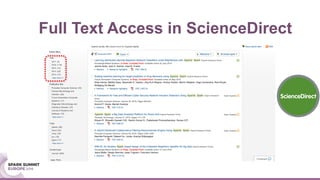
Full Text Access in ScienceDirect
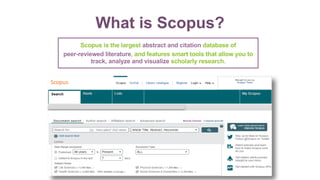
Scopus is the largest abstract and citation database of
peer-reviewed literature, and features smart tools that allow you to
track, analyze and visualize scholarly research.
What is Scopus?
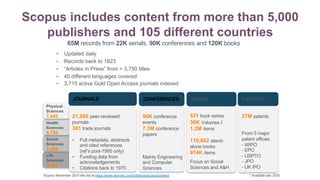
Scopus includes content from more than 5,000
publishers and 105 different countries
21,568 peer-reviewed
journals
361 trade journals
• Full metadata, abstracts
and cited references
(ref’s post-1995 only)
• Funding data from
acknowledgements
• Citations back to 1970
Physical
Sciences
7,443
Health
Sciences
6,795
Social
Sciences
8,086
Life
Sciences
4,492
90K conference
events
7.3M conference
papers
Mainly Engineering
and Computer
Sciences
531 book series
30K Volumes /
1.2M items
119,882 stand-
alone books
974K items
Focus on Social
Sciences and A&H
65M records from 22K serials, 90K conferences and 120K books
• Updated daily
• Records back to 1823
• “Articles in Press” from > 3,750 titles
• 40 different languages covered
• 3,715 active Gold Open Access journals indexed
BOOKSCONFERENCES
Source: November 2015 title list at https://www.elsevier.com/solutions/scopus/content * Available late 2016
JOURNALS
27M patents
From 5 major
patent offices
- WIPO
- EPO
- USPTO
- JPO
- UK IPO
PATENTS*
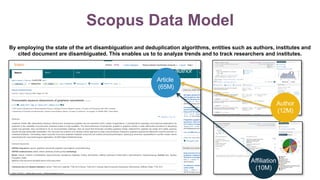
Scopus Data Model
By employing the state of the art disambiguation and deduplication algorithms, entities such as authors, institutes and
cited document are disambiguated. This enables us to to analyze trends and to track researchers and institutes.
author
affiliation
Article
(65M)
Author
(12M)
Affiliation
(10M)
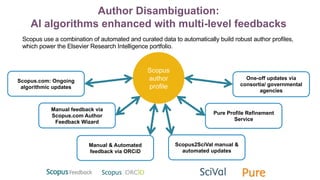
Author Disambiguation:
AI algorithms enhanced with multi-level feedbacks
Scopus use a combination of automated and curated data to automatically build robust author profiles,
which power the Elsevier Research Intelligence portfolio.
Scopus
author
profile
Scopus.com: Ongoing
algorithmic updates
Manual feedback via
Scopus.com Author
Feedback Wizard
Pure Profile Refinement
Service
Scopus2SciVal manual &
automated updates
Manual & Automated
feedback via ORCiD
One-off updates via
consortia/ governmental
agencies
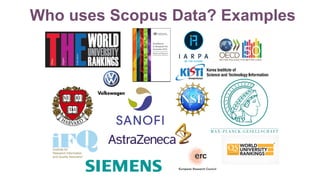
Who uses Scopus Data? Examples
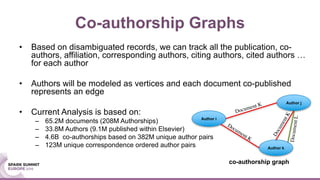
Co-authorship Graphs
• Based on disambiguated records, we can track all the publication, co-
authors, affiliation, corresponding authors, citing authors, cited authors …
for each author
• Authors will be modeled as vertices and each document co-published
represents an edge
• Current Analysis is based on:
– 65.2M documents (208M Authorships)
– 33.8M Authors (9.1M published within Elsevier)
– 4.6B co-authorships based on 382M unique author pairs
– 123M unique correspondence ordered author pairs
Author i
Author j
Author k
co-authorship graph
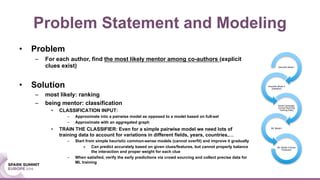
Problem Statement and Modeling
• Problem
– For each author, find the most likely mentor among co-authors (explicit
clues exist)
• Solution
– most likely: ranking
– being mentor: classification
• CLASSIFICATION INPUT:
– Approximate into a pairwise model as opposed to a model based on full-set
– Approximate with an aggregated graph
• TRAIN THE CLASSIFIER: Even for a simple pairwise model we need lots of
training data to account for variations in different fields, years, countries,…
– Start from simple heuristic common-sense models (cannot overfit) and improve it gradually
» Can predict accurately based on given clues/features, but cannot properly balance
the interaction and proper weight for each clue
– When satisfied, verify the early predictions via crowd sourcing and collect precise data for
ML training
Heuristic Mode I
Heuristic Mode II
(baseline)
Email Campaign
(Crowd Sourcing
Training Data)
ML Model I
ML Model II (Extra
Features)
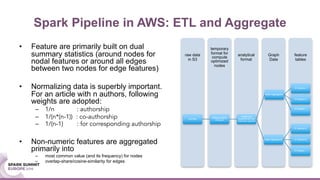
Spark Pipeline in AWS: ETL and Aggregate
feature
tables
Graph
Data
analytical
format
temporary
format for
compute
optimized
nodes
raw data
in S3
xml files
Selected fields
into json
sorted and
repartitioned into
columnar parquet
Node Aggregation
N Feature I
N Feature II
N Feature ...
Edge Aggregation
E Feature A
E Feature B
E Feature ...
• Feature are primarily built on dual
summary statistics (around nodes for
nodal features or around all edges
between two nodes for edge features)
• Normalizing data is superbly important.
For an article with n authors, following
weights are adopted:
– 1/n : authorship
– 1/(n*(n-1)) : co-authorship
– 1/(n-1) : for corresponding authorship
• Non-numeric features are aggregated
primarily into
– most common value (and its frequency) for nodes
– overlap-share/cosine-similarity for edges
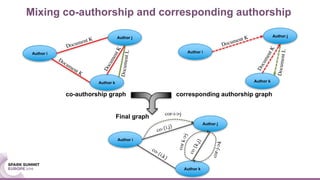
Mixing co-authorship and corresponding authorship
Author i
Author j
Author k
corresponding authorship graph
Author i
Author j
Author k
Final graph
co-authorship graph
Author i
Author j
Author k
cor-i->j
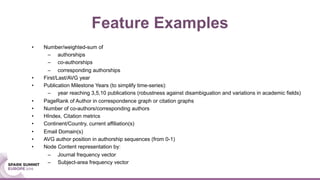
Feature Examples
• Number/weighted-sum of
– authorships
– co-authorships
– corresponding authorships
• First/Last/AVG year
• Publication Milestone Years (to simplify time-series):
– year reaching 3,5,10 publications (robustness against disambiguation and variations in academic fields)
• PageRank of Author in correspondence graph or citation graphs
• Number of co-authors/corresponding authors
• HIndex, Citation metrics
• Continent/Country, current affiliation(s)
• Email Domain(s)
• AVG author position in authorship sequences (from 0-1)
• Node Content representation by:
– Journal frequency vector
– Subject-area frequency vector
1. Apply mentorship to each edge
2. Rank co-authors based on their mentorship score and pick up the best score as the
candidate mentor
3. Create the mentorship graph (batch process):
1. Look for loops of length L (L=2,3,4,…)
2. Break loops by the weakest link and replace that link with the next mentor candidate
3. Go back to step 2 and if no loop found increase L
4. Create academic family-trees (for select authors):
can locally break loops of bigger lengths (such as L=7)
graph=GraphFrame(vertices, edges)
paths =graph.find("(a1)-[e]->(a2)")
paths.rdd.map(mentorship).toDF().write.format('parquet').mode('overwrite').saveAsTable(…)
Applying Pairwise Model
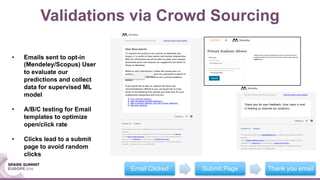
Validations via Crowd Sourcing
• Emails sent to opt-in
(Mendeley/Scopus) User
to evaluate our
predictions and collect
data for supervised ML
model
• A/B/C testing for Email
templates to optimize
open/click rate
• Clicks lead to a submit
page to avoid random
clicks
Email Clicked Submit Page Thank you email
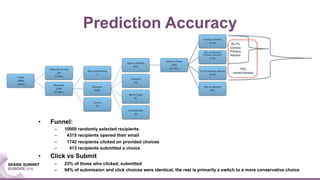
• Funnel:
– 10000 randomly selected recipients
– 4315 recipients opened their email
– 1742 recipients clicked on provided choices
– 413 recipients submitted a choice
• Click vs Submit
– 23% of those who clicked, submitted
– 94% of submission and click choices were identical, the rest is primarily a switch to a more conservative choice
Prediction Accuracy
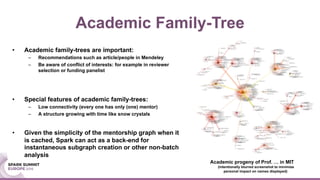
• Academic family-trees are important:
– Recommendations such as article/people in Mendeley
– Be aware of conflict of interests: for example in reviewer
selection or funding panelist
• Special features of academic family-trees:
– Low connectivity (every one has only (one) mentor)
– A structure growing with time like snow crystals
• Given the simplicity of the mentorship graph when it
is cached, Spark can act as a back-end for
instantaneous subgraph creation or other non-batch
analysis
Academic Family-Tree
Academic progeny of Prof. … in MIT
(intentionally blurred screenshot to minimize
personal impact on names displayed)
• To visualize (big) graphs in Spark application we need two components:
1. Sub-Graph creation: it would not be possible to visualize all edge/nodes, especially for highly
connected graphs such as:
1. co-authorships
2. journal to journal citation
3. institute to institute citation
To select a limited set of node/edges, filter or GraphFrame queries can help. They work great, if the
sub-graph can be obtained by some global filters (such as n-top strongest edges). However, we
had to make substantial development to cover sub-graphs centered around a given node. The
local sub-graph creation was extended by our library via customized development in line with data-frame
operations.
2. Visualization library: Adopted D3.js and displayHTML to visualize (Edges, Vertices) Dataframes
interactively. The library recognizes following elements:
– Directed Graphs (such as citation) including self referral edges or non-directed graphs (such as co-authorship)
displayed with or without arrows
– size, colors based on continuous/categorical data, line type for edges and nodes
– Line types
(Big) Graph Visualization (by Spark)
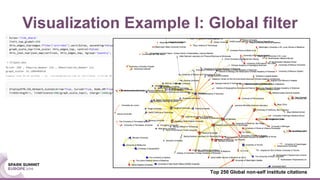
Visualization Example I: Global filter
Top 250 Global non-self institute citations
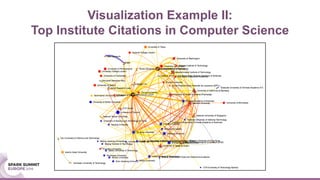
Visualization Example II:
Top Institute Citations in Computer Science
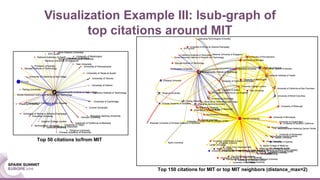
Visualization Example III: lsub-graph of
top citations around MIT
Top 50 citations to/from MIT
Top 150 citations for MIT or top MIT neighbors (distance_max=2)
SPARK SUMMIT
EUROPE2016
THANK YOU.
Feel free to reach me for further information or if
interested to join our team:
r.karimi@elsevier.com
Acknowledgment:
Bob Schijvenaars, Antonio Gulli, Darin McBeath, Daul Trevor,
and Elsevier members in BOS/Labs/Scopus teams

Spark Summit EU talk by Reza Karimi

  • 1.
    SPARK SUMMIT EUROPE2016 MENTOR ANDMENTEE RELATIONS BASED ON AUTHORSHIP GRAPHS Reza Karimi Elsevier
  • 2.
    Outline • Introduction: – Elsevierand Scopus Data • Mentorship Model • Training and Validation • (Big) Graph Visualization (in Spark)
  • 3.
    Who are we? •Elsevier: the #1 provider of scientific, technical, and medical information, and a technology company originally established in 1880 in Netherlands. Now part of RELX group. • Privileged to publish about 25% of cited (what matters) scientific publications • Publishing 400K articles per year in about 2500 journals such as Lancet, Cell, Trends, Current Opinions, Artificial Intelligence (generally accessed via ScienceDirect platform (about 900m full text download per year) • Curating Scientific publication data in products such as Scopus, SciVal, Pure
  • 4.
    Full Text Accessin ScienceDirect
  • 5.
    Scopus is thelargest abstract and citation database of peer-reviewed literature, and features smart tools that allow you to track, analyze and visualize scholarly research. What is Scopus?
  • 6.
    Scopus includes contentfrom more than 5,000 publishers and 105 different countries 21,568 peer-reviewed journals 361 trade journals • Full metadata, abstracts and cited references (ref’s post-1995 only) • Funding data from acknowledgements • Citations back to 1970 Physical Sciences 7,443 Health Sciences 6,795 Social Sciences 8,086 Life Sciences 4,492 90K conference events 7.3M conference papers Mainly Engineering and Computer Sciences 531 book series 30K Volumes / 1.2M items 119,882 stand- alone books 974K items Focus on Social Sciences and A&H 65M records from 22K serials, 90K conferences and 120K books • Updated daily • Records back to 1823 • “Articles in Press” from > 3,750 titles • 40 different languages covered • 3,715 active Gold Open Access journals indexed BOOKSCONFERENCES Source: November 2015 title list at https://www.elsevier.com/solutions/scopus/content * Available late 2016 JOURNALS 27M patents From 5 major patent offices - WIPO - EPO - USPTO - JPO - UK IPO PATENTS*
  • 7.
    Scopus Data Model Byemploying the state of the art disambiguation and deduplication algorithms, entities such as authors, institutes and cited document are disambiguated. This enables us to to analyze trends and to track researchers and institutes. author affiliation Article (65M) Author (12M) Affiliation (10M)
  • 8.
    Author Disambiguation: AI algorithmsenhanced with multi-level feedbacks Scopus use a combination of automated and curated data to automatically build robust author profiles, which power the Elsevier Research Intelligence portfolio. Scopus author profile Scopus.com: Ongoing algorithmic updates Manual feedback via Scopus.com Author Feedback Wizard Pure Profile Refinement Service Scopus2SciVal manual & automated updates Manual & Automated feedback via ORCiD One-off updates via consortia/ governmental agencies
  • 9.
    Who uses ScopusData? Examples
  • 10.
    Co-authorship Graphs • Basedon disambiguated records, we can track all the publication, co- authors, affiliation, corresponding authors, citing authors, cited authors … for each author • Authors will be modeled as vertices and each document co-published represents an edge • Current Analysis is based on: – 65.2M documents (208M Authorships) – 33.8M Authors (9.1M published within Elsevier) – 4.6B co-authorships based on 382M unique author pairs – 123M unique correspondence ordered author pairs Author i Author j Author k co-authorship graph
  • 11.
    Problem Statement andModeling • Problem – For each author, find the most likely mentor among co-authors (explicit clues exist) • Solution – most likely: ranking – being mentor: classification • CLASSIFICATION INPUT: – Approximate into a pairwise model as opposed to a model based on full-set – Approximate with an aggregated graph • TRAIN THE CLASSIFIER: Even for a simple pairwise model we need lots of training data to account for variations in different fields, years, countries,… – Start from simple heuristic common-sense models (cannot overfit) and improve it gradually » Can predict accurately based on given clues/features, but cannot properly balance the interaction and proper weight for each clue – When satisfied, verify the early predictions via crowd sourcing and collect precise data for ML training Heuristic Mode I Heuristic Mode II (baseline) Email Campaign (Crowd Sourcing Training Data) ML Model I ML Model II (Extra Features)
  • 12.
    Spark Pipeline inAWS: ETL and Aggregate feature tables Graph Data analytical format temporary format for compute optimized nodes raw data in S3 xml files Selected fields into json sorted and repartitioned into columnar parquet Node Aggregation N Feature I N Feature II N Feature ... Edge Aggregation E Feature A E Feature B E Feature ... • Feature are primarily built on dual summary statistics (around nodes for nodal features or around all edges between two nodes for edge features) • Normalizing data is superbly important. For an article with n authors, following weights are adopted: – 1/n : authorship – 1/(n*(n-1)) : co-authorship – 1/(n-1) : for corresponding authorship • Non-numeric features are aggregated primarily into – most common value (and its frequency) for nodes – overlap-share/cosine-similarity for edges
  • 13.
    Mixing co-authorship andcorresponding authorship Author i Author j Author k corresponding authorship graph Author i Author j Author k Final graph co-authorship graph Author i Author j Author k cor-i->j
  • 14.
    Feature Examples • Number/weighted-sumof – authorships – co-authorships – corresponding authorships • First/Last/AVG year • Publication Milestone Years (to simplify time-series): – year reaching 3,5,10 publications (robustness against disambiguation and variations in academic fields) • PageRank of Author in correspondence graph or citation graphs • Number of co-authors/corresponding authors • HIndex, Citation metrics • Continent/Country, current affiliation(s) • Email Domain(s) • AVG author position in authorship sequences (from 0-1) • Node Content representation by: – Journal frequency vector – Subject-area frequency vector
  • 15.
    1. Apply mentorshipto each edge 2. Rank co-authors based on their mentorship score and pick up the best score as the candidate mentor 3. Create the mentorship graph (batch process): 1. Look for loops of length L (L=2,3,4,…) 2. Break loops by the weakest link and replace that link with the next mentor candidate 3. Go back to step 2 and if no loop found increase L 4. Create academic family-trees (for select authors): can locally break loops of bigger lengths (such as L=7) graph=GraphFrame(vertices, edges) paths =graph.find("(a1)-[e]->(a2)") paths.rdd.map(mentorship).toDF().write.format('parquet').mode('overwrite').saveAsTable(…) Applying Pairwise Model
  • 16.
    Validations via CrowdSourcing • Emails sent to opt-in (Mendeley/Scopus) User to evaluate our predictions and collect data for supervised ML model • A/B/C testing for Email templates to optimize open/click rate • Clicks lead to a submit page to avoid random clicks Email Clicked Submit Page Thank you email
  • 17.
    • Funnel: – 10000randomly selected recipients – 4315 recipients opened their email – 1742 recipients clicked on provided choices – 413 recipients submitted a choice • Click vs Submit – 23% of those who clicked, submitted – 94% of submission and click choices were identical, the rest is primarily a switch to a more conservative choice Prediction Accuracy
  • 18.
    • Academic family-treesare important: – Recommendations such as article/people in Mendeley – Be aware of conflict of interests: for example in reviewer selection or funding panelist • Special features of academic family-trees: – Low connectivity (every one has only (one) mentor) – A structure growing with time like snow crystals • Given the simplicity of the mentorship graph when it is cached, Spark can act as a back-end for instantaneous subgraph creation or other non-batch analysis Academic Family-Tree Academic progeny of Prof. … in MIT (intentionally blurred screenshot to minimize personal impact on names displayed)
  • 19.
    • To visualize(big) graphs in Spark application we need two components: 1. Sub-Graph creation: it would not be possible to visualize all edge/nodes, especially for highly connected graphs such as: 1. co-authorships 2. journal to journal citation 3. institute to institute citation To select a limited set of node/edges, filter or GraphFrame queries can help. They work great, if the sub-graph can be obtained by some global filters (such as n-top strongest edges). However, we had to make substantial development to cover sub-graphs centered around a given node. The local sub-graph creation was extended by our library via customized development in line with data-frame operations. 2. Visualization library: Adopted D3.js and displayHTML to visualize (Edges, Vertices) Dataframes interactively. The library recognizes following elements: – Directed Graphs (such as citation) including self referral edges or non-directed graphs (such as co-authorship) displayed with or without arrows – size, colors based on continuous/categorical data, line type for edges and nodes – Line types (Big) Graph Visualization (by Spark)
  • 20.
    Visualization Example I:Global filter Top 250 Global non-self institute citations
  • 21.
    Visualization Example II: TopInstitute Citations in Computer Science
  • 22.
    Visualization Example III:lsub-graph of top citations around MIT Top 50 citations to/from MIT Top 150 citations for MIT or top MIT neighbors (distance_max=2)
  • 23.
    SPARK SUMMIT EUROPE2016 THANK YOU. Feelfree to reach me for further information or if interested to join our team: r.karimi@elsevier.com Acknowledgment: Bob Schijvenaars, Antonio Gulli, Darin McBeath, Daul Trevor, and Elsevier members in BOS/Labs/Scopus teams