INSERTIONALINACTIVATIONAND
COMPLEMENTATIONOFDEFINEDMUTATION
CONTENTS
1. INTRODUCTION
2. EXPLANATION
3. BLUE WHITE SCREENING
4. ANTIBIOTIC RESISTSNCE
5. COMPLIMENTATION
6. COMPLIMENTATION TEST
7. COMPLIMENTATION OF DEFINED MUTATIONS
8. CONCLUSION
INTRODUCTION
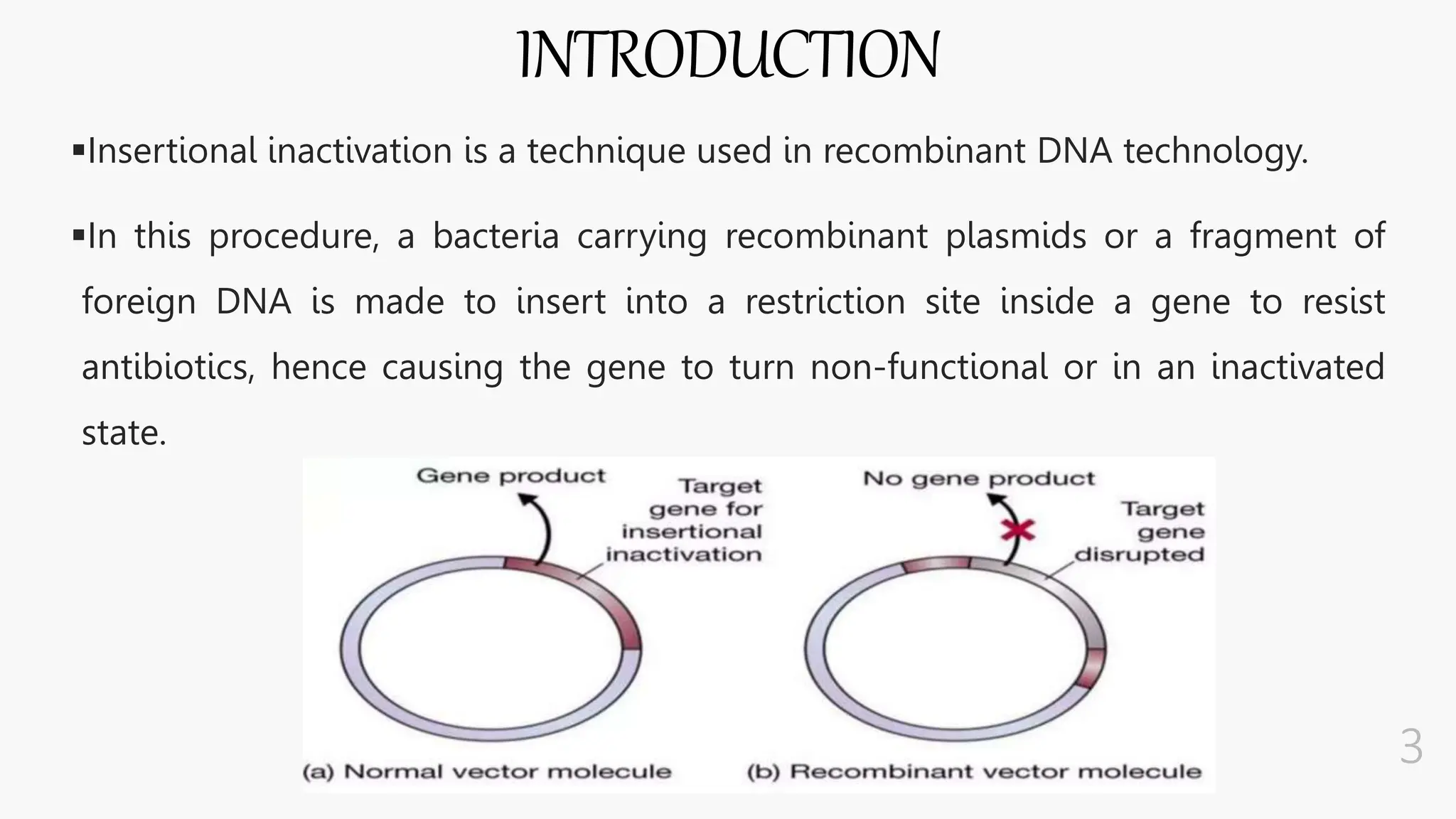
Insertional inactivation is a technique used in recombinant DNA technology.
In this procedure, a bacteria carrying recombinant plasmids or a fragment of
foreign DNA is made to insert into a restriction site inside a gene to resist
antibiotics, hence causing the gene to turn non-functional or in an inactivated
state.
EXPLANATION
Insertional inactivation is one of the screening methods, which is a fundamental
process involved in the recombinant DNA technology.
It is used in the detection of cells (host cells) that has received the foreign DNA
molecule.
There are several examples of insertional inactivation, few of them are :-
1. Blue white screening method.
BLUEWHITESCREENING
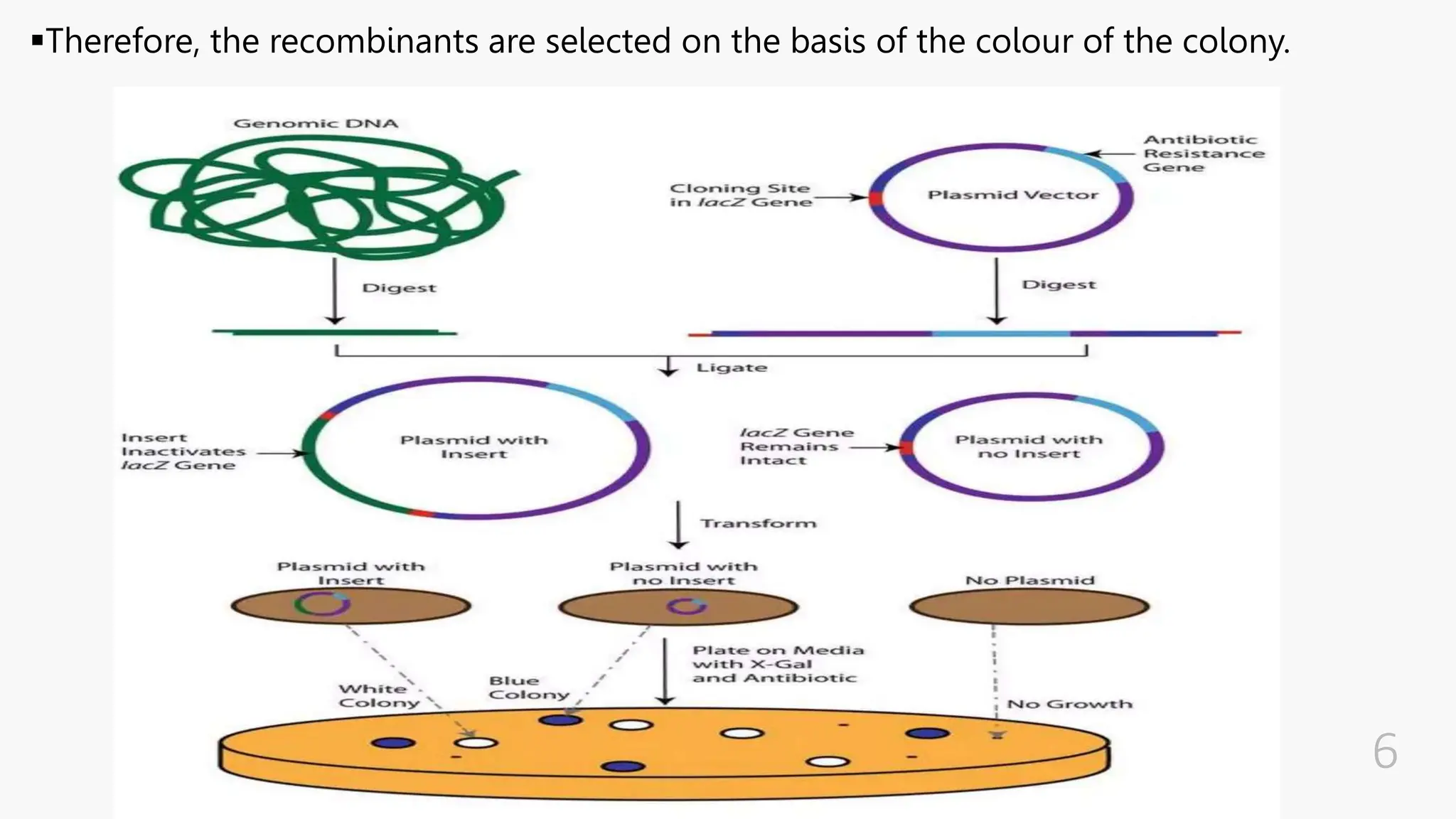
The lacZ gene encodes for an enzyme beta-galactosidase. This gene is inserted into the
vector.
The enzyme beta-galactosidase has the ability to split a synthetic substrate, X-gal, which is
an organic compound abbreviated as BCIG.(5-BROMO-4-CHLORO-INDOYL-BETA-D-
GALACTOPYRANOSIDE) insoluble product, that is blue in colour.
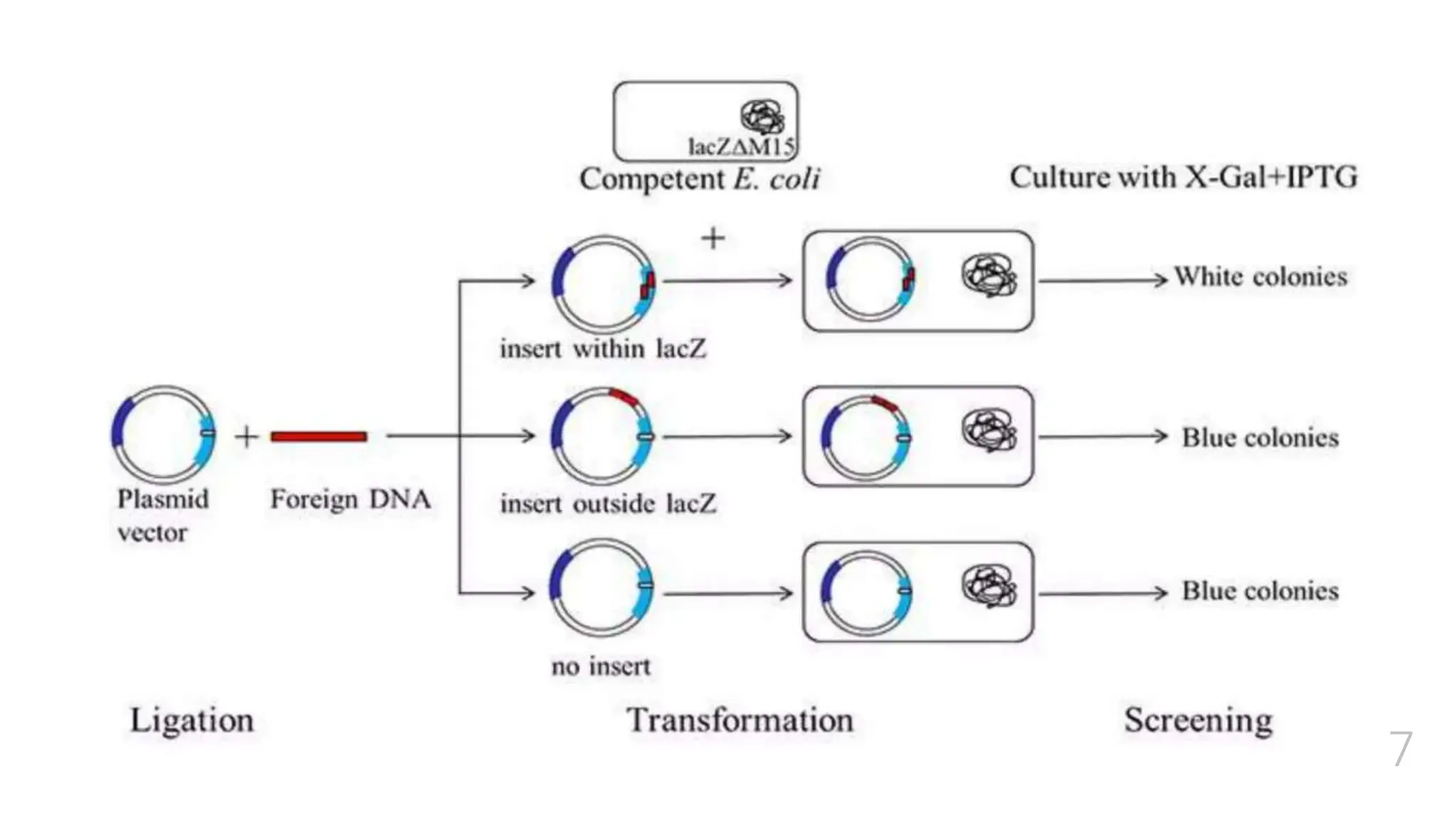
If the foreign gene is introduced into the gene lacz, the gene will be disrupted and hence
it's activity will be inhibited. Thus, no blue colour will develop as beta-galactosidase is not
produced due to deactivation of the lacZ gene.
Consequently, the host cell comprising the rDNA will create white background colonies on
the medium containing X-gal, whereas other cells bearing non-recombinant DNA will tend
Therefore, the recombinants are selected on the basis of the colour of the colony.
ANTIBIOTICRESISTANCE
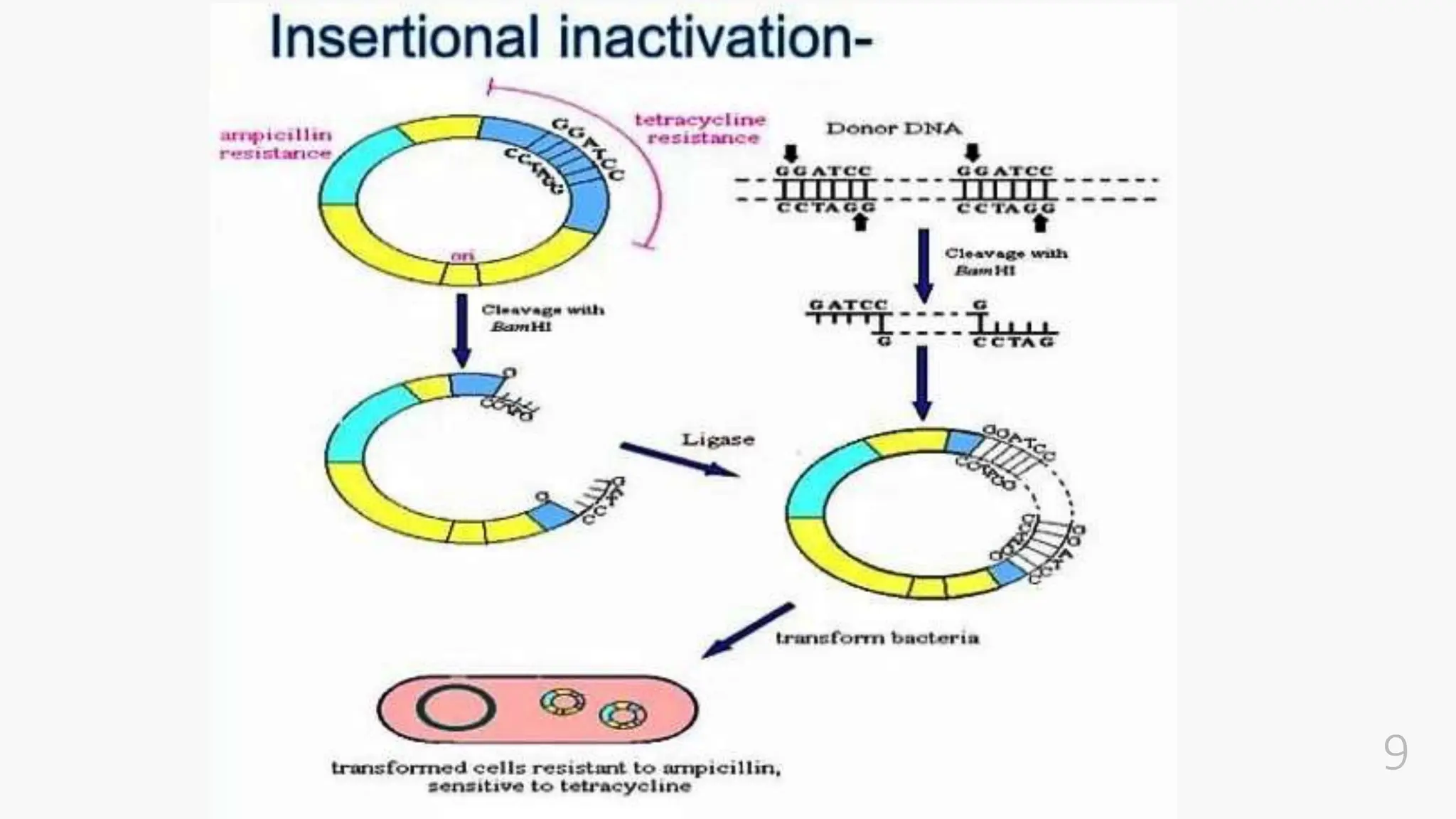
Plasmid vector pBR322, which has genes that encodes polypeptides which confer
resistance to ampicillin and tetracycline antibiotics.
 In the example given, the gene of interest is inserted into the tetracycline gene coding
region, this leads to the inactivation of tetracycline resistance gene. This process is
called insertional inactivation.
This process helps in the selection of recombinant colonies. Recombinant colonies
with desired gene inserted at tetracycline coding region can grow only in ampicillin
coding medium, whereas transformed colonies with unaltered vector can grown in
both tetracycline and ampicillin medium.
MERITS:
1. Easy screening procedure i.e., it is inexpensive and does not need very skilled
people to perform this experiment.
2. The whole setup is very easy to handle.
3. The changes can be observed very easily and quickly.
DEMERITS
1.There are chances of non-specific insertion.
2. The normal functioning of the gene is disrupted.
COMPLIMENTATION
Complementation occurs when two strains of an organism with different homozygous
recessive mutations that produce the same mutant phenotype. (e.g. a change in wing
structure in flies) produce offspring with the wild-type phenotype when mated or
crossed.
► Complementation will occur only if the mutations are in different genes.
In this case, each strain's genome supplies the wild-type allele to "complement" the
mutated allele of the other strain's genome. Since the mutations are recessive, the
offspring will display the wild-type phenotype.
COMPLIMENTATIONTEST
A complementation test (sometimes called a "cis-trans" test) can be used to test whether
the mutations in two strains are in different genes.
► Complementation will not occur if the mutations are in the same gene.
► The complementation test was developed by American geneticist Edward B. Lewis.
► A heterozygote with two mutations of the same gene will produce only mutant mRNAs,
which result in mutant enzymes.
► The two mutations will complement each other and produce the wild-type.
► Mutations that fail to each other are termed as functional alleles.
The test for defining alleles strictly on the basis of functionality is termed the cis-trans
complementation test.
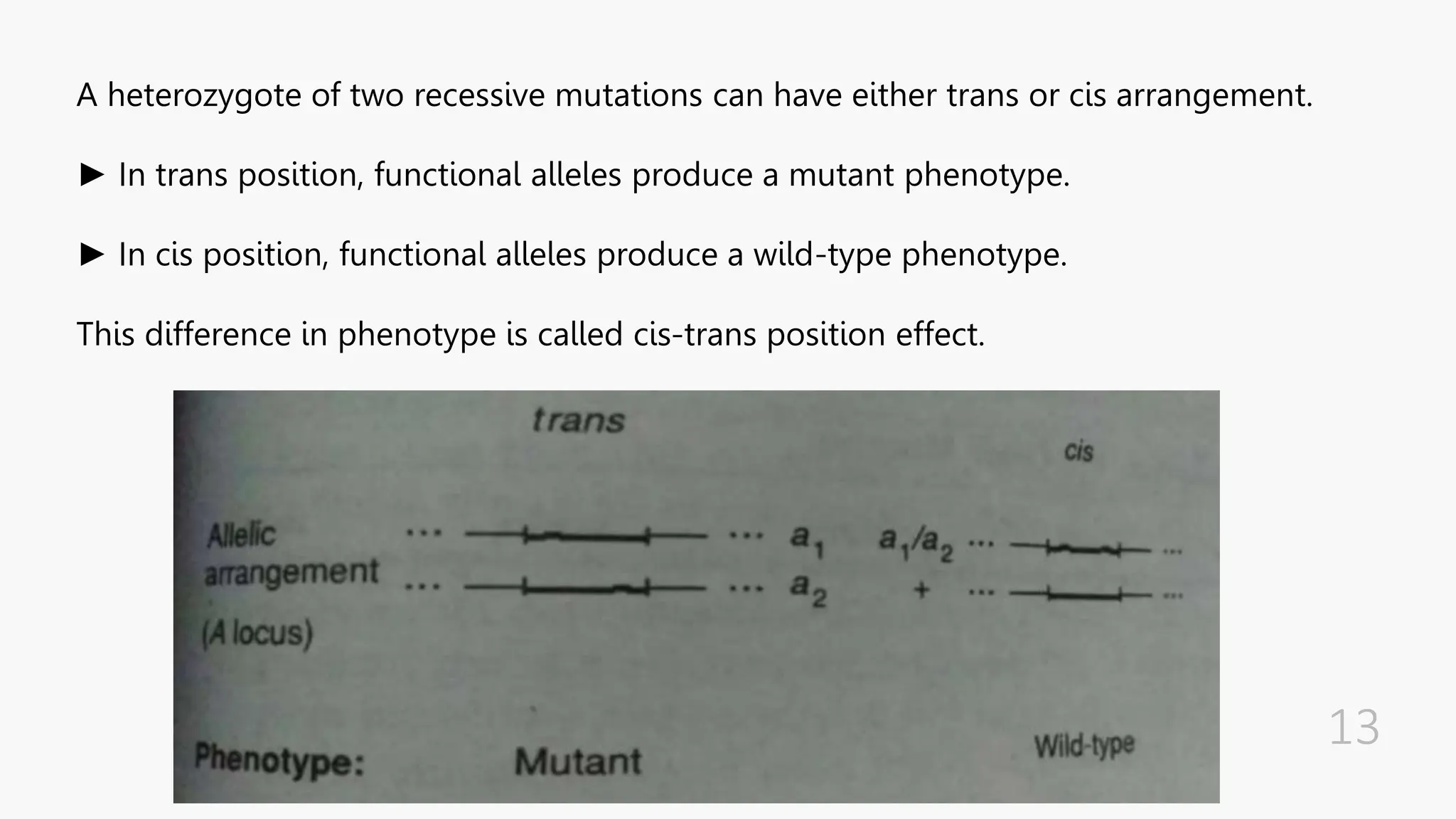
A heterozygote of two recessive mutations can have either trans or cis arrangement.
► In trans position, functional alleles produce a mutant phenotype.
► In cis position, functional alleles produce a wild-type phenotype.
This difference in phenotype is called cis-trans position effect.
COMPLEMENTATION OF DEFINED MUTATIONS
EXAMPLES:
► The complementation test is used to establish how many units of genes are defined by a
given test of mutations that express the same mutant phenotypes.
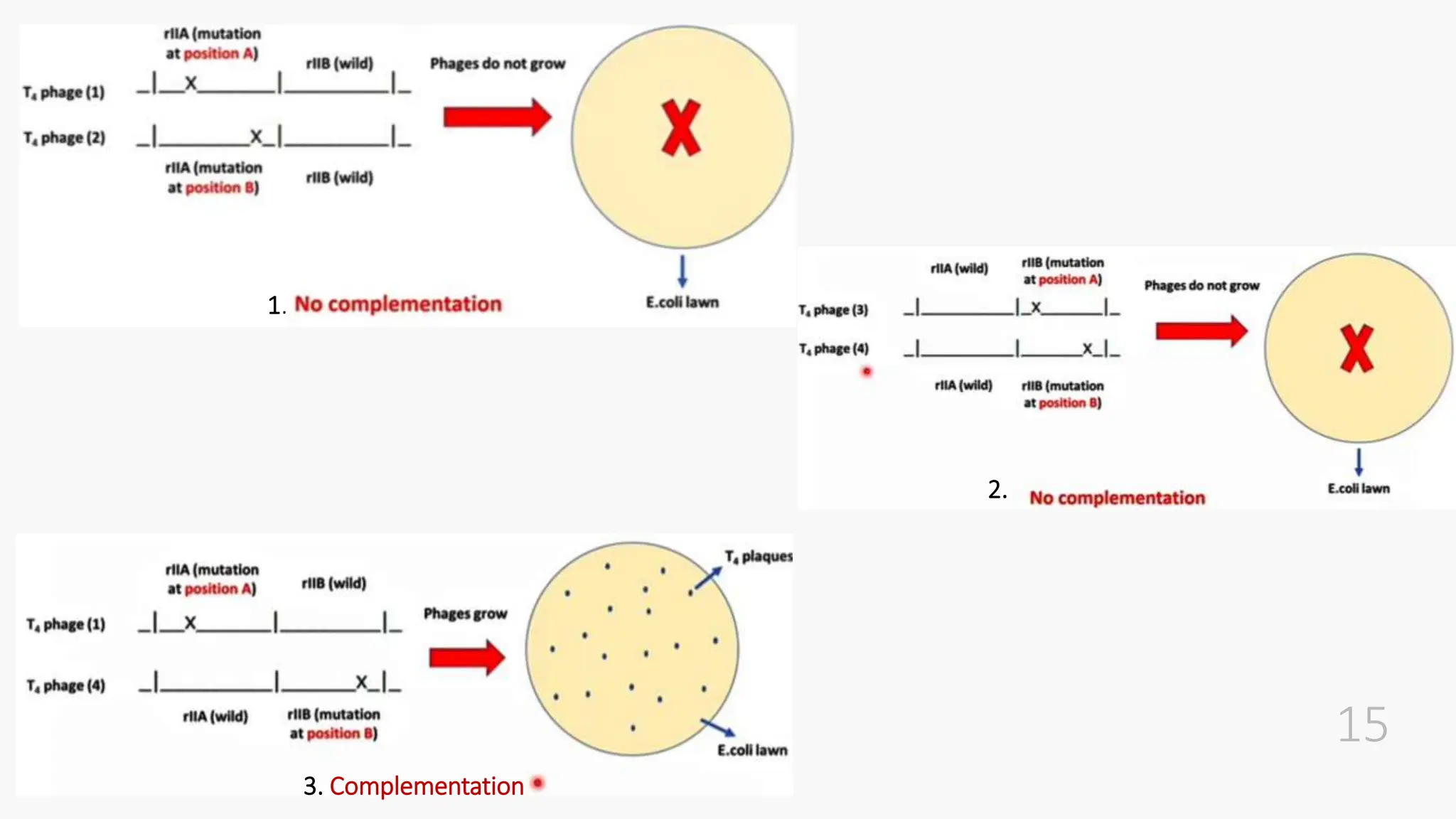
► In Benzer's work with r-II mutants, the non-permissive strain K12(lamda) was infected
with a pair of r-II mutant phages.
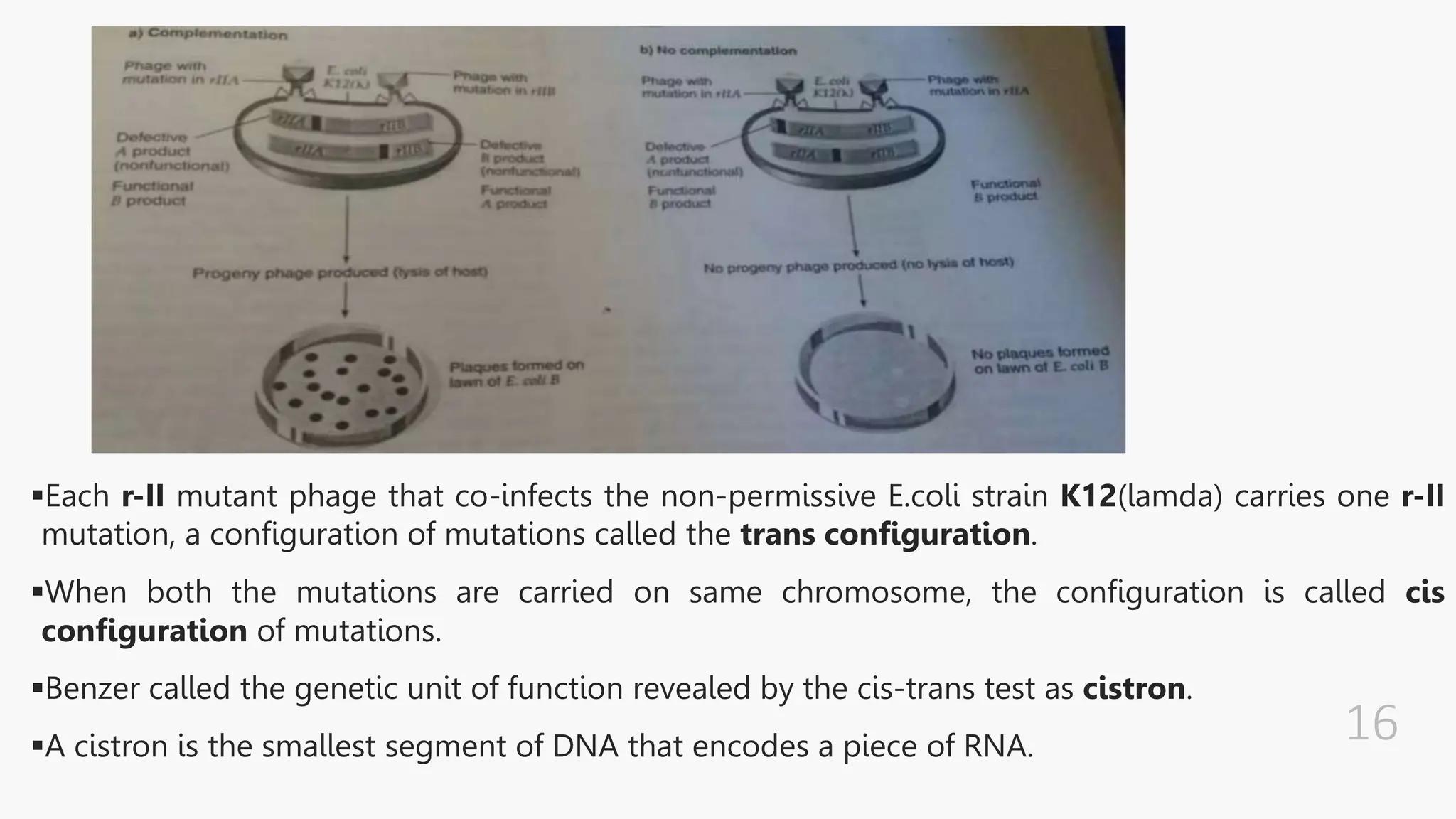
► If the phages produce progeny, the two mutants are said to complement each other,
meaning that the two mutations must be in different genes that encode different products.
► If no progeny phages are produced, the mutants are not complementary indicating that
mutations are in the same functional unit.
1.
2.
3. Complementation
Each r-II mutant phage that co-infects the non-permissive E.coli strain K12(lamda) carries one r-II
mutation, a configuration of mutations called the trans configuration.
When both the mutations are carried on same chromosome, the configuration is called cis
configuration of mutations.
Benzer called the genetic unit of function revealed by the cis-trans test as cistron.
A cistron is the smallest segment of DNA that encodes a piece of RNA.
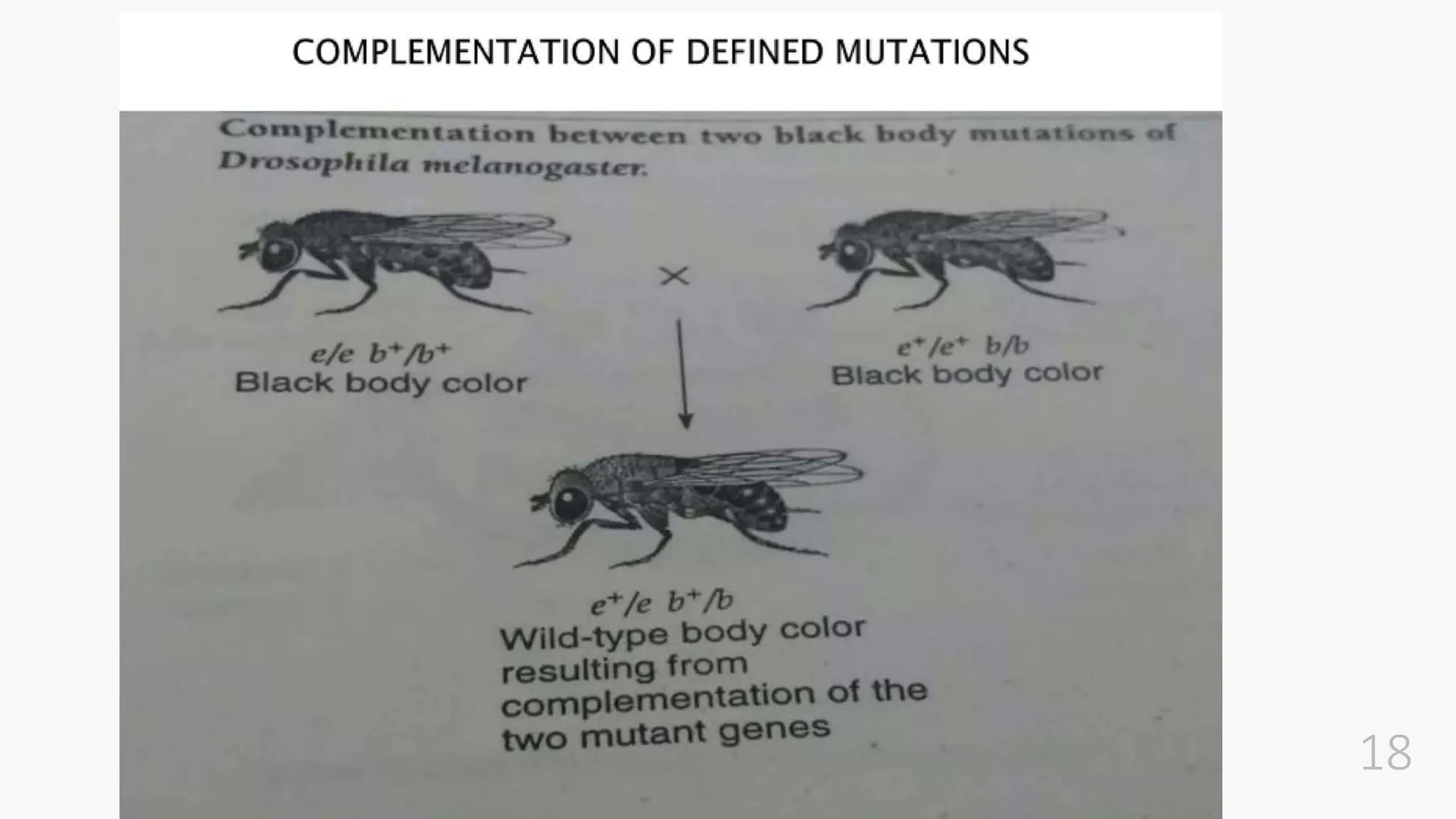
Example of complementation in a diploid organism :-
 Two true-breeding mutant strains of Drosophila melanogaster have black body color
instead of wild-type grey-yellow.
 When the two strains are crossed, all the F1 flies have wild-type body color.
This is because complementation has occurred between mutations into genes, each of
which is involved in the body color phenotype.
That is a recessive autosomal gene, ebony(e), when homozygous, produces a black body
color.
On another autosome a different recessive gene, black(b), also produces a black body color
when homozygous.
 Because the two parents are homozygotes, they are genotypically e/eb+/b+ and
e+/e+b/b, which is equivalent to trans configuration.
 The F1 have wild-type body color because complementation has occurred.
THANKYOU
.

INSERTIONAL INACTIVATION AND COMPLEMENTATION OF DEFINED MUTATION (1).pptx

  • 1.
  • 2.
    CONTENTS 1. INTRODUCTION 2. EXPLANATION 3.BLUE WHITE SCREENING 4. ANTIBIOTIC RESISTSNCE 5. COMPLIMENTATION 6. COMPLIMENTATION TEST 7. COMPLIMENTATION OF DEFINED MUTATIONS 8. CONCLUSION
  • 3.
    INTRODUCTION Insertional inactivation isa technique used in recombinant DNA technology. In this procedure, a bacteria carrying recombinant plasmids or a fragment of foreign DNA is made to insert into a restriction site inside a gene to resist antibiotics, hence causing the gene to turn non-functional or in an inactivated state.
  • 4.
    EXPLANATION Insertional inactivation isone of the screening methods, which is a fundamental process involved in the recombinant DNA technology. It is used in the detection of cells (host cells) that has received the foreign DNA molecule. There are several examples of insertional inactivation, few of them are :- 1. Blue white screening method.
  • 5.
    BLUEWHITESCREENING The lacZ geneencodes for an enzyme beta-galactosidase. This gene is inserted into the vector. The enzyme beta-galactosidase has the ability to split a synthetic substrate, X-gal, which is an organic compound abbreviated as BCIG.(5-BROMO-4-CHLORO-INDOYL-BETA-D- GALACTOPYRANOSIDE) insoluble product, that is blue in colour. If the foreign gene is introduced into the gene lacz, the gene will be disrupted and hence it's activity will be inhibited. Thus, no blue colour will develop as beta-galactosidase is not produced due to deactivation of the lacZ gene. Consequently, the host cell comprising the rDNA will create white background colonies on the medium containing X-gal, whereas other cells bearing non-recombinant DNA will tend
  • 6.
    Therefore, the recombinantsare selected on the basis of the colour of the colony.
  • 8.
    ANTIBIOTICRESISTANCE Plasmid vector pBR322,which has genes that encodes polypeptides which confer resistance to ampicillin and tetracycline antibiotics.  In the example given, the gene of interest is inserted into the tetracycline gene coding region, this leads to the inactivation of tetracycline resistance gene. This process is called insertional inactivation. This process helps in the selection of recombinant colonies. Recombinant colonies with desired gene inserted at tetracycline coding region can grow only in ampicillin coding medium, whereas transformed colonies with unaltered vector can grown in both tetracycline and ampicillin medium.
  • 10.
    MERITS: 1. Easy screeningprocedure i.e., it is inexpensive and does not need very skilled people to perform this experiment. 2. The whole setup is very easy to handle. 3. The changes can be observed very easily and quickly. DEMERITS 1.There are chances of non-specific insertion. 2. The normal functioning of the gene is disrupted.
  • 11.
    COMPLIMENTATION Complementation occurs whentwo strains of an organism with different homozygous recessive mutations that produce the same mutant phenotype. (e.g. a change in wing structure in flies) produce offspring with the wild-type phenotype when mated or crossed. ► Complementation will occur only if the mutations are in different genes. In this case, each strain's genome supplies the wild-type allele to "complement" the mutated allele of the other strain's genome. Since the mutations are recessive, the offspring will display the wild-type phenotype.
  • 12.
    COMPLIMENTATIONTEST A complementation test(sometimes called a "cis-trans" test) can be used to test whether the mutations in two strains are in different genes. ► Complementation will not occur if the mutations are in the same gene. ► The complementation test was developed by American geneticist Edward B. Lewis. ► A heterozygote with two mutations of the same gene will produce only mutant mRNAs, which result in mutant enzymes. ► The two mutations will complement each other and produce the wild-type. ► Mutations that fail to each other are termed as functional alleles. The test for defining alleles strictly on the basis of functionality is termed the cis-trans complementation test.
  • 13.
    A heterozygote oftwo recessive mutations can have either trans or cis arrangement. ► In trans position, functional alleles produce a mutant phenotype. ► In cis position, functional alleles produce a wild-type phenotype. This difference in phenotype is called cis-trans position effect.
  • 14.
    COMPLEMENTATION OF DEFINEDMUTATIONS EXAMPLES: ► The complementation test is used to establish how many units of genes are defined by a given test of mutations that express the same mutant phenotypes. ► In Benzer's work with r-II mutants, the non-permissive strain K12(lamda) was infected with a pair of r-II mutant phages. ► If the phages produce progeny, the two mutants are said to complement each other, meaning that the two mutations must be in different genes that encode different products. ► If no progeny phages are produced, the mutants are not complementary indicating that mutations are in the same functional unit.
  • 15.
  • 16.
    Each r-II mutantphage that co-infects the non-permissive E.coli strain K12(lamda) carries one r-II mutation, a configuration of mutations called the trans configuration. When both the mutations are carried on same chromosome, the configuration is called cis configuration of mutations. Benzer called the genetic unit of function revealed by the cis-trans test as cistron. A cistron is the smallest segment of DNA that encodes a piece of RNA.
  • 17.
    Example of complementationin a diploid organism :-  Two true-breeding mutant strains of Drosophila melanogaster have black body color instead of wild-type grey-yellow.  When the two strains are crossed, all the F1 flies have wild-type body color. This is because complementation has occurred between mutations into genes, each of which is involved in the body color phenotype. That is a recessive autosomal gene, ebony(e), when homozygous, produces a black body color. On another autosome a different recessive gene, black(b), also produces a black body color when homozygous.  Because the two parents are homozygotes, they are genotypically e/eb+/b+ and e+/e+b/b, which is equivalent to trans configuration.  The F1 have wild-type body color because complementation has occurred.
  • 19.