By
KAUSHAL KUMAR SAHU
Assistant Professor (Ad Hoc)
Department of Biotechnology
Govt. Digvijay Autonomous P. G. College
Raj-Nandgaon ( C. G. )
SYNOPSIS
 Introduction
 Components of binary vector
 Development of binary vector system
 Properties of binary vector
 Types of binary vector
 Plant transformation using binary vector
 Advantage of using binary vector
 Conclusion
 References
INTRODUCTION
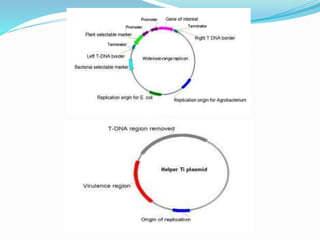
 In these systems, the T-DNA region containing a gene of
interest is contained in one vector and the vir region is
located in a separate disarmed (without tumor-genes) Ti
plasmid. The plasmids co-reside in Agrobacterium and
remain independent.
 In the binary vector system, the two different plasmids
employed are:
 a wide-host-range small replicon, which has an origin of
replication (ori) that permits the maintenance of the plasmid
in a wide range of bacteria including E. coli and
Agrobacterium.
 a helper Ti plasmid, harbored in A. tumefaciens, which
lacks the entire T-DNA region but contains an intact vir
region.
COMPONENT OF BINARY VECTOR
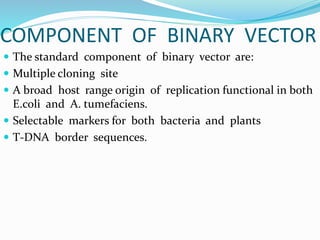
 The standard component of binary vector are:
 Multiple cloning site
 A broad host range origin of replication functional in both
E.coli and A. tumefaciens.
 Selectable markers for both bacteria and plants
 T-DNA border sequences.
DEVELOPMENT OF BINARY VECTOR
 Hoekema et al. (1983) and de Framond et al.
(1983) determined that the vir and T-DNA regions of Ti-
plasmids could be split onto two separate replicons.
•Genes of interest are maintained within the T-DNA
region of a binary vector. Vir proteins encoded by genes
on a separate replicon (vir helper) mediate T-DNA
processing from the binary vector and T-DNAtransfer
from the bacterium to the host cell.
• The selection marker is used to indicate successful
plant transformation. ori, Origin of replication; Abr,
antibiotic-resistance gene used to select for the
presence of the T-DNAbinary vector in E.Coli
or in Agrobacterium.
PROPERTIES OF BINARY VECTOR
These include the following:
 T-DNA left and right border repeat sequences to define and
delimit T-DNA.
 A plant-active selectable marker gene .
 Restriction endonuclease, rare-cutting, or homing
endonuclease sites within T-DNA into which goi can be
inserted.
 Origin(s) of replication to allow maintenance in E. coli and
Agrobacterium.
 Antibiotic-resistance genes within the chromosome and
within backbone sequences for selection of the binary vector
in E. coli and Agrobacterium.
TYPES
 pGA series vectors
 pCG series vectors
 pCIT series
 Pgptv
 pBECK2000 series
 pGreen series
PLANT TRANSFORMATION USING
BINARY VECTOR
 Propagate binary vector in E. coli
 Isolate binary vector from E.coli and engineer (introduce a
foreign gene)
 Isolate engineered binary vector and introduce into
Agrobacterium containing a modified Ti plasmid
 Infect plant tissue with engineered Agrobacterium (T-DNA
containing the foreign gene gets inserted into a plant cell
genome)
Advantages of using Binary vector
 Binary vector do not need in vivo recombination.
 Binary vectors require only that an intact plasmid vector
to be introduced into the target bacterium, making the
process of bacterial transformation both more efficient
and quicker.
 Binary vector systems with plant ready genes in
Agrobacteria are easily and efficiently obtained.
 In binary system, the binary plasmids exist as separate
replicons, thus copy number is not strictly tied to that of
Ti plasmid.
CONCLUSION
 T-DNA binary systems have greatly simplified the generation
of transgenic plants. Along with companion vir helper
strains, numerous different T-DNA binary vectors with
specialized properties have been designed to facilitate such
diverse activities as protein expression, activation tagging,
protein localization, protein-protein interaction studies, and
RNAi-mediated gene silencing.
REFERENCES
 MK Razdan and SS Bhojwani- Plant tissue culture
 H.S. Chawla- Introduction to plant biotechnology
 IK Vasil- plant cell and Tissue culture

Binary Vector, By KK Sahu sir

  • 1.
    By KAUSHAL KUMAR SAHU AssistantProfessor (Ad Hoc) Department of Biotechnology Govt. Digvijay Autonomous P. G. College Raj-Nandgaon ( C. G. )
  • 2.
    SYNOPSIS  Introduction  Componentsof binary vector  Development of binary vector system  Properties of binary vector  Types of binary vector  Plant transformation using binary vector  Advantage of using binary vector  Conclusion  References
  • 3.
    INTRODUCTION  In thesesystems, the T-DNA region containing a gene of interest is contained in one vector and the vir region is located in a separate disarmed (without tumor-genes) Ti plasmid. The plasmids co-reside in Agrobacterium and remain independent.  In the binary vector system, the two different plasmids employed are:  a wide-host-range small replicon, which has an origin of replication (ori) that permits the maintenance of the plasmid in a wide range of bacteria including E. coli and Agrobacterium.  a helper Ti plasmid, harbored in A. tumefaciens, which lacks the entire T-DNA region but contains an intact vir region.
  • 5.
    COMPONENT OF BINARYVECTOR  The standard component of binary vector are:  Multiple cloning site  A broad host range origin of replication functional in both E.coli and A. tumefaciens.  Selectable markers for both bacteria and plants  T-DNA border sequences.
  • 6.
    DEVELOPMENT OF BINARYVECTOR  Hoekema et al. (1983) and de Framond et al. (1983) determined that the vir and T-DNA regions of Ti- plasmids could be split onto two separate replicons.
  • 7.
    •Genes of interestare maintained within the T-DNA region of a binary vector. Vir proteins encoded by genes on a separate replicon (vir helper) mediate T-DNA processing from the binary vector and T-DNAtransfer from the bacterium to the host cell. • The selection marker is used to indicate successful plant transformation. ori, Origin of replication; Abr, antibiotic-resistance gene used to select for the presence of the T-DNAbinary vector in E.Coli or in Agrobacterium.
  • 8.
    PROPERTIES OF BINARYVECTOR These include the following:  T-DNA left and right border repeat sequences to define and delimit T-DNA.  A plant-active selectable marker gene .  Restriction endonuclease, rare-cutting, or homing endonuclease sites within T-DNA into which goi can be inserted.  Origin(s) of replication to allow maintenance in E. coli and Agrobacterium.  Antibiotic-resistance genes within the chromosome and within backbone sequences for selection of the binary vector in E. coli and Agrobacterium.
  • 9.
    TYPES  pGA seriesvectors  pCG series vectors  pCIT series  Pgptv  pBECK2000 series  pGreen series
  • 10.
    PLANT TRANSFORMATION USING BINARYVECTOR  Propagate binary vector in E. coli  Isolate binary vector from E.coli and engineer (introduce a foreign gene)  Isolate engineered binary vector and introduce into Agrobacterium containing a modified Ti plasmid  Infect plant tissue with engineered Agrobacterium (T-DNA containing the foreign gene gets inserted into a plant cell genome)
  • 11.
    Advantages of usingBinary vector  Binary vector do not need in vivo recombination.  Binary vectors require only that an intact plasmid vector to be introduced into the target bacterium, making the process of bacterial transformation both more efficient and quicker.  Binary vector systems with plant ready genes in Agrobacteria are easily and efficiently obtained.  In binary system, the binary plasmids exist as separate replicons, thus copy number is not strictly tied to that of Ti plasmid.
  • 12.
    CONCLUSION  T-DNA binarysystems have greatly simplified the generation of transgenic plants. Along with companion vir helper strains, numerous different T-DNA binary vectors with specialized properties have been designed to facilitate such diverse activities as protein expression, activation tagging, protein localization, protein-protein interaction studies, and RNAi-mediated gene silencing.
  • 13.
    REFERENCES  MK Razdanand SS Bhojwani- Plant tissue culture  H.S. Chawla- Introduction to plant biotechnology  IK Vasil- plant cell and Tissue culture