COMMERCIALPRODUCTION OF
AMYLASEAND THEIR USES
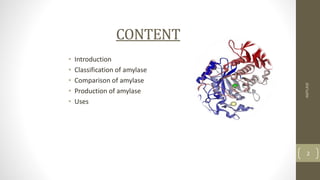
CONTENT
• Introduction
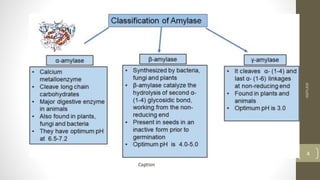
• Classification of amylase
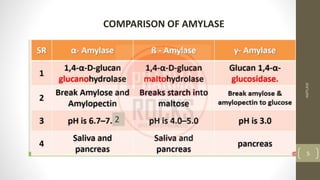
• Comparison of amylase
• Production of amylase
• Uses
AMYLASE
2
INTRODUCTION
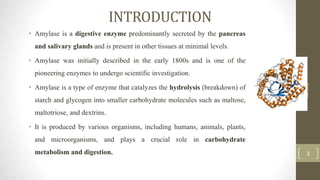
• Amylase is a digestive enzyme predominantly secreted by the pancreas
and salivary glands and is present in other tissues at minimal levels.
• Amylase was initially described in the early 1800s and is one of the
pioneering enzymes to undergo scientific investigation.
• Amylase is a type of enzyme that catalyzes the hydrolysis (breakdown) of
starch and glycogen into smaller carbohydrate molecules such as maltose,
maltotriose, and dextrins.
• It is produced by various organisms, including humans, animals, plants,
and microorganisms, and plays a crucial role in carbohydrate
metabolism and digestion.
AMYLASE
3
Caption
4
AMYLASE
AMYLASE
5
COMPARISON OF AMYLASE
2
PRODUCTION OF AMYLASE
 STEPS OF PRODUCTION OF AMYLASE
1. Sources
2. Fermentation
3. Determination of enzyme activity
4. Purification
5. Formulation and stabilization
6. Quality control
7. Packaging and distribution
AMYLASE
6
AMYLASE
7
1. SOURCES
• Selection of Source: Amylase can be obtained from various sources including
plants, animals, bacteria, and fungi.
• Depending on the desired properties and application, the appropriate source is
selected.
• For example, fungal amylases, particularly those derived from strains of
Aspergillus or Rhizopus, are commonly used in industrial applications due to
their high enzyme activity and stability under various conditions.
AMYLASE
8
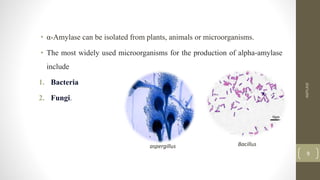
• α-Amylase can be isolated from plants, animals or microorganisms.
• The most widely used microorganisms for the production of alpha-amylase
include
1. Bacteria
2. Fungi.
AMYLASE
9
Bacillus
aspergillus
AMYLASE
10
BACTERIAL SOURCE
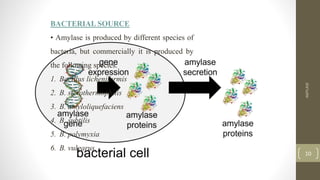
• Amylase is produced by different species of
bacteria, but commercially it is produced by
the following species.
1. Bacillus licheniformis
2. B. sterothermophilis
3. B. amyloliquefaciens
4. B. subtilis
5. B. polymyxia
6. B. vulgarus.
FUNGALAMYLASE
• Amylase is produced by different species of fungi, but commercially
it is produced by the following species.
• Aspergillus orizae
• A. niger
• Penicillium sps.
• Thermomyces lanugino
AMYLASE
11
2. FERMENTATION
• There are mainly two methods which are used for production of α-Amylase
on a commercial scale.
• These are:
1) Submerged fermentation (SMF)
2) Solid State fermentation (SSF)
AMYLASE
12
1. Submerged fermentation (SMF):
• Submerged fermentation (SmF) employs free flowing liquid substrates, such
as molasses and broths.
• The products yielded in fermentation are secreted into the fermentation broth.
• This fermentation technique is suitable for microorganisms such as bacteria
that require high moisture content for their growth.
• Sml is primarily used for the extraction of secondary metabolites that need to
be used in liquid form.
AMYLASE
13
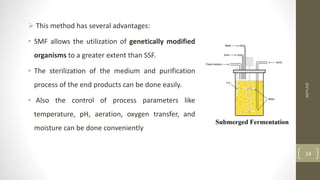
 This method has several advantages:
• SMF allows the utilization of genetically modified
organisms to a greater extent than SSF.
• The sterilization of the medium and purification
process of the end products can be done easily.
• Also the control of process parameters like
temperature, pH, aeration, oxygen transfer, and
moisture can be done conveniently
AMYLASE
14
2. SOLID STATE FERMENTATION
• Solid state fermentation (SSF) systems appear promising due to the natural
potential and advantages they offer.
• SSF resembles the natural habitat of microorganisms and is, therefore, the
preferred choice for microorganisms to grow and produce useful value-
added products.
• Solid state fermentation is a method used for microbes which require less
moisture content for their growth.
• The solid substrates commonly used in this method are, bran, bagasse, and
paper pulp.
AMYLASE
15
• The main advantage is that nutrient-rich
waste materials can be easily recycled and
used as substrates in this method.
• Other advantages that SSF offers over SmF
are simpler equipments, higher
concentration of products and lesser
effluent generation.
• For several such reasons SSF is considered as
a promising method for commercial
production of enzymes.
AMYLASE
16
3. Determination of enzyme activity
THREE METHODS
i. DINITROSALICYCLIC ACID METHOD (DNS)
• In the dinitrosalicyclic acid method, aliquots of the substrate stock solution
are mixed with the enzyme solution.
• Followed by 10 minutes of incubation at 50 celsius.
• DNS reagent is added to the test tube and the mixture is incubated in a
boiling water bath for 5 minutes.
• After cooling to room temperature, the absorbance of the supernatant at
540nm is measured.
AMYLASE
17
ii. NELSON –SOMOGYI (NS) METHOD
• In the NS method, an aliquot of stock solution of substrate is heated at 50°C
for 5min.
• Preheated (50°C for 5 min) enzyme solution is added to the substrate.
• This reaction mixture is incubated at 50°C and the reaction is carried out for
10min.
• After incubation Somogyi copper reagent is added to terminate the reaction.
• This is then incubated in boiling water bath for 40 min & cooled to room
temperature.
• Finally water is added and the mixture is centrifuged at 13,000 rpm for 1 min
and absorbance of supernatant is read at 610 nm.
AMYLASE
18
iii. Determination of Activity Using lodine
• The hydrolytic activity of a-Amylase can be determined based on the
principle that starch and iodine react to form a blue colored complex.
• On hydrolysis of starch this complex changes to a reddish brown
colored one.
• The absorbance can be read after the enzyme substrate reaction has been
terminated.
• This gives a measure of the extent of hydrolysis of starch by α-Amylase.
AMYLASE
19
4. Purification
• Enzymes used for industrial applications are usually crude preparations and
require less downstream processing.
• Whereas the enzymes used clinical and pharmaceutical industry need to be
highly purified.
• The enzyme in the purified form is also a prerequisite in studies of structure-
function relationships and biochemical properties .
• Different strategies for purification of enzymes have been investigated,
exploiting specific characteristics of the target biomolecule.
• Laboratory scale purification for α-amylase includes various combinations of
ion exchange, gel filtration, hydrophobicity interactions and reverse phase
chromatography.
AMYLASE
20
5. FORMULATION AND STABILIZATION
• The purified enzyme is often formulated into a stable and
concentrated form suitable for storage and use in various applications.
• Stabilizers, preservatives, and other additives may be incorporated to
enhance enzyme stability and activity under different conditions.
AMYLASE
21
6. QUALITY CONTROL
• Throughout the production process, quality control measures are implemented to
ensure the consistency, purity, and activity of the amylase enzyme.
• Analytical techniques such as enzyme assays, protein quantification, and
electrophoresis are used to assess the quality of the enzyme product.
7. PACKAGING AND DISTRIBUTION:
• The purified and formulated amylase enzyme is packaged into appropriate
containers and shipped for distribution to customers in various industries,
including food and beverage, textile, paper, pharmaceutical, and biofuel sectors.
AMYLASE
22
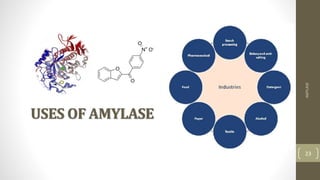
USES OF AMYLASE
AMYLASE
23
1. Food Industry:
• Baking: Amylases are used in baking to break down starches in flour,
leading to improved dough handling, increased volume, and enhanced texture
of baked goods.
• Brewing: Amylases are crucial in the brewing process for converting
starches in malted grains (such as barley) into fermentable sugars during
mashing, which is essential for alcohol production.
• Production of Sweeteners: Amylases are used to convert starches into
various sweeteners like glucose, maltose, and high-fructose corn syrup.
2. Textile Industry:
• Amylases are utilized in the desizing process to remove starch from fabrics
before dyeing or finishing.
AMYLASE
24
3. Biofuel Production:
• Amylases are employed in the conversion of starch-rich feedstocks such
as corn, wheat, and cassava into fermentable sugars, which can then be
fermented into ethanol for biofuel production.
4. Detergent Industry:
• Amylases are included in laundry detergents as part of the enzyme cocktail
to break down starch-based stains like pasta, rice, and potato residues.
5. Animal Feed Industry:
• Amylases are used as feed additives to enhance the digestibility of starches
in animal feeds, thereby improving the overall nutritional value and
efficiency of feed utilization.
AMYLASE
25
6. Paper Industry:
• Amylases are employed in the papermaking process to modify starch-
based coatings and improve the paper's strength, smoothness, and
printability.
7. Pharmaceutical Industry:
• Amylases are used in pharmaceutical formulations for their digestive
properties, such as aiding in the breakdown of complex carbohydrates in
oral dosage forms to facilitate absorption.
8. Diagnostic Applications:
• Amylase levels in biological fluids (such as blood, urine, and saliva) are
measured clinically to diagnose pancreatic disorders, including
pancreatitis and pancreatic cancer.
AMYLASE
26
REFERENCE
• JAEM-2-4-10.pdf
(appliedenvironmentalmicrobiohttp://article.appliedenvironmentalmicrobiology.com
/pdf/JAEM-2-4-10.pdflogy.com)
• PowerPoint Presentation (govtsciencecollegedurg.acPowerPoint Presentation
(govtsciencecollegedurg.ac.in).in)
• Microsoft Word - BJM 1692.doc (scielo.br)
https://www.scielo.br/j/bjm/a/W9gqJLhHTVTddVzCnvcbSVc/?format=pdf&lang=en
AMYLASE
27

AMYLASE..............................pptx

  • 1.
  • 2.
    CONTENT • Introduction • Classificationof amylase • Comparison of amylase • Production of amylase • Uses AMYLASE 2
  • 3.
    INTRODUCTION • Amylase isa digestive enzyme predominantly secreted by the pancreas and salivary glands and is present in other tissues at minimal levels. • Amylase was initially described in the early 1800s and is one of the pioneering enzymes to undergo scientific investigation. • Amylase is a type of enzyme that catalyzes the hydrolysis (breakdown) of starch and glycogen into smaller carbohydrate molecules such as maltose, maltotriose, and dextrins. • It is produced by various organisms, including humans, animals, plants, and microorganisms, and plays a crucial role in carbohydrate metabolism and digestion. AMYLASE 3
  • 4.
  • 5.
  • 6.
    PRODUCTION OF AMYLASE STEPS OF PRODUCTION OF AMYLASE 1. Sources 2. Fermentation 3. Determination of enzyme activity 4. Purification 5. Formulation and stabilization 6. Quality control 7. Packaging and distribution AMYLASE 6
  • 7.
  • 8.
    1. SOURCES • Selectionof Source: Amylase can be obtained from various sources including plants, animals, bacteria, and fungi. • Depending on the desired properties and application, the appropriate source is selected. • For example, fungal amylases, particularly those derived from strains of Aspergillus or Rhizopus, are commonly used in industrial applications due to their high enzyme activity and stability under various conditions. AMYLASE 8
  • 9.
    • α-Amylase canbe isolated from plants, animals or microorganisms. • The most widely used microorganisms for the production of alpha-amylase include 1. Bacteria 2. Fungi. AMYLASE 9 Bacillus aspergillus
  • 10.
    AMYLASE 10 BACTERIAL SOURCE • Amylaseis produced by different species of bacteria, but commercially it is produced by the following species. 1. Bacillus licheniformis 2. B. sterothermophilis 3. B. amyloliquefaciens 4. B. subtilis 5. B. polymyxia 6. B. vulgarus.
  • 11.
    FUNGALAMYLASE • Amylase isproduced by different species of fungi, but commercially it is produced by the following species. • Aspergillus orizae • A. niger • Penicillium sps. • Thermomyces lanugino AMYLASE 11
  • 12.
    2. FERMENTATION • Thereare mainly two methods which are used for production of α-Amylase on a commercial scale. • These are: 1) Submerged fermentation (SMF) 2) Solid State fermentation (SSF) AMYLASE 12
  • 13.
    1. Submerged fermentation(SMF): • Submerged fermentation (SmF) employs free flowing liquid substrates, such as molasses and broths. • The products yielded in fermentation are secreted into the fermentation broth. • This fermentation technique is suitable for microorganisms such as bacteria that require high moisture content for their growth. • Sml is primarily used for the extraction of secondary metabolites that need to be used in liquid form. AMYLASE 13
  • 14.
     This methodhas several advantages: • SMF allows the utilization of genetically modified organisms to a greater extent than SSF. • The sterilization of the medium and purification process of the end products can be done easily. • Also the control of process parameters like temperature, pH, aeration, oxygen transfer, and moisture can be done conveniently AMYLASE 14
  • 15.
    2. SOLID STATEFERMENTATION • Solid state fermentation (SSF) systems appear promising due to the natural potential and advantages they offer. • SSF resembles the natural habitat of microorganisms and is, therefore, the preferred choice for microorganisms to grow and produce useful value- added products. • Solid state fermentation is a method used for microbes which require less moisture content for their growth. • The solid substrates commonly used in this method are, bran, bagasse, and paper pulp. AMYLASE 15
  • 16.
    • The mainadvantage is that nutrient-rich waste materials can be easily recycled and used as substrates in this method. • Other advantages that SSF offers over SmF are simpler equipments, higher concentration of products and lesser effluent generation. • For several such reasons SSF is considered as a promising method for commercial production of enzymes. AMYLASE 16
  • 17.
    3. Determination ofenzyme activity THREE METHODS i. DINITROSALICYCLIC ACID METHOD (DNS) • In the dinitrosalicyclic acid method, aliquots of the substrate stock solution are mixed with the enzyme solution. • Followed by 10 minutes of incubation at 50 celsius. • DNS reagent is added to the test tube and the mixture is incubated in a boiling water bath for 5 minutes. • After cooling to room temperature, the absorbance of the supernatant at 540nm is measured. AMYLASE 17
  • 18.
    ii. NELSON –SOMOGYI(NS) METHOD • In the NS method, an aliquot of stock solution of substrate is heated at 50°C for 5min. • Preheated (50°C for 5 min) enzyme solution is added to the substrate. • This reaction mixture is incubated at 50°C and the reaction is carried out for 10min. • After incubation Somogyi copper reagent is added to terminate the reaction. • This is then incubated in boiling water bath for 40 min & cooled to room temperature. • Finally water is added and the mixture is centrifuged at 13,000 rpm for 1 min and absorbance of supernatant is read at 610 nm. AMYLASE 18
  • 19.
    iii. Determination ofActivity Using lodine • The hydrolytic activity of a-Amylase can be determined based on the principle that starch and iodine react to form a blue colored complex. • On hydrolysis of starch this complex changes to a reddish brown colored one. • The absorbance can be read after the enzyme substrate reaction has been terminated. • This gives a measure of the extent of hydrolysis of starch by α-Amylase. AMYLASE 19
  • 20.
    4. Purification • Enzymesused for industrial applications are usually crude preparations and require less downstream processing. • Whereas the enzymes used clinical and pharmaceutical industry need to be highly purified. • The enzyme in the purified form is also a prerequisite in studies of structure- function relationships and biochemical properties . • Different strategies for purification of enzymes have been investigated, exploiting specific characteristics of the target biomolecule. • Laboratory scale purification for α-amylase includes various combinations of ion exchange, gel filtration, hydrophobicity interactions and reverse phase chromatography. AMYLASE 20
  • 21.
    5. FORMULATION ANDSTABILIZATION • The purified enzyme is often formulated into a stable and concentrated form suitable for storage and use in various applications. • Stabilizers, preservatives, and other additives may be incorporated to enhance enzyme stability and activity under different conditions. AMYLASE 21
  • 22.
    6. QUALITY CONTROL •Throughout the production process, quality control measures are implemented to ensure the consistency, purity, and activity of the amylase enzyme. • Analytical techniques such as enzyme assays, protein quantification, and electrophoresis are used to assess the quality of the enzyme product. 7. PACKAGING AND DISTRIBUTION: • The purified and formulated amylase enzyme is packaged into appropriate containers and shipped for distribution to customers in various industries, including food and beverage, textile, paper, pharmaceutical, and biofuel sectors. AMYLASE 22
  • 23.
  • 24.
    1. Food Industry: •Baking: Amylases are used in baking to break down starches in flour, leading to improved dough handling, increased volume, and enhanced texture of baked goods. • Brewing: Amylases are crucial in the brewing process for converting starches in malted grains (such as barley) into fermentable sugars during mashing, which is essential for alcohol production. • Production of Sweeteners: Amylases are used to convert starches into various sweeteners like glucose, maltose, and high-fructose corn syrup. 2. Textile Industry: • Amylases are utilized in the desizing process to remove starch from fabrics before dyeing or finishing. AMYLASE 24
  • 25.
    3. Biofuel Production: •Amylases are employed in the conversion of starch-rich feedstocks such as corn, wheat, and cassava into fermentable sugars, which can then be fermented into ethanol for biofuel production. 4. Detergent Industry: • Amylases are included in laundry detergents as part of the enzyme cocktail to break down starch-based stains like pasta, rice, and potato residues. 5. Animal Feed Industry: • Amylases are used as feed additives to enhance the digestibility of starches in animal feeds, thereby improving the overall nutritional value and efficiency of feed utilization. AMYLASE 25
  • 26.
    6. Paper Industry: •Amylases are employed in the papermaking process to modify starch- based coatings and improve the paper's strength, smoothness, and printability. 7. Pharmaceutical Industry: • Amylases are used in pharmaceutical formulations for their digestive properties, such as aiding in the breakdown of complex carbohydrates in oral dosage forms to facilitate absorption. 8. Diagnostic Applications: • Amylase levels in biological fluids (such as blood, urine, and saliva) are measured clinically to diagnose pancreatic disorders, including pancreatitis and pancreatic cancer. AMYLASE 26
  • 27.
    REFERENCE • JAEM-2-4-10.pdf (appliedenvironmentalmicrobiohttp://article.appliedenvironmentalmicrobiology.com /pdf/JAEM-2-4-10.pdflogy.com) • PowerPointPresentation (govtsciencecollegedurg.acPowerPoint Presentation (govtsciencecollegedurg.ac.in).in) • Microsoft Word - BJM 1692.doc (scielo.br) https://www.scielo.br/j/bjm/a/W9gqJLhHTVTddVzCnvcbSVc/?format=pdf&lang=en AMYLASE 27