INTRAGENIC CROSSING-OVER &
COMPLIMENTATION
Submitted to: Submitted by:
Dr. Bharat singh Deepti barange
B.tech biotech
4th sem
WHAT IS INTRAGENIC CROSSING OVER?
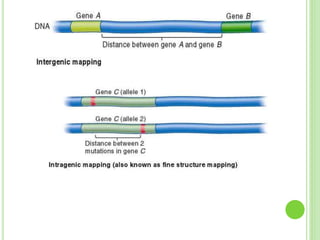
 This simply means recombination within a gene.
 In early 1950s Seymour Benzer undertook a
detailed examination of a single locus, rII,in
phage T4
 He successfully designed experiments to recover
the extremely rare genetic recombinations
arising as a result of intragenic exchange.
 He demonstrated such recombination occurs
between DNA of individual bacteriophages
during simultaneous infection of the host
bacterium E.coli
 His work is described as fine structure analysis
due to extremely detailed information provided
from his analysis
WHAT ARE PLAQUES?
 A plaque is a clear area
on an otherwise opaque
bacterial lawn on the agar
surface of a petri dish
 It is caused by the lysis
of bacterial cells as a
result of the growth &
reproduction of phages
 Some mutations in the phage’s genetic
material can alter the ability of the phage
to produce plaques
 Thus, plaques can be viewed as traits of
bacteriophages
 Plaques are visible with the naked eye
 So mutations affecting them lend themselves to
easier genetic analysis
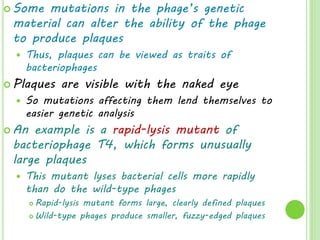
 An example is a rapid-lysis mutant of
bacteriophage T4, which forms unusually
large plaques
 This mutant lyses bacterial cells more rapidly
than do the wild-type phages
 Rapid-lysis mutant forms large, clearly defined plaques
 Wild-type phages produce smaller, fuzzy-edged plaques
Benzer’s fine-structure mapping of phage T4 used similar
experiments involving the rII gene.
a. Different rII mutations of T4 were used, each with the
characteristic large clear plaques and limited host range.
b. T4 with the wild-type r+ gene infects E. coil strains B
and K12(λ). But For rII T4(mutant), strain B is
permissive but K12(λ) is nonpermissive.
 In E. coli B
 rII phages produced unusually large plaques that had poor
yields of bacteriophages
 The bacterium lyses so quickly that it does not have time to
produce many new phages
 In E. coli K12S
 rII phages produced normal plaques that gave good yields of
phages
 In E. coli K12(λ)has phage lambda DNA integrated into
its chromosome)
 rII phages were not able to produce plaques at all
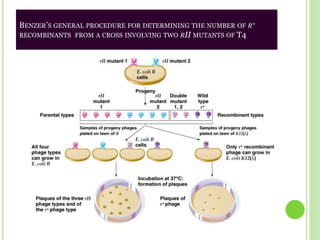
BENZER’S GENERAL PROCEDURE FOR DETERMINING THE NUMBER OF R+
RECOMBINANTS FROM A CROSS INVOLVING TWO RII MUTANTS OF T4
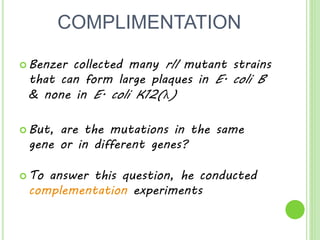
COMPLIMENTATION
 Benzer collected many rII mutant strains
that can form large plaques in E. coli B
& none in E. coli K12(λ)
 But, are the mutations in the same
gene or in different genes?
 To answer this question, he conducted
complementation experiments
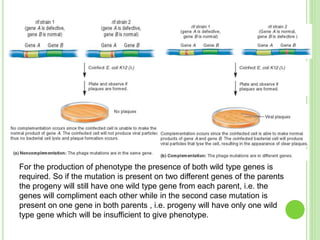
For the production of phenotype the presence of both wild type genes is
required. So if the mutation is present on two different genes of the parents
the progeny will still have one wild type gene from each parent, i.e. the
genes will compliment each other while in the second case mutation is
present on one gene in both parents , i.e. progeny will have only one wild
type gene which will be insufficient to give phenotype.
 Benzer carefully considered the pattern of
complementation & noncomplementation
 He determined that the rII mutations occurred in
two different genes, which were termed rIIA & rIIB
 Benzer coined the term cistron to refer to the
smallest genetic unit that gives a negative
complementation test
 So, if two mutations occur in the same cistron,
they cannot complement each other
 A cistron is equivalent to a gene
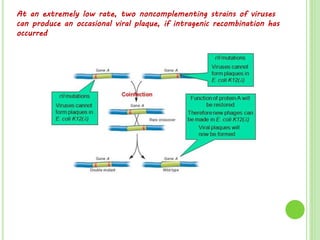
At an extremely low rate, two noncomplementing strains of viruses
can produce an occasional viral plaque, if intragenic recombination has
occurred
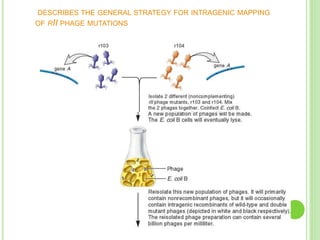
DESCRIBES THE GENERAL STRATEGY FOR INTRAGENIC MAPPING
OF RII PHAGE MUTATIONS
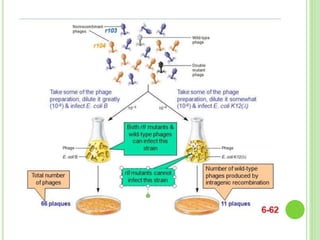
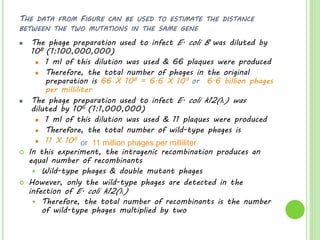
THE DATA FROM FIGURE CAN BE USED TO ESTIMATE THE DISTANCE
BETWEEN THE TWO MUTATIONS IN THE SAME GENE
 The phage preparation used to infect E. coli B was diluted by
108 (1:100,000,000)
 1 ml of this dilution was used & 66 plaques were produced
 Therefore, the total number of phages in the original
preparation is 66 X 108 = 6.6 X 10⁹ or 6.6 billion phages
per milliliter
 The phage preparation used to infect E. coli k12(λ) was
diluted by 106 (1:1,000,000)
 1 ml of this dilution was used & 11 plaques were produced
 Therefore, the total number of wild-type phages is
 11 X 106
 In this experiment, the intragenic recombination produces an
equal number of recombinants
 Wild-type phages & double mutant phages
 However, only the wild-type phages are detected in the
infection of E. coli k12(λ)
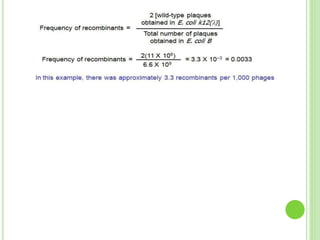
 Therefore, the total number of recombinants is the number
of wild-type phages multiplied by two
or 11 million phages per milliliter
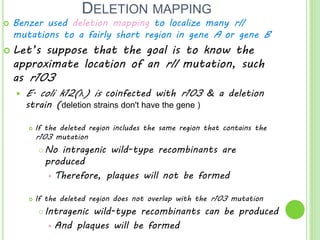
DELETION MAPPING
 Benzer used deletion mapping to localize many rII
mutations to a fairly short region in gene A or gene B
 Let’s suppose that the goal is to know the
approximate location of an rII mutation, such
as r103
 E. coli k12(λ) is coinfected with r103 & a deletion
strain (deletion strains don't have the gene )
 If the deleted region includes the same region that contains the
r103 mutation
 No intragenic wild-type recombinants are
produced
 Therefore, plaques will not be formed
 If the deleted region does not overlap with the r103 mutation
 Intragenic wild-type recombinants can be produced
 And plaques will be formed
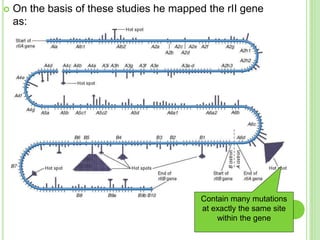
 On the basis of these studies he mapped the rII gene
as:
Contain many mutations
at exactly the same site
within the gene
Thank you !!

Genetics ppt

  • 1.
    INTRAGENIC CROSSING-OVER & COMPLIMENTATION Submittedto: Submitted by: Dr. Bharat singh Deepti barange B.tech biotech 4th sem
  • 2.
    WHAT IS INTRAGENICCROSSING OVER?  This simply means recombination within a gene.  In early 1950s Seymour Benzer undertook a detailed examination of a single locus, rII,in phage T4  He successfully designed experiments to recover the extremely rare genetic recombinations arising as a result of intragenic exchange.  He demonstrated such recombination occurs between DNA of individual bacteriophages during simultaneous infection of the host bacterium E.coli  His work is described as fine structure analysis due to extremely detailed information provided from his analysis
  • 4.
    WHAT ARE PLAQUES? A plaque is a clear area on an otherwise opaque bacterial lawn on the agar surface of a petri dish  It is caused by the lysis of bacterial cells as a result of the growth & reproduction of phages
  • 5.
     Some mutationsin the phage’s genetic material can alter the ability of the phage to produce plaques  Thus, plaques can be viewed as traits of bacteriophages  Plaques are visible with the naked eye  So mutations affecting them lend themselves to easier genetic analysis  An example is a rapid-lysis mutant of bacteriophage T4, which forms unusually large plaques  This mutant lyses bacterial cells more rapidly than do the wild-type phages  Rapid-lysis mutant forms large, clearly defined plaques  Wild-type phages produce smaller, fuzzy-edged plaques
  • 6.
    Benzer’s fine-structure mappingof phage T4 used similar experiments involving the rII gene. a. Different rII mutations of T4 were used, each with the characteristic large clear plaques and limited host range. b. T4 with the wild-type r+ gene infects E. coil strains B and K12(λ). But For rII T4(mutant), strain B is permissive but K12(λ) is nonpermissive.  In E. coli B  rII phages produced unusually large plaques that had poor yields of bacteriophages  The bacterium lyses so quickly that it does not have time to produce many new phages  In E. coli K12S  rII phages produced normal plaques that gave good yields of phages  In E. coli K12(λ)has phage lambda DNA integrated into its chromosome)  rII phages were not able to produce plaques at all
  • 7.
    BENZER’S GENERAL PROCEDUREFOR DETERMINING THE NUMBER OF R+ RECOMBINANTS FROM A CROSS INVOLVING TWO RII MUTANTS OF T4
  • 8.
    COMPLIMENTATION  Benzer collectedmany rII mutant strains that can form large plaques in E. coli B & none in E. coli K12(λ)  But, are the mutations in the same gene or in different genes?  To answer this question, he conducted complementation experiments
  • 9.
    For the productionof phenotype the presence of both wild type genes is required. So if the mutation is present on two different genes of the parents the progeny will still have one wild type gene from each parent, i.e. the genes will compliment each other while in the second case mutation is present on one gene in both parents , i.e. progeny will have only one wild type gene which will be insufficient to give phenotype.
  • 10.
     Benzer carefullyconsidered the pattern of complementation & noncomplementation  He determined that the rII mutations occurred in two different genes, which were termed rIIA & rIIB  Benzer coined the term cistron to refer to the smallest genetic unit that gives a negative complementation test  So, if two mutations occur in the same cistron, they cannot complement each other  A cistron is equivalent to a gene
  • 11.
    At an extremelylow rate, two noncomplementing strains of viruses can produce an occasional viral plaque, if intragenic recombination has occurred
  • 12.
    DESCRIBES THE GENERALSTRATEGY FOR INTRAGENIC MAPPING OF RII PHAGE MUTATIONS
  • 14.
    THE DATA FROMFIGURE CAN BE USED TO ESTIMATE THE DISTANCE BETWEEN THE TWO MUTATIONS IN THE SAME GENE  The phage preparation used to infect E. coli B was diluted by 108 (1:100,000,000)  1 ml of this dilution was used & 66 plaques were produced  Therefore, the total number of phages in the original preparation is 66 X 108 = 6.6 X 10⁹ or 6.6 billion phages per milliliter  The phage preparation used to infect E. coli k12(λ) was diluted by 106 (1:1,000,000)  1 ml of this dilution was used & 11 plaques were produced  Therefore, the total number of wild-type phages is  11 X 106  In this experiment, the intragenic recombination produces an equal number of recombinants  Wild-type phages & double mutant phages  However, only the wild-type phages are detected in the infection of E. coli k12(λ)  Therefore, the total number of recombinants is the number of wild-type phages multiplied by two or 11 million phages per milliliter
  • 16.
    DELETION MAPPING  Benzerused deletion mapping to localize many rII mutations to a fairly short region in gene A or gene B  Let’s suppose that the goal is to know the approximate location of an rII mutation, such as r103  E. coli k12(λ) is coinfected with r103 & a deletion strain (deletion strains don't have the gene )  If the deleted region includes the same region that contains the r103 mutation  No intragenic wild-type recombinants are produced  Therefore, plaques will not be formed  If the deleted region does not overlap with the r103 mutation  Intragenic wild-type recombinants can be produced  And plaques will be formed
  • 17.
     On thebasis of these studies he mapped the rII gene as: Contain many mutations at exactly the same site within the gene
  • 18.