GENE TARGETING AND
SEQUENCE TAGS
ALEN SHAJI
P1914015
GENE TARGETING
 To modifying the structure of a specific gene.
 Gene targeting vector introduced into the cell.
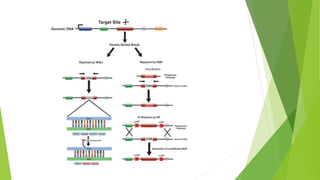
 Vector modifies the normal chromosomal gene through homologous
recombination.
HOMOLOGOUS RECOMBINATION
 Occurs within the chromosome.
 One piece of DNA to be exchanged for another piece.
 Cellular mechanism.
 DNA undergoing recombination be almost identical/homologous in sequence.
 Sequence on either side of the target should be identical, to promote more
efficient targeting and recombination.
 Modification of more or less any gene of interest, in more or less any way
desired.
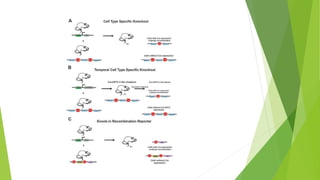
 Mutating specific genes
 Knock out specific genes.
 Knock in specific genes – Introduction of novel pieces of DNA into a specific
chromosomal location – To examine the function of a gene in a variety of
ways.
 By changing single genes, it is possible to remove or alter large pieces of
chromosomes.
 Genes can be removed from a particular tissue.
THERAPEUTIC POTENTIAL OF GENE
TARGETING
 Useful in treating some human genetic disorders – Hemophilia, Duchenne
Muscular Dystrophy.
 Treating human diseases by genetic approaches – Gene Therapy.
 Gene Therapy – Replacing the defective gene by normal copy of the gene.
AWARDS
 Mario R. Capecchi, Martin. J. Evans and Oliver Smithies were awarded the
2007 Nobel Prize in Physiology and Medicine.
 Work – “Principles for introducing specific gene modifications in mice by the
use of embryonic stem cells”, or gene targeting.
SEQUENCE TAG
 Expressed sequence tag/EST is a short partial sequence, typically 200-400 bp
long, of a complimentary DNA/cDNA.
 EST is a short sub-sequence of a cDNA sequence.
 Used to identify gene transcripts, and are instrumental in gene discovery and
in gene-sequence determination.
 Approximately 74.2 million ESTs are available in public databases.
 EST results from one-short sequencing of a cloned cDNA.
 Low-quality fragments.
 Length is approximately 500 to 800 nucleotides.
 Complementary to mRNA.
 ESTs represents portions of expressed genes.
 Represented in databases as either cDNA/mRNA sequence or as the reverse
complement of the mRNA, the template strand.
 One can map ESTs to specific chromosome locations using physical mapping
techniques – Radiation hybrid mapping, Happy mapping, or FISH.
 Alternatively, if the genome of the organism that originated the EST has been
sequenced, one can align the EST sequence to that genome using a computer.
 The current understanding of the human set of genes includes the existence
of thousands of genes based solely on EST evidence.
 ESTs have become a tool to refine the predicted transcripts for those genes,
which leads to the prediction of their protein products and ultimately of their
function.
 The situation in which those ESTs are obtained gives information on the
conditions in which the corresponding gene is acting.
 ESTSs contain enough information to permit the design of precise probes for
DNA microarrays that then can be used to determine gene expression profiles.
REFERENCE
 Joyner, A., ed. Gene Targeting; A Practical Approach, 2nd ed. New York; Oxford
University; Press, 1999.
 Torres, R.M., and R. Kuhn. Laboratory Protocols for Conditional Gene
Targeting; New York; Oxford University; Press, 1997.
 Campagne f, Skrabanek L; Bioinformatics; 2006.
 Christoffels A, van Gelder A, Greyling G, Miller R, Hide W; “stack; Sequence
Tag Alignment and Consensus Knowledgebase”; 2001.
THANK YOU

Gene targeting and sequence tags

  • 1.
    GENE TARGETING AND SEQUENCETAGS ALEN SHAJI P1914015
  • 2.
    GENE TARGETING  Tomodifying the structure of a specific gene.  Gene targeting vector introduced into the cell.  Vector modifies the normal chromosomal gene through homologous recombination.
  • 3.
    HOMOLOGOUS RECOMBINATION  Occurswithin the chromosome.  One piece of DNA to be exchanged for another piece.  Cellular mechanism.  DNA undergoing recombination be almost identical/homologous in sequence.  Sequence on either side of the target should be identical, to promote more efficient targeting and recombination.  Modification of more or less any gene of interest, in more or less any way desired.
  • 4.
     Mutating specificgenes  Knock out specific genes.  Knock in specific genes – Introduction of novel pieces of DNA into a specific chromosomal location – To examine the function of a gene in a variety of ways.  By changing single genes, it is possible to remove or alter large pieces of chromosomes.  Genes can be removed from a particular tissue.
  • 7.
    THERAPEUTIC POTENTIAL OFGENE TARGETING  Useful in treating some human genetic disorders – Hemophilia, Duchenne Muscular Dystrophy.  Treating human diseases by genetic approaches – Gene Therapy.  Gene Therapy – Replacing the defective gene by normal copy of the gene.
  • 8.
    AWARDS  Mario R.Capecchi, Martin. J. Evans and Oliver Smithies were awarded the 2007 Nobel Prize in Physiology and Medicine.  Work – “Principles for introducing specific gene modifications in mice by the use of embryonic stem cells”, or gene targeting.
  • 9.
    SEQUENCE TAG  Expressedsequence tag/EST is a short partial sequence, typically 200-400 bp long, of a complimentary DNA/cDNA.  EST is a short sub-sequence of a cDNA sequence.  Used to identify gene transcripts, and are instrumental in gene discovery and in gene-sequence determination.  Approximately 74.2 million ESTs are available in public databases.  EST results from one-short sequencing of a cloned cDNA.  Low-quality fragments.  Length is approximately 500 to 800 nucleotides.
  • 10.
     Complementary tomRNA.  ESTs represents portions of expressed genes.  Represented in databases as either cDNA/mRNA sequence or as the reverse complement of the mRNA, the template strand.  One can map ESTs to specific chromosome locations using physical mapping techniques – Radiation hybrid mapping, Happy mapping, or FISH.  Alternatively, if the genome of the organism that originated the EST has been sequenced, one can align the EST sequence to that genome using a computer.
  • 11.
     The currentunderstanding of the human set of genes includes the existence of thousands of genes based solely on EST evidence.  ESTs have become a tool to refine the predicted transcripts for those genes, which leads to the prediction of their protein products and ultimately of their function.  The situation in which those ESTs are obtained gives information on the conditions in which the corresponding gene is acting.  ESTSs contain enough information to permit the design of precise probes for DNA microarrays that then can be used to determine gene expression profiles.
  • 12.
    REFERENCE  Joyner, A.,ed. Gene Targeting; A Practical Approach, 2nd ed. New York; Oxford University; Press, 1999.  Torres, R.M., and R. Kuhn. Laboratory Protocols for Conditional Gene Targeting; New York; Oxford University; Press, 1997.  Campagne f, Skrabanek L; Bioinformatics; 2006.  Christoffels A, van Gelder A, Greyling G, Miller R, Hide W; “stack; Sequence Tag Alignment and Consensus Knowledgebase”; 2001.
  • 13.