COMMUNITY DYNAMICS CHARACTERISTICS- CYCLIC AND NON-
CYCLIC REPLACEMENT CHANGES
SUBMITTED TO, SUBMITTED BY
DR. AGHIL SOORYA KRISHNAPRIYA M
DEPARTMENT OF BOTANY ROLL NO: 10
ST.TERESA’S COLLEGE II M.Sc BOTANY
1
COMMUNITY DYNAMICS
 Communities are complex systems characterized by community structure (number and size of populations
and their interactions) and community dynamics (how members and their interactions change over time).
 Understanding community structure and dynamics allow us to minimize impacts on ecosystem and manage
ecological communities we benefit from.
 Changes in community structure and composition over time, often following environmental disturbances
such as earthquakes, volcanoes, storms, fires and climate change is called Community Dynamics.
2
Community dynamics cont…
 Communities with a relatively constant number of species are said to be at equilibrium.
 Equilibrium is dynamic with species identities and relationships changing over time.
 But it maintains relatively constant numbers.
 Following a disturbance, communities may or may not return to equilibrium state.
 Succession- sequential appearance and disappearance of species in a community over time after a severe
disturbance.
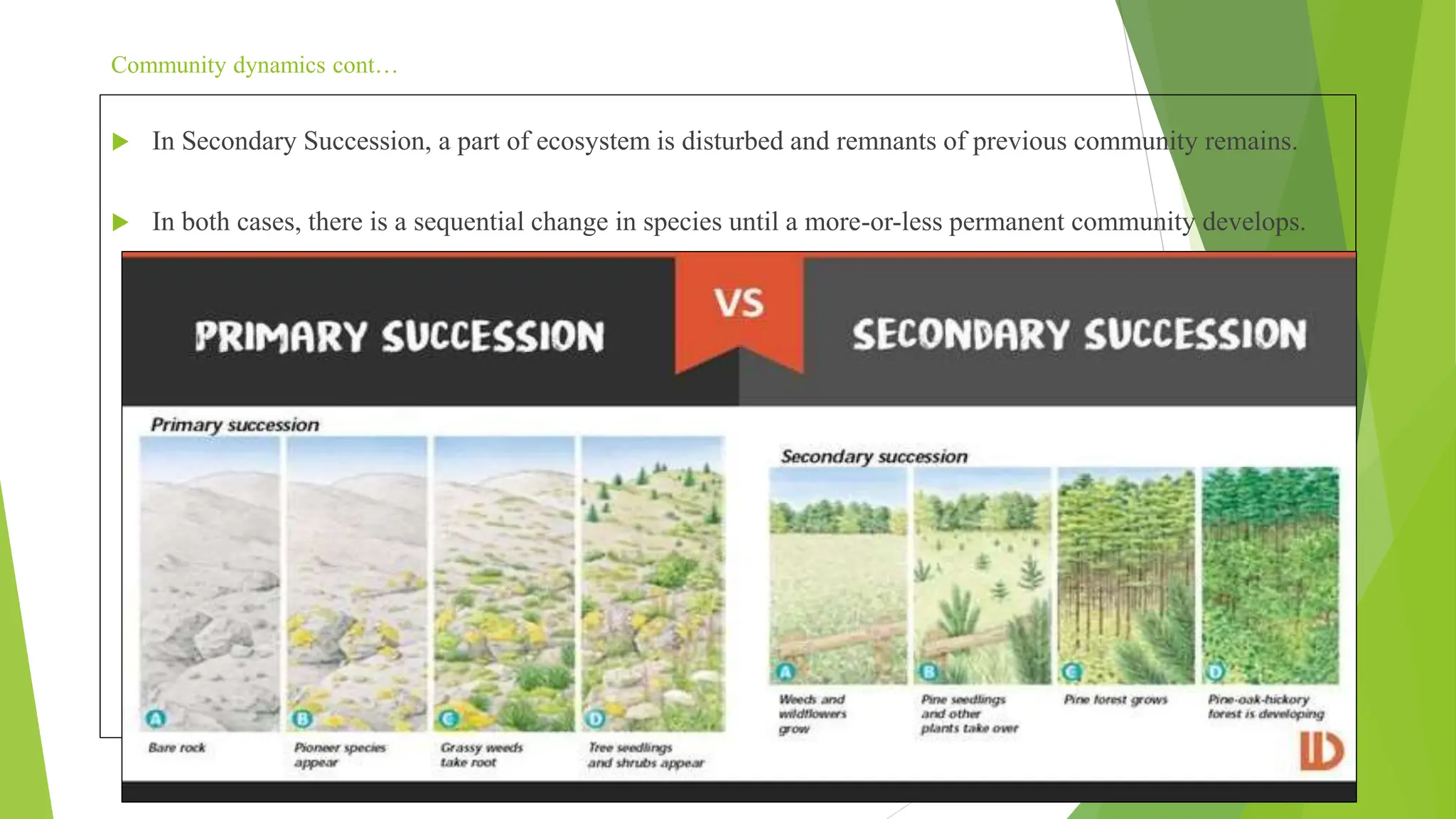
 In Primary Succession, newly exposed or newly formed rock is colonized by living organisms.
3
Community dynamics cont…
 In Secondary Succession, a part of ecosystem is disturbed and remnants of previous community remains.
 In both cases, there is a sequential change in species until a more-or-less permanent community develops.
4
CYCLIC REPLACEMENT CHANGES
 Cyclic replacement changes involves a series of vegetation and habitat changes through which community
maintains and regenerates itself.
 It is also a pattern of vegetation change in which small number of species tend to replace each other over
time unless there is large-scale disturbance.
 It is one of several types of ecological succession and is a concept of community ecology.
 Cyclic succession refers to processes not initiated by wholesale exogenous disturbances or long term
physical changes in environment.
5
Cyclic replacement changes cont…
 Cyclic mode of succession was proposed by British ecologist Alexander Watt in 1947 in his seminal paper
on vegetation patterns in grass, heath and bog communities.
 He described plant community as a regenerating entity.
 He explains that community can either be in an upgrade phase toward late successional shrubs or downward
phase toward grasses.
 These phases occur in a predictable cycle.
6
Cyclic replacement changes cont…
 Cyclic model of succession can be explained in a transition matrix.
 The three states in the cyclic model are open substrate (usually a bare patch of land), Species A dominance
and Species B dominance.
 It explains that Species A and Species B are not autosuccessional- they do not facilitate their own growth.
 Species A will either facilitate succession of Species B or be eliminated (through mortality) such that patch
occupied becomes open substrate.
 Species B will either facilitate succession of Species A or be eliminated.
 Open substrate can remain open or become occupied by either Species A or B.
 This results in cyclic scheme of species dominance.
7
Cyclic replacement changes cont…
 Cyclic succession usually involves a series of stages, with different dominating at each stage.
 These stages often occur due to disturbances or environmental changes.
a) Pioneer species:
 Cyclic succession often begins with pioneer species, which are first to colonize a disturbed or barren
environment.
 These species are adapted to harsh conditions.
b) Intermediate species:
 As environment stabilizes, intermediate species with different ecological characteristics may replace pioneer
species. This lead to increased biodiversity.
8
Cyclic replacement changes cont…
c) Climax species:
 Eventually, a stable and mature community dominated by climax species may develop.
 These species are well suited to prevailing environmental conditions and are typically more competitive.
d) Disturbance and Reversal:
 Cyclic succession may not always lead to a climax community.
 Disturbances or changes in environmental conditions can restart the cycle, returning community to earlier
stages.
9
Cyclic replacement changes cont…
Example 1: Calluna vulgaris
 When Calluna dies in a patch, Cladonia sylvatica grows and become dominant on dead stems of Calluna
stems, if protection is provided.
 Disintegration of Cladonia and creation of bare patches of exposed soil follow this and is the termination of
downgrade series.
 Upgrade series is initiated on bare patches with appearance and subsequent occupation of Arctostaphylos
uva-ursi.
 This stage is subsequently invaded by Calluna, which becomes dominant again completing upgrade series.
10
11
Cyclic replacement changes cont…
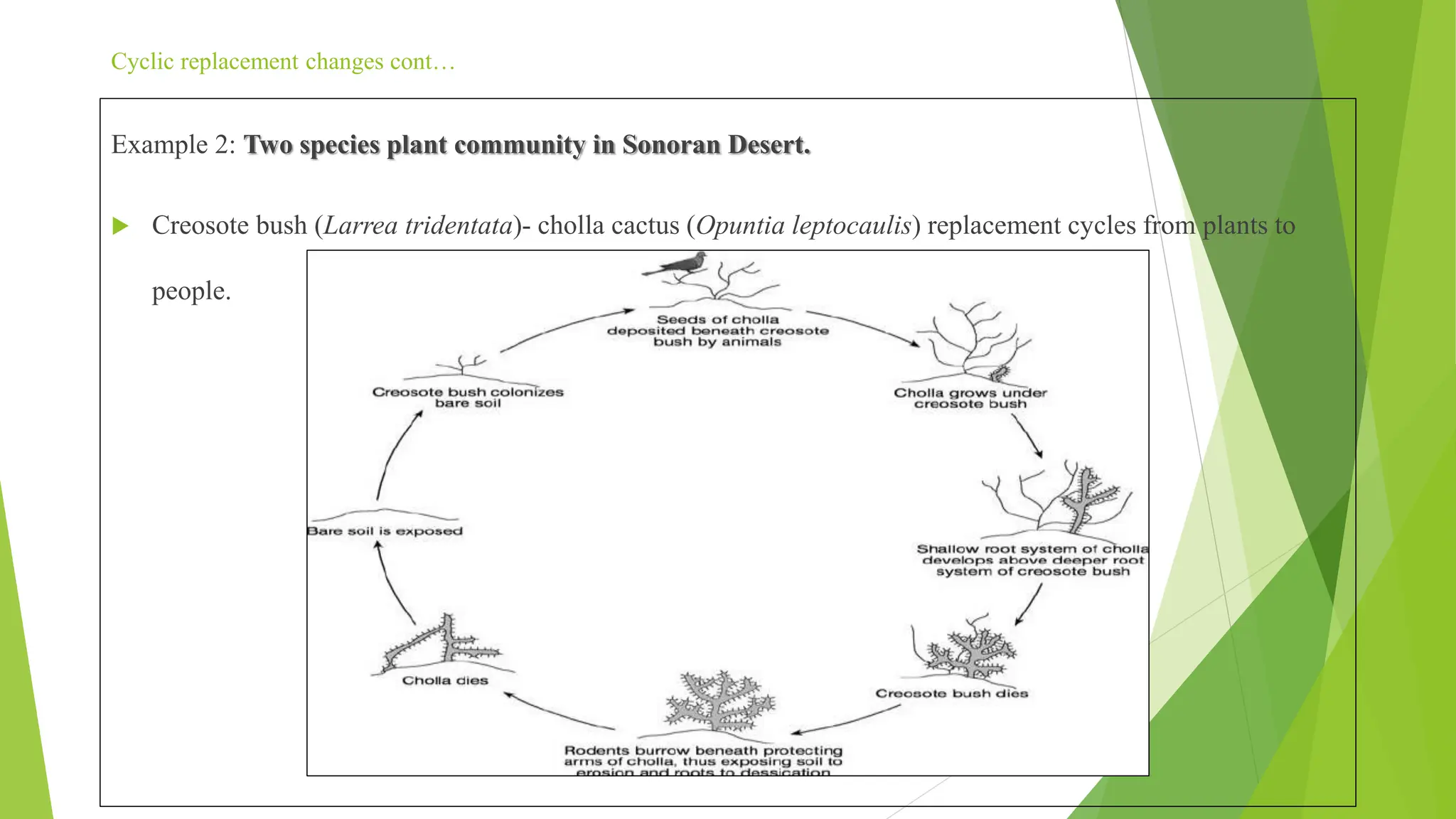
Example 2: Two species plant community in Sonoran Desert.
 Creosote bush (Larrea tridentata)- cholla cactus (Opuntia leptocaulis) replacement cycles from plants to
people.
12
13
Cyclic replacement changes cont…
Example 3: Repeated fire cycles of coastal chaparral ecosystem in California
 This type of ecosystem has a climax community of shrub-sized deciduous and evergreen vegetation.
 Fires are major source of disturbance in this ecosystem.
 Fires come through in cycles of between 10 and 15 years or sometimes longer.
 Plants and animals must be adapted to long periods of dryness and mild, winter time precipitation.
 When fires occur, plant life can recover relatively rapidly and return to similar climax community in less
than several years.
14
15
NON-CYCLIC REPLACEMENT CHANGES
 Also known as directional succession.
 It involves a continuous and one-way sequence of species replacement within a community.
 This type of succession occurs when a community transitions through a series of distinct stages, each
characterised by different dominant species.
 Community ultimately reaches a climax state in which species composition remains relatively stable, as long
as environmental conditions remain constant.
 They are often observed in environments with more gradual or continuous changes, such as changes in soil
conditions or climate.
16
Non-cyclic replacement changes cont…
 As environmental conditions shifts, species that are better adapted to new conditions gradually replaces
previous dominant species.
 This process continues until a climax community is reached where species composition is relatively stable.
Eg: If a field is left abandoned, it may undergo directional succession from grasses to shrubs and eventually to
trees over course of many years as soil and environmental conditions change.
17
reference
1) Dash. M. C. (2001). Fundamentals of Ecology. Tata McGraw-Hill Education.
2) Mishra, D. D. (2008). Fundamental Concepts in Environmental Studies. S. Chand & Company Pvt Ltd.
3) Sharma, P. D., & Sharma, P. D. (2012). Ecology and Environment. Rastogi Publications.
18
THANK YOU
19

COMMUNITY DYNAMICS CHARACTERISTICS- CYCLIC AND NON-CYCLIC REPLACEMENT CHANGES.pptx

  • 1.
    COMMUNITY DYNAMICS CHARACTERISTICS-CYCLIC AND NON- CYCLIC REPLACEMENT CHANGES SUBMITTED TO, SUBMITTED BY DR. AGHIL SOORYA KRISHNAPRIYA M DEPARTMENT OF BOTANY ROLL NO: 10 ST.TERESA’S COLLEGE II M.Sc BOTANY 1
  • 2.
    COMMUNITY DYNAMICS  Communitiesare complex systems characterized by community structure (number and size of populations and their interactions) and community dynamics (how members and their interactions change over time).  Understanding community structure and dynamics allow us to minimize impacts on ecosystem and manage ecological communities we benefit from.  Changes in community structure and composition over time, often following environmental disturbances such as earthquakes, volcanoes, storms, fires and climate change is called Community Dynamics. 2
  • 3.
    Community dynamics cont… Communities with a relatively constant number of species are said to be at equilibrium.  Equilibrium is dynamic with species identities and relationships changing over time.  But it maintains relatively constant numbers.  Following a disturbance, communities may or may not return to equilibrium state.  Succession- sequential appearance and disappearance of species in a community over time after a severe disturbance.  In Primary Succession, newly exposed or newly formed rock is colonized by living organisms. 3
  • 4.
    Community dynamics cont… In Secondary Succession, a part of ecosystem is disturbed and remnants of previous community remains.  In both cases, there is a sequential change in species until a more-or-less permanent community develops. 4
  • 5.
    CYCLIC REPLACEMENT CHANGES Cyclic replacement changes involves a series of vegetation and habitat changes through which community maintains and regenerates itself.  It is also a pattern of vegetation change in which small number of species tend to replace each other over time unless there is large-scale disturbance.  It is one of several types of ecological succession and is a concept of community ecology.  Cyclic succession refers to processes not initiated by wholesale exogenous disturbances or long term physical changes in environment. 5
  • 6.
    Cyclic replacement changescont…  Cyclic mode of succession was proposed by British ecologist Alexander Watt in 1947 in his seminal paper on vegetation patterns in grass, heath and bog communities.  He described plant community as a regenerating entity.  He explains that community can either be in an upgrade phase toward late successional shrubs or downward phase toward grasses.  These phases occur in a predictable cycle. 6
  • 7.
    Cyclic replacement changescont…  Cyclic model of succession can be explained in a transition matrix.  The three states in the cyclic model are open substrate (usually a bare patch of land), Species A dominance and Species B dominance.  It explains that Species A and Species B are not autosuccessional- they do not facilitate their own growth.  Species A will either facilitate succession of Species B or be eliminated (through mortality) such that patch occupied becomes open substrate.  Species B will either facilitate succession of Species A or be eliminated.  Open substrate can remain open or become occupied by either Species A or B.  This results in cyclic scheme of species dominance. 7
  • 8.
    Cyclic replacement changescont…  Cyclic succession usually involves a series of stages, with different dominating at each stage.  These stages often occur due to disturbances or environmental changes. a) Pioneer species:  Cyclic succession often begins with pioneer species, which are first to colonize a disturbed or barren environment.  These species are adapted to harsh conditions. b) Intermediate species:  As environment stabilizes, intermediate species with different ecological characteristics may replace pioneer species. This lead to increased biodiversity. 8
  • 9.
    Cyclic replacement changescont… c) Climax species:  Eventually, a stable and mature community dominated by climax species may develop.  These species are well suited to prevailing environmental conditions and are typically more competitive. d) Disturbance and Reversal:  Cyclic succession may not always lead to a climax community.  Disturbances or changes in environmental conditions can restart the cycle, returning community to earlier stages. 9
  • 10.
    Cyclic replacement changescont… Example 1: Calluna vulgaris  When Calluna dies in a patch, Cladonia sylvatica grows and become dominant on dead stems of Calluna stems, if protection is provided.  Disintegration of Cladonia and creation of bare patches of exposed soil follow this and is the termination of downgrade series.  Upgrade series is initiated on bare patches with appearance and subsequent occupation of Arctostaphylos uva-ursi.  This stage is subsequently invaded by Calluna, which becomes dominant again completing upgrade series. 10
  • 11.
  • 12.
    Cyclic replacement changescont… Example 2: Two species plant community in Sonoran Desert.  Creosote bush (Larrea tridentata)- cholla cactus (Opuntia leptocaulis) replacement cycles from plants to people. 12
  • 13.
  • 14.
    Cyclic replacement changescont… Example 3: Repeated fire cycles of coastal chaparral ecosystem in California  This type of ecosystem has a climax community of shrub-sized deciduous and evergreen vegetation.  Fires are major source of disturbance in this ecosystem.  Fires come through in cycles of between 10 and 15 years or sometimes longer.  Plants and animals must be adapted to long periods of dryness and mild, winter time precipitation.  When fires occur, plant life can recover relatively rapidly and return to similar climax community in less than several years. 14
  • 15.
  • 16.
    NON-CYCLIC REPLACEMENT CHANGES Also known as directional succession.  It involves a continuous and one-way sequence of species replacement within a community.  This type of succession occurs when a community transitions through a series of distinct stages, each characterised by different dominant species.  Community ultimately reaches a climax state in which species composition remains relatively stable, as long as environmental conditions remain constant.  They are often observed in environments with more gradual or continuous changes, such as changes in soil conditions or climate. 16
  • 17.
    Non-cyclic replacement changescont…  As environmental conditions shifts, species that are better adapted to new conditions gradually replaces previous dominant species.  This process continues until a climax community is reached where species composition is relatively stable. Eg: If a field is left abandoned, it may undergo directional succession from grasses to shrubs and eventually to trees over course of many years as soil and environmental conditions change. 17
  • 18.
    reference 1) Dash. M.C. (2001). Fundamentals of Ecology. Tata McGraw-Hill Education. 2) Mishra, D. D. (2008). Fundamental Concepts in Environmental Studies. S. Chand & Company Pvt Ltd. 3) Sharma, P. D., & Sharma, P. D. (2012). Ecology and Environment. Rastogi Publications. 18
  • 19.