1
 Ethanol (ethyl alcohol, EtOH) is a clear, colourless liquid with a characteristic,
pleasant odour .
 Ethyl alcohol is the intoxicating component in beer, wine and other alcoholic
beverages.
 In dilute aqueous solution, it has a somewhat sweet flavor, but in more
concentrated solutions it has a burning taste.
 It is also being used as a biofuel in several countries across the world.
 Large industrial plants are the primary sources of ethanol production,
though some people have chosen to produce their own ethanol.
 Ethanol production from agricultural products has been in practice for more
than 100 years
2
 . Ethanol can be produced from many kinds of raw materials that contain
starch, sugar or cellulose etc.
 In general there are three groups of raw materials from which ethanol can
be produced:
 1) beet, sugar cane, sweet sorghum and fruits
 2) starchy material such as corn, milo, wheat, rice, potatoes, cassava,
sweet potatoes etc.
 3) cellulose materials like wood, used paper, crop residues etc.
 The third group of materials mostly include biomass. Recently, biomass is
being considered as an important biological resource for the production
of ethanol
3
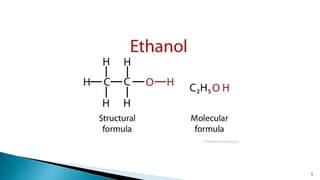
 Ethanol/ ethyl alcohol/ drinking alcohol, is a chemical compound, with
chemical formula C₂H₅OH.
 Boiling point -78.37 °C, molar mass - 46.07 g/mol .
 It is colorless, volatile, flammable liquid that has a characteristic odour.
 It burns with a smokeless blue flame that is invisible in normal light .
4
5
 It is imperative that the microorganisms used must have a high tolerance
for alcohol, must grow vigorously and produce a large quantity of alcohol.
 Yeasts, particularly Saccharomyces cerevisiae, represent the best known
microorganisms used in the production of ethyl alcohol.
 Yeast – Saccharomyces, Torulposis, Candida , Mucor sps etc.
 Most important kind belong to the Saccharomyces genus
 Two types :
 Top Fermenter yeasts ex: S. cervisiae
 Bottom fermenters ex: S. carlsbergensis
6
 Efficient strain for large production .
 Fast growing strain.
 High tolerance to alcohol as well as osmotic pressure .
 Possess uniform and stable biochemical properties .
7
 10 ml of sterile medium is inoculated with culture and incubated at 28 °c to
30 °c for a suitable period.
 Tube medium is transferred to a flask containing 200 ml sterile medium
and incubated at 30 °c.
 The flask medium is further transferred to a glass container containing
sterile medium and incubated.
 Finally the sterile medium is transferred into small vessel with 10 to 30
gallons of medium that goes fermentation
8
 Saccharide materials: molasses,, whey, glucose, fruit juices.
 Starchy material: potato starch, corn starch, wheat starch, cereals.
 Cellulosic materials: sulphite waste liquor
 Pretreatment of raw material depends on type of raw material.
 Sugary materials : mild
 Cellulosic: extensive acidic or enzyme hydrolysis to release monosaccharide
units
 PRE TREATMENT: Hydrolysis, clarification, filtration
9
 CARBON SOURCE: sugar concentration of 12 percent is usually used, being
the optimum range. For ex: cane molasses contains sucrose as a carbon
source.
 NITROGEN SOURCE: ammonium sulphate (0.15g per 2.5 gallons of
molasses) is used to Promotes growth.
 pH: 4.8 - 5.
 Temperature: 70 to 80 °F. (30-35 °c)
 TIME: 24 hours.
10
 Alcoholic fermentation is an anaerobic process.
 Microorganisms utilizes the carbohydrates in the raw materials (molasses)
for growth and metabolic activity and for the formation of alcohol.
 Monosaccharides have direct fermentation. But disaccharides have to first
hydrolyze into hexose and later ferment into alcohols and gives out CO2.
 Follows the EMBDEN-MEYERHOF-PARNAS (EMP) pathway .
 C6H12O6 2CH3CH2OH + 2CO2
11
 Molasses contain about 50% fermentable carbohydrates (sugars).
 Big deep tanks of steel or stainless steel are used as containers in the
industrial production method.
 Molasses is diluted to a suitable sugar concentration (15-16%); a small
quantity of nitrogen source (e.g., ammonium phosphate, urea, ammonium
sulphate) and sulphuric acid (H2SO4 ) is added in it.
 pH of this medium is maintained at about 5.0 and an actively growing
Saccharomyces cerevisiae culture is added in it.
 The fermentation starts and is allowed to proceeding for about 24-40 hours
at about 25-30°C temperature.
12
 The fermented medium is then distilled and passes through rectifying
columns to obtain ethyl alcohol.
 The yield of ethyl alcohol ranges about 50% of the fermentable sugar
concentration present in the medium.
 The large amount of CO2 which is produced during the fermentation
process as a result of decarboxylation, is recovered and compressed to its
solid state.
 The yeast recovered is usually used as an animal feed.
13
14
15
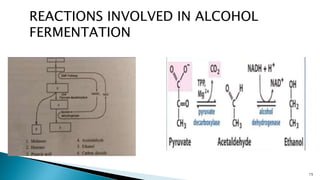
REACTIONS INVOLVED IN ALCOHOL
FERMENTATION
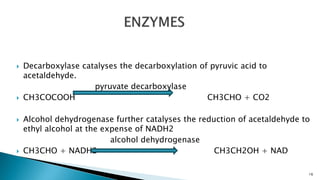
 Decarboxylase catalyses the decarboxylation of pyruvic acid to
acetaldehyde.
pyruvate decarboxylase
 CH3COCOOH CH3CHO + CO2
 Alcohol dehydrogenase further catalyses the reduction of acetaldehyde to
ethyl alcohol at the expense of NADH2
alcohol dehydrogenase
 CH3CHO + NADH2 CH3CH2OH + NAD
16
 Both yeasts (Saccharomyces cerevisiae, S. uvarum S. carlsbergensis, Candida
brassicae, C. utilis, Kluyveromyces fragilis, K. lactis) and bacteria (Zymomonas
mobilis) have been employed for ethanol production in industries.
 The commercial production is carried out with Saccharomyces cerevisiae. On the
other hand,S. uvarum has also largely been used. The Candida utilis is used for
the fermentation of waste sulphite liquor since it also ferments pentoses.
 Recently, experimentation with Schizosaccharomyces has shown promising
results. When whey from milk is used, strain of K. fragilis is recommended for
the production of ethanol. It is also found that Fusarium, Bacillus and Pachysolen
tannophilus (yeast) can transform pentose sugars to ethanol.
 It is noteworthy that the ethanol at high concentration inhibits the yeast. Hence,
the concentration of ethanol reduces the yeast growth rate which affect the
biosynthesis of ethanol.
 The bacteria Zymomonas mobilis has a merit over yeast that it has osmotic
tolerance to higher sugar concentration. It is relatively having high tolerance to
ethanol and have more specific growth rate.
17
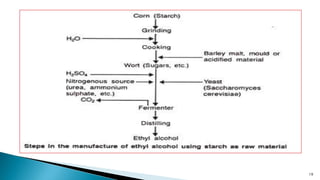
 When starches such as corn are used as the raw material they have first to
be hydrolysed to release simple fermentable sugars.
 The hydrolysis can be accomplished with enzymes from barley malt or
moulds (e.g., Aspergillus oryzae) or by heat-treatment of acidified
material.
 After the simple fermentable sugars are obtained, the fermentation
process proceeds similarly to that of molasses.
18
19
 Three types of substrates are used for ethanol production:
 (a) Starch containing substrate
 (b) Juice from sugarcane or molasses or sugar beet,
 (c) Waste products from wood or processed wood.
 (d) Production of ethanol from whey is not viable.
20
 If yeast strains are to be used, the starch must be hydrolysed as yeast does
not contain amylases.
 After hydrolysis, it is supplemented with celluloses of microbial origin so
as to obtain reducing sugars.
 About 1 ton of starch required 1 litre of amylases and 3.5 litre of
glucoamylases.
 On the other hand, if molasses are used for ethanol production, the
bagasse can also give ethanol after fermentation.
 Several other non-conventional sources of energy such as aquatic plant
biomass, wood after hydrolysis with celluloses gives ethanol.
 Sulphite waste-liquor, a waste left after production of paper, also contains
hexose as well as pentose sugar. The former can be microbially easily
converted.
21
 Ethanol is produced by continuous fermentation. Hence, large fermenters
are used for continuous manufacturing of ethanol.
 The process varies from one country to another. India, Brazil, Germany,
Denmark have their own technology for ethanol production.
 The fermentation conditions are almost similar (pH 5, temperature 35°C)
but the cultures and culture conditions are different.
 The fermentation is normally carried out for several days but within 12h
starts production.
22
 After the fermentation is over, the cells are separated to get biomass of
yeast cells which are used as single cell protein (SCP) for animal’s feed.
 The culture medium or supernatant is processed for recovery of ethanol
 Ethanol is also produced by batch fermentation as no significant
difference is found both in batch and continuous fermentation.
 Although as stated earlier within 12h Saccharomyces cerevisiae starts
producing ethanol at the rate of 10% (v/v) with 10-20g cells dry
weight/lit.
 The reduction in fermentation time is accomplished use of cell recycling
continuously in fermentation.
23
 Ethanol can be recovered upto 95% by successive distillations.
 To obtain 100%, it requires to form an azeotropic mixture containing 5%
water.
 Thus 5% water is removed from azeotropic mixture of ethanol, water and
benzene after distillation.
 In this procedure, benzene water ethanol and then ethanol-benzene
azeotropic mixture are removed so that absolute alcohol is obtained
24
 (i) Use as a chemical feed stock : In the chemical industry, ethanol is an
intermediate in many chemical processes because of its great reactivity. It is
thus a very important chemical feed stock.
 (ii) Solvent use : Ethanol is widely used in industry as a solvent for dyes, oils,
waxes, explosives, cosmetics etc.
 (iii) General utility : Alcohol is used as a disinfectant in hospitals, for
cleaning and lighting in the home, and in the laboratory second only to
water as a solvent.
 (iv) Fuel : Ethanol is mixed with petrol or gasoline up to 10% and known as
gasohol and used in automobiles.
25
 Amorim, H., & Lima, U. A., (2000). Ethanol production. Industrial
Biotechnology, 3, 16–17
 Okafor, N. (2007). Modern Industrial Microbiology and Biotechnology.
Science Publishers
 http://www.biologydiscussion.com/industrialmicrobiology2/fermentation
-industrialmicrobiology-2/production-of-ethanol-microbiology/66072.
26