Biol207 Dr. Locke section Lecture#3-Appendix Fall'08 page 1
BIOLOGY 207 - Dr.Locke
Complementation Help
Complementation is a fundamental principle in genetics and its understanding is needed to appreciate many
aspects of genetics.
Definitions: (Modified from "A Dictionary of Genetics" 4th Edition by RC King & WD Stansfield, 1990.)
Complementation - the appearance of a wild type phenotype in an organism or cell containing two
different mutations combined in a hybrid diploid.
Non-complementation - the appearance of a mutant phenotype in an organism or cell containing two
different mutations combined in a hybrid diploid. Also called "lack of complementation" or "no complementation".
Mutant and gene nomenlature: Prior to a complementation test we will be unsure of the
relationship between the two mutations (allelic or non-allelic) so the nomenclature we use needs to be
ambiguous. Here "m1" and "m2" are used and not "a" and "b" or a
1
and a
2
. Only after a complementation test
results are known can we use typical genetic nomenclature that defines the mutations as allelic (m1/m2) or non-
allelic (m1 + / + m2).
Complementation test - the introduction of two mutant chromosomes into the same cell to see if the
mutations in question (e.g. "m1" and "m2") occurred in the same gene (allelic) or in different genes (non-allelic).
If the mutations are allelic then a mutant phenotype will result and the genotype of the hybrid may be
symbolized as m1/m2 .
If the mutations are non-allelic then the phenotype will be wild type and the genotype of the hybrid may be
symbolized as m1 + / + m2 or m1/+ ; +/m2.
The wild type phenotype will be expressed, since each chromosome "makes up for" or "complements" the
defect in the other.
Complementation test:
In Haploid species (e.g. yeast)
Introduction:
You begin with two (or more) independently derived
mutations in strains of haploid yeast that have similar
mutant phenotypes. In this example we will call the two
strains "m1" and "m2", for mutation#1 and mutation#2. The
mutant phenotype could be colony colour, auxotrophy of the
same compound, or any other character that distinguishes it
from wild type.
The question to be answered in a complementation
test is:
Are these two (or more) strains mutant in the same gene or
are they mutant in different genes? That is, are m1 and m2
allelic or non-allelic mutations?
In Diploid species (e.g. Drosophila,
humans, plants, etc.)
Introduction:
You begin with two (or more) independently derived
mutations in strains of diploid speices that have similar
mutant phenotypes. In this example we will call the two
strains "m1" and "m2", for mutation#1 and mutation#2. The
phenotype could be body colour or any other character that
distinguishes it from wild type.
The question to be answered in a complementation test
is:
Are these two (or more) strains mutant in the same gene or
are they mutant in different genes? That is, are m1 and m2
allelic or non-allelic mutations?
TEST:
To "cross" yeast strains we need differing mating types, a
and α (alpha), which are similar to males and female in
diploid species. The cross is done by putting the two
strains, with the different mutations (and different mating
types) together on a petri dish containing mating medium.
When mating occurs the two haploid cells fuse to form one
diploid cell. This diploid cell contains both mutations. We
can now propagate this diploid cell to make a diploid cell
strain that we can test or examine for its phenotype -
mutant or wild type?
One of two outcomes is possible from a cross of
TEST:
We "cross" males of one strain (one mutation) with female of
another strain (a different mutation. The resulting progeny
are tested or examined for their phenotype - mutant or wild
type?
One of two outcomes is possible from a cross of
Biol207 Dr. Locke section Lecture#3-Appendix Fall'08 page 2
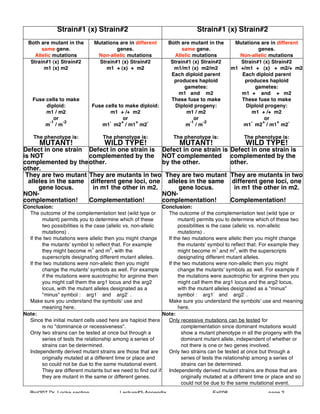
Strain#1 (x) Strain#2 Strain#1 (x) Strain#2
Both are mutant in the
same gene.
Allelic mutations
Mutations are in different
genes.
Non-allelic mutations
Both are mutant in the
same gene.
Allelic mutations
Mutations are in different
genes.
Non-allelic mutations
Strain#1 (x) Strain#2
m1 (x) m2
Fuse cells to make
diploid:
m1 / m2
or
m
-1
/ m
-2
The phenotype is:
MUTANT!
Strain#1 (x) Strain#2
m1 + (x) + m2
Fuse cells to make diploid:
m1 + /+ m2
or
m1
-
m2
+
/ m1
+
m2
-
The phenotype is:
WILD TYPE!
Strain#1 (x) Strain#2
m1/m1 (x) m2/m2
Each diploid parent
produces haploid
gametes:
m1 and m2
These fuse to make
Diploid progeny:
m1 / m2
or
m
-1
/ m
-2
The phenotype is:
MUTANT!
Strain#1 (x) Strain#2
m1 +/m1 + (x) + m2/+ m2
Each diploid parent
produces haploid
gametes:
m1 + and + m2
These fuse to make
Diploid progeny:
m1 + /+ m2
or
m1
-
m2
+
/ m1
+
m2
-
The phenotype is:
WILD TYPE!
Defect in one strain
is NOT
complemented by the
other.
Defect in one strain is
complemented by the
other.
Defect in one strain is
NOT complemented
by the other.
Defect in one strain is
complemented by the
other.
They are two mutant
alleles in the same
gene locus.
NON-
complementation!
They are mutants in two
different gene loci, one
in m1 the other in m2.
Complementation!
They are two mutant
alleles in the same
gene locus.
NON-
complementation!
They are mutants in two
different gene loci, one
in m1 the other in m2.
Complementation!
Conclusion:
The outcome of the complementation test (wild type or
mutant) permits you to determine which of these
two possibilities is the case (allelic vs. non-allelic
mutations) .
If the two mutations were allelic then you might change
the mutants' symbol to reflect that. For example
they might become m
1
and m
2
, with the
superscripts designating different mutant alleles.
If the two mutations were non-allelic then you might
change the mutants' symbols as well. For example
if the mutations were auxotrophic for arginine then
you might call them the arg1 locus and the arg2
locus, with the mutant alleles designated as a
"minus" symbol : arg1
-
and arg2
-
.
Make sure you understand the symbols' use and
meaning here.
Conclusion:
The outcome of the complementation test (wild type or
mutant) permits you to determine which of these two
possibilities is the case (allelic vs. non-allelic
mutations) .
If the two mutations were allelic then you might change
the mutants' symbol to reflect that. For example they
might become m
1
and m
2
, with the superscripts
designating different mutant alleles.
If the two mutations were non-allelic then you might
change the mutants' symbols as well. For example if
the mutations were auxotrophic for arginine then you
might call them the arg1 locus and the arg2 locus,
with the mutant alleles designated as a "minus"
symbol : arg1
-
and arg2
-
.
Make sure you understand the symbols' use and meaning
here.
Note:
Since the initial mutant cells used here are haploid there
is no "dominance or recessiveness".
Only two strains can be tested at once but through a
series of tests the relationship among a series of
strains can be determined.
Independently derived mutant strains are those that are
originally mutated at a different time or place and
so could not be due to the same mutational event.
They are different mutants but we need to find out if
they are mutant in the same or different genes.
Note:
Only recessive mutations can be tested for
complementation since dominant mutations would
show a mutant phenotype in all the progeny with the
dominant mutant allele, independent of whether or
not there is one or two genes involved.
Only two strains can be tested at once but through a
series of tests the relationship among a series of
strains can be determined.
Independently derived mutant strains are those that are
originally mutated at a different time or place and so
could not be due to the same mutational event.
Biol207 Dr. Locke section Lecture#3-Appendix Fall'08 page 3
Questions to test your understanding
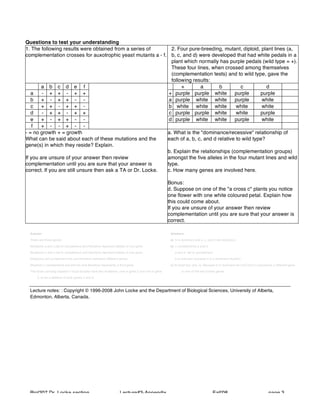
1. The following results were obtained from a series of
complementation crosses for auxotrophic yeast mutants a - f.
2. Four pure-breeding, mutant, diploid, plant lines (a,
b, c, and d) were developed that had white pedals in a
plant which normally has purple pedals (wild type = +).
These four lines, when crossed among themselves
(complementation tests) and to wild type, gave the
following results:
a b c d e f + a b c d
a - + + - + + + purple purple white purple purple
b + - + + - - a purple white white purple white
c + + - + + - b white white white white white
d - + + - + + c purple purple white white purple
e + - + + - - d purple white white purple white
f + - - + - -
- = no growth + = growth
What can be said about each of these mutations and the
gene(s) in which they reside? Explain.
If you are unsure of your answer then review
complementation until you are sure that your answer is
correct. If you are still unsure then ask a TA or Dr. Locke.
a. What is the "dominance/recessive" relationship of
each of a, b, c, and d relative to wild type?
b. Explain the relationships (complementation groups)
amongst the five alleles in the four mutant lines and wild
type.
c. How many genes are involved here.
Bonus:
d. Suppose on one of the "a cross c" plants you notice
one flower with one white coloured petal. Explain how
this could come about.
If you are unsure of your answer then review
complementation until you are sure that your answer is
correct.
Answer:
There are three genes:
Mutations a and d fail to complement and therefore represent alleles of one gene.
Mutations b and e fail to complement and therefore represent alleles of one gene.
Mutations a/d complement b/e and therefore represent different genes.
Mutation c complements a/d and b/e and therefore represents a third gene.
The strain carrying mutation f must actually have two mutations, one in gene 2 and one in gene
3, or be a deletion of both genes 2 and 3.
Answers:
a) b is dominant and a, c, and d are recessive.
b) c complements a and d
a and d fail to complement
b is unknown because it is a dominant mutation
c) At least two (a/d, c). Because b is dominant we can't tell if it represents a different gene
or one of the two known genes.
Lecture notes: : Copyright © 1996-2008 John Locke and the Department of Biological Sciences, University of Alberta,
Edmonton, Alberta, Canada.

Complementation

  • 1.
    Biol207 Dr. Lockesection Lecture#3-Appendix Fall'08 page 1 BIOLOGY 207 - Dr.Locke Complementation Help Complementation is a fundamental principle in genetics and its understanding is needed to appreciate many aspects of genetics. Definitions: (Modified from "A Dictionary of Genetics" 4th Edition by RC King & WD Stansfield, 1990.) Complementation - the appearance of a wild type phenotype in an organism or cell containing two different mutations combined in a hybrid diploid. Non-complementation - the appearance of a mutant phenotype in an organism or cell containing two different mutations combined in a hybrid diploid. Also called "lack of complementation" or "no complementation". Mutant and gene nomenlature: Prior to a complementation test we will be unsure of the relationship between the two mutations (allelic or non-allelic) so the nomenclature we use needs to be ambiguous. Here "m1" and "m2" are used and not "a" and "b" or a 1 and a 2 . Only after a complementation test results are known can we use typical genetic nomenclature that defines the mutations as allelic (m1/m2) or non- allelic (m1 + / + m2). Complementation test - the introduction of two mutant chromosomes into the same cell to see if the mutations in question (e.g. "m1" and "m2") occurred in the same gene (allelic) or in different genes (non-allelic). If the mutations are allelic then a mutant phenotype will result and the genotype of the hybrid may be symbolized as m1/m2 . If the mutations are non-allelic then the phenotype will be wild type and the genotype of the hybrid may be symbolized as m1 + / + m2 or m1/+ ; +/m2. The wild type phenotype will be expressed, since each chromosome "makes up for" or "complements" the defect in the other. Complementation test: In Haploid species (e.g. yeast) Introduction: You begin with two (or more) independently derived mutations in strains of haploid yeast that have similar mutant phenotypes. In this example we will call the two strains "m1" and "m2", for mutation#1 and mutation#2. The mutant phenotype could be colony colour, auxotrophy of the same compound, or any other character that distinguishes it from wild type. The question to be answered in a complementation test is: Are these two (or more) strains mutant in the same gene or are they mutant in different genes? That is, are m1 and m2 allelic or non-allelic mutations? In Diploid species (e.g. Drosophila, humans, plants, etc.) Introduction: You begin with two (or more) independently derived mutations in strains of diploid speices that have similar mutant phenotypes. In this example we will call the two strains "m1" and "m2", for mutation#1 and mutation#2. The phenotype could be body colour or any other character that distinguishes it from wild type. The question to be answered in a complementation test is: Are these two (or more) strains mutant in the same gene or are they mutant in different genes? That is, are m1 and m2 allelic or non-allelic mutations? TEST: To "cross" yeast strains we need differing mating types, a and α (alpha), which are similar to males and female in diploid species. The cross is done by putting the two strains, with the different mutations (and different mating types) together on a petri dish containing mating medium. When mating occurs the two haploid cells fuse to form one diploid cell. This diploid cell contains both mutations. We can now propagate this diploid cell to make a diploid cell strain that we can test or examine for its phenotype - mutant or wild type? One of two outcomes is possible from a cross of TEST: We "cross" males of one strain (one mutation) with female of another strain (a different mutation. The resulting progeny are tested or examined for their phenotype - mutant or wild type? One of two outcomes is possible from a cross of
  • 2.
    Biol207 Dr. Lockesection Lecture#3-Appendix Fall'08 page 2 Strain#1 (x) Strain#2 Strain#1 (x) Strain#2 Both are mutant in the same gene. Allelic mutations Mutations are in different genes. Non-allelic mutations Both are mutant in the same gene. Allelic mutations Mutations are in different genes. Non-allelic mutations Strain#1 (x) Strain#2 m1 (x) m2 Fuse cells to make diploid: m1 / m2 or m -1 / m -2 The phenotype is: MUTANT! Strain#1 (x) Strain#2 m1 + (x) + m2 Fuse cells to make diploid: m1 + /+ m2 or m1 - m2 + / m1 + m2 - The phenotype is: WILD TYPE! Strain#1 (x) Strain#2 m1/m1 (x) m2/m2 Each diploid parent produces haploid gametes: m1 and m2 These fuse to make Diploid progeny: m1 / m2 or m -1 / m -2 The phenotype is: MUTANT! Strain#1 (x) Strain#2 m1 +/m1 + (x) + m2/+ m2 Each diploid parent produces haploid gametes: m1 + and + m2 These fuse to make Diploid progeny: m1 + /+ m2 or m1 - m2 + / m1 + m2 - The phenotype is: WILD TYPE! Defect in one strain is NOT complemented by the other. Defect in one strain is complemented by the other. Defect in one strain is NOT complemented by the other. Defect in one strain is complemented by the other. They are two mutant alleles in the same gene locus. NON- complementation! They are mutants in two different gene loci, one in m1 the other in m2. Complementation! They are two mutant alleles in the same gene locus. NON- complementation! They are mutants in two different gene loci, one in m1 the other in m2. Complementation! Conclusion: The outcome of the complementation test (wild type or mutant) permits you to determine which of these two possibilities is the case (allelic vs. non-allelic mutations) . If the two mutations were allelic then you might change the mutants' symbol to reflect that. For example they might become m 1 and m 2 , with the superscripts designating different mutant alleles. If the two mutations were non-allelic then you might change the mutants' symbols as well. For example if the mutations were auxotrophic for arginine then you might call them the arg1 locus and the arg2 locus, with the mutant alleles designated as a "minus" symbol : arg1 - and arg2 - . Make sure you understand the symbols' use and meaning here. Conclusion: The outcome of the complementation test (wild type or mutant) permits you to determine which of these two possibilities is the case (allelic vs. non-allelic mutations) . If the two mutations were allelic then you might change the mutants' symbol to reflect that. For example they might become m 1 and m 2 , with the superscripts designating different mutant alleles. If the two mutations were non-allelic then you might change the mutants' symbols as well. For example if the mutations were auxotrophic for arginine then you might call them the arg1 locus and the arg2 locus, with the mutant alleles designated as a "minus" symbol : arg1 - and arg2 - . Make sure you understand the symbols' use and meaning here. Note: Since the initial mutant cells used here are haploid there is no "dominance or recessiveness". Only two strains can be tested at once but through a series of tests the relationship among a series of strains can be determined. Independently derived mutant strains are those that are originally mutated at a different time or place and so could not be due to the same mutational event. They are different mutants but we need to find out if they are mutant in the same or different genes. Note: Only recessive mutations can be tested for complementation since dominant mutations would show a mutant phenotype in all the progeny with the dominant mutant allele, independent of whether or not there is one or two genes involved. Only two strains can be tested at once but through a series of tests the relationship among a series of strains can be determined. Independently derived mutant strains are those that are originally mutated at a different time or place and so could not be due to the same mutational event.
  • 3.
    Biol207 Dr. Lockesection Lecture#3-Appendix Fall'08 page 3 Questions to test your understanding 1. The following results were obtained from a series of complementation crosses for auxotrophic yeast mutants a - f. 2. Four pure-breeding, mutant, diploid, plant lines (a, b, c, and d) were developed that had white pedals in a plant which normally has purple pedals (wild type = +). These four lines, when crossed among themselves (complementation tests) and to wild type, gave the following results: a b c d e f + a b c d a - + + - + + + purple purple white purple purple b + - + + - - a purple white white purple white c + + - + + - b white white white white white d - + + - + + c purple purple white white purple e + - + + - - d purple white white purple white f + - - + - - - = no growth + = growth What can be said about each of these mutations and the gene(s) in which they reside? Explain. If you are unsure of your answer then review complementation until you are sure that your answer is correct. If you are still unsure then ask a TA or Dr. Locke. a. What is the "dominance/recessive" relationship of each of a, b, c, and d relative to wild type? b. Explain the relationships (complementation groups) amongst the five alleles in the four mutant lines and wild type. c. How many genes are involved here. Bonus: d. Suppose on one of the "a cross c" plants you notice one flower with one white coloured petal. Explain how this could come about. If you are unsure of your answer then review complementation until you are sure that your answer is correct. Answer: There are three genes: Mutations a and d fail to complement and therefore represent alleles of one gene. Mutations b and e fail to complement and therefore represent alleles of one gene. Mutations a/d complement b/e and therefore represent different genes. Mutation c complements a/d and b/e and therefore represents a third gene. The strain carrying mutation f must actually have two mutations, one in gene 2 and one in gene 3, or be a deletion of both genes 2 and 3. Answers: a) b is dominant and a, c, and d are recessive. b) c complements a and d a and d fail to complement b is unknown because it is a dominant mutation c) At least two (a/d, c). Because b is dominant we can't tell if it represents a different gene or one of the two known genes. Lecture notes: : Copyright © 1996-2008 John Locke and the Department of Biological Sciences, University of Alberta, Edmonton, Alberta, Canada.