By
KAUSHAL KUMAR SAHU
Assistant Professor (Ad Hoc)
Department of Biotechnology
Govt. Digvijay Autonomous P. G. College
Raj-Nandgaon ( C. G. )
SYNOPSIS
INTRODUCTION
Agrobacterium tumefaciens
Ti plasmid
CLASSIFICATION
T- DNAregion:
Vir region:
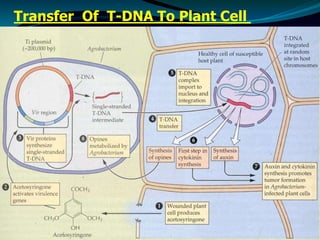
Transfer Of T-DNATo Plant Cell
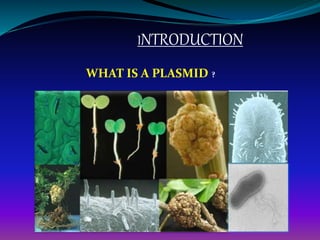
INTRODUCTION
WHAT IS A PLASMID ?
Agrobacterium tumefaciens
1. Soil bacterium closely related to Rhizobium.
2. Causes crown gall disease in plants
Agrobacterium is well
known for its ability to
transfer DNA between
itself and plants.
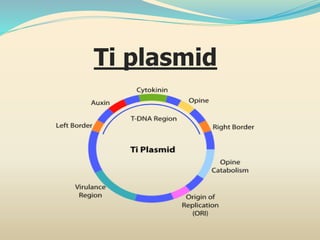
Ti plasmid
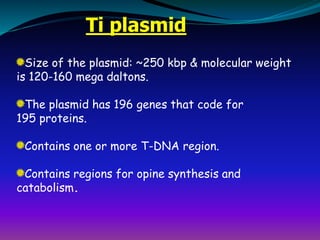
Size of the plasmid: ~250 kbp & molecular weight
is 120-160 mega daltons.
The plasmid has 196 genes that code for
195 proteins.
Contains one or more T-DNA region.
Contains regions for opine synthesis and
catabolism.
Ti plasmid
CLASSIFICATION
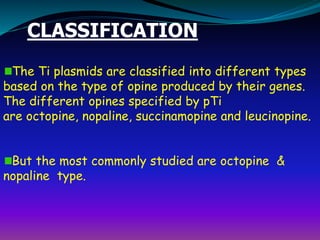
The Ti plasmids are classified into different types
based on the type of opine produced by their genes.
The different opines specified by pTi
are octopine, nopaline, succinamopine and leucinopine.
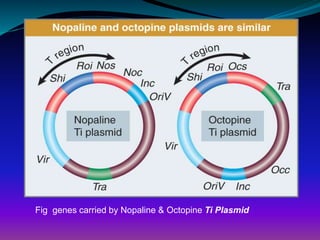
But the most commonly studied are octopine &
nopaline type.
Fig genes carried by Nopaline & Octopine Ti Plasmid
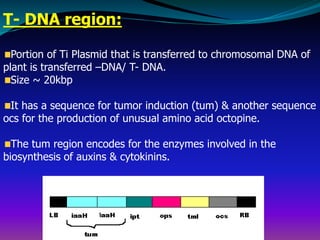
T- DNA region:
Portion of Ti Plasmid that is transferred to chromosomal DNA of
plant is transferred –DNA/ T- DNA.
Size ~ 20kbp
It has a sequence for tumor induction (tum) & another sequence
ocs for the production of unusual amino acid octopine.
The tum region encodes for the enzymes involved in the
biosynthesis of auxins & cytokinins.
Opine Biosynthesis
1 Within tumor tissues, the synthesis of various
unusual amino acid-like compounds are directed
by genes encoded on the integrated plasmid.
The type of opine produced is specified by the
bacterial T-DNA
Opines are used by the bacteria as a carbon
(nutrient) source for growth.
Opine catabolism within bacteria is mediated by
genes encoded on the Ti plasmid.
Vir region:
It is a part of Ti Plasmid which takes part
intransfer and integration of T-DNA into plant
chromosome.
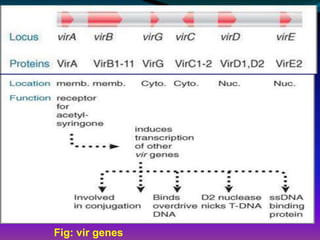
The vir sequence consist of 8 operons which take
part in different functions associated with virulence
of Ti Plasmid. These are vir H, vir A, vir B, vir G, vir
C, vir D, vir E, & vir F. ( vir H & vir F present
occasionally).
Fig: vir genes
Transfer Of T-DNA To Plant Cell
Ti as vectors
Properties
Ti is natural genetic engineers because of the following
properties:
They replicate autonomously without any influence of the
chromosomal DNA.
They carry foreign DNA segments to plant cells during
infection.
They have a segment called T DNA which is integrated into
plant DNA.
They can be transferred from bacterium to bacterium by
conjugation.
Transformed plants can easily be identified by tumourogenic
property of the plasmid.
Limitations:
Wild type Ti plasmids cannot be directly used as vectors because
of the following limitations:
1) Large size
2) Absence of unique restriction enzyme site
3) Opine production in transformed plant lowers the plant yield.
Plant tissue culture Bhojwani & Razdan
Biotechnology U. Satyanarayan
Biotechnology B.D. Singh
www.wikipedia.com

Feature of ti plasmid

  • 1.
    By KAUSHAL KUMAR SAHU AssistantProfessor (Ad Hoc) Department of Biotechnology Govt. Digvijay Autonomous P. G. College Raj-Nandgaon ( C. G. )
  • 2.
    SYNOPSIS INTRODUCTION Agrobacterium tumefaciens Ti plasmid CLASSIFICATION T-DNAregion: Vir region: Transfer Of T-DNATo Plant Cell
  • 3.
  • 4.
    Agrobacterium tumefaciens 1. Soilbacterium closely related to Rhizobium. 2. Causes crown gall disease in plants Agrobacterium is well known for its ability to transfer DNA between itself and plants.
  • 5.
    Ti plasmid Size ofthe plasmid: ~250 kbp & molecular weight is 120-160 mega daltons. The plasmid has 196 genes that code for 195 proteins. Contains one or more T-DNA region. Contains regions for opine synthesis and catabolism.
  • 6.
  • 7.
    CLASSIFICATION The Ti plasmidsare classified into different types based on the type of opine produced by their genes. The different opines specified by pTi are octopine, nopaline, succinamopine and leucinopine. But the most commonly studied are octopine & nopaline type.
  • 8.
    Fig genes carriedby Nopaline & Octopine Ti Plasmid
  • 9.
    T- DNA region: Portionof Ti Plasmid that is transferred to chromosomal DNA of plant is transferred –DNA/ T- DNA. Size ~ 20kbp It has a sequence for tumor induction (tum) & another sequence ocs for the production of unusual amino acid octopine. The tum region encodes for the enzymes involved in the biosynthesis of auxins & cytokinins.
  • 10.
    Opine Biosynthesis 1 Withintumor tissues, the synthesis of various unusual amino acid-like compounds are directed by genes encoded on the integrated plasmid. The type of opine produced is specified by the bacterial T-DNA Opines are used by the bacteria as a carbon (nutrient) source for growth. Opine catabolism within bacteria is mediated by genes encoded on the Ti plasmid.
  • 11.
    Vir region: It isa part of Ti Plasmid which takes part intransfer and integration of T-DNA into plant chromosome. The vir sequence consist of 8 operons which take part in different functions associated with virulence of Ti Plasmid. These are vir H, vir A, vir B, vir G, vir C, vir D, vir E, & vir F. ( vir H & vir F present occasionally).
  • 12.
  • 13.
    Transfer Of T-DNATo Plant Cell
  • 14.
    Ti as vectors Properties Tiis natural genetic engineers because of the following properties: They replicate autonomously without any influence of the chromosomal DNA. They carry foreign DNA segments to plant cells during infection. They have a segment called T DNA which is integrated into plant DNA. They can be transferred from bacterium to bacterium by conjugation. Transformed plants can easily be identified by tumourogenic property of the plasmid.
  • 15.
    Limitations: Wild type Tiplasmids cannot be directly used as vectors because of the following limitations: 1) Large size 2) Absence of unique restriction enzyme site 3) Opine production in transformed plant lowers the plant yield.
  • 16.
    Plant tissue cultureBhojwani & Razdan Biotechnology U. Satyanarayan Biotechnology B.D. Singh www.wikipedia.com